Direct or representative democracy?
A phenomenon such as the concept of direct democracy cannot be overlooked by "Logic of Progress". If this principle is viable, then the political demands of social democrats must be restructured to accommodate it; if it is unfeasible, then the specific reasons why must be brought to everyone's attention.
It is sometimes assumed that direct democracy is a more democratic, more “left-wing” system than representative democracy. Representative democracy does indeed have its drawbacks — for example, the fact that decisions are made by people through an intermediary who may be unreliable. The difficulty of recalling an elected deputy is also among these downsides (however, in our article on the imperative mandate, we noted that this is implemented and works quite well in some representative democracies). In short, there are many flaws, but they are not critical, and the efficiency of representative democracy can be improved — for instance, by ensuring the rotation of power or through decentralization. Direct democracy also has its disadvantages, but in this case, they are more critical and difficult to reform.
Dr. Yanina Welp, a doctor of political and social sciences and director of the department at the center for research on direct democracy at the University of Zurich, notes that in 2016, following referendums such as “Brexit”, in which the British voted to leave the European Union, or the Colombian referendum, where voters by a small majority rejected a carefully prepared peace agreement between the government and the Revolutionary Armed Forces of Colombia (FARC), discussions regarding direct forms of democracy were renewed1. Welp herself, in her article on the mechanisms of direct democracy, concludes that representatives of the authorities are the key figures in obtaining the results of such referendums2. Is it possible that direct democracy carries the danger that decisions will be made even more by elites rather than the people?
Contents
What is direct democracy
According to the Britannica encyclopedia, direct democracy consists of “forms of direct participation of citizens in democratic decision making, in contrast to indirect or representative democracy”3. The content of this term is revealed in more detail on the Oxford Constitutional Law website: “direct democracy is a form of democracy in which the people express their political will without any intermediate elective body”4. At the same time, the author of the article, Professor Anna Gamper, notes that in most cases, representative and direct democracies are not separated from each other, but rather constitute a combined model: for example, when a citizens’ initiative is presented to parliament or when the fate of a parliamentary bill must be decided by a referendum. Accordingly, what we will consider in this article is not a representative or a mixed model, but specifically direct democracy — that is, the expression of the people’s political will directly, bypassing any intermediate elective body.
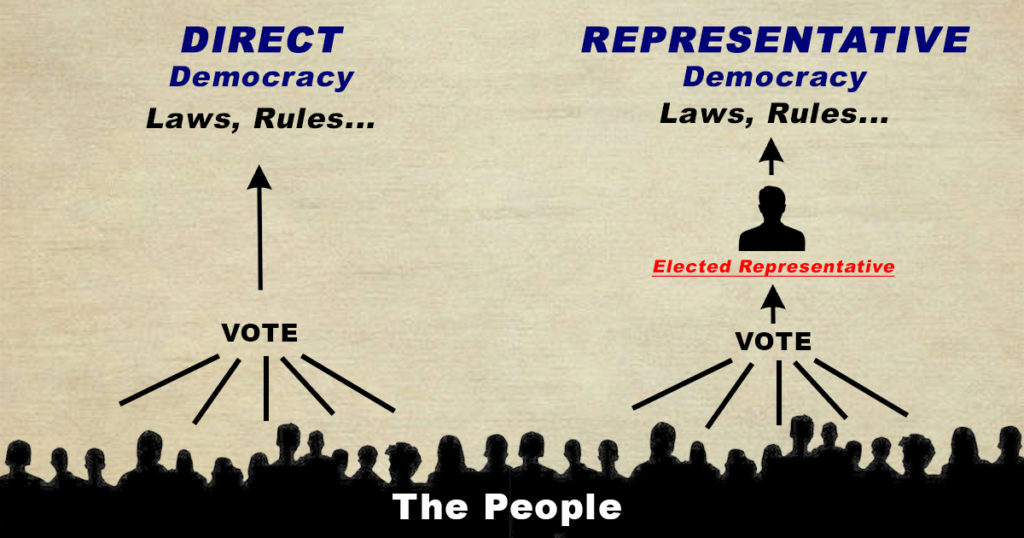
A common mistake is attempting to prove the effectiveness of direct democracy using Switzerland as an example. However, Switzerland has a parliament at both the federal and regional levels (we wrote more about its structure here). Thus, Switzerland is not an example of direct democracy. It is an example of a parliamentary democracy with extensive use of elements of direct democracy.
Vulnerability to populism
Direct democracy is unlikely to be feasible instantaneously. The immediate introduction of a direct democracy system in a country like today’s Russia (i.e., with a predominance of conservative ideology) carries the risk of it being seized by populists, including local nationalists and separatists. Perhaps, following the immediate introduction of direct democracy, the country would collapse into many fragments governed by conservatives. Viktor Rudenko, Doctor of Law and Candidate of Philosophical Sciences, emphasizes not only that populism (we have already written a separate article on the dangers of populism) is a huge problem in the context of direct democracy, but also that direct democracy itself can be used for the purposes of dictatorship — meaning it is not a panacea in itself:
In the conditions of authoritarian and totalitarian regimes, institutions of direct democracy often become a tool for giving an aura of nationwide support to the decisions of authoritarian leadership. In legal literature, the so-called “referendums”, or more precisely, Bonapartist plebiscites held by Napoleon I and Napoleon III to strengthen their personal power regimes, have long become classic examples. Attention has also been repeatedly drawn to the populist nature of the referendums held in Germany by Hitler regarding the withdrawal from the League of Nations in 1933, as well as the issue of the annexation of Austria in 1938. Similar types of referendums include the so-called “survey-referendums” of the Soviet state (see the chapter dedicated to the institution of the referendum). In modern society, there are also examples where authoritarian leadership attempts to find support in the institution of general assemblies of citizens. Thus, according to the vision of the Libyan leader M. Gaddafi, the system of people’s congresses in the Libyan Jamahiriya was supposed to become the embodiment of direct rule by the people5.
The system of direct democracy is extremely vulnerable to populist politicians. This means that if, for instance, a country experiences a low level of press freedom, direct democracy can be manipulated and, as a result, fail to express the interests of society.
Decisions will be made by an incompetent minority, not the majority
Arndt Leininger, a research fellow at the Otto Suhr Institute of Political Science at the Free University of Berlin, warns:
Firstly, direct expression of the population’s will on a large number of specific issues is impossible from a purely practical standpoint. The fact is that such votes require significant effort from the population, and when, for example, referendums are held in Berlin on specific issues — such as the introduction of religious education as an elective subject in schools or the return of power grids to municipal ownership — turnout for these referendums is much lower than in elections. And if the number of referendums were to increase significantly, only a small part of the population would take part in them6.
Simply put, the majority of citizens will not participate in deciding all administrative issues because it is time-consuming, and they want to spend their time on something else. Therefore, the vast majority of issues will be decided not by the majority, but by a minority. The difference is that this will be an unprofessional and unaccountable minority, unlike in a representative democracy. Mikhail Grachev, Doctor of Political Sciences, and Alexander Madatov, Associate Professor at the RSUH, agree with this:
Direct democracy has its negative sides. Its main vulnerability stems from the fact that all citizens cannot decide all issues at once. Many of them do not have sufficient time, interest, information, or competence for this. Furthermore, during direct debates on a particular issue, it is much harder to reach a consensus between the majority and the minority than within an elected representative body7.
Under such conditions, a clever political force seeking to seize power or use it for selfish ends can organize the submission of its preferred initiatives to a vote and secure the necessary votes through bribery. For instance, if a large corporation builds a factory near a lake and citizens vote against it — an active minority might speak out almost entirely against it; however, when there is a passive majority, it might sell its votes (since it is not interested in the decision-making anyway), and then the corporation would naturally win.
Since the people cannot decide all issues, they also cannot control the agenda:
A significant weakness of the institutions of direct democracy is the lack of citizens’ ability to effectively control the agenda. Since all institutions of direct democracy are periodic in nature, issues brought before the citizens can be artificially introduced into the agenda by interest groups to whose pressure citizens are extremely susceptible. Meanwhile, control over the agenda, as R. Dahl showed, is one of the primary indicators of democracy8.
This is a crucial point — who will decide which questions are put to a general vote and which are not. Under direct democracy, it is easy to create a precedent where a group of citizens constantly submits foolish proposals for public discussion, leading to them being stripped of this opportunity (perhaps by setting requirements for those who submit proposals); as a result, decision-making is no longer universal, and consequently, it becomes elitist. Yanina Welp argues that there is a trend in which most referendums are initiated by the authorities rather than coming “from below”9. Arndt Leininger continues:
Secondly, there is a view that better-quality decisions are made in parliament because deputies deal professionally with the issues on which they vote10.
In many ways, this is true. If in our proposed system of professional councils “political officers” are replaced by actual professionals in their field, then direct democracy involves the raising of issues and decision-making by non-professionals. Under direct democracy, initiatives that are objectively unfeasible may be put to a general vote. Leininger cites examples of Greece, when a referendum was held on the issue of financial support from the EU, or the vote on the fate of Tegel Airport in Berlin. The government was fundamentally unable to fulfill the demands made in these referendums.
Another difficulty is that under direct democracy, it is challenging to adopt unpopular measures, even if they are necessary for the development of society. No one will vote for them, and populist, unprofessional decisions will be made, which will ultimately have a negative impact on social development.
The factor of delegation and the division of labor
The logic of direct democracy supporters is often based on the idea that the representative to whom management is delegated may not live up to expectations, and therefore citizens must manage all political processes themselves. But by this logic, one shouldn’t delegate dental treatment to a dentist either, but rather treat one’s teeth oneself (since the dentist might do a poor job). It would follow that a person cannot delegate car production to others and must build their own car by hand, and so on. However, this would be extremely irrational and even absurd. You don’t go to university for 7–8 years to become a dentist just to be able to treat your own teeth and ensure maximum control over the process. You can delegate this matter.
That is why people delegate the resolution of most issues. This is the reason why the division of labor arose, and societies based on it developed into modern societies. Spending a huge amount of one’s precious time on solving issues that can be delegated is simply inefficient.
Yes, a representative often does not perform their job perfectly, or may even handle it abysmally. However, this does not mean that you have to do everything yourself; it means you need to choose another professional and ensure the possibility of such a choice. You cannot understand each of the many issues better than even a mid-level professional. You simply won’t have the time. The real issue is the ability to choose and change both your dentist and your politician. Yes, both dentists and politicians can sometimes be terrible. But if you can choose another one, the chance of getting a result that satisfies you is much higher than if you were to treat your own teeth or vote on every single issue. And it will be many times faster than learning the skills that would allow you to achieve a high-quality result yourself.
Representative democracy as the natural evolution of direct democracy
Political scientist Alexander Kustarev notes that the formation of representative democracy is a natural development of direct democracy:
Representative democracy… in the process of dismantling the Old Regime, did not simply displace direct democracy as more competitive, but proved to be its further development. In other words, representative democracy is nothing other than routinized direct democracy. One could also put it this way: direct democracy is the embryo that subsequently developed into “adult” representative democracy. Or this way: direct democracy was a problem, and representative democracy turned out to be its solution11.
One of the factors that made representative democracy more competitive was the issue of responsibility for decisions (which the masses, as a rule, do not want to take upon themselves):
The making of public-authority decisions requires not only a clear understanding of any of the tasks at hand, decisiveness, and political will, but most importantly, the specific personal responsibility of the individual making the decision. The absence of personal responsibility when public-authority decisions are made by citizens can deprive these decisions of positive content. It is no coincidence that C. Schmitt emphasized that mass movements exhibit the least capacity to adopt and implement a political decision with full responsibility12.
Infringement on minority interests
Mikhail Grachev and Alexander Madatov reveal another crucial problem of direct democracy (in this case, its evolution — participatory democracy) — the potential tyranny of the majority:
Another drawback of the theory of participatory democracy is that, by effectively absolutizing the idea of a common interest, it harbors the threat of the tyranny of the majority. Indeed, in the practical implementation of many provisions of direct democracy theory, the problems of individual autonomy, freedom of individuality, and the issues of voluntary participation or non-participation in the political process remain open13.
Indeed, direct democracy always carries the danger of adopting, for example, laws against dissent or laws controlling a person’s sexual life. Here is a video about the problems of “pure” democracy:
It is possible that certain authoritarian forces may promote the ideas of direct democracy with the aim of creating “controlled chaos” in order to dominate that chaos by right of might. After all, the dismantling of institutions such as parliament will ultimately benefit those forces that possess sufficient resources to establish control over society and do not need such a serious rival on that path as a parliament.
Summary
All the aforementioned shortcomings of direct democracy compel us to conclude that today the most reasonable approach is to reform the system of representative democracy (possibly partially combined with elements of direct democracy) in the form of parliamentary democracy, the expansion of democratic institutions, rotation of power, and so on.
- Yanina Welp. Development of Direct Democracy: What do the People Decide? // Russian Political Science, № 1, 2017. – p. 132.
- Ibid, p. 139.
- Theo Schiller. Direct democracy // Encyclopaedia Britannica (www.britannica.com). [Electronic resource]. URL: https://www.britannica.com/topic/direct-democracy (accessed: 22.05.2020).
- Anna Gamper. Direct Democracy // Oxford Constitutional Law (oxcon.ouplaw.com). [Electronic resource]. URL: https://oxcon.ouplaw.com/view/10.1093/law-mpeccol/law-mpeccol-e242 (accessed: 22.05.2020).
- V.N. Rudenko. Direct democracy: models of government, constitutional and legal institutions. – 476 p. – Yekaterinburg: UrO RAN, 2003. – pp. 120-121.
- Why aren’t referendums more democratic than parliaments? // Quorum Initiative (www.initiative-quorum.org). [Electronic resource]. URL: https://www.initiative-quorum.org/ru/details/warum-sind-volksentscheide-nicht-demokratischer-als-parlamente-2286.html (accessed: 22.05.2020).
- M.N. Grachev, A.S. Madatov. Democracy: Research Methodology, Analysis of Prospects: Monograph. – 128 p. – Moscow: “ALKIGAMMA” Publishing House, 2004
- V.N. Rudenko. Direct democracy: models of government, constitutional-legal institutions. – 476 p. – Yekaterinburg: Ural Branch of the RAS, 2003. – p. 117.
- Yanina Welp. Development of Direct Democracy: What do the People Decide? // Russian Political Science, № 1, 2017. – p. 136.
- Why aren’t referendums more democratic than parliaments? // Quorum Initiative (www.initiative-quorum.org). [Electronic resource]. URL: https://www.initiative-quorum.org/ru/details/warum-sind-volksentscheide-nicht-demokratischer-als-parlamente-2286.html (accessed: 22.05.2020).
- Alexander Kustarev. After Representative Democracy // Open University (openuni.io). Neprikosnovenny Zapas. 2011. № 3. [Electronic resource]. URL: https://openuni.io/course/11-course-7-4/lesson/8/material/882/ (accessed: 22.05.2020).
- V.N. Rudenko. Direct democracy: models of government, constitutional-legal institutions. – 476 p. – Yekaterinburg: Ural Branch of the RAS, 2003. – p. 116.
- M.N. Grachev, A.S. Madatov. Democracy: Research Methodology, Analysis of Prospects: Monograph. – 128 p. – Moscow: “ALKIGAMMA” Publishing House, 2004
