Propagandist Yuri Zhukov
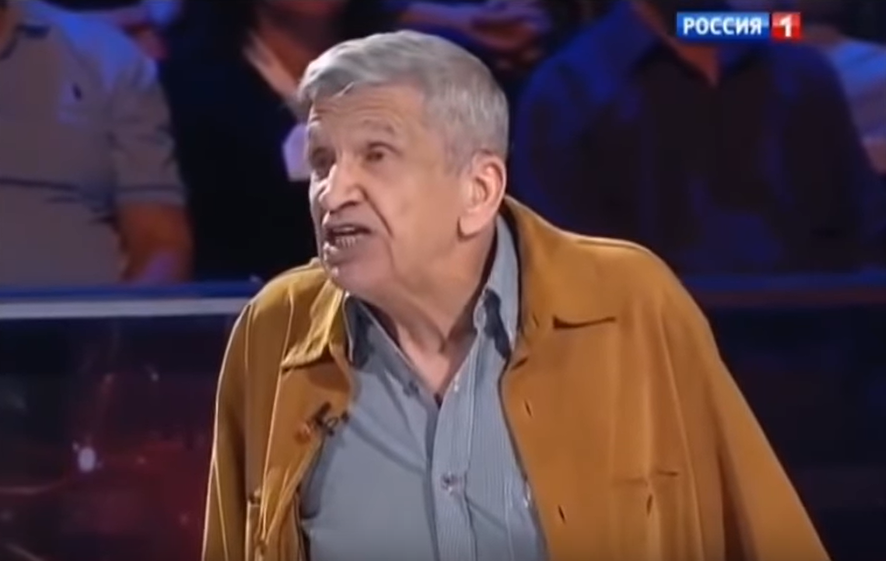
In 2019, one of the “trends” among Stalinists was referencing Yuri Zhukov, whom they present as a serious and respected historian. Is he really such a figure? In this article, we examine this question using quotations from his works.
If Elena Prudnikova, Yuri Mukhin, and many other publicists who defend Stalin simply invent facts, as we demonstrate with concrete examples in the relevant articles, then the most “high-profile” Stalinists try not to resort to outright lies like the aforementioned figures. Their work is far more subtle, which is why people in positions of power who lobby for Stalinism entrust them with much larger print runs, more airtime, and more favorable working conditions. Such “elite” Stalinists are represented primarily by Nikolai Starikov and Doctor of Historical Sciences Yuri Zhukov.
Stalinists present Yuri Zhukov as an “archival historian”, supposedly distinguished by the fact that he substantiates every word with sources. But what kind of sources are these that he relies on? Let us read the book “Another Stalin”:
The content of the decision undoubtedly indicates that it emerged as a reaction to the initiative memorandum by R. I. Eikhe that is obligatory in such cases. A memorandum that has not been found to this day, but whose content can be reconstructed with a high degree of reliability1.
That is, the entire theory he sets out in the book is built by this “archival historian” on a memorandum that “has not been found” (his words: “The initiative memorandum of R. I. Eikhe turned out to be the pebble that triggered a terrible mountain avalanche”2, where Zhukov is referring to the repressions of 1937–1938), and whose content he himself has invented. This example quite vividly illustrates the level of evidentiary basis among Stalinists.
Examples of outright lies
When Yuri Zhukov wrote “The Stalinist’s Handbook”, he had not yet fully assumed the role of an “archival historian”, so this work is more akin to propaganda of the same level as the books of Yuri Mukhin. Therefore, we find outright lies there very quickly. Thus, in this book Yuri Zhukov states:
Revolutionaries knew how to speak at rallies and wave a “Mauser”, but they lacked one thing: education. Yet it was necessary to revive industry, create new enterprises, and manage the economy3.
We have analyzed this myth in a separate article: be sure to read the text via the link to verify that Yuri Zhukov is directly lying when he claims that revolutionaries supposedly lacked education. He accuses the Bolsheviks (who, despite a strategic failure, achieved significant economic successes) of being incapable of managing the economy and writes: “Stalin understood: you cannot simply remove all of them for the collapse of their work”4. This is despite the fact that we have far more grounds to accuse Stalin himself of being unable to build a normal, viable economy.
Zhukov also had the following conversation with Lenta.ru special correspondent Mikhail Karpov. Karpov asks, Yuri Zhukov answers:
– So who, in your view, pays those candidates and doctors of historical sciences who publish works…
– Oh! Excuse me! There is no such thing. The Doctor of Historical Sciences who writes [about Stalin] is me. There are no candidates. There is one more Doctor of Sciences, Oleg Khlevniuk5.
Here Zhukov is also lying, since several names immediately come to mind — first of all, Doctor of Historical Sciences Alexander Shubin, Doctor of Historical Sciences Boris Ilizarov, and even the interviewer immediately recalled Doctor of Historical Sciences Oleg Budnitsky (all of them rather agree with Khlevniuk than with Zhukov), to which Yuri Zhukov immediately responds by dismissing them: they are not historians, and in general they have sold out. One may have different attitudes toward the opinions of these historians, but here we are dealing with a proven fact of falsehood on the part of our “subject”. Therefore, who exactly has “sold out” remains an open question.
Further, Yuri Zhukov asserts, without providing any sources:
In October 1926, the 15th Party Conference took place, at which it was decided to raise workers’ wages. But how? By sharply reducing the number of officials. That is a statesmanlike approach! The funds that had gone to maintaining this “nettle seed”, as Gogol used to say, were redirected to raising workers’ wages. This was the first thing Stalin managed to achieve behind the scenes.
<…>
We must act as they did in 1926: reduce the bureaucracy tenfold, and allocate the difference to pension payments6.
Was the bureaucracy reduced tenfold? Zhukov, as we have already noted, provided no evidence for his claim. But we have other figures. In April 1922, when Stalin was appointed General Secretary of the Central Committee, there were 325 people in Moscow, 2,000 in the provinces, and 8,000 in the districts; in addition, there were 5,000 full-time secretaries of party committees in volosts and large enterprises — a total of 15,325 people in the party apparatus7. In March 1937, at a plenary session of the Central Committee, Stalin was already speaking as follows:
Within our party, if we consider its leading strata, there are about 3,000–4,000 top leaders. This, I would say, is the general staff of our party. Next come 30,000–40,000 middle-level leaders. This is our party officer corps. Then there are about 100,000–150,000 lower-level commanding personnel. This is, so to speak, our party non-commissioned officers8.
As we can see, Yuri Zhukov is lying quite brazenly — Stalin did not reduce the bureaucracy but increased its numbers. Perhaps Zhukov means not a tenfold reduction, but an increase? Let us read what the “archival historian” writes next:
Trotsky, prompted by his right-hand man in the field of economics, Preobrazhensky, believed that industrial development should be carried out at the expense of plundering the peasantry as a whole; Zinoviev and Kamenev believed that one should nevertheless rely on the middle peasant and put pressure on the kulak alone9.
And this is also falsehood on the part of Yuri Zhukov. Let us read Trotsky, “Letter to middle peasants from the People’s Commissar for Military and Naval Affairs”:
Are the middle peasants our enemies or our friends? By their entire position and by their interests, the middle peasant, if his mind is not clouded by kulak lies, must be our friend.
<…>
The Soviet government does not compel and does not intend to compel middle peasants, by means of violence, to adopt the communist method of farming. The task of the Soviet government in this sphere is, first, to demonstrate in practice to the peasants the enormous advantage of collective communist farming over small peasant farming and, second, to assist peasant farming through the dissemination of agronomic knowledge and by providing peasants with the necessary technical resources and means.
<…>
Do not allow dishonest schemers to undermine the Soviet government, for only the power of the proletarians and semi-proletarians of the city and countryside, in close alliance with the middle peasants, will save Soviet Russia and make it an independent and prosperous country10.
Perhaps Trotsky thought this only in 1919? Very well, let us read the “Draft Platform of the Bolshevik-Leninists” of 1927 for the 15th Congress of the All-Union Communist Party (Bolsheviks), which included Trotsky and Preobrazhensky:
The most important social fact indicated by Lenin cannot, as has been said, simply be abolished. But it can be overcome through a correct, planned, and systematic policy of the working class, relying on the rural poor and on an alliance with the middle peasant.
<…>
The task of the party is to ensure that agricultural cooperation truly becomes an объединением of the poor and middle strata of the countryside and serves as an instrument of struggle of these elements against the growing economic power of the kulaks.11
Where is the “plundering of the peasantry as a whole” here? Those who have studied the history of the party and the positions of all sides are simply shocked by Yuri Zhukov’s complete lack of integrity.
“Another Stalin”
In 1937 and 1938, according to his data, 681,692 people were executed. That means a thousand people were killed every day! What necessity was there for this? How does the Doctor of Historical Sciences explain this bloodbath? By Stalin’s desire to build democracy!12
In the book “Another Stalin”, Yuri Zhukov attempts to shift the blame for the mass repressions from Stalin onto the nomenklatura (which he himself created). Here Zhukov, without much sophistication, simply plagiarizes the theory of the American revisionist historian Arch Getty, which he presented in the 1985 book “Origins of the Great Purges”. Among historians in the West, the possibility of Getty’s correctness regarding the idea that the purges of the Great Terror were connected with the potential holding of alternative elections was once considered, but after the opening of Soviet archives in the late 1980s, this theory, like Getty himself, lost its former authority. Russian Stalinists, however, were not troubled by this and decided to adopt it.
We have already mentioned the “initiative memorandum” on which Yuri Zhukov builds the core of his theory. But there are plenty of such examples of manipulation in the book. Thus, Zhukov cites statements by party figures such as Panas Lyubchenko, Fyodor Griadinsky, Nikolai Goloded, and others (who called to “increase vigilance” and “destroy Trotskyists”), after which he arrives at the conclusion:
In short, both these speakers and even those in which Trotskyists and Zinovievites, class enemies, were mentioned merely in one or two ritual phrases, quite consciously and deliberately created an atmosphere of suspicion and distrust, the next stage of which was supposed to become a “witch hunt”13.
However, here Zhukov conceals other facts. These speeches were published in Pravda on November 27, 1936, as Zhukov himself notes, and it is well known that by that time the “witch hunt” was already underway. Zinoviev and Kamenev had been executed back in August, and calls for “vigilance” and the hunting of Trotskyists had already been made in the closed letter of the Central Committee of the All-Union Communist Party (Bolsheviks) “On the terrorist activities of the Trotskyite-Zinovievite counter-revolutionary bloc” dated July 29, 193614. Yuri Zhukov, however, falsely claims that the “witch hunt was supposed to become the next stage”, because without this falsehood it is impossible to draw a direct line between the speeches of party members and the Great Terror, and to shift the blame from Stalin onto party members.
Another example. Yuri Zhukov, fully aware that leading party positions were filled by those recommended “from above” (those who did not vote for the required candidates feared accusations of “double-dealing”, “Trotskyism”, and “sabotage”; incidentally, the mechanics of “elections” in the USSR deserve a separate discussion), feigns surprise that in 1937 no one else was elected:
Despite their approval of Zhdanov’s report at the February-March plenum and the corresponding resolution, the party bureaucracy left everything unchanged, openly ignoring the meaning of the two directive letters of the Central Committee. Neither the unlimited possibility of nominating candidates to leading bodies, nor the complete freedom to criticize all candidates without exception, including members of the Central Committee, nor even secret voting led to the emergence of new people in the bureaus of regional and provincial committees or in the Central Committees of national communist parties15.
Based on the fact that those who were recommended by the “narrow leadership” (Stalin’s group) were in fact elected, it is logical to assume that the nomenklatura demonstrated absolute loyalty to Stalin’s group. Zhukov, however, draws a spectacular and directly opposite conclusion — that local leaders opposed the “narrow leadership”!
Practically all first secretaries retained their leading positions, thereby demonstrating to Moscow, to the narrow leadership, that it was they who were the masters of the situation in their regions and that they had no intention of stepping down voluntarily — even during alternative elections to the Supreme Soviet of the USSR16.
The fact that those recommended from above were the ones elected is not something we invented. Zhukov himself is well aware of this:
In those same days, the broad leadership was replenished with new people who were supposed to be grateful both to Stalin’s group as a whole and personally to Malenkov for their sudden promotion. On May 21, V. M. Putnin was recommended as first secretary to the Mordovian regional committee to replace the removed Prusanov; on June 2, A. S. Shcherbakov was recommended to the East Siberian regional committee. On June 4, P. A. Smirnov, previously head of the political departments of the Baltic Fleet and the North Caucasian, Volga, Belarusian, and Leningrad military districts, was approved as head of the Political Directorate of the Red Army17.
Why has Yuri Zhukov’s theory not gained recognition among professional historians? There are quite a few reasons:
- His argumentation is based on his own speculations, as we have clearly demonstrated above;
- After openly manipulating facts (as we have also shown above), his authority in the academic community declined significantly;
- Yuri Zhukov conceals the existence of closed letters of the Central Committee of the All-Union Communist Party (Bolsheviks) and other documents and statements, which we examined in the article showing that mass repressions were initiated by Joseph Stalin;
- The idea that hundreds of thousands of people were executed because the nomenklatura across the entire country simultaneously “figured out” to write denunciations sounds highly implausible. Where they supposedly knew that those they denounced would be destroyed or removed (rather than acquitted) is of no concern to Zhukov, and he offers no explanation;
- Even if we assume that the events of 1937 occurred because the nomenklatura decided to destroy itself, what does this have to do with the destroyed peasants, scientists, and cultural figures, many of whom we discussed in the article debunking the myth that “under Stalin people were executed for a reason”? Zhukov’s theory does nothing to justify their mass destruction;
- It is equally implausible that Stalin was opposed to the repressions. If he was opposed, why did he not stop them, given that he had the full extent of power and influence to do so? According to Zhukov’s version, does this mean Stalin was such an uninfluential politician that he could not affect even such processes in the country?
- The Stalin Constitution, which party members were supposedly so afraid of, was largely nominal, and Stalin himself and his inner circle did not hesitate to violate it (this topic deserves separate discussion). All high-ranking party members were well aware that Stalin’s words often diverged from his actions, which we will also demonstrate separately;
- The fact remains — fabricated cases followed by executions ceased after Stalin’s death.
One could endlessly provide arguments against Yuri Zhukov’s position and examples of his falsehoods, but even this is more than sufficient. Let us instead consider a few other interesting aspects of the activity of this “archival historian”.
Manipulator
It is likely that most people who have read the work “Another Stalin” noticed that Zhukov is constantly surprised — a fairly substantial portion of the historical events he describes are “unexpected”, “sudden”, “unprecedented”, and so on for him. For example, he writes:
The second surprise of the sluggish plenum was the report by N. I. Yezhov “On the progress of the exchange of party documents”, which was included in the agenda only on the day of its opening as the third item18.
Is it really a surprise for Zhukov that a People’s Commissar delivers a report at a plenum? Of course not. The point is different: since Yuri Zhukov’s theory is very difficult to believe — so much does it contradict reality — the author constantly prepares the reader for the idea that at that time supposedly almost everything contradicted reality and was very unexpected and illogical. Over the course of reading the book, the reader gets used to this idea, and it becomes easier for them to accept Zhukov’s illogical and unrealistic version.
The total number of words with a shade of “childlike surprise” used in Zhukov’s book (counting cognates and words close in meaning, excluding words in quoted fragments) is:
- unexpectedly — 30 times;
- strangely — 26 times;
- unusually — 21 times;
- suddenly — 20 times;
- rarely — 9 times;
- unprecedentedly — 5 times;
- all of a sudden — 4 times;
- mysteriously — 4 times;
- uniquely — 3 times;
- inexplicably — 3 times;
- never before — 2 times;
- uncharacteristically — 2 times.
Two conclusions suggest themselves — either Yuri Zhukov is so incompetent as a historian that most of what happens seems unexpected and strange to him, or he is deliberately manipulating perception.
Interestingly, according to Zhukov’s own words, Joseph Stalin was a schizophrenic. As he himself wrote regarding the collapse of the USSR, “This shocked me. You live in a country, and suddenly you are deprived of that country — only a schizophrenic can take this normally”19. And Joseph Stalin not only treated the “deprivation” of citizens of the Russian Empire as something normal, but also had a hand in it. In reality, Zhukov’s words, of course, constitute primitive propaganda.
However, he readily uses manipulation in other cases as well, for example the classic demagogical technique number 3, “everyone around is lying”:
At the same time, all politicians, regardless of whether they consider themselves Stalinists or anti-Stalinists, unanimously attribute to Stalin, to him alone and only to him, responsibility for everything that happened to the country and within the country. True, Stalinists remind us exclusively of positive aspects, while anti-Stalinists present their version of the past, consisting entirely of shortcomings and mistakes, violence and crimes. All, consciously or unconsciously, turn Stalin into a demiurge, the sole creator of history, its driving force. In short, they engage in myth-making20.
That is, everyone (presumably except himself) is engaged in myth-making. In other words, everyone is a fool and a liar, and only he is intelligent and honest. Or everyone around is bought (here Yuri Zhukov combines demagogical techniques number 3, “everyone around is lying”, and number 6, “you are just paid off”, in a single statement):
And that is why not within the historical community, but generally among so-called political scientists and so-called historians, there are many who smear anyone for hire. Moreover, for them, in general, Stalin is an unknown figure. He does not concern them, and nevertheless, for their thirty pieces of silver, they gladly work on this topic21.
Why does he do this?
In reality, it is Yuri Zhukov who quite willingly earns his money this way. As he himself hinted, Stalinism sells very well, and publishers are eager to print it:
This is what prompted me first to write the book “Another Stalin” for myself; at the same time, I consulted with my wife for a long time, and she told me that it was still too early, that a generation needed to pass so that everything would be completely forgotten. But it was gnawing at me, and I could not help but write it; it did not matter to me whether it would be published or not. Fortunately, the publishing house seized upon it and published it in a colossal print run by today’s standards22.
And he continued to promote this topic further, since it yields such good returns. As he himself says, his wife was concerned: it was necessary “for everything to be completely forgotten”. It turns out that for the “archival historian” to be believed, everyone must forget how things really were — a very scientific approach. As for the rest, the motives of those who defend Joseph Stalin were discussed in the article on Stalinism, and they are, of course, equally applicable to Yuri Zhukov.
- Yu. N. Zhukov. Another Stalin. – 512 p. – Moscow: VAGRIUS, 2005. – p. 433.
- Ibid., p. 434.
- Yu. N. Zhukov. The Stalinist’s Handbook – 320 p. – Moscow: Eksmo, 2010. – p. 292.
- Ibid., p. 293.
- Mikhail Karpov. “Should they be shot, the dead?”. Stalin was forced to kill, while he only wanted to drink wine // Lenta.ru (lenta.ru). December 18, 2017, 00:01. [Electronic resource]. URL: https://lenta.ru/articles/2017/12/18/stalina_na_nas_net/ (access date: 14.12.2019).
- Yu. N. Zhukov. The Stalinist’s Handbook – 320 p. – Moscow: Eksmo, 2010. – p. 304, 316.
- The CPSU in resolutions and decisions of congresses, conferences, and plenums of the Central Committee. Volume two (1917–1922) // Under the general editorship of A. G. Egorov and K. M. Bogolyubov. – 605 p. – Moscow: Politizdat, 1983. – p. 596.
- On the shortcomings of party work and measures to eliminate Trotskyist and other double-dealers. Report by Comrade Stalin at the Plenum of the Central Committee of the All-Union Communist Party (Bolsheviks), March 3, 1937 // RGASPI, f. 558, op. 11, d. 1084, ll. 35-55. Original with corrections by I. V. Stalin.
- Yu. N. Zhukov. The Stalinist’s Handbook – 320 p. – Moscow: Eksmo, 2010. – p. 303.
- L. Trotsky. Works. Volume XVII. The Soviet Republic and the Capitalist World. Part II. The Civil War – 662 p. – Moscow-Leningrad: State Publishing House, 1926. – p. 529-532.
- Draft Platform of the Bolshevik-Leninists (Opposition) for the 15th Congress of the All-Union Communist Party (Bolsheviks) (The crisis of the party and ways to overcome it) // The Communist Opposition in the USSR. 1923-1927 (from the archive of Leon Trotsky in four volumes). Vol. 4 (1927, July-December) / comp. Y. Felshtinsky. — 280 p. — Chalidze Publications, 1988. — p. 113, p. 130.
- Lev Kolodny. Three arrests of the elder brother and “Two Captains” of the younger // Moskovsky Komsomolets (www.mk.ru). Published in the newspaper “Moskovsky Komsomolets” No. 26076, October 25, 2012. [Electronic resource]. URL: https://www.mk.ru/moscow/2012/10/24/765643-tri-aresta-starshego-brata.html (access date: 14.12.2019).
- Yu. N. Zhukov. Another Stalin. – 512 p. – Moscow: VAGRIUS, 2005. – p. 297.
- Closed letter of the Central Committee of the All-Union Communist Party (Bolsheviks) on the terrorist activities of the Trotskyite-Zinovievite counter-revolutionary bloc. July 29, 1936 // RGASPI F.17, Op.171, D.230 L. 72-78ob.
- Yu. N. Zhukov. Another Stalin. – 512 p. – Moscow: VAGRIUS, 2005. – p. 416.
- Ibid.
- Ibid., p. 418.
- Ibid., p. 214.
- Yu. N. Zhukov. The Stalinist’s Handbook – 320 p. – Moscow: Eksmo, 2010. – p. 300.
- Yu. N. Zhukov. Another Stalin. – 512 p. – Moscow: VAGRIUS, 2005. – p. 5-6.
- Mikhail Karpov. “Should they be shot, the dead?”. Stalin was forced to kill, while he only wanted to drink wine // Lenta.ru (lenta.ru). December 18, 2017, 00:01. [Electronic resource]. URL: https://lenta.ru/articles/2017/12/18/stalina_na_nas_net/ (access date: 14.12.2019).
- Yu. N. Zhukov. The Stalinist’s Handbook – 320 p. – Moscow: Eksmo, 2010. – p. 302.