Symbols of social democracy
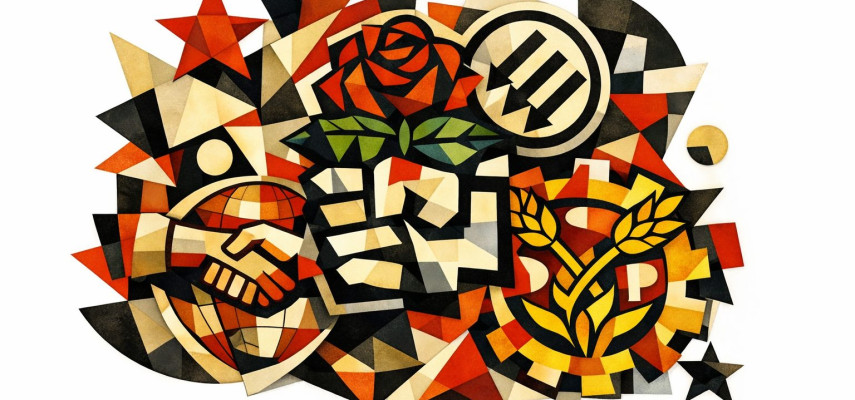
An integral part of the identity of a political ideology is its symbolism. At times, a single symbol can express a vast palette of ideas and demands. A hammer and sickle or a swastika drawn on a wall, for example, communicate quite specific ideas, demands, and threats. But democratic movements have symbols too, including social democracy. Yuman Kalugin attempts to list these symbols. New political parties and organizations associated with social democracy can rely on the traditional ideas listed in our article when developing their symbolism.
Social democracy as a political ideology has existed since the mid-19th century, and over this long period it has acquired many symbols that reflect its ideas and foundations. This material is written to explain which symbols were and are present in the social democratic movement, why those particular symbols were used, and how they became an important part of social democracy as a political ideology.
Contents
Red colour
In many ways, it became the foundation for all the symbolism. The colour red is used both in the logos of social democratic parties and on their campaign materials and flags.

But why specifically the colour red? The beginning of the use of the colour red, especially in the form of the red flag in its revolutionary sense, is considered to be the end of the 19th century. Here, events that took place in France played a major role, as the modern history of the red flag as a class (and broadly left-wing) symbol began during the French Revolution1.

On October 21, 1789, a law on martial law (or state of siege) was promulgated in Paris. It was introduced in case of a “threat to public tranquility”, and its signal was a red flag displayed in the main window of the city hall and in the streets. In suppressing disturbances, the National Guard was used, with a red flag being carried ahead of the guardsmen as a warning sign. After the lifting of martial law, as sources attest, the red flag in the city hall window was replaced by a regular white one. Thus, both flags served as symbols of the exact same authority: “peaceful” or employing force2.
On July 17, 1791, opponents of the monarchy gathered at the Champ de Mars demanding the abdication of the king, who had fled Paris. The Mayor of Paris, Jean Sylvain Bailly, ordered the red flag to be displayed as a signal of martial law; during the dispersion of the crowd, several dozen republicans were killed.

On August 10, 1792, republicans stormed the Tuileries Palace; on the same day, the king was deposed. According to a widespread view, “the red banner floated here and there over the revolutionary columns”3, meaning it became a symbol of revolution for the first time. However, as Maurice Dommanget demonstrated in his monograph on the history of the red flag4, this notion is false.
The only true aspect is that on the eve of the uprising, it was proposed in the Cordeliers Club to prepare red flags inscribed: “Martial law of the sovereign people against executive authority” — as a response to the flag that became the signal for the shooting on the Champ de Mars. This idea was claimed by the radical Pierre Chaumette, as well as the Girondin Jean-Louis Carra (their notes, from which we know about these flags, reached print only decades later). Such flags were made, but were not used (presumably due to the stance of the uprising’s leadership); the storming of the Tuileries took place under tricolour flags5.

There were, of course, rare cases of using specifically the red banner: for instance, in late December 1792, a unit raised in Brussels from local sans-culottes was assigned a red military banner. Lines from the “Marseillaise” were placed on both of its sides: “Tremble, tyrants and you, slaves!” (in the “Marseillaise”: “…and you, traitors!”); “May an impure blood water our fields!”. The banner was crowned with a Phrygian cap with a tricolour cockade6.
Yet the symbol itself in the form of the “red flag” retained largely a negative meaning: for example, on April 28, 1793, at the fresh grave of Clauditus Franciszek Lazowski, idol of the sans-culottes and one of the leaders of the storming of the Tuileries, two flags were burned — a white one and a red one, as equally hated symbols. On the red one was written: “He [Lazowski] avenged the patriots [of the Champ de Mars] by tearing down this flag together with his comrades”7, while at the celebration in honour of the Constitution in Blois on June 30, 1793, the red flag was called an “infamous symbol of royalism”, an “emblem of cruelty and butchery”8.
The later perception of the colour red as radically revolutionary was associated with the Phrygian cap. This soft red cap with a pointed, curved top was called the “red cap” in France, and an example of the cap being used in a revolutionary sense was that back in 1675 in Brittany, a peasant uprising against new taxes took place, known as the “rebellion of the red caps”9.
Interestingly, in 1797, British sailors mutinied at Spithead and the Nore (their demands were socio-economic)10, and on their ships they raised red flags11. This instance can also be counted among the first conscious uses of the colour red as a revolutionary symbol.

It is also worth recalling that on June 5, 1832, at the funeral of the republican general Jean Maximilien Lamarque, which escalated into a political demonstration, red banners were also used. This moment was vividly depicted in the film “Les Misérables”, based on the popular musical, which in turn is based on the novel by Victor Hugo.
In the eyes of radical republicans, the tricolour had discredited itself by becoming the flag of the monarchy of Louis-Philippe, but why precisely the red banner was chosen, contemporaries do not explain; some even suspected police provocation here. A year later, the republican newspaper “Tribune” called red flags “an emblem hateful to us, absurd to others”12. One can assume that the banners of 1832 derived their colour from that very same Phrygian cap. In the 1790s, it was already used to crown the tricolour; it was also placed on a pike or a stick, serving as a substitute for a flag.
As the “repressive” function of the red flag faded into oblivion, the association of red with “caps of liberty” came to the fore. Phrygian caps came back into fashion; one of the banners on June 6, 1832, was crowned with such a cap. The success of the new revolutionary symbol was aided by the heightened suggestiveness (in sociology, this term denotes the phenomenon of prompting or instilling a specific pre-programmed emotion or mood in a listener or reader) of red, keenly noted by Heine: “…The sight of the red banner obviously seemed to spellbind their [the demonstrators’] reason”13. Unlike “revolutionary black”, red could be perceived both as the colour of struggle and as a festive colour.
Here one needs to talk about “revolutionary black”: according to Louis Blanc (“History of Ten Years”, 1841), the idea of the black flag as revolutionary originated during the days of the July Revolution. On July 29, 1830, one of the insurgents, seeing the tricolour flag on the city hall building, declared: “We need a black flag, and France will not renounce this colour until it wins back its freedom”14.
On the streets, black banners (inscribed: “Work or death!”) first appeared during the uprising of unemployed navvies in Reims on January 15, 183115. The black colour of these banners is usually interpreted as the colour of despair and hardship. Two months later (April 1831), Lyon weavers revolted under black banners. The most famous inscription on these banners: “To live working or to die fighting” — precisely signified the determination to fight to the death.
Today, the colour black is used by anarchists, which they have done since the 1860s. According to one version, this was facilitated by the fact that black, being the “negation of all colours”, could also be interpreted as a symbol of the negation of the entire existing order16.

The red banner of 1832 was a radical republican symbol, though not yet a “social” one. During the Lyon rising (1834), the red flag became a symbol of the workers’ revolutionary struggle, although the main banner of the Lyonnese insurgents remained, as during the first revolt, black. In 1848, the color red was already widely used by the insurgents in France.
The red color, explained Blanqui, is the color of the “generous blood shed by the people and by the national guard” in the struggle for the republic. However, Alphonse de Lamartine, head of the Ministry of Foreign Affairs of the Provisional Government, in his speech from the balcony of the Paris City Hall, recalled that under the red flag took place the massacre on the Champ de Mars, whereas the tricolor “has gone round the world, with the name, the glory, and the liberty of the fatherland”17.

Since 1871, after the Paris Commune, the color red has consolidated as a symbol of the international revolutionary working-class movement.

Outside of France, red was first used as a symbol of the working class during the Merthyr Rising (Great Britain) in 1831 in South Wales18.

In 1848, red becomes a term of political language: all supporters of left-wing ideas are called red, and they adopt this name. The red banner is henceforth a symbol of international socialism, social democracy, and the labor movement19.
In uncensored journalism, the red banner — as the banner of a bloody uprising and the symbol of the “social and democratic Russian Republic” — appears in Pyotr Zaichnevsky’s proclamation “Young Russia” (1862)20. At a demonstration organized by Land and Liberty members near the Kazan Cathedral in St. Petersburg on December 6, 1876, the red banner was unfurled openly for the first time. At the turn of the 19th and 20th centuries, red flags become an attribute of strikes and May Day rallies.
In popular literature, there is a claim that the red revolutionary flag first appeared in Russia during the so-called Kandievka uprising in Tambov Governorate (March–April 1861). In Penza, a mosaic panel “Kandievka Uprising” was even installed depicting a huge figure of a peasant revolutionary under a red banner. In reality, the peasants “went to rouse neighboring villages, attaching poles with red kerchiefs to their carts”21.

The primary color of social democracy today remains red, which is used as the main designation of social democracy, as can be seen on numerous posters from different eras.


In addition, as mentioned earlier, the color is used in the logos of social democratic parties.
Left side
Social democrats are usually classified on the left of the political spectrum both by scholars and by social democrats themselves.

The political distinction between “left” and “right” dates back to the post-revolutionary National Assembly of France. After a new constitution was adopted in France in 1792, enshrining the principles of the revolution in law, a legislative assembly was elected for the first time the following year.

The distribution of seats among individual political groups in this National Assembly became a formative factor for the ideological classification of political groups worldwide: monarchists (by coincidence) sat on the far right, while Jacobin republicans, who wanted nothing to do with supporters of the restoration of the monarchy, took seats on the far left.
The rose
Perhaps the main and most famous symbol of social democracy in principle is the rose (a variant being the rose held in a fist). Why did the rose specifically become a symbol of social democracy? Its history as a symbol is inextricably linked with the history of the socialist movement as a whole, where various red flowers served as symbols22: dog-rose, rose, poppy. Carnation is also a symbol, but we will discuss it separately.
As one example of the use of the rose specifically, one can recall the Swedish Social Democrats, who used it as a May badge since at least the early 20th century23.
However, its emergence as the primary symbol of social democracy is linked to the iconic “Rose in the Fist”, designed by French graphic artist Marc Bonnet, which became the official logo of the French Socialist Party in 197124.

The social democratic President of France François Mitterrand himself defines the symbol as follows25: the fist for the struggle of the past, present, and future, and the rose for hope, happiness, and the desire to change life. Later it was used, and is still used with minor or significant changes and adaptations, by several parties in other European countries: for example, in Spain.

This symbol was also taken up by the Socialist International and is still used today.

The red carnation
This flower, unlike the rose, is not as well known as a symbol of social democracy, but it is also used.
One of the early examples of its use was France, where from the 1820s a red carnation in the buttonhole became a “censored” symbol of republicans. In February 1831, Heinrich Heine contrasts the “red flowers” of Jacobinism with the “[white] lilies” of royalism26.
The carnation was also used by social democrats in Germany. The Anti-Socialist Laws (a law of the German Empire prohibiting the activity of social democratic and other similar parties) in the first years made political work very difficult. Holding events and rallies was forbidden. Instead, social democrats met for a joint “excursion” or “stroll”. A red carnation in the buttonhole was considered an identifying mark27.
The carnation was used because it symbolizes the rising sun; it is also closely associated with May 1 — a date closely linked to the workers’ demand for an eight-hour workday28. A red carnation in a buttonhole or on clothing became a symbol of protest and worker solidarity. It retained this symbolism of protest and identity up until the Weimar Republic.


And, despite the fact that the symbol was over time replaced by the rose, it is still used today. Another example would be the social democrats of Austria, where from the early 20th century the carnation was regularly worn at major May celebrations in Vienna. The red carnation was particularly suitable for stylization as a “socialist flower” due to its bright red color and relatively easy availability.
After World War I, the red carnation finally became the official symbol of social democrats. Made at home as an artificial flower from tissue or crepe paper, it was ubiquitous even after World War II alongside the official “Three Arrows” symbol (about which more later) and decorated numerous May badges of the Second Republic. This flower is still relevant to Austrian social democracy. The carnation was also a symbol of the Italian Socialist Party.

And despite the fact that this party no longer exists, the carnation as a symbol is used by the new Italian Socialist Party, founded in 200729.

Of interest, one can note the Party of Socialists and Democrats of San Marino, whose symbol features two red flowers at once: a carnation and a rose.
Three arrows
In the rich history of the anti-fascist movement, an important role is also played by a social democratic symbol, namely the three arrows. Originally, they were the symbol of the Iron Front organization, created on December 16, 1931, by the SPD, Reichsbanner, the General German Trade Union Confederation, workers’ sports clubs, and the General Federation of Free Employees. The aim of the association was to mobilize republican forces to defend the Weimar Republic, which was increasingly threatened by National Socialists, Communists, and other anti-democratic forces30.

The three arrows symbolized the SPD, the trade unions, and the Reichsbanner, representing the political, economic, and physical power of the working class. The Iron Front was non-partisan from the outset, although it was dominated by social democrats.
The “inventor” of the symbol was an émigré from Russia, Sergei Chakhotin, previously an assistant to the physiologist Ivan Pavlov31. As he recounted himself, in 1931 in Heidelberg he saw, either on the wall of a building or on a poster, a swastika crossed out with white chalk in a crosswise manner. He imagined a furious worker as the author. He immediately stylized this image as the symbol of the “unknown soldier of our great working army”. The refined simplicity of the three arrows and its apparently spontaneous origin, which became the basis of an origin myth, contributed to the spread of this symbol.

Chakhotin and the Reichstag deputy from the Hessian SPD Carlo Mierendorff simultaneously played a key role in the propaganda reorientation of social democracy. They realized that the “era of the masses” required completely new forms of communication. However, to achieve this, they had to overcome significant resistance within the SPD bureaucracy. Chakhotin noted that the dominance of the emotional over the rational had been fully internalized by Nazi leaders, whereas republicans still believed that “the masses could only be won over through pure conviction”.
From late 1931, the Iron Front developed an extensive symbolic canon, a significant part of which was linked to the three arrows, including songs and a flag. This flag was red and depicted arrows in the lower left corner. Many SPD newspapers began using this symbol in the header of their front pages. It was intended to be “hammered into readers’ heads for the thousandth time, even without the pierced swastika”, as Chakhotin and Mierendorff put it. Countless songs and poems were dedicated to the three arrows; on election posters, they were sometimes directed against the hostile triad of monarchism, fascism, and communism.

Others began to adopt this symbol as well: thus, on August 8, 1932, at the suggestion of Otto Felix Kanitz, the executive committee of the Social Democratic Party of Austria decided to use the three arrows as a political symbol32. In the most common interpretation, the “threatening three” in the SDAP were a slogan “against capitalism, against fascism, and against reaction”.

During the years of Austrofascism and National Socialism, the three arrows pointing downward also became a symbol of resistance for revolutionary social democrats. As Comrade Eduard Lindner from Krems noted regarding the symbol in “Arbeiterzeitung” on January 2, 1933, “[…] our Three Arrows are the sign of the struggle against capitalism, fascism, and reaction, and every class-conscious worker rises above the bourgeois quagmire. Since we wish to express this, we direct the arrowheads downward, because our enemy resides only in the lowlands of humanity”33.
After World War II, many began using the three arrows as their symbol: for instance, in May 1945, the French Section of the Workers’ International chose the three arrows as its symbol.

Of note among unusual examples is the symbol of the Italian Democratic Socialist Party, which, in addition to the three arrows, featured a sickle, hammer, and book, as did the Italian Socialist Party.

Today this symbol is a symbol of anti-fascism, and speaking of parties and movements, one can recall the Social Democrats of Austria (and the youth organization of the Italian Socialist Party, namely the Federation of Young Socialists).

Songs
Music and songs can also be included among the symbols of social democracy, of which perhaps the most famous is “The Internationale” (words by Eugène Pottier, music by Pierre De Geyter)34.

Despite its association with communist regimes, this song is also performed by social democratic forces.
In addition to “The Internationale”, many countries may also sing their local songs: for example, the Austrian Social Democratic Party sings “Lied der Arbeit” (“Song of Labor”).
A number of parties (the British Labour Party, the Northern Ireland Social Democratic and Labour Party, and the Irish Labour Party) sing “The Red Flag”.
Old symbols
These symbols were used within the social democratic movement, but for a number of reasons, over time they became merely part of history. Many of them partially remain in service, but their presence can be assessed as extremely minor against the backdrop of those described above.
Tools
We must forge our common will into a single hammer and place this hammer in the hands of a man in whose mind, character, and goodwill we have confidence, in order to strike a blow with this hammer.
Tools in principle were always associated with social democracy, as they most clearly displayed the idea of labor and struggle.

Perhaps the most famous tool was the hammer — an ancient attribute of supernatural power already borne by the gods Thor and Hephaestus35. Those professions that best represented the early industrial proletariat — blacksmiths, metalworkers, and miners — used it as a tool. They were also the ones who brought their symbolism into the labor movement. The very first symbols of social democratic parties were precisely a combination of tools (sometimes with other symbols).
Spain: anvil, book, inkwell with quills. The logo represented the union of physical and intellectual labor.

Finland: wheat and gear.

Great Britain: torch, ink feather, and spade.

Czechoslovakia (later Czechia): gear and wheat.

Of note among unusual examples are the parties of Italy’s past: thus, the Italian Socialist Party featured a hammer, sickle, and Sun in its symbolism (adding a book shortly thereafter).

Today, such symbolism is practically unused, but there are exceptions: for example, the party from Cyprus “Movement for Social Democracy”.

Also a rather unusual symbol was the “starry plough”, which represents a depiction of an asterism (a group of bright stars that forms an easily distinguishable and recognizable shape in the sky, possessing an officially recognized name) located in the constellation Ursa Major (this group of stars is also known as the “Big Dipper”). For the Irish left, this symbol has an important significance in the context of its initial use by the Irish Citizen Army, which had socialist Irish republican foundations and participated in the Easter Rising of 1916, and subsequently the symbol was adopted by other Irish political organizations36.

Currently, the “starry plough” is a symbol of the Irish Labour Party.

Symbols of freedom: allegory, Phrygian cap, and torch
The allegory of freedom, depicted as an ancient female figure, appeared during the French Revolution, but became especially popular after the Paris Commune (1871)37. The goddesses Pallas Athena (wisdom), Justitia (justice), Aequitas (equality, fairness), Victoria (goddess of victory), Gloria (glory), Fortitudo (courage), or Veritas (truth) served as iconographic models for her. The socialist movement adopted this allegory of freedom and, as was already customary at revolutionary theatrical performances in Paris at the end of the 18th century, additionally adorned it with a Phrygian cap (also known as the “Jacobin cap”), which we wrote about above. The torch, which is also linked to the theme of the struggle for freedom, can also be included among the symbols of this group. Symbols of freedom can be found on numerous badges, picture postcards, or as an illustration for commemorative publications.


An example of a modern representation of the symbol of freedom is the logo of the Partit Laburista of Malta, whose symbol is a torch.

Allegory of the worker
Man of labor, awake!
Realize your power!
All wheels stand still,
If your strong arm so wills it.
The “male” counterpart to the symbol of freedom was a stylized worker: brave, warlike, strong-willed, and just, endowed with various attributes, especially blacksmithing tools such as a hammer, anvil, leather apron, or work coat, as well as broken chains as a sign of liberation38. A typical 19th-century industrial worker was a locksmith, mechanic, or blacksmith; moreover, thanks to his hard work, he possessed the often-quoted “strong arm”. The allegory of the worker, like the allegory of freedom, is sometimes found in numerous illustrations for May Day commemorative publications, certificates, and posters.


Clasped hands
This symbol reflects one of the classic values of social democracy, namely solidarity. Perhaps the most famous representation can be considered the banners of social democratic parties, especially the SPD.


The emblem of the “World Order of Socialists” by Walter Crane, who was called the “artist of socialism” because his imagery dominated early last century’s socialist visual culture. This emblem displays a number of social democratic movement symbols, both current and outdated: a handshake, a hopeful rising sun, and a beautiful red rose39:

The sun
Motifs of the sun and light have played an important role in the symbolic world of the labor movement from its very beginning. They are meant to depict the emergence from the darkness of slavery into a bright future, into a “new era” of social progress and solidary happiness, in which a better existence is possible for every person40. The sun motif is part of workers’ songs (“Brüder, zur Sonne, zur Freiheit, Brüder zum Lichte empor. Hell aus dem dunklen Vergangenen leuchtet die Zukunft hervor”, or “Brothers, to the sun, to freedom, brothers up to the light. Brightly out of the dark past the future shines forth”), adorns May Day badges, and commemorative publications. This symbol was found on badges of, for example, French social democrats of the early 20th century.

The Italian Democratic Socialist Party also used the sun as a symbol.


Among what exists today, the sun symbol is used by the Panhellenic Socialist Movement (PASOK).

Conclusion
Social democracy has come a long way, and during this time it has undergone many changes, which is reflected in its symbolism, but much has remained unchanged, since the idea, even with modifications, has an eternal foundation in the form of striving for the better. New ideas and new symbols will appear in the future, but we firmly know that they will be an essential part of a new era, preserving and augmenting the progressive.
- K.V. Dutshenko. Reds and Whites: Symbolism of Colour in Political Language // Symbolic Politics, 2015. — issue 3. — pp. 255-297.
- Ibid.
- J. Jaurès. A Socialist History of the French Revolution [Text]: In 6 vols. / Transl. from French; Ed. A.Z. Manfred – Vol. 2.: Legislative Assembly (1791-1792). – 647 p. – Moscow: Progress, 1976-1983, 1978. – p. 592.
- K.V. Dutshenko. Reds and Whites: Symbolism of Colour in Political Language // Symbolic Politics, 2015. — issue 3. — pp. 255-297.
- Dommanget M. Histoire du drapeau rouge des origines à la guerre de 1939. – 502 p. – Paris: Librairie de l’Étoile, 1967. – p. 30-32.
- K.V. Dutshenko. Reds and Whites: Symbolism of Colour in Political Language // Symbolic Politics, 2015. — issue 3. — pp. 255-297.
- Ibid.
- Dommanget M. Histoire du drapeau rouge des origines à la guerre de 1939. – 502 p. – Paris: Librairie de l’Étoile, 1967. – p. 34.
- K.V. Dutshenko. Reds and Whites: Symbolism of Colour in Political Language // Symbolic Politics, 2015. — issue 3. — pp. 255-297.
- Spithead and Nore Mutinies of 1797 // Royal Museums Greenwich (https://www.rmg.co.uk). [Electronic resource]. URL: https://www.rmg.co.uk/collections/research-guides/research-guide-b8-spithead-nore-mutinies-1797 (Accessed: 19.03.2025)
- RMGC Object 11988 // Royal Museums Greenwich (https://www.rmg.co.uk). [Electronic resource]. URL: https://www.rmg.co.uk/collections/objects/rmgc-object-11988 (Accessed: 19.03.2025)
- Dommanget M. Histoire du drapeau rouge des origines à la guerre de 1939. – 502 p. – Paris: Librairie de l’Étoile, 1967. – p. 56.
- K.V. Dutshenko. Reds and Whites: Symbolism of Colour in Political Language // Symbolic Politics, 2015. — issue 3. — pp. 255-297.
- Ibid.
- Dommanget M. Histoire du drapeau rouge des origines à la guerre de 1939. – 502 p. – Paris: Librairie de l’Étoile, 1967. – p. 45.
- Ibid., p. 48.
- Dommanget M. Histoire du drapeau rouge des origines à la guerre de 1939. – 502 p. – Paris: Librairie de l’Étoile, 1967. – p. 87,92.
- The Red Flag // BBC Wales History (https://www.bbc.co.uk). [Electronic resource]. URL: https://www.bbc.co.uk/wales/history/media/pages/h_industry_redflag.shtml (Accessed: 19.03.2025)
- K.V. Dutshenko. Red and White: From the History of Political Language: Coll. of articles / RAS. INION. Center for Humanit. Sci.-Inform. Research. Dept. of Cultural Studies; Ed. by Kuleshova O.V. – 307 p. – M, 2018. – p. 24-25.
- Revolutionary Radicalism in Russia: Nineteenth Century: Doc. publ. / RAS. Inst. of Russian History; Ed. by E. L. Rudnitskaya. – 570 p. – M.: Archeographic Center, 1997. – p. 149.
- Penza Encyclopedia / Ch. ed. K.D. Vishnevsky. – 756, [2] p. – M: BRE, 2001. – p. 228.
- Histoire politique // OpenEdition Journals (https://journals.openedition.org). [Electronic resource]. URL: https://journals.openedition.org/histoirepolitique/5984 (Accessed: 19.03.2025)
- Socialdemokraterna firar 125 års jubileum // Arbark (https://www.arbark.se). March 31, 2014. [Electronic resource]. URL: https://www.arbark.se/sv/2014/03/socialdemokraterna-firar-125-ars-jubileum/ (Accessed: 19.03.2025)
- Histoire politique // OpenEdition Journals (https://journals.openedition.org). [Electronic resource]. URL: https://journals.openedition.org/histoirepolitique/5984 (Accessed: 19.03.2025)
- Histoire politique // OpenEdition Journals (https://journals.openedition.org). [Electronic resource]. URL: https://journals.openedition.org/histoirepolitique/5984 (Accessed: 19.03.2025)
- K.V. Dutshenko. Red and White: Color Symbolism in Political Language // Symbolic Politics, 2015. — Issue 3. — p. 255-297.
- Rote Nelken und Rosen // Jusos Birkenfeld (http://www.jusos-birkenfeld.de). [Electronic resource]. URL: http://www.jusos-birkenfeld.de/spdbuch/organisation/14traditionen/143rotenelkenundrosen.html (Accessed: 19.03.2025)
- Rote Nelken // Friedrich-Ebert-Stiftung (https://www.fes.de). [Electronic resource]. URL: https://www.fes.de/adsd50/rote-nelken (Accessed: 19.03.2025)
- La Storia // Partito Socialista Italiano (https://www.partitosocialista.it). [Electronic resource]. URL: https://www.partitosocialista.it/psi-pagine/la-storia/ (Accessed: 19.03.2025)
- Drei Pfeile für die Republik: 85 Jahre Eiserne Front // Reichsbanner (https://www.reichsbanner.de). [Electronic resource]. URL: https://www.reichsbanner.de/reichsbanner-heute/mitteilungen/2016/drei-pfeile-fuer-die-republik-85-jahre-eiserne-front (Accessed: 19.03.2025)
- Der Dreipfeil // Erinnerungsorte FES (https://erinnerungsorte.fes.de). December 16, 2016. [Electronic resource]. URL: https://erinnerungsorte.fes.de/der-dreipfeil/ (Accessed: 19.03.2025) Die Drei Pfeile // Rot bewegt (https://rotbewegt.at). [Electronic resource]. URL: https://rotbewegt.at/lexikon/die-drei-pfeile/ (Accessed: 19.03.2025)
- Die Drei Pfeile // Rot bewegt (https://rotbewegt.at). [Electronic resource]. URL: https://rotbewegt.at/lexikon/die-drei-pfeile/ (Accessed: 19.03.2025)
- Geschichte der 3 Pfeile // Donaufeld (https://www.donaufeld.net). [Electronic resource]. URL: https://www.donaufeld.net/geschichte-der-3-pfeile/ (Accessed: 19.03.2025)
- L’Internationale // Britannica (https://www.britannica.com). [Electronic resource]. URL: https://www.britannica.com/topic/LInternationale (Accessed: 19.03.2025)
- Symbole sozialdemokratischer Bewegungen // Rotes Wien (https://dasrotewien.at). [Electronic resource]. URL: https://dasrotewien.at/seite/symbole-sozialdemokratische (Accessed: 19.03.2025)
- The Starry Plough Flag // Irish Studies (https://irishstudies.sunygeneseoenglish.org). [Electronic resource]. URL: https://irishstudies.sunygeneseoenglish.org/the-starry-plough-flag/ (Accessed: 19.03.2025)
- Symbole sozialdemokratischer Bewegungen // Rotes Wien (https://dasrotewien.at). [Electronic resource]. URL: https://dasrotewien.at/seite/symbole-sozialdemokratische (Accessed: 19.03.2025)
- Symbole sozialdemokratischer Bewegungen // Rotes Wien (https://dasrotewien.at). [Electronic resource]. URL: https://dasrotewien.at/seite/symbole-sozialdemokratische (Accessed: 19.03.2025)
- The World Order of Socialist Movements // Parabol Press (https://www.parabol.press). [Electronic resource]. URL: https://www.parabol.press/the-world-order-of-socialist/ (Accessed: 19.03.2025)
- Sonne als Symbol // Demokratiezentrum (https://www.demokratiezentrum.org). [Electronic resource]. URL: https://www.demokratiezentrum.org/ressourcen/lexikon/sonne-symbol/ (Accessed: 19.03.2025)