Project “Free Russia”
In this article, Gennady Reshevsky, analyzing the general ideological crisis in the ranks of Russia's democratic forces and the difficulties faced by both those who remain in the country and emigrants, proposes the idea of creating a democratic structure called "Free Russia". Inspired by historical examples such as the Federal Republic of Germany, this model could become a counterweight to Putin's authoritarian regime. The author emphasizes the importance of discussing these issues and both developing and practical implementing constructive agendas among democratic forces to ensure future changes.
As noted in several articles on the “Logic of Progress” website, today’s Russia is an authoritarian state ruled by the nomenklatura, whose ideological core today is great-power statism (derzhavnichestvo) — a specific form of misanthropic ideology characterized by a mania for world domination, the seizure and retention of territories, conservatism, and hatred of progressive values. Such an ideology often parasitizes on other worldviews, synthesizing them with itself. An important part of changes, according to the authors, is a democratic coalition of progressive forces, as well as taking the necessary measures for democratization.
Contents
Current difficulties and a possible solution
Although there are examples of useful activity of the Russian opposition, such as the “Ark” project1, which helps emigrants, the situation as of today remains difficult both inside the country and beyond its borders. Problems inside Russia are well known and detailed in the article on the standard of living in the country. As for emigration, the situation is as follows. In 2022, Amnesty International noted that many Russian political emigrants who entered the European Union on Schengen visas become undocumented after 90 days because they do not want to apply for asylum due to the impossibility of continuing their activities as journalists, human rights defenders, and so on in such a case. In addition, many Russian opposition figures and representatives of civil society who are in Russia or emigrated from Russia to other unsafe countries (for example, to CIS countries) do not have Schengen visas and experience difficulties in obtaining them2. Today, emigrants face a number of problems3.
One of the biggest risks is “deportation to the RF”, where criminal and/or administrative cases await many. Thus, US authorities deported to Russia a resident of the city of Kovrov (Vladimir Oblast), 27-year-old Yevgeny Mashinin, who asked for asylum due to detentions in the RF, despite decisions of the European Court of Human Rights on his cases in 2017 and 2021. After his return, Russian authorities continued to persecute the activist: police officers immediately came to him and drew up two administrative protocols — on “discrediting” the army and on petty hooliganism. After two days spent under arrest in the case of petty hooliganism, Yevgeny Mashinin left Russia. Now, according to him, he is in Morocco4.
Other problems should also be noted:
- According to survey data within the framework of the OutRush project, the level of perceived discrimination against emigrants by banks, governmental, and other organizations rose from 11% to 19%. Discrimination from local residents in March 2022 was felt by 12% of respondents, and their number remained approximately the same by the summer of 2023 — 13%5;
- According to survey data within the framework of the OutRush project, only 41% of Russian emigrants consider their situation at least relatively stable from the point of view of various rights in host countries; in some countries the proportion of those feeling stable does not exceed 16%;
- For the majority of those who left, emigration was accompanied by a sharp drop in income, which was stated by the authors of the OutRush project and confirmed by a study by “Bumaga”. Respondents were asked to characterize their financial situation on a scale of six categories: from “Not enough money even for food” to “We can afford anything”. On average, according to OutRush data, by September 2022 the income of each respondent fell by one or two categories. By the summer of 2023, the income level of emigrants had not recovered. At the same time, the incomes of the poorest emigrants stabilized, while the richest continued to lose funds compared to the pre-migration level.
Dismissal from Russian companies can be cited as the reason for this. This is due to the fact that the Russian government and many Russian companies began prohibiting remote work from abroad. In addition, for some emigrants, working for Russian companies is tantamount to supporting the regime.
Another problem is the disunity of emigration in political terms. “The decline in activism among emigrants may be associated with integration into a new cultural environment, changing priorities, and fatigue from the political agenda”, suggest the authors of the OutRush study based on 500 conducted interviews. Another possible reason for the decline in political activity is fears associated with repressions and family safety in Russia. Their level grew: in March 2022, 59% of emigrants feared repressions, and now there are 78% of such people.
In many respects this is due to the fact that Russians are not united. There are no organizations sufficiently representing them in communication with the authorities of countries, there is no broad social and economic mutual aid, there are no representatives of Russians in a wide variety of spheres, starting from social and everyday matters to economic ones.
At the same time, it cannot be said that there is no help at all. As noted above, the “Ark” project exists, and one can also recall the Exil Solidaire guide (designed to provide Russian-speaking migrants with key information about integration in France6) and the Foundation for Assistance to Refugees and Displaced Persons in Montenegro “Pristanište”7.
If we speak about the political part, the situation is unsatisfactory, since there is no consolidated representation of Russians today, which is largely caused by conflicts between different groups, the basis of which is leaderism and the desire to crush others. As a result, of something close to representation in political terms, there remains perhaps only the Congress of People’s Deputies. However, at the end of September 2024, a conflict arose between the Executive Council and Ilya Ponomarev, where each side accuses the other of leaderism, and there is also a serious crisis of the organization both inside and outside8.
In addition, there are the Free Russia Forum9, the Russian Action Committee10, the Anti-War Committee of Russia11, and others, but all of them do not represent Russians both in Russia and abroad, and rather act as platforms for discussions and deliberations where the practical part raises questions. Representatives of different groups often wage a struggle among themselves, both in social networks (especially in the former Twitter) and in the media and the Internet. One such example was the scandal when an investigation video was released on Maxim Katz’s YouTube channel, where the Anti-Corruption Foundation (ACF) was accused of covering up the former owners of Probiznesbank, who in turn are accused of stealing depositors’ money and using the current situation with Russia’s political system as a means of protection against extradition and payouts12 (later the ACF released a response13).

As an example of a missed opportunity, one can recall that in early June 2023 at the “Brussels Dialogue” forum, a wide variety of opposition figures from Russia currently living abroad gathered: Mikhail Khodorkovsky, Dmitry Gudkov, Vladimir Milov, Maxim Katz, Boris Akunin, Galina Timchenko, Yevgeny Kiselyov, Ekaterina Schulmann, as well as other politicians, activists, journalists, publicists, lawyers, political scientists, and other experts — more than 300 people in total. Despite the opportunity to create a full-fledged body representing Russians, this event turned out to be another platform for discussions and deliberations that did not lead to a result.
Against this background, the question arises: is there any alternative? One way to solve the problem should be legitimation, that is, recognition of Russian democratic forces, which can be achieved through the creation of a separate state (let us designate it as “Free Russia”) as an alternative to the authoritarian model (the current system of Russia, which was separately analyzed in the relevant article, can be designated as the “great-power statist regime”, and in some cases simply the RF for understanding). This can be compared to the Federal Republic of Germany (FRG) from 1949 to 1990, which was a democratic option in contrast to the authoritarian German Democratic Republic (GDR), which embarked on the path of democracy thanks to the peaceful revolution in the autumn of 1989, and the result of which was the first and only free elections on March 18, 1990, and the final unification with the FRG on October 3 of the same year14.

But is such an option realistic? What difficulties may arise, and if the idea is unrealistic, then what to do? In this article we will try to figure it out. It should be kept in mind that this article is unusual in its topic and rather discussion-oriented. It is necessary for discussing and forming constructive agendas that can in the future become the basis for improving Russia.
On the potential territory of “Free Russia”
To begin with, it is necessary to determine the place where this state should be located. One should immediately exclude such an option as a “virtual state”, which differs from real states not only in the absence of recognition by other countries (since there are examples of such states as, for example, the Turkish Republic of Northern Cyprus, which is recognized only by Turkey), but also in a number of other features of a state, including the presence of a certain territory15.

There is also the category of “terra nullius” or “no man’s land” — territories that are considered unoccupied or uninhabited by law16. Of greatest interest for creating a state is Bir Tawil — a territory between Egypt and Sudan that no one claims17. However, the lack of infrastructure, lack of access to the sea, harsh climate, and complex political situation in the region make this option unattractive.

To theoretical options, some refer to territories de facto largely controlled by the Kremlin, such as Transnistria. The Transnistrian Moldavian Republic (PMR) is a self-proclaimed state that arose in 1990 after a conflict between the authorities of Moldova and this part of the country (the main reason was the issue of language). In 1991, the PMR declared its independence18, and in 1992 an armed conflict began involving Russian “peacekeepers” (at present their number is about 450 people)19. In 2018, the UN General Assembly adopted a resolution demanding the withdrawal of foreign armed forces from the territory of Moldova, including the Russian contingent in Transnistria20. The PMR is still not recognized by any UN member state21. It is recognized only by the partially recognized states of South Ossetia and Abkhazia, which in turn are considered part of Georgia.
It is worth noting that Moldova views Transnistria as part of its territory. In accordance with the Constitution of Moldova, special forms of autonomy may be granted to places on the left bank of the Dniester22. Thus, the issue of Transnistria remains an internal matter of Moldova, and an attempt to create a “Free Russia” there would be seen as a manifestation of imperialism and an attempt to discredit the democratic forces of Russia.
The only realistic option for creating “Free Russia” is the internationally recognized territory of Russia to which no territorial claims exist. As such a territory, one can consider Kaliningrad Oblast, located in the far west of the country, separated from the rest of Russia by the territories of other states (in the north and east it borders Lithuania, in the south — Poland, and in the west and southwest it is washed by the Baltic Sea)23.

This territory became part of Russia in 1945, when the northern half of German East Prussia was annexed to the USSR (administratively into the RSFSR, which subsequently became the Russian Federation) under the Potsdam Agreement24.
The area of Kaliningrad Oblast is 15.1 thousand square kilometers (slightly larger than the area of Montenegro — 13.8 thousand square kilometers25), and as of January 1, 2024, its population is 1,033,914 people26. Today, this territory is surrounded by NATO and European Union countries, which creates not only territorial problems with neighbors (for example, sanctions), but can also become a source of threat from the great-power statist regime.
In the end, it can be argued that although Kaliningrad Oblast is the most problematic due to its geographical position, it is simultaneously the most suitable for creating “Free Russia”.
Advantages of “Free Russia”
What advantages can this project provide both to those who left the territory controlled by the great-power statist regime, and to local residents, as well as neighboring states? Here are the main points.
1. Provision of full citizenship and/or residence permit. For those who left, this will be a guarantee of safe residence to avoid the need to return to the territory controlled by the great-power statist regime, where many face criminal or administrative prosecution. For local residents — the opportunity to obtain citizenship that will be recognized in a number of countries, including NATO and EU countries, which will open opportunities for study, work, and travel.
2. Removal of sanction pressure. Elimination of the sanctions status will open the way for economic development, including by attracting professionals from various fields.
3. Transformation from autocracy to democracy. The emergence of “Free Russia” can lead to the transformation of the territory from an authoritarian regime into a democratic one, which will provide significant benefits for society. We have already written about what democratization will bring.
4. Representation of Russian citizens abroad. Democratic “Free Russia” will provide legal protection to Russian citizens abroad and will contribute to constructive cooperation with other countries and international organizations. One of the key tasks of “Free Russia” will be to establish ties with Russian-speaking communities around the world and to combat conservative-authoritarian groups supported by the great-power statist regime.

An important element of foreign policy will also be the transfer of assets and real estate of the great-power statist regime under the patronage of “Free Russia”. For example, the so-called “Russian Houses” (an informal name for the foreign representative offices of Rossotrudnichestvo27) can be adapted for the needs of “Free Russia”, providing an opportunity for strengthening humanitarian ties.
5. Creation of jobs for professionals. “Free Russia” will become a place where professional personnel in the fields of IT, education, journalism, economics, and politics will be able to work and develop. This will contribute to the strengthening of the democratic system.
One of the ways to strengthen Russian democratic forces will be the creation of a Russian University and an Academy of Sciences in exile. These institutions will become not only a “home” for scientists and students, but also a “forge of personnel” preparing specialists whose knowledge and skills will help “Free Russia” become a center of science and education. In addition, these figures will be able to contribute to the future of “Free Russia” and to changing the rest of the world for the better.
6. The army of “Free Russia” as a pillar of democratic forces in the region.
One of the key steps will be solving the problem of the so-called “Suwałki Gap” — the only land route connecting the Baltic states (Lithuania, Latvia, and Estonia) with the rest of NATO. This is a narrow space that, in the event of a conflict with the great-power statist Putin regime, could become a target for artillery fire from both sides28. If the troops of the great-power statist regimes (the Putin regime, which seized power in Russia, and the Lukashenko regime, which controls Belarus) can block this corridor, NATO will not be able to deploy reinforcements by land and will be forced to rely on air and sea routes. This will create a threat, as delivering reinforcements to the Baltic states will be difficult, and they will not be able to effectively resist aggression from the “great-power statist regimes”.

7. “Free Russia” as a platform for disseminating democratic information. “Free Russia” will become an important center through which Russian-speaking democratic forces will be able to freely disseminate information materials, including those concerning the territory controlled by the “great-power statist regime”. This will help create an alternative channel for truth and objective information, maintaining connection with those who are under an information blockade and repressions in Russia.
8. Democratic legitimacy. The current great-power statist regime claims its legal succession from the “USSR” on the territory of Russia (Article 67.1 of the Constitution of the RF)29, which partly corresponds to reality in the context of some aspects, such as membership in international organizations. However, actual legal succession rather stems from the former political system based on the “Constitution (Fundamental Law) of the Russian Federation of 1978” (until 1991 the regime was called the RSFSR30), with subsequent amendments.
At the same time, legal succession in Russian history is associated with authoritarian transitions of power. Thus, in 1917, power was seized by the Communists, who organized a coup d’état and dissolved the Constituent Assembly. The modern system of power is built on the results of the 1993 conflict, when Yeltsin and his supporters changed the structure of Soviet power. These transitions have a questionable origin and an authoritarian basis, which makes them an unreliable foundation for democratic construction.

“Free Russia” can rely on the formation of provisional government bodies and the convocation of a Constituent Assembly, which will be elected on the basis of universal, direct, equal, and secret suffrage. This assembly will adopt a democratic Constitution and form a vector of development for Russia, fulfilling what was not done in 1917.
Part of Russia will remain under the control of the great-power statist regime, and in such a case, the adopted Constitution may be temporary, as was the case with the Basic Law of the FRG until 1990, which became permanent after the reunification of Germany31. This Basic Law took into account the fact that part of the citizens were under the control of an autocracy regime, and the importance of unification was emphasized in the preamble32.
One can also consider the experience of the Baltic states (Estonia, Latvia, and Lithuania), which restored legal continuity with the republics that existed prior to the Soviet occupation of 1940, without recognizing the period of Communist rule. These countries enshrined their position in regulatory legal acts, such as the Resolution of the Supreme Council of the Estonian SSR of March 30, 1990 “On the State Status of Estonia”33, the Declaration of the Supreme Council of the Latvian SSR “On the Restoration of Independence of the Republic of Latvia” of May 4, 199034, and the Act of the Supreme Council of the Lithuanian SSR “On the Restoration of the Independent State of Lithuania” of March 11, 199035.
For Russia, a similar path is possible: non-recognition of authoritarian authorities, both Communists and modern great-power statists, and restoration of the Russian State of the 1917 model during a transition period, when power will belong to provisional government bodies until the convocation of the Constituent Assembly. It is necessary to take into account the changed political, economic, and social realities, as well as the internationally recognized borders of Russia. In “Free Russia”, laws that do not contradict the acts forming its foundation will continue to operate.
Some may ask: why not immediately proclaim the “Russian Republic” or the “Russian Democratic Federative Republic” (“Russian Empire” makes no sense to restore due to its outdated and authoritarian regulatory legal acts, as well as the recognition in 1917 of the need to develop new Fundamental Laws for a more democratic system)? The answer is that the Provisional Government on September 1 (14), 1917, proclaimed the Russian Republic, but this right belonged only to the Constituent Assembly. The Russian Democratic Federative Republic was proclaimed by the Constituent Assembly on January 6 (19), 1918, but this decision was declarative and was not supported by necessary regulatory legal acts, and was also accompanied by a political crisis (elections in wartime conditions, pressure from Bolshevik power, as well as the presence of Bolsheviks and their allies in this assembly), because of which the need for new elections arises (which was recognized by many even then). As a result, an official and full-fledged proclamation is needed, which can be confirmed by a new Constituent Assembly recognized as the legal successor to the Russian Democratic Federative Republic and the Constituent Assembly of 1918.
We ask Belarusian readers, as well as those who have friends, acquaintances, loved ones, and relatives who are Belarusians, to propose to parties, movements, organizations, and other democratic forces of Belarus, including Sviatlana Tsikhanouskaya, to initiate the creation of a similar project, namely “Free Belarus”. This project will become a democratic and free alternative to the Lukashenko authoritarian regime.
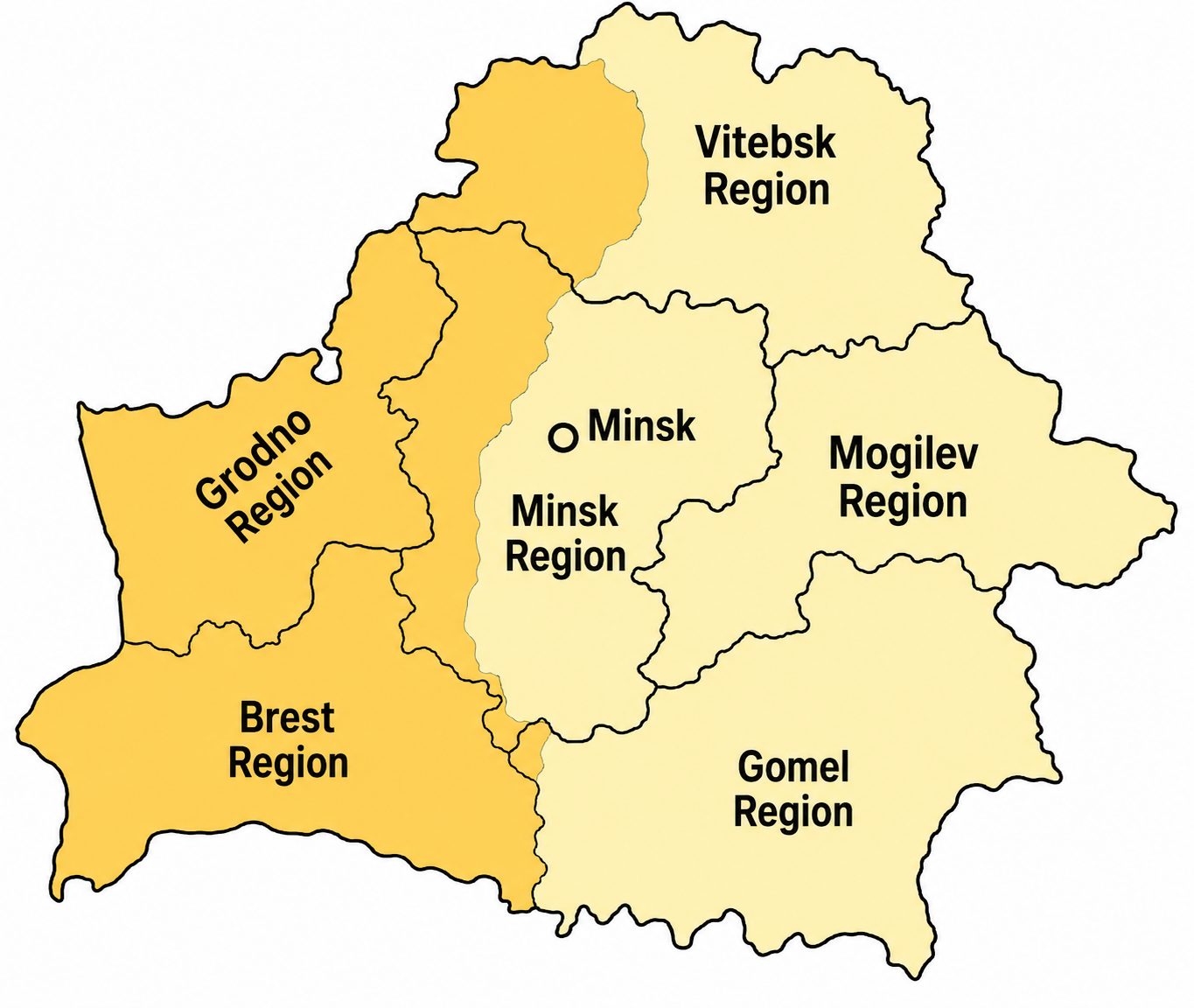
As the territory of “Free Belarus”, the territory highlighted in orange, which was formed by 1946, can serve.
How to organize “Free Russia”?
What to do in the case of a hypothetical creation of “Free Russia”? This question is largely answered by the article on democratization of Russia already mentioned by us above; here we will briefly highlight those points that are directly related to this topic:
1. Lustration of the local nomenklatura and its allies. At the same time, an exchange for political prisoners held in custody by the great-power statist regime can be offered.
2. Withdrawal of pro-great-power statist forces from “Free Russia” in accordance with international law. International groups, such as UN troops and OSCE groups, can act as a guarantor of security.

3. Elections to the Constituent Assembly (as well as to other representative bodies) and drafting of a democratic Constitution. Since many Russian citizens live abroad, and “Free Russia” itself has only just begun to function, the assistance of the international community will be required to organize and conduct elections to guarantee compliance with international standards.
4. Drafting a project for federalization of Russia and resolving the issue regarding national republics.
If the reunification of Russia does take place, how should it be organized? Let us turn to the experience of the FRG, in which there were two options36:
- Article 23 in the old wording: “For the time being, this Basic Law shall apply in the territory of the Länder… In other parts of Germany it shall put into force on their accession”. It was this option that was used during German reunification37, after which the old Article 23 was replaced by a new one, which now concerns matters related to the European Union38;
- Article 146 in the old wording: “This Basic Law shall cease to apply on the day on which a constitution freely adopted by the German people comes into force”. This option was complicated from the very beginning, because of which it had little chance of implementation. Today, Article 146 reads as follows: “This Basic Law, which since the achievement of the unity and freedom of Germany applies to the entire German people, shall cease to apply on the day on which a constitution freely adopted by the German people takes effect”.
5. Democratization and absence of privileges for religious organizations (details can be read in the article dedicated to religious policy).
In the current situation, it is possible to create religious organizations directly in “Free Russia” as democratic alternatives to existing ones that are subordinate to the great-power statist regime. However, it must be remembered that democratic authorities can conduct negotiations with friendly religious groups and give them advice, but the decisions will be made by themselves.
How to achieve this?
After we have described all the above steps, the question arises: is it realistic to achieve this? This question is complex, since the territory of Russia is part of the Russian Federation, and NATO and EU member states cannot interfere in its affairs. To solve the problem, it is necessary for democratically minded Russians to actively participate in this process. The basis for implementing the project will be negotiations between the democratic forces of Russia and the authorities of NATO and EU countries.
To solve the problem, it is important to create a Russian democratic group that will work on a common concept of goals and objectives. It is also necessary to prepare a detailed report on this topic and continue to defend one’s position, taking into account the opinions of other parties.
As noted in the article dedicated to the fight against authoritarian regimes, an important step will be the creation of a government in exile or a parliament of democratic parties in exile. The basic principles of this government or parliament should be as follows:
- Electability;
- Rotation of office (all leadership positions must have a limited term of office);
- Pluralism;
- Collective management (the government in exile should work in the form of a parliament, without concentration of power in the hands of one person);
- Rejection of authoritarianism (a clearly stated ban on admitting to parliament parties that do not share the principles of parliamentarism, as well as parties that have compromised themselves).
A hypothetical Round Table of democratic forces of Russia, which will either be established by a broad coalition or formed on the basis of such negotiations, can become the “Constituent Assembly”. As in the case of creating a broad coalition, it must be understood that the body of democratic forces should not be formed from any and all organizations. It should unite those who share positive requirements and common moral principles. Today, such a requirement is parliamentary democracy, and the principles are human rights.
Nevertheless, questions may arise about legitimacy, since there is no opportunity to hold full-fledged elections. The answer is simple: initially, the parliament, which can be called the Council of “Free Russia”, should be formed from several organizations representing various parts of Russian society. At the same time, any organization can apply for membership, and the decision on its admission or non-admission will be made at a meeting of parliament. In addition, it will be decided how many seats will be allocated to each organization.
When it becomes possible to hold elections with guaranteed voting rights and security, it will be possible to move to a more formalized process.
The Council itself can be formed according to the following scheme:
- Parties and political movements of the democratic coalition (since they play an important role, they can occupy 50% of the seats in the Council, or perhaps 3/5 or 2/3 of the seats; at the same time, each party should have an equal number of seats);
- Other democratic parties and political movements (parties and movements not included in the coalition, but ready to cooperate to create a democratic society);
- Resistance and the “Brotherhood of Dissenters” (about which more detail can be learned in the article dedicated to the fight against authoritarian regimes);
- Independent trade unions;
- Public organizations (human rights protection, charity, work with vulnerable groups, youth policy, anti-fascism, ecology, cultural heritage, and so on);
- Representatives of business, peasant farms, artisans, individual entrepreneurs and self-employed, production and consumer cooperatives;
- Independent national organizations of small indigenous peoples;
- Emigrant democratically minded organizations of Russian citizens abroad.
As an example, one can take the Coordination Council of Belarus and other similar bodies, taking into account both the characteristics of the Russian opposition movement and successful (and not so successful) decisions.
The Council of “Free Russia” elects an executive body — the Government of “Free Russia”, which will consist of the following ministries.
1. Office of the Prime Minister. Organization of the government’s work, coordination of actions of all ministries and government bodies, representation of the government’s interests in the international arena. The Office of the Prime Minister also manages administrative and political tasks associated with leadership.
2. Ministry of Foreign Affairs. Establishing ties with governments of democratic countries, supporting international solidarity, representing the interests of citizens in international organizations.
3. Ministry of Justice. Human rights protection, work with international human rights organizations and courts. Creation of a system of independent courts, investigation of human rights violations. Development of temporary legislative initiatives to ensure law and order in exile and laws to restore democratic institutions.
4. Ministry of Internal Affairs. Interaction with international law enforcement and intelligence agencies, ensuring the safety of democratic activists, human rights defenders, and members of the opposition. Establishing contacts with the opposition inside the country, developing a strategy to fight authoritarian regimes.
5. Ministry of Defense. Cooperation with foreign armies and intelligence services to ensure security. Support for opposition armed formations. Creation of databases on authoritarian regimes.
6. Ministry of Finance. Coordination of financial flows, fundraising for the government in exile through international donor organizations and private donations. Maintaining economic infrastructure in exile, work with international financial institutions. Development of economic policy to restore and reform the economy after the liberation of the country.
7. Ministry of Education and Culture. Development of educational programs for citizens who find themselves in exile, including courses in language adaptation and professional retraining. Support for scientific research and development of the academic community in exile, including online education and exchange programs with universities abroad. Creation of platforms for educational initiatives to preserve scientific traditions and long-term development.
Development and dissemination of materials that contribute to forming a positive image of the government in exile and promoting democratic values. Organization of cultural events, exhibitions, creation of online platforms to preserve cultural heritage. Work on reforming education, science, culture, and other areas.
8. Ministry of Economy and Employment. Development of strategies to restore the country’s economy in the event of its liberation, including structural reforms and attracting investment. Cooperation with international agencies on economic development issues. Support for and creation of innovative technologies and startups to stimulate economic growth. Development of long-term economic strategies for economic recovery and reform.
9. Ministry of Social Security and Healthcare. Coordination of assistance to citizens who find themselves in exile, including refugees and forced migrants. Provision of social support, including housing, education, and medical care. Creation and support of programs for rehabilitation and social integration of citizens in new countries. Cooperation with international organizations to provide humanitarian assistance. Work on plans for reforming the social sphere.
10. Ministry of Transport and Communications. Ensuring communication between citizens in exile and Russia, as well as with international partners. Work with the media and organization of information campaigns. Dissemination of information about government actions and the situation in the country. Maintaining connection between the government and citizens. Development of infrastructure restoration plans in the homeland, including the transport network and communication systems.
11. Ministry of Agriculture and Forestry. Support for establishing agricultural enterprises, cooperation with international organizations. Development of a long-term strategy for restoring agriculture in the country after its liberation.
12. Ministry of Environment. Development of projects to protect the environment and preserve natural resources. Cooperation with international environmental organizations.
Inside Russia, democratic forces need to create two key structures.
1. Resistance. Resistance should consist of opposition activists from various organizations remaining in the country. Its goals include: creating opposition cells, observing rules of conspiracy, distributing promotional materials (especially outside the Internet), sheltering persecuted Resistance participants, creating dissident circles, organizing mass protests, and preparing to counteract forceful methods of suppressing protests.

2. “Brotherhood of Dissenters”. An underground anti-government structure consisting of supporters among civil servants and their allies. These can be officials, big businessmen, police officers, and military personnel who will be able to guarantee themselves immunity after the fall of the authoritarian regime in exchange for helping the opposition (financial aid, information leaks, weakening of political repressions, sabotaging orders for torture, refusing to disperse rallies, and readiness to side with the opposition at critical moments). These people must be provided with anonymity and the opportunity to prove the fact of assistance to the Brotherhood after the fall of the regime in order to avoid lustration.
If we talk about military force, it is important for democratic forces to create armed forces capable of fighting back. As noted in the article on decolonization, Russian formations within the Armed Forces of Ukraine (such as the FRL, Sibbat, and RDK) can help liberate the territory under certain conditions. This work needs to be supported and encouraged, but it is important to understand that hope should not rest solely on external forces without one’s own efforts.
Russian formations can become part of the Armed Forces of “Free Russia”, while retaining their specifics and coordinating actions with the AF of “Free Russia”.

In terms of social unification, there is a prospect: more than 50% of Russian emigrants surveyed consider themselves part of the community of their compatriots abroad. This indicates the presence of shared experiences and history, which becomes the basis for group solidarity.
Although the idea itself may seem unlikely, discussing this issue can serve as the beginning of constructive interaction between various groups.
As first steps, taking into account the current situation, the following can be implemented. Many have heard about the so-called “Familistère” of Jean-Baptiste Godin39. It existed for more than 100 years – Godin built a large residential complex for workers and a factory near it; they lived and worked there as a cooperative. Godin remained in history, as did the “Familistère”; today there is a museum and a landmark. The project itself was largely preserved for so long thanks to Godin’s efforts, as many similar ideas left to take their own course existed for a short time. The idea is to create and/or sponsor something similar. For this, it is necessary to:
1. Agree with the authorities of some country, for example in Europe, on the allocation of land (possibly in some dying towns).
2. Build several houses. Currently, there are various options – for example, the Dutch have a project of living cells from which a modular house can be assembled. One cell costs 45 thousand euros. That is, a house for 40 apartments will cost approximately 1,800,000 euros. 5 such houses – 9,000,000, that is 200 people (although a couple can live in one cell).
3. Announce the recruitment of those willing to participate in the project among Russian emigrants and those who wish to emigrate. Select people from whom it is possible to create a cooperative, and also build premises for the work of this cooperative. Including lawyers who will help people naturalize. Alternatively, the creator of the project can recruit them to work at their enterprise. It can be stipulated in the agreement that the settlers are required to allocate part of their income to a fund for Russian democracy, which will finance educational and opposition projects. Thus, the settlement will become a center of Russian emigration, where other opposition Russians will come and purchase new cells for themselves.
4. Some of these people (perhaps even a significant portion) will invest money themselves. 45,000 euros is not a too excessive amount. Fundraising can also be opened for this idea. Perhaps some Western left-wing intellectuals will support the idea or even invest in it. In the end, it may not require any expenditure at all.
5. The creator of such a project will become a new “Godin”, which will be a powerful plus to their reputation – after all, this will be real assistance to Russian emigrants. This will be a real deed. All parties should benefit. A brand like “Familistère” can be created for this. Conduct tours for people who have a demand for models of a new type of society or cooperatives (cooperatives often raise money to support their existence from sympathizers), sell souvenirs. In this way, one can help people, create some added value, and help ensure the existence of such a community.
This idea could really help emigrants who find themselves in a difficult situation.
Risks of “Free Russia”
Like any other project, the “Free Russia” project has its own risks. These risks manifest in potential aggression from the great-power statist regime, as well as in the hesitation of a number of countries to interfere in this process. However, against the background of events in certain regions of the Russian Federation, the probability of “red lines” and retaliatory reactions is narrowing. An additional problem is ensuring stability in the region so as not to worsen the situation, as well as the risk of penetration by saboteurs and spies who may hide under the guise of refugees. This risk can be minimized if an active role is played by EU countries and various diasporas.

Also, an important problem at first will be the accommodation of emigrants. Here, the state must play an appropriate role to avoid problems.
What next?
The question remains: what will happen if the conflict ends, but the authoritarian power remains for some reason? “Free Russia” in this case would be a democratic alternative to the current regime in Moscow. Thanks to its location between Poland and Lithuania, as well as being surrounded by NATO and EU countries, “Free Russia” is in a relatively safe position.
However, to minimize risks, the deployment of international forces is necessary. Such a state will become an important center for forming a democratic agenda and a “forge of personnel” that can directly or indirectly change the situation in Russia for the better. “Free Russia” will become not only a deterrent factor for the great-power statist regime, but also the foundation for the future democratization of the rest of Russia.
And although the question of a full reunification of Russia in such a case remains unclear, the existence of “Free Russia” can bring this process closer by providing an accessible alternative to the authoritarian system.
Conclusion
The “Free Russia” project is largely unique, as few people consider it today, which, in turn, can attract the attention of people both inside Russia and beyond its borders. However, against the backdrop of current news, democratic consolidation and joint pressure on international forces are necessary not only to create an opportunity for the democratic development of Russia, but also to ensure European security. Even if the project turns out to be unsuccessful, it will still become an important platform for other initiatives (for example, creating a community in Europe) that may help build a democratic Russia in the future.
- Helping Russians with an anti-war stance // “The Ark” (https://kovcheg.live/). 2022-2024. [Electronic resource]. URL: https://kovcheg.live/ (Date of access: 11.12.2024).
- Deutschland: Russische und belarusische Menschenrechtsverteidiger_innen brauchen Schutz // Amnesty International in Deutschland (https://www.amnesty.de/). May 25, 2022. [Electronic resource]. URL: https://www.amnesty.de/informieren/aktuell/deutschland-russische-und-belarusische-menschenrechtsverteidigerinnen-brauchen-schutz (Date of access: 11.12.2024).
- Darya Nevkrytaya. Emigrants from Russia on their departure, difficulties abroad, and decision to return (or never to do so) // Current Time (https://www.currenttime.tv/). February 7, 2024, 06:52. [Electronic resource]. URL: https://www.currenttime.tv/a/emigranty-iz-rossii/32807946.html (Date of access: 11.12.2024).
- Activist Yevgeny Mashinin asked for asylum in the USA after several detentions in Russia. He was deported back home — where he began to be persecuted for anti-war posts // Meduza (https://meduza.io/). January 20, 2025, 16:13. [Electronic resource]. URL: https://meduza.io/feature/2025/01/20/aktivist-evgeniy-mashinin-posle-neskolkih-zaderzhaniy-v-rossii-zaprosil-ubezhische-v-ssha-ego-deportirovali-na-rodinu-gde-stali-presledovat-za-antivoennye-posty (Date of access: 20.01.2025).
- Ekaterina Alyabyeva for “Bumaga”. Russian emigrants earn less than at home and complain of discrimination. But they believe in a better future — for themselves and Russia. // Meduza (https://meduza.io/). January 23, 2024, 20:10. [Electronic resource]. URL: https://meduza.io/feature/2024/01/23/rossiyskie-emigranty-zarabatyvayut-menshe-chem-doma-i-zhaluyutsya-na-diskriminatsiyu-no-veryat-v-luchshee-buduschee-dlya-sebya-i-rossii (Date of access: 11.12.2024).
- About us // Exil Solidaire (https://exil-solidaire.fr/). [Electronic resource]. URL: https://exil-solidaire.fr/about (Date of access: 21.12.2024).
- We are the Pristanište Foundation, citizens of different countries living in Montenegro and united to help refugees from the war in Ukraine // Pristanište Budva Nevladina Fondacija (https://pristaniste.me/ru). [Electronic resource]. URL: https://pristaniste.me/ru (Date of access: 21.12.2024).
- DECISIONS of the Chairman of the Congress of People’s Deputies and the Executive Council of the Congress of People’s Deputies of the Russian Republic. // Congress of People’s Deputies (https://rosdep.online/). September 30, 2024. [Electronic resource]. URL: https://rosdep.online/resheniya-predsedatelya-sezda-narodnyh-deputatov-i-ispolnitelnogo-soveta-sezda-narodnyh-deputatov-rossijskoj-respubliki/ (Date of access: 11.12.2024).
- About the Forum // Free Russia Forum (https://www.forumfreerussia.org/). July 3, 2018. [Electronic resource]. URL: https://www.forumfreerussia.org/o-forume (Date of access: 11.12.2024).
- Russian Action Committee // Russian Action Committee (https://ruskd.com/). [Electronic resource]. URL: https://ruskd.com/ (Date of access: 11.12.2024).
- Russian Antiwar Committee // Russian Antiwar Committee (https://antiwarcommittee.info/). [Electronic resource]. URL: https://antiwarcommittee.info/ (Date of access: 11.12.2024).
- Maxim Katz published an investigation into the former owners of Probiznesbank. He accused them of stealing depositors’ money, and the Anti-Corruption Foundation — of “laundering” the bankers’ reputation // Meduza (https://meduza.io/). October 1, 2024, 20:47. [Electronic resource]. URL: https://meduza.io/feature/2024/10/01/maksim-kats-opublikoval-rassledovanie-o-byvshih-vladeltsah-probiznesbanka-on-obvinil-ih-v-krazhe-deneg-vkladchikov-a-fond-borby-s-korruptsiey-v-otmyvanii-reputatsii-bankirov (Date of access: 11.12.2024).
- The ACF released a response to Maxim Katz’s investigation into the former owners of Probiznesbank. The Foundation denies “roofing” the bankers and accuses the politician of manipulation and lies // Meduza (https://meduza.io/). October 25, 2024, 17:39. [Electronic resource]. URL: https://meduza.io/feature/2024/10/25/fbk-vypustil-otvet-na-rassledovanie-maksima-katsa-o-byvshih-vladeltsah-probiznesbanka (Date of access: 11.12.2024).
- Erste frei gewählte DDR-Volkskammer // Deutscher Bundestag (https://www.bundestag.de/). [Electronic resource]. URL: https://www.bundestag.de/parlament/geschichte/parlamentarismus/10_volkskammer/10_volkskammer-200884 (Date of access: 11.12.2024).
- Yan Veselov. Mind of its own: the phenomenon of virtual states and micronations // RBC (https://trends.rbc.ru/trends/). October 18, 2022. [Electronic resource]. URL: https://trends.rbc.ru/trends/social/634e62769a794711b65adaa3 (Date of access: 11.12.2024).
- terra nullius // Oxford Reference (https://www.oxfordreference.com/). [Electronic resource]. URL: https://www.oxfordreference.com/display/10.1093/oi/authority.20110803103157982 (Date of access: 11.12.2024).
- Jack Shenker. Welcome to the land that no country wants // The Guardian (https://www.theguardian.com/europe). March 3, 2016, 06:00. [Electronic resource]. URL: https://www.theguardian.com/world/2016/mar/03/welcome-to-the-land-that-no-country-wants-bir-tawil (Date of access: 11.12.2024).
- Yulia Sapronova. Chronicle of the Transnistrian conflict // RBC (https://www.rbc.ru/). September 17, 2016, 13:10. [Electronic resource]. URL: https://www.rbc.ru/photoreport/17/09/2016/57da38bb9a79475a5bfe6b27 (Date of access: 11.12.2024).
- The MFA named the purpose of Russia’s military presence in Transnistria // RBC (https://www.rbc.ru/). May 25, 2023, 16:27. [Electronic resource]. URL: https://www.rbc.ru/rbcfreenews/646f5bd79a79473888999e55 (Date of access: 11.12.2024).
- Andrey Gatinsky. UN General Assembly adopted a resolution on the withdrawal of Russian troops from Transnistria // RBC (https://www.rbc.ru/). June 22, 2018, 20:32. [Electronic resource]. URL: https://www.rbc.ru/politics/22/06/2018/5b2d31d79a7947180dffc38e (Date of access: 11.12.2024).
- Transdniestria // Encyclopædia Britannica, Inc. (https://www.britannica.com/). July 30, 2024. [Electronic resource]. URL: https://www.britannica.com/place/Transdniestria (Date of access: 11.12.2024).
- Constitution // The Parliament of the Republic of Moldova (https://www.parlament.md/Home/tabid/37/language/en-US/Default.aspx). July 30, 2024. [Electronic resource]. URL: https://www.parlament.md/CadrulLegal/Constitution/tabid/151/language/en-US/Default.aspx (Date of access: 11.12.2024).
- N.N. Kalutskova, D.A. Pulyaeva, V.I. Kulakov, A.N. Prokinova. Kaliningrad Oblast // BRE 2004-2017 (https://old.bigenc.ru/). June 22, 2018, 20:32. [Electronic resource]. URL: https://old.bigenc.ru/geography/text/2035827 (Date of access: 11.12.2024).
- Kaliningrad oblast, Russia // Encyclopædia Britannica, Inc. (https://www.britannica.com/). August 23, 2024. [Electronic resource]. URL: https://www.britannica.com/place/Kaliningrad-oblast-Russia (Date of access: 11.12.2024).
- list of the world’s largest countries and dependencies by area // Encyclopædia Britannica, Inc. (https://www.britannica.com/). [Electronic resource]. URL: https://www.britannica.com/topic/list-of-the-total-areas-of-the-worlds-countries-dependencies-and-territories-2130540 (Date of access: 11.12.2024).
- Population of Kaliningrad Oblast as of January 1, 2024 // Federal State Statistics Service (https://39.rosstat.gov.ru/). June 28, 2024, 16:33. [Electronic resource]. URL: https://39.rosstat.gov.ru/publications_2/document/239947 (Date of access: 11.12.2024).
- In six European countries, the work of Russian Houses was frozen // RBC (https://www.rbc.ru/). April 13, 2023, 09:38. [Electronic resource]. URL: https://www.rbc.ru/rbcfreenews/64379de59a79475391b6c1cc (Date of access: 11.12.2024).
- Callum Tennant. NATO used to fret over Russia’s threat against the Suwałki Gap. The threat is now smaller than ever // Euronews (https://www.euronews.com/). September 28, 2023, 17:15. [Electronic resource]. URL: https://www.euronews.com/my-europe/2023/09/28/nato-used-to-fret-over-russias-threat-against-the-suwalki-gap-the-threat-is-now-smaller-th (Date of access: 11.12.2024).
- Constitution of the RF with amendments of 2022 // State Duma of the Federal Assembly of the Russian Federation (http://duma.gov.ru/). October 6, 2020, 19:34. [Electronic resource]. URL: http://duma.gov.ru/news/55446/ (Date of access: 11.12.2024).
- Renaming of the RSFSR into the Russian Federation // RIA Novosti (https://ria.ru/). March 3, 2020, 02:06. [Electronic resource]. URL: https://ria.ru/20161225/1484432304.html (Date of access: 11.12.2024).
- Elena Aleksandrova. Basic Law: 70 years of German democracy // Information portal Germania-online (https://germania-online.diplo.de/ru-dz-ru). May 23, 2019. [Electronic resource]. URL: https://germania-online.diplo.de/ru-dz-ru/geschichte/Gedenkdaten/-/2220552 (Date of access: 11.12.2024).
- 23. Mai: Jahrestag der Verkündung des Grundgesetzes 1949 // Bezirksregierung Düsseldorf (https://www.brd.nrw.de/). [Electronic resource]. URL: https://www.brd.nrw.de/23-mai-jahrestag-der-verkuendung-des-grundgesetzes-1949 (Date of access: 11.12.2024).
- Towards the Union of Sovereign Peoples : Coll. of documents of the CPSU, legislative acts, declarations, appeals, and presidential decrees devoted to the problems of national-state sovereignty / Inst. of Theory and History of Socialism of the CC CPSU; [Comp. and author of intro. A. I. Doronchenkov]. – 541 p. – M: ITIS, 1991. – p. 243.
- Ibid., – pp. 191 – 195.
- ACT OF THE SUPREME COUNCIL OF THE REPUBLIC OF LITHUANIA ON THE RESTORATION OF THE INDEPENDENT STATE OF LITHUANIA // Office of the Seimas of the Republic of Lithuania (https://www.e-tar.lt/portal/index.html). [Electronic resource]. URL: https://www.e-tar.lt/portal/ru/legalAct/TAR.12C754906DE4 (Date of access: 11.12.2024).
- Ursula Münch. 1990: Grundgesetz oder neue Verfassung? // bpb (https://www.bpb.de/). October 1, 2018. [Electronic resource]. URL: https://www.bpb.de/themen/deutsche-einheit/deutsche-teilung-deutsche-einheit/43813/1990-grundgesetz-oder-neue-verfassung/ (Date of access: 11.12.2024).
- Die DDR und das Grundgesetz // Presse- und Informationsamt der Bundesregierung (https://www.bundesregierung.de/breg-de). May 16, 2024. [Electronic resource]. URL: https://www.bundesregierung.de/breg-de/schwerpunkte-der-bundesregierung/75-jahre-grundgesetz/die-ddr-und-das-grundgesetz-2283134 (Date of access: 11.12.2024).
- Grundgesetz für die Bundesrepublik Deutschland Art 23 // Gesetze im Internet (https://www.gesetze-im-internet.de/). [Electronic resource]. URL: https://www.gesetze-im-internet.de/gg/art_23.html (Date of access: 11.12.2024).
- L’Association coopérative du capital et du travail // Le Familistère de Guise (https://www.familistere.com/fr). December 10, 2019, 20:10. [Electronic resource]. URL: https://www.familistere.com/fr/decouvrir/cent-ans-d-experimentation-sociale/l-association-cooperative (Date of access: 11.12.2024).