
Can authoritarian regimes win World War III?
Spoiler: this is extremely unlikely. The events of 2022 force us to pay attention to topics we would rather not touch – namely, the threat of a real major war. We will try to imagine what would happen in the event of such a war and how events would unfold. We urge military personnel across the Russian-speaking world to read this article and draw conclusions. Right now, the Russian-language sphere is teeming with jingoistic articles by military "experts" who predicted Ukraine's defeat within a few days in the war against Russia. You have a chance to get acquainted with an alternative viewpoint. The article will be updated as new information becomes available.
The start of the “military operation” in Ukraine has shown that nothing is impossible in the modern world, and the danger of an actual World War III starting exists. Between which sides would it be fought? Which outcome of the confrontation is most likely? In this article, we will examine various facts that might suggest an answer to us. At the same time, however, we must take into account the considerable weight that chance and unpredictability carry in wartime, so the conclusions of the article cannot be considered a guarantee of any outcome.
Contents
Sides
We have previously written that in effect, Second Cold War is underway today, with the backbone of one side consisting of democratic countries and the other side consisting of authoritarian ones. In the event of World War III breaking out, the division of sides will most likely follow the same principle. A similar viewpoint was expressed by US President Joe Biden in March 2022, when he mentioned in his Warsaw speech that there is “a great battle for freedom: a battle between democracy and autocracy, between liberty and repression, between a rules-based order and one governed by brute force”1.
What will the conditional democratic block look like? Obviously, it will be based on two structures – NATO and the EU, as most of the leading countries in terms of democracy level belong to these structures. An attack on one of the members of the NATO block automatically draws all other members into the war – this is enshrined in Article 5 (“Collective defence”) of the foundational treaty of this organization2. Work on developing the principles of collective defense is also underway in the European Union; “NATO Review” also reports the following:
“Member States of the European Union and NATO share a common commitment to democratic principles, the respect for and protection of the rule of law and human rights. Moreover, they share market economies, and are located in the same geographic region facing common security challenges, coming potentially from the South or the East. These bonds connect them even tighter than membership in other value-based international organisations, such as the Organisation for Security and Cooperation in Europe or the United Nations. And as such, this means that both the European Union and NATO are obliged to cooperate in order to defend their citizens and ensure their prosperity”3.
The EU Diplomatic Service regularly develops new proposals for cooperation between the EU and NATO4. It is hardly possible to confidently assert guarantees of participation by all non-NATO EU countries in the event of a conflict, but the probability of this can be assessed as very high. Which countries are we talking about right now? As of 2020, 30 countries were members of NATO5: the US, Turkey, Germany, the UK, France, Italy, Spain, Greece, Poland, Romania, Portugal, Bulgaria, Canada, Czechia, the Netherlands, Croatia, Slovakia, Norway, Belgium, Hungary, Denmark, Slovenia, Albania, North Macedonia, Lithuania, Latvia, Estonia, Montenegro, Luxembourg, and Iceland. Of the countries that are not in the NATO block but are part of the European Union, we can note 6 more countries6 – Sweden, Finland, Ireland, Austria, Cyprus, and Malta (however, while this article was being written, Sweden and Finland already submitted applications to join NATO, and they will likely be accepted there7).
As for the other countries that might take the side of the democratic block, much depends on US ties, as the European Union does not attach such high importance to building military connections – apparently relying on its elder brother in the military sense in the form of the United States. The latter has a structure of allies designated by the term “major non-NATO ally”. At the beginning of 2021, this included Israel, South Korea, Japan, Australia, Pakistan, Brazil, Argentina, Taiwan, Egypt, the Philippines, Thailand, Tunisia, Morocco, New Zealand, Jordan, Bahrain, Kuwait, and Afghanistan8, though with the change of power in Afghanistan, this state has likely dropped off the list of allies. At the same time, Qatar received this status in 2022, and during the writing of this article, Colombia also received such status9. Will these countries take the side of the democratic block in case of a conflict? There are no guarantees of this, but they will in all likelihood assist economically and may join sanctions. In addition, should a dangerous situation arise in their region, the likelihood of their joint participation increases significantly. For example, Iran’s participation in the war on the side of the authoritarian block could trigger the start of military actions by Middle Eastern US allies against that state. We can also note that potential US allies can be considered countries that allow the States to locate military bases on their territory. However, sources lack unanimity on the question of the exact number and location of these bases.
The advantage of the democratic block lies in the fact that for a significant number of potential allies, Pax Americana is seen as a clearer, more predictable, and safer world option that provides access to many benefits, whereas the authoritarian block is seen as a potential aggressor striving to revise the world order, which could be carried out without taking into account the interests of small countries.
In the European region, countries close to the democratic block are Ukraine and Georgia, which applied for NATO membership, and whose accession there at the beginning of 2022 was considered by the block’s leadership as an almost settled matter10. Moldova at the moment is also closer to the democratic block, as its Prime Minister Maia Sandu sent an appeal requesting admission to the EU11, but there is still a higher probability that this country will maintain neutrality – besides the lack of final clarity regarding accession, this is suggested by the country’s relatively low military potential and the presence of a strong pro-Russian opposition in the country12.
In the Middle East, the primary and most obvious partner is Israel, which has long been a “major non-NATO ally of the United States”. The website of the Israeli Ministry of Foreign Affairs calls the United States Israel’s “most reliable ally”13. There is also a strong perception in society that Saudi Arabia – one of the most militarily powerful states in the region – is an ally of the US, but The Washington Post notes that it has never officially been one14 – there are no corresponding agreements, and the regime of Saudi Arabia is authoritarian. At the same time, one should note the tense relations of the Saudis with Iran15, their invitation to the Americans in 1990 to contain the aggression of Saddam Hussein, the use of a large quantity of US military equipment models, as well as the deployment of American military bases on the country’s territory16. These factors allow the democratic block to count at least on economic cooperation, at most – on a military action by Saudi Arabia on their side. Among other states in the region that may side with the US (besides Turkey) are Egypt, the UAE, Jordan, Kuwait, Qatar, Bahrain, Oman (at least most of them were named among those potentially interested in an anti-Iranian coalition17).
In the Asian region, potential members of the democratic block are Japan, South Korea, the Philippines, Thailand, Taiwan – these are not only some of the most democratic states in the region (by Asian standards, of course), but also “major non-NATO allies of the US”. Singapore is also developing relations with NATO, having contributed a military contingent to ISAF in Afghanistan18. Unexpectedly, in the event of a conflict, Vietnam might take the side of the democratic block – despite the authoritarian system operating in the country, relations between the US and Vietnam have warmed noticeably in recent times19, which is due to tensions in relations between Vietnam and China that have not abated for many decades (since the Sino-Vietnamese War of 1979). However, there are no guarantees regarding Vietnam’s position. But it can be said that Australia and New Zealand, located near the Asian region, almost unequivocally take the side of the democratic block.
There is a high probability that the democratic block will one way or another be supported by the countries of the Commonwealth of Nations20, which includes quite a few states. Non-communist countries of Latin America may also provide assistance. The support will be either diplomatic or material – as during the first and second world wars.
The conditional authoritarian block does not have a structure that would bind its most combat-ready members in the way the US is bound with the EU. In fact, it is fragmented and can hardly coordinate in a high-quality and reliable manner. Since no official binding structure exists between Russia and China, the basis of the authoritarian block would have to become the CSTO (Collective Security Treaty Organization). It includes: Russia, Kazakhstan, Belarus, Armenia, Tajikistan, and Kyrgyzstan21. Serbia is also an observer in this structure. However, Russian propagandists claim that formally an alliance between Russia and China does exist, and urge that it be officially secured22. Vladimir Putin’s press secretary Dmitry Peskov stated that there are “allied relations” between China and Russia23. The countries already cooperate within the framework of the Shanghai Cooperation Organisation (SCO), which also includes China, while observers are Iran, Mongolia, Pakistan, and India, and agreements on cooperation between the CSTO and this organization exist24. Therefore, it can be said that the authoritarian block has its strongest positions in Asia: besides Russia, China and the DPRK can be included here. Myanmar and Laos could potentially connect here. With a high degree of probability, it can be assumed that in the event of war, at least Serbia and Kyrgyzstan will prefer to maintain neutrality (however, the Serbs may start an independent operation against Kosovo, which would draw them into a conflict with other countries of the region). Armenia, which saw Russia’s inaction during the war with Azerbaijan, will perhaps also not intervene. This is confirmed by recent events in Ukraine, from which most CSTO members prefer to stay away2526.
In the Middle East, Syria has long been an ally of Russia27, ruled by authoritarian ruler Bashar al-Assad, who has good mutual relations with Vladimir Putin. Close ties also exist with another authoritarian state – Iran28, although some experts note that problems are observed in the rapprochement29. In 2021, Israeli Prime Minister Naftali Bennett noted that forces allied to Iran exist in the following countries: Syria, Yemen, Lebanon, and Iraq30. It is also not ruled out that Afghanistan and (less likely) Turkmenistan will side with the authoritarian block, as authoritarian regimes are established in them.
In the Western Hemisphere, authoritarian states group around the ALBA association (“Bolivarian Alliance for the Peoples of Our America”), the founders of which are traditionally authoritarian Cuba and Venezuela. As of 2022, it also includes Nicaragua, Bolivia, Grenada, Saint Vincent and the Grenadines, Antigua and Barbuda, the Commonwealth of Dominica, and the Federation of Saint Kitts and Nevis31. Taking into account that Syria and Iran are invited members, and Russia also participated in the alliance as an invited member32, it can be said that this alliance is a possible participant of the authoritarian block. However, considering the colossal advantage of democratic countries in the region (as well as the fact that most countries of the Western Hemisphere are signatories to the “Rio Pact”, from which Venezuela and Bolivia withdrew33), it would be far more sensible for them to maintain neutrality. Their only motivation to enter the war is the understanding that in the event of the fall of their “elder brothers” in the form of Russia and China, their regimes might be next. But still, they are unlikely to be able to hold out for long against the forces of the US and Canada, especially if other democracies of the region join them, and they are obligated to enter the war according to the terms of the “Rio Pact” in the event of an attack on one of the pact countries34, which also includes the US. Therefore, the position here for the authoritarian block is a dead end – the US may not attack (even if there is a desire to destroy authoritarian regimes, it is better to do so after colliding with the strongest dictatorships of Eurasia), and if ALBA carries out an attack, they will face the troops of Brazil, Argentina, Colombia, Chile, and other states of the region, not just the US and Canada.
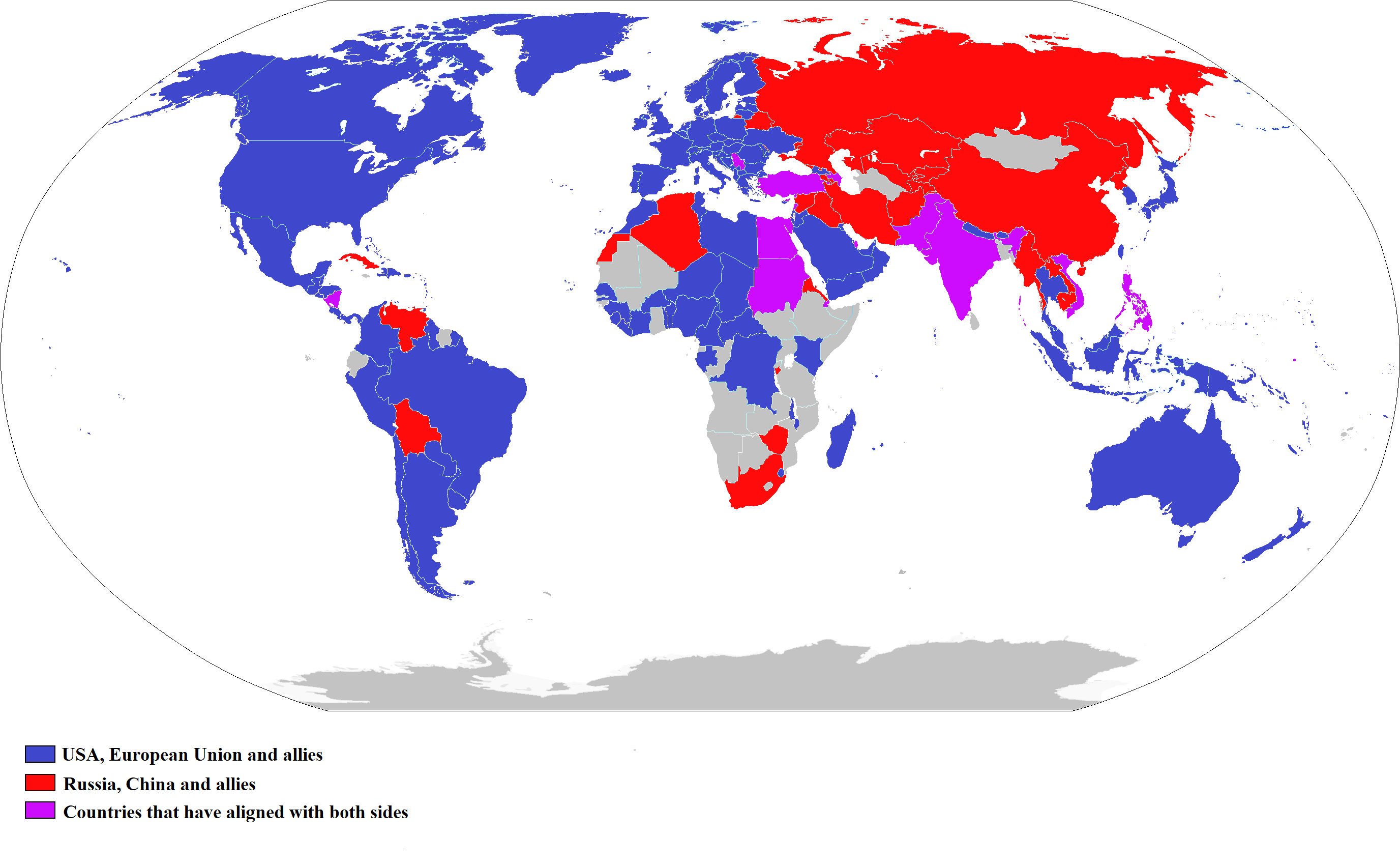
There is a group of countries that could take either side of the conflict. The largest of them is India. On the one hand, this country actively cooperates with Russia and China35, and also conducts joint exercises with the Russian army36; on the other hand, the Russian International Affairs Council notes an “increasingly distinct tilt of India’s foreign policy toward the United States”37, and the 2020 Sino-Indian border conflict forced India to make several decisions that can be described as an economic attack on Chinese companies38. An additional argument is that this country is a member of the Commonwealth of Nations. At present, India leans more toward the democratic block (for example, it participates in the QUAD block, which has an anti-Chinese focus and includes the US, Australia, Japan, and India39), but it is most likely that this country is still aimed at neutrality. Another significant state whose position is not completely clear is Pakistan, which is a nuclear power and possesses a fairly strong army. Pakistan is a US partner holding “major non-NATO ally” status and hosts their military bases on its territory, but it is an authoritarian country that is also considered an opponent of Israel, and its relations with the US have recently deteriorated40. A large country not associated with any military blocks is Mexico. However, given that its economy is closely linked with the US economy, and the Mexicans would hardly want to have such an adversary next door in any case, the probability of its side with the authoritarian block is extremely low. Here it should also be recalled that in 1942 Mexico entered World War II on the side of the US. Cambodia is not associated with any blocks, but is more oriented toward China41. The potential position of Indonesia and Malaysia is also unclear.
We can hardly expect any active participation in a potential conflict from African countries due to the relatively small strength of their armies and the absence of particularly aggressively minded authoritarian regimes at the moment. However, even if the war spreads to Africa (in which case the democratic block would likely rely on the ECOWAS countries), this theater of military operations would most likely be secondary.
So, let us try to imagine the situation on the world map. Potential participants of the “democratic block” are marked on it in dark green, and potential participants of the “authoritarian block” – in black. Countries whose participation is more doubtful, but has a more or less pronounced inclination toward one of the blocks, are designated respectively in light green and dark gray.

Next, let us move on to considering arguments in favor of a possible victory for one block or the other.
What is the main difference of the authoritarian block countries? In the fact that power in these countries is not elected by citizens – elections either do not exist at all, or they exist, but are completely or highly controlled by the nomenklatura. For this reason, the governments of these countries can take the most brutal measures, as they know that they will not lose their power without a revolution and will not bear responsibility for crimes. In wartime, the following could play in their favor:
- The element of surprise. Since authoritarian countries can launch a war and conduct mobilization without considering the opinion of their citizens, without holding any discussions, they can attack suddenly. Furthermore, dictators may not even care about the opinion of their inner circle, allowing them to agree on the start of military operations exclusively among themselves in conditions of strict secrecy. And this further increases the element of surprise. Decisions can be made by authoritarian states faster than by democratic governments, which may delay declaring war and making decisions. However, this point can also work against authoritarian countries – the world beyond their control will immediately understand that they are aggressors, which will help foster a mindset to fight them. Moreover, this point is almost completely neutralized by the intelligence strength of democratic countries. Thus, Western intelligence agencies warned about the preparation of Russia’s “special operation” in Ukraine back in 202142;
- Authoritarian countries can play dirty – use “scorched earth” tactics, violate international agreements, destroy peaceful cities, and so forth. In their countries, there is neither a free press nor an opposition that could be outraged by such atrocities, convey information about them to other citizens, and call for a shift toward a humanistic course. In addition, this also allows authoritarian governments to throw a large number of their own people into the meat grinder of war for the sake of achieving a geopolitical result. However, this point can also work against them, further convincing the rest of the world of the need to fight authoritarian countries.
The strengths of the authoritarian block include specific properties of the countries that make up this block. First and foremost, these are China’s human resources – they are larger than those of any other country (1,450,000,000 people as of 202243, though India lags behind by only 50 million). If we compare as a whole the potential available military force (people who have undergone military training and are considered “combat-ready”), the authoritarian block’s advantage is small. If we make a comparison between the sum of its forces (here and below in comparisons we include China, Russia, the DPRK, Iran, Myanmar, Venezuela, Syria, Afghanistan, Cuba, Yemen, Belarus, Nicaragua – that is, we will assume that regimes from the Americas will participate) and the sum of forces of the democratic block (here and below we include the US, the European Union, the UK, Norway, Turkey, Ukraine, Georgia, Canada, Australia, New Zealand, Israel, Japan, South Korea, Taiwan, Singapore, the Philippines, Thailand – that is, we will assume that Saudi Arabia, Vietnam, and Egypt will not side with the democratic block), the amount of military force in the authoritarian block will be approximately 5.4 million people, and in the democratic block – approximately 5.3 million44.
The authoritarian block will most likely have no problems with natural resources: countries such as Russia, China, Iran, and Venezuela possess massive resource reserves4546. The democratic block, on the other hand, in terms of resources depends significantly on the position of the Arab countries, despite the resource wealth of the US, Canada, and Australia. And while in terms of oil production the democratic block barely lags behind the authoritarian one47, in terms of its proven reserves the authoritarian block exceeds it by more than two and a half times48. The territories of authoritarian countries are difficult to fight in. First of all, we mean here the climatic conditions of Russia, as well as the mountainous terrains of China and Afghanistan (if the latter joins the authoritarian block). However, the failures of Napoleon Bonaparte and Adolf Hitler and their lack of preparation for the Russian winter climate have already become so textbook, and industry has become so developed, that this time an army intending to fight on Russian territory will probably be much better prepared. And inconvenient terrains for warfare also exist in democratic countries (the maritime position of the UK, Australia, and Japan, the swamps of Finland, and so forth).
Authoritarian countries can spend more resources to bribe politicians, propagandists, and military personnel in democratic countries (especially in peacetime), since they siphon money from their citizens and are not obliged to be accountable to them for spending this money (for example, many European politicians are accused of links with Russia – on these grounds even Austrian Chancellor Sebastian Kurz was forced to resign49). However, democratic countries are substantially richer in principle, plus the level of corruption in them is significantly lower, so in the event of war, bribing enemy politicians may be even easier for them.
A strength of authoritarian countries can be combat experience and military traditions of the Russian army. However, over the past 100 years, far from every case of Russia’s participation in a military conflict was successful – thus, the state achieved some positive results for itself in the Second Chechen War, in the military operation of the RF in Syria, and in the Russo-Georgian War. Of course, the most impressive result – victory in World War II, carried out in a block with democratic countries and turned into a kind of cult. Other cases – the Polish-Soviet and Soviet-Finnish wars, wars in Afghanistan and Ukraine, the First Chechen War – hardly showed the strength of the Russian army in its best light. As for China, its army after World War II has practically no military experience (with the exception of small conflicts with India, as well as the Sino-Vietnamese War), and overall over recent centuries its military forces showed an extremely low level of combat capability. Iran also did not demonstrate high military efficiency in recent decades. And yet, the Russian army represents a serious force, plus this state possesses capabilities for effective cyberattacks (for example, Russian hackers interfered in the US election process50):
Russia, in my view, represents an exceptional threat… We are talking about an army that today has well – integrated air defense, the ability to strike at long distances, it has electronic warfare assets, it possesses anti – ship cruise missiles, anti – satellite weapons, and it is capable of conducting large – scale cyber operations51.
Armaments
The strengths of the authoritarian block can include an advantage in the quantity of tank armor (the number of tanks in authoritarian countries is approximately 33,100 units, while in the democratic block it is about 25,60052), although it is neutralized by the fact that a significant portion consists of obsolete models – for example, various modifications of the T-72 occupy more than half of the Russian tank fleet53. Nevertheless, thanks to Russia, the authoritarian block has some interesting models of military equipment. In recent years, China has also been engaged in developing new equipment. Here we can highlight the following armament models.
First of all, small arms and the famous “Kalashnikov rifles”, which are the most widespread weapon in the world. It is distinguished by low cost, reliability, and simplicity in training (to train a modern soldier in field disassembly, cleaning, and maintenance of an American M16 rifle in combat conditions may take about a week, while for an AK – about four hours54). Therefore, Russia can arm a huge number of people in a fairly short time. Another question – how loyal they will be to the authoritarian government. Moreover, various AKs are produced not only in Russia, but also in Ukraine, Bulgaria, Hungary, Egypt, and some other potential members of the democratic block. At the same time, they are unlikely to be the primary infantry weapon of this block – some experts note that the current small arms market is split between German Heckler & Koch and Belgian FN Herstal, while “Kalashnikov” gets rather the niche of cheap consumer goods, rather than a model of advanced weaponry55. For instance, the AK is poorly compatible with suppressors, unlike the American M-4.
While American generals noted in reports during the Vietnam War that about 30% of personnel losses were linked to failures of personal small arms, Kalashnikov rifles worked properly in any conditions, be it mud, water, or sand. At the same time, the AK was cheaper than the American M16. The Kalashnikov model is very simple to maintain and operate. A simple rag is enough to clean it, and to lubricate the barrel, soldiers serving in Afghanistan sometimes used ordinary shoelaces with several knots soaked in oil56.
The Dragunov sniper rifle (SVD) possesses roughly the same advantages, distinguished by its simple and reliable design57; its design includes a bayonet knife (a unique solution for sniper rifles58), but it lacks a Picatinny rail, making it very difficult to mount modern scopes, and it is too bulky for moving snipers in IFVs59. However, among Russian weapons, one can also highlight the SVLK-14S “Sumrak” sniper rifle, considered the longest-range in the world60, the suppressed VSS “Vintorez”, which demonstrated high effectiveness during the war in Chechnya, and the “Pecheneg” machine gun, which also features the highest firing range in its class of weapons61.
Russia can produce modern T-14 “Armata” tanks, which employ many technical innovations such as an unmanned turret, stealth technologies, dynamic armor, and so on. However, experts noted that the tank was presented to the public back in 2015, but in 2022 it had still not been adopted into service. Apparently, it turned out to be too expensive, and replacing classic T-72s with “Armatas” proved to be beyond the capabilities of the Russian economy62. Roughly the same can be said about the newest BMPT “Terminator”: as reported by Viktor Murakhovsky, member of the Expert Council of the Military-Industrial Commission of the Russian Federation, “it possesses no advantages that are significant over a main battle tank”63, so its mass production is also unlikely to be justified. On the other hand, Russia produces sufficient quantities of self-propelled anti-aircraft guns that are among the world’s best examples – namely the “Tunguska” and “Pantsir-S1” SPAAGs64. Russia also has high-quality anti-aircraft missile systems – S-400 and S-500. They can destroy modern air attack targets, including ballistic missiles65.
The most dangerous Russian weapons remain missile systems: the “Iskander” missile system (evaluated by The National Interest as the most dangerous weapon of the Russian Armed Forces66), the “Sarmat” ICBM, the “Kinzhal” hypersonic system (if Izvestia is to be believed, top air and missile defense systems are incapable of shooting down these missiles67), the “Avangard” system (similarly68), the “Yars” ICBM, the “Zircon” cruise missile (“Rossiyskaya Gazeta” claims that a single such missile can disable an aircraft carrier, and no defense against it exists69), and so forth. Another dangerous weapon of the authoritarian block is the “Solntsepek” heavy flamethrower systems. However, as other sources claim, using the “Zircon” effectively requires a sufficient number of carriers (which are critically lacking); moreover, while effective means of defense against the “Zircon” itself may not exist, there are effective means to destroy the carriers of these missiles70. Some experts argue: to launch a missile from the frigate “Admiral Gorshkov”, for example, at an aircraft carrier – it must first get within 600 kilometers. But on approach it will already be detected by a carrier-based “Hawkeye” AEW&C aircraft. The frigate will be sunk before the “Zircon” is even launched71. It is not ruled out that the effectiveness of other systems in actual combat operations will also prove questionable.
In general, problems with USSR “superweapons” arose regularly. Thus, the titanium-hulled submarine K-222 “Anchar” set a world underwater speed record in its day (82.8 kilometers per hour), but its high cost made the combat use of the submarine unjustified; moreover, at such high speed the “Anchar” lost its stealth, so over time it was decommissioned from the fleet72, and in 2008 its scrapping began. Another famous example is the submarine K-278 “Komsomolets”, which set a world submarine diving record (1,027 meters)73. In 1989, the submarine sank in the Norwegian Sea after a fire, killing most of the crew. The dissonance between the masterpiece design of Soviet submarines and the impossibility for various reasons of their effective use was repeatedly reflected in both Russian and foreign culture – it is enough to recall the feature films “72 Meters”, “The Hunt for Red October”, and “K-19”.
Russian media also assure that a unique underwater drone “Poseidon” has been developed, capable of reaching a maximum speed of 200 kilometers per hour underwater74, freely crossing the world ocean and, detonating near the US coast, causing a tsunami that will destroy coastal cities75. However, they also report that little is known about this weapon, and it is expected to enter service only in 2027 at the earliest76.
The Chinese military – industrial complex is currently not as developed as the Russian one, but it is beginning to surpass it in certain details. Thus, China has a significant number of fifth – generation Chengdu J-20 fighters (very few Russian Su-57s have been produced so far) – only the US can boast of something similar (in Japan, a similar fighter is still being tested). According to some reports, their number in 2021 was 150 units77. China is also beginning to build an aircraft carrier fleet78. However, the Institute of International Political and Economic Strategies notes:
«From the MiG, the Chinese borrowed the “canard” forward horizontal fin. However, this makes the stealth of the fighter impossible – the main sign of belonging to the fifth generation… In general, US experts believe that in the Chengdu J-20 model (created in 2017) the Chinese tried to combine solutions from various aircraft building concepts and, above all, did not fully understand the essence of stealth technologies. According to Pentagon experts, the Chengdu J-20 cannot achieve air superiority»79.
Strengths of the democratic block
Democratic countries are usually more effective due to the reasons why rotation of power and democracy are more effective. Where generals and soldiers of authoritarian countries are intimidated, misinformed (since there is no free press, criticism is suppressed, and leadership is only told good news), afraid to make decisions not approved from “above”, military personnel of democratic countries are not afraid to take initiative. For example, Doctor of Historical Sciences Oleg Khlevniuk wrote about the actions of the Soviet command staff during the Second World War: “The purges, which continued until the war itself, had a destructive moral effect on the military. They destroyed a commander’s most important asset – initiative – and encouraged play-it-safers; they undermined the authority of commanders and led to a collapse in discipline… Officers at all levels were terrified and often acted timidly, without initiative, which was one of the reasons for defeats and losses”80. This is also confirmed by the memoirs of Marshal Zhukov, who reported that “the strong-willed qualities of our commander – initiative, the ability to take responsibility – are insufficiently developed, and this had a very disastrous effect on the course of the war in the first period”81. This is one of the main reasons for the huge losses in that war. The higher initiative of troop commanders in democratic countries was well demonstrated during the Arab – Israeli wars. For instance, Israeli officer Zvi Greengold during the Yom Kippur War commanded a tank whose crew destroyed up to 60 enemy tanks82, which were advised by a group of Soviet military specialists, in two days. It should also be noted that officials in authoritarian countries are less competent – this is reflected in the positions of countries in development, economy, and standard of living rankings, where leading positions mostly remain with democratic countries. Similar results should likely be expected in the field of military organization as well.
Proponents of dictatorships like to cite Hitler’s Germany in response, which fully utilized the strengths of dictatorships (such as the element of surprise) coupled with parasitism on the economy of parliamentary pre-Nazi Germany and the military training school of the Kaiser period. However, even this dictatorship, the most successful in military terms, turned out to be defeated by a block of democratic countries and the USSR.
In authoritarian countries, if the leader or party gets it into their head that they understand military affairs better than the military (and this happens quite often), the latter will be forced to carry out their commands, which are incompetent from a military point of view. In democratic countries, this will be much more difficult to do, since in the event of failure, such manipulation will become public through the free press, and a politician who dared to dictate to a military officer could instantly lose their post. Therefore, it is more beneficial for politicians in democratic countries not to interfere in the process so that the responsibility lies with the military. And this increases the quality of military operations.
As we have noted earlier in the article on the foreign policy of social democrats, democratic countries fight each other incomparably less often than authoritarian countries do among themselves or authoritarian countries with democratic ones. This means that the alliance between them will be significantly stronger. Authoritarian countries will attempt to betray each other – this is not excluded even during military operations. This already happened in 1941, when the authoritarian block was noticeably stronger than the democratic one, but Adolf Hitler decided to attack the USSR, which was a friendly state at the time. Today, specialists also note that if China becomes a world leader, the territorial integrity of Russia will immediately be called into question83.
Citizens of democratic countries are more motivated to defend their way of life, as the standard of living in them is, as a rule, much higher. Related to this is another strength of the democratic block – in these countries it will be harder to create any strong collaborationist structures and armies. For example, Marshal Philippe Pétain, who was a French collaborationist during the Second World War, did not command military operations on Germany’s side, taking Hitler’s side closer to the moment of surrender. Of course, in some democratic countries there are communist and fascist parties, which are potentially detachments of the authoritarian block, but their influence is, as a rule, minimal, and in the event of war they can be quickly neutralized.
And citizens of authoritarian countries (either the suppressed opposition, or simply those dissatisfied, who are the potential audience of the opposition) will have significant motivation to fight on the side of the democratic block. And even the total purge of dissenters, such as the one Joseph Stalin carried out during the years of the Great Terror, will not fix this – on the contrary, after that the strength of the ROA ranged from 7084 to 12085 thousand people, and the UPA, according to some estimates, more than 60 thousand people86, not counting other formations. Mass surrender is not excluded – thus, as of December 11, 1941, according to the summary of reports of German military units, the number of Soviet prisoners of war was 3.8 million people87. And this despite the fact that the Nazis were not the best alternative to Stalin’s rule, in connection with which some of the anti-Soviet military formations were forced not to take either side. There are significant grounds to believe that if Germany had been democratic rather than Nazi, the number of anti-Soviet formations could have been several times higher. Citizens of authoritarian countries will create military formations that will side with democratic countries, and they will be quite numerous. This is due to the fact that democratic countries are not going to enslave residents of authoritarian ones or capture their countries, but are merely going to establish democracy there (as was the case, for example, with Germany, Japan, Italy, and South Korea, where the standard of living soared sharply upward). In China itself, the army is essentially not the army of the country, but the army of the Communist Party. In addition, hazing in the Russian army, which is still significant88, in peacetime does not give soldiers the opportunity to subdue senior soldiers, but in wartime they have a higher probability of successfully suppressing them. Finally, territories liberated by democratic countries can quickly realize the benefits of democracy and are unlikely to be ready to return to the rule of an authoritarian regime after that.
And the authoritarian block’s problems with the opposition are serious. Thus, in Russia in 2011 and after, mass protests took place89, which were suppressed, but this does not mean that people became sincere supporters of the authorities. In Syria, a civil war between rebels and Assad is still ongoing90, and there is little doubt that they will be happy to join the democratic block. Mass protests are also observed in Cuba91, and in Iran92. If we are talking about China, an unstable situation has long been observed in Hong Kong – from the “Umbrella Revolution” of 201493 to the mass protests of 2019-202094 – as well as Uyghur separatism95 and the protest movement in Tibet96. All these political forces have no chance of gaining political power, unlike in democratic countries, which is why in the latter the opposition will unite with the government, while in authoritarian countries the non-nationalist opposition will likely fight the government.
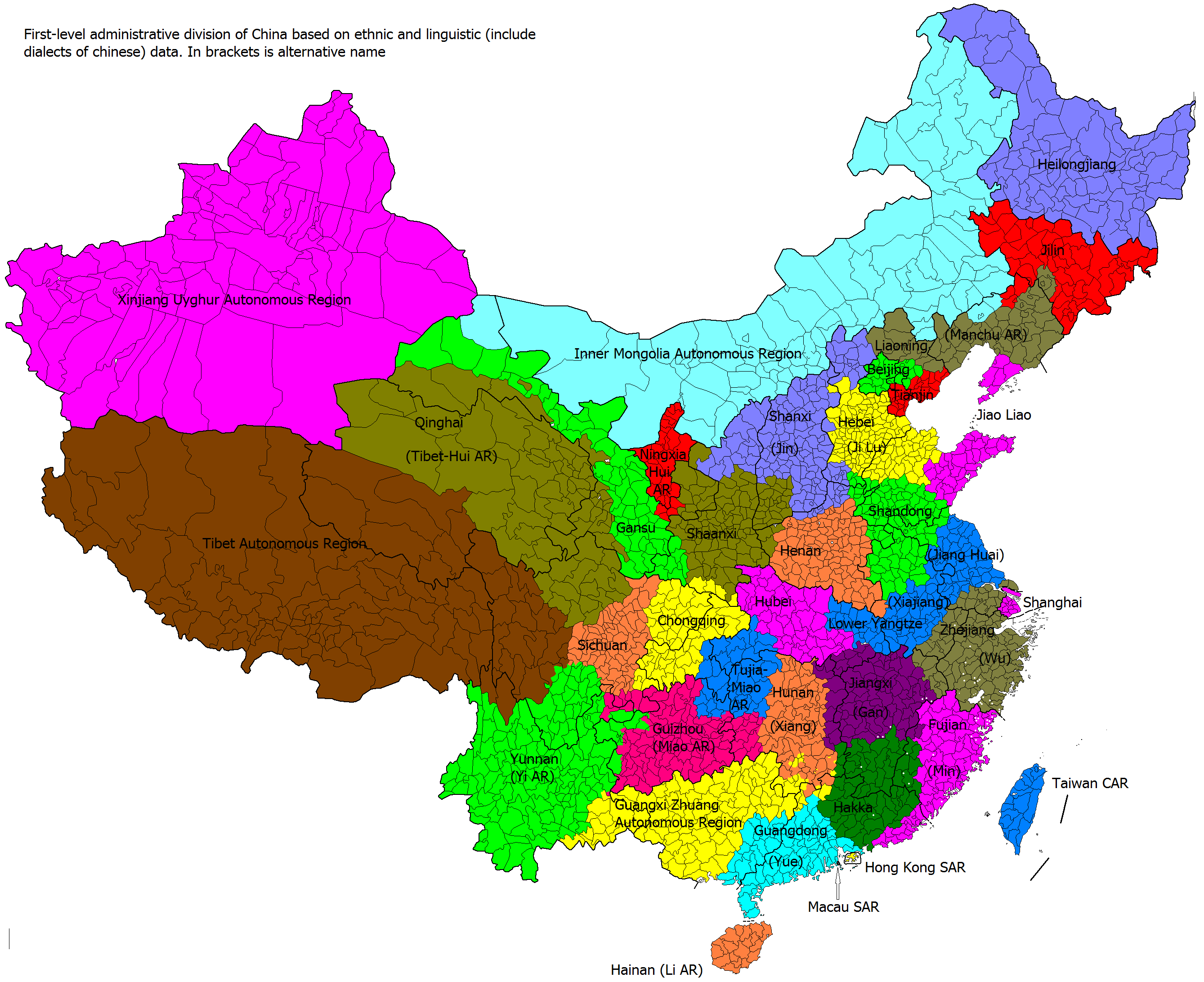
China has one very vulnerable point – Tibet. On the one hand, it is as if China, according to official Beijing. But from the point of view of many other states, including the US, it is a sovereign state illegally seized by China97.
Democratic countries have significantly more developed industry and science. Thus, out of the 30 largest countries in the world by total GDP size98, 20 (US, Japan, Germany, UK, France, Italy, Canada, South Korea, Australia, Spain, Netherlands, Turkey, Saudi Arabia, Poland, Sweden, Belgium, Thailand, Austria, Ireland, Israel) are classified by us as potential participants in the democratic block, and only 3 (China, Russia, Venezuela) belong to the authoritarian block. This is also manifested in the fact that the defense budget sizes of the countries in the democratic block are more than three times higher than the defense budgets of the countries in the authoritarian block99. If we take the Nobel Prize, the 3 leaders100 by the number of awards received among the countries of the authoritarian block are Russia/USSR (32 awards), China (8 awards), and Belarus (2). Combined, they are inferior to the fourth country in terms of awards – France (71 laureates), not to mention Germany (111), the UK (137), and the US (400), even without taking into account other countries of the democratic block.
All this means that in the event of mobilization of industry, the democratic block will surpass the authoritarian block in equipment production levels by several times, and with a much higher probability will create effective new types of weaponry. Technical superiority will manifest itself even in such details that are hard to think about – for example, democratic countries will be able to use the Windows system for their own purposes – for propaganda, for disruptions in the work of state institutions, and so on. In addition, in cyber warfare, during which attacks will be carried out on state portals and important websites, the democratic block will most likely prove stronger, as it is a target for migration of the best specialists – for example, a GeekBrains survey showed that every second Russian student studying information technology would like to leave Russia, and the most popular destinations named are the US, Germany, and the UK101. Silicon Valley has long been attracting the best technical specialists102. All this indicates that in the event of successful application of any types of weaponry by the authoritarian block, the democratic one can quickly create not only similar, but superior systems, owing to its advantage in the scientific sphere.
In the ranking of the Global Firepower think tank among the 50 countries with the greatest military power, only 7 can be attributed to the authoritarian block, while almost half – 24 states – can be attributed to the democratic block103.
Democratic countries can disconnect countries of the authoritarian block from the Swift system, as well as freeze the accounts of their officials and confiscate their property on their territory, as has already happened with many Russian officials104; which means that the danger of their families, who are often located in countries of the democratic block, being taken hostage is also not excluded. They can introduce a ban on American and European banks holding currency correspondent accounts of banks in countries of the authoritarian block. That is, effectively introduce a ban on any operations in dollars and euros. Then exporters will not be able to receive revenue in dollars and euros, companies in principle will not be able to conduct operations in these currencies, which remains the main settlement currency, and even the Bank of Russia will not be able to conduct interventions in dollars and euros, which will lead to a collapse of the ruble exchange rate.
Finally, democratic countries do not have such a strong dependence on raw material exports as the economy of Russia – one of the key countries of the authoritarian block. In 2021, mineral products accounted for 55.6% of the country’s export structure105, and this is without taking into account exports of timber, metals, rubber, and agricultural raw materials. With a total foreign trade turnover of 345.4 billion dollars, the EU countries alone accounted for 123.2 billion. If democratic countries stop buying Russian raw materials, the main revenue stream of Russian exports will thin out significantly, which will negatively affect the country’s economic capabilities, while democratic countries can choose other, neutral suppliers for themselves (though likely more expensive ones).
The quality of Russian and Chinese military equipment is likely the same as that of the automotive industry and other manufactured goods (conventionally speaking, while democratic countries have many military vehicles like Hummer and Gelandewagen, their authoritarian opponents have vehicles like UAZ or Chinese “fake Hummers”106). And usually neither Chinese nor Russian brands make it into the most reliable rankings – for example, they are absent from the top 20 most reliable car brands according to the CarMax portal107 or the top 28 in the Kelley Blue Book ranking108, although the quality of Chinese equipment is gradually growing. German and Japanese goods are most often cited as the most reliable, that is, goods from countries of the democratic block. Therefore, a large number of breakdowns of military equipment in countries of the authoritarian block and the reliability of equipment in countries of the democratic block can be predicted. In addition, countries of the democratic block have sufficient samples of Russian equipment (for example, T-80 tanks are held by Ukraine109 and South Korea110), and former Warsaw Pact countries are well acquainted with Soviet warfare practices, so they may be better prepared to counter them. It is possible that in the 90s, when Russia had an extremely unstable economic and political situation, Americans managed to buy up certain military secrets from corrupt authorities (for example, the UK managed to acquire several T-80U tanks for study111).
Moreover, the democratic block has a significant advantage in the number of many types of military equipment. Thus, the democratic block counts approximately 25,500 units of military aircraft, while the authoritarian block has approximately 10,400112. Superiority in attack helicopters is also overwhelming – approximately 10,700 against about 3,200 units113. Also, if we previously spoke about the authoritarian block’s advantage in the number of tanks, the democratic block significantly surpasses it in the total number of armored vehicles – 175,500 units against only 90,500114.
The democratic bloc has several traditionally strong intelligence services – the American CIA, the British MI6, and the Israeli Mossad115 (not counting the intelligence agencies of other democratic states). In the authoritarian bloc, the well-known ones usually include the Russian GRU and SVR. However, this is largely due to continuity from Soviet intelligence, which benefited from the ideology of communism that attracted people like Niels Bohr116 or Kim Philby; today, Russia has no such ideology with supporters in many countries around the world. Former Russian Vice Prime Minister Alfred Koch recalled that he learned all the information from top-secret reports brought to him by intelligence officers several days earlier from his own press service:
What was the difference between these two files: the stern top-secret FSB report and the frivolous digest from my press service? The whole point was that they wrote about the exact same news differently. My press service wrote: “Süddeutsche Zeitung reports”. And the FSB reports: “As was ascertained through a source recruited by us”. And then one day it hit me: there is no source. It is all lies! They do not recruit anyone. They read newspapers too and based on that they write their reports to the Center. And the recruitment money goes straight into their pockets… I also realized that this system has existed for decades. They were so confident that a government Vice Prime Minister (a seventy-year-old grandpa with a parish school background) would never, under any circumstances, read the “New York Times”, that they easily fed him garbage from the front page, passing it off as information from a top-secret, super-influential source whose recruitment required huge sums of money and tons of time (now hand over the Order of the “Red Star” and the shoulder boards of a KGB colonel). Periodically, the KGB financed exciting detective stories about intelligence agents and created a mythology around itself117.
Also, the situation for the intelligence services of the authoritarian bloc is complicated by the fact that many USSR intelligence officers and special service personnel emigrated to democratic countries – Oleg Gordievsky, Oleg Kalugin, Sergei Skripal, Alexander Litvinenko, Alexander Poteyev, and so on. In addition, even the Deputy Chief of Romania’s Foreign Intelligence, Ion Mihai Pacepa, defected to the US at one time. Ukrainian SVR knows Russian intelligence and its methods very well. The situation surrounding the poisoning of Alexei Navalny, who was able to uncover his poisoners with the help of phone calls, did not reflect very well on the image of Russian special services. However, despite all these factors, Russian intelligence remains one of the strongest in the world.
The democratic bloc has latest technologies at its disposal, such as Google Maps service databases with features like Google Street View, allowing users to view city streets. Accordingly, Google also possesses imagery of military and strategic facilities of authoritarian bloc countries118; moreover, other companies are also involved in satellite imagery119. Systems like Starlink allow democratic countries and their troops to have reliable Internet access to receive information120, and we will discuss UAVs further below. Why is advanced intelligence so important? The point is that if you have a better knowledge of enemy positions, plans, strength, and supply levels, then the difference in situational awareness, speed of response, and the ability to deliver accurate fire before being detected will also be significant, directly affecting the success of military operations.
Armament
As for the military equipment of the democratic bloc countries, it should be noted that it is very diverse, allowing the bloc to test which models will be most effective in combat operations and focus production on them. It also possesses many types of weaponry that either provide major advantages in combat or rank among the finest examples.
For example, the Austrian Glock is traditionally considered one of the best semi-automatic pistols121122. It features low weight and a simple design, consisting of only 33 parts, including the magazine123. It can be fully disassembled in under a minute using a nail and is made mostly of high-strength, heat-resistant – up to 200°C – plastic. The “Glock” is exceptionally reliable: its service life is 300,000 rounds (compared to general requirements of 40,000; the pistol was even listed in the Guinness Book of World Records), and it is also capable of firing underwater, after being pulled out of mud and sand, and is equally convenient for right-handed and left-handed shooters124.
One of the most powerful pistols in the world is often called the American – Israeli Desert Eagle125 – it was specially designed for the super – powerful .357 Magnum ammunition. Such ammunition is capable of piercing flimsy walls and body armor. However, this model is extremely inconvenient to use and demanding in maintenance, which is why the majority of the armed forces of the world refrain from adopting it, so the Desert Eagle is unlikely to create an advantage for the armies of the democratic block. However, there is already a much lighter and more convenient pistol capable of piercing Kevlar body armor – this is the Belgian FN Five – SeveN126 with a 20 – round magazine, which is also compatible with some interesting technologies like a sight with tritium inserts or a magazine safety.
One of the best submachine guns is considered to be the Belgian FN P90, created for the exact same high – power ammunition as the FN Five – SeveN (the author of the “Encyclopedia of Weapons”, Dmitry Alekseev, notes that “Belgium is a leading developer and manufacturer of small arms in the world, and this is known to anyone who has ever taken even a slight interest in military affairs”127). Its magazine holds almost twice as many rounds as the magazines of other modern submachine guns (50), which can be a significant advantage in fleeting close – quarters combat when there is no time to reload. In addition, the magazine is made of transparent plastic – the shooter can check the number of rounds in it at any time. Among other unique submachine guns of the democratic block is the Israeli Uzi, which allows firing with one hand if necessary128 and which is much cheaper to manufacture.
A widespread automatic carbine of the democratic block is the M4, which replaced the finicky M16 in the US army (however, it still has some reliability issues). The M4 is equipped with a Picatinny rail and an adjustable telescopic stock. Many additional components were specially developed for it, among which are – a reflex sight and an ACOG optical scope, night sights, visible and infrared laser target designators, a tactical flashlight, a characteristic front grip, a quick – detachable silencer that slips directly onto the standard flash hider, and a modified 40 – millimeter M203 grenade launcher. A more reliable model of an automatic rifle, which serves as a sort of substitute for the AK in the armies of the democratic block, is the inexpensive and proven Belgian FN FAL.
However, many consider the best model of automatic weapons to be the Austrian Steyr AUG, which combines the accuracy of the Belgian FN FAL, the grouping of the American M16, and the reliability of the AK129. It is light, ergonomic, and revolutionarily convenient when working in confined spaces. Like the FN P90, its magazine is made of transparent plastic. Thanks to interchangeable units, the assault rifle can be easily configured to perform a wide range of tasks – from clearing a building with narrow corridors and small rooms to conducting long – range sniper fire. True, some believe that the “best rifle of the West” is the FN SCAR – H130. In any case, the unreliability of primary small arms is no longer a weak point of the democratic block’s armies.
Snipers of the democratic world are also equipped with the state of the art. One of the best models is the US – manufactured semi – automatic large – caliber Barrett M82, intended more for destroying equipment and unexploded ordnance than manpower. When firing at medium distances, the bullet easily pierces a sheet of rolled steel armor up to three centimeters thick. It is traditionally included in many rankings of the best sniper rifles131. One of the most advanced is the CheyTac M200, which is part of the CheyTac LRRS system. It also includes a ballistic computer to which wind sensors, temperature sensors, and atmospheric pressure sensors can be connected. All this makes it possible to effectively hit a target comparable to a human figure at a range of up to 2,000 meters132. The world record for accuracy in combat conditions was set with the American McMillan TAC – 50, when a Canadian special forces soldier killed a militant in Iraq from a distance of 3,540 meters133. One of the most accurate rifles in the world is considered to be the Austrian Steyr HS .50 – according to RIA Novosti, it possesses “fantastic grouping” and from a distance of one hundred meters places bullets in a circle one and a half centimeters in diameter134. The compact Swiss OM 50 Nemesis is designed for effective operation in urban environments, in confined spaces.
However, the democratic block also has weapons that are effective against concentrations of a large number of infantry. For example, the German MG 3 is considered the highest – rate – of – fire machine gun in the world135, with a rate of fire ranging from 1,200 to 1,500 rounds per minute, depending on the firing mode. By this parameter, it leaves far behind counterparts from other countries (their rate of fire ranges from 600 to 900 rounds per minute). The American M2 is distinguished by high accuracy – the famous sniper Carlos Hathcock even used it for sniper shooting. In Vietnam, firing single shots, he hit human – sized targets at a distance of over 2,000 yards (1,830 meters), which is twice as far as for ordinary rifles. He set a record that held until 2002 by hitting a target (the hit was confirmed) at 2,460 yards, that is, 2,250 meters136.
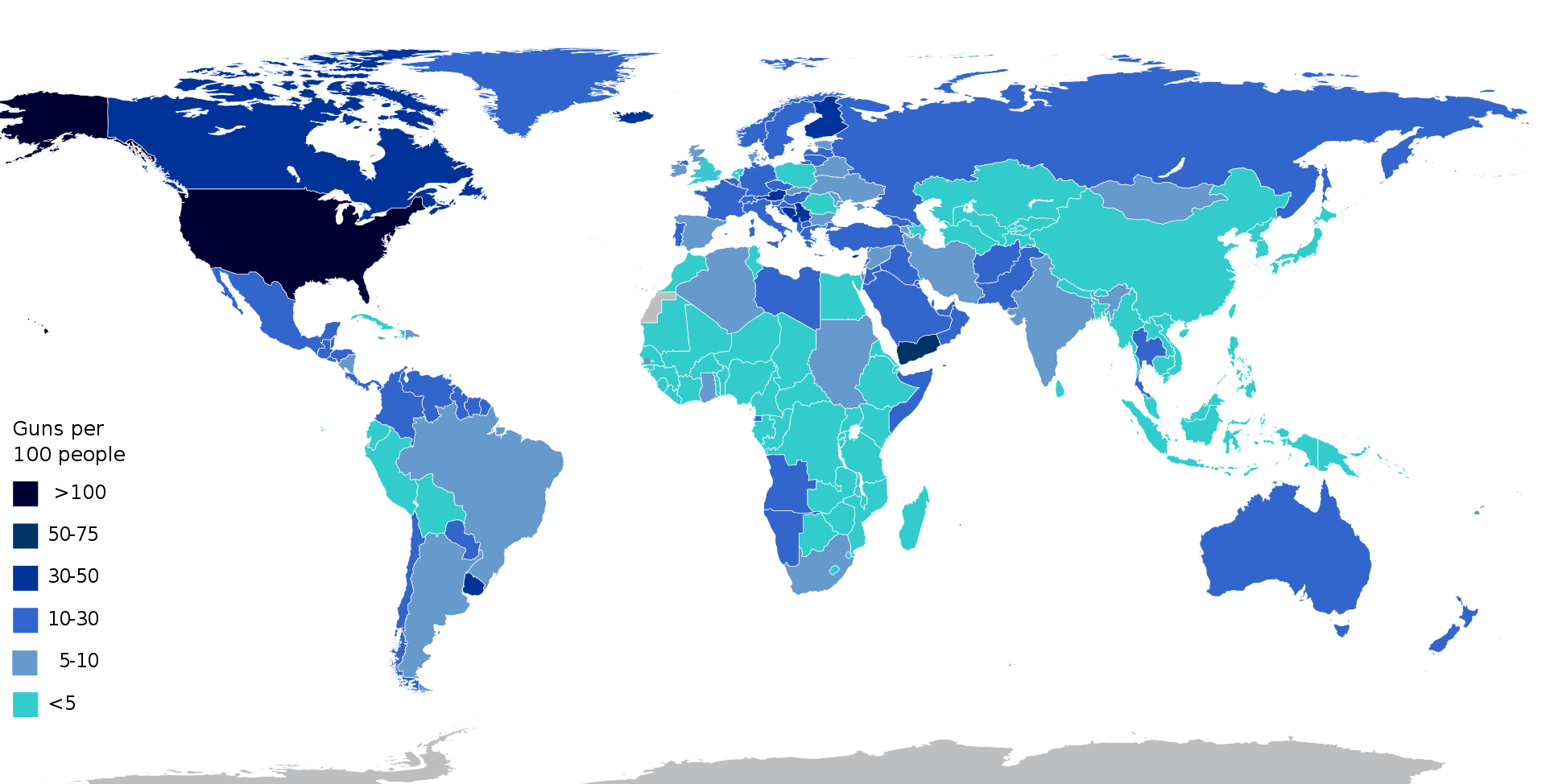
Generally, if the entire authoritarian block among the best advanced small arms manufacturers can boast at most the Kalashnikov Concern, the democratic block possesses a large number of well – known manufacturers and developers: FN, Heckler&Koch, Steyr, Beretta, SIG Sauer, Walther, Colt, Smith&Wesson, and so on. Moreover, besides professional armies, the democratic block will have enough civilians who know how to handle weapons – for instance, citizens of the US alone own 40% of all civilian firearms in the world, and in this country there are 121 units of small arms per every 100 people137.
Until the T-14 Armata is produced in sufficient quantities, the tanks of democratic countries are recognized as the most technologically advanced and combat – capable. Rossiyskaya Gazeta reports that, in addition to the T-14, the list of the world’s best includes the American M1 Abrams, the German Leopard 2, and the South Korean K2 Black Panther138. The Abrams features the most powerful depleted uranium armor and possibly the richest combat experience among all modern tanks. It is equipped with advanced thermal imagers and GPS systems, and its weaponry can be controlled remotely. The smoothbore gun of the Leopard 2 is capable of firing LAHAT guided missiles, and the tank itself is equipped with a protection system against weapons of mass destruction139. It is also worth noting the French Leclerc with an automatic shell loader (similar to the one on the South Korean Black Panther) and a digital fire control system.
However, in the modern world, the value of tank forces is declining due to the emergence of such effective tank – destruction means as the Javelin ATGM – for example, there are known cases where a dozen American paratroopers destroyed an entire tank company of the Iraqi army equipped with old T-55s using this weapon140. It is noted that Javelins will not be able to defeat the new modifications of the T-90SM141, however, according to The National Interest, they are capable of destroying the T-90A142. At the same time, as of 2018, the US had managed to produce about 40,000 Javelin systems143. As of 2021, the RF still lacked third – generation ATGMs144, whereas the democratic block has models that even surpass the Javelin – for instance, the Israeli Spike system, whose missiles have twice the range, cope with the task of target destruction even under jamming and the deployment of modern smoke screen systems, and the system itself can be mounted on aircraft.
The democratic block has a huge number of models of one of the most successful combat helicopters – the AH-64 Apache (in 2020, it was reported that Boeing delivered the 2,500th helicopter for the US Army145), which many still call the best of its kind146, and this despite the presence of newer AH-1Z Vipers, Eurocopter Tigers in democratic countries, as well as the existence of a relatively noticeable quantity of Ka-52 Alligators among authoritarian block countries. However, combat helicopters risk becoming a thing of the past, as drones are proving extremely effective in recent conflicts, such as the Turkish Bayraktar TB2, which, according to some experts, ensured Azerbaijan’s victory in the military conflict with Armenia in 2020147. Russia has no analogues to these drones (the S-70 Okhotnik is still in development), though China does; in any case, the democratic block has advanced noticeably further in this regard – for example, the British have the supersonic stealth drone Taranis, and the US has the MQ-9 Reaper, capable of ascending to an altitude of 14 kilometers and responsible for eliminating Sheikh al-Masri and General Qasem Soleimani148, as well as GAAS Avengers deployed on aircraft carriers, having an 18-kilometer ceiling and capable of carrying two laser – guided bombs. New types of weapons also include the so – called “kamikaze drones” Switchblade – guided homing missiles that can strike targets from a distance of tens of kilometers. Due to their small size, high speed, and silent flight, they are virtually invulnerable149.
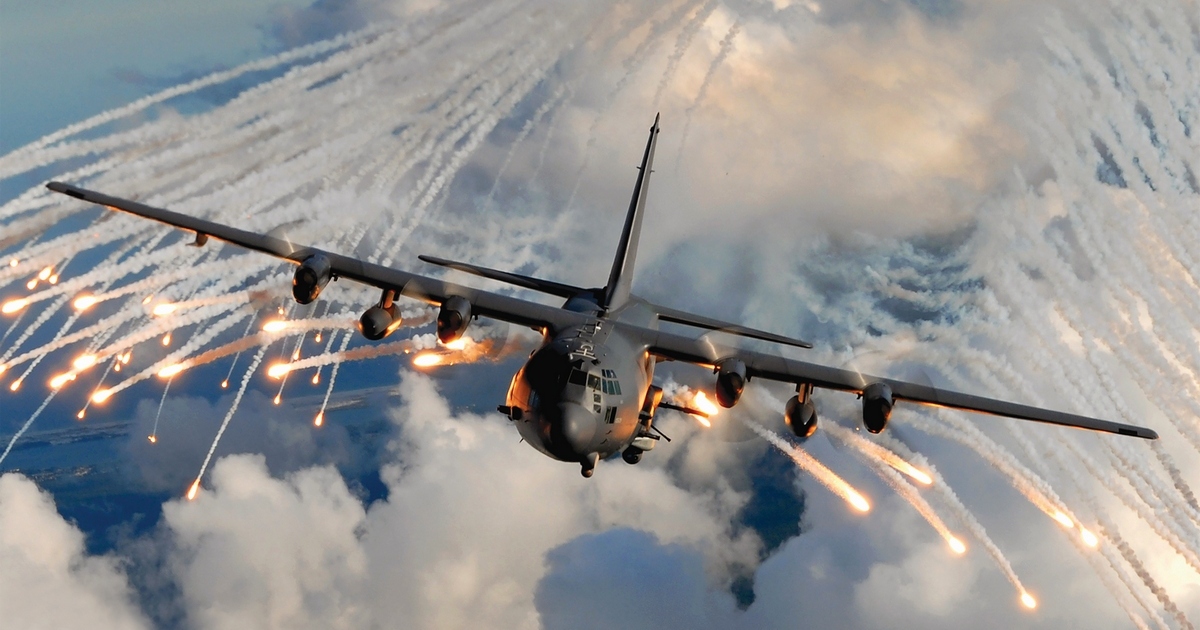
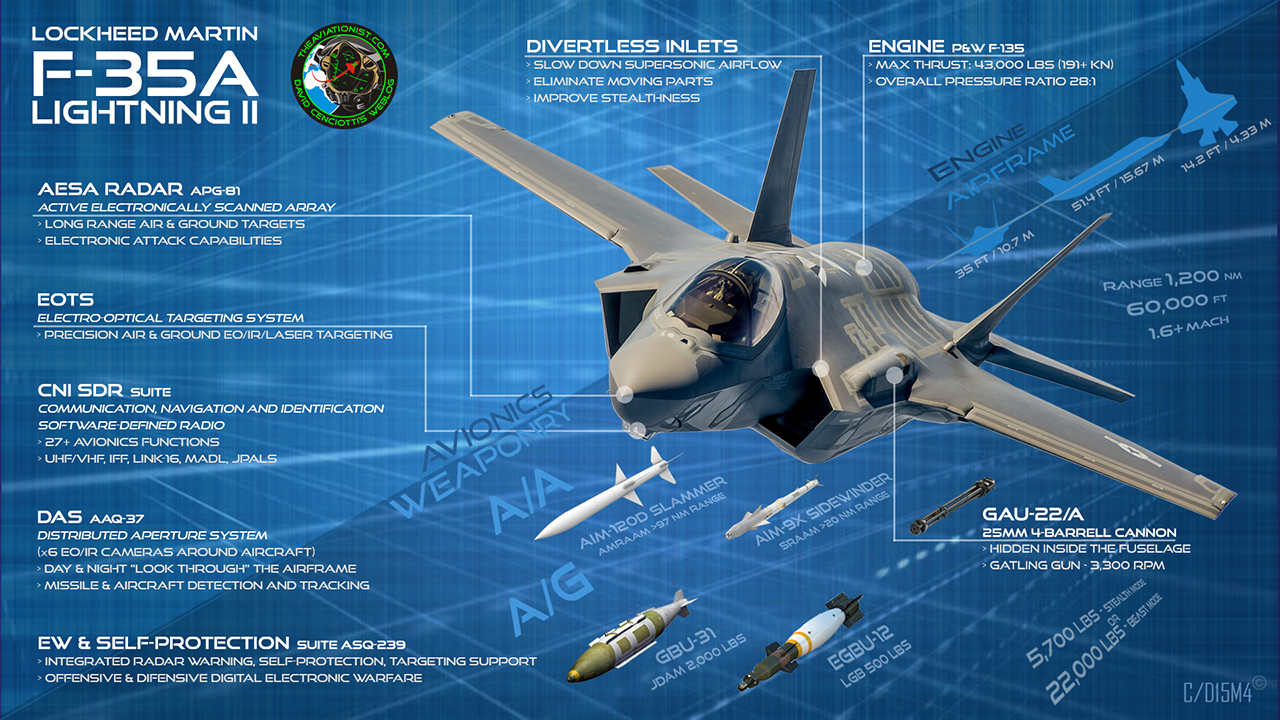
Continuing the theme of air weaponry, it should be noted that air superiority is traditionally fundamental for democratic states. For example, one of the deadliest types of weaponry is considered to be the American AC-130 gunships150. They are simultaneously equipped with a huge amount of weaponry, up to a 105-millimeter howitzer151 and a combat laser152. These aircraft have shown extremely high combat effectiveness in practice in destroying ground troops, enemy fortifications, and other targets153 – for example, during the Vietnam War they destroyed over 10,000 trucks of Viet Cong transport columns154. The democratic block has a large number of modern fifth-generation fighters built using stealth technology and capable of flying over enemy territory unnoticed by radar. These include the F-35, sometimes called the “best fighter in the world”155, though it is not just a fighter – it is a multifunctional aircraft also capable of performing bomber functions. By the end of 2021, there was information that as many as 730 units of the F-35 had been produced156. However, the US also has F-22 fifth-generation fighters produced in the quantity of 187 units157, as well as the legendary but outdated F-117s decommissioned and stored at the Davis-Monthan Air Base. There is also a certain number of B-2 heavy stealth bombers in service. Besides all this, the US claims that it is already working on the development of a sixth-generation fighter158. Vertical takeoff and landing fighter-bombers Harrier II also remain in service. The armament of the democratic block’s aviation also surpasses that of its rivals – for instance, Russian aviation lacks glide bombs (such as the American JSOW glide bombs), as well as tactical airborne cruise missiles, such as the American AGM-158 JASSM tactical cruise missile and the European Storm Shadow159.
The US has traditionally been very strong in reconnaissance aviation, dating back to the times of the famous U-2 aircraft. The last known strategic reconnaissance aircraft is the SR-71 – according to some reports, more than 4,000 missiles were fired at it, but not a single one hit the target160. However, it is now decommissioned. There are assumptions that it was replaced by the new top – secret strategic reconnaissance aircraft Aurora161, though there is no confirmation of this. Officially, one of the main US reconnaissance vehicles is the MQ-4C Triton UAV, which can ascend to an altitude of about 18 kilometers162. But US intelligence gets its main data from satellites, which even commercial companies possess – for example, a certain commotion was caused by rumors that Google stopped hiding Russia’s military and strategic facilities on its maps163.
Also, the democratic block traditionally includes powers considered to be maritime. Today, control over the oceans is exercised primarily by the US. The main striking force here is 10 nuclear aircraft carriers of the Nimitz class, which are the largest warships in the world. Also, one Kitty Hawk aircraft carrier is in reserve, and 3 newest Gerald R. Ford class ships are under construction. Such power gives the US the ability to deploy its air groups to different parts of the world’s oceans and perform a wide range of combat missions, ensuring the global presence of the US in all parts of the world. The democratic block has 5 more aircraft carriers (the French Charles de Gaulle, the Spanish Juan Carlos, the Italian Cavour and Giuseppe Garibaldi, the Thai Chakri Naruebet), and 2 British Kitty Hawk class aircraft carriers are under construction. As for the authoritarian block, it has only 2 such ships – the Russian Admiral Kuznetsov and the Chinese Liaoning (another one is under construction). In total, the democratic block has about 3,700 military vessels and submarines, while the authoritarian block has approximately 2,300164.
In general, the submarine fleet of the democratic block does not greatly surpass the submarine fleet of the authoritarian block, but this is compensated by increased attention to anti – submarine warfare. Thus, developed democratic countries possess American Boeing P-8A Poseidon anti – submarine aircraft, whose radar station allows terrain mapping, recognition of stationary surface targets, as well as detecting submarines located at periscope depth165. It can very quickly arrive in the zone where enemy submarines are potentially located. Orca underwater drones are currently under construction and are planned to be used in reconnaissance, long – range autonomous missions, as well as in rescuing swimming vehicles and working in hazardous conditions166. In addition, they will be capable of destroying sea mines, submarines, surface ships, conducting electronic warfare, detecting enemy submarines, and transmitting information about them to aviation and ships167.
High – precision Tomahawk cruise missiles are also an instrument of control over water spaces, which can likewise serve for strikes against ground targets and generally have a wide range of applications. Their latest modifications have been protected against electronic warfare and manufactured using stealth technologies, which significantly increases survivability168. However, the authoritarian block has a comparable analogue – Russian Kalibr missiles (although the RF has approximately 5 times fewer carriers for such missiles). In general, in terms of missile weaponry, the authoritarian block is very advanced, although the democratic block also has modern systems like the MGM-140 ATACMS. At the same time, let us note that while the authoritarian block has nowhere to maneuver Iskanders to strike US territory, the democratic block has sufficient space for the effective deployment of ATACMS. The democratic block also has good developments in the field of missile defense. For example, Israel has the Iron Dome air defense system, which over 10 years managed to intercept and destroy 2,400–2,500 missiles flying toward Israel, which is about 90%169.
Unique new technologies are also being tested by the armies of the democratic block countries. For example, these are Quantum Stealth “invisibility cloaks” created by the Canadian company Hyperstealth Biotechnology, capable of making infantry, equipment (tanks, planes, ships), and from a certain angle even buildings literally invisible170. At the same time, IAVS goggles were developed to order by the US Army, allowing soldiers to see through the walls of combat vehicles and structures171, which will allow for a better assessment of the situation during combat. Daedalus jetpacks are being tested by the British172. TALON combat robots are already successfully used by democratic countries and can be utilized in any weather and time of day for laying mines, demining, reconnaissance, communications, and in search and rescue operations. In Iraq, Talon robots neutralized over 50,000 mines and improvised explosive devices173.
Most of the above are just well – known types of weaponry. It is quite possible that the democratic world’s armies also possess weaponry about which we have no information. In general, we see that the democratic block has an advantage at sea and in the air. That means strategic bombings on its part will be much more effective than those of the authoritarians. It also holds superiority in space.
A possible course of events
In the event that a world war between such blocks actually begins, the main theaters of operations will become three – Asia, the Middle East, and Europe. If Cuba, Venezuela, and Nicaragua enter the war, most likely the battles on the Latin American front will not last long – the US has experience with fairly lightning – fast operations in El Salvador (1977), Grenada (1983), Panama (1989), and Haiti (1994), and the democracies’ advantage in this region is far too overwhelming.
The only region where authoritarian regimes have an advantage is Asia. Therefore, the US will probably concentrate on helping the democracies in this region and direct most of its forces specifically toward countering China. Due to the island positioning of states such as Japan, Australia, the Philippines, Taiwan, New Zealand, one can assume that the authoritarian block realizes the labor – intensiveness of knocking them out of the fight and will either concentrate on one of them (it is logical to assume this will be Taiwan, given the particularly difficult relationship with the leader of the authoritarian block – China) or on the continental allies of the democratic block, such as South Korea (here, an offensive will most likely be conducted jointly with North Korea). There is a high probability that the democracies will be able to hold out until American armies land on the continent, in which case the advantage will pass over to them. In general, the outcome of the confrontation in Asia is unpredictable and it is not possible to forecast it in any reasonably convincing manner within the scope of a single article.
Much will depend on the war in the oil – rich Middle East. Here, Iran, Syria, and Yemen can currently be attributed to the authoritarian block. Whether Afghanistan or anyone else will join them is not entirely clear at the moment. The democratic block is represented by Israel and Turkey; Saudi Arabia, Egypt, Kuwait, and Qatar may potentially join them. If such an accession takes place, it can be considered that an overwhelming advantage will be on the side of the democratic block, and it will not even need Europe’s help or the participation of significant forces on the part of Turkey. In Syria, rebels will perform on the side of the democratic block, so here, most likely, Syria will be quickly defeated and more complex military operations against Iran will begin.
Finally, in the potential European theater of operations, the democracies have a noticeable advantage. During the “special operation” currently underway in Ukraine, the Russian army has not shown the ability to quickly and convincingly defeat the Ukrainian army, and performing jointly with the Belarusian army against the combined forces of the European Union, Ukraine, Georgia, and Turkey has extremely low chances of success. It is hard to expect that China or Iran will send troops to help Russia and Belarus – they will be concerned primarily with the situation in their regions, which is far from simple. But it is also logical to assume that European democracies will not advance into Russian territory until the fuel problem in the Middle East is resolved, so Russia may have time to organize military operations capable of introducing chaos on this front. Therefore, the most probable scenario is the victory of the democratic block first in the Middle East, and following that in Europe. In this case, the defeat of the authoritarian block in Asia also becomes a matter of time.
Does the authoritarian block have the capabilities for victory? The start of Russia’s “special operation” in Ukraine significantly diminished the power of one of authoritarianism’s strong points – the element of surprise. Therefore, today these chances can be viewed as fairly low. Perhaps if China, North Korea, and Iran do not force events in their regions, but concentrate on a joint “dash to the English Channel” with Russia – such a scenario could pose a significant danger to the democratic block. However, for the successful execution of such an operation, China would also have to allocate aviation, which would weaken the defense of Beijing and the country’s important industrial centers, exposing it to strikes by US aviation and the region’s democracies. And all this for the sake of an almost adventuristic design to quickly capture continental Europe, which, after the events in Ukraine, looks even more unbelievable. Therefore, it can be assumed that this scenario will be abandoned.
Will there be an Apocalypse?
Of course, all adequate humanity fears the possibility of the use of doomsday weapons and subsequent mutual nuclear annihilation. And all the above – described scenarios imply that nuclear weapons will not be used. But what if madness prevails over common sense and one of the sides decides to use them?
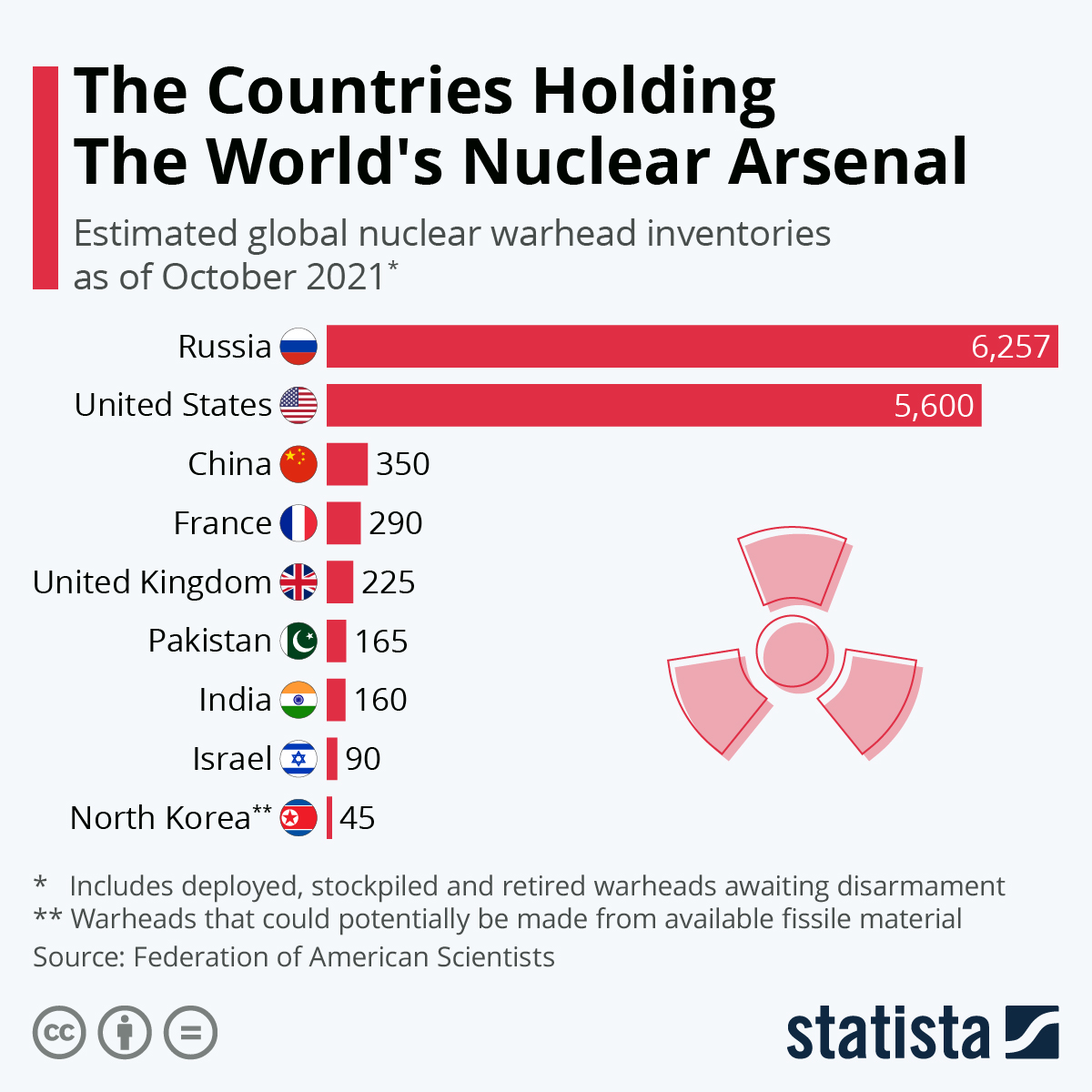
The current director of Roscosmos, Dmitry Rogozin, stated no earlier than 2013 that in the event of a war, the US could destroy 90% of Russia’s missiles in 6 hours using high – precision weapons174. Has the situation changed now? In 2021, former Pentagon employee Edward Luttwak said the following:
ABM systems could neutralize the most important final argument in the defense of Russia’s sovereignty – its nuclear potential. Since Russia simply does not have the money either for a qualitative nuclear arms race or for a race of strategic defense systems, they decided to invest money in long – term programs to create weaponry that will bypass all defense systems capable of lowering the combat potential of Russia’s strategic nuclear potential175.
The General Staff of the RF has already noted the ability of US ABM systems to intercept ballistic missiles in the boost phase of their flight, as well as to destroy orbital satellites176. Considering the strength of the democratic block’s intelligence agencies, as well as its superiority in technology, one could assume that democracies will find a way to destroy most of Russia’s nuclear weapons and shoot down those missiles that still manage to take off. Besides, in countries with a more affluent population, a greater number of people can afford to build bomb shelters, so it is logical to expect the survival of a larger number of representatives specifically from democratic countries after such a war (in authoritarian countries, at most their top leadership might survive, which upon the emergence of people into the post – apocalypse world will inevitably be destroyed by surviving democrats due to the high level of threat). Therefore, the culture of authoritarian countries in the event of a nuclear war is certainly doomed. However, the risk is too great for everyone in any case – the possibility of the destruction of the entire world and all of humanity as a species in the event of a nuclear conflict remains very high.
Conclusion
It can be stated with a very high degree of probability that if the modern “cold” war transitions into a hot phase and flows into World War III, which, apparently, will become a conflict between the democratic and authoritarian blocks of countries, it will lead to the defeat of the authoritarian block. The consequence of this, perhaps, will be the redivision of spheres of influence, the collapse of authoritarian countries, and regime change to a democratic one. Russia cannot win in this war in any case. Even if we allow for a scenario with the victory of the authoritarian block, China – which surpasses Russia in technological potential and significantly surpasses it in population – would not need a strong rival nearby, and the conduct of military operations by it against Russia becomes a matter of time. Therefore, participation in the authoritarian block promises no benefits for the country.
The most beneficial scenario for Russia is the radical democratization of the regime. Of course, the transition to a complete democracy is impossible without creating a strong opposition, ensuring real rotation of power, and a wide complex of similar measures. These are all labor – intensive processes that require considerable political will. However, with Russia, the dominance of the democratic block will become overwhelming and undisputed, and the country itself will end up on the winning side. Transitioning to a democratic regime and participating in the democratization of Asia, having secured a stable and calm situation in the country due to the growth of its citizens’ well – being and partnership relations with developed countries, is the best thing that can be in Russia’s interests today. A democratic Russia could in the future become one of the leaders of the European Union, and after the democratization of Asia and the Middle East, the US itself might become an authoritarian state by new global standards requiring democratization (due to the fact that the presidential model is less democratic than the parliamentary one). To show an example of democracy to the United States itself and help its citizens in improving their political system, to become a leader of democratic Eurasia not through the violent subjugation of others, but through respect from them – this is a goal worthy of Russia, and this is why this country needs radical democratization. And being a Sancho Panza for China in a low – prospect authoritarian block in order to become the next victim in case of victory is a role that merely disgraces the country.
We express our gratitude to Nikita Malinovsky and Artem Kuznetsov for their help in writing the article.
- V. Kropman. Joe Biden: The People of Russia Are Not Our Enemy // Deutsche Welle (www.dw.com). March 26, 2022. [Electronic resource]. URL: https://www.dw.com/ru/dzho-bajden-narod-rossii-ne-javljaetsja-nashim-vragom/a-61270256 (Date of access: May 3, 2022).
- Collective defence – Article 5 // NATO (www.nato.int). [Electronic resource]. URL: https://www.nato.int/cps/ru/natohq/topics_110496.htm (Date of access: May 3, 2022).
- A. Papaioannou. EU-NATO Relations: Time to Step Up // NATO Review (www.nato.int). July 16, 2019. [Electronic resource]. URL: https://www.nato.int/docu/review/ru/articles/2019/07/16/ukreplenie-otnoshenij-es-s-nato/index.htm (Date of access: May 3, 2022).
- EU Package of Measures in Security and Defence // EEAS Website (www.eeas.europa.eu). October 19, 2017, 12:23. [Electronic resource]. URL: https://eeas.europa.eu/headquarters/headquarters-homepage_ru/17110/Пакет мер ЕС в сфере безопасности и обороны (Date of access: January 16, 2019).
- NATO Member Countries // NATO (www.nato.int). [Electronic resource]. URL: https://www.nato.int/cps/ru/natohq/topics_52044.htm (Date of access: May 3, 2022).
- Countries in the EU and EEA // GOV.UK (www.gov.uk). [Electronic resource]. URL: https://www.gov.uk/eu-eea (Date of access: May 8, 2022).
- Olga Lebedeva. Sweden and Finland Submitted Applications for NATO Membership // Deutsche Welle (www.dw.com). May 18, 2022. [Electronic resource]. URL: https://www.dw.com/ru/shvecija-i-finljandija-podali-zajavki-na-chlenstvo-v-nato/a-61834245 (Date of access: May 27, 2022).
- Major Non-NATO Ally Status // U.S Department of State (www.state.gov). January 20, 2021. [Electronic resource]. URL: https://www.state.gov/major-non-nato-ally-status/ (Date of access: May 8, 2022).
- Tatyana Zykina. Biden Made Colombia One of the Major US Allies Outside NATO // RBC (www.rbc.ru). May 24, 02:51. [Electronic resource]. URL: https://www.rbc.ru/politics/24/05/2022/628c18119a79470cf5eebbdd (Date of access: May 27, 2022).
- Stoltenberg Stated That Timeframes for Ukraine and Georgia Entering NATO Have Not Been Set // TASS (tass.ru). January 14, 2022, 14:28. [Electronic resource]. URL: https://tass.ru/mezhdunarodnaya-panorama/13426487 (Date of access: May 8, 2022).
- EU Council Announced the Start of Consideration of Applications from Ukraine, Georgia, and Moldova for Accession // TASS (tass.ru). March 7, 2022, 23:18. [Electronic resource]. URL: https://tass.ru/mezhdunarodnaya-panorama/13995871 (Date of access: May 8, 2022).
- Moldova Will Choose Between Pro-Western and Pro-Russian // RBC (www.rbc.ru). July 8, 2021, 07:30. [Electronic resource]. URL: https://www.rbc.ru/politics/08/07/2021/60e570039a794778de017ca5 (Date of access: May 8, 2022).
- Israel on the world map: North America // Ministry of Foreign Affairs of Israeli (mfa.gov.il). [Electronic resource]. URL: https://mfa.gov.il/mfarus/foreignrelations/amongthenations/pages/northamerica.aspx (Date of access: August 31, 2013).
- E.R. Wald. The United States and Saudi Arabia aren’t allies. They never have been // The Washington Post (www.washingtonpost.com). February 5, 2020. [Electronic resource]. URL: https://www.washingtonpost.com/outlook/2020/02/05/united-states-saudi-arabia-arent-allies-they-never-have-been (Date of access: May 9, 2022).
- J. Marcus. Why Iran and Saudi Arabia Are Bitter Rivals // BBC (www.bbc.com). September 17, 2017. [Electronic resource]. URL: https://www.bbc.com/russian/features-49716664 (Date of access: May 9, 2022).
- A. Sharkovsky. The Pentagon Has Redeployed Troops, Combat Aircraft and Four Missile Defense Batteries to Saudi Arabia // Nezavisimoye Voyennoye Obozreniye (nvo.ng.ru). February 26, 2020, 22:33. [Electronic resource]. URL: https://nvo.ng.ru/nvo/2020-02-26/100_pentagon260220.html (Date of access: May 9, 2022).
- D. Hodali, N. Pozdnyakova. Military Coalition Against Iran: Who in the Persian Gulf Will Support the US // Deutsche Welle (www.dw.com). July 12, 2019. [Electronic resource]. URL: https://www.dw.com/ru/военная-коалиция-против-ирана-кто-в-персидском-заливе-поддержит-сша/a-49553497 (Date of access: May 9, 2022).
- M. Tsuruoka. Asia, NATO and Its Partners: A Complicated Relationship? // NATO (www.nato.int). February 10, 2010. [Electronic resource]. URL: https://www.nato.int/docu/review/ru/articles/2010/02/10/aziya-nato-i-ee-partnery-sloyonye-otnosheniya/index.htm (Date of access: May 9, 2022).
- V.M. Mazyrin. A New Step on the Path of Vietnam’s Rapprochement with the US // IA REGNUM (regnum.ru). September 13, 2021, 21:13. [Electronic resource]. URL: https://regnum.ru/news/polit/3369119.htm (Date of access: May 9, 2022).
- Commonwealth // Great Russian Encyclopedia (bigenc.ru). [Electronic resource]. URL: https://bigenc.ru/world_history/text/4465324 (Date of access: May 9, 2022).
- List of Countries // Collective Security Treaty Organization (odkb-csto.org). [Electronic resource]. URL: https://odkb-csto.org/countries/ (Date of access: May 9, 2022).
- Proposal Made to Russia and China to Create an Alliance Superior in Strength to NATO // Lenta.ru (lenta.ru). January 18, 2020. [Electronic resource]. URL: https://lenta.ru/news/2022/01/18/sco/ (Date of access: May 9, 2022).
- Chinese Hypersonic Missile Tests: US Alarmed, Kremlin Indifferent // BBC (www.bbc.com). October 19, 2021. [Electronic resource]. URL: https://www.bbc.com/russian/news-58968154 (Date of access: May 9, 2022).
- A Protocol on Cooperation Between the CSTO and SCO Will Be Signed in the Near Future // CSTO (www.odkb.gov.ru). July 31, 2007. [Electronic resource]. URL: http://www.odkb.gov.ru/pr/ezp.htm (Date of access: May 9, 2022).
- T. Vaal. CSTO Troops Will Not Be Involved in the Armed Conflict Between Russia and Ukraine – Ashimbayev // Vlast Analytical Internet Magazine (vlast.kz). February 24, 2022, 11:50. [Electronic resource]. URL: https://vlast.kz/novosti/48825-vojska-odkb-ne-budut-zadejstvovany-v-vooruzennom-konflikte-mezdu-rossiej-i-ukrainoj-asimbaev.html (Date of access: May 9, 2022).
- B. Bezpalko. Mad Kazakhstan Is Turning into a Second Ukraine // IA REGNUM (regnum.ru). April 1, 2022. [Electronic resource]. URL: https://regnum.ru/news/3552717.html (Date of access: May 9, 2022).
- Putin Flew to Assad in Damascus. They Discussed War and Peace // BBC (www.bbc.com). January 7, 2020. [Electronic resource]. URL: https://www.bbc.com/russian/news-51028674 (Date of access: May 9, 2022).
- D. Laru. On the Same Path Together: Iran Offered the RF Long-Term Strategic Cooperation // Izvestia (iz.ru). January 1, 2022, 20:20. [Electronic resource]. URL: https://iz.ru/1279555/dmitrii-laru/na-tom-zhe-vmeste-iran-predlozhil-rf-strategicheski-sotrudnichat-vdolguiu (Date of access: May 9, 2022).
- N. Smagin. Strategic Distrust. Why Russia and Iran Are Failing to Become Allies // Carnegie Endowment for International Peace (carnegie.ru). June 4, 2019. [Electronic resource]. URL: https://carnegie.ru/commentary/79251 (Date of access: May 9, 2022).
- Israel Announced Iran’s Plans to Arm Allies with Drones // Izvestia (iz.ru). September 27, 2021, 16:58. [Electronic resource]. URL: https://iz.ru/1227569/2021-09-27/v-izraile-zaiavili-o-planakh-irana-vooruzhit-soiuznikov-bespilotnikami (Date of access: May 9, 2022).
- ALBA-TCP (www.albatcp.org). [Electronic resource]. URL: https://www.albatcp.org/en/ (Date of access: May 9, 2022).
- A.E. Yakimenko. Bolivarian Alliance for the Peoples of Our America – Peoples’ Trade Agreement // Great Russian Encyclopedia (bigenc.ru). [Electronic resource]. URL: https://bigenc.ru/economics/text/3438801 (Date of access: May 9, 2022).
- Inter-American Treaty of Reciprocal Assistance (1947) // RIA Novosti (ria.ru). September 18, 2019, 13:27. [Electronic resource]. URL: https://ria.ru/20190918/1558803891.htm (Date of access: May 9, 2022).
- State Department: US and Allies Invoked Collective Pact for Joint Measures Against Caracas // TASS (tass.ru). September 18, 2019, 04:55. [Electronic resource]. URL: https://tass.ru/mezhdunarodnaya-panorama/6897016 (Date of access: May 9, 2022).
- M. Kovalenko. Russia Has Two Allies, and Even Those Are Not Allies // Kommersant (www.kommersant.ru). November 26, 2019, 20:45. [Electronic resource]. URL: https://www.kommersant.ru/doc/5098345 (Date of access: May 9, 2022).
- A. Kots. Ideal Allies. Why the Russian and Indian Militaries Are Learning to Fight Together // RIA Novosti (ria.ru). October 19, 2017, 07:31. [Electronic resource]. URL: https://ria.ru/20171019/1507179582.html (Date of access: May 9, 2022).
- A. Kortunov. Why India Will Not Become an Ally of the US // RIAC: Russian International Affairs Council (russiancouncil.ru). November 8, 2021. [Electronic resource]. URL: https://russiancouncil.ru/analytics-and-comments/analytics/pochemu-indiya-ne-stanet-soyuznikom-ssha/ (Date of access: May 9, 2022).
- A. Zakharov. Separated to the Poles. How India’s Rapprochement with the US Will Affect Relations with Russia // Carnegie Endowment for International Peace (carnegie.ru). July 2, 2021. [Electronic resource]. URL: https://carnegie.ru/commentary/84815 (Date of access: May 9, 2022).
- E. Pakhomov. The QUAD Four — an Asian NATO? A View from India // TASS (tass.ru). September 28, 2021, 11:15. [Electronic resource]. URL: https://tass.ru/opinions/12522035 (Date of access: August 30, 2023).
- S. Strokan. The Pakistani Prime Minister Will Fly to Moscow // Kommersant (www.kommersant.ru). February 22, 2022, 15:01. [Electronic resource]. URL: https://www.kommersant.ru/doc/5229062 (Date of access: May 9, 2022).
- V. Gulevich. Cambodia in the Context of US-China Competition in SEA // The International Affairs (interaffairs.ru). December 24, 2021. [Electronic resource]. URL: https://interaffairs.ru/news/show/33024 (Date of access: May 9, 2022).
- G. Corera. How Intelligence Officers Tried to Warn the World About the Invasion of Ukraine and Why No One Believed Them // BBC (www.bbc.com). April 10, 2022. [Electronic resource]. URL: https://www.bbc.com/russian/features-61052965 (Date of access: May 9, 2022).
- Total Population by Country 2022 // World Population Review (worldpopulationreview.com). [Electronic resource]. URL: https://worldpopulationreview.com/countries (Date of access: May 13, 2022).
- Active Military Manpower (2022) // Global Firepower – 2022 World Military Strength Rankings (www.globalfirepower.com). [Electronic resource]. URL: https://www.globalfirepower.com/active-military-manpower.php (Date of access: May 13, 2022).
- M. Garside. Leading countries worldwide based on natural resource value as of 2021 // Statista (www.statista.com). May 9, 2022. [Electronic resource]. URL: https://www.statista.com/statistics/748223/leading-countries-based-on-natural-resource-value/ (Date of access: May 13, 2022).
- C. Antony, M. Boyle, K.R. Shmitt. 10 Countries With the Most Natural Resources // Investopedia (www.investopedia.com). May 7, 2022. [Electronic resource]. URL: https://www.investopedia.com/articles/markets-economy/090516/10-countries-most-natural-resources.asp (Date of access: May 13, 2022).
- Oil Production by Country by Country // Global Firepower – 2022 World Military Strength Rankings (www.globalfirepower.com). [Electronic resource]. URL: www.globalfirepower.com/oil-production-by-country.php (Date of access: May 13, 2022).
- Proven Oil Reserves by Country by Country // Global Firepower – 2022 World Military Strength Rankings (www.globalfirepower.com). [Electronic resource]. URL: https://www.globalfirepower.com/proven-oil-reserves-by-country.php (Date of access: May 13, 2022).
- Scandal in Austria over “talks with a Russian woman”. Chancellor Kurz called for early elections // BBC (www.bbc.com). May 18, 2019. [Electronic resource]. URL: https://www.bbc.com/russian/news-48320868 (Date of access: May 13, 2022).
- Report On The Investigation Into Russian Interference In The 2016 Presidential Election // U.S. Department of Justice (www.justice.gov). March 2019. [Electronic resource]. URL: https://www.justice.gov/archives/sco/file/1373816/download (Date of access: May 13, 2022).
- Y. Zhigalkin. The Power and Weakness of Russia. U.S. Military Intelligence Report // Radio Liberty (www.svoboda.org). June 15, 2021. [Electronic resource]. URL: https://www.svoboda.org/a/31256277.html (Accessed: May 13, 2022).
- Tank Strength by Country (2022) // Global Firepower – 2022 World Military Strength Rankings (www.globalfirepower.com). [Electronic resource]. URL: https://www.globalfirepower.com/armor-tanks-total.php (Date of access: May 13, 2022).
- The Military Balance 2021 / International Institute for Strategic Studies. — Abingdon: Taylor & Francis, 2021. — 504 p.
- D. Alekseev. Encyclopedia of Weapons / Dmitry Alekseev. – 504 p. – M.: Eksmo, 2014. – p. 442.
- Pavel Voronov. “Kalash” is No Longer the World’s Best // Ferra (www.ferra.ru). September 11, 2021, 14:13. [Electronic resource]. URL: https://www.ferra.ru/review/techlife/kalash-bolshe-ne-luchshii-v-mire.htm (Date of access: May 26, 2022).
- D. Alekseev. Encyclopedia of Weapons / Dmitry Alekseev. – 504 p. – M.: Eksmo, 2014. – p. 442.
- V. Grinkevich. A Lethal Masterpiece: What You Need to Know About the Legendary SVD After the 100th Anniversary of Its Creator // Profile (profile.ru). March 3, 2020. [Electronic resource]. URL: https://profile.ru/military/ubojnyj-shedevr-chto-nuzhno-znat-o-legendarnoj-svd-posle-100-letiya-ee-avtora-244389/ (Date of access: May 13, 2022).
- D. Alekseev. Encyclopedia of Weapons / Dmitry Alekseev. – 504 p. – M.: Eksmo, 2014. – p. 468.
- M. Ovsyannikova. Experts Talked About the Pros of the Sniper Rifle Replacing the SVD // RBC (www.rbc.ru). October 6, 2021. [Electronic resource]. URL: https://www.rbc.ru/rbcfreenews/615c4f309a794774de8c626c (Date of access: May 13, 2022).
- The Longest-Range Russian Rifle Is in Service in Five Countries // RIA Novosti (ria.ru). June 5, 2020, 11:28. [Electronic resource]. URL: https://ria.ru/20200605/1572504368.html (Date of access: May 13, 2022).
- A. Kots. Support with Fire. The Best General-Purpose Machine Guns of World Countries // RIA Novosti (ria.ru). March 3, 2018, 10:06. [Electronic resource]. URL: https://ria.ru/20180422/1518612654.html (Date of access: May 13, 2022).
- The “Armata” Tank Turned Out to Be Too Expensive for Russia, and the T-72 Not That Old // BBC (www.bbc.com). July 31, 2018. [Electronic resource]. URL: https://www.bbc.com/russian/features-45005420 (Date of access: May 13, 2022).
- E. Pozhidaev. Who Criticizes the New Russian BMPTs and Why: Opinion // EurAsia Daily (eadaily.com). April 30, 2018, 11:15. [Electronic resource]. URL: https://eadaily.com/ru/news/2018/04/30/kto-i-zachem-kritikuet-novye-rossiyskie-bmpt-mnenie (Date of access: May 13, 2022).
- R. Ganya. Comparison and Analysis of the “Tunguska” SPAAG and Foreign Counterparts // Science and Technology (naukatehnika.com). June 21, 2020, 5:45. [Electronic resource]. URL: https://naukatehnika.com/neproniczaemyij-shhit-zprk-tunguska-2.html (Date of access: May 13, 2022).
- Head of Turkish Ministry of Interior Evaluated Calls to Return S-400 to Russia Over Ukraine // Izvestia (iz.ru). March 1, 2022, 23:06. [Electronic resource]. URL: https://iz.ru/1299056/2022-03-01/glava-mvd-turtcii-otcenil-prizyvy-vernut-rf-s-400-iz-za-ukrainy (Date of access: May 13, 2022).
- R. Farley. Five Russian Weapons of War NATO Should Fear // The National Interest (nationalinterest.org). July 6, 2014. [Electronic resource]. URL: https://nationalinterest.org/feature/five-russian-weapons-war-nato-should-fear-10816 (Date of access: May 13, 2022).
- D. Boltenkov. “Kinzhal” in Its Sheath: What Advantages the System Will Give the Navy // Izvestia (iz.ru). January 9, 2021, 00:01. [Electronic resource]. URL: https://iz.ru/1105644/dmitrii-boltenkov/kinzhal-v-nozhnakh-kakie-preimushchestva-kompleks-dast-vmf (Date of access: May 13, 2022).
- I. Petrov. Who Will Catch Up to “Avangard” // Rossiyskaya Gazeta (rg.ru). February 2, 2019, 12:00. [Electronic resource]. URL: https://rg.ru/2019/01/31/pochemu-giperzvukovoj-avangard-neuiazvim-dlia-liuboj-pro.html (Date of access: May 13, 2022).
- S. Ptichkin. Hypersonic on Approach // Rossiyskaya Gazeta (rg.ru). September 19, 2019, 20:36. [Electronic resource]. URL: https://rg.ru/2019/09/19/chto-predstavliaet-soboj-giperzvukovaia-raketa-cirkon.html (Date of access: May 13, 2022).
- V. Shcherbakov. “Zircons” Will Not Ensure Victory at Sea // Izvestia (www.ng.ru). December 25, 2019, 21:47. [Electronic resource]. URL: https://www.ng.ru/armies/2019-12-25/1_7761_main.html (Date of access: May 13, 2022).
- Denis Volin. “Zircon”: Story of a “Useless” Missile Capable of Destroying Everything // MBK Media (mbk-news.appspot.com). June 28, 2021, 14:44. [Electronic resource]. URL: https://mbk-news.appspot.com/suzhet/cirkon/ (Date of access: May 26, 2022).
- M. Sukharev. Soviet Submarine Set World Record 50 Years Ago // Rossiyskaya Gazeta (rg.ru). December 18, 2020, 9:34. [Electronic resource]. URL: https://rg.ru/2020/12/18/sovetskaia-podlodka-ustanovila-mirovoj-rekord-50-let-nazad.html (Date of access: May 13, 2022).
- Unsurpassed Records: The Absolute Top Submarines of the Northern Fleet // RIA Novosti (ria.ru). June 1, 2021, 10:00. [Electronic resource]. URL: https://ria.ru/20210601/podlodki-1734953961.html (Date of access: May 13, 2022).
- S. Ptichkin. Running under the waves // RG.RU (rg.ru). February 26, 2019, 22:21. [Electronic resource]. URL: https://rg.ru/2019/02/26/chem-udivit-podvodnyj-bespilotnik-posejdon.html (Date of access: 13.05.2022).
- D. Litovkin. How the Russian nuclear drone “Poseidon” scares America // TASS (tass.ru). November 20, 2020, 20:15. [Electronic resource]. URL: https://tass.ru/opinions/10057181 (Date of access: 13.05.2022).
- I. Potapov. The armageddon scenario being prepared by Russia for the US revealed // Lenta.ru (lenta.ru). November 13, 2021, 13:56. [Electronic resource]. URL: https://lenta.ru/news/2021/11/13/poseidon/ (Date of access: 13.05.2022).
- M. Chan. China deploys J-20 stealth fighter jets to units monitoring Taiwan Strait // South China Morning Post (www.scmp.com). June 26, 2021, 8:00. [Electronic resource]. URL: https://www.scmp.com/news/china/military/article/3138783/china-deploys-j-20-stealth-fighter-jets-units-monitoring-taiwan (Date of access: 13.05.2022).
- A. Sychev. China creates an aircraft carrier fleet designed to ensure dominance in the world ocean // Novye Izvestia (newizv.ru). January 9, 2022, 12:54. [Electronic resource]. URL: https://newizv.ru/article/general/09-01-2022/kitay-sozdaet-avianosnyy-flot-kotoryy-dolzhen-obespechit-gospodstvo-v-mirovom-okeane (Date of access: 13.05.2022).
- Military modernization of the PLA and factors of its undermining by the US // Russtrat (russtrat.ru). February 23, 2022. [Electronic resource]. URL: https://russtrat.ru/reports/23-fevralya-2022-0011-8947 (Date of access: 13.05.2022).
- O. Khlevniuk. Stalin: New Biography of a Dictator. – Yale University Press, 2015. – p. 182, p. 235.
- RGASPI. F. 83. Op. 1. D. 30. L. 95–96; Istorik. 1996. No 2. P. 137–138.
- O. Aderet. Israeli Officer Says He Made Up One of the IDF’s Most Iconic Tales of Heroism // Haaretz (www.haaretz.com). April 24, 2018. [Electronic resource]. URL: https://www.haaretz.com/israel-news/one-of-idf-s-most-iconic-tales-of-heroism-debunked-1.5454577 (Date of access: 13.05.2022).
- Yu. Zhigalkin. The strength and weakness of Russia. Report of American military intelligence // Radio Liberty (www.svoboda.org). May 15, 2021. [Electronic resource]. URL: https://www.svoboda.org/a/31256277.html (Date of access: 13.05.2022).
- «Russian Liberation Army» // Great Russian Encyclopedia. Volume 29. Moscow, 2015, pp. 54-55.
- S. Reznik. Russians who fought on Germany’s side: four-volume work “Vlasov” completed // Voice of America (www.golosameriki.com). April 30, 2005, 3:00. Electronic resource]. URL: https://www.golosameriki.com/a/a-33-2005-04-30-voa7/657688.html (Date of access: 13.05.2022).
- N.F. Kovalevsky. Ukrainian Insurgent Army // Great Russian Encyclopedia. Volume 32. Moscow, 2016, pp. 759-760.
- V.N. Zemskov. “Statistical Labyrinth”. Total number of Soviet prisoners of war and the scale of their mortality // Published in the journal “Russian History”, 2011, No. 3, pp. 22-32.
- L. Chizhova. “Violence remained”. How the Ministry of Defense “defeated” hazing // Radio Liberty (www.svoboda.org). August 27, 2020. [Electronic resource]. URL: https://www.svoboda.org/a/30803720.html (Date of access: 13.05.2022).
- O. Korelina. 10 years ago, the largest (and most optimistic) protests against Putin began in Moscow. Back then, it seemed that he would really leave soon // Meduza (meduza.io). December 5, 2021, 17:16. [Electronic resource]. URL: https://meduza.io/feature/2021/12/05/10-let-nazad-v-moskve-nachalis-samye-massovye-i-optimistichnye-protesty-protiv-putina-togda-kazalos-chto-on-deystvitelno-skoro-uydet (Date of access: 13.05.2022).
- K. Gogitidze. 10 years of war in Syria. 10 main questions // BBC (www.bbc.com). March 15, 2021. [Electronic resource]. URL: https://www.bbc.com/russian/features-56320994 (Date of access: 13.05.2022).
- Why did mass protests break out in Cuba? Three main reasons // BBC (www.bbc.com). July 12, 2021. [Electronic resource]. URL: https://www.bbc.com/russian/news-57803273 (Date of access: 13.05.2022).
- O. Demidova. Amnesty International reported hundreds of victims of protests in Iran // Deutsche Welle (www.dw.com). December 16, 2019. [Electronic resource]. URL: https://www.dw.com/ru/amnesty-international-заявила-о-сотнях-жертв-протестов-в-иране/a-51689365 (Date of access: 13.05.2022).
- The “Umbrella Revolution” continues in Hong Kong // BBC (www.bbc.com). September 29, 2014. [Electronic resource]. URL: https://www.bbc.com/russian/international/2014/09/140929_hong_kong_protests_continue (Date of access: 13.05.2022).
- D. Sudworth. Six months of protests in Hong Kong: why does Beijing insist they are directed from outside? // BBC (www.bbc.com). December 16, 2019. [Electronic resource]. URL: https://www.bbc.com/russian/features-50800636 (Date of access: 13.05.2022).
- E. Nizamov. Uprising against the Khanate // Kommersant (www.kommersant.ru). July 13, 2009, 0:00. [Electronic resource]. URL: https://www.kommersant.ru/doc/1199796 (Date of access: 13.05.2022).
- S.V. Dmitriev, S.A. Komissarov et al. Tibet // Great Russian Encyclopedia. Volume 32. Moscow, 2016, pp. 116-119.
- V. Kuzovkov. If war comes tomorrow: whose army is stronger today – the US or China? // Novye Izvestia (newizv.ru). [Electronic resource]. URL: https://newizv.ru/article/general/22-03-2021/esli-zavtra-voyna-chya-armiya-segodnya-silnee-u-ssha-ili-kitaya (Date of access: 13.05.2022).
- GDP (current US$) // The World Bank (data.worldbank.org). [Electronic resource]. URL: https://data.worldbank.org/indicator/NY.GDP.MKTP.CD?most_recent_value_desc=true (Date of access: 13.05.2022).
- Defense Spending by Country (2022) // Global Firepower – 2022 World Military Strength Rankings (www.globalfirepower.com). [Electronic resource]. URL: https://www.globalfirepower.com/defense-spending-budget.php (Date of access: 13.05.2022).
- Nobel Prizes by Country 2022 // World Population Review (worldpopulationreview.com). [Electronic resource]. URL: https://worldpopulationreview.com/country-rankings/nobel-prizes-by-country (Date of access: 13.05.2022).
- IT workers named the countries to which they want to move from Russia // Secret Firmy (secretmag.ru). [Electronic resource]. URL: https://secretmag.ru/news/aitishniki-nazvali-strany-v-kotorye-oni-khotyat-pereekhat-iz-rossii-19-11-2021.html (Date of access: 13.05.2022).
- A. Zenkov. How different US cities can tap into the Silicon Valley phenomenon // RB.RU (rb.ru). February 7, 2017. [Electronic resource]. URL: https://rb.ru/story/tap-into-silicon-valley/ (Date of access: 13.05.2022).
- 2022 Military Strength Ranking // Global Firepower – 2022 World Military Strength Rankings (www.globalfirepower.com). [Electronic resource]. URL: https://www.globalfirepower.com/countries-listing.php (Date of access: 15.05.2022).
- M. Berk. The rich pay too: the West takes away yachts and villas from Russian billionaires // Komsomolskaya Pravda. March 5, 2022, 20:00. [Electronic resource]. URL: https://www.kp.ru/daily/27373/4554788/ (Date of access: 13.05.2022).
- Operational data on foreign trade. January – June 2021 // Federal State Statistics Service (rosstat.gov.ru). [Electronic resource]. URL: https://rosstat.gov.ru/storage/mediabank/trade-june.pdf (Date of access: 15.05.2022).
- S. Yakovlev. Chinese military equipment: fake “Hummer” and others // 5 Koleso (5koleso.ru). December 25, 2014. [Electronic resource]. URL: https://5koleso.ru/articles/obzory/voennaya-tehnika-kitaya-poddelnyy-hammer-i-drugie/ (Date of access: 15.05.2022).
- Most reliable car brands for 2022 // CarMax (www.carmax.com). December 2, 2021. [Electronic resource]. URL: https://www.carmax.com/articles/most-reliable-car-brands (Date of access: 15.05.2022).
- S. Tucker. Consumer Reports: Lexus Makes the Most Reliable Cars; Lincoln the Least // Kelley Blue Book (www.kbb.com). November 22, 2021, 8:45. [Electronic resource]. URL: https://www.kbb.com/car-news/consumer-reports-lexus-makes-the-most-reliable-cars-lincoln-the-least/ (Date of access: 15.05.2022).
- The Military Balance 2021, p. 210
- The Military Balance 2021, p. 277
- Essex Training and Enterprise Council // United Kingdom Parliament (publications.parliament.uk). [Electronic resource]. URL: https://publications.parliament.uk/pa/cm199394/cmhansrd/1994-02-03/Writtens-9.html (Date of access: 15.05.2022).
- Military Aircraft Strength (2022) // Global Firepower – 2022 World Military Strength Rankings (www.globalfirepower.com). [Electronic resource]. URL: https://www.globalfirepower.com/aircraft-total.php (Date of access: 15.05.2022).
- Attack Helicopters Fleet Strength by Country (2022) // Global Firepower – 2022 World Military Strength Rankings (www.globalfirepower.com). [Electronic resource]. URL: https://www.globalfirepower.com/aircraft-helicopters-total.php (Date of access: 15.05.2022).
- Armored Vehicle Strength by Country (2022) // Global Firepower – 2022 World Military Strength Rankings (www.globalfirepower.com). Electronic resource]. URL: https://www.globalfirepower.com/armor-apc-total.php (Date of access: 15.05.2022).
- Alla Shershen. Yegor Bozhok, Chairman of the Foreign Intelligence Service of Ukraine: Russia and its satellites – the greatest threat to the global intelligence community // Ukrinform (www.ukrinform.ru). January 24, 2019, 17:14. [Online resource]. URL: https://www.ukrinform.ru/rubric-world/2626032-egor-bozok-predsedatel-sluzby-vnesnej-razvedki-ukrainy.html (Accessed: May 26, 2022).
- Pavel Sudoplatov. Intelligence and the Kremlin. Notes of an Unwanted Witness. — 507 p. — M.: TOO “Geya”, 1996.
- A. Koch. KGB jargon and the global conspiracy of intelligence services // Novoye Vremya (nv.ua). February 5, 2015, 17:02. [Online resource]. URL: https://nv.ua/opinion/kegebeshnyy-zhargon-i-mirovoy-zagovor-specsluzhb-32999.html (Accessed: May 15, 2022).
- Google denied revealing Russia’s military facilities on satellite maps // RBC (www.rbc.ru). April 18, 2022, 21:43. [Online resource]. URL: https://www.rbc.ru/politics/18/04/2022/625daa109a7947d655ab7d8e (Accessed: May 15, 2022).
- Russian troops in Belarus are located 50 km from the Ukrainian border // Voice of America (www.golosameriki.com). February 6, 2022, 15:48. [Online resource]. URL: https://www.golosameriki.com/a/6429634.html (Accessed: May 15, 2022).
- O. Bozhyev. Leonkov explained how US space intelligence over Ukraine works // MK (www.mk.ru). March 5, 2022, 19:13. [Online resource]. URL: https://www.mk.ru/politics/2022/03/05/leonkov-obyasnil-kak-rabotaet-kosmicheskaya-razvedka-ssha-nad-ukrainoy.html (Accessed: May 15, 2022).
- C. Frenchank. Best 9MM pistols: The top 10 semi-automatic handguns // GunBacker (www.gunbacker.com). [Online resource]. URL: https://www.gunbacker.com/best-9mm-pistols-handguns/ (Accessed: May 15, 2022).
- Top 10 Pistols // Military Today (www.military-today.com). [Online resource]. URL: http://www.military-today.com/firearms/top_10_pistols.htm (Accessed: May 15, 2022).
- Hogg, I., Weeks, J. “Glock” (Austria) // All the Pistols of the World. Complete Illustrated Guide to Pistols and Revolvers = Pistols of the World. The definitive illustrated guide to the world’s pistols and revolvers. — M.: ZAO Izd-vo EKSMO, 1997. — P. 142. — 384 p.
- D. Alekseev. Encyclopedia of Weapons / Dmitry Alekseev. – 504 p. – M.: Eksmo, 2014. – p. 327.
- K. Lazarev. Big score: the real power of the legendary Desert Eagle pistol // Popular Mechanics (www.popmech.ru). March 20, 2022, 10:15. [Electronic resource]. URL: https://www.popmech.ru/weapon/173221-pm-testiruet-legendarnyy-desert-eagle/ (Date of access: 10.05.2022).
- A. Ulanov. History of the caliber: Belgian 5.7×28 mm // Kalashnikov Media (kalashnikov.media). July 30, 2019. [Electronic resource]. URL: https://kalashnikov.media/article/weapons/istoriya-kalibra-belgiyskiy-5-7-28-mm (Date of access: 20.05.2022).
- D. Alekseev. Encyclopedia of Weapons / Dmitry Alekseev. – 504 p. – M.: Eksmo, 2014. – p. 359.
- Ibid., p. 357.
- Ibid., p. 451.
- D. Boris. FN SCAR marches across the world // Military – Industrial Courier (vpk-news.ru). March 7, 2019. [Electronic resource]. URL: https://vpk-news.ru/articles/48844 (Date of access: 20.05.2022).
- A. Stanavov. Monsters with optics. Five best large – caliber sniper rifles in the world // RIA Novosti (ria.ru). April 29, 2018, 8:00. [Electronic resource]. URL: https://ria.ru/20180429/1519641915.html (Date of access: 20.05.2022).
- Top best sniper rifles in the world // Naked Science (naked-science.ru). January 9, 2016. [Electronic resource]. URL: https://naked-science.ru/article/top/top-luchshikh-snaiperskikh-vin (Date of access: 20.05.2022).
- Sniper from Canada sets new record for fatal shot distance // Lenta.ru (lenta.ru). June 22, 2017, 19:54. [Electronic resource]. URL: https://lenta.ru/news/2017/06/22/sniper/ (Date of access: 20.05.2022).
- A. Stanavov. Monsters with optics. Five best large – caliber sniper rifles in the world // RIA Novosti (ria.ru). April 29, 2018, 8:00. [Electronic resource]. URL: https://ria.ru/20180429/1519641915.html (Date of access: 20.05.2022).
- A. Kots. Support with fire. Best general – purpose machine guns of the world’s countries // RIA (ria.ru). March 3, 2018, 10:06. [Electronic resource]. URL: https://ria.ru/20180422/1518612654.html (Date of access: 20.05.2022).
- Sniper Rifles // GlobalSecurity (www.globalsecurity.org). [Electronic resource]. URL: https://www.globalsecurity.org/military/systems/ground/sniper.htm (Date of access: 20.05.2022).
- B. Yürük, C. Alizade. Количество оружия в США превышает численность населения // Агенство Анадолу (www.aa.com.tr). 26 июня 2018 года. [Электронный ресурс]. URL: https://www.aa.com.tr/ru/заголовки-дня/количество-оружия-в-сша-превышает-численность-населения-/1179755 (Дата обращения: 20.05.2022).
- А. Иванов. “Армату” включили в список лучших современных танков // Российская газета (rg.ru). 30 марта 2021 года, 10:24. [Электронный ресурс]. URL: https://rg.ru/2021/03/30/armatu-vkliuchili-v-spisok-luchshih-sovremennyh-tankov.html (Дата обращения: 20.05.2022).
- C. Шумилин. Чем же хорош основной танк Бундесвера? Внутреннее содержание танка Leopard 2 // Наука и Техника (naukatehnika.com). 5 ноября 2021 года, 3:45. [Электронный ресурс]. URL: https://naukatehnika.com/leopard-2-vtoroe-prishestvie-leoparda-ct.html (Дата обращения: 20.05.2022).
- О. Макаров. Удар с небес: как устроен противотанковый ракетный комплекс Javelin и чем он опасен // Популярная механика (www.popmech.ru). 25 февраля 2022 года, 23:00. [Электронный ресурс]. URL: https://www.popmech.ru/weapon/449342-udar-s-nebes-kak-ustroen-protivotankovyy-raketnyy-kompleks-javelin/ (Дата обращения: 10.05.2022).
- О. Корякин. Т-90СМ с системой “Айнет” не оставит шансов Javelin // Российская газета (rg.ru). 18 февраля 2015 года, 13:25. [Электронный ресурс]. URL: https://rg.ru/2015/02/18/aynet-site-anons.html (Дата обращения: 20.05.2022).
- Javelin назвали убийцей Т-90A // Лента.ру (lenta.ru). 25 апреля 2019 года, 00:06. [Электронный ресурс]. URL: https://lenta.ru/news/2019/04/25/javelin/ (Дата обращения: 20.05.2022).
- Противотанковый комплекс Javelin // Коммерсантъ (www.kommersant.ru). 29 января 2018 года, 13:38. [Электронный ресурс]. URL: https://www.kommersant.ru/doc/3533685 (Дата обращения: 20.05.2022).
- П. Воронов. Когда Россия «родит» свой аналог Джавелина 25-летней давности // Ferra (www.ferra.ru). 21 сентября 2021 года, 00:18. [Электронный ресурс]. URL: https://www.ferra.ru/review/techlife/javelin-for-mother-russia.htm (Дата обращения: 20.05.2022).
- C. Thompson. Boeing Delivers 2,500th AH-64 Apache Helicopter // Boeing MediaRoom (boeing.mediaroom.com). 30 июня 2020 года. [Электронный ресурс]. URL: https://boeing.mediaroom.com/2020-06-30-Boeing-Delivers-2-500th-AH-64-Apache-Helicopter (Дата обращения: 20.05.2022).
- В. Парфенов. Высший пилотаж «Апача»: лучший боевой вертолет в мире выполняет трюки в воздухе // Популярная механика (www.popmech.ru). 16 марта 2022 года, 8:00. [Электронный ресурс]. URL: https://www.popmech.ru/weapon/537774-na-chto-sposoben-luchshiy-boevoy-vertolet-v-mire-vysshiy-pilotazh/ (Дата обращения: 10.05.2022).
- А. Желенин. После успеха «Байрактаров» Эрдоган мечтает о мировом лидерстве // Росбалт (www.rosbalt.ru). 15 сентября 2021 года, 18:53. [Электронный ресурс]. URL: https://www.rosbalt.ru/world/2021/09/15/1921413.html (Дата обращения: 20.05.2022).
- Е. Югова. Удар с небес: как выглядят самые мощные беспилотники в мире // РБК Тренды (trends.rbc.ru). 21 июня 2021 года. [Электронный ресурс]. URL: https://trends.rbc.ru/trends/industry/60ae826c9a7947fcb9be3ebb (Дата обращения: 20.05.2022).
- США передадут Украине дроны-камикадзе. Что это за оружие? // BBC (www.bbc.com). 17 марта 2022 года. [Электронный ресурс]. URL: https://www.bbc.com/russian/news-60768580 (Дата обращения: 20.05.2022).
- B.M. Eastwood. Pictures: 5 Weapons The US Military Could Use In A Russia War (As In World War III) // 19FortyFive (www.19fortyfive.com). 14 марта 2022 года. [Электронный ресурс]. URL: https://www.19fortyfive.com/2022/03/pictures-5-weapons-the-us-military-could-use-in-a-russia-war-as-in-world-war-iii/ (Дата обращения: 20.05.2022).
- И. Ведмеденко. Американцы создали новую гаубицу для летающей батареи AC-130 // Naked Science (naked-science.ru). 21 января 2022 года. [Электронный ресурс]. URL: https://naked-science.ru/article/tech/amerikantsy-sozdali-novuyu (Дата обращения: 20.05.2022).
- А. Валагин. Летающая батарея AC-130 получит ещё и боевой лазер // Российская газета (rg.ru). 22 мая 2020 года, 10:39. [Электронный ресурс]. URL: https://rg.ru/2020/05/22/letaiushchaia-batareia-ac-130-poluchit-eshche-i-boevoj-lazer.html (Дата обращения: 20.05.2022).
- Вымирающий вид: самые смертоносные штурмовики // Корреспондент (korrespondent.net). 30 января 2015 года, 18:16. [Электронный ресурс]. URL: https://korrespondent.net/world/3473343-vymyrauischyi-vyd-samye-smertonosnye-shturmovyky (Дата обращения: 20.05.2022).
- AC-130U // The Official Home Page of the U.S. Air Force (www.af.mil). [Электронный ресурс]. URL: https://www.af.mil/About-Us/Fact-Sheets/Display/Article/104486/ac-130u/ (Дата обращения: 20.05.2022).
- F-35: лучший истребитель в мире? // BBC (www.bbc.com). 19 июля 2010 года. [Электронный ресурс]. URL: https://www.bbc.com/russian/multimedia/2010/07/100719_f15_plane (Дата обращения: 20.05.2022).
- И. Потапов. В США заявили о доминировании F-35 над миром // Лента.ру (lenta.ru). 23 декабря 2021 года, 00:10. [Электронный ресурс]. URL: https://lenta.ru/news/2021/12/23/f35/ (Дата обращения: 20.05.2022).
- И. Максимов. “Ахиллесова пята” F-22: почему США свернули производство “Рапторов” // Российская газета (rg.ru). [Электронный ресурс]. URL: https://rg.ru/2018/07/30/ahillesova-piata-f-22-pochemu-ssha-svernuli-proizvodstvo-raptorov.html (Дата обращения: 20.05.2022).
- О. Иванов. Бюджетный убийца США испытали «истребитель шестого поколения». Чем это грозит России? // Лента.ру (lenta.ru). [Электронный ресурс]. URL: https://lenta.ru/articles/2020/09/21/ngad/ (Дата обращения: 20.05.2022).
- П. Румянцев. Российское авиационное управляемое оружие. Настоящее и будущее // Новый оборонный заказ. Стратегии (dfnc.ru). [Электронный ресурс]. URL: https://dfnc.ru/aviazcia/rossijskoe-aviatsionnoe-upravlyaemoe-oruzhie-nastoyashhee-i-budushhee/ (Дата обращения: 20.05.2022).
- S. Silver. 4,000 Missiles Were Fired At the SR-71 Blackbird. None Ever Hit // The National Interest (nationalinterest.org). 10 июня 2021 года. [Электронный ресурс]. URL: https://nationalinterest.org/blog/buzz/4000-missiles-were-fired-sr-71-blackbird-none-ever-hit-187427 (Дата обращения: 20.05.2022).
- Strategic Reconnaissance // Aerospaceweb (www.aerospaceweb.org). [Электронный ресурс]. URL: http://www.aerospaceweb.org/aircraft/recon/aurora/ (Дата обращения: 20.05.2022).
- MQ-4C Triton Broad Area Maritime Surveillance (BAMS) UAS // Naval Technology (www.naval-technology.com). 18 сентября 2020 года. [Электронный ресурс]. URL: https://www.naval-technology.com/projects/mq-4c-triton-bams-uas-us/ (Дата обращения: 20.05.2022).
- А. Пучкарев. Google прекратил скрывать военные и стратегические объекты России на своих картах // Daily Storm (dailystorm.ru). 18 апреля 2022 года, 17:20. [Электронный ресурс]. URL: https://dailystorm.ru/news/google-prekratil-skryvat-voennye-i-strategicheskie-obekty-rossii-na-svoih-kartah (Дата обращения: 20.05.2022).
- Navy Fleet Strength by Country (2022) // Global Firepower – 2022 World Military Strength Rankings (www.globalfirepower.com). [Электронный ресурс]. URL: https://www.globalfirepower.com/navy-ships.php (Дата обращения: 20.05.2022).
- Л.Е. Сытин. Самое современное оружие и боевая техника / Л.Е. Сытин. – 512 с. – Москва: Издательство АСТ, 2019. – с. 401.
- Пентагон получит гигантские подводные беспилотники «Косатка» // Лента.ру (lenta.ru). 15 февраля 2019 года, 20:18. [Электронный ресурс]. URL: https://lenta.ru/news/2019/02/15/orca/ (Дата обращения: 20.05.2022).
- С. Цыганкова. Американский флот пополнится беспилотными подводными лодками Orca // Российская газета (rg.ru). 15 февраля 2019 года, 10:16. [Электронный ресурс]. URL: https://rg.ru/2019/02/15/reg-szfo/amerikanskij-flot-popolnitsia-bespilotnymi-podvodnymi-lodkami-orca.html (Дата обращения: 20.05.2022).
- А. Коц. Американский ответ “Калибрам”: что умеют новейшие “Томагавки” // РИА Новости (ria.ru). 28 декабря 2020 года, 8:00. [Электронный ресурс]. URL: https://ria.ru/20201228/tomagavki-1590977911.html (Дата обращения: 20.05.2022).
- У. Штайнвер, Е. Гункель. Щит Израиля: как работает система ПВО “Железный купол” // Deutsche Welle (www.dw.com). 14 мая 2020 года. [Электронный ресурс]. URL: https://www.dw.com/ru/kak-rabotaet-sistema-pvo-zheleznyj-kupol/a-57527691 (Дата обращения: 20.05.2022).
- Как работает «плащ-невидимка» для военных, способный скрывать даже танки // РБК Тренды (trends.rbc.ru). 8 ноября 2019 года. [Электронный ресурс]. URL: https://trends.rbc.ru/trends/innovation/5dc40aa09a79473cf2b8845f (Дата обращения: 20.05.2022).
- Н. Макаренко. Армия США разработала новые очки IAVS, которые позволят солдатам видеть сквозь стены // Наука и Техника (naukatehnika.com). [Электронный ресурс]. URL: https://naukatehnika.com/armiya-ssha-razrabotala-ochki-iavs.html (Дата обращения: 20.05.2022).
- Daedalus. В Британии испытали реактивный ранец для «человека-ракеты». Видео // ИА REGNUM (regnum.ru). 1 августа 2019 года, 23:43. [Электронный ресурс]. URL: https://regnum.ru/news/it/2679109.html (Дата обращения: 20.05.2022).
- Голландским солдатам в Афганистане помогут роботы-саперы // Лента.ру (lenta.ru). 18 июля 2006 года, 23:11. [Электронный ресурс]. URL: https://lenta.ru/news/2006/07/18/robot/ (Дата обращения: 20.05.2022).
- Д.Рогозин: США за первые часы войны могут уничтожить 90% ракет РФ // РБК (www.rbc.ru). 28 июня 2013 года, 12:46. [Электронный ресурс]. URL: https://www.rbc.ru/society/28/06/2013/57040b5d9a7947fcbd44a993 (Дата обращения: 20.05.2022).
- Ю. Жигалкин. Сила и немощь России. Доклад американской военной разведки // Радио Свобода (www.svoboda.org). 15 мая 2021 года. [Электронный ресурс]. URL: https://www.svoboda.org/a/31256277.html (Дата обращения: 20.05.2022).
- Опасность ПРО США для ядерных потенциалов РФ и Китая оказалась недооцененной // Интерфакс (www.interfax.ru). 11 октября 2016 года, 11:46. [Электронный ресурс]. URL: https://www.interfax.ru/world/531967 (Дата обращения: 20.05.2022).