Who are the derzhavniks and why they are dangerous for Russia
In this article, we will examine what derzhavnichestvo is, how this concept developed in Russia, and which organizations spread it. Today, the entire Russian political landscape has become divided into derzhavniks and democrats. We will certainly explore the genesis of the democratic movement in one of our upcoming articles.
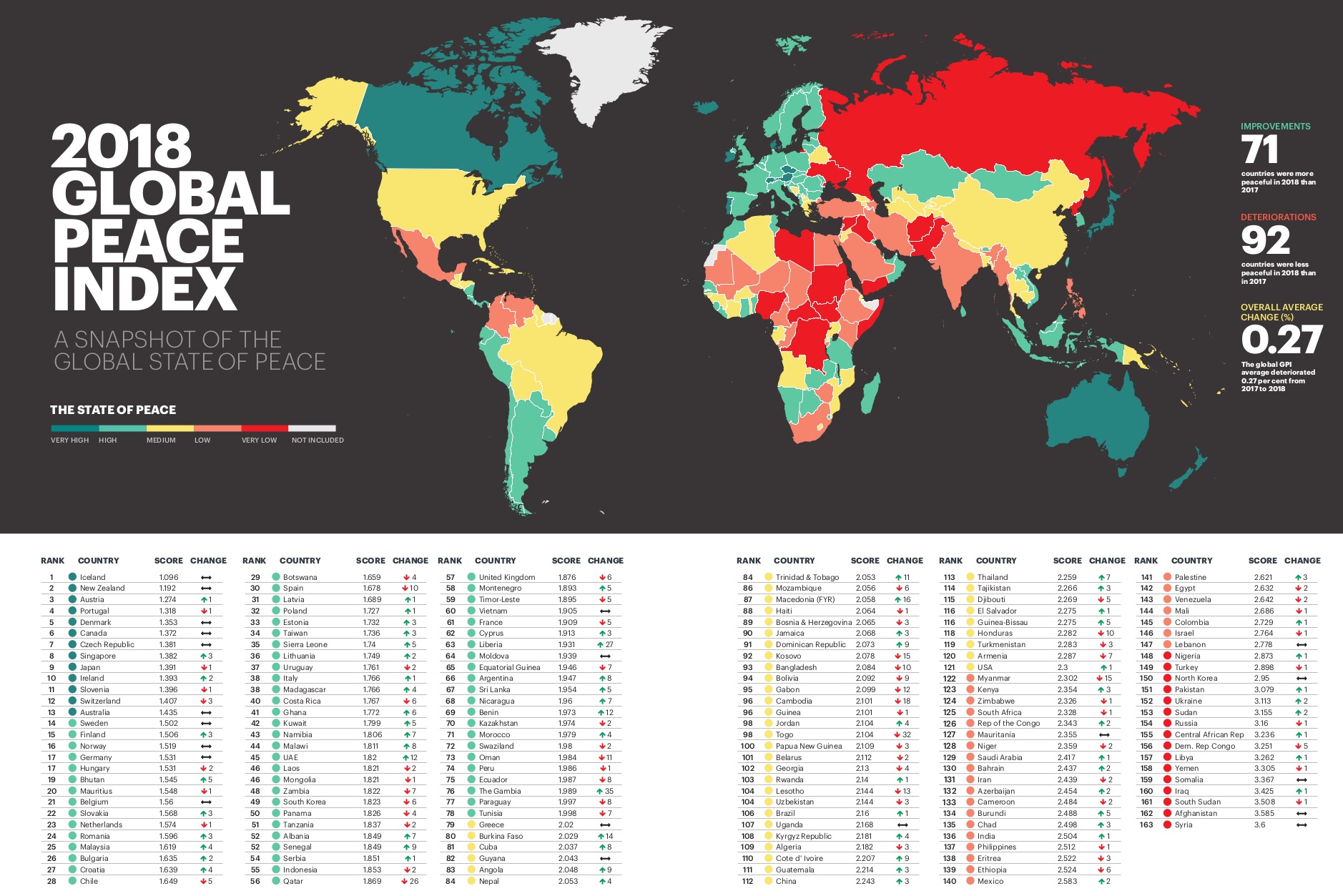
On February 24, 2022, Russia’s “military operation” against Ukraine began. Prior to this, Vladimir Putin delivered a speech1 delivered in a style whose specific characteristics have long become recognizable to citizens of the RF: accusations against “Western politicians” and NATO, regret over the collapse of the USSR, defense of Third World dictators and war criminals, the US “empire of lies” (!), the desire of enemies to “destroy traditional values”, and so on. This speech is a derivative of the ideology of derzhavnichestvo — one of the most dangerous misanthropic ideologies in the world. In this article, we will attempt to explain why, despite the constant change of ideologies (absolutism, communism, liberalism, and so on), Russia still remains a poor country with inflated ambitions, conflicting with the democratic world (often with tragic consequences for itself).
Derzhavniks call those who hate them “Russophobes”, thereby substituting reality — in fact, progressive democratic forces do not hate Russians, but derzhavniks. The latter cowardly hide behind the backs of all Russians and citizens of Russia so that they take the blow for them, and sometimes they manage to frame someone instead of themselves for a strike. In order to remain untouched themselves while Russians and Russian-speakers die and suffer for them, they need to create the perception that opponents of derzhavnichestvo and Russophobes are one and the same.
Contents
What is derzhavnichestvo?
Doctor of Social Sciences Vladimir Kochetkov noted that derzhavnichestvo “is presented in cooperation, isolationism, and aggressiveness”2. However, he isolates this ideology into a separate tradition from “Third-Rome-ism”, which includes Slavophilism, Russian communism, and Eurasianism. The reason for such a division is not entirely clear, since isolationism and aggressiveness are present in all three of these “Third-Rome” theories. Candidate of Political Sciences Valery Dubovtsev believes3 that derzhavnik-patriotic ideologies were constructed, firstly, on the principle of inversion according to Alexander Akhiezer (if not the Western path, then the anti-Western one), and secondly, naturally utilized both the existing ideological arsenal (Slavophilism, pochvennichestvo, Orthodoxy, K. Leontiev’s Byzantinism, imperism, Russian patriotism and nationalism, communism) and historical images of past greatness to legitimize their own ideological projects (pre-Petrine Rus, the Russian Empire, the USSR). A typical representative of such an ideology is a member of the Civic Chamber of the RF, Natalya Narochnitskaya:
Narochnitskaya’s books are full of grandiose statements extolling the greatness, uniqueness of Russia, and its enormous role not only in all world politics and world history, but in the Universe. Narochnitskaya’s general style is journalistic, aimed at awakening anger and hatred toward Western enemies. A simple and effective key is used — an appeal to former imperial greatness, military glory. If Narochnitskaya is to be believed, Europe has always, at least since the XI century, hated Russia4.
A clear definition of this phenomenon has not been given to this day, but from its study we can conclude that derzhavnichestvo is a special form of misanthropic ideology, distinguished by a mania for world domination, capture and retention of territories, conservatism, hatred of progressive values or parts thereof, often parasitizing on other ideologies by synthesizing them with itself. The constituent parts of derzhavnichestvo are:
- Obsession with the size of territories controlled by one’s government. The capture of as much territory as possible is the core value of derzhavnichestvo, for the realization of which its supporters consider it justified to resort to murder, lies, and the violation of human dignity. The ruler who grants independence to any territory becomes an object of violent hatred for them;
- Hatred toward the “West”, NATO, the USA (we examined anti-Westernism in detail here);
- Conviction in Russia’s “Special Path”, that it cannot repeat the path of successful countries. This “special path” can transform into divine chosenness and a belief in the superhuman, messianic destiny of the country and people when dividing the universe into forces of good and evil;
- Hatred toward revolutions and democracies, toward everything that can lead to a change of power;
- Doublethink. Derzhavnichestvo can simultaneously promote narratives about “brotherly Ukrainians” and “Ukro-Nazis” — the first to attempt to capture Ukraine with “little bloodshed” and motivate its residents not to resist, and the second to crush them after resistance and not yield on various issues before;
- Uncompromising hypocrisy. Derzhavniks can without the slightest problem call black white, respond to facts about the presence of their troops in a country with “we are not there”, even if they themselves previously let slip that they were present. The ideology itself rests on a massive and constant stream of disinformation, at times the most hypocritical. When derzhavniks write “NATO wants to capture the whole world”, it should be read as “we want to capture the whole world”. When derzhavniks say “the West wants to rewrite history”, it means: “We want to rewrite history”. When derzhavniks say “Ukrainians are conducting Nazification in their country”, it means: “we are conducting Nazification in our country”. And so on. Lies and disinformation are the foundation, the basis of derzhavnichestvo, which is easily verifiable.
Otherwise, it possesses properties inherent to conservatism, which we have already examined here. Like conservatism, derzhavnichestvo is a “superstructure” over a primary ideology, which can be communism, liberalism, and even (theoretically) social democracy. In Russia, together with conservatism, it migrates from ideology to ideology, parasitizing on them in turn. As is known, parasitism is a form of symbiosis with an antagonistic character of relationships between its members, in which one of them (the parasite) uses the other (the host) as an environment and/or source of food, and its relationships with the external environment are mediated by the host5. To put it slightly differently, it is a type of relationship between different species in which one of them (the parasite) uses the other for a certain time as a source of nutrition and habitat, partially or fully placing upon it the regulation of its relationships with the surrounding environment. For example, the wasp Hymenoepimecis argyraphaga parasitizes on spiders6. Having temporarily paralyzed its victim, the wasp attaches its egg to the spider’s body. Soon the spider recovers and continues its life. The developing larva gradually sucks the juices out of it, and before pupating, injects chemicals into the spider, under the influence of which it constructs a cocoon instead of a regular web, where the larva completes its transformation into an adult wasp.
It is precisely such a parasite that derzhavnichestvo is, parasitizing on communism, liberalism, and other ideologies. For this reason, the threat to humanity did not disappear with the collapse of the USSR — many believed that the main problem lay in communism, but overlooked this dangerous parasite, which now began parasitizing on liberalism. Russians began to think that their problem lay in liberals, but today liberals have been ousted from key posts, and things have only gotten worse. The fact is that the virus of derzhavnichestvo has infected a vast number of political forces in Russia, while those that remained uninfected were subjected to persecution and bans. Thus, the collection “Russian Multiparty System” noted:
The second component of the anti-reform movement in Russia is the nationalist (national-patriotic) and “derzhavnik” (“statist”, etatist) movement. Visibly inferior to the communists in numbers and organization, “white” anti-reformers nevertheless dominate their “red” allies ideologically. This is manifested both in the active use by communists of elements of “derzhavnik” (CPRF) and nationalist (RKRP) ideology, and in the fact that all occurrences of unification of the “right-left” opposition were carried out, as a rule, precisely on the ideological basis of “derzhavnichestvo”…
In point of fact, the modern national-patriotic and “derzhavnik” movement is based on the ideology that was maintained by the CPSU since the 1940s. It was then that internationalist themes in official propaganda began to be displaced by “derzhavnik-patriotic” (imperial) and even nationalist (xenophobic) themes. In later times — in the 1960s–1980s — the leadership of the CPSU was far more tolerant toward the propaganda of nationalist and imperial views than toward liberal views. During Perestroika, the Ideological Department of the CC CPSU viewed the national-patriots as their objective allies in the struggle against the spread of liberal ideas, and while unauthorized rallies of the Democratic Union were ruthlessly suppressed, the attitude toward actions of this kind by national-patriots was incomparably softer. The reason for such favor is more than obvious. National-patriotic and “derzhavnik” ideology is even more “retrospective”, and therefore even more “romantic” (i. e., utopian), than the communist one. While the ideal of the communists is the Soviet society of the 1930s–1950s, the ideal of national-patriots and “derzhavniks” is the pre-revolutionary Russian Empire. If both the “white” and “red” ideologies are stripped of their mythological (propaganda) cover, at the center of both we will find the same single “material interest” — the strengthening of state control over public life, both in the sphere of economics and politics, and in the sphere of culture. Thus, “derzhavnichestvo” can be considered a kind of common denominator to which both national-patriotic (ethnocratic, xenophobic) and communist ideologies reduce7.
Derzhavnichestvo is merciless toward people — it exhibits absolute indifference to the cruelties and massive casualties of the imperial, communist, and Putin regimes; moreover, it reacts aggressively to attempts to draw attention to these cruelties. All the bloodshed, all the poverty is justified for it by the “greatness of the state”, patriotic aspirations, military victories, and territorial captures. This is also expressed in culture, where it is indicated that for the sake of military victory “we will not stand at any price” — in this, the desire of derzhavniks to realize geopolitical goals at any cost manifests itself. Therefore, this ideology is misanthropic, in which it is comparable to Nazism (while it can also exploit the idea of fighting Nazism, declaring as evil only “foreign” Nazism beyond the control of the authorities, or even declaring all opposing ideologies as Nazism).
Derzhavnichestvo sacrifices to “greatness” not only human lives, not only the level of their well-being, but also their will, freedom, and right to choose. Derzhavnik general Andrey Nikolaev wrote as follows: “The regime of a besieged fortress, which was more the rule than the exception for Russia, demanded surrendering in favor of the state both the conquests of democracy, and one’s liberties, one’s veche structure, one’s opportunities for independent development along the path of city-republics”8. Derzhavnichestvo does not separate society from the state; moreover, it substitutes personal and group interests with the interests of the state, placing them above and going so far as to oppose state interests to personal and group ones, rejecting the latter two groups. In short, a summary of the main ideas of derzhavnichestvo would sound as follows:
Russians are the best nation, they invented almost everything, they win almost all sports tournaments and wars, their weapons are the best and have no analogs. Russians must capture the whole world, but enemies stand in the way — the West, democrats, liberals, capitalists, Jews, and so on. They have always wanted to capture and enslave Russia, and because of their machinations, Russia lives poorly. They arrange revolutions to capture the whole world. And worst of all is the USA, it is the world evil. The main thing for a subject of the Russian state is not human rights, but the greatness of the state, the size of its territories. Russia is very ancient, and Moscow is the Third Rome, the center of the Orthodox world. Russian people must give birth to as many soldiers as possible to capture territories, so gay people are unacceptable. The West is not only cunning and mean, but also spiritual-less and weak, its end is coming soon.
We have spiritual bonds, Orthodoxy, autocracy, asceticism, we will not sell out for jeans and chewing gum, it is an honor to renounce material goods for the sake of the victory of the idea and/or the state. Political decisions used in the West must not be repeated, we have our own, special path. Dictators like Stalin, Hitler are effective. But Hitler is evil because he attacked the USSR-Russia, although on the whole his methods were correct. We need a large and strong army, because we — Russians — have only two allies: the army and the navy. We need propaganda in which all means are good, and everything is justified by the goal of Russia’s greatness. We need a strong state, with strong state property. Allowing the loss of any territories by this state is a most terrible sin, which should be followed by a curse and terrible punishment. Whoever does not agree with these views is a traitor, and strict measures must be taken against traitors.
Another important feature of derzhavnichestvo is obedience to bosses as long as they are bosses. Sofia Shirogorova, creator of the Stalag Null Telegram channel, notes:
What concept lies at the core of Russian historical policy?.. Authors rack their brains: is it the Soviet view of the past? Late-Stalinist? Brezhnevite? Imperial, as under conditional Alexander III? Or — already exotic — near-fascist, after Ilyin, about which Timothy Snyder writes?
The problem is that none of the explanations is capable of encompassing all manifestations of the historical policy of the Putin regime. To glorify simultaneously Stalin, Alexander III, and Stolypin? Ukraine was invented by Lenin, but Bogdan Khmelnitsky is a fine fellow because he reunited with Russia? Revolution is a catastrophe, but the peasant uprisings of the Civil War are banditry? Orthodoxy + Stalinism? Hitler dreamed of arranging a “genocide of the Soviet people”, but the Molotov-Ribbentrop Pact was a triumph of Soviet diplomacy? Any explanation, like Trishka’s coat, is stretched over a couple of monuments, speeches, films, and textbooks, but does not fit everything else within itself — and therefore seems unconvincing.
<…>
The historical concept in the current RF is the “history of the bosses”. The main idea is very simple: the bosses are always right, regardless of what their ideology is and what policy they pursue. Those who are against the bosses are enemies, rebels, the fifth column, American hires, fascists, etc.
Watch the hands. As long as the Bolsheviks are in opposition to the bosses — they are rootless terrorists and German spies. As soon as they themselves become the bosses — they are fine fellows, doing everything right, and now those who fight against them are traitors and accomplices of the Entente…
Nicholas II is a fine fellow, correctly got into WWI, and conducted a wonderful policy, but then fell out of the BOSSES, and ceased to be a fine fellow. It’s not even really a pity that he was shot, the Voykovskaya metro station bothers no one.
Alexander III is a boss, Stalin is a boss, Brezhnev is a boss, Peter I is a boss… something is coming together, eh?
Ideology, type of regime, method of coming to power, domestic and foreign policy do not matter — the bosses are right and interesting only because they RULE.The only occasion for criticism is if the bosses lose power or limit their authority. Hence the lack of enthusiasm for Alexander II (although it would seem that with his foreign policy, every “imperialist” is obliged to bounce off the walls in delight), or Alexander I (the guy defeated NAPOLEON, but no, NOT THAT). Khrushchev flew out of the bosses, and smashed the previous bosses to smitdereens, HOW COULD HE. And so on and so forth.
Of course, within such a concept one needs to know how to be flexible: oscillate along with the party line, reconcile the irreconcilable, glorify new ideas of the latest bosses, brand those who were at the helm themselves just yesterday.
Within such a concept, a “Soviet”, “imperial”, or “liberal” history (=here with the meaning of “paradigm”) is not needed — what is needed is an obedient history, twisted and retwisted.What is telling is that the same flexibility and reverence before the bosses is expected regarding current events as well: not only are the liberals unpleasant, but hawks and the so-called “patriots” are also not liked if they are not ready to keep quiet, approve, and adapt.
Terminological problem
Speaking about a phenomenon such as derzhavnichestvo, first of all I would like to mention that we face a terminological problem — for many years people have been unsuccessfully trying to identify this ideology. People have gone through a large number of terms — Rashism, Russism, Russian imperism, Muscovitism, Hordeism, vatnichestvo, and so on. However, most of these terms have serious drawbacks.
In 2022, the term “Rashism” became especially popular. Thus, it is used by Doctor of Psychology Vladimir Zakharov. According to him, “the direct heir of Chekism is Rashism. This is a variety of totalitarian ideology of spreading the Russian way of life to other countries and peoples. In this, Rashism resembles autocracy. Russian power has always sought to occupy and annex other countries and peoples with the ‘noble’ goal of gathering Russian lands and assimilating the peoples residing in them. At different times, Rashism was called Russism (Alexander Herzen, 1868), Russophilia, Slavophilism, etc… As civilization develops among the rest of humanity, the forms and methods of governance in Russia may change, but the vertical of power, the primacy of the state over the individual, and the repressive nature of the active authority based on repression and fear remain unchanged”9. The Ukrainian journal “Vox” believes that Nazism, Fascism, Stalinism, and Rashism are one and the same10. At the same time, its authors write that “almost the only thing that distinguishes Putin’s Rashism from Hitler’s Nazism or Stalinism is that, unlike modern ones, previous regimes were much more ruthless toward nepotism and corruption”, however, this betrays insufficient awareness of the authors, since, for example, Stalinism was extremely corrupt (the same can be said about Hitler’s regime). Despite initiatives to create a definition for the term “Rashism”11, it still does not really exist to this day.
Another term is “Russism”. According to Dzhokhar Dudayev, who often used this term, “Russism is a special form of misanthropic ideology based on great-power chauvinism, total lack of spirituality, and immorality. It differs from known forms of fascism, racism, nationalism by its special cruelty, both toward man and nature. The principle of operation is the destruction of everything and everyone, the scorched earth tactic. It is distinguished by a schizophrenic form of mania for world domination. Possessing a slave psychology, it parasitizes on false history, on occupied territories, and oppressed peoples. Russism is characterized by constant political, legal, and ideological terrorism”12.
However, this term is not Dudayev’s invention. It was used back in the XIX century by Alexander Herzen:
Slavism, or Russism, not as a theory, not as a doctrine, but as an offended national feeling, as a dark memory and a true instinct. As a reaction against exclusively foreign influence, it has existed since the shaving of the first beard by Peter I.
<…>
The soldiers demanding the replacement of Barclay de Tolly for his German surname were the predecessors of Khomyakov and his friends… Chaadayev and the Slavs alike stood before the unsolved sphinx of Russian life — a sphinx sleeping under a soldier’s overcoat and under royal supervision; they both asked: “What will come of this? It is impossible to live like this: the burden and absurdity of the present are obvious, intolerable — where is the way out?”
“The way out is behind us”, said the Slavs, “the way out lies in renouncing the Petersburg period, in returning to the people, from whom we were separated by foreign education, a foreign government, let us return to the old customs!”
The error of the Slavs consisted in the fact that it seems to them that Russia once had a development proper to it, obscured by various events and, finally, by the Petersburg period…13
However, both Rashism and Russism are terms that have obvious drawbacks. For example, “Russism” is usually called a word or turn of phrase in any language borrowed from the Russian language or modeled after a Russian word or expression14. Scholars, specialists in Russian studies, are usually called Russists15. The term “Rashism” has a humorous connotation, as it is actually an errative of the word “fascism” and sounds like mockery, which is inappropriate for describing such a serious problem that is the cause of death and suffering of a large number of people (for the same reason, terms like “vatnichestvo” are also unsuitable for serious use). In addition, there is another problem described, for example, by Doctor of Economics Yakov Mirkin: “Rashism — this concept should not exist, the one who created it and forcefully introduces it — is on the side of evil. Nazism was never called “Germanism”. Fascism was never called “Italianism”, in the hardest, worst times. For the first time, an attempt has been made — the most wretched, the most nationalist in spirit — to link a people, the Russian people, the Rossiyan people, and an ideology that brings distress”16. Indeed, the use of terms like “Rashism” and “Russism” has a nationalist character, is a concession to nationalists, and thereby fosters phenomena similar to the ideology in question.
The terms “Rashism” and “Russism” link the ideology with a country or a nation, working toward their identification. However, it is obvious that not all citizens of Russia and not all Russians are derzhavniks. These terms push the mass voter into the arms of derzhavniks. The latter say: “Russians, the whole world hates you! Come to us and we will protect you”. And so Russians hear the humiliating “Rashism” and begin to think: “They seem to be right”. Derzhavniks try to depict the essence of what is happening through the prism of confrontation between all of Russia, all Russians, and the haters of everything Russian surrounding them. Here they end up, as it were, on the same side of the barricades as the Russians. Therefore, the use of such terms is incorrect.
There were also attempts to introduce a term such as “Muscovitism”, which stem from a statement by Ukrainian nationalist Stepan Bandera: “The radical extermination of all rebellious, freedom-loving elements who do not want to serve Muscovitism, systematic genocide — these are the main means of Moscow’s policy of subjugating peoples. It consists in keeping each enslaved nation, all its strata, every person under constant pressure of an unyielding either-or: submit, accept the false Moscow doctrine as truth and without resistance serve the realization of the Kremlin’s goals, or be destroyed”17. Evgeny Ikhlov, an expert at the “Human Rights Movement”, proposed the following definition of the term: the doctrine of substantiating Russian imperialism with the aim of creating and expanding a military-politically isolated space in which an acute rejection of Western liberal values and principles of an open society reigns18. However, this definition is incorrect, since derzhavnichestvo is characterized by an acute rejection not only of Western and liberal, but of democratic values in general. It is also tied to geography, as are the terms “Rashism”, “Russism”, and the more rarely encountered term “Hordeism”.
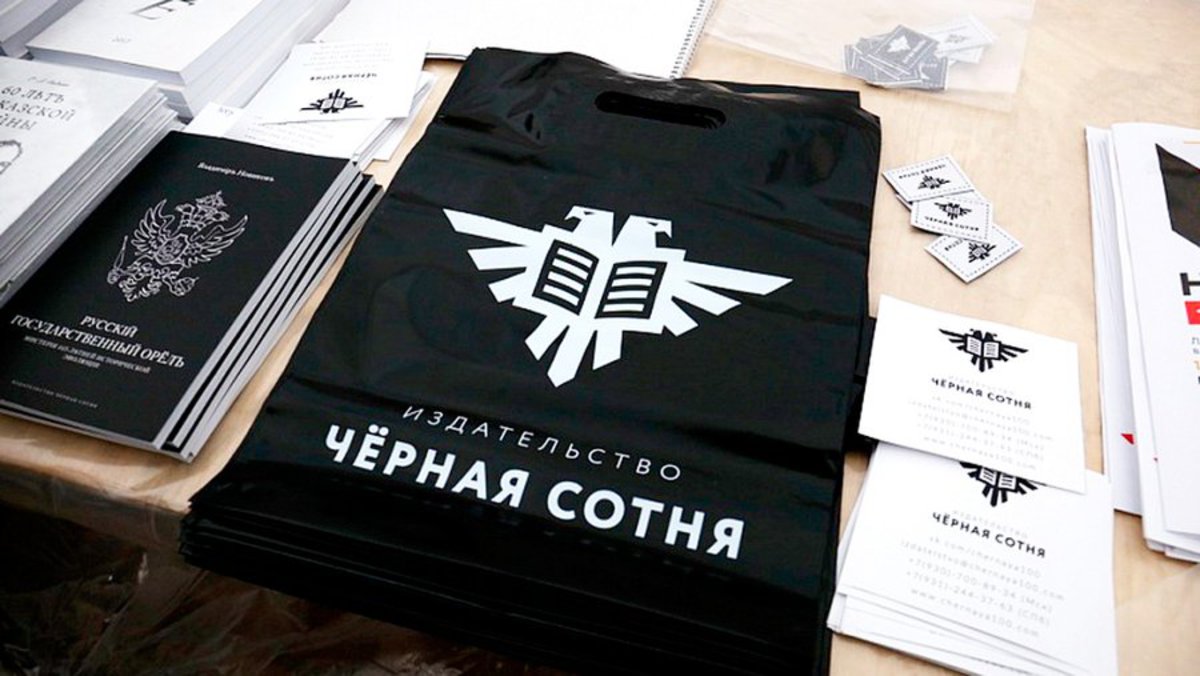
There are proposals to denote the ideas of derzhavnichestvo with terms like “Black Hundreds-ism” or “Eurasianism”. What is this? The Black Hundreds are members of far-right organizations in Russia in 1905–17 who, from the standpoint of Russian nationalism, campaigned under slogans of defending the monarchy and Orthodoxy19. After the February Revolution, Black Hundreds organizations were banned. As we can see, this term is tied to a specific historical period, so it is also unsuitable for us. Eurasianism, by definition of the Orthodox Encyclopedia (one of the few sources where a definition can be found), is initially an ideological-worldview, then also a socio-political movement, at the base of which lay the concept of Eurasia as an independent “geographical and historical world”, located between Europe and Asia and differing from both in geopolitical and cultural terms20. It implies the transformation of the whole system of cultural and worldview attitudes, the result of which should be a spiritual demarcation from Europe, designed to open for Russia and neighboring countries, which together make up Eurasia, a new path of spiritual and socio-political development peculiar only to them. However, here the problem for choosing a term is also that all this does not necessarily imply the capture of territories, authoritarianism, cruel suppression of peoples (for the same reason, the terms “Russian conservatism” and “anti-Atlantism” are also unsuitable for the described phenomenon), besides Eurasianism is a fairly isolated movement from Stalinism and other manifestations of derzhavnichestvo, being rather its component, like these manifestations.
Closest to the concept of “derzhavnichestvo” turns out to be the term “imperism”. There is no clear definition of this term, as with many others considered. We can only say that this is the idea of building an empire, through conquest policy. Alexander Rubtsov, head of the Center for Philosophical Studies of Ideological Processes at the Institute of Philosophy of the RAS, describes the idea of empire as follows: “a strong power with a clear imperial mission — a bridgehead of world revolution — a stronghold of progress and the hope of humanity… And in the end — a temptation for a humbled and confused population, to whom the government no longer knows how to offer anything except involvement in mythologized greatness. And degradation in everything that constituted and can constitute the basis of the civilizational mission and imperial attraction of metropolises — science, art, education, etc., up to the culture of social policy and everyday practices”21. However, the term “imperism” can be misinterpreted — for example, as a synonym for monarchism, or as a desire to return the order and customs, for example, of the Russian Empire. Derzhavnichestvo, on the other hand, in an extreme case agrees to the destruction of any order and traditions for the sake of preserving power and territories. Also, there are different types of imperism, and the imperists of not all countries possess properties characteristic of derzhavnichestvo — for example, hatred of the West. In the end, the term “derzhavnichestvo” turns out to be preferable to others.
History of the emergence of derzhavnichestvo
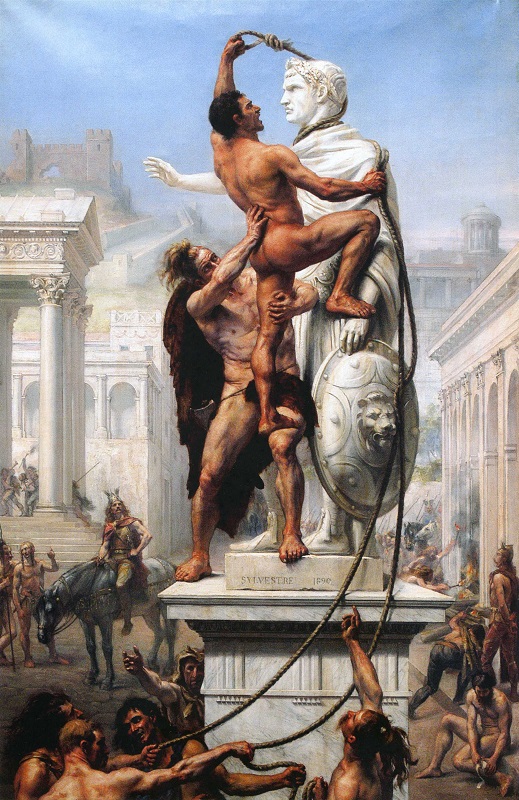
The roots of derzhavnichestvo lie back in the practice of barbarian tribes that did not understand the true reasons for the greatness of the culture of such civilizations as the Greek and Roman ones. The barbarians were not successful in creating high culture or advanced science; their skills mostly came down to waging war and conquering. It is the derzhavniks who are the continuators of precisely this practice. The genesis of this ideology can probably be traced back to even earlier eras. The cult of hunting, patriarchy, military raids, rigid hierarchy, and the caste system against agricultural and craft traditions mutated over time into various forms of barbarism and imperism, among which is derzhavnichestvo. The essence is similar — weak organization of society does not provide favorable conditions for building, creating, inventing, or growing, and forces one to achieve success by plundering and enslaving those societies that turned out to be more successful in this. Sometimes nomads who engaged in military raids managed to destroy great civilizations, or even invent something valuable, but most often they were beaten and suffered destruction themselves, leaving behind almost nothing remarkable that could remind descendants of their existence.
Russia did not always follow this path, because, for example, in the Novgorod Republic the rudiments of democracy still existed. Probably, Rus would have been able to continue moving in the European direction, were it not for its subsequent enslavement by the barbarian Mongolian Horde. In the territories of the Russian principalities occupied by the Golden Horde, primarily Moscow, an “off-Mongolization”, a barbarization of Rus took place (the process of de-conservatization of Russia, which we will mention later, in many ways will also mean the process of its de-barbarization). The princes of the occupied principalities adopted the Horde mania for world conquest and the multiplication of their territories — Prince Ivan Kalita and his father Daniil Aleksandrovich, “gatherers of Russian lands”, were already engaged in their multiplication22. The Horde occupation also instilled in the inhabitants of Russian principalities the fear that their land wants to be seized and occupied (hence the regular exhortations of derzhavniks that “the West wants to seize Russia”, “China wants to seize the Far East”, and so on). After the Muscovites expelled the weakened Horde members from their territories, they engaged even more actively in annexing new lands.
According to most historians, with the Tatar conquest, alternatives for the development of the Russian state vanished, and in the eastern part of Rus, a rapid and sharp turn toward autocracy took place.
In 1305, an event unthinkable from the point of view of antiquity occurred in Nizhny Novgorod. After the people gathered at the veche in Kostroma and Nizhny Novgorod judged the boyars for their arbitrariness according to the traditions of the veche past and beat them, the Nizhny Novgorod prince returned with the Tatars and slaughtered the “veche members”. With the Tatars came a new concept of power, which dominates without any agreement with the people… Immediately after the conquest of Rus, the Mongols eliminated the traditional forms of territorial administration. In the south-west of Rus, the Mongols completely removed the princely administration, replacing it with their direct rule23.
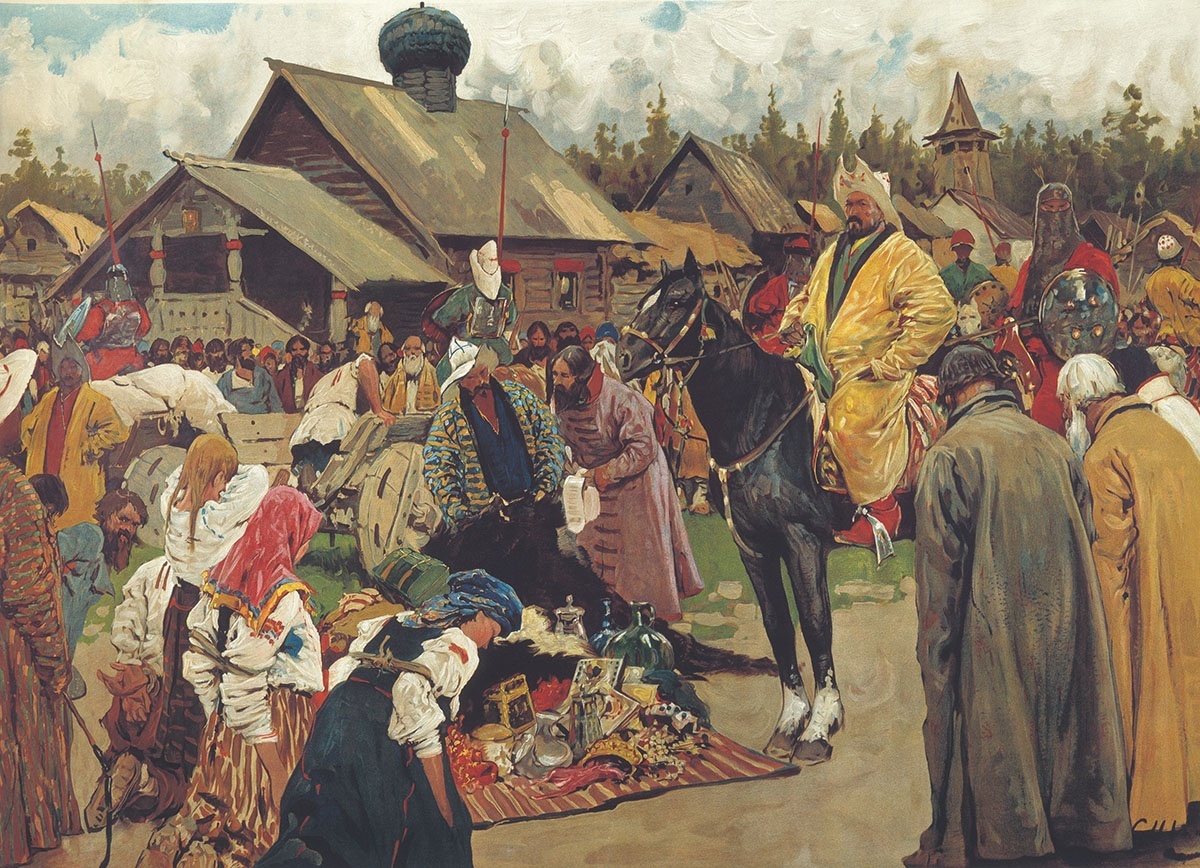
The cradle of Muscovy was the bloody mire of Mongolian slavery, not the rude glory of the Norman epoch. And modern Russia is nothing but a transformed Muscovy.
The Tatar yoke lasted from 1237 to 1462, more than two centuries. It not only crushed, but dishonored and withered the very soul of a people that became its victim. The Mongol Tatars established a regime of systematic terror; devastation and wholesale massacre became its regular accompaniments. In view of the fact that the number of Tatars compared with the vast extent of their conquests was small, they aimed, by surrounding themselves with a halo of terror, at multiplying their forces and diminishing, by mass killings, the number of the population that might rise in revolt behind their back.
<…>
In order to maintain feud among the Russian princes and secure their servile submission, the Mongols restored the importance of the title of Grand Duke. The struggle between the Russian princes for this title was, as a modern author writes, “a mean struggle, a struggle of slaves, whose chief weapon was calumny, and who were always ready to denounce each other to their cruel masters; who disputed about a fallen throne, and could reach it only as robbers and parricides, with hands full of gold and stained with blood; who dared to step upon the throne only by crawling, and could hold it only on their knees, prostrate and trembling under the threat of the curved scimitar of the Khan, always ready to dash to his feet these servile crowns and the heads that wore them”.
It was in this shameful struggle that the Moscow line of princes at last won the upper hand.
<…>
Muscovy was reared and grew up in the terrible and abject school of Mongolian slavery. It achieved strength only by becoming a virtuoso in the art of slavery. Even after its emancipation, Muscovy continued to play its traditional character of the slave turned master. At a later period Peter the Great combined the political craft of the Mongol slave with the proud aspirations of the Mongol master, to whom Genghis Khan had bequeathed his plan of conquering the world24.
The point of no return for Russia passed when the Muscovites subjugated the Novgorodians during the reign of Ivan III. Novgorod was a more democratic principality compared to Moscow, and in the event of its victory, it was not excluded that Rus could have followed the Scandinavian path of development. However, Moscow formulated the thesis that Novgorod was the ancestral patrimony of the Vladimir princes and asserted the unity of Russian Orthodox lands under the aegis of the Grand Prince of Moscow. In addition, in the circle of Ivan III in the second half of the 1460s, accusations against the Novgorod boyars of “deviating into Latinism” intensified25. After the Battle of Shelon in 1471, Novgorod was gradually subjugated by Moscow; traditional Novgorodian judicial and administrative institutions were abolished, and the veche bell was removed and sent to Moscow26. Unfortunately for Russia, the barbaric tradition won out.
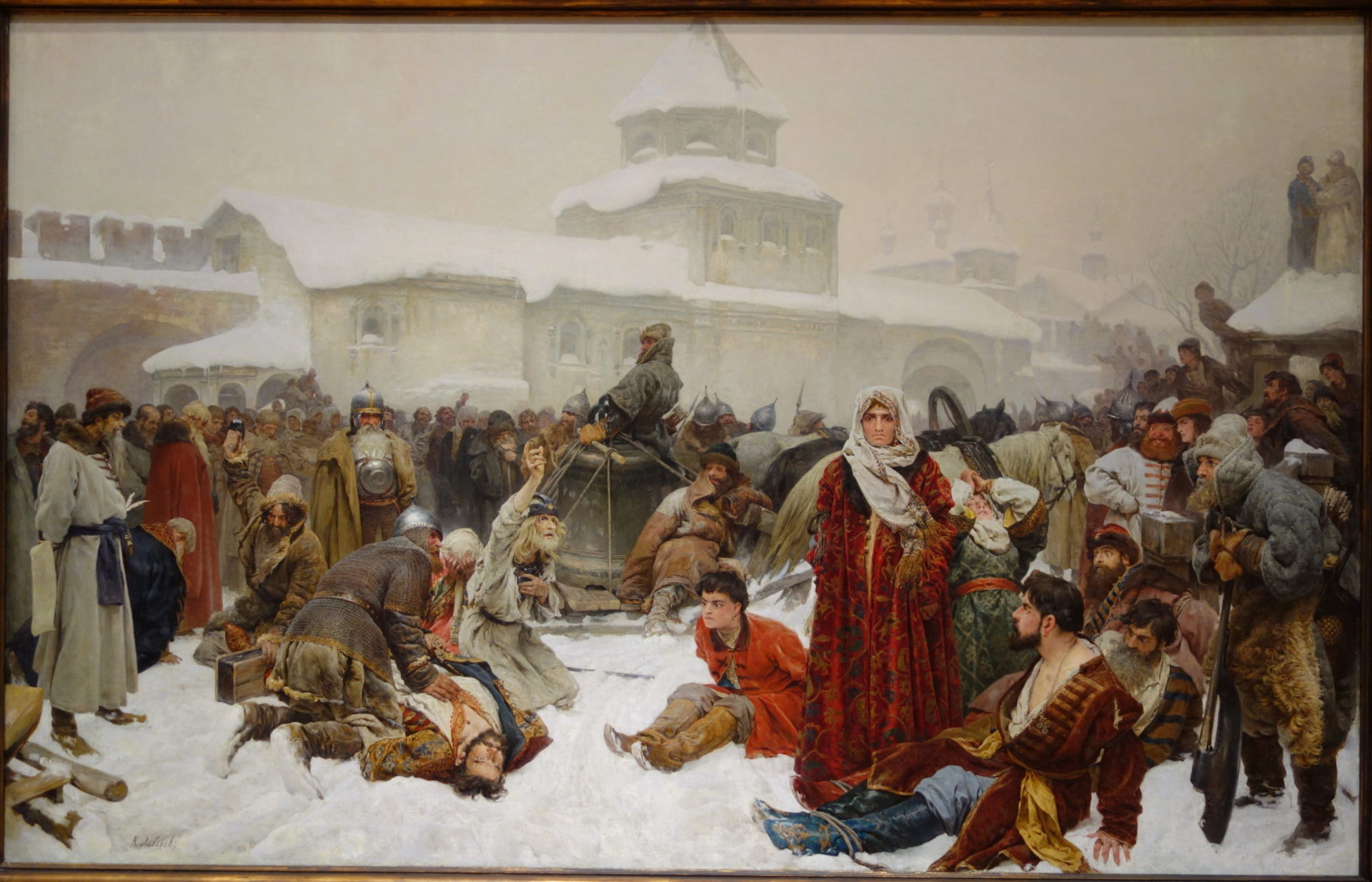
When Constantinople fell as a result of the Turkish conquests, Moscow became the center of the Orthodox world, acquiring its own patriarch, which eventually led to the creation of the “Moscow – the Third Rome” concept, signifying a “special path” distinct from other civilizations and a desire to become an empire (from Byzantium, Moscow inherited the double-headed eagle symbolism). Moscow gradually began to position itself, firstly, as the heir to the Byzantine Empire, and secondly, as a contender for control over the entire Orthodox world. All of this required foreign policy and military strength. In this way, a “multipolar world” centered on Moscow was also being built, whose special faith would help it pull new “satellites” into its orbit of influence (just as later the “special” communist path would pull various countries into Moscow’s orbit of influence in the future). Ivan III’s thirst for imperial grandeur was so great that he even married the heiress to the Byzantine imperial dynasty, Sophia Palaiologina.
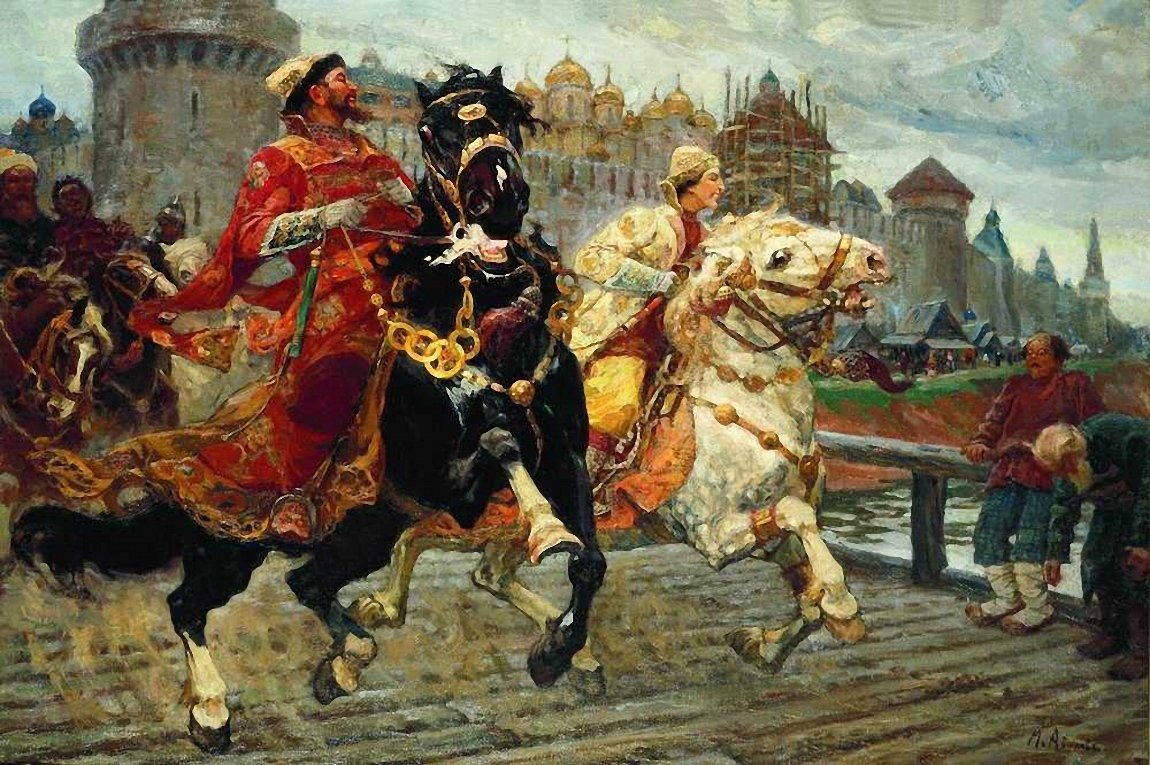
Under Ivan IV the Terrible, statism discovered the possibilities of the oprichnina – it turned out that it was possible to maintain an organization that would torture, kill, and keep its own people in fear so that they would not interfere with isolation and armed expansion. After all, far from everyone agrees to go die in the name of barbaric conquest ambitions. Many want to live well and peacefully, engage in construction and science. This did not correspond to the tenets of statism, which, due to its weak capacity for creation, preferred enslavement, robbery, and “protection rackets”. Therefore, such people had to be destroyed, and the creation of strong state security agencies became the key to solving this problem. The oprichnina had the right to punish “traitors and disobedient persons” of the Tsar extrajudicially by execution with confiscation of property, which it did, and in 1567-1570 mass repressions and executions of undesirables were carried out27. Thus were born the infamous security forces of the statists, which later became the Secret Chancellery, the Okhrana, and later – the Chekists and the FSB. This stratum of individuals enjoyed a privileged position and was therefore loyal to the authorities.
“The strong hand” of Ivan the Terrible led to instability of the system, a lack of respect for authority and the law, a struggle between the boyars and tsarist power, and the exhaustion of the economy through wars of conquest, which later resulted in the collapse of the state and the Time of Troubles – a severe period of painful crises. During this period, Polish-Lithuanian troops occupied Moscow for two years, which statists later masterfully used for their own purposes, citing it as proof of the desire of external enemies to destroy Russian statehood (even though it was nothing other than their own policy that led to this).
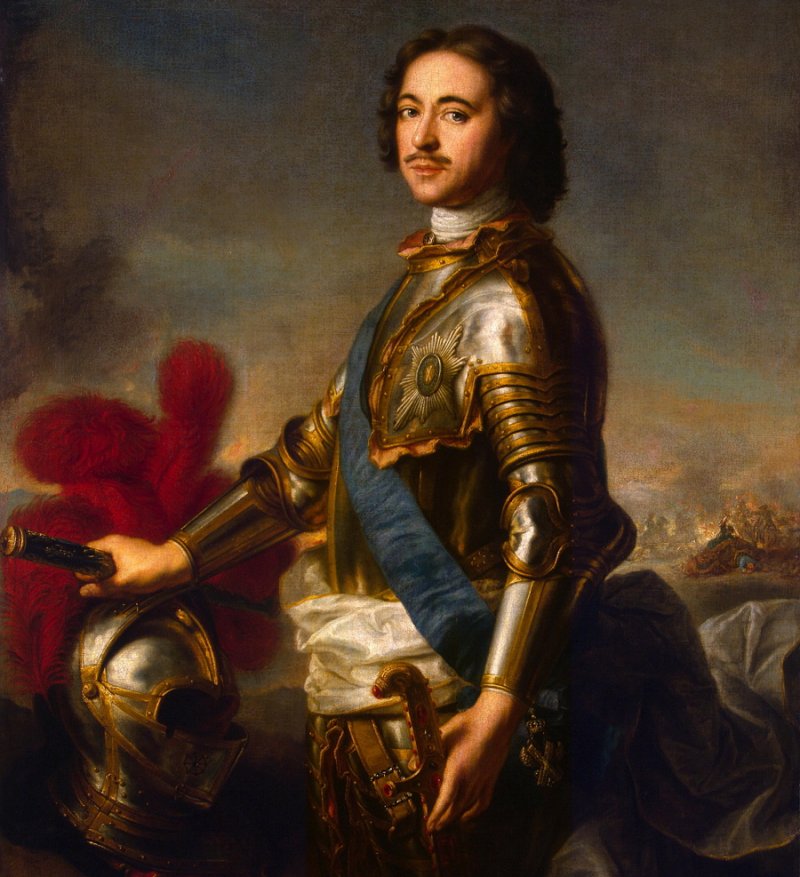
Under Peter I, statists received both painful blows and the satisfaction of their Horde urges. On the one hand, the reformer tsar destroyed the idea of a “special”, “distinct” path for Russia and the rejection of the latest innovations of civilization, primarily European. The tsar tried in many ways to adopt the practices of the Netherlands – one of the most successful societies of that time. Stories became textbook examples of how Peter I cut the beards of noblemen28 who did not want to accept the European style, how he reorganized customs and the army on the European model, how he created universities and scientific collections on the European model, and how he began the construction of manufactories. He even created a new capital, giving it a completely non-Russian name – Saint Petersburg. All the measures he adopted yielded a military result – the defeat of one of the most powerful states of that period (Sweden), the conquest of a considerable amount of territory, to the surprising delight of the statists, and the proclamation of the Empire. For this, the statists proved ready to spit on their ideas of a “special path”, because Russia had gained the grandeur they so craved (even if this was done completely contrary to their notions of how it should be done). At the same time, Peter’s subjects became even more deprived of rights – the burden of peasant labor and Petrine construction projects claimed thousands of lives, and taxes increased29. Nevertheless, meager pro-European reforms allowed the Empire to be militarily successful for many years to come.
Statism had its ribs broken, and the state picked up speed a bit. In fact, Peter was one of the most pro-Western rulers of the country in history, and without him there would be no “greatness of Russia”, nor would there be any Empire. Practice demonstrated the weak viability of statists with their “special path”.
We see a new round in the development of statism after 1789 and 1825, between the moment when Russian elites found themselves frightened by the French Revolution, which swept away the ruling classes, and the Decembrist revolt. Statists rushed to offer these elites an “exit”, hoping to gain access to funding. It was then that the main enemy of the statists was definitively identified – the pernicious “West”, which wants to deprive them of their “spiritual bonds” (which help keep subordinates in check) and infect them with the virus of revolutions, thereby posing a threat to statist rule, which wants to own its subjects eternally and indivisibly. Thus, Alexander I initially pursued a relatively progressive policy (we wrote about this in the article on the history of democracy in Russia), but after the statist Nikolai Karamzin, who had access to the inner circle of the emperor’s conservative sister, presented him with the “Memoir on Ancient and Modern Russia”30, where he criticized Mikhail Speransky and the timid democratic reforms he was trying to promote, Alexander began to lean more toward pursuing a conservative policy31. Speransky in general met fierce resistance from statists to any attempts to make life easier for the people.
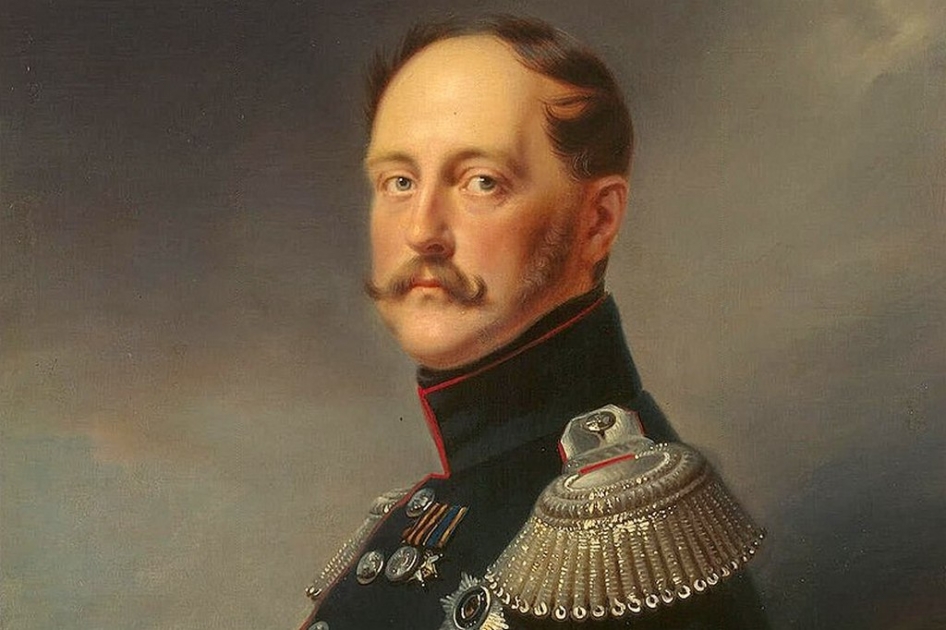
Emperor Nicholas I, who came to power against the backdrop of the Decembrist revolt and shared the ideas of statism (this was later defined as the “Theory of Official Nationality”32), was most concerned with fighting people’s desire for freedom. Having organized repressions against the Decembrists33, this emperor set about strengthening state security services, ideological work, and tightening censorship34. The statists’ assistance in suppressing the “Springtime of Nations”35 – one of the lowest points in Russian history. They sent their army to Eastern Europe to suppress people’s desire for freedom, to bring slavery and submission, for which Russian statists (and along with them all of Russia, thanks to their policy) were hated for the first time by the peoples of Eastern Europe. The personnel policy of this tsar was expressed in the phrase “I do not need learned heads, I need loyal subjects”36. This ended with Nicholas I’s disgrace in the Crimean War, when statists wanted to establish control over territories practicing the Orthodox religion, but, due to their inability to create a competitive, modern state, suffered a crushing defeat, including from France – which gladly joined the anti-Nicholas coalition, and to which in 1848 the emperor, who died in 1855 without waiting for the humiliating surrender, had wished to send troops to suppress the revolution.
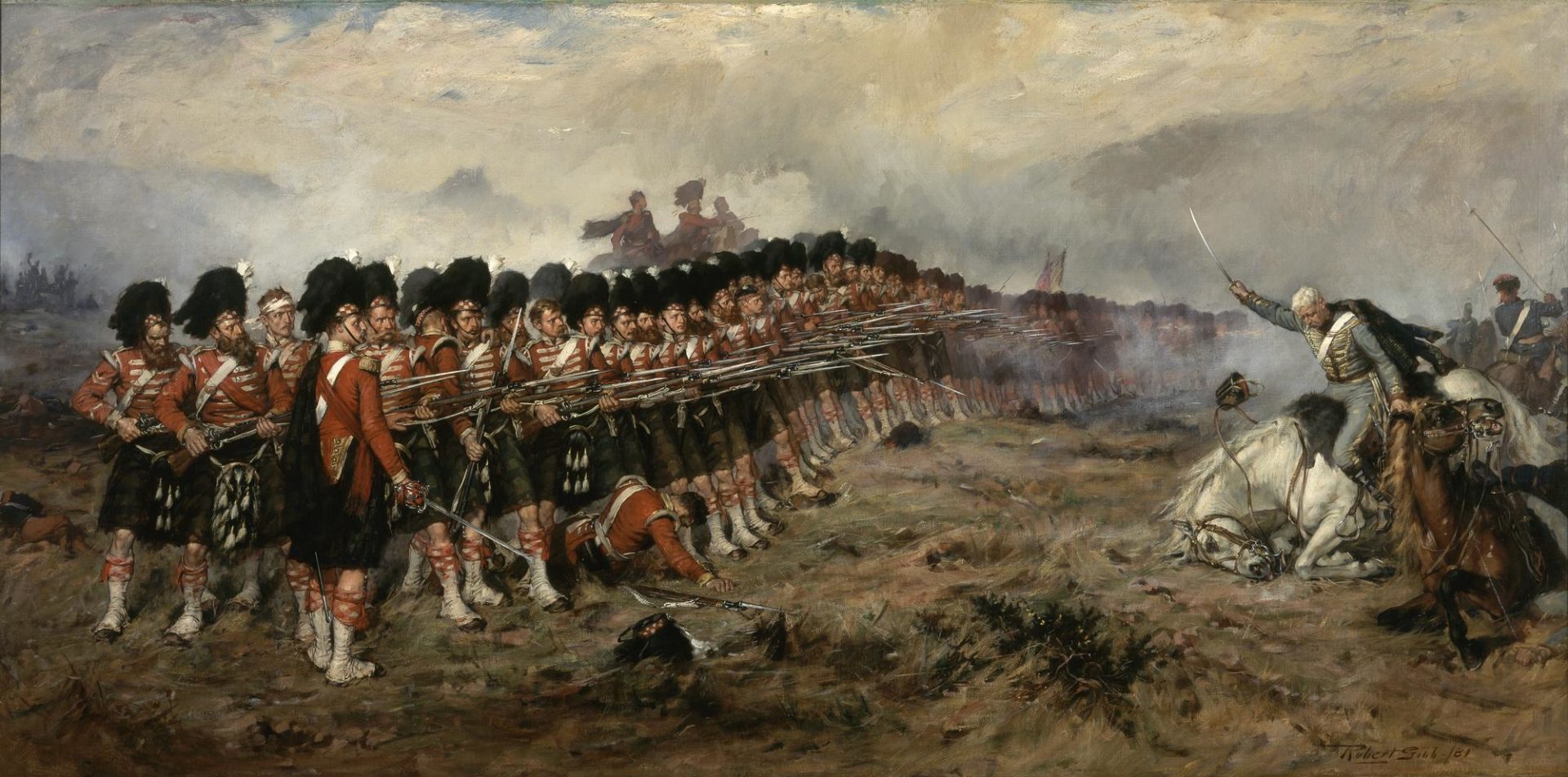
Also under Nicholas I, the advanced ideological detachments of statism began to take shape, and among the most prominent of them were the Slavophiles. Their concept lay in Russia’s “special path”, the saving role of Orthodoxy, and the ideas of “Slavic unity”. Now it is difficult to say in which exact period the imperial disinformation machine was formed: the emergence of concise talking points, such as the “rotting West”, was recorded as early as the 19th century37. Conservative statist propaganda began spreading disinformation that significantly helped exercise control over Russian society and keep it in check.
Under Alexander II, statists suffered a blow – this ruler realized that they were leading the country to collapse and constant disgrace, in connection with which he carried out some democratic reforms – for example, the abolition of serfdom and judicial reform. The statists’ resistance to these reforms was fiercely strong, which caused these reforms to be half-hearted and led to public discontent with them. They managed to get what they wanted – the reformer tsar was assassinated, and under his successor, a new stage in the triumph of statism began, which would ultimately result in a social explosion and the inglorious collapse of the empire in 1917. Under Alexander III, statism was reflected in the formula “Orthodoxy, Autocracy, Nationality” (read: religion, authoritarianism, populism). The policy of this tsar was also distinguished by antisemitism with Jewish pogroms and the strengthening of the state in the economy (while the “Okhrana” continued the traditions of the oprichnina). The pursuit of misanthropic policies under this emperor was largely dictated by the influence of high-ranking statists Konstantin Pobedonostsev and Mikhail Katkov. Under Nicholas II, the Black Hundreds movement also began to develop, although the democratic movement also began to win concessions for itself.
At the beginning of the 20th century, statism received several painful blows. Once again, it brought society to a state where even the army and navy (the primary passion of the statists) turned out to be insufficiently developed and suffered a deafeningly disgraceful defeat in the war with Japan, which at that time was actively adopting technologies and institutions from developed countries. At the same time, social tension that had accumulated in recent years led to the revolution of 1905-1906. The statists’ persistence in rejecting democracy naturally led to the catastrophes of 1917 and the outbreak of the civil war, as well as paved the way for the Bolshevik victory.
The Bolsheviks, who emerged victorious from the civil war, seemed to have dealt a mortal blow to statism, since the constituent parts of their ideology were atheism, Marxism (at that time actively used by the European labor movement), and the struggle for a welfare state and equal rights. However, this turned out to be merely a screen, as the seeds of statism had long taken root in the fertile Bolshevik soil – latent statists, opposition factions of the imperial authorities, and those simply wanting a better standard of living took a liking to the ideas of world revolution, which replaced the idea of world domination for them; the ideas of the “dictatorship of the proletariat”, which replaced autocracy for them; and the ideas of “confronting capitalism”, which replaced the fight against the West for them. Communism became the new “special path”, while revolutions and democracies were declared “bourgeois”, allowing hatred toward them to be preserved. “Communist revolutions” were declared correct, which effectively meant a country’s transition into Russia’s orbit of influence, a new way of subjugating territories. “Pravda” wrote on May 9, 1920: “In the West, the fates of world revolution are being decided. Over the corpse of White Poland lies the path to world conflagration. On bayonets we will carry happiness and peace to working humanity. To the West! To decisive battles, to resounding victories!”38
The Bolsheviks need an atomic bomb in order to stay in power, i. e., against their own people. A little time will pass, and they will begin blackmailing the whole world so that the whole world begs us, the people, not to make revolutions and to tolerate these ghouls and support them… The ease with which we enter foreign countries (or bring weapons there) – Czechoslovakia, Hungary, Poland, GDR, Afghanistan, Cuba, Nicaragua, China, Vietnam, and many others – shows that the West did not arm itself in vain. We are professional aggressors. And to this day we have not abandoned the idea of World Domination, modestly calling this idea “World Revolution”… This is a catastrophe. Later they will beg for alms. Feed them again!39
At first, the Bolsheviks promoted progressive values and rejected conservative ones, but during the reign of Joseph Stalin, a return to conservative values occurred. Statism began to practice political terrorism, sophisticated torture, and assassinations abroad on an even more massive scale. It cultivated within itself an even more serious contempt for the law, developing the maxim that the will of the party is above the law. The KGB, which over time replaced the Tsarist Okhrana, became the main vehicle for the ideas of statism.

This time, the statists decided to begin their conquest of the world with small Finland, whose population was almost 45 times smaller, and even managed to prepare a puppet government to establish control over the country. However, the scheme once again ended in a fantastic disgrace – Finland managed not only to defend its independence, but also to conclude a peace whose terms clearly did not correspond to the ambitions of the statists. In many ways, they were lucky that during World War II, by virtue of Adolf Hitler’s decision to launch a sudden attack, they ended up on the side of democratic states, and thereby ended up on the side of the victors. The postwar expansion of communism, which essentially represented the expansion of the interests of a Russia controlled by statists, was successful (largely due to the attractiveness of communist ideas), and many states ended up in the country’s orbit of influence – not only Eastern Europe, which finally submitted to the statists, but also some Asian states and even some very distant countries – such as Cuba. However, this expansion rested on an extremely unstable economic foundation – in our articles on the standard of living in the USSR and the reasons for the collapse of the Soviet Union, we explained why this state entity could not last long. Almost everything the statists touch turns into garbage, which is why their ideology suffered a crushing collapse by the late 1980s, leaving Russian society with no other choice than the attempts of Mikhail Gorbachev’s government to reformat the policy and structure of the state.

The period of Gorbachev and Boris Yeltsin dealt a tangible blow to statism – the detente in relations with democratic countries, openness to their culture, a course toward exchanging experience, the opening of many archives, mutual disarmament, and many other measures seemed to signify a course toward the elimination of barbarism. However, all these measures turned out to be half-hearted – for instance, lustration of the statists was never carried out. For all this, the surviving statists who blocked lustrations cursed the “weak” Gorbachev and Yeltsin and launched a propaganda campaign against them of unthinkable proportions, aimed at repeating the Nazi trick of the “stab in the back”40 (according to the Nazi version, democrats stabbed Germany in the back during World War I, and this was supposedly almost the sole reason for defeat; using this legend, the Nazis were able to seize power and once again involve Germany in a war destructive to itself and other countries), and in this case the legend stated that the USSR lost the Cold War exclusively due to the betrayal of democrats, rather than due to objective reasons. In addition, the statists made an attempt to seize power again (the GKChP coup), but showed weakness and indecision, so the coup failed. However, after the failure of the GKChP, statism did not disappear anywhere – using its remaining resource, it launched an active information war against the democrats and a behind-the-scenes struggle for power. As a result, under Yeltsin’s successor – Vladimir Putin – statism was once again able to determine the government’s course of action, which over time led to the seizure of Crimea and the start of the war with Ukraine. At the moment, everything is heading toward the fact that, as usual, this will lead to the collapse of the state. The policy of the statists has already resulted in the Time of Troubles, the Civil War of 1917-1922, and the collapse of the USSR, and it is logical to assume that this time it will lead to something similar.
Statists cannot help but be failures, as the ideas of a “special path” contradict logic and common sense. As Candidate of Economic Sciences Dmitry Travin notes, “many of one’s failures can be attributed to the fact that everything is meaningless in a country following a meaningless special path”41. He also notes that there is nothing special about the concept of a “special path”, as it is a copy of the German Sonderweg, which in its time led the Germans not to success, but to collapse. In addition, usually the most backward countries are those that do not want to follow the path traveled by more developed civilizations.

Vehicles of the ideas of statism
The main vehicles for the ideas of statism are structures controlled by the nomenklatura – an irreplaceable political power. Acting in accordance with feudal and barbaric logic, they wish to retain power and subjugate more lands. Therefore, statism seems to them the optimal option for an ideology that facilitates the realization of these goals. In modern Russia, such structures include the Presidential Administration, the Government of the Russian Federation, regional governments, and so on. A special role here is also played by security forces, primarily the FSB, which is the main forge of statist propaganda cadres. Many former participants of the GKChP also released statist propaganda literature. Political parties under the control of the nomenklatura, such as “United Russia”, the LDPR, the CPRF, “A Just Russia – For Truth”, and “Rodina”, should also be included here. Representatives of their leadership are most often vehicles and popularizers of the ideas of statism (exceptions sometimes occur). The ideology of statism also dominates the leadership of the Russian Orthodox Church, which has extensive ties with representatives of power. Since the state education system is subordinate to the executive branch, it also serves as a channel for spreading statism.
Statism largely relies on conspiracy cult-like movements, such as KOB (“Concept of Social Security”), NOD (“National Liberation Movement”), SERB, the International Eurasian Movement (including the Eurasian Youth Union), “Putin’s Squads”, PVO (“Patriots of the Great Fatherland”), the “Night Wolves” biker club, and Cossack societies (such as the “Central Cossack Host”; essentially, paramilitary organizations). Statism is also upheld by movements that do not declare a pro-government orientation and portray themselves as opposition. Perhaps the most striking example is “The Other Russia”, while other such movements include “Essence of Time”, “Great Russia”, the UCP, “For New Socialism”, and “Russian Unity”.
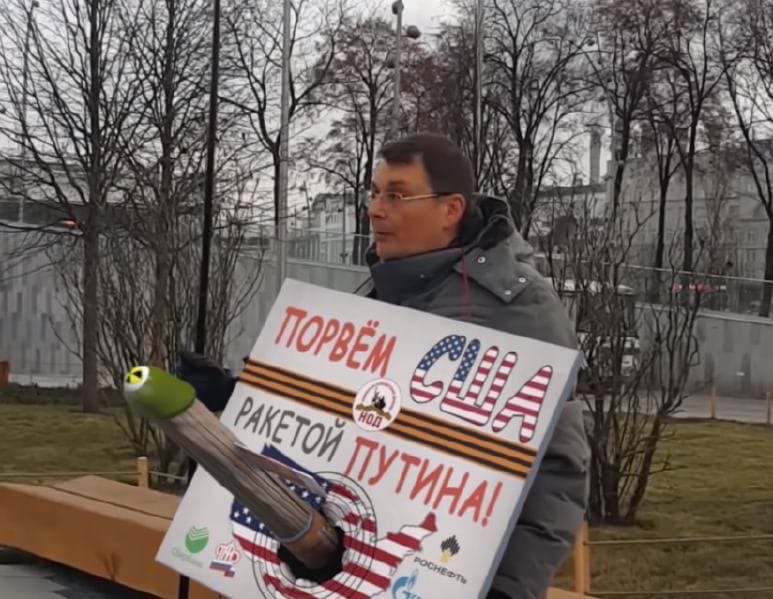
As we can see, statists do not have a single unified ideology – Stalinists, “Soviet patriots”, Putin supporters, Eurasians, Limonovites, fascists, social conservatives, and so on unite and cooperate under this platform.
The main “Think Tanks” unifying and coordinating the primary ideologues of statism across various currents are the “Izborsk Club” and the “January 25 Committee”. Organizations like RUSTRAT and INVISIN (Institute for Foreign Policy Research and Initiatives) are geared more toward ideological work than coordination. There is some information that “manuals” for Russian media are developed at EISR — the Expert Institute for Social Research, and their compilation is supervised by State Duma deputy from United Russia Oleg Matveychev42. A special place is occupied by “troll factories”, the most famous of which is the Internet Research Agency. The above-mentioned organizations are financially fed through statist foundations – primarily the “Russkiy Mir” Foundation, as well as less significant foundations (St. Andrew the First-Called Foundation, Foundation of St. Basil the Great, and so on).
In addition to organizations, various media outlets promote the ideas of statism – primarily federal TV channels (Channel One, “Russia-1”, NTV, “Zvezda” TV channel, and so on), projects of the international news agency “Rossiya Segodnya” (RT, Sputnik, RIA Novosti, and so on), Tsargrad TV, Kremlin-controlled media (RIA FAN, “Komsomolskaya Pravda”, “Rossiyskaya Gazeta”, “Parlamentskaya Gazeta”, TASS, “Interfax”, “Izvestia”, ANNA News), the wiki-project “Ruxpert”, the Colonel Cassad project, IA “Krasnaya Zvezda”, the “Eurasia Expert” portal, the Life.ru portal, Geopolitika.ru, Den-TV, the “Stoletie.ru” portal, and so on. The “Sputnik i Pogrom” project could also have been included here before its closure in 2018.
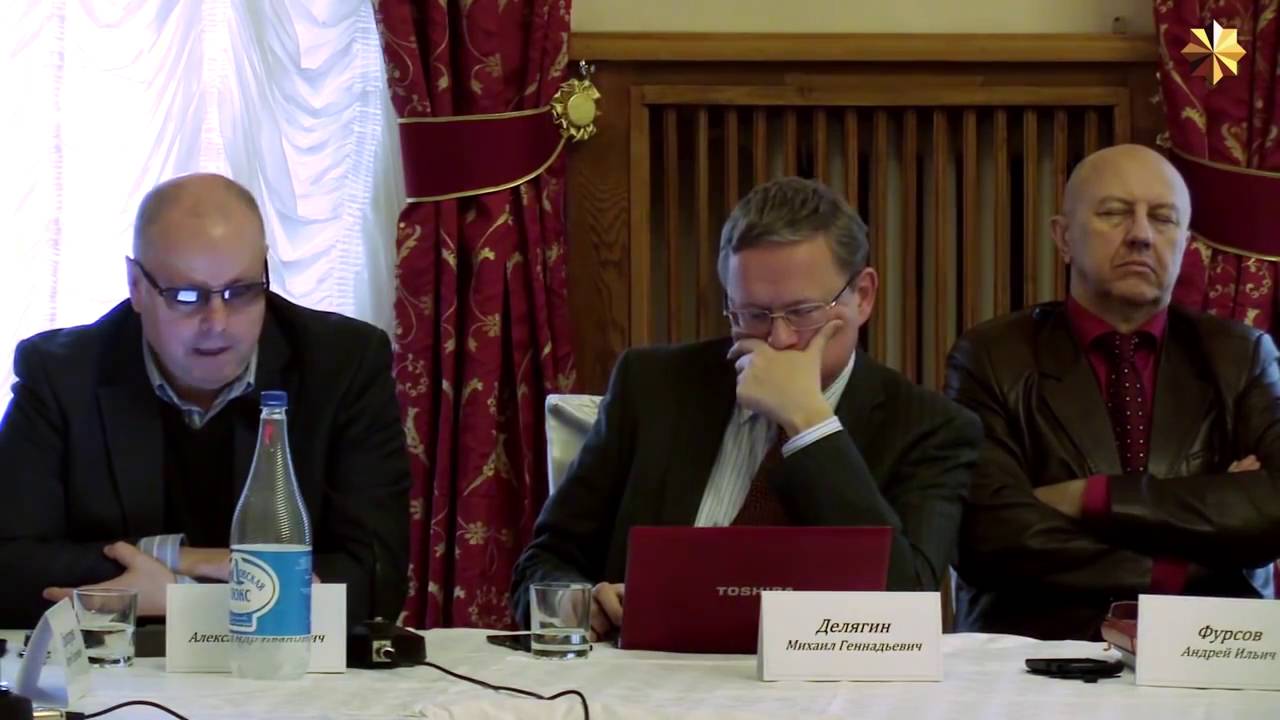
Statism also rests on individuals – publicists of various directions, lobbyists, bloggers, media personalities. Among them are Aleksandr Dugin, Aleksandr Prokhanov, Nikolai Starikov, Maxim Kalashnikov, Mikhail Delyagin, Dmitry “Goblin” Puchkov, Konstantin Syomin, Vladislav Surkov, Stanislav “Ai, Kak Prosto” Vasilyev, and so on.
Statism does not express the interests of broad strata of citizens, as degradation and impoverishment of the country as a whole are disadvantageous to them, but it expresses the interests of the aforementioned organizations, as it allows their members to gain access to financial flows available by siphoning funds from the rest of society, through the seizure of property and business. These groups do not possess the skills and abilities necessary for the effective organization of production and for creativity. The skills of such social groups are limited to the ability to use force, steal, coordinate organized crime, lie, and so on, which makes them typical heirs to the ideology of nomadic tribes and barbarians. Thanks to statism, they do not need to study complex methods of production organization, nor do they need to work – it is enough to display loyalty, apply force (in some cases in an organized manner), and loudly utter “patriotic” phrases.
How to get rid of statism
The above clearly shows democratic forces – statism poses a threat to the existence of Russian civilization, to a decent standard of living for Russian citizens, and to peace on the planet. It constantly leads Russia to collapse, poverty, and blood. If the presence of this ideology in the public sphere is not minimized, the consequences may be irreversible for all humanity, and the existence of Russia may cease. But how to get rid of the threat of statism?
Methods of struggle depend on the stage – whether democratic forces possess state power or not. If we are talking about a stage where democratic forces do not have power, the methods of struggle will be one thing, which we described in a separate article – both the development of the democratic movement and the fight against the statist one. If we are talking about a stage where democratic forces have gained state power in their hands, the methods will be different. A major mistake of democratic forces in the late 1980s and 1990s was giving full freedom to statists and their organizations. Russian democrats must not repeat such a stupid mistake – democracy is not the absence of laws, it is the presence of reasonable laws. Democracy is not freedom for fascists, terrorists, and murderers, it is the pluralism of various democratic organizations that combine competition and consensus. Therefore, the first step required is the lustration of the leadership of all vehicle organizations of statism and nomenklatura lustration. The second step is conducting a show trial of statism, similar to the one conducted in 1945 in Nuremberg over Nazism. The third step is launching de-conservatization. The fourth step is the democratization of the country. A policy of zero tolerance must be conducted toward statism (we analyzed the issue of tolerance here). Any other policy, as practice has shown, yields no results, and statism returns in an even more ferocious form, even more threatening to the existence of humanity, and a policy similar to the denazification process in Germany, which concluded successfully and transformed Germany into a democratic, developed, and prosperous state, must be carried out in its regard.
- Address by the President of the Russian Federation // President of Russia (kremlin.ru). February 24, 2022, 6:00. [Electronic resource]. URL: http://kremlin.ru/events/president/news/67843 (Accessed: 17.06.2022).
- V. V. Kochetkov. Sociological dimension of international relations // Journals of Belarusian State University (journals.bsu.by). [Electronic resource]. URL: https://journals.bsu.by/index.php/sociology/article/view/1660/1428 (Accessed: 17.06.2022).
- V. A. Dubovtsev. “Mission of a great empire” and “special path”: derzhavnik and pochvennik views on Russian history and modernity [Text] / V. A. Dubovtsev // Socium and Power. – 2009. – No. 2. – p. 36-41.
- Ibid.
- K. V. Galaktionov. Parasitism // Great Russian Encyclopedia. Volume 25. Moscow, 2014, p. 291.
- A. Salleh. Spider drugged by parasitic wasp // ABC News (www.abc.net.au). July 21, 2000. [Electronic resource]. URL: https://www.abc.net.au/science/news/stories/s154197.htm (Accessed: 17.06.2022).
- Yu. G. Korgunyuk, S. E. Zaslavsky. Nationalist and “derzhavnik” movement // Russian Multiparty System: Formation, Functioning, Development. M.: INDEM Foundation, 1996. [Electronic resource]. URL: http://partinform.ru/ros_mn/rm_6.htm (Accessed: 17.06.2022).
- A. Nikolaev. Russia at the Turning Point: Thoughts on the Most Important and Painful Issues. – M.: Sovremenny Pisatel, 1998. – p. 24.
- Vladimir Zakharov. Slavery and Lies in Russia (Second Russian edition). – 230 p. – 2022.
- V. Maraev, Yu. Huz. Rashism, or why Russians are the new Nazis // VoxUkraine (voxukraine.org). March 23, 2022. [Electronic resource]. URL: https://voxukraine.org/ru/rashyzm-yly-pochemu-rossyyane-novye-natsysty/ (Accessed: 17.06.2022).
- Rada favors official definition of the term “Rashism” // Ukrinform (www.ukrinform.ru). May 12, 2022, 20:01. [Electronic resource]. URL: https://www.ukrinform.ru/rubric-polytics/3481750-v-rade-vystupaut-za-oficialnoe-opredelenie-termina-rasizm.html (Accessed: 17.06.2022).
- Art. 2 of the Statute of the Special Non-Appeals Judicial Board of the ChRI. Cited in: Russia and Chechnya (1990-1997): Documents testify. M., 1997. P. 211.
- A. I. Herzen. My Past and Thoughts // Herzen A. I. Philosophical Heritage. Works: in 2 vols. Vol. 1. M., 1986.
- S. I. Ozhegov and N. Yu. Shvedova. Explanatory Dictionary of the Russian Language: 80 000 words and phraseological expressions / Russian Academy of Sciences. V. V. Vinogradov Institute of the Russian Language. – 4th ed., expanded. – 944 p. – M.: A TEMP LLC, 2006. – p. 688.
- Ibid.
- Yakov Mirkin // Facebook (www.facebook.com). April 28, 2022. [Electronic resource]. URL: https://www.facebook.com/yakov.mirkin/posts/3244184412485990 (Accessed: 17.06.2022).
- E. Ikhlov. Let the saved world remember, or Entry into “ur-Muscovitism” // Kasparov.ru (www4.kasparov.ru). May 10, 2018, 19:02. [Electronic resource]. URL: http://www4.kasparov.ru/material.php?id=5AF3405094C70 (Accessed: 17.06.2022).
- E. Ikhlov. “Trumpism”, “Russism”, “Muscovitism” // Kasparov.ru (www1.kasparov.ru). November 14, 2016, 23:24. [Electronic resource]. URL: http://www1.kasparov.ru/material.php?id=5829ECA860AD2 (Accessed: 17.06.2022).
- Black Hundreds // Great Russian Encyclopedia. Volume 34. Moscow, 2017, pp. 486-487.
- D. V. Smirnov. EURASIANISM // Orthodox Encyclopedia edited by Patriarch Kirill of Moscow and All Russia (www.pravenc.ru). March 13, 2013. [Electronic resource]. URL: https://www.pravenc.ru/text/187285.html (Accessed: 17.06.2022).
- A. Rubtsov. Mythology of Greatness: How the Imperial Idea is Resurrected in Russia // RBC (www.rbc.ru). February 26, 2016, 9:39. [Electronic resource]. URL: https://www.rbc.ru/opinions/society/26/02/2016/56cfe95f9a7947ed925e57de (Accessed: 17.06.2022).
- M. Molchanova. Ivan Kalita and the beginning of the rise of the Moscow Principality // Dilettante (diletant.media). September 13, 2018. [Electronic resource]. URL: https://diletant.media/articles/43467783/ (Accessed: 17.06.2022).
- K. T. Yalaeva. Formation and development of democratic political institutions from the time of Kievan Rus to the middle of the XVIII century // Bulletin of Chelyabinsk State University. – 2011. – No. 19(234). Law. Issue 28. — p. 105.
- K. Marx. Secret Diplomatic History of the Eighteenth Century // Skepsis (scepsis.net). [Electronic resource]. URL: https://scepsis.net/library/id_883.html (Accessed: 18.06.2022).
- V.L. Yanin. Novgorod Republic // Great Russian Encyclopedia. Volume 23. Moscow, 2013, pp. 156-159.
- Ibid.
- V.D. Nazarov. Ivan IV Vasilyevich // Great Russian Encyclopedia (bigenc.ru). [Electronic resource]. URL: https://bigenc.ru/domestic_history/text/3789529 (Date of access: 17.06.2022).
- S. Antonov. A special law for beard lovers: tax and work clothes from Peter I // Istoriya.rf (histrf.ru). April 17, 2019. [Electronic resource]. URL: https://histrf.ru/read/articles/osobyi-zakon-dlia-liubitieliei-borody-nalogh-i-spietsodiezhda-ot-pietra-i (Date of access: 17.06.2022).
- V.F. Glukhovsky. Russian peasantry during the period of reforms of Peter I and under his successors in the 18th century // News of the Orenburg State Agrarian University. 2006. Issue No. 11-1. Vol. 3.
- M. Zinko. Karamzin Nikolai Mikhailovich // Great Russian Encyclopedia (bigenc.ru). May 12, 2023, 15:23. [Electronic resource]. URL: https://bigenc.ru/c/karamzin-nikolai-mikhailovich-cd8c60 (Date of access: 04.10.2023).
- A. Sidorchik. Speransky’s option. The story of a man who was not allowed to change Russia // Argumenty i Fakty (aif.ru). January 12, 2017, 00:01. [Electronic resource]. URL: https://aif.ru/society/people/variant_speranskogo_istoriya_cheloveka_kotoromu_ne_dali_izmenit_rossiyu (Date of access: 04.10.2023).
- M.M. Shevchenko. “Official Nationality” theory // Great Russian Encyclopedia. Volume 24. Moscow, 2014, p. 713.
- S.V. Mironenko. Decembrists // Great Russian Encyclopedia (bigenc.ru). [Electronic resource]. URL: https://bigenc.ru/domestic_history/text/3113474 (Date of access: 17.06.2022).
- L. Lyashenko, I. Kaliteevskaya. Everything you need to know about Nicholas I, in 10 points // Arzamas (arzamas.academy). [Electronic resource]. URL: https://arzamas.academy/materials/1342 (Date of access: 17.06.2022).
- N. Troitsky. Nikolaevan Russia: Foreign Policy // Skepsis (scepsis.net). [Electronic resource]. URL: https://scepsis.net/library/id_1449.html (Date of access: 17.06.2022).
- N. Proskuryakova. Nicholas I (Russian emperor) // Great Russian Encyclopedia (bigenc.ru). August 30, 2022, 21:02. [Electronic resource]. URL: https://bigenc.ru/c/nikolai-i-rossiiskii-imperator-917d9e (Date of access: 04.10.2023).
- 5 Common Pro-Kremlin Disinformation Narratives // EU vs Disinfo (euvsdisinfo.eu). April 2, 2019. [Electronic resource]. URL: https://euvsdisinfo.eu/5-common-pro-kremlin-disinformation-narratives/ (Date of access: 17.06.2022).
- Cited from: V. Ivanov. Requiem on victorious kettledrums // Ural. 1994. No. 2-3. – p. 242.
- Georgy Burkov. Chronicle of the Heart – 318 p. – Moscow, “Vagrius”, 1998 – pp. 225-229.
- N.N. Baranov. “A treacherous stab in the back”: the legend of Germany’s defeat in the First World War in visual sources (1918–1932) // Documentary Heritage and Historical Science: Proceedings of the Ural Historical and Archival Forum Dedicated to the 50th Anniversary of the Historical and Archival Specialty at the Ural University (Yekaterinburg, September 11–12, 2020). — Yekaterinburg: Ural University Press, 2020. — pp. 95-99.
- D.Ya. Travin. Russia’s “Special Path”. From Dostoevsky to Konchalovsky – 224 p. – St. Petersburg: European University at St. Petersburg Press, 2018 – p. 9.
- You won’t believe it, but we got another Kremlin manual. Now propagandists will talk about Putin’s “prophecies” and compare 2022 with 1914 // Meduza (meduza.io). August 4, 2022, 15:00. [Electronic resource]. URL: https://meduza.io/feature/2022/08/04/vy-ne-poverite-no-my-razdobyli-esche-odnu-metodichku-kremlya-teper-propagandisty-budut-rasskazyvat-o-prorochestvah-putina-i-sravnivat-2022-y-s-1914-m (Date of access: 04.10.2023).