
Social democratic parties of the world
The experience of foreign parties and movements is valuable to Russian social democrats, but before analyzing it, we should understand who can be classified as social democrats and why. Therefore, we begin a brief overview of social democratic parties. In the course of this examination, we will also provide some examples of the achievements of social democratic parties abroad. The data in the article is as of 2020.
In this article, we will highlight the strongest and most influential social democratic parties of the world, as well as consider some other interesting social democratic parties and movements. Mostly these will be, of course, European social democrats. It should be noted right away that the social democratic environment is not completely homogeneous; however, one can speak of a great similarity in their values and policies.
Contents
Let us first highlight those social democratic parties that play a leading (or one of the leading) role in their respective countries, are mass parties, and influence world politics as a whole. Today, the word “social democrat” should bring to mind precisely these parties, since it is the fruits of their activities that are most noticeable (thanks to their domestic influence and long periods in power).
Social Democratic Workers’ Party of Sweden. Founded in 18891. In September 1917, the Social Democrats, together with the Liberals, formed a government2, and in 1920, the party leader headed the government for the first time (also in 1921-1923 and 1924-1925)3. It was the ruling party in Sweden from 1936 to 19764, from 1982 to 1991, in 1994-2006, and since 20145, meaning for most of the last 100 years. In 1919, the party contributed to the introduction of the 8-hour working day6; in 1944, under the leadership of the prominent ideologue Ernst Wigforss, it developed a post-war development program aimed at achieving social justice through full employment, worker participation in production management and profit sharing, and pension reform. The government of Tage Erlander (1946-1969, during which he also served as chairman of the SAP) put the main points of this program into practice, after which their implementation was continued by the government under the leadership of one of the most brilliant social democratic practitioners – Olof Palme. Palme’s government expanded trade union rights in enterprises, improved social protection measures and working conditions. Palme initiated the adoption of a new constitution that abolished the Privy Council and reduced the ceremonial rights of the monarch; the creation of the Independent Commission on Disarmament and Security Issues (“Palme Commission”) to find ways to accelerate the disarmament process; in 1983, he secured the passage of the Law on Employee Investment Funds, which he viewed as a form of worker co-management in enterprises7. According to 2019 data, Sweden ranks 8th in the world in the Human Development Index (HDI)8. The SAP is a member of the Progressive Alliance.
Norwegian Labour Party. The official website of the party states that it was founded in 18879. It also indicates that the party has been the largest in Norway since 1927. In 1928, it formed a government for the first time10. In the early 1930s, the party changed its course from revolutionary to reformist. From 1935 to 1965 (except for the period from 1940 to 1945), the party was the ruling party, as well as during the periods 1971-72, 1973-81, 1986-89, 1990-97, 2000-2001, and 2005-2013. The Labour Party played a decisive role in shaping the welfare state in Norway. After the war, the Social Democrats carried out post-war economic reconstruction, implemented social reforms (the introduction of old-age pensions and social insurance, progressive taxation, free medical care, and a huge number of other social reforms). Under Prime Minister Einar Gerhardsen, the Welfare Act of 1964 was adopted11. Important social transformations were also carried out under his successors, among whom Gro Harlem Brundtland (Director-General of the World Health Organization in 1998-2003), Thorbjørn Jagland (Secretary General of the Council of Europe in 2009-2019), and Jens Stoltenberg (Secretary General of NATO since 2014) are well known. The party’s manifesto is available in English12. In 2019, Norway ranks 1st in the world in the HDI. The party is a member of the Progressive Alliance.

Social Democrats (Denmark). Founded in 1871. In 1924, it became the largest party in Denmark and remains so to this day13. Since 1916, it has participated in the formation of governments14. It headed the country’s government in 1924-1942 (excluding the years 1926-1929), as well as in 1945, 1947-1950, 1953-1968, 1971-1973, 1975-1982, 1993-2001, 2011-2015, and since 201915. It had a significant impact on the creation and maintenance of the Danish welfare state. The Social Democrat Thorvald Stauning, in the years 1924-1940, reformed the system of social and criminal legislation, ensured wage increases, and fought the consequences of the global economic crisis. He is one of the creators of the Danish welfare state16. Social transformations were also carried out by other prime ministers from among the Social Democrats, such as Anker Jørgensen. As of 2019, Denmark ranks 11th in the world in the HDI. The Social Democratic Party of Denmark is a member of the Progressive Alliance.
Social Democratic Party of Finland. Founded in 1899. It has been and remains one of the three largest parties in Finland, and throughout its history, it has been a constant partner in coalition governments17. In 1926, it formed a government for the first time, and headed the government of Finland in 1948-1950, 1966–70, 1972–75, and 1977–87, 1995–200318. In 2019, it won the elections19 and became the most popular party in the country20. By this time, the country ranks 12th in the world in the Human Development Index. One of the most important figures of the party is Kalevi Sorsa, the initiator of the welfare state reforms in Finland21, who initiated and supported a series of reforms in education, healthcare (the development of public medical centers), and social legislation (expansion of the system of social benefits, including child care; strengthening of occupational health and safety measures, and so on). The SDP is a member of the Progressive Alliance.
SPD (Social Democratic Party of Germany). The oldest SD party in the world22, founded in 1863. For the most part, it is a member of the ruling coalition. In the period from 1918 to 1933, it was in a ruling coalition with liberals and Christian democrats. This coalition abolished the monarchy, replacing it with the Weimar Republic, and ended the war, which was heading toward Germany’s defeat. All German men and women over the age of 20 were admitted to elections, an 8-hour working day was introduced, and unemployment benefits, pensions, and sickness benefits were established23, along with the changeability of power and the right to collective bargaining24. However, the harsh conditions of the Treaty of Versailles coincided with the mistakes of the Social Democrats — such as granting too broad powers to the president, granting freedom of propaganda and activity to totalitarian organizations like the NSDAP (we separately analyzed the erroneousness of such a policy), insufficient lustration of the former elites, and insufficient pressure on big capital. These and other mistakes became one of the factors in Hitler’s rise to power and the subsequent purging of democracy in Germany, as a result of which the SPD resumed full activity only after 1945. In 1966, the Social Democrats became part of the “grand coalition” government led by the Christian Democrats, and from 1969 to 1982, they headed the government coalition. The greatest figure of the SPD at that time was Willy Brandt. During his tenure as chancellor, a system of scholarships was introduced, a flexible age scale for retirement instead of the mandatory 65 years of age was established, and pension insurance conditions for individuals with low earnings were improved. Changes in the health insurance system were aimed at preventive measures and early detection of diseases, which enhanced the quality of medical services. Assistance to disabled individuals was expanded, and a law on improving occupational health and safety was passed. Under the Works Constitution Act, workers received one-third of the seats on supervisory boards, and in enterprises with more than 2,000 employees — half of the seats25. Many other social reforms were also carried out. In the period from 1998 to 2005, it was the ruling party, and since 2005 (with the exception of the 2009–2013 period) — it has been in the government coalition led by the CDU26. By 2019, Germany ranks 4th in the world in the Human Development Index. The SPD is a member of the Progressive Alliance.
The SPD made serious mistakes (it is probably the only one of the SD parties that can compete with the RSDLP in terms of mistakes) — part of the party supported patriotic forces during the First World War, in addition to the already mentioned insufficient struggle against totalitarian movements. Modern social democrats are obliged to never forget the mistakes of the SPD and to learn from them.
Labour Party (United Kingdom). Founded in 190027. The social democratic party of the United Kingdom, in 1924 its leader James Ramsay MacDonald formed the first ever Labour government in British history28. It lasted only 9 months; in 1929, the second Labour government was formed, and due to the economic crisis, it also did not last long. In May 1940, the Labour Party joined the coalition government of Winston Churchill, which they left at the end of the war. In 1945, they won a confident victory over the Conservatives, gaining about 50 percent of the popular vote, and set about creating a comprehensive state social security system for the population, including the National Health Service (NHS — today it is a national treasure of the British people). Furthermore, the government of the social democrat Clement Attlee implemented a major housing construction program. In 1947, the Labour government granted independence to India, and in 1948 — to Burma and Ceylon. Labour was in power until 1951, as well as during the periods 1964–1970, 1974–1979, and 1997–2010. These periods saw the abolition of the death penalty, the decriminalization of homosexuality, the passage of anti-racist legislation, and the creation of the Open University. In 1970, the Equal Pay Act between men and women was passed29. During Tony Blair’s leadership of the party, a series of progressive reforms was also carried out. By 2019, the United Kingdom ranks 15th in the world in the HDI. The UK Labour Party is a member of the Progressive Alliance.
Socialist Party (France). Founded in 1905 as the French Section of the Workers’ International30, in 1960 it merged with several other left-wing movements into a single party. During the First World War (1914–1918), representatives of the party held ministerial posts31. In 1934, the party became one of the main forces in the Popular Front coalition bloc, which won the elections to the Chamber of Deputies in 1936. The first Popular Front government was led by the socialist leader Léon Blum, under whose direction, within the framework of the Matignon Agreements, important social and economic reforms were carried out — paid vacations, a 40-hour work week, collective agreements, the extension of civil rights to colonies32, and so forth. However, in 1937, due to a lack of support in the Senate, Blum resigned. After the seizure of France by the Nazis, the party was dissolved and resumed its activities in the underground. After the war, its representatives were members of coalition governments until it went into opposition in 1959. In 1981, under the leadership of the party leader François Mitterrand, who won the presidential election, a government was formed under Pierre Mauroy, which included socialists and communists. The cabinet implemented large-scale left-wing reforms in France (the abolition of the death penalty, a significant increase in the minimum wage, old-age and family allowances, the opportunity to retire at age 60, and so on), the momentum of which slowed down in 1984, and in 1986, the socialists lost their majority in the National Assembly, yielding the government to conservatives led by Jacques Chirac. Nevertheless, Mitterrand remained president until 1995. In 1997–2002, the prime minister of the state was a representative of the party, Lionel Jospin33. Under him, social policies were pursued, for example, reducing working hours to 35 hours per week and establishing universal health coverage, while privatization policies continued34. From 2012 to 2017, the socialist François Hollande became president. Hollande became one of the greatest disappointments for the global social democratic movement — even one of the greatest economists of modern times, Thomas Piketty (who holds close social democratic views), refused to accept the Legion of Honour from his hands as a sign of disagreement with his policies35. In 2019, the country ranks 26th in the world in the HDI. The PS is a member of the Progressive Alliance.

Australian Labor Party. Founded in 1890. Already in 1891, its representatives won 86 out of 141 seats in the legislature of New South Wales36. In 1901, Labor won 16 seats in the House of Representatives and 8 in the Senate. The first majority federal government was won by Labor in 1910 and lasted until the era of the First World War. Subsequently, they were in power in 1929–1931 and from 1941 to 1949; from 1944, the formation of the welfare state in Australia began. This was conducted under the leadership of the Labor Prime Minister Ben Chifley, who is considered one of the most influential prime ministers in Australian history. Chifley increased social benefits (old-age and disability pensions), introduced widows’ pensions, maternity allowances, and unemployment and sickness benefits, reformed taxation, and reduced unemployment to minimum indicators37. The next period of Labor in power was in 1972–1975, when Gough Whitlam was prime minister. Under Whitlam, the death penalty and conscription were abolished38, while free university education was introduced, the Australian Legal Aid Office was established39, and indigenous land rights were secured. The Whitlam government laid sewerage to many areas of Australia, fought against nuclear testing in the Pacific40, protected consumer rights, paid benefits to the homeless, and carried out a host of other transformations41. Labor governments were also in power in 1983–1996 and 2007–2013 [Translator’s note: the text states 2007–2019, but Labor went into opposition in 2013]. In 2019, Australia ranks 6th in the world in the HDI. The Australian Labor Party is a member of the Progressive Alliance.
Spanish Socialist Workers’ Party. Founded in 1879. Since 1910, party members have been elected to the Cortes42, and since 1931, they have been part of the country’s government. In 1936, the party joined the Popular Front and won the elections. The Popular Front program called for social reforms, amnesty for political prisoners, punishment for those responsible for the 1934 repressions, the introduction of a progressive income tax, public works for the unemployed, and the continuation of agrarian reform43. However, in the same year, the fascists launched a rebellion, and in 1939, they achieved victory, which led to the banning of the party. It was re-established in the early 1970s. At the extraordinary congress of 1979, the PSOE renounced Marxist ideology. In 1982, 1886, 1989, 1993, and 2004, the party achieved victory in the elections to the Cortes. The most famous figures are Felipe González Márquez, who was prime minister from 1982 to 1996 (we wrote about his policies in a separate article), and José Luis Rodríguez Zapatero, Prime Minister of Spain from 2004 to 2011. Since 2018, the head of the government has been the social democrat Pedro Sánchez. Felipe González Márquez continued the course toward strengthening democracy and implemented reforms aimed at building a welfare state (increasing spending on healthcare and education44, fighting unemployment). He sought to ease state control over the economy and contributed to large-scale infrastructure improvements (construction of high-speed highways and railways). He reduced the size of the armed forces and the terms of compulsory military service, expanded press freedom, and ensured the independent functioning of the judicial system. He facilitated Spain’s entry into the European Economic Community on January 1, 1986, which, combined with a favorable economic climate, stimulated GDP growth and eased the expansion of the state’s social policy45 (however, in the early ’90s, the quality of governance under the González administration declined, leading to high unemployment, corruption, and scandals involving the killings of separatists — yet another proof that even effective governments must be replaceable). Social reforms continued under José Luis Zapatero — for instance, same-sex marriage was legalized and domestic violence was criminalized46. Spain ranks 25th in the world in the HDI. The party is a member of the Progressive Alliance.
Social democrats of some smaller countries
Here we will outline the social democratic parties that have spent a significant amount of time in power in smaller countries.
Labour Party (Netherlands). Founded in 1881 as the Social Democratic League; in 1894, a faction split off (the SDL moved toward anarchist positions) and founded the Social Democratic Workers’ Party of the Netherlands, which was transformed into the Labour Party in 1946. In 1897, representatives of the party won their first seats in the States General; the number of these seats grew, and in 1917, the Social Democrats succeeded in introducing universal male suffrage47. In 1939, party members entered the government for the first time. After the Second World War, the party joined government coalitions 13 times, and its leaders headed government cabinets in 1948–58 (Willem Drees), 1973–77 (Joop den Uyl), and 1994–2002 (Wim Kok)48. Willem Drees was one of the most popular prime ministers in the history of the Netherlands and was popularly nicknamed “Father Drees”. Under him, in 1947 (when he was still Minister of Social Affairs), old-age pensions were introduced49; he was one of the first prime ministers to walk or bicycle to work, and it was Drees who laid the foundations of the welfare state in the country50. Today, the Netherlands ranks 10th in the world in the HDI. The Labour Party is a member of the Progressive Alliance.

Socialist Party (Wallonia) and Socialist Party (Flanders) (Belgium). In 1978, a split occurred among the social democrats in Belgium over the language issue; however, they still operate as a coalition. The Flemish Socialist Workers’ Party itself was founded in 1877. Representatives of the party won their first mandates at the local level in 188451. The party organized the general strike of 1893 for the introduction of universal suffrage; the socialists began creating cooperative enterprises and even the Bank of Labour, first in Ghent and then in other cities, which provided the political movement with new financial opportunities. In 1918, the Social Democrats entered a coalition government with Christian democrats and liberals. In 1919, the party became the largest in Wallonia and the second largest in Flanders. Universal suffrage was introduced (unfortunately, only for men at the time), along with an 8-hour working day, unemployment benefits52, pensions, and a progressive tax. The party also ruled or was part of the government in the 1920s and 1930s53 (when a 40-hour work week in certain industries and paid vacations were introduced), from 1945 to 1978, and subsequently after the split. Belgian socialists are represented in the legislative and executive authorities at all levels. In 1938–1939, 1945–1949, 1954–1958, 1973–1974, and 2011–2014, party leaders headed the government (Achille Van Acker, Camille Huysmans, Paul-Henri Spaak, Edmond Leburton, Elio Di Rupo). In 1951, under pressure from the left, King Leopold III abdicated. In 2019, Belgium ranks 17th in the world in the HDI. Today, both social democratic parties in the country are members of the Progressive Alliance.

Social Democratic Party of Austria. Founded in 1888. It has been represented in parliament since 1918, and the party leader Karl Renner served as federal chancellor in 1918–1920. In 1934–1945, it was banned and operated underground. In 1945–66, it formed a coalition government together with the Austrian People’s Party (ÖVP), and was in opposition from 1966 to 1970. After winning the elections in 1970, with a break in 1999–2008, it remained the leading political party in Austria. In 2006–17, it was once again in the ruling coalition with the ÖVP54. One of the most notable figures of the party is Bruno Kreisky, who was federal chancellor from 1970 to 1983. Under Kreisky’s leadership, reforms were carried out in the social and legal spheres (family law was modernized, the work week was shortened, abortion was legalized, and so on), as well as in the education system55. Other well-known figures of the party are Theodor Körner (president of the country in 1951–1957), Franz Vranitzky (federal chancellor in 1986–1997), Viktor Klima (chancellor in 1997–2000), and Werner Faymann (chancellor in 2008–2016). In the HDI ranking, Austria rounds out the list of the top 20 leading countries. The party is a member of the Progressive Alliance.
New Zealand Labour Party. Created in 1916 as a result of a merger of socialist and trade union groups, including the United Labour Party (founded in 1910) and the Social Democratic Party (founded in 1913)56. In 1935, the party won 53 seats in Parliament and formed the first Labour government, with Michael Joseph Savage becoming prime minister. Labour’s reforms transformed New Zealand into a “welfare state”. They launched a broad housing construction program, built factories and plants (creating jobs), raised basic wage levels, introduced a 40-hour work week, and created an impressive state social security system; New Zealand became the first country in the world to pass social security legislation57. Labour was in power until 1949, as well as during the periods 1957–1960, 1972–1975, 1984–1990, 1999–2008, and since 2017 they have formed a coalition government with the Greens. Helen Clark, who led the Labour government from 1999 to 2008, was a candidate for the post of UN Secretary-General58. In 2019, New Zealand ranks 14th in the world in the HDI. The New Zealand Labour Party is a participant in the Progressive Alliance.

Social Democratic Party of Switzerland. Founded in 1888. Already in 1908, the Social Democrats were part of the National Council59. Since 1959, the party has been invariably represented in the Federal Council of Switzerland and the National Council60. The country’s presidents have included Social Democrats Ernst Nobs, Willy Spühler, Hans-Peter Tschudi, Pierre Graber, Pierre Aubert, Otto Stich, René Felber, Ruth Dreifuss (the first woman to hold this post), Moritz Leuenberger, Micheline Calmy-Rey, Simonetta Sommaruga, and Alain Berset. In 1981–1991, the federal chancellor was the Social Democrat Walter Buser. Typically, the Social Democrats hold about a quarter of the seats in the country’s National Council. In the Human Development Index, Switzerland ranks 2nd in the world. Swiss Social Democrats are members of the Progressive Alliance.

Labour Party (Ireland). Founded in 1912, it won more than 20 percent of the popular vote in the 1922 parliamentary elections. It participated in coalition governments during the periods 1948–1951, 1954–1957, 1973–1977, 1981–1987 (with a break in 1982), 1992–1997, and 2011–201761. One of the party’s founders was the famous socialist James Connolly62 (who was also one of the seven leaders who signed the Proclamation of the Irish Republic). From 1990 to 1997, the country’s president was the Social Democrat Mary Robinson. The current president, Michael D. Higgins, who has held the office since 2011, was also a member of the Labour Party. Overall, Irish Labour usually plays a secondary role in government behind the Fine Gael party. Ireland ranks 3rd in the world in the HDI. The Labour Party of Ireland is a member of the Progressive Alliance.
New Democratic Party (Canada). Founded in 1932 as the Co-operative Commonwealth Federation; in 1961, after merging with trade unions, it received its modern name. In 1944, the party formed North America’s first social democratic government, led by Tommy Douglas, which implemented a program of universal medical care63 (Douglas was Premier of Saskatchewan until 1961). In 2004, Douglas was named “The Greatest Canadian” following a contest on the CBC64. The party’s 1933 Regina Manifesto contained a plan for building a mixed economy, nationalizing key industries and financial corporations, developing cooperatives, introducing planning, public healthcare, pensions, unemployment insurance, and so on. Since 1962, the party has consistently received 13–20% of the popular vote, and in 2011, it won more than 30% of the vote65. At the provincial level, the NDP has led governments at various times in British Columbia, Saskatchewan, Yukon, Manitoba, Nova Scotia, and Ontario. In 2019, Canada ranks 13th in the HDI. The NDP is a member of the Progressive Alliance.

Czech Social Democratic Party. Founded in 187866 as part of the Social Democratic Party of Austria and existed until 1948, being re-established in 1990. In 1998–2006, it was the ruling party of the Czech Republic, forming a minority government after a failed attempt to form a ruling coalition. The party suffers from continuous conflicts between its conservative and liberal wings. In 2014, the Social Democrats governed in a coalition with the communists in 10 out of the 13 regions of the Czech Republic67; from 2013 to 2017, the Czech Social Democrats were the senior party in the ruling coalition. By 2017, the Czech Republic led the Visegrád Group (V4) of Central European EU member states in all socio-economic indicators68. In 2019, the country ranks 26th in the world in the HDI. The party is a member of the Progressive Alliance.
Social Democratic Party of Lithuania. Founded in 189669; however, for a significant period, the party was banned by various conservative regimes. In 2001, the party’s chairman, Algirdas Brazauskas, became the Prime Minister of the Republic of Lithuania. The BBC called him one of Central Europe’s most prominent politicians and noted that “under his leadership, the government carried out economic reforms that helped trigger a boom in the Lithuanian economy”70. The party delegates deputies to the European Parliament — for instance, in 2010, there were three LSDP members there71. In 2011, the party won the most mandates in municipal elections72. Overall, the party is one of the strongest in the country. As of 2019, Lithuania ranks 34th in the HDI index. The party is a member of the Progressive Alliance.
Social Democratic Party “Harmony” (Latvia). Formed in 2010 from several parties (including the “National Harmony Party”, founded in 1994). Before that, the first SD party of Latvia — the LSDSP — operated in 1904–1940. Back in 2010, “Harmony” won 29 mandates in the Latvian Saeima elections, and reached its maximum number of 31 mandates in 201173. In 2020, it remains the leader by number of members in the Saeima — 22 participants74. Party member Nils Ušakovs, while serving as the mayor of Riga, introduced free public transport fares for seniors and schoolchildren75. According to the assessment of Latvian public media, the country is a parliamentary republic thanks to the Social Democrats76. According to 2019 data, Latvia ranks 39th in the world in the HDI. “Harmony” is part of the Progressive Alliance.
Socialist Party of Albania. Founded in 1991. It held a majority of seats in parliament in 1997–2001 — 101 seats77, as well as from 2013 to the present day (65 seats in 201378 and 74 seats in 201779). When the Albanian Social Democrats came to power in 1997, the previous government, which had implemented “free market” principles, had brought the country to collapse, pushing it to the brink of civil war and impoverishment — as a result of the economic crisis, the population lost between 1.5 and 2 billion dollars80, over 300,000 people suffered from the actions of pyramid banks, and on February 9, police opened fire on a 200,000-strong demonstration in Vlorë. After the Social Democrats came to power, large-scale purges of officials and judges caught in corruption were carried out, and the state of emergency was lifted. Gradually, the police broke up most criminal groups. Nevertheless, despite the Social Democrats overcoming the catastrophic situation, Albania remains one of the poorest countries in Europe and the policy of the local SDs is far from perfect. In the Human Development Index, the country ranks only 69th in the world, though ahead of countries like China, Brazil, Mexico, and Ukraine. The party is a member of the Socialist International.

There is currently very little information in Russian and English about many social democratic parties, so we do not include them in this article. For example, these include the Social Democratic Party of Croatia, the Mongolian People’s Party, the Social Democratic Union of Macedonia, and so on. For some parties, there is a lack of data to confidently classify them as social democratic.
Almost SDs
Here we will outline large and influential parties that either do not position themselves as social democrats in the full sense of the word, or, for various reasons, pursue policies that are not sufficiently and systematically aimed at reducing economic inequality and ensuring equal opportunities, but overall share the values of social democrats.
Democratic Party (USA). Created in 1828. It has a highly ambiguous history — for instance, during the Civil War, the Democrats stained themselves by supporting the slave-owning system. A leftward turn was observed with the emergence of a leader like Woodrow Wilson. During Wilson’s presidency, the Democrats passed a number of important antitrust laws (including the Clayton Act of 1914), the 16th Amendment to the US Constitution, which introduced the federal income tax, and laid the foundations of labor legislation and social security for broad segments of the population81. Under Wilson, women received the right to vote. The left wing strengthened during the presidency of Franklin D. Roosevelt and his “New Deal”, which helped lift the economy out of crisis, and also passed the Social Security Act82 and the so-called “G.I. Bill”. The program of Democratic presidents John F. Kennedy and Lyndon B. Johnson included demands to ensure equal rights for all US citizens, fight poverty and unemployment, develop the social and health insurance system, reform the education system, and so on. The Civil Rights Act of 1964 and the Voting Rights Act of 1965 were signed, becoming important milestones in the fight against racism and the banning of segregation; the Medicare program was launched. In 1992, after 12 years of Republican presidencies that led to record budget deficits and high unemployment, Democrat Bill Clinton became president, balancing the budget, adding 23 million new jobs, and creating the longest period of peacetime economic expansion in the nation’s history83. In March 2010, President Barack Obama passed a major healthcare reform. Democratic presidents who have led the US since the beginning of the 20th century: Woodrow Wilson (1913–1921), Franklin D. Roosevelt (1933–1945), Harry S. Truman (1945–1953), John F. Kennedy (1961–1963), Lyndon B. Johnson (1963–1969), Jimmy Carter (1977–1981), Bill Clinton (1993–2001), Barack Obama (2009–2017). In 2019, the United States shares 15th place in the world with Great Britain in the HDI. The Democratic Party is a member of the Progressive Alliance.

Democratic Party (Italy). Founded in 2007 by the parties of the “Olive Tree” coalition, which have a complex genealogy. It formed a government in 201384. It carried out financial reforms (tax reform, the so-called stability law) and a reform of the electoral law (the “Italicum” law was adopted on May 6, 2015). The party is partially influenced by the Catholic religion85, so it can hardly be positioned as social-democratic in the full sense of the word. In 2019, Italy ranks 29th in the world in the HDI. The party is a member of the Progressive Alliance.

Alliances
Left-wing forces from various countries have been uniting into Internationals since ancient times — for instance, the First International was established on September 28, 1864, in London, and included Marxists and anarchists. The subsequent history of the Internationals is quite rich and cannot be covered within the scope of this article. We will look at the main Internationals that social democrats belong to today.
Progressive Alliance. Full name — Progressive Alliance of Socialists and Democrats. Founded on May 22, 2013, at a conference in Leipzig86, which preceded the 150th anniversary of the SPD celebrated the following day87. In essence, this marked the social democrats’ abandonment of the vague goal of “socialism” and a socialist identity, resulting in many advanced social democratic parties leaving the Socialist International and joining the Progressive Alliance. Consequently, the orbit of the new social democratic International came to include parties that could previously have been described as social liberals, such as the US Democratic Party mentioned above. In 2019, the alliance ranked second in terms of the number of seats in the European Parliament — 190 against 213 held by conservatives and Christian democrats88. The basic document of the alliance states that “neoliberalism has failed miserably”89, and therefore a progressive answer must be developed to best protect human rights and help strive for equality.
Socialist International. Abbreviated as SI. Considers itself the legal successor to the First International. Founded in 1951 at the Founding Congress in Frankfurt am Main, where 34 socialist and social democratic parties participated90. The proclaimed goals of the Socialist International were the achievement of democratic socialism and the fight against all forms of discrimination, colonialism, and imperialism. As of 2015, it included 152 parties. In 2013, SPD leader Sigmar Gabriel called the policy of the Socialist International outdated, incapable of reform, and corrupt91. Many parties, such as the Social Democratic Party of Sweden92 or the SPD itself93, suspended their membership in the Socialist International, deciding to develop the Progressive Alliance instead. It can be said that without these parties, the Socialist International ceased to be a serious political force and is unlikely ever to become one again.

It is interesting that revolutionary Marxists today do not have any meaningful International. Democratic socialists have the “Party of the European Left”, but it is a long way from the power of the Progressive Alliance.
Pseudo-SDs
“A Just Russia”. Founded in 200694. The party stained itself with political lack of principle — its members included individuals like Aleksey Mitrofanov, who speculated about the possibilities of a thermonuclear strike on the US95, or Elena Mizulina, one of the authors of the bill on the registry of banned websites and the law “On Offending Religious Feelings”96. The head of the party, Sergey Mironov, stated that there is no worthy alternative to Vladimir Putin in Russia97. It is obvious that despite its membership in the Socialist International, “A Just Russia” represents a reactionary, conservative force that is an enemy to social democrats.

Social Democratic Party (Portugal). Founded in 197498. Despite its name, the party is liberal-conservative99 with all the ensuing consequences. For instance, it included the ultra-right terrorist Ramiro Moreira100, who organized dozens of terrorist attacks.
In Russia
LeftSD (Left Socialist Action). The movement was created in 2007 by a group of left social democrats and has not yet shaped into a political party. LeftSD advocates for the respect of human rights, increasing social guarantees, internationalism, and the equality of all people. From the point of view of Nikolay Kavkazsky, one of the movement’s most famous participants, “social democracy implies a secular state, free democratic elections, support for trade unions, affordable housing and medicine, the introduction of a progressive tax, matching the minimum wage to the cost of living, the rejection of all types of discrimination, and a careful attitude toward nature”101. Overall, LeftSD remains a small movement, and it is not purely social-democratic but involves Marxists, democratic socialists, libertarian socialists, and communists102.
Also, a social democratic faction operates within the Yabloko party, which makes this party the closest to Russian social democrats103. New organizations are also emerging, such as the Social Democrats of Russia (SDR) party.
Conclusion
We can see that the strongest social democratic parties successfully achieve the introduction of the institutions of the welfare state, directly influencing successes in the development of their countries and the well-being of their citizens. They win the right to participate in political life and come to power through democratic means. They do not stage mass terror or engage in the destruction of democracy. In the group of leaders according to key quality of life indicators, the majority is always occupied by those countries where social democrats are strong. If we look at the ranking of the top 20 leading countries by the Human Development Index for 2019, we see the following:
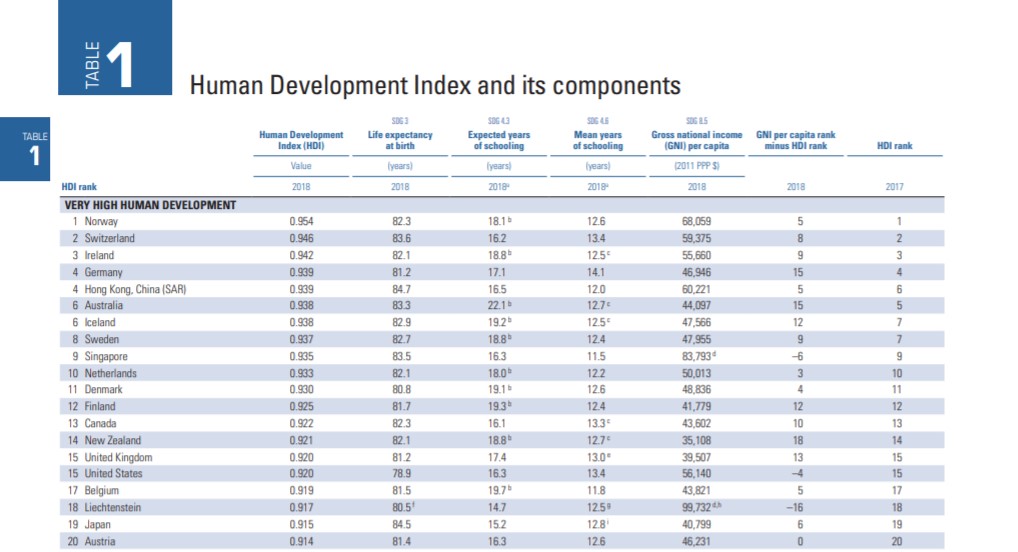
If we exclude small states (Hong Kong, Singapore, Liechtenstein), it turns out that out of 17 countries on the list, 12 have very strong social democratic parties that have been ruling in them for a significant amount of time. At the same time, out of the remaining 5 countries, social democrats failed to exert a huge influence only on the development of Japan (although there was a large social democratic party there as well). Those countries that do not have strong SD parties (Russia, China, Ukraine, Serbia, and so on) most often occupy low places according to key quality of life indicators. In the press freedom index, the first 5 places are occupied by Norway, Finland, Denmark, Sweden, and the Netherlands104, that is, countries where the influence of social democrats is very strong. Therefore, social democrats are perhaps the world’s most successful movement in terms of improving people’s living standards, ensuring freedoms, and reducing inequality.
The article was written in collaboration with Andrey Dzhimshitashvili.
- Vår historia // Socialdemokraterna (www.socialdemokraterna.se). [Electronic resource]. URL: https://www.socialdemokraterna.se/vart-parti/om-partiet/var-historia (accessed: 26.06.2020).
- Jörgen Weibull. Swedish History in Brief – 164 p. – Stockholm: Swedish Institute, 1993. – p. 117.
- N.S. Plevako. Social Democratic Workers’ Party of Sweden // Great Russian Encyclopedia. Volume 30. Moscow, 2015, pp. 747-748. [Electronic resource]. URL: https://bigenc.ru/world_history/text/3638940 (accessed: 26.06.2020).
- Jan Melin, Alf W. Johansson, S. Hedenborg. History of Sweden – 400 p. – M.: Publishing House “Ves Mir”, 2002
- N.S. Plevako. Social Democratic Workers’ Party of Sweden // Great Russian Encyclopedia. Volume 30. Moscow, 2015, pp. 747-748. [Electronic resource]. URL: https://bigenc.ru/world_history/text/3638940 (accessed: 26.06.2020).
- Christina Winroth. 6-Hour Working Day: the Swedish Story. Or Whatever Happened to the 6-Hour Day? // EuroCité (eurocite.eu). March 23, 2017. [Electronic resource]. URL: http://eurocite.eu/wp-content/uploads/2017/04/Winroth-6-hour-working-day-Sweden.pdf (accessed: 26.06.2020).
- V.V. Roginsky. Palme // Great Russian Encyclopedia. Electronic version (2018). [Electronic resource]. URL: https://bigenc.ru/world_history/text/5462918 (accessed: 26.06.2020).
- Human Development Report 2019. Beyond income, beyond averages, beyond today: Inequalities in human development in the 21st century // United Nations Development Programme (hdr.undp.org). [Electronic resource]. URL: http://hdr.undp.org/sites/default/files/hdr2019.pdf (accessed: 26.06.2020).
- Information in english. Information about The Norwegian Labour Party // Arbeiderpartiet (www.arbeiderpartiet.no). [Electronic resource]. URL: https://www.arbeiderpartiet.no/om/information-in-english/ (accessed: 26.06.2020).
- V.V. Roginsky. Norwegian Labour Party // Great Russian Encyclopedia. Volume 23. Moscow, 2013, pp. 313-314. [Electronic resource]. URL: https://bigenc.ru/world_history/text/2670688 (accessed: 26.06.2020).
- Einar Gerhardsen // Encyclopaedia Britannica (www.britannica.com). [Electronic resource]. URL: https://www.britannica.com/biography/Einar-Gerhardsen (accessed: 26.06.2020).
- Arbeiderpartiet. Party manifesto 2017-2021. Everyone participates. [Electronic resource]. URL: https://res.cloudinary.com/arbeiderpartiet/image/upload/v1/ievv_filestore/f9d8039b230240f3aedb79ad7620543a0a8dd04c769c4600832eb7a354801839 (accessed: 26.06.2020).
- In English: The Social Democratic Party // Socialdemokratiet (www.socialdemokratiet.dk). [Electronic resource]. URL: https://www.socialdemokratiet.dk/da/partiet/in-english-the-social-democratic-party/ (accessed: 26.06.2020).
- V.V. Roginsky. Social Democratic Party of Denmark // Great Russian Encyclopedia. Volume 30. Moscow, 2015, p. 746. [Electronic resource]. URL: https://bigenc.ru/world_history/text/3638885 (accessed: 26.06.2020).
- Social Democratic Party of Denmark // RIA Novosti (ria.ru). June 6, 2019, 12:02. [Electronic resource]. URL: https://ria.ru/20190606/1555316731.html (accessed: 26.06.2020).
- V.V. Roginsky. Stauning // Great Russian Encyclopedia. Volume 31. Moscow, 2016, p. 204. [Electronic resource]. URL: https://bigenc.ru/world_history/text/4164535 (accessed: 26.06.2020).
- Party history // Sosialidemokraatit (sdp.fi). [Electronic resource]. URL: https://sdp.fi/ru/сдп/история-партии/ (accessed: 26.06.2020).
- Social Democratic Party of Finland // Great Russian Encyclopedia. Volume 30. Moscow, 2015, pp. 746-747. [Electronic resource]. URL: https://bigenc.ru/world_history/text/3638911 (accessed: 26.06.2020).
- Finnish nationalists fell short by 0.2% to win parliamentary elections // RBC (www.rbc.ru). April 15, 2019, 01:11. [Electronic resource]. URL: https://www.rbc.ru/politics/15/04/2019/5cb3b0259a7947c81333f5d5 (accessed: 26.06.2020).
- Evgenia Zybina. Social Democratic Party of Finland became the most popular in the country // ERR (rus.err.ee). April 18, 2020, 14:44. [Electronic resource]. URL: https://rus.err.ee/1079185/social-demokraticheskaja-partija-finljandii-stala-samoj-populjarnoj-v-strane (accessed: 26.06.2020).
- Sorsa // Great Russian Encyclopedia. Volume 30. Moscow, 2015, pp. 718-719. [Electronic resource]. URL: https://bigenc.ru/world_history/text/3637816 (accessed: 26.06.2020).
- Social Democratic Party of Germany Celebrates 150th Anniversary // Deutsche Welle (www.dw.com). May 22, 2013.[Electronic resource]. URL: https://www.dw.com/ru/социал-демократическая-партия-германии-празднует-150-летний-юбилей/a-16827701 (accessed: 26.06.2020).
- The Weimar Republic 1918-1929. Changes in society, 1924–29 // BBC (www.bbc.co.uk). [Electronic resource]. URL: https://www.bbc.co.uk/bitesize/guides/z9y64j6/revision/8 (accessed: 26.06.2020).
- Weimar Republic // Encyclopaedia Britannica (www.britannica.com). [Electronic resource]. URL: https://www.britannica.com/place/Weimar-Republic (accessed: 26.06.2020).
- History of Germany: A Textbook: In 3 Vols. / Under the general editorship of B. Bonwetsch, Yu.V. Galaktionov – M.: KDU, 2008. – 672 p. – Vol. 2: From the Creation of the German Empire to the Beginning of the 21st Century / A.M. Betmakaev, T.A. Byalikova, Yu.V. Galaktionov, [et al.]; managing editor Yu.V. Galaktionov; compiled by A.A. Mit. – p. 452.
- L.N. Brovko (2015). Update: BRE Editorial Board (2020). Social Democratic Party of Germany // Great Russian Encyclopedia. [Electronic resource]. URL: https://bigenc.ru/world_history/text/5677289 (accessed: 26.06.2020).
- Labour’s Legacy // The Labour Party (labour.org.uk). [Electronic resource]. URL: https://labour.org.uk/about/labours-legacy/ (accessed: 26.06.2020).
- N.M. Stepanova. Labour Party // Great Russian Encyclopedia. Volume 17. Moscow, 2010, pp. 173-175. [Electronic resource]. URL: https://bigenc.ru/world_history/text/2137537 (accessed: 26.06.2020).
- Equal Pay Act 1970 // Legislation.gov.uk (www.legislation.gov.uk). [Electronic resource]. URL: http://www.legislation.gov.uk/ukpga/1970/41/enacted (accessed: 26.06.2020).
- Notre histoire // Socialistes à Paris (www.parti-socialiste.paris). [Electronic resource]. URL: https://www.parti-socialiste.paris/socialistes-a-paris/les-instances-federales/notre-histoire/ (accessed: 26.06.2020).
- M.Ts. Arzakanyan. French Socialist Party // Great Russian Encyclopedia. Volume 33. Moscow, 2017, p. 596. [Electronic resource]. URL: https://bigenc.ru/world_history/text/4722696 (accessed: 26.06.2020).
- A.V. Shubin. The Popular Front in France // Encyclopedia of World History (w.histrf.ru). [Electronic resource]. URL: https://w.histrf.ru/articles/article/show/narodnyi_front_vo_frantsii (accessed: 26.06.2020).
- Lionel Jospin // Gouvernement.fr (www.gouvernement.fr). [Electronic resource]. URL: https://www.gouvernement.fr/lionel-jospin (accessed: 26.06.2020).
- Andrew Glyn. Social Democracy in Neoliberal Times: The Left and Economic Policy Since 1980 – 384 p. – Oxford University Press, 2001. – p. 134
- Alexander Ratnikov. Economist Thomas Piketty to RBC: “Where Did the Money Go in Russia?” // RBC (www.rbc.ru). November 27, 2015, 19:29. [Electronic resource]. URL: https://www.rbc.ru/interview/society/27/11/2015/56586d809a794769fa3df926 (accessed: 26.06.2020).
- Australian Labor Party // Encyclopaedia Britannica (www.britannica.com). [Electronic resource]. URL: https://www.britannica.com/topic/Australian-Labor-Party (accessed: 26.06.2020).
- Ben Chifley: the true believer // Australian Government. The Treasury (treasury.gov.au). March 30, 2012. [Electronic resource]. URL: https://treasury.gov.au/publication/economic-roundup-issue-3-2011/economic-roundup-issue-3-2011/ben-chifley-the-true-believer (accessed: 26.06.2020).
- Gough Whitlam // Encyclopaedia Britannica (www.britannica.com). [Electronic resource]. URL: https://www.britannica.com/biography/Gough-Whitlam (accessed: 26.06.2020).
- Michele Brennan. Law: The legal reforms of the Whitlam government // Parliament of Australia (parlinfo.aph.gov.au). [Electronic resource]. URL: https://parlinfo.aph.gov.au/parlInfo/download/library/prspub/3566484/upload_binary/3566484.pdf (accessed: 26.06.2020).
- Things you didn’t know Gough Whitlam did // ABC News (www.abc.net.au). [Electronic resource]. URL: https://www.abc.net.au/news/2014-10-21/things-you-didnt-know-whitlam-did/5830508 (accessed: 26.06.2020).
- Gough Whitlam: Guide to Archives of Australia’s Prime Ministers. Chapter 7 – Prime Minister, 1972–75 // Research guides (guides.naa.gov.au). [Electronic resource]. URL: http://guides.naa.gov.au/gough-whitlam/chapter7/7.5.aspx (accessed: 30.03.2020).
- S.P. Pozharskaya. Iglesias Posse // Great Russian Encyclopedia. Volume 10. Moscow, 2008, p. 673. [Electronic resource]. URL: https://bigenc.ru/world_history/text/1999498 (accessed: 26.06.2020).
- M.Ts. Arzakanyan. The Popular Front // Great Russian Encyclopedia. Volume 22. Moscow, 2013, pp. 78-80. [Electronic resource]. URL: https://bigenc.ru/world_history/text/2249989 (accessed: 26.06.2020).
- Felipe González Márquez // Encyclopaedia Britannica (www.britannica.com). [Electronic resource]. URL: https://www.britannica.com/biography/Felipe-Gonzalez-Marquez (accessed: 26.06.2020).
- I.Yu. Mednikov. González Márquez, Felipe // Encyclopedia of World History (w.histrf.ru). [Electronic resource]. URL: https://w.histrf.ru/articles/article/show/gonsa_lies_ma_rkies_isp_gonzalez_marquez_fielipie (accessed: 26.06.2020).
- José Luis Rodríguez Zapatero // Encyclopaedia Britannica (www.britannica.com). [Electronic resource]. URL: https://www.britannica.com/biography/Jose-Luis-Rodriguez-Zapatero (accessed: 26.06.2020).
- G.A. Shatokhina-Mordvintseva. Social Democratic Workers’ Party of the Netherlands // Great Russian Encyclopedia. Volume 30. Moscow, 2015, p. 747. [Electronic resource]. URL: https://bigenc.ru/world_history/text/3638931 (accessed: 26.06.2020).
- G.A. Shatokhina-Mordvintseva. Labour Party // Great Russian Encyclopedia. Volume 32. Moscow, 2016, p. 452. [Electronic resource]. URL: https://bigenc.ru/world_history/text/4205946 (accessed: 26.06.2020).
- Willem Drees // Canon van Nederland (www.canonvannederland.nl). [Electronic resource]. URL: https://www.canonvannederland.nl/en/willemdrees (accessed: 26.06.2020).
- Willem Drees // Rijksmuseum (www.rijksmuseum.nl). [Electronic resource]. URL: https://www.rijksmuseum.nl/en/rijksstudio/historical-figures/willem-drees (accessed: 26.06.2020).
- Van sociale beweging tot sp.a // De Vlaamse sociaaldemocratische partij (www.s-p-a.be). [Electronic resource]. URL: https://www.s-p-a.be/geschiedenis-van-spa/ (accessed: 26.06.2020).
- Histoire // Le parti Socialisite (www.ps.be). [Electronic resource]. URL: https://www.ps.be/#/maison_du_parti/Vie_privee/8084 (accessed: 26.06.2020).
- A.S. Namazova. Belgian Socialist Party // Great Russian Encyclopedia. Volume 3. Moscow, 2005, p. 275. [Electronic resource]. URL: https://bigenc.ru/world_history/text/1873768 (accessed: 26.06.2020).
- Social Democratic Party of Austria // Great Russian Encyclopedia. [Electronic resource]. URL: https://bigenc.ru/world_history/text/5598471 (accessed: 26.06.2020).
- Kreisky, Bruno // Encyclopedia of World History (w.histrf.ru). [Electronic resource]. URL: https://w.histrf.ru/articles/article/show/kraiskii_bruno (accessed: 26.06.2020).
- New Zealand Labour Party // Encyclopaedia Britannica (www.britannica.com). [Electronic resource]. URL: https://www.britannica.com/topic/New-Zealand-Labour-Party (accessed: 26.06.2020).
- L.G. Stefanchuk. Formation of the “Welfare State” in New Zealand // Southeast Asia: Current Problems of Development. Issue XVIII. – Moscow: Institute of Oriental Studies of the Russian Academy of Sciences, 2012. – pp. 300-315.
- Candidate for UN Secretary-General Clark: It’s Time to Look at People Like Me // RIA Novosti (ria.ru). June 21, 2016, 12:30. [Electronic resource]. URL: https://ria.ru/20160621/1449442401.html (accessed: 26.06.2020).
- First social-democrat // The Swiss Parliament (www.parlament.ch). [Electronic resource]. URL: https://www.parlament.ch/en/über-das-parlament/parlamentsgeschichte/parlamentsgeschichte-detail?historyId=88 (accessed: 26.06.2020).
- Social Democratic Party of Switzerland // Great Russian Encyclopedia. Volume 30. Moscow, 2015, p. 747. [Electronic resource]. URL: https://bigenc.ru/world_history/text/3638922 (accessed: 26.06.2020).
- Michael Marsh. Labour Party // Encyclopaedia Britannica (www.britannica.com). [Electronic resource]. URL: https://www.britannica.com/topic/Labour-Party-political-party-Ireland (accessed: 26.06.2020).
- James Connolly // Encyclopaedia Britannica (www.britannica.com). [Electronic resource]. URL: https://www.britannica.com/biography/James-Connolly (accessed: 26.06.2020).
- I.A. Aggeeva. Co-operative Commonwealth Federation // Great Russian Encyclopedia. Volume 33. Moscow, 2017, pp. 226-227. [Electronic resource]. URL: https://bigenc.ru/world_history/text/4707353 (accessed: 26.06.2020).
- Tommy Douglas crowned ‘Greatest Canadian’ // CBC.ca (www.cbc.ca). November 29, 2004, 9:39. [Electronic resource]. URL: https://www.cbc.ca/news/entertainment/tommy-douglas-crowned-greatest-canadian-1.510403 (accessed: 26.06.2020).
- I.A. Aggeeva. New Democratic Party // Great Russian Encyclopedia. Volume 23. Moscow, 2013, pp. 112-113. [Electronic resource]. URL: https://bigenc.ru/world_history/text/2665762 (accessed: 26.06.2020).
- Archiv ČSSD // Česká strana sociálně demokratická (www.cssd.cz). [Electronic resource]. URL: https://www.cssd.cz/aktualne/aktuality/archiv-cssd/ (accessed: 26.06.2020).
- Chris Terry. Czech Social Democratic Party (CSSD) // The Democratic Society (www.demsoc.org). February 20, 2014. [Electronic resource]. URL: https://www.demsoc.org/2014/02/20/czech-social-democratic-party-cssd/ (accessed: 26.06.2020).
- Epochal elections in the Czech Republic: oligarchization and a fig to the European Union // EADaily (eadaily.com). [Electronic resource]. URL: https://eadaily.com/ru/news/2017/10/24/epohalnye-vybory-v-chehii-oligarhizaciya-i-kukish-evrosoyuzu (accessed: 26.06.2020).
- Early history: it all started with a few people // LSDP (www.lsdp.lt). [Electronic resource]. URL: https://www.lsdp.lt/apie/lsdp-istorija/ (accessed: 26.06.2020).
- Algirdas Brazauskas – a cautious reformer // BBC News Russian Service (www.bbc.com). June 27, 2010. [Electronic resource]. URL: https://www.bbc.com/russian/international/2010/06/100627_brazauskas_obituary (accessed: 27.06.2020).
- Lithuanian Social Democrats in the European Parliament initiate a declaration on “Rail Baltica” // Newspaper “Obzor” (www.obzor.lt). May 5, 2010, 15:14. [Electronic resource]. URL: https://www.obzor.lt/news/n500.html (accessed: 27.06.2020).
- Eglė Samoškaitė. Vaigauskas: independent candidates received 5% of mandates // Ru.Delfi (delfi.ru). February 28, 2011, 13:07. [Electronic resource]. URL: https://ru.delfi.lt/news/politics/vajgauskas-nezavisimye-kandidaty-poluchili-5-mandatov.d?id=42551633 (accessed: 27.06.2020).
- From unification to demarcation: where the “Harmony” party is heading // Sputnik Latvia (lv.sputniknews.ru). July 19, 2019, 12:07. [Electronic resource]. URL: https://lv.sputniknews.ru/politics/20190719/12075949/Ot-obedineniya-do-razmezhevaniya-kuda-idet-partiya-Soglasie.html (accessed: 27.06.2020).
- Members of the 13th Saeima // Latvijas Republikas Saeima (www.saeima.lv). [Electronic resource]. URL: http://titania.saeima.lv/personal/deputati/saeima13_depweb_public.nsf/deputies?OpenView&lang=EN&count=1000 (accessed: 27.06.2020).
- Nils Ušakovs // Russians of Latvia (www.russkije.lv). [Electronic resource]. URL: https://www.russkije.lv/ru/lib/read/n-ushakov.html (accessed: 27.06.2020).
- Kārlis Sils. What and why you need to know about how Latvia became a parliamentary republic thanks to the Social Democrats // Latvian Public Media (rus.lsm.lv). [Electronic resource]. URL: https://rus.lsm.lv/statja/kultura/istorija/chto-i-pochemu-nuzhno-znat-o-tom-kak-blagodarja-socdemam-latvija-stala-parlamentskoy-respublikoy.a360931/ (accessed: 27.06.2020).
- Albania. Parliamentary Chamber: Kuvendi Popullor // Inter-Parliamentary Union (archive.ipu.org). [Electronic resource]. URL: http://archive.ipu.org/parline-e/reports/arc/2001_97.htm (accessed: 27.06.2020).
- Election for Kuvendi i Shqipërisë (Parliament of Albania) // IFES Election Guide (www.electionguide.org). [Electronic resource]. URL: http://www.electionguide.org/elections/id/1664/ (accessed: 27.06.2020).
- Election for Kuvendi i Shqipërisë (Parliament of Albania) // IFES Election Guide (www.electionguide.org). [Electronic resource]. URL: http://www.electionguide.org/elections/id/2461/ (accessed: 27.06.2020).
- Кирилл Лиманов. Албания // Энциклопедия Кругосвет (www.krugosvet.ru). [Electronic resource]. URL: https://www.krugosvet.ru/enc/strany_mira/ALBANIYA.html (accessed: 27.06.2020).
- M.O. Troyanovskaya. Democratic Party of the USA // Great Russian Encyclopedia. Volume 8. Moscow, 2007, p. 511. [Electronic resource]. URL: https://bigenc.ru/world_history/text/1947070 (accessed: 27.06.2020).
- Social Security Act (1935) // Our Documents (www.ourdocuments.gov). [Electronic resource]. URL: https://www.ourdocuments.gov/doc.php?flash=true&doc=68 (accessed: 27.06.2020).
- Our history // Democratic Party (democrats.org). [Electronic resource]. URL: https://democrats.org/who-we-are/our-history/ (accessed: 27.06.2020).
- E.S. Tokareva. Italian Democratic Party // Encyclopedia of World History (w.histrf.ru). [Electronic resource]. URL: https://w.histrf.ru/articles/article/show/italianskaia_diemokratichieskaia_partiia (accessed: 27.06.2020).
- The Italian Party System [Text] / T.V. Zonova // Current Problems of Europe. – 2018. – No. 2. – p. 163
- Leipzig Conference – A Progressive Network for the 21st Century // Progressive Alliance (progressive-alliance.info). May 22, 2013. [Electronic resource]. URL: https://progressive-alliance.info/event_type/leipzig-conference/ (accessed: 27.06.2020).
- Latvian Social Democrats joined the Progressive Alliance // IA REGNUM (regnum.ru). May 26, 2013, 13:22. [Electronic resource]. URL: https://regnum.ru/news/polit/1663200.html (accessed: 27.06.2020).
- Yu. Basharimov. Progressive Alliance of Socialists and Democrats: Current Problems of World Politics // Scientific and Analytical Herald of IE RAS, 2019, No. 2, p. 85.
- Progressive Alliance: A Network of Progressive Forces for the 21st Century // Progressive Alliance (progressive-alliance.info). May 2013. [Electronic resource]. URL: https://progressive-alliance.info/wp-content/uploads/2015/09/150930-Draft-Progressive-Alliance-Basic-Document-1.pdf (accessed: 27.06.2020).
- Socialist International // Great Russian Encyclopedia. Volume 30. Moscow, 2015, p. 751. [Electronic resource]. URL: https://bigenc.ru/world_history/text/3639057 (accessed: 27.06.2020).
- Brotherly feud among socialists // Süddeutsche Zeitung (www.sueddeutsche.de). [Electronic resource]. May 22, 2013, 18:56. URL: https://www.sueddeutsche.de/politik/streit-zwischen-spd-und-sozialistischer-internationale-bruderzwist-unter-sozialisten-1.1678352 (accessed: 27.06.2020).
- Löfven to the board of the new organization // SVT Nyheter (www.svt.se). [Electronic resource]. URL: https://www.svt.se/nyheter/inrikes/lofven-till-styrelsen-for-ny-organisation (accessed: 27.06.2020).
- Social Democrats found a global network // Spiegel Politik (www.spiegel.de). May 22, 2013, 19:15. [Electronic resource]. URL: https://www.spiegel.de/politik/deutschland/progressive-alliance-sozialdemokraten-gruenden-weltweites-netzwerk-a-901352.html (accessed: 27.06.2020).
- History of the party // A Just Russia (spravedlivo.ru). [Electronic resource]. URL: https://spravedlivo.ru/4774510 (accessed: 27.06.2020).
- A.V. Mitrofanov. Steps of the new geopolitics. – 286 p. – Moscow: Russkiy Vestnik, 1997
- Aleksey Gavrilko-Alekseev. Five Main Legislative Initiatives of Elena Mizulina // RBC (www.rbc.ru). January 23, 2017, 15:05. [Electronic resource]. URL: https://www.rbc.ru/politics/23/01/2017/5885d6b19a794709dbbcc308 (accessed: 27.06.2020).
- Mironov stated that there is no worthy alternative to Putin for the presidency // TASS (tass.ru). December 25, 2017, 12:04. [Electronic resource]. URL: https://tass.ru/politika/4840600 (accessed: 27.06.2020).
- História // Partido Social Democrata (www.psd.pt). [Electronic resource]. URL: https://www.psd.pt/partido/historia/ (accessed: 27.06.2020).
- Portugal // Parties and Elections in Europe (www.parties-and-elections.eu). [Electronic resource]. URL: http://www.parties-and-elections.eu/portugal.html (accessed: 27.06.2020).
- Viktor Grigoryev. Reluctant Democrat. Who Established Freedom and Democracy in Portugal. The Story of Ramiro Moreira // Solidarizm (solidarizm.ru). [Electronic resource]. URL: http://solidarizm.ru/txt/depon.shtml (accessed: 27.06.2020).
- Nikolay Kavkazsky. Another socialism // Radio Liberty (www.svoboda.org). December 6, 2013. [Electronic resource]. URL: https://www.svoboda.org/a/25191034.html (accessed: 27.06.2020).
- About us // Left Socialist Action (levsd.ru). August 19, 2008. [Electronic resource]. URL: http://levsd.ru/?page_id=2 (accessed: 27.06.2020).
- Social-democratic faction // Yabloko (yabloko.ru). [Electronic resource]. URL: https://yabloko.ru/Faction/Social-demokrat/index.html (accessed: 27.06.2020).
- 2020 World Press Freedom Index // Reporters Without Borders (rsf.org). [Electronic resource]. URL: https://rsf.org/en/ranking/2020 (accessed: 27.06.2020).