Progressive tax – what, how, why
At the beginning of 2020, Russia remained one of the countries with a flat tax scale, despite the fact that most developed countries had long since switched to a progressive one. The actual transition to a progressive scale that began on January 1, 2021, consisted of a negligible increase in the top rate from 13% to 15%. This is facilitated by many stereotypes that have formed around the progressive tax. Let’s try to break down these stereotypes.
It is not very unreasonable that the rich should contribute to the public expense, not only in proportion to their revenue, but something more in that proportion.
For social democrats around the world, progressive taxation has been and remains one of the key pillars of economic policy. Why? First and foremost, because it helps achieve a balance of social justice, prevents resources from being concentrated in a single set of hands, and prevents a small handful of the wealthy from receiving compensation for their activities that is many times greater than what those activities are worth from the perspective of fairness. Furthermore, progressive taxation is one of the ways to secure funds for the creation and development of a social state. This is why social democrats advocate for a progressive tax, while many right-wing movements, which express the interests of the elites, oppose it.
Contents
What is a progressive tax?
Progressive taxation is applied when the tax rate increases as the taxable base grows1. The feature of a progressive scale is that the income tax rate is differentiated and increases as the taxpayer’s income rises2. To put it simply, with a flat scale, everyone pays, for example, 13% of their income (both the worker and the billionaire), whereas with a progressive scale, the more you earn, the more you pay (for instance, a worker might pay 10% of their income, while a billionaire might pay 40%).
Libertarians have devised an argument that under a progressive scale, high-income individuals do not pay the same amount of tax as everyone else, but rather more, which they claim is unfair. However, firstly, in absolute numbers, high-income individuals typically have much more money left over after taxes than the majority of citizens (for example, if a worker pays 10% on a salary of 80,000 rubles and a billionaire pays 40% on an income of 80,000,000 rubles, the former is left with 72,000 rubles, while the latter retains 48,000,000 rubles). Secondly, high-income individuals pay more even under a flat scale, but few in their right mind would suggest that billionaires should pay the same amount of tax in absolute figures as ordinary workers (roughly speaking, 10,000 rubles each). Thirdly, after taxes, most citizens lack the money to cover essential needs like purchasing housing, whereas people with super-incomes, even in many progressive tax systems, retain sufficient funds to purchase excess luxury goods and large amounts of real estate. Social democrats, as we have emphasized repeatedly (for example, in the article on equality), are not against income differences, but they advocate for a reasonable difference that leads to the common good.
A progressive tax helps smooth out the injustice in income disparities. Because the majority of citizens pay fewer taxes (which is precisely what happens under a progressive tax), they are left with more money; also, because money from the progressive tax goes toward supporting the social state, citizens spend less on certain services, which again raises their well-being and closes the gap with the super-rich. A progressive tax is an additional source of revenue for the treasury. For instance, according to estimates by the Russian Ministry of Finance made in 2018, applying a 20 percent higher tax rate (a relatively low upper ceiling) to high incomes could have generated about 75-120 billion rubles per year3. This is not a large figure, but one should take into account the small increase in the rate and the imperfect legal system of the Russian Federation, which makes tax collection difficult.
Due to the redistribution created by such a tax, a middle class is created and strengthened that is capable of purchasing goods, which stimulates the growth of their production and the country’s well-being as a whole. A progressive tax also curbs the growth of social inequality.
“Strong shoulders should bear a heavier load” — so goes a widely prevalent argument linked to an individual’s labor contribution. Whoever has more should make a larger contribution to the common good4. It is unlikely that if you went shopping with your grandmother, you would insist that you carry bags of the exact same weight. In this case, the stronger person must carry more weight, and it is the same with taxes.
1) Proportional, rather than progressive, tax rates violate the principles established back by Adam Smith — the uniform establishment of taxes among citizens in proportion to their incomes. The fact is that with rising income, the necessity of expenditures decreases, and consequently, the share of discretionary income — that is, income not burdened by expenses — increases. It is not difficult to notice that under proportional taxation of total income, a less affluent taxpayer bears a heavier tax burden than a more affluent one because the share of their disposable income is smaller, and the share of tax paid out of this disposable income is higher. Under the current system, wealthy citizens have more income left over. Meanwhile, low-income citizens spend all their income on current consumption;
2) People become rich exclusively due to the fact that they live in society, and not as individuals on a desert island. Wealth is a derivative of the public economy. Therefore, everyone should pay back to society in proportion to how much they receive from it. It is all fair: the rich receive more from the capitalist system, so they should give more back5.
Where the progressive scale is in effect
As the renowned economist Thomas Piketty notes, a progressive tax on total income was introduced almost universally in the first third of the 20th century (in 1913 in the USA, in 1914 in France, in 1909 in the UK, in 1922 in India, in 1932 in Argentina)6. This system has remained in most developed countries. For instance, it exists in the USA (top rate – 37%7), in Scandinavian countries (e.g., Denmark, where the top rate is 52%8), in the UK (top rate – 45%9), in Germany (45%10), in South Korea (42%11), and other countries with high standards of living and/or economic development. This is confirmed by Lund University professor Andreas Berg (it should be noted that tax rates change from time to time):
Sweden once had the highest taxes in the world, but that was 20 years ago. Today the leader is France. It is followed by Denmark, Belgium, and Sweden is only in fourth place. Next are Finland, Austria, and Italy. The marginal income tax rate in Sweden today is 60%. This is still higher than in most countries in the world. But Sweden has reduced the progressivity of its tax system (the marginal rate used to be 90%). It turned out that if you raise taxes on the rich too much, they start optimizing their expenses in such a way that the budget gains nothing in the end12.

Where the flat scale is in effect
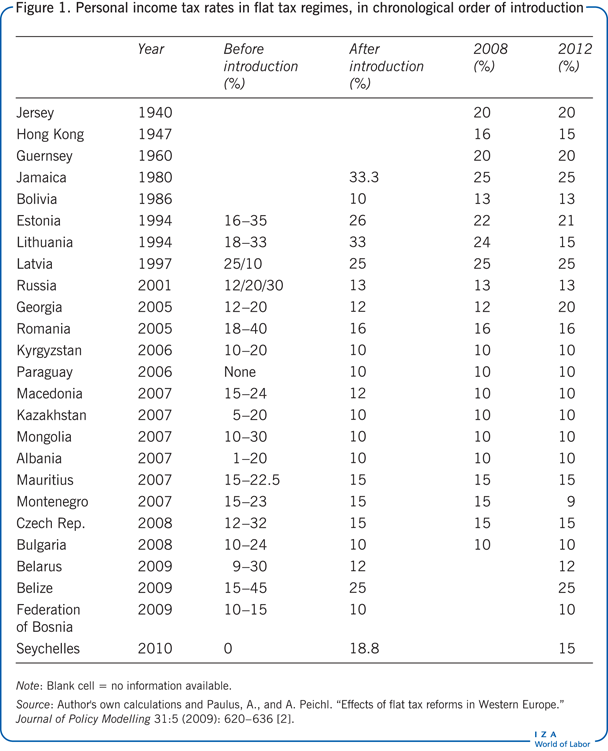
There are few such countries left today. As of 2010, there were only 2913. If we exclude some US states and Hong Kong (as they can only be called separate countries very conditionally), the most developed of them was the Czech Republic (in Iceland, a flat scale was introduced for a short time and a progressive one was soon returned). The rest of the countries were mostly former republics of the USSR like Russia, Ukraine, Kazakhstan, or Turkmenistan, and Third World countries like Iraq, Jamaica, Mongolia, Mauritania, and so on.

As Professor Andreas Peichl, Director of the Center for Macroeconomic Research at the University of Munich, notes, in the 20th century, a flat scale existed only in “tax havens” like Hong Kong; however, after the fall of former communist regimes, its mass introduction by former communists began, and in 2012 there were 27 countries using it (about half of which were Eastern European countries)14. In his research, Peichl concludes that there are no compelling reasons to recommend a flat scale.
“Hinders economic growth”
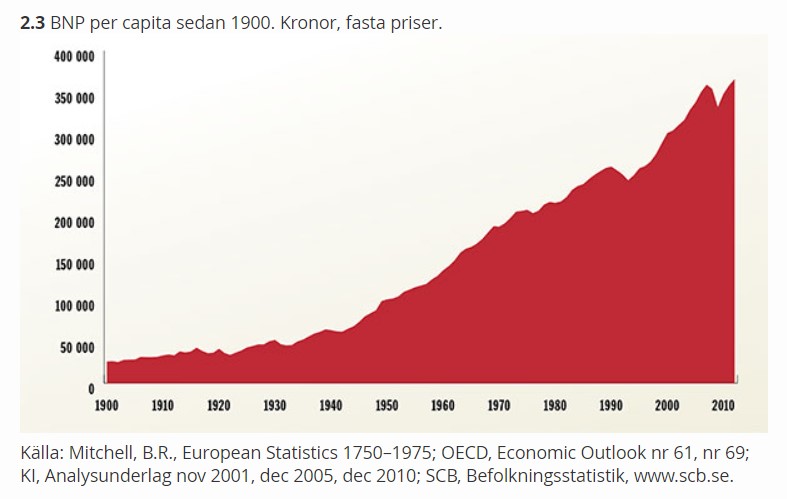
There is a point of view that economic growth is impossible with a progressive tax. It is refuted by practice. Let us take Sweden as an example as one of the most social-democratic countries, where the top tax rate has been one of the highest in the world since the 20th century. GDP per capita grew especially rapidly in Sweden from about 194015:
Now let us compare this graph with the growth of the tax-to-GDP ratio in Sweden16:

It correlates well with the graph of the growth of the top tax rate17:
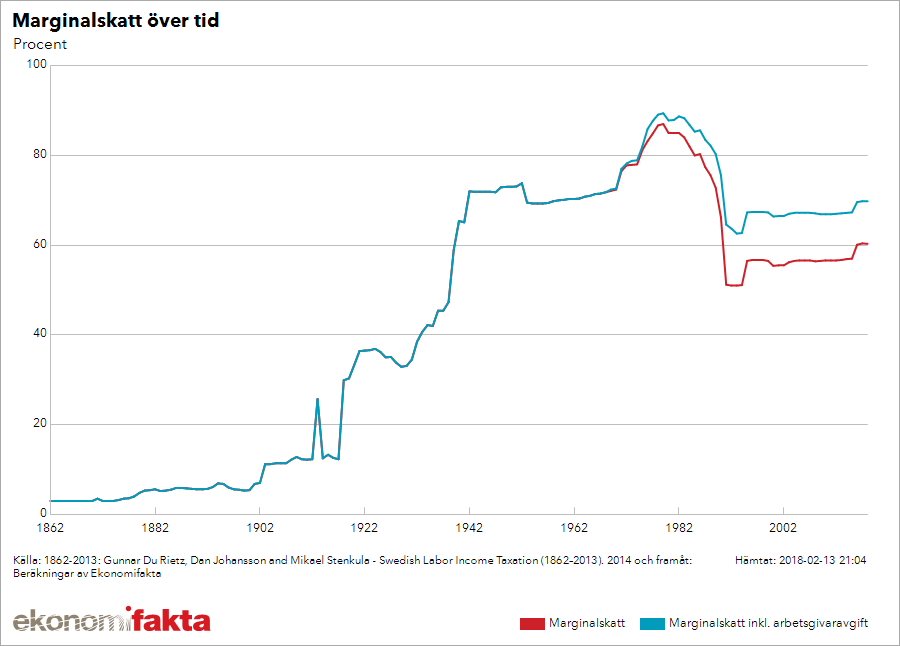
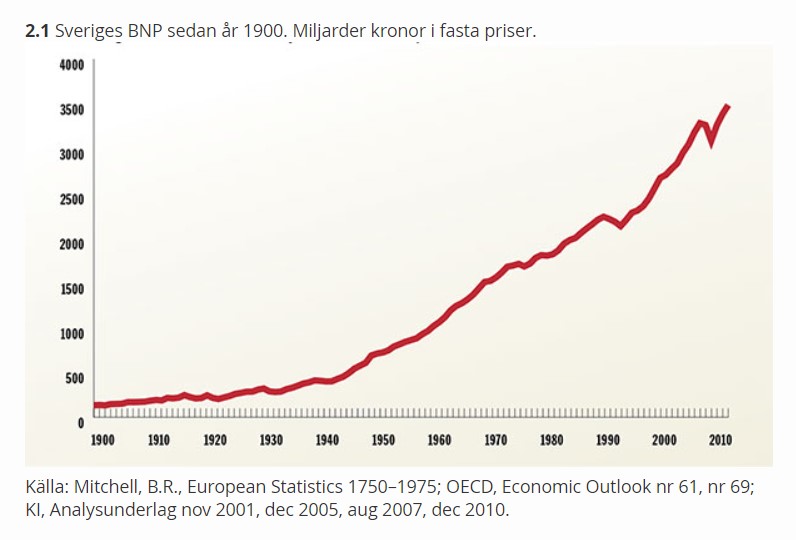
As we can see, taxes grew particularly rapidly in the period from 1940 to the mid-1980s, and this did not hinder economic growth in that same period in the slightest. GDP in absolute figures also grew along with the progressive tax:
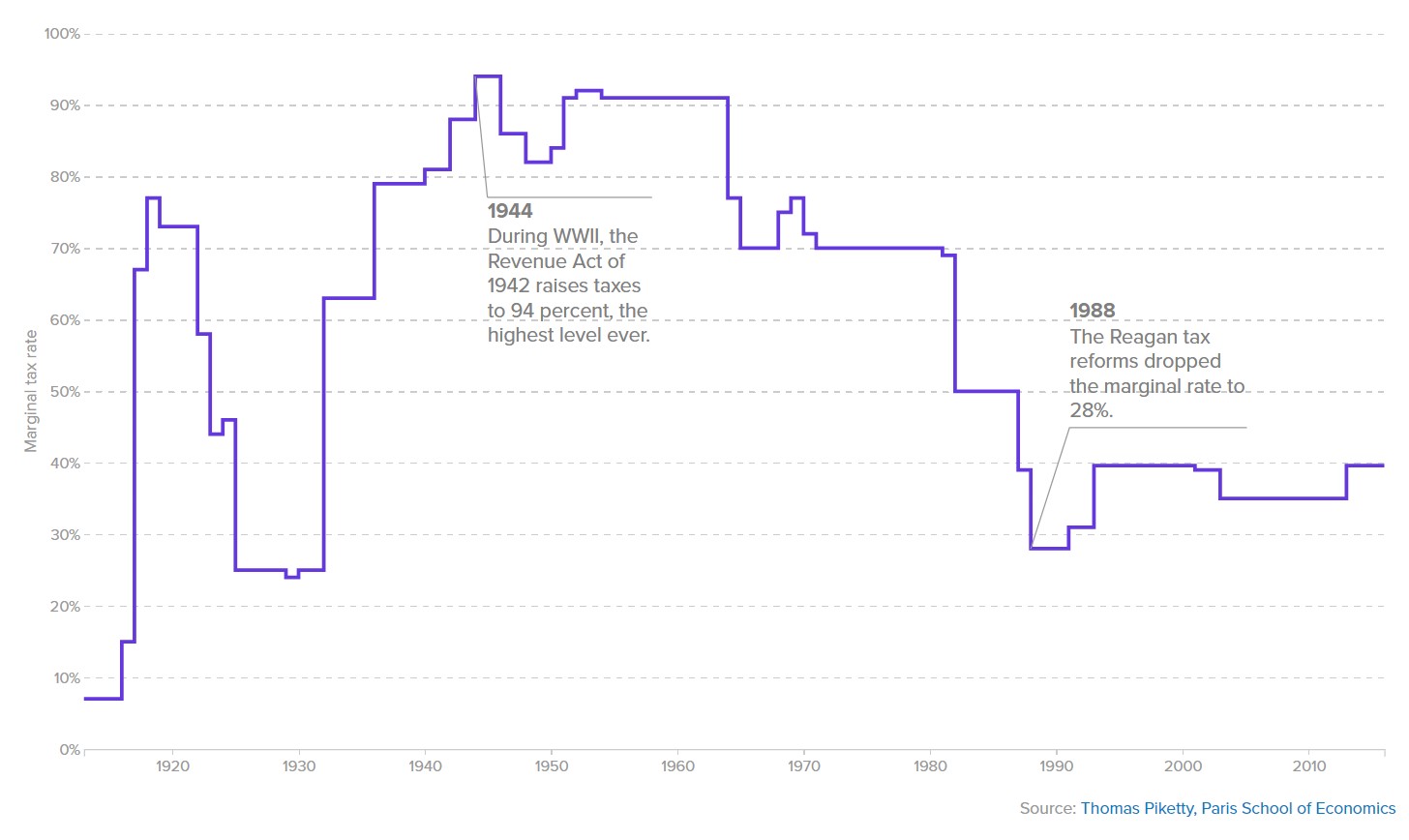
Let us also consider the example of another country where a progressive tax was introduced (one of the first in the world) — the United States of America. It was introduced in 1913, and for a significant part of the 20th century, its top marginal rate was at a very high level18:
Should we assume that the US economy stopped growing or declined during these periods? Let us look at the GDP per capita chart compiled by the Becker Friedman Institute at the University of Chicago19:
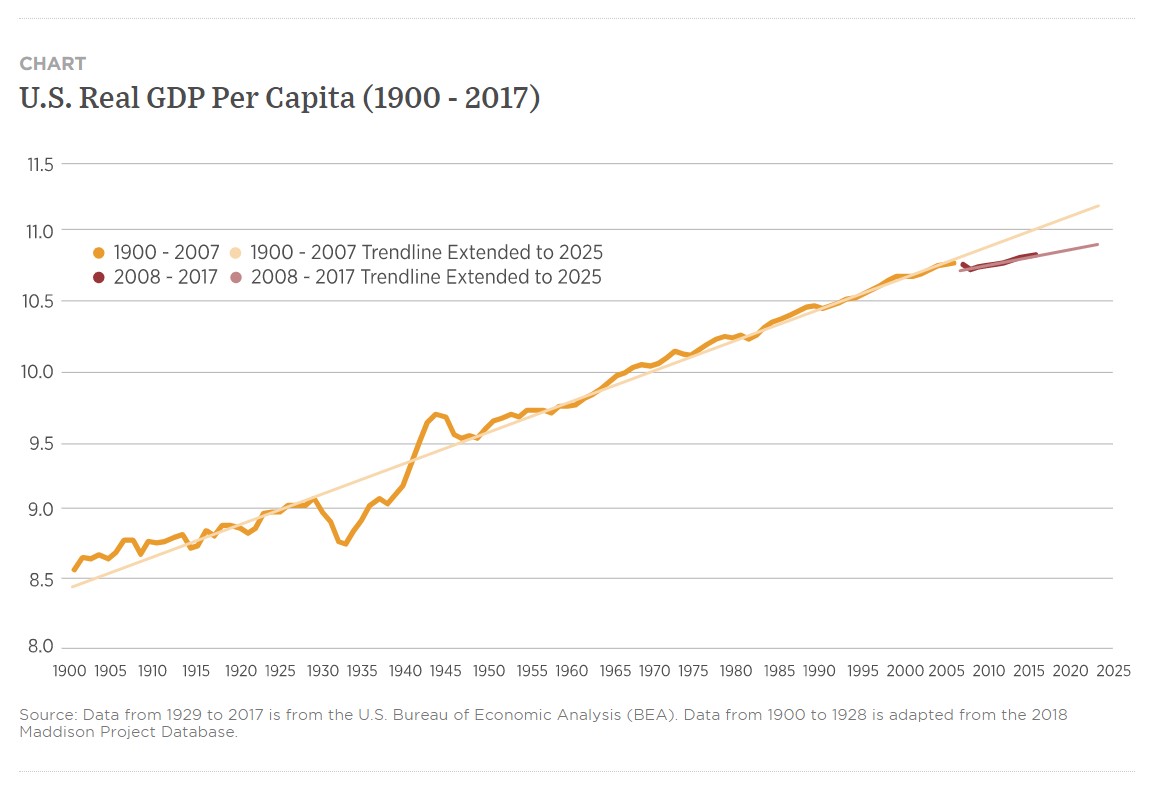
As we can see, the picture is the exact opposite — it was precisely after the top tax rate was significantly reduced in the first half of the 1920s that a failure in economic growth occurred toward the end of the second half. In the same years when the rate was significantly increased, such failures did not occur, and stable economic growth was observed. Finally, in 2012, the Congressional Research Service published a study in which no connection was found between high tax rates and economic growth20. POLITICO magazine conducted a similar study using a slightly different methodology and arrived at the same results21.
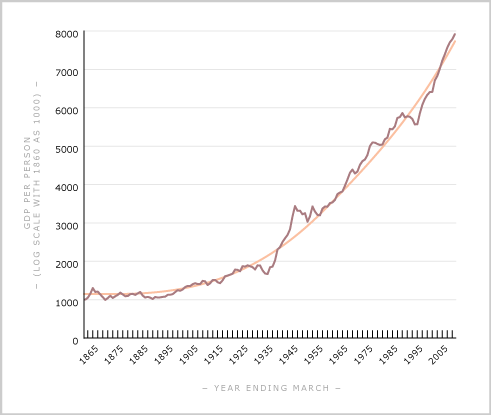
Let us also take New Zealand as an example. A progressive tax had existed there for a long time, and while in 1930 its maximum rate was 29.25%, in 1939 it was already 57%22. During the Second World War, it increased to 90%, and in 1949 it was 76.5%23. The subsequent, non-Labour government did not dare to lower this figure24, and a high maximum ceiling was maintained until the end of the 1980s. Did this hinder New Zealand’s economic growth? Data from the Encyclopedia of New Zealand25 clearly show — it did not:
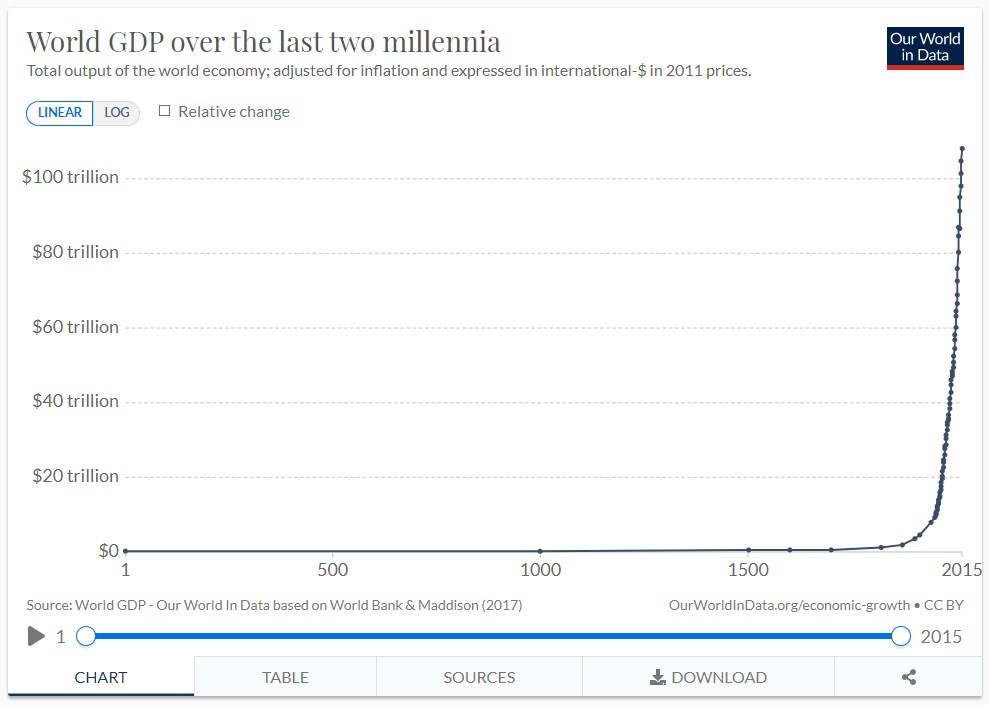
Finally, if a flat tax scale offers advantages in economic development compared to a progressive one, then the assumption would be true that countries where a flat scale existed would expect very high economic growth, which would have allowed them to make a leap similar to that of the so-called “Asian tigers” in their time (by the way, as Osaka University economics professor Masaaki Homma notes, the Japanese tax system was “extremely progressive” — during a period of fairly high economic growth, from 1970 to 1984, the top ceiling was 70%26). However, none of the countries that we indicated above as countries with a flat tax scale were marked by such a leap. Meanwhile, despite the widespread adoption of the progressive scale in the 20th century, this century was marked by the highest economic growth in human history27. All these data clearly indicate that a progressive tax does not hinder economic growth, and a flat scale provides no advantages compared to a progressive tax in this component.
“Unpopular measure”
Sometimes one hears that the introduction of a progressive tax is an unpopular measure. This is incorrect — for example, in 2013, according to Levada Center polls, 56% of Russians supported the introduction of a progressive scale28, and a similar figure (55%) was shown by a Rambler poll in 201729. In 2021, a VTsIOM poll showed that 83% of Russians are in favor of a progressive tax30. In a poll by the Public Television of Russia, 98% even spoke out in favor of adopting such a tax31. The situation is similar not only in Russia — for example, a Reuters poll in January 2020 showed that 64% of respondents in the USA hold the opinion that citizens with high incomes should pay more taxes32. All these figures show that the introduction of a progressive tax will be supported by citizens, and it is by no means possible to classify it as an unpopular measure.
“It’s robbery”
The Commonwealth puts an end to the war of all against all, and taxes are the price at which public peace is bought.
Some libertarians view any tax as “legalized robbery”, and a progressive one in particular. This is motivated, for example, by the fact that if a person does not want to pay a tax, they face punishment up to and including imprisonment or the seizure of assets, and this constitutes violence.
However, equating a tax with robbery is demagoguery. If for no other reason than that by such logic, one would then need to repeal all other laws, not just tax laws — for example, the law on punishment for murder. After all, if a person wants to kill, they face punishment up to and including imprisonment or the seizure of assets, and this constitutes violence. Therefore, the logic used to prove the thesis that taxes are legalized robbery is demagogic and effectively signifies a defense of lawlessness, as well as a defense of the utopian and amateurish libertarian idea that the state should be abandoned (we analyzed this in more detail here). Even the definitions of the concepts “tax” and “robbery” are different. Robbery, according to the Criminal Code of the Russian Federation, is the open theft of someone else’s property33, while a tax in the legislation of the Russian Federation is understood as a mandatory, individually gratuitous payment levied on organizations and individuals in the form of the alienation of monetary funds belonging to them by right of ownership, economic management, or operational management for the purpose of financial support for the activities of the state and (or) municipalities34. In essence, a tax is a payment made by citizens to support the state, which can provide a wide range of services in exchange for this payment.
Furthermore, if we move to concepts such as “legalized robbery”, the logical response of the majority would be to recognize earnings using someone else’s labor as “legalized robbery”. If one uses figurative rather than dictionary definitions of the term “robbery”, then a tax could be admitted as robbery, but then one could also recognize it as robbery that a businessman does not give a sufficient share of profits to their workers. By rejecting taxes as a consensus, libertarians thereby open the door to revolutionary Marxism, which will allow certain groups of people to commit redistribution according to their own understanding of justice, but not through taxation and consensus, but through reprisals and expropriations.
Another argument that can be attributed here is that “an entrepreneur gets nothing from a progressive tax”. This is incorrect — they receive better infrastructure (due to an expanded budget), social peace, and solvent consumers for their products (due to redistribution). The major Russian businessman Mikhail Khodorkovsky described the advantages of social peace as follows:
I will remember my trip to South Africa forever. What made the greatest impression on me was not the conversations with de Klerk and Mandela, but a dinner at the home of my casual acquaintances (I believe they were Dutch) — a good, hard-working family, successful farmers, who had lived in South Africa all their lives. Everything was fine — except for the fence over four meters high and the barbed wire, and you couldn’t let your children out of the house without a guard, and you had to know where you could go and where you couldn’t, and you were hated very much…
What for? To have a Rolls-Royce instead of a Volvo? To have a 150-meter yacht instead of a ticket for a cruise ship? No, I don’t want that kind of life for myself, my children, or my grandchildren35.
By concluding a mutually beneficial deal with society, business receives in return additional guarantees of private property. Therefore, the entrepreneur, while losing the hypothetical ability to buy 20 apartments instead of 5, nevertheless gains something greater – a progressive and prosperous society in which to live. To have 20 apartments in a destitute society is the same as living in a dump with a gold Rolex watch and Versace clothes. Fortunately, such perversions are not to everyone’s taste.
The most well-off segment of the population is, to a greater extent than other residents of the country, interested in maintaining social and political stability in society, strengthening law enforcement agencies, and government support for entrepreneurial activity. A financially secure taxpayer, as a rule, possesses more property than a less secure one. Therefore, they are in greater need of the protection of private property, the assurance of the integrity and inviolability of assets, and therefore should contribute a larger share of their income to the state, which can be achieved only with the introduction of progressive taxation36.
“They won’t pay a progressive tax”
In Russia, it is believed that the transition to a flat tax scale proved effective and increased tax collection (which is disputed, for example, by Candidate of Economic Sciences Olga Averyanova37). This thesis is cited as one of the reasons why a progressive tax should not be introduced – from the point of view of its opponents, this will lead to tax evasion and the fact that people will not pay them. However, for anyone even slightly familiar with public administration, it is obvious that simply issuing a decree is not enough for it to be immediately implemented. Of course, if you introduce a progressive tax where laws are not enforced, the legal system has a low level of efficiency, and the tax and political systems are riddled with corruption, it will be collected with low efficiency. However, in those countries where these issues have been resolved, a progressive tax is successfully paid and collected.
Therefore, before introducing a progressive tax, one should at least increase the level of democracy, the rule of law, and press freedom. It would also be very useful to build competent tax and law enforcement institutions, as well as to create a political force that will defend the idea of a progressive tax (this force, as a rule, is the social democrats). People must also understand what they are paying this tax for. It is necessary that they receive high-quality infrastructure and social guarantees in return – in this case, their willingness to pay the tax will increase, as Andreas Berg notes:
There are people in Sweden who want to increase or decrease taxes on the rich. But by and large, taxes are quite high. Hence the question: why are people in Sweden so willing to pay them? The level of evasion here is lower than in countries with much lower tax rates. And the answer is that people are satisfied with the benefits they receive as a result. They understand that if taxes were lower, they would have to pay for everything themselves and take care of themselves. And Swedish politicians don’t just run off with the money, but actually provide services for the population. Surprisingly, people are even willing to pay more if the money goes, for example, to schools or healthcare38.
The same is written on the official website of Sweden:
Swedes are among the most compliant taxpayers. Public opinion polls show that many would agree to pay even more taxes if necessary. A 2016 national poll showed that the Swedish Tax Agency is the fifth most popular among nearly thirty major government agencies. Swedes trust the state and its institutions – this is confirmed by numerous public opinion studies39.
Furthermore, problems with tax collection exist in countries with a flat tax scale as well. Thus, when the data leak of the Panamanian law firm Mossack Fonseca occurred40, it included data on the ownership of offshore companies by many citizens of Russia and Ukraine, which at that time had a flat scale. The level of tax evasion depends on the size of the tax to a much lesser extent than on the level of organization of the tax service, the level of the rule of law, the ease of doing business in the country, and other factors. A progressive tax is only one of many factors influencing the decision to evade, and far from the most important one. In Russia, where a flat scale is implemented, about 30-40% of citizens receive “grey” wages, according to the estimate of the Federation Council41. Such a figure hardly aligns with the myth about the effectiveness of the flat scale in combating tax evasion. Sometimes one also hears that if a progressive tax is introduced, wealthy taxpayers will start leaving the country. However, according to Reuters estimates, from 2014 to 2017 alone, a third (!) of the 500 wealthiest businessmen left Russia “to avoid disclosure of offshore assets”, despite the flat scale42.
To combat tax evasion, one needs not to introduce a flat scale, but to improve institutions and conduct an international fight against offshore companies and tax havens, as well as tax evasion. For example, in 2021, German Finance Minister Olaf Scholz ordered the purchase of data on citizens of the country who have assets in Dubai43, and the ministry began studying them to identify non-payers and open cases against them. Social democrats should more often use various methods for finding non-payers and apply the most decisive punishments possible toward those who attempt to conceal their income, and most importantly – ensure the highest possible likelihood of the inevitability of punishment.
In summary
A progressive tax is a fair measure that has support in society and is implemented in the most developed countries of the world. It does not hinder economic growth. At the same time, it requires a certain preparation of the state for the introduction of this measure, without which it will be ineffective and unfair.
- L.N. Lykova. Taxation // Great Russian Encyclopedia. Volume 21. Moscow, 2012, pp. 724-725. [Electronic resource]. URL: https://bigenc.ru/economics/text/2246961 (Date of access: 24.06.2021).
- G.V. Morozova, N.A. Prokofyeva. Introduction of progressive personal income taxation as a tool for regulating the economy // BSU Electronic Library (elib.bsu.by). [Electronic resource]. URL: https://elib.bsu.by/bitstream/123456789/56267/1/Морозова_Введение%20прогрессивного%20налогообложения.pdf (Date of access: 24.06.2021).
- President’s address to the citizens of Russia // Official website of the President of Russia (kremlin.ru). August 29, 2018, 12:00. [Electronic resource]. URL: http://kremlin.ru/events/president/news/58405 (Date of access: 24.06.2021).
- Tobias Gombert, Julia Blesius, Christian Krell, Martin Timpe. Foundations of Social Democracy – p. 33. // Friedrich-Ebert-Stiftung (www.fes.de). [Electronic resource]. URL: https://library.fes.de/pdf-files/akademie/07650.pdf (date of access: 26.10.2020).
- Yury Mirzoyev. Refutation of popular misconceptions regarding the progressive taxation system // Zakon.ru (zakon.ru). May 21, 2020, 10:44. [Electronic resource]. URL: https://zakon.ru/blog/2020/05/21/oproverzhenie_populyarnyh_zabluzhdenij_otnositelno_progressivnoj_sistemy_nalogooblozheniya (Date of access: 24.06.2021).
- Thomas Piketty. Capital in the Twenty-First Century. – 592 p. – Moscow: Ad Marginem Press, 2015. – p. 30.
- Evelyn Pimplaskar. What are the 2019 tax brackets for federal income taxes? // Credit Karma (www.creditkarma.com). December 7, 2020. [Electronic resource]. URL: https://www.creditkarma.com/tax/i/2019-tax-brackets-things-to-know (Date of access: 24.06.2021).
- Jacob Lundberg, Gustav Fritzon, Daniel Bunn. Taxing High Incomes: A Comparison of 41 Countries // Tax Foundation (taxfoundation.org). October 23, 2019. [Electronic resource]. URL: https://taxfoundation.org/taxing-high-income-2019/ (Date of access: 24.06.2021).
- Income Tax rates and Personal Allowances // GOV.UK (www.gov.uk). [Electronic resource]. URL: https://www.gov.uk/income-tax-rates (Date of access: 24.06.2021).
- Jacob Lundberg, Gustav Fritzon, Daniel Bunn. Taxing High Incomes: A Comparison of 41 Countries // Tax Foundation (taxfoundation.org). October 23, 2019. [Electronic resource]. URL: https://taxfoundation.org/taxing-high-income-2019/ (Date of access: 24.06.2021).
- Ibid.
- Arnold Khachaturov. “Sweden used to be a much more socialist country”. Economist Andreas Berg on the main lessons of the Scandinavian economic model for Russia and the whole world // Novaya Gazeta (novayagazeta.ru). September 25, 2020, 11:00. [Electronic resource]. URL: https://novayagazeta.ru/articles/2020/09/25/87228-ranshe-shvetsiya-byla-gorazdo-bolee-sotsialisticheskoy-stranoy (Date of access: 24.06.2021).
- 29 countries use a flat personal income tax scale today // Expert (expert.ru). [Electronic resource]. URL: https://expert.ru/ratings/table_586195/ (Date of access: 24.06.2021).
- Andreas Peichl. Flat-rate tax systems and their effect on labor markets // IZA World of Labor (wol.iza.org). [Electronic resource]. URL: https://wol.iza.org/articles/flat-rate-tax-systems-and-their-effect-on-the-economy/long (Date of access: 24.06.2021).
- Has Sweden become poorer? // Ekonomihandboken (ekonomihandboken.se). [Electronic resource]. URL: https://ekonomihandboken.se/den-rika-offentliga-sektorn/har-sverige-blivit-fattigare/ (Date of access: 24.06.2021).
- Magnus Henrekson, Mikael Stenkula. Swedish Taxation since 1862: An Overview // Institutet för Näringslivsforskning (www.ifn.se). [Electronic resource]. URL: https://www.ifn.se/wfiles/wp/wp1052.pdf (Date of access: 24.06.2021).
- Marginal tax rate – historical // Ekonomifakta (www.ekonomifakta.se). [Electronic resource]. URL: https://www.ekonomifakta.se/Fakta/Skatter/Skatt-pa-arbete/marginalskatt-historiskt/ (Date of access: 30.10.2021).
- Tyler Fisher. How past income tax rate cuts on the wealthy affected the economy // Politico (www.politico.com). September 27, 2017, 02:35. [Electronic resource]. URL: https://www.politico.com/interactives/2017/gop-tax-rate-cut-wealthy/ (Date of access: 24.06.2021).
- U.S. Real GDP Per Capita (1900 – 2017): Current Economy vs Historical Trend Line // Becker Friedman Institute for Economics at the University of Chicago (bfi.uchicago.edu). [Electronic resource]. URL: https://bfi.uchicago.edu/insight/chart/u-s-real-gdp-per-capita-1900-2017-current-economy-vs-historical-trendline/ (Date of access: 24.06.2021).
- Thomas L. Hungerford. Taxes and the Economy: An Economic Analysis of the Top Tax Rates Since 1945 // The New York Times (www.nytimes.com). September 14, 2012. [Electronic resource]. URL: http://graphics8.nytimes.com/news/business/0915taxesandeconomy.pdf (Date of access: 24.06.2021).
- Tyler Fisher. How past income tax rate cuts on the wealthy affected the economy // Politico (www.politico.com). September 27, 2017, 02:35. [Electronic resource]. URL: https://www.politico.com/interactives/2017/gop-tax-rate-cut-wealthy/ (Date of access: 24.06.2021).
- Page 3. War, depression and increased taxes – 1914 to 1935 // Te Ara – The Encyclopedia of New Zealand (teara.govt.nz). [Electronic resource]. URL: https://teara.govt.nz/en/taxes/page-3 (Date of access: 24.06.2021).
- Page 4. First Labour government taxes – 1935 to 1949 // Te Ara – The Encyclopedia of New Zealand (teara.govt.nz). [Electronic resource]. URL: https://teara.govt.nz/en/taxes/page-4 (Date of access: 24.06.2021).
- Page 5. Post-war taxation – 1950 to 1959 // Te Ara – The Encyclopedia of New Zealand (teara.govt.nz). [Electronic resource]. URL: https://teara.govt.nz/en/taxes/page-5 (Date of access: 24.06.2021).
- Brian Easton. GDP per person, 1860–2007 // Te Ara – The Encyclopedia of New Zealand (teara.govt.nz). March 11, 2010. [Electronic resource]. URL: https://teara.govt.nz/en/graph/24365/gdp-per-person-1860-2007 (Date of access: 24.06.2021).
- Masaaki Homma. Tax Reform in Japan / Takatoshi Ito, Anne O. Krueger. The Political Economy of Tax Reform – p. 72, 1992 // CORE (core.ac.uk). [Electronic resource]. URL: https://core.ac.uk/download/pdf/6870882.pdf (Date of access: 24.06.2021).
- World GDP over the last two millennia // Our World In Data (ourworldindata.org). [Electronic resource]. URL: https://ourworldindata.org/grapher/world-gdp-over-the-last-two-millennia (Date of access: 24.06.2021).
- 56% of Russians in favor of returning a progressive income tax // Levada Center (www.levada.ru). February 6, 2013. [Electronic resource]. URL: https://www.levada.ru/2013/02/06/56-rossiyan-za-vozvrashhenie-progressivnogo-podohodnogo-naloga/ (Date of access: 24.06.2021).
- Poll: The rich should pay higher taxes // Rambler (finance.rambler.ru). July 7, 2017. [Electronic resource]. URL: https://finance.rambler.ru/economics/37342679-opros-bogatye-dolzhny-platit-bolee-vysokie-nalogi/ (Date of access: 24.06.2021).
- Ivan Tkachev, Maria Lisitsyna, Evgenia Kuznetsova. Russians agreed to pay higher taxes to support the poor // RBC (www.rbc.ru). June 03, 2021, 03:21. [Electronic resource]. URL: https://www.rbc.ru/society/03/06/2021/60b81d119a7947da35dccfba (Date of access: 24.06.2021).
- Progressive tax: FOR or AGAINST? // OTR – Public Television of Russia (otr-online.ru). [Electronic resource]. URL: https://otr-online.ru/realnye-cifry/progressivnyy-nalog-za-ili-protiv-109.html (Date of access: 24.06.2021).
- Howard Schneider, Chris Kahn. Majority of Americans favor wealth tax on very rich: Reuters/Ipsos poll // Reuters (www.reuters.com). January 10, 2020, 02:05. [Electronic resource]. URL: https://www.reuters.com/article/us-usa-election-inequality-poll-idUSKBN1Z9141 (Date of access: 24.06.2021).
- Criminal Code of the Russian Federation Article 161. Robbery // “Criminal Code of the Russian Federation” dated 13.06.1996 N 63-FZ (as amended on 11.06.2021).
- Tax Code of the Russian Federation Article 8. Concept of tax, fee, insurance contributions // “Tax Code of the Russian Federation (part one)” dated 31.07.1998 N 146-FZ (as amended on 20.04.2021).
- Mikhail Khodorkovsky. Trump’s victory // Mikhail Khodorkovsky (khodorkovsky.ru). November 6, 2020. [Electronic resource]. URL: https://khodorkovsky.ru/pobeda-trampov/ (Date of access: 24.06.2021).
- Yury Mirzoyev. Refutation of popular misconceptions regarding the progressive taxation system // Zakon.ru (zakon.ru). May 21, 2020, 10:44. [Electronic resource]. URL: https://zakon.ru/blog/2020/05/21/oproverzhenie_populyarnyh_zabluzhdenij_otnositelno_progressivnoj_sistemy_nalogooblozheniya (Date of access: 24.06.2021).
- O.V. Averyanova. The influence of fair taxation on reducing social tension – Problems of Modern Economics, N 3 (71), 2019 – pp. 155-158
- Arnold Khachaturov. “Sweden used to be a much more socialist country”. Economist Andreas Berg on the main lessons of the Scandinavian economic model for Russia and the whole world // Novaya Gazeta (novayagazeta.ru). September 25, 2020, 11:00. [Electronic resource]. URL: https://novayagazeta.ru/articles/2020/09/25/87228-ranshe-shvetsiya-byla-gorazdo-bolee-sotsialisticheskoy-stranoy (Date of access: 24.06.2021).
- Swedish taxes: love with obligations // Official website of Sweden in Russian (ru.sweden.se). June 12, 2020. [Electronic resource]. URL: https://ru.sweden.se/ljudi/nalogi-v-shvecii-lyubov-s-obyazatelstvami/ (Date of access: 15.08.2020).
- Irina Filatova. “Panama Papers”: what you need to know about the investigation // Deutsche Welle (www.dw.com). April 04, 2016. [Electronic resource]. URL: https://www.dw.com/ru/панамские-досье-что-нужно-знать-о-расследовании/a-19163172 (Date of access: 24.06.2021).
- The Federation Council stated that the volume of the “grey” wage fund exceeds 10 trillion rubles annually // TASS (tass.ru). November 24, 2020, 15:44. [Electronic resource]. URL: https://tass.ru/ekonomika/10086043 (Date of access: 24.06.2021).
- Anastasia Lyalikova. The budget lost: Reuters reported on billionaires’ refusal to pay taxes in Russia // Forbes (www.forbes.ru). June 6, 2017, 16:35. [Electronic resource]. URL: https://www.forbes.ru/milliardery/345703-byudzhet-proigral-reuters-rasskazalo-ob-otkaze-milliarderov-platit-nalogi-v (Date of access: 24.06.2021).
- Platon Shchukin. Germany bought secret data to fight the rich // Lenta.ru (lenta.ru). June 17, 2021, 07:01. [Electronic resource]. URL: https://lenta.ru/news/2021/06/16/secret/ (Date of access: 24.06.2021).