Myths and truth about US “wars of aggression”
One of the main "foundations" of both Putin's and many other anti-Western regimes — authoritarian, communist, fascist, islamist — is anti-Americanism. Proponents of this "foundation" regularly spread the claims that the US has attacked and continues to attack peaceful countries, bombing them for no reason, and attempting to install "their own" government. However, when spreading these claims, they keep quiet about a whole range of facts, and such an approach allows them to turn reality upside down. We realize that the majority does not wish to understand the reasons behind US foreign policy, so they will not process any information that threatens the worldview in their heads and will most likely not even read this material to the end. However, for those who wish to hear a position distinct from authoritarian propaganda, it may be useful.
When danger lowers, and pressing needs arise,
We welcome him who to our rescue flies;
But when the danger's past, the danger's o'er,
The savior gets but little thanks, or lower:
All join to carp, to criticize, and blame,
And if he escapes unhurt, 'tis marvel all the same.
In response to the condemnation of the aggressive foreign policy of the authoritarian regimes that governed Russia in various years, statists often answer by claiming that US policy is also aggressive, “imperialist”, that the US invaded a large number of countries and bombed them. The argument is strange, because if, for example, a criminal proves their innocence in court by pointing out that other people also commit crimes, it is unlikely to help them avoid punishment. Even in the event that other people are indeed guilty. However, is the situation with the US really as statists claim it to be?
Contents
General foreign policy line
If we study the history of US foreign policy activity over recent decades, we will indeed discover frequent uses of military force, and in some cases, the use of underhanded political tactics. However, this same study will also show us that in a significant portion of cases, the US was either not the initiator of military action, merely helping the victims of aggression, or opposed dictators who oppressed their citizens, or protected someone’s property (most often that of its own citizens, which is logical) from infringement by various political fraudsters who sought to take it for themselves. The behavior of the United States on the foreign policy stage since the presidency of Woodrow Wilson is generally quite predictable and fits within strictly defined criteria. The following can be listed among them:
- Confronting military aggressors. If any state committed military aggression against another, for the United States this often served as grounds for intervention and protection of the victim of aggression;
- Confronting the center of global reaction. First it was the confrontation with the Central Powers in World War I, then with fascism and the Axis countries, after that with communism and the “red menace” led by the USSR, and finally today with Russia and China alongside the countries oriented toward them. The strengthening of reactionary authoritarian regimes keeping their citizens in poverty and disenfranchisement meant a threat both to the democratic system of the US in the long term and to the citizens of those countries where this strengthening was bound to take effect. This factor was taken into account by the United States when conducting its foreign policy course. Therefore, if there was a threat of any country falling into the orbit of influence of the center of global reaction, efforts were made to counter this threat;
- Confronting authoritarian regimes. In some cases, the reason for US intervention was a dictator’s or authoritarian regime’s gross violation of human rights, the commission of mass killings and crimes against humanity, the suppression of democratic opposition, and the murder and abuse of the vulnerable, who required protection from the militarily strongest democracy in the world;
- Confronting terrorist organizations. In some cases, the elimination of terrorist organizations committing murders of civilians, including in democratic countries, was impossible without military intervention;
- Protecting property rights. In some cases, the situation was such that the US could not support a democratic side due to the absence of one, and the choice had to be made based on two considerations: the aforementioned confrontation with the center of global reaction and the attitude toward property rights. The US leaned toward supporting the authority that did not seek to strip its citizens of property, rather than one that wanted to carry out forced nationalizations and the seizure of property by other means. In this article, we explained in detail why supporting the protection of private property is a progressive demand.
The last point is the most controversial, as there are a number of situations where carrying out nationalization would be progressive and democratic. However, in those cases, accompanying factors were taken into account — in whose interests the nationalization is carried out, whether there is a threat of sweeping nationalizations, and so forth.
The mythology of statists responds to this with arguments including: “and why didn’t they protect human rights in country X?”, “and what is their benefit from protecting democracy? They attacked out of economic interests”, and so on. As for the first of these considerations, firstly, the US has limited resources, and it physically cannot solve the problems of citizens of every country in the world. They also need to spend money on ensuring a high standard of living in their own country. This is equivalent to bringing claims against someone who stood up for a victim of an assault in a fight, asking why they did not stand up for all victims around the world. This claim is an indicator of either mental inferiority or a desire, disguised under good intentions, to side with the aggressor.
Secondly, a reason for intervention does not always arise. It must be something serious, like the Srebrenica massacre, and moreover, the US military must be prepared at that moment to complete the task with the minimum possible number of casualties on both sides. As for the second consideration (“what’s the benefit?”), for some reason it is difficult for an ordinary person prone to conspiracy thinking to accept the idea that not all human decisions are driven by economic rationality, although practically every such person themselves occasionally makes decisions not based on economic rationality. However, there is, of course, economic rationality for the US in establishing democratic regimes around the world. According to democratic peace theory, which enjoys great popularity in the US, developed democracies are much less likely to wage war against one another (we wrote about this here). Accordingly, such countries pose less of a threat both to the US and to other democracies, many of which are important partners for the American economy. That is, global democratization in the long run will make it possible to invest less in the defense industry and spend less money on war.

Often in the 20th century, the US was faced with a choice only between supporting right-wing authoritarians and left-wing authoritarians in a given country, as there were no other options. Frequently, the choice was made in favor of right-wing authoritarians for a number of reasons:
- They would not support the USSR, which was then the center of global reaction — it was an authoritarian country with a low standard of living and gross violations of human rights. There is nothing strange about the fact that between dictators who were ready to support the US and dictators who hated the US, the Americans chose the former;
- Under right-wing authoritarians, widespread seizure of property from the population was less likely to occur. And the possession of property by citizens is one of the important factors that assist in the future growth of democratic forces;
- Accordingly, the property of US citizens was also not seized in the process, the protection of which is in the interest of the American government’s reputation.
The US was well aware that communists sometimes use a clever tactic — first creating the appearance of a coalition democratic government under the control of communist forces and not conducting sweeping nationalizations. However, in doing so, the total robbery of the population and seizure of property is merely postponed “for a certain period”. This is known to us today as well — for instance, from a letter from Joseph Stalin to Mao Zedong:
We think that various opposition political parties in China representing the middle strata of the Chinese population and opposing the Kuomintang clique will exist for a long time yet, and the Chinese Communist Party will have to draw them into cooperation against Chinese reaction and the imperialist powers, while retaining hegemony, that is, the leading position. It is possible that some representatives of these parties will have to be introduced into the Chinese People’s Democratic Government, and the government itself declared a coalition one, so as to thereby broaden the base of this government among the population and isolate the imperialists and their Kuomintang agency. It must be borne in mind that the Chinese Government after the victory of the Chinese People’s Liberation Army will, in its policy — at least in the period following victory, the duration of which is difficult to determine now — be a national revolutionary-democratic government, and not a communist one.
This means that for the time being, the nationalization of all land and the abolition of private land ownership, the confiscation of property of all commercial and industrial bourgeoisie from small to large, and the confiscation of property not only of large landowners, but also of medium and small ones living by wage labor, will not be carried out. These reforms will have to wait for a certain period1.
In connection with this, the US had grounds to suspect those governments that conducted large-scale nationalizations and pursued a foreign policy directed against developed democratic states of subsequent mass seizure of property, transition to authoritarianism, and falling under the influence of the USSR. With the caveat, of course, that these suspicions gave no guarantees of a future transition to authoritarianism — such governments could also remain democratic. The fifth point of those we noted is the most controversial for this reason as well; accordingly, those cases of US intervention where the main justification for intervention was precisely this point, we can classify as morally questionable.
We also note that the claim that the US supported only right-wing authoritarians is false. Thus, in World War II, the US supported left-wing authoritarians (the USSR) in the fight against right-wing ones (Germany, Italy, Japan), since they proceeded from the premise that the center of global reaction and the greatest threat to humanity at that moment was precisely right-wing authoritarianism. After the destruction of the aggressive right-wing authoritarian block, the situation changed — now the strongest opponent of democracy was the left-wing authoritarian block.
Let us conventionally designate this choice as the “choice of the lesser evil”, since we will be returning to it throughout the article. It should also be noted here that it will be extremely difficult to find an incident where the US intervened in a military conflict against a country that was more democratic. The editorial staff of “Logic of Progress” knows of no such cases. None of the wars that will be examined by us further were aimed at the US seizing territories either. Russia, as a rule, started military intervention either with the goal of seizing territories or with the goal of installing a puppet authoritarian government in a country. The US, on the other hand, installed independent governments that could later pursue a course opposite to the American one (we will return to this later), or did not install a new government at all.
As we wrote in the article on the foreign policy of social democrats mentioned above, there are 3 possible courses. Our journal does not consider the course of “exporting democracy” (with which the US was often accused, although this is incorrect — for the most part, military intervention was not connected with a desire to export democracy, as we will see further) a priority, since the very fact of frequently applying a policy of military intervention can be associated with numerous risks (huge expenses on war, human casualties, a possible lack of support for the military operation among the population and international community, unclear prospects of the military campaign, and so forth). Therefore, if the situation does not require urgent intervention, it is preferable for democratic forces to conduct informational and organizational campaigns. On the other hand, seeing injustice and lawlessness on the part of authoritarians and doing nothing, not helping people who wish to rid themselves of tyranny in their country, is also the wrong path.
Let us examine military conflicts involving the US over the last 100-plus years, or more precisely since 1922 — the first year after the conclusion of Woodrow Wilson’s presidential terms. In many ways, it was precisely under Wilson that today’s US foreign policy was shaped — contrary to previous policy, he decided on active intervention in European affairs, he promoted the concept of the League of Nations — an international organization aimed at disarmament, ensuring collective security, and settling disputes between countries through diplomatic negotiations. His “14 Points” also formed the main directions of US foreign policy at that time and became the foundation for future policy. Prior to Wilson, the States adhered to a policy of non-intervention in European affairs (the “Monroe Doctrine”), but it did not justify itself — the destructive First World War broke out on the continent. Initially, the US did not intervene in the confrontation between the Entente and the Triple Alliance, adhering to a policy of neutrality, while US President Woodrow Wilson unsuccessfully tried to make peace proposals. In the course of the German Empire’s aggressive naval tactics (unrestricted submarine warfare), the German submarine fleet sank the civilian liner “Lusitania”, which had 128 United States citizens on board, and in 1916 German diplomats were instructed (the “Zimmermann Telegram”) to begin seeking approaches to Mexican statesmen in order to induce them to launch military operations against the US on the side of the “Triple Alliance”. It was clear that the policy of non-intervention had proven to be a failure, as had the policy of appeasing the aggressor (which became clear in the 1930s).
The final proof that the policy of non-intervention is destructive and damaging was the genocide in Rwanda. As UN News wrote, in 1994 nobody was going to save the Rwandans2, everyone was withdrawing their troops from there. As a result, this led to colossal casualties (according to some estimates, in 100 days the number of victims reached about a million people3), and the UN Secretary-General was forced to admit: “The international community failed Rwanda”. And today the UN states that it feels shame for its failure to prevent the genocide in Rwanda4. This is one of the reasons why US foreign policy implies intervention where possible.
Anti-American propaganda of Russian statists
Statist propagandists compile various lists with US “aggressions”, and below we provide such a list from “Komsomolskaya Pravda” as an example.
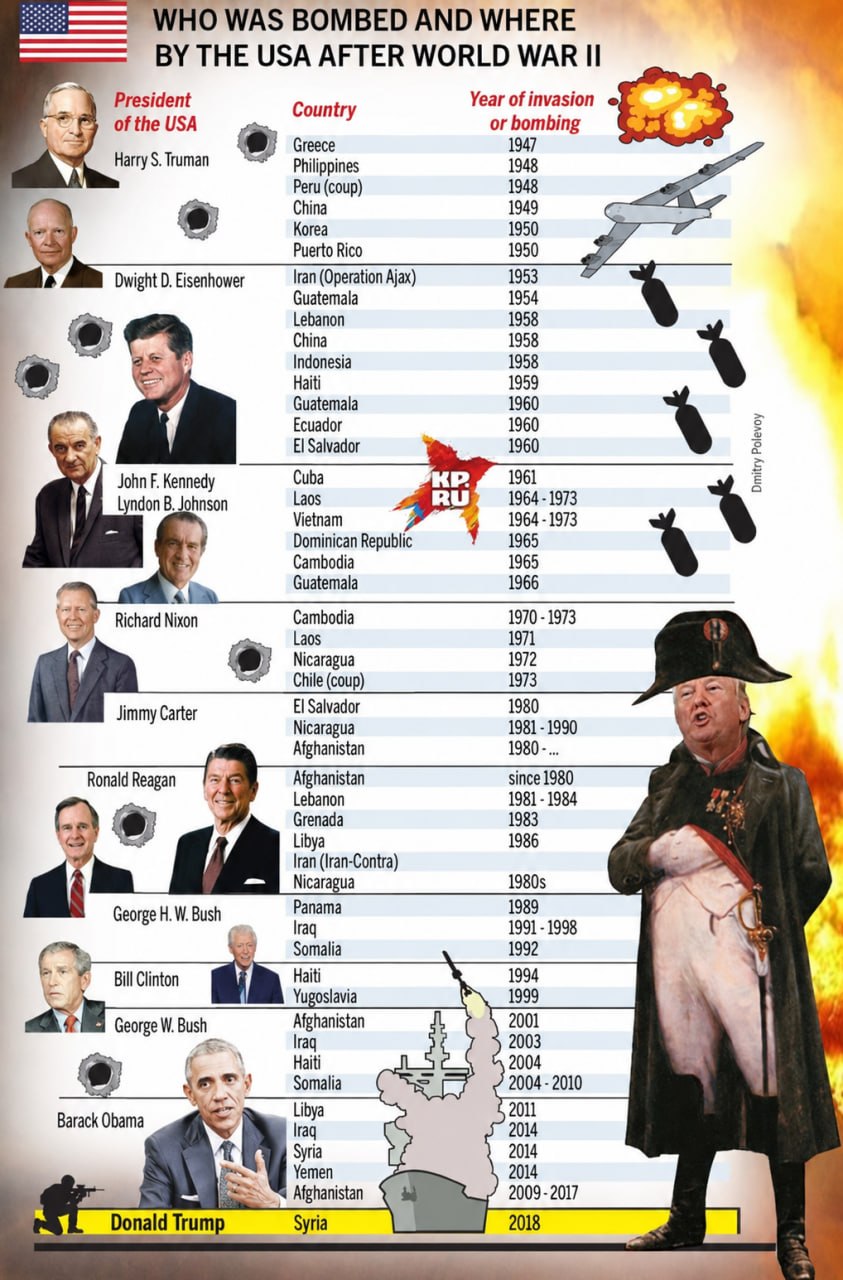
We should note right away that it is unknown where a significant part of the information from this list was taken from by the compiler — for example, it is impossible to find information about US military intervention in Peru in 1948. The same applies to Puerto Rico in 1950; moreover, an assassination attempt on US President Harry Truman was committed there in that year. After this, Truman did not take revenge; on the contrary, he agreed to hold a referendum in Puerto Rico so that the island would be given its own Constitution. As a result of the approved constitution, on July 25, 1952, Puerto Rico received its current status as an associated territory. In the 1950s, rapid growth in industrial production was observed on the island, which allowed transforming Puerto Rico’s economy from agricultural to industrially developed. We find no information about an invasion of Nicaragua in 1972; in 2004 in Haiti there was also neither a US military invasion nor bombings — after a military coup, 50 Marines were sent there to ensure the security of the US embassy5 from urban rioters.
The Iran-Contra affair mentioned in the list has nothing to do with invasions or bombings at all — it is a political scandal during which it emerged that individual members of the US administration organized secret arms supplies to Iran, thereby violating the arms embargo against that country. That is, Iran was not bombed here, but on the contrary, supplied with weapons! We are also not talking here about the fact that the same conflict is mentioned several times in these lists. Thus, Laos is mentioned twice — 1964-1973 and 1971, Afghanistan is also mentioned twice marked “1980 – …” and “from 1981”. Do the compilers not understand that the year 1971 falls within the interval from 1964 to 1973, and the interval “from 1981” falls within the interval “1980 – …”? Of course, this is not the point, but rather that they set out to stretch this list as far as possible. And there are several such examples in the list. The double mention of Nicaragua marked “1980s” and “1981-1990” is of particular interest.
And in many cases, there was indeed US military intervention, so let us analyze these cases, adding a few more examples from other sources. So, US wars since 1922, that is, after Woodrow Wilson.
World War II
1. Liberation of Italy (1943-1945). In 1922, fascists led by Benito Mussolini seized power in Italy. In 1935, they unleashed a war against Ethiopia, and later dragged Italy into World War II as well. Here, American troops helped the British liberate Italy from the Fascist Party that had seized the country and unleashed numerous aggressive wars in Europe and beyond, as well as the Nazi allies of this party. US and British troops supported various movements of the Italian Resistance, which began a war against Mussolini’s regime. Italy was liberated, after which Italians voted in a referendum to transition from a monarchy to a republic and were able to establish democratic rule, which after the war would help Italy become an economically successful (“the Italian economic miracle”) and developed country. There is no US aggression here; there is assistance to European allies attacked by fascists, and to Italian citizens in the struggle against authoritarianism.

2. Liberation of France (1944). In 1940, Nazi armies occupied France, and later the famous Normandy landings, in which American troops participated, and their advance on the Western Front helped fairly quickly liberate France from Nazi troops and their allies. After the war, the French established the democratic Fourth Republic. There is no US aggression here; there is assistance to European allies attacked by Nazis.
3. Liberation of Belgium (1945). In 1940, the Nazis occupied Belgium. In 1944-1945, Allied troops, including American forces, liberated Belgium from Nazi occupation. After the war, Belgium became one of the most developed regions in Europe, and Brussels became the seat of EU structures. There is no US aggression here; there is assistance to European allies attacked by Nazis.
4. Liberation of Luxembourg (1945). Like Belgium and the Netherlands, Luxembourg was occupied in 1940 by the Germans. In September 1944, an operation was conducted to liberate it, in which US troops participated. After the war, democratic power was established in Luxembourg, and the country itself began to take a more active part in European integration processes that ensured the building of democratic institutions. There is no US aggression here; there is assistance to European allies attacked by Nazis.
5. Liberation of the Netherlands (1945). In 1940, Hitler’s Germany occupied the Netherlands. The liberation of the Netherlands by the coalition, which included US troops, was difficult and lasted until May 5, 1945. After the war, the Netherlands, liberated by democratic countries, became one of the most prosperous countries in Europe. There is no US aggression here; there is assistance to European allies attacked by Nazis.

6. Liberation of western Germany (1945). Today in Germany, May 8 is celebrated as Liberation Day — in 1933, the Nazis seized power in the country, and subsequently Germany was essentially under occupation by the Nazi Party. In September 1944, the first units of American troops entered Germany, and a month later Soviet troops crossed its eastern border. After the defeat of Adolf Hitler’s regime, the country was divided into several occupation zones — later, in the zone of occupation by the countries that joined NATO, the Federal Republic of Germany was proclaimed, which would later become one of the most economically successful states in Europe and experience the “West German economic miracle”. There is no US aggression here; here we are dealing with the pacification of the aggressor — the Nazi regime under Hitler’s leadership.
7. War with Japan (1941-1945). Strictly speaking, power pursuing an aggressive foreign policy was observed in Japan long before the outbreak of World War II — the annexation of Korea in 1910, the policy of Japanese militarism (the right wing harshly cracked down on their political opponents inside the country — take, for example, the assassination of liberal Prime Minister Inukai Tsuyoshi), the intervention in Manchuria, the Second Sino-Japanese War that began in 1937, and rapprochement with the Axis powers. As is known, on December 7, 1941, the Empire of Japan suddenly attacked the US naval base at Pearl Harbor. This was an act of aggression, meaning that the US did not start this war. However, the States dealt Japan a heavy defeat, occupied the country, and began conducting its democratization. General Douglas MacArthur, Commander-in-Chief of the occupation forces in Japan, replaced Japanese police personnel three times in order to combat corruption (according to the journalists of “Profil”6). He was also the organizer of the Tokyo Trial. MacArthur gave women the right to vote, organized the fight against monopolies, permitted trade unions, and carried out many other reforms, thanks to which today the Japanese feel no sense of revenge toward Americans for the results of the war, while Douglas MacArthur himself was given the nickname “Gaijin Shogun” (foreign shogun7), had a monument erected to him in 19958, and various public places are named in his honor9, while Atsugi has a garden named after the general10. After the war, Japan experienced an economic flourish (“the Japanese economic miracle”) and a rise in living standards, later becoming one of the world’s leading countries. There is no US aggression here; here we are dealing with the pacification of the aggressor — the Empire of Japan.
Mention should be made separately of how statists accuse the US of bombing Hiroshima and Nagasaki when nuclear weapons were used. Why was this done? Bombing Japanese cities with conventional bombs did not force the country out of the war. The Japanese did not wish to surrender — this is clearly demonstrated by the entry in the War Journal of the Imperial General Headquarters in 1944: “We can no longer conduct the war with any hope of success. The only course left is for the one hundred million people of Japan to sacrifice their lives by encouraging the enemy to lose his will to fight”11 (and we are not even mentioning other evidence, such as the phenomenon of kamikaze pilots). It was clear that the Japanese regime was ready to sacrifice the lives of all Japanese rather than surrender.
In addition, the level of atrocities and war crimes committed by this regime was extremely high. Thus, we can recall the Nanking Massacre, Unit 731, “comfort stations”, the torture of prisoners of war, the implementation of the “Three Alls” policy, and other crimes. One example: the Japanese Air Force dropped huge quantities of ceramic bombs filled with fleas infected with bubonic plague on Ningbo, China. These attacks would ultimately result in thousands of deaths years after the end of the war12. The number of people killed by the Japanese regime alone is estimated to be between 3 and 10 million13.
Harry Truman was faced with a choice — either to continue this war with colossal losses on all sides and lose a huge number of American soldiers during an invasion of Japan, or to use nuclear weapons in the hope that, seeing their destructive power, Japan would still surrender. Having made a final attempt to force Japan to surrender without further casualties (in the form of the Potsdam Declaration, which was ignored by the Japanese regime), Truman made the decision to strike Hiroshima and Nagasaki, and the shocking effect of these bombings forced the Japanese to surrender.
The First Cold War
8. Intervention in the Greek Civil War (1946-1949). During World War II, the Greek Resistance consisted of two guerrilla forces fighting the occupiers — the predominantly communist EAM-ELAS and EDES, supporters of the government-in-exile and King George II. Since Greece was liberated by the British in cooperation with Greek guerrillas, and in the “percentages agreement” Stalin’s USSR effectively allowed Great Britain and the US to engage in restoring power in the country, after the withdrawal of German troops the King’s government was restored. However, it was decided to compromise with the communists, who had made a major contribution to the country’s liberation, and form a coalition government with them; nevertheless, when the communists refused to disband their guerrilla forces, the coalition collapsed14. The government was well familiar with communist guidelines (for example, Neuberg’s manual “Armed Insurrection”, which gives instructions on creating “combat proletarian hundreds” designed to take power in the future) and understood that if the communist combat units were not disbanded, they would be used in accordance with communist instructions. Therefore, the communists’ refusal to disband them can be viewed as an admission that they were aiming to seize power and establish a communist dictatorship. Under British pressure, the Greek King agreed to hold a post-war referendum in Greece in which the Greeks would decide whether to retain the monarchy or transition to a republic15, while the British themselves desired the establishment of a constitutional monarchy in Greece.

The first acts of the civil war began as early as October 1943, when EAM-ELAS attacked EDES with the aim of disbanding and disarming the latter’s units16. However, in the first stage of the civil war, the communists were defeated, as British troops sided with EDES. In 1946, parliamentary elections were held in Greece, which the communists decided to boycott17. In the end, they concluded with a victory for the right-wing monarchists, and the referendum on retaining the monarchy was accompanied by falsifications, as noted in the official report of the Allied Mission to Observe the Greek Elections; however, the same commission concluded that even without them, the referendum would have ended in favor of the monarchy18. In March 1946, communist militants attacked a police station in Litochoro, marking the beginning of the second stage of the civil war19. The right wing, in turn, unleashed political repression against the left. The Greek left lost seriously because they decided to trust the communists — this was a mistake.
What position did the US hold in this situation? First of all, they were guided by considerations of the “choice of the lesser evil”, which we have already mentioned. Secondly, the US could in no way support communists who were clearly not aimed at participating in elections and competing within a democratic system, and who had essentially started a civil war. Thirdly, Prime Minister of the democratically elected government, Konstantinos Tsaldaris, who flew to Washington in December 1946, appealed to the US for help20. Before this (at least since October 1946), supplies of military materials to the Greek communists from Yugoslavia had begun with the sanction of the USSR21. The US began large-scale assistance to the Greek army in 1948. Therefore, there is no ground to speak of any aggression on the part of the US — the legitimate government of Greece requested intervention, while the aggression came from the communists.
9. Assistance in suppressing the Hukbalahap rebellion in the Philippines (1948). What happened in 1948 in the Philippines? As we know, after the Spanish-American War, Spain ceded the Philippines to the US. In 1946, the States granted the Philippines independence — on July 4, the independence day of the US itself. Work on granting independence had been underway since 193222. In the first elections held after this, the communists won seats in Congress, but the Liberal Party won23, and the communists did not recognize these results. Their military units retreated into the jungle and started a civil war. As a result, in 1950 the US supplied the Philippine government with modern weaponry, and over time they suppressed the communist rebellion, bringing the civil war to an end. There is no US military invasion here at all; there is their assistance in suppressing communist aggression.
10. Evacuation of the embassy from China (1949). Statists manage to portray even the evacuation of diplomats from cities captured by communists as US “aggression”. However, in the late 1940s, the US precisely did not wish to support the Kuomintang in its fight against the communists due to the insufficient democracy of that government — for instance, in 1948, the US Consul General in Shanghai wrote: “Our primary task in battling communism for the minds of men, as I see it, is our defense of freedom and democracy… How then can we support a Nanking regime which clearly does not support either?”24 Similar views were expressed by other US public figures25. However, subsequent events and atrocities of the communist dictatorship established in China showed that this was an erroneous position (which apparently influenced the final choice in favor of the “choice of the lesser evil” concept). In 1950, the communists confiscated the property of the US consulate in Beijing, after which American employees faced a very difficult evacuation. Here we see neither US aggression, nor their military aid to any side, nor the use of military force — they simply evacuated their people from China.
11. Korean War (1950-1953). After World War II, Korea was divided into two occupation zones — the northern one, governed by the USSR, and the southern one, governed by the US. Following the withdrawal of both Soviet and American troops in 1949, two independent states were formed there — the DPRK (oriented toward the USSR) and the Republic of Korea (oriented toward the US). In 1950, North Korean troops, on Kim Il Sung’s orders, launched a massive attack on the positions of their southern opponent, which is confirmed even by Russian sources26. On June 27, the UN Security Council (the USSR representative was absent from the meeting) adopted a resolution to provide urgent military assistance to South Korea, and the US President ordered American forces stationed in the Far East to enter combat operations against the DPRK. In addition to the US Armed Forces, the multinational forces included military contingents from 15 states — totaling about 45 thousand people, 600 guns and mortars, 200 tanks, 150 aircraft, and 50 ships. The USSR, China, and some other communist states sided with the aggressor and began providing it with assistance. China even sent two army groups of troops that struck the positions of the multinational forces. Ultimately, neither of the opposing forces managed to establish control over the entire territory of Korea, and in 1953 an armistice agreement was signed. South Korea, whose independence the US helped defend, after several decades of mistakes and failures would become a developed and prosperous country by Asian standards, while the DPRK would become a poorly developed state with a high level of poverty, social injustice, and disenfranchisement of the population. There is no US aggression here; there is their assistance in suppressing DPRK aggression.
12. Attack on the Sukhaya Rechka airfield (1950). In October 1950, two US Air Force fighters strafed the Soviet Sukhaya Rechka airfield located near Korea, damaging seven Soviet aircraft, one of which burned down (an American Bell P-63 Kingcobra supplied to the Soviet Union under Lend-Lease). None of the USSR Air Force personnel were injured. US President Harry Truman forced Warren Austin, the chief US representative to the UN, to admit the attack, apologize for it, offer compensation for the damage caused27, and report that disciplinary measures had been taken against the two pilots. The pilots themselves claimed that, firstly, they had made a navigation error, and secondly, had mistaken the aircraft with red stars for North Korean ones28. There was indeed a US attack on the airfield here, but it was followed by a US apology, and it was likely committed by mistake, although Russian media express the opinion that it was a provocation. However, if it were a provocation, it should have been followed by other attacks, which did not happen — on the contrary, the US offered its apologies despite the extremely complex relations with the USSR and the war in Korea.
13. Overthrow of the government in Iran in 1953 (“Operation Ajax”). Finally, we come to one of the few examples where the foreign policy line pursued by the US turned out to be largely wrong. Prime Minister of Iran Mohammad Mosaddegh believed that Iran should become a constitutional monarchy and that the Shah’s powers should be curtailed; perhaps he even deserved the support of democratic countries. However, he also supported a movement in favor of nationalizing oil production. In 1951, the Iranian parliament voted to nationalize AIOC, a controlling stake in which belonged to the UK government. Taking an enterprise from an owner despite the lack of their consent is a gross violation of private property rights, and we have written why such a policy often causes harm to the economy (moreover, many countries like Australia have a substantial amount of foreign business on their territory, but this does not prevent them from developing). In that same year of 1951, Conservative Winston Churchill became Prime Minister of Great Britain again, determined to resolve the issue radically. The British began developing ways to remove Mosaddegh from power, while in 1952 he declared Great Britain an enemy and severed diplomatic relations with it29. The British appealed to the US for help, but Secretary of State Dean Acheson criticized British policy in Iran.
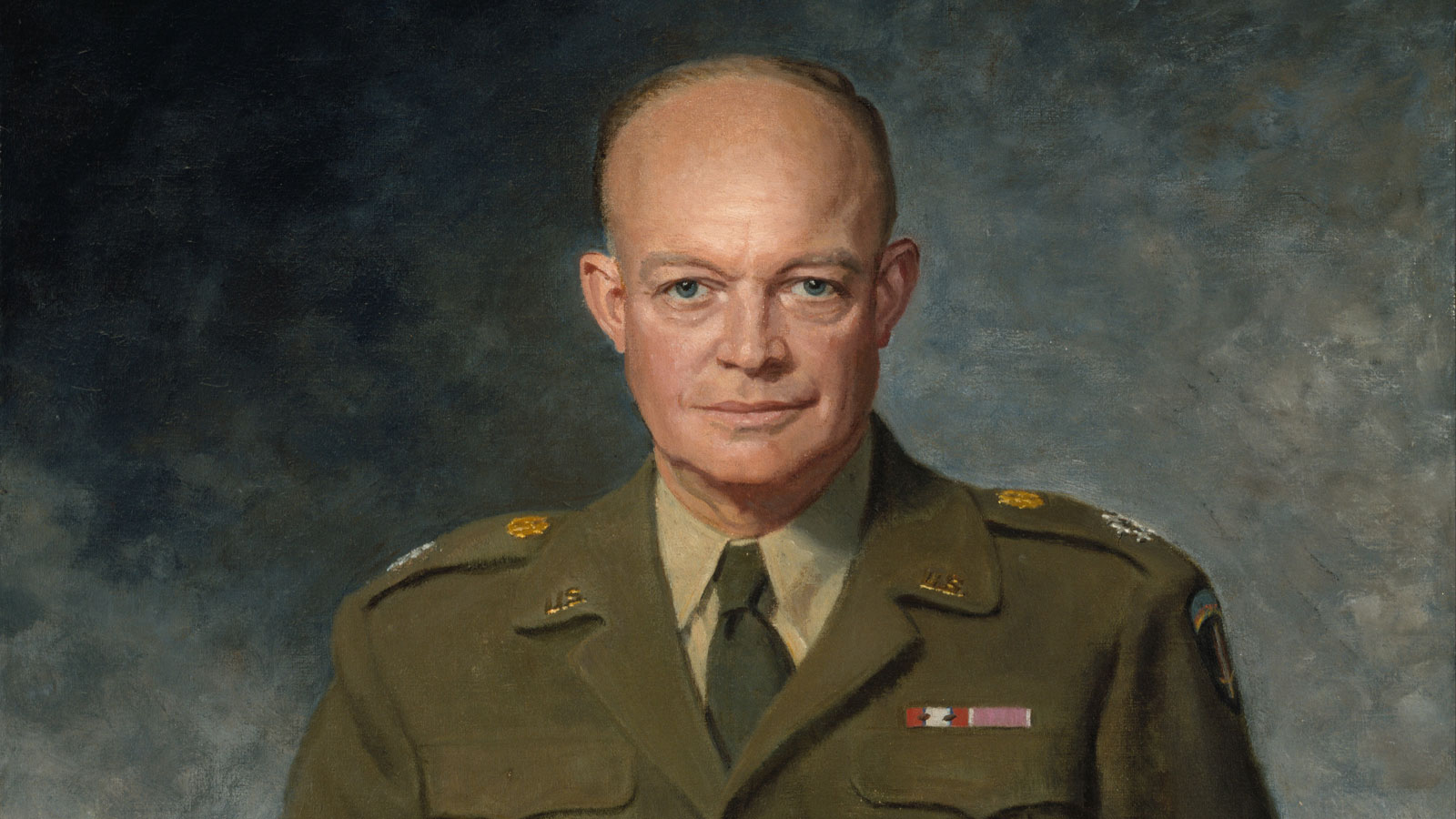
The situation changed when Republican Dwight Eisenhower became US President in 1952. After this, Great Britain and the US, governed by center-right forces, agreed to cooperate and secured the support of Shah of Iran Mohammad Reza Pahlavi. The intelligence agencies of both countries financed and coordinated forces hostile to Mosaddegh’s government (Operation “Ajax”). In 1953, the Shah dismissed the Prime Minister and appointed a candidate convenient to the United States and Great Britain to this post. After this, clashes between supporters of the Shah and Mosaddegh occurred in Iran, but in the end, the latter was arrested for three years and kept under house arrest at his estate for the remainder of his life. As we can see, there was no military invasion or bombing by the US and NATO here. There was, however, gross interference in democratic processes, which was nevertheless preceded by a violation of property rights. This was a miscalculation — as a result, anti-American sentiment spread in Iran and influenced the 1979 Islamic Revolution, after which Iran turned onto the path of wild authoritarianism for a long time. The regime of the Ayatollahs still achieved the confiscation of British property, oil was nationalized, and as a result, citizens’ well-being did not grow (on the contrary, compared to other Middle Eastern authoritarian regimes, the country lives poorly), and by the early 1990s Iran was forced to import certain types of petroleum products30.
14. Coup d’état in Guatemala (Operation PBSuccess, 1954). In 1951, former Minister of Defense Jacobo Árbenz was elected President of Guatemala. He decided to carry out agrarian reform, which implied the expropriation of lands belonging to the American United Fruit Company31, which was offered compensation that did not satisfy the company. In the end, expropriation without the consent of the owners was approved32. A US intelligence report stated that this time the reform promised positive changes as well — primarily, liberating thousands of agrarian workers from centuries-old dependence on privileged large landowners, but this reform also implied strict control of rural residents by the state33. Instead of transferring land directly to peasants, it was supposed to be placed under the control of the National Agrarian Department.

There was a danger of a Bolshevik style here — after all, Bolsheviks also nationalized land, initially letting peasants use it relatively freely, but later depriving them of the opportunity to conduct their farming freely, dispose of land as they saw fit, and trade the fruits of their labor. The intelligence report also drew attention to the broad representation of communists in agrarian management bodies (communist party leaders were close political and personal friends of Árbenz34), as well as to an economic decline in Guatemala that had already begun in connection with the implementation of the reform. Intelligence concluded that it would be difficult to avoid violent clashes in Guatemala provoked by such a policy.
Árbenz carried out progressive reforms, but the danger of land nationalization, coupled with the strengthening of communists, created the threat of establishing communist rule in Guatemala in the future (with all the ensuing threats to citizens) and the country moving into the orbit of USSR influence. In the end, in 1953 Eisenhower authorized Operation PBSuccess35. The CIA provided assistance to Colonel Castillo Armas and mercenary units formed under his command in order to carry out a military coup. Ultimately, Armas’s paramilitary units achieved Árbenz’s resignation and established a far-right dictatorship. This was an unfortunate choice — Armas and his successors pursued a policy close to fascist, and in 1960 a civil war began in Guatemala. There was no US invasion here, but there was harmful interference in the internal processes of the country.
15. Lebanon crisis (1958). In 1958, President of Lebanon Camille Chamoun refused to break relations with Great Britain and France, as demanded by the Muslim world in connection with the events of the Suez Crisis36. According to Lebanon’s political structure, the president was required to be a Maronite Christian and the prime minister a Muslim37, which provoked a crisis — Chamoun took the position of the European powers, and the Muslim opposition took the position of the Arab states. In May 1958, Muslims launched an armed uprising in Tripoli38, demanding accession to the united state of Syria and Egypt (the United Arab Republic, which would not last long). The army under General Fuad Chehab refused to suppress the uprising supported by the UAR (as claimed by Chamoun’s government, which appealed to the UN to look into the situation), and Chamoun requested US intervention. American Marines landed in Lebanon, but the crisis was resolved with their minimal involvement — American diplomats persuaded Chamoun to resign39, and the Lebanese parliament approved Chehab as the new president. Thus, there is no US aggression here — the States came to a country where a civil war was flaring up and stabilized the situation, contributing to a peaceful settlement of the conflict.
16. Second Taiwan Strait crisis (1958). In 1949, the Kuomintang evacuated to Taiwan after Chiang Kai-shek’s troops lost the struggle for mainland China to the communists. Neither side relinquished claims to territories occupied by the other side. The communists acted most actively here — for instance, on September 3, 1954, PRC aviation subjected islands controlled by the Kuomintang to bombardment40. The intervention of the US, which had concluded a defense treaty with the Republic of China (Taiwan), led to a cessation of the bombings, but not for long, and as early as August 23, 1958, the communists began intense artillery shelling of Kinmen Island41. The Republic of China requested help from Eisenhower according to the previously concluded treaty. After Eisenhower dispatched US forces, including a large naval contingent, toward China, the PRC entered into negotiations with the US and, based on their results, stopped the bombings42. The crisis ended. There was no US invasion here at all, and moreover, in this case the Americans came to the aid of an ally to repel communist aggression.
17. Uprising led by the Revolutionary Government of the Republic of Indonesia (1958). In post-war Indonesia, nationalist Sukarno was president from 1945 to 1967, having collaborated with the occupation authorities during the Japanese occupation43. In the 1950s, Sukarno began establishing ties with the USSR and China. One of the principles of his policy was the principle of “guided democracy” — weakening the influence of political parties, limiting parliament’s power, and significantly strengthening the power of the president, essentially building an authoritarian system. Sukarno himself delivered speeches calling to “bury political parties”44 and carried out nationalizations that, however, yielded no positive effect for the country’s economy, only opening additional opportunities for corruption among officials. Press censorship was introduced.

All this, coupled with the strengthening of the role of the Communist Party in the country, worried CIA officials, who decided to support the rebellious regional authorities in Indonesia45 (who were concerned about the strengthening of the president’s power and tried to win back more powers for themselves), and who had been organizing regional rebellions since 1957. The US supported the rebellious colonels who could pursue a pro-Western course, meaning it was not a given that their rule would lead to the democratization of Indonesia, but it could offer Westernization and assistance in confronting the Communist Bloc. In April–May 1958, the operation to support the rebels failed, and Sukarno remained in power. There was no US invasion here either, but there was an unsuccessful intervention in the country’s internal politics. Sukarno’s imposition of Asian-style authoritarianism in Indonesia serves in this case as an extenuating circumstance for the US.
18. Bay of Pigs invasion (1961). In 1959, dictator Fulgencio Batista was overthrown in Cuba and another dictatorship was established, this time a communist one, but the US decided not to intervene (erroneously, as it turned out). The Cuban communists did not beat around the bush — they immediately set about seizing property, and at the same time dispatched their agents to initiate communist revolution in other Latin American countries46. One of the leaders of the Cuban Revolution — Che Guevara — describing the policy pursued by the Cuban communists, openly admitted: “we have executed, we are executing, and we will continue to execute”47.
Since 1960, the CIA provided assistance to Cuban émigrés (Brigade 250648) in preparing their invasion to win Cuba back from the communists. They were given American military equipment, and special training in weapons handling and warfare was conducted under the leadership of CIA personnel. Sources agree that the organization of assistance from the US was of poor quality — thus, Encyclopedia Britannica claims that contrary to Kennedy’s orders, Batista supporters were included in the invasion forces, while members of the non-communist People’s Revolutionary Movement were excluded49. Military.com, on the other hand, blames Kennedy for canceling US air support for the rebels50. In any case, the landing of the Cubans, which the US supported rather indecisively (mainly through the provision of equipment), failed.
Even Russian propagandists note that the invasion was carried out by 1,500 Cubans51 (meaning the entire operation was carried out by Cubans, not by US forces), although they put forward conspiracy theories that these were merely US “mercenaries” (after all, one can only fight against communists for money, not out of conviction). Russian propagandists also try to frame the matter as if on April 15, 1961, American aircraft bombed Cuba, but keep silent about the fact that these were Cubans who piloted aircraft provided to them by the Americans5253. Here we see a typical example of mind manipulation exercised by Russian authoritarianism over its citizens. In reality, there was no US invasion here, although there was an unsuccessful intervention in the internal affairs of Cuba and support for one of the sides in the civil war in response to the communist takeover of power. The motivation was the same — to prevent the communists from deploying their aggressive dictatorship to plunder and suppress the will of citizens. As can be seen from subsequent history, the US mistake consisted not in intervention, but in an insufficient level of intervention — later the communists would deploy nuclear weapons in Cuba and threaten the world with nuclear war, while lying for a long time that their missiles were not in Cuba54.
19. Civil war in Laos, Vietnam war, bombings of Cambodia — all these should be combined into one conflict in Indochina, which lasted from 1946 to 1973. The US was not drawn into the conflict in this region until 1955, when an American military mission was opened there — after Laos gained independence from France, the US supported it financially55. Prior to that, in 1954, the Geneva Accords were concluded, in which it was agreed that both French and Vietnamese military forces were to be withdrawn from the territory of Laos and Cambodia. Laos became a neutral territory56, and Vietnam was temporarily divided along the 17th parallel57. These agreements were signed by France and North Vietnam, while the US did not sign the agreements58. South Vietnam refused to abide by them.
After France, which tried to retain Laos by force, was defeated (and the French “war cabinet” in the government was overthrown), a treaty recognizing the independence of Laos was concluded between France and Laos on October 22, 195359. One war ended, but another began immediately — on November 9, 1953, the communist organization Pathet Lao started a war against the Kingdom of Laos, having armed itself with the help of communists from the Viet Minh60. Thus began the civil war in Laos — with communist aggression.
Naturally, the division of Vietnam along the 17th parallel did not suit the communists, and even though they had signed the agreements, they still wanted all of Vietnam. Therefore, in July 1957, the communists of South Vietnam launched an armed uprising61. They also began to carry out a policy of terror against South Vietnamese officials. The decision to organize an uprising in South Vietnam was made at the XV plenum of the Central Committee of the Communist Party of North Vietnam62. Decisions were made to support the uprising, and many speeches were delivered about “national reunification”, that is, about the seizure of the entire territory of Vietnam by the communists. In 1960, South Vietnamese communists created the National Liberation Front of South Vietnam, also known as the Viet Cong. North Vietnam began delivering military aid to the rebels63. The President of South Vietnam requested US military assistance.
Communist terrorism was becoming widespread — in the second half of 1959, they organized about 100 terrorist attacks per month, and in 1960, about 2,500 people were killed64. Against the backdrop of the helplessness and incompetence of the South Vietnamese government, the US decided to step up aid to help it counter communist aggression. Initially, having received American weapons, South Vietnam achieved some success, but by 1963, the ability of its government to organize the competent conduct of the war began to raise great doubts. All this was exacerbated by the fact that Mao Zedong and the USSR decided to send aid to North Vietnam65. Finally, in August 1964, the American destroyer USS Maddox was attacked by North Vietnamese torpedo boats (the Gulf of Tonkin incident). After this, the US entered the war.
Meanwhile, in 1963, the notorious for their cruelty Khmer Rouge launched a communist uprising in Cambodia66 with the support of Vietnamese communists. The communists also used the border regions of Cambodia67 to conduct combat operations against the US, which led to the bombing of these areas in 1965.
Both the USSR and China poured huge amounts of money into helping the Vietnamese communists — for instance, China spent about two billion dollars aiding Hanoi68. In 1968, the communists attempted to carry out the Tet Offensive, which was intended to be supported by broad sections of the South Vietnamese population staging a revolution, but this did not happen — not only were the communists not supported by the South Vietnamese, but on the contrary, the latter began to trust the government more. The thing is that the communists decided to treacherous attack during a holiday truce, which met no sympathy from the people. The commander of American forces, William Westmoreland, requested an additional 206,000 troops to deliver a decisive blow to the North Vietnamese, but the American press interpreted this as evidence that the situation in Vietnam was dire69. Due to mass protests and demonstrations in the US, the increase in American troop strength was blocked, and President Lyndon Johnson was forced to initiate a course toward reducing the US presence in the region.

In 1973, South Vietnam, North Vietnam, and the US signed an agreement on ending the war and restoring peace in Vietnam70 (the Paris Peace Accords), after which the withdrawal of American troops began. Within 60 days, the US withdrew all its troops and dismantled military bases, while Congress prohibited any US military operations in Indochina. One Soviet military retiree recalled in an interview:
On January 27, 1973, when the peace treaty was signed in Paris, many officers allowed themselves to get drunk. Because that treaty meant one thing: we had achieved our goal, and the Vietnamese people were now finally free. There were still doubts about the Americans: like, the imperialists are treacherous, what if they don’t want to fulfill their obligations?! But they did everything according to the treaty and withdrew their troops in March. And suddenly, six months later, those of us who had been in Vietnam were gathered in such numbers in one place, and clearly not to take part in a parade… We were now acting not only as military specialists, but as participants in special operations. Or rather, we were developing and directing them. And these actions were directed not against the Americans, but against the same kind of Vietnamese, only non-communists. I saw firsthand what a civil war is, and I really didn’t like it. That was the first time I wondered: if communist ideology demands so much blood from those who disagree with it, then how does it differ from Nazi ideology? And then came another realization. After all, I was raised in a spirit where a word given by a man must be kept by that man. Otherwise, he is no man at all. And here was such a dilemma: the treacherous imperialists kept their word, while we, who promised to stop the war and hold elections, brazenly spat on our given word and didn’t even hide it71.
Naturally, the communists did not observe the agreements, and in 1974, they launched an offensive on the provincial capital of Phuoc Long72, and in 1975, after the US failed to react to this event, a major Spring Offensive began, resulting in the fall of South Vietnam and the communists taking control of all of Vietnam. Thus, there is no US aggression here either — we are dealing with unprecedented treachery demonstrated by the communists, who organized aggression against South Vietnam and repeatedly violated treaties grossly.
20. Intervention in the Dominican civil war (1965). Until 1961, the Dominican Republic was ruled by the right-wing dictator Rafael Trujillo, but in that year the dictator was assassinated with CIA involvement73. The CIA itself characterized its role in changing the government of the Dominican Republic as a “success”, since it helped transition from a totalitarian dictatorship (Trujillo conducted some of the bloodiest repressions in American history) to a Western-style democracy. In 1962, democratic elections were held, won by Juan Bosch, who began carrying out social-democratic reforms. Local conservatives, industrialists, and priests branded him a communist74, and his reforms were too progressive for the backward Dominican society of that time, as a result of which he lost the support of too many groups of citizens. In 1963, he was overthrown in a military coup. In 1965, the military under the leadership of Francisco Caamaño Deñó (constitutionalists) organized a coup against the junta (loyalists). A civil war began.

In April, the US received a written request for aid from the junta75, and the Americans dispatched troops there — however, not only American units were sent there, but also other peacekeepers from the Organization of American States (OAS), such as Brazilians. OAS forces conducted combat operations on Dominican territory, at the end of which an Act of Reconciliation was signed between the opposing sides of loyalists and constitutionalists, according to which a provisional government was established in the country to organize elections within the next 6-9 months. As a result, elections took place in 1966, and Joaquín Balaguer was elected president, winning 57.6% of the vote, while Bosch received only 39%.
Here we cannot speak of US aggression — the aggression was started by the right-wing military, which in 1963 overthrown the democratically elected president, and in 1965, in response, supporters of the constitution organized a coup. The US, on the one hand, is not reflected well by the fact that it came to the aid of this military junta at its request alongside other OAS countries. On the other hand, OAS troops were able to end the war quickly and hold democratic elections in the country, stabilizing the domestic political situation. It is a pity that Dominican society turned out to be too backward for social-democratic reforms, but the Americans bear no blame here. The US supported Bosch financially and morally76, but, as the American ambassador noted, there were “strong grounds for believing that Bosch himself prefers the comfortable martyrdom of Puerto Rican exile to the pain and suffering of trying to govern this distressingly un-governable country”77. At that moment, Dominican society turned out to be unreformable.
21. Coup in Chile (1973). US military actions in Chile in 1973 are fictional. There is no evidence of them. Most often, Russian sources report that the military coup committed that year by the Chilean General Augusto Pinochet was carried out “with the support of American intelligence services”78, and that the US spent millions of dollars on campaigns against Salvador Allende79, but this is neither aggression nor even military intervention. The USSR funded Allende80, which does not make the Soviet Union an aggressor. When the left came to power in Chile in the 2020s, they requested that the US declassify documents related to these events, which the Americans did, but there was nothing in them that indicated “support of American intelligence services” specifically regarding the military coup81. Within the US itself, a Senate committee was even convened to investigate covert interference in Chilean affairs during the 1960s and 1970s, but it failed to find anything beyond the funding of candidates and propaganda campaigns against Allende82.
22. Intervention in the civil war in El Salvador (1980). In the 1930s–1970s in El Salvador, one authoritarian regime was replaced by another83, until in 1979 General Carlos Romero, who had rigged the elections (and pursued ultra-right policies while creating “death squads” to fight left-wing activists), was overthrown by the Revolutionary Government Junta, which was dominated by Christian Democrats and the military84, who intended to carry out center-right reforms, including an agrarian reform that threatened the interests of local coffee-business elites85. The latter supported radical ultra-right figures, including Roberto D’Aubuisson, who ordered the assassination of Archbishop Óscar Romero, who had called for civil peace and an end to repression86. A huge crowd gathered at the archbishop’s funeral, and the military opened fire on them87. After this, the centrists and leftists left the government88, and the communists together with other left-wing groups created the Farabundo Martí National Liberation Front, which was supplied with weapons by Cuba and the USSR89. In January 1981, the FMLN announced the start of a “final offensive”90 (which turned out not to be the final one), and a civil war began, which was obviously provoked by right-wing repressions.

The US, where Ronald Reagan had come to power by that time, began providing aid to government forces91, fearing a repetition of the situation in Nicaragua, where communists had managed to take power. The American embassy reported to Washington that Marxists dominated the insurgent forces, noting: “we seem as far as ever from a reduction in far-right violence. On the contrary, savage killings of anyone suspected of liberal views, even Christian Democrats, yield a daily morning harvest of mutilated bodies along roadside ditches. Security force excesses against peasant villages have also not diminished and even seem to be growing. Extreme-left violence in urban areas has declined, but it is growing in the countryside, where every effort is being made to sabotage land reform and intimidate the peasantry into refusing to plant this year’s crops”92. Overall, the American embassy’s message showed that the US initially intended to support the centrists after all, but far-right terror derailed those plans. In the civil war that ensued, the US aided government forces with money, weapons, and troop training93. There was no US military intervention here, and the exact same assistance — only to the other side — was provided by Cuba and the USSR (yet no one speaks of their aggression). There were two sides in the civil war, and both were heavily influenced by reactionary forces (one under the influence of the military junta, the other under the influence of the communists). The US chose one of the sides influenced by reaction, namely the one influenced by the military junta, which together with the ultra-right was the primary culprit behind this war. However, two facts should be noted here:
- Initially, the US attempted to support the centrists after all, which would have been favorable for a democratic transition;
- Had the US supported the other side, it would not have fundamentally changed the situation — it was still not a democratic coalition, and furthermore, there was a risk of the country eventually falling under communist rule.
The civil war lasted 12 years. After peace was concluded, the FMLN became a democratic socialist party and won elections between 2009 and 2019.
23. Assistance to Afghanistan (1980). The war in Afghanistan began in 1979 with the entry of Soviet troops into the country94 (this was preceded by the communists taking power in Afghanistan, but the problem was that they lacked popular support95; interestingly, Mohammad Daoud, who was overthrown by the communists, had also cooperated with the USSR96). The new dictator — Hafizullah Amin — was uncontrollable and launched repressions against his own supporters, for which he was eliminated by Soviet troops97, and the puppet regime of Babrak Karmal was installed instead. Following this, the armed Islamic opposition—the Mujahideen — intensified its activities, using the entry of Soviet troops as proof of an “infidel threat to Islam”. The US began supplying arms to this opposition98, but American troops themselves were not sent to Afghanistan at that time — not a single American directly participated in combat operations99. Therefore, there was no US military intervention here — it was a supply of arms in response to the entry of Soviet troops. Interestingly, in this case, the troop deployment by the USSR could have even been morally justified if its goal had been to destroy the dictatorship and establish a democratic regime (however, this did not happen). Ultimately, after the withdrawal of Soviet troops, Islamists seized power in the country. Here, between two reactionary forces — the communists and the Islamists — the US chose the second. While it might seem that it was more reactionary on the scale of Afghanistan, it was supported out of the same consideration that led to supporting the USSR against the Axis powers — in accordance with the second foreign policy criterion (confronting the center of world reaction) that we presented at the beginning of the article. Moreover, the failure of the USSR in Afghanistan became one of the factors behind the collapse of the Socialist bloc, which ultimately made US intervention justified.
24. Support for rebels in Nicaragua (1981). A dictatorial reactionary regime of Anastasio Somoza operated in this country, which the US supported. The problem was that the main opposition force was the Sandinistas — an authoritarian group that still rules the country today (and supports the policies of Vladimir Putin). They came to power in September 1978, when the Sandinista National Liberation Front attacked National Guard detachments in the main cities of Nicaragua100, to which the latter responded with strikes, including against the civilian population. The Sandinistas immediately proceeded to suppress the opposition and confiscate property101. In 1981, the Reagan administration began funding anti-Sandinista armed forces — the Contras. Aid was also provided illegally, which is why several dozen Reagan officials, including Secretary of Defense Caspar Weinberger, National Security Advisor Robert McFarlane, and National Security Council staff member Oliver North, were later charged with various counts ranging from obstruction of justice to perjury and concealing evidence, and eleven officials were convicted102. Thus, there was no US military invasion here, although the Americans supported anti-Sandinista forces illegally. At the same time, it should be noted that there were democrats among the Contras, for example, the social liberal Alfonso Robelo or the liberal democrat Óscar Sobalvarro. Part of the Contras was the left-democratic Nicaraguan Democratic Movement.
25. Intervention in the civil war in Lebanon (1982). In 1975 in Lebanon, Phalangists (right-wing nationalists) attacked a bus carrying Palestinians to a refugee camp, which ultimately provoked a war between the Phalangists and the corrupt government of Suleiman Frangieh103. The latter called on the Syrian army for help, which then introduced its troops into the country. At the same time, Palestinian guerrillas carried out cross-border raids into Israel from Lebanese territory (in 1969, the Lebanese government granted them permission to conduct “armed struggle” against Israel from the country’s territory104), which, coupled with the entry of Syrian troops and the assassination of the Israeli ambassador by terrorists in London105, also provoked the entry of Israeli troops. As a result, a multinational force (including US troops) was deployed to Lebanon with the goal of withdrawing the Palestine Liberation Organization troops and Israeli troops from the country’s territory. By mid-1985, most of the Israeli troops were withdrawn, while Palestinian militants had been withdrawn from Lebanon even earlier as a result of the advance of Israeli troops in the country106. However, Syria did not withdraw its troops. Thus, there was no US aggression here — troops (not only American) were sent to stop an already ongoing civil war, but this task was not accomplished. Partial success was achieved — the withdrawal of PLO and Israeli troops — but this was not enough to solve the region’s problems.
26. Operation in Grenada (1983). After Grenada gained independence from Great Britain in 1974, Eric Gairy became the country’s prime minister with the tacit approval of the British — a populist who established an authoritarian regime there with brutal repressions against his political opponents, and who was known for his interest in paranormal phenomena107. While in 1979 he was insisting at the UN on establishing a committee to study UFOs, local Marxists took advantage of this and overthrew his regime bloodlessly. The US attempted to establish diplomatic contact with them, and in 1983 Marxist leader Maurice Bishop was invited to Washington. Pro-Soviet Marxists, seeing Bishop’s improving relations with the US, organized his overthrow and placed him under house arrest; however, soon crowds of the prime minister’s supporters gathered near Bishop’s house, overcame the guards, and freed him. After this, the protesters went to the headquarters of the Grenadian army, and as a result, the supporters of Bishop’s overthrow opened fire on the crowd. The former prime minister himself and several of his ministers were captured and executed. Leadership passed to the radical Marxist Winston Bernard Coard. They imposed a curfew and announced that anyone leaving their house in the coming days would be shot on the spot108.

On October 22, representatives of the Organization of Eastern Caribbean States (OECS) met in Barbados and decided to eliminate the “criminal regime in Grenada” that had organized the overthrow of Bishop and shot its own citizens, for which they officially requested assistance from the US. Soon, an expeditionary force landing took place on the island, consisting of US and OECS troops. Thus, a US military invasion did take place here, but it was an invasion not by the US alone, and it was not aggression, but a response to the fact that radical communists had seized power in the country through murders and shootings (on October 19 alone, soldiers killed 100 people109). The US had tried to negotiate with the communists, who had come to power bloodlessly, and only acted when the communists began killing protesters in order to seize power in the country. As a result, radical rebels, including Bernard Coard, were arrested. According to some polls, 91% of surveyed Grenadians supported the arrival of the American army to eliminate the communists110. In 1984, elections were held, won by the center-left New National Party111.
27. Operation El Dorado Canyon in Libya (1986). On April 5, 1986, an improvised explosive device exploded at the “La Belle” disco in Berlin, resulting in the deaths of civilians, including two American service members. In 2001, a court in Germany proved that the bombing was planned by Libyan intelligence services and the Libyan embassy in Germany112. In 2004, Libya agreed to pay $35 million in compensation to the victims113. However, until the opening of the Stasi archives in 1990, it was impossible to prove the guilt of the Libyan intelligence services in court, and the US calculated their involvement based on Libyan messages intercepted by American intelligence. In response to this terrorist act carried out by the government of dictator Muammar Gaddafi, the US conducted bombings of military targets and saboteur training centers in Libya114. Thus, there is no US aggression here — there is a corresponding response to the aggressive terrorist actions of the Libyan government. However, the authoritarian terrorist government was not overthrown, and this was a major mistake by the US.
28. Operation Just Cause in Panama (1989-1990). The US turned a blind eye for a long time to the actions of former Colonel Manuel Noriega, who usurped power in Panama and became a dictator. However, by 1989, a considerable amount of information had accumulated regarding Noriega’s money laundering and involvement in drug trafficking. Ronald Reagan, who was President of the US at the time, showed benevolence toward Noriega (who was not a communist — Reagan would likely have held communists to a much stricter account) and offered him a deal: the Panamanian dictator would step down from power and leave the country, while the US would drop the drug trafficking charges against him. Noriega not only refused the deal, but also annulled the results of the presidential election, which was won not by him, but by an opposition candidate. Opposition supporters were also beaten in the streets. On December 15, 1989, the National Assembly of Panama, on Noriega’s instructions, declared that Panama and the US were in a state of war115. A few days later, an unarmed American officer in civilian clothes was killed by Panamanian soldiers. In response, an American military contingent was sent to Panama to capture Noriega’s headquarters. The latter hid for several days, but was ultimately arrested and brought to trial. As a result, we have the fact that there was no US aggression here — it was the aggression of the right-wing dictator and drug trafficker Noriega. Moreover, the Americans handed power over to the legitimately elected president of the country116.
Between two cold wars
29. Pacification of Saddam Hussein’s aggression in 1991 and the war in Iraq in 2003. We wrote a separate article about this conflict, where we also explained why there can be no question of any US aggression; it was the pacification of the aggression of the Iraqi dictator Saddam Hussein.
30. UN peacekeeping operation in Somalia (1992-1995). In 1969, power in Somalia was seized by the military led by pro-Soviet General Mohamed Siad Barre, who declared the beginning of building “scientific socialism” in the country. However, socialism was not going very well, so in 1974 “Somalia laid claim to part of the territories of neighboring states populated predominantly by Somali tribes (Ogaden province in Ethiopia, the North-Eastern Province of Kenya, east of Djibouti). President Barre proposed a concept of recreating Greater Somalia through the occupation of parts of the territories of adjacent countries”117. Delusions of grandeur finally struck the Somali dictator in 1977, when he unleashed a large-scale armed conflict with Ethiopia, which outraged even the USSR (because Ethiopia was also pursuing a pro-Soviet course).
After the defeat in the war, Barre in 1986 declared himself the sole candidate in the elections and was “reelected” for 7 years. This triggered a backlash from local clans, who created the opposition organization USC and began an armed struggle. By the end of 1990, Barre’s regime controlled only the country’s capital, and in 1991 the dictator fled abroad. The process of state disintegration began118, the central government collapsed119, meaning Barre became one of the few socialists whose rule actually led to the withering away of the state. As a result, by 1992 nearly 4.5 million people (over 50% of the population) were threatened by famine and related diseases. The victims of the humanitarian catastrophe numbered 300 thousand people, with about 2 million people fleeing to neighboring countries or to other regions of Somalia120.
The UN had to make the decision121 to send humanitarian aid to Somalia to fight famine, but it would have been simply unsafe for its participants to remain in the country, so UN personnel were guarded by military forces. The use of force was authorized by Resolution 794 of the UN Security Council, adopted in 1992122. Military personnel from 24 countries (not just the US) participated in securing humanitarian aid123. However, Somali clans engaged in attacks on UN troops, and by March 1994, the US and European countries withdrew their troops from the country. One of the mistakes of the operation was that it set a goal not to influence the balance between warring factions, essentially letting things drift instead of dealing with local organized crime groups. But one way or another, there is no US aggression here — this was a peacekeeping operation under the auspices of the UN.
31. Operation Uphold Democracy in Haiti (1994). For a long time, Haiti was ruled by dictator François “Papa Doc” Duvalier, and his clan’s stay in power ruined the country economically124. After his death, power passed to Duvalier’s son, who was unable to maintain control over the situation and fled the country after protests in 1986. The regime of the local nomenklatura collapsed under pressure from the National Front for Change and Democracy led by priest Jean-Bertrand Aristide. In 1990, the latter was elected president, but as early as 1991 he was overthrown in a military coup led by Raoul Cédras. The UN imposed sanctions against the military regime, and as a result of negotiations, the so-called “Governors Island Agreement” was concluded, signed by Aristide and Cédras on July 3, which provided for Aristide’s return to Haiti by October 30, 1993, amnesty for the coup leaders, assistance in modernizing the Haitian army, and suspension of sanctions; however, the military soon sabotaged the fulfillment of the treaty’s conditions125.
Following this, the UN Security Council imposed a naval blockade on Haiti. On July 31, 1994, the Security Council adopted Resolution 940 of the UN Security Council126, authorizing the use of force to restore democracy in a member country. After that, under a UN mandate, a multinational force began preparations for the forceful overthrow of the military junta. Under these conditions, former US President Jimmy Carter led a delegation to Haiti in search of a negotiated settlement, and the junta leadership surrendered in time, which avoided major bloodshed127. As a result, free elections were held in the country in 1995128. Here, a US invasion ultimately did not take place, and the operation to restore constitutional authority was conducted under a UN mandate.
32. Intervention in the civil war in Yugoslavia (1995 and 1999). We examined the situation with Yugoslavia in detail in this material, from which it clearly follows that the aggressors in that war were local nationalists, mainly Serbian, there was no question of US aggression there; on the contrary — their intervention helped pacify the nationalists and the war they unleashed.
33. Intervention in the civil war in Afghanistan (2001). Ever since the Soviet intervention in Afghanistan and after the withdrawal of Soviet troops, a war had been going on in that country between the Mujahideen leaders who had seized power in the country129. In the mid-1990s, many cities fell under the rule of the terrorist movement “Taliban”. Starting in 1996, the territory of Afghanistan was used by Osama bin Laden and his organization “al-Qaeda” as a base for preparing violent actions against “infidels”. In the late 1990s, the country was effectively turned into a hotbed of international terrorist activity130. When terrorists assassinated anti-Taliban leader Ahmad Shah Massoud and carried out a series of terrorist attacks in the US on September 11, 2001, the Taliban refused to hand over al-Qaeda leader Osama bin Laden to American justice, stating: “We will not hand over Osama bin Laden to the US, even if Afghanistan is wiped off the face of the Earth”131.

After this, an international coalition led by the US entered Afghanistan with the goal of destroying the aggressive terrorist organization al-Qaeda132. Initially, the coalition advanced successfully, but the assault on bin Laden’s bunker was carried out by the Afghan opposition, and the US did not lead this attack133, which they would later be rightfully blamed for. Bin Laden and Taliban leader Mohammed Omar escaped. The US allocated funds for the reconstruction of Afghanistan, but not in such large amounts as during the Marshall Plan. The Afghans themselves failed to develop a competent government — the Interim Administration turned out to be corrupt and ineffective. As a result, the Taliban was never destroyed, and 20 years after the invasion, it seized power again. Over these 20 years, there were no terrorist attacks from Afghanistan on the territory of the allies134. This fact and the fact that the terrorists were significantly weakened were positive aspects of the operation, but overall its results were weak. At the same time, it is obvious that there is no US aggression here — there is aggression by the Taliban and other terrorist organizations.
34. Intervention in the Libyan civil war (2011). On February 15, 2011, a rally was held in Benghazi against the arrest of human rights lawyer Fathi Terbil, who represented the relatives of the victims killed at Abu Salim prison (where the Gaddafi regime executed more than a thousand prisoners135). The protesters demanded the resignation of Libyan dictator Muammar Gaddafi and the release of political prisoners136. Libyan security forces dispersed the protesters using rubber bullets and water cannons, injuring several people. However, the protests did not stop, and on February 17, 2011, security forces opened fire on demonstrators, killing at least 24 people137. Soon, citizens established control over Benghazi, and unrest also broke out in Tripoli. After this, Gaddafi ordered the bombing of residential areas of the capital, and pilots who refused to do so to be executed138. The dictator declared: “If the protesters do not surrender, I will cleanse Libya house by house”139, while also claiming that the protesters were simply under the influence of drugs140.
Initially, the rebellious citizens gained the upper hand over the forces loyal to the dictator, but soon the situation turned unfavorable for the opposition. In response to the bombing of civilians by Gaddafi’s forces, the UN Security Council adopted a resolution providing for the establishment of a no-fly zone over the country’s territory141. To make this feasible, forces of democratic countries attacked targets in Libya to disable the air defense systems and air force of the Gaddafi regime142. Soon after, the rebels captured the dictator’s headquarters and subsequently eliminated him. Here again, there was no US aggression — there was aggression by the dictator Gaddafi against his own people, and it was the dictator who unleashed a civil war, into which international forces were later forced to intervene to protect the country’s population. A stable democracy did not emerge in Libya following the civil war unleashed by Gaddafi, but the UN Security Council resolution authorizing the use of force in Libya explicitly stated that the goal of the intervention was “to protect civilians and civilian populated areas under threat of attack”143, rather than establishing democracy in the country (which is a much more complex process).
35. Military operation against ISIS (2014). In 2014, ISIS seized large swathes of territory in Iraq and Syria, totaling more than thirty percent of the territory of these countries along with oil fields and refineries144. Following this, a US-led coalition began launching strikes on the aggressor’s positions145. Iraq immediately consented to the strikes; Russia initially blocked the use of force against ISIS in the UN Security Council, but changed its stance after terrorist attacks on a Russian airliner146. Syrian dictator Bashar al-Assad attempted to block the use of force against ISIS, but a Security Council resolution adopted unanimously authorized these actions147. As a result of this operation, ISIS was driven out of both Iraq and Syria148. Thus, here too there is no US aggression — there is aggression by ISIS, which was successfully repelled with UN authorization. Although the ultimate goal of the complete elimination of ISIS was not accomplished.
36. Intervention in the Syrian civil war (2014). By 2011, a dictatorial regime led by Bashar al-Assad, who inherited the “presidential” post from his father Hafez al-Assad, was established in Syria. Clan elites enriched themselves and inequality grew, while the population of Syria was effectively deprived of rights and crushed by censorship149. Following the 2006-2010 crisis, the situation of ordinary Syrians deteriorated even further, and in March 2011, major protests broke out in the country. In the city of Daraa, Syrian security forces opened fire on protesters150 who accused the president’s brother (who owned a large business) of corruption. After this, protests flared up across the entire country151, the opposition began taking up arms to protect themselves from government terror, and Assad promised to crush the protesters. The clashes escalated into a civil war.
The complexity lay in the fact that it was not only the democratic opposition that began fighting against the regime, but also the terrorist organization al-Qaeda152, which exploited the emerging instability and rising radicalism of the local population. This was also facilitated by the Assad regime itself, which released hundreds of jihadists from prison in 2011 in order to portray the uprising against the regime as an alliance of Islamic extremists with Western forces153. In 2012, non-al-Qaeda rebels achieved some success. They were mainly aided by Qatar, Saudi Arabia, and Turkey; the US provided rather meager aid to the rebels154. Assad, on the other hand, received assistance from Iran and terrorists from Hezbollah. In 2013, the Assad regime used chemical weapons against its civilian population155, and Assad himself declared that he would win even if Damascus were destroyed in the process156.
In 2015, Russia carried out airstrikes against targets in Syria, claiming they were aimed at ISIS, but it quickly became clear that they were targeted at rebels fighting against Assad157 – Putin’s corrupt and dictatorial regime, fearing that Russian citizens would also rise up against it, viewed Assad’s situation with understanding. In 2017, following another instance of chemical weapons use by the Syrian regime against its citizens, the US and its allies launched over 100 strikes on chemical weapons sites in Syria. In addition, the US conducted airstrikes to help the Syrian Democratic Forces drive ISIS out of Syrian territory158. To sum up all of the above – there is no US aggression, there is aggression by the Assad regime against its own people, the destruction of the civilian population with chemical weapons, in response to which the US provided some assistance to the oppressed population by destroying chemical weapons sites, but no goal of eliminating the Assad regime was set (unfortunately).
37. Intervention in the Yemeni civil war (2014). In 2014, the terrorist Islamist Houthi group159 seized territories of Yemen160, which was governed by the authoritarian regime of Abdrabbuh Mansur Hadi (in 2012, dictator Ali Abdullah Saleh was overthrown), who opened fire on protesters in 2014161. On the one hand, the Yemeni regime was reactionary; on the other hand, Yemen would not have ceased to be authoritarian and reactionary in the event of a Houthi victory, but could have become a springboard for international terrorists. Therefore, overall the Yemeni regime was less reactionary than the Houthis. In 2015, a coalition of Gulf countries led by Saudi Arabia launched a campaign to economically isolate the Houthis and conduct airstrikes against them with US support162. The Houthis were supported by Iran. Saudi Arabia and the UAE launched more than 25 thousand airstrikes against the Houthis163. The main military operations were conducted precisely by the coalition troops, while US activity manifested only in conducting a number of counterterrorism operations164 and supporting the coalition. It is amusing that statists are afraid to accuse Saudi Arabia of “aggression”, shifting attention to the US, but one way or another, neither the coalition nor the US were aggressors — we are dealing with aggression by the Houthi terrorist group, to which a corresponding response was given.
There is also a large number of various conspiracy theories attributing the organization of a revolution in one state or another to the US. It simply does not occur to conspiracy theorists that citizens might want to overthrow a thieving dictator, rather than some secret Masonic committee. This is due to the deeply slavish psychology of such individuals, who believe that if they lack both the courage and the desire to revolt against oppressors, then no one else can either. However, the “organization of color revolutions by the United States” is not the topic of this material.
In general
In total, we have 37 conflict situations not invented by Kremlin propaganda. In 11 of them (uprisings in the Philippines and Indonesia, embassy evacuation from China, coups in Iran, Guatemala, Chile, the Second Taiwan Strait Crisis, Bay of Pigs invasion, civil war in El Salvador, support for rebels in Nicaragua, operation in Haiti), there were no invasions or bombings by the US at all. 7 cases in which the US used armed force (liberation of Italy, France, Belgium, Luxembourg, the Netherlands, West Germany, elimination of the Japanese regime) were assistance to victims of aggression by the Axis countries or a direct response to aggression by this bloc. 7 cases (Operation El Dorado Canyon, suppression of Saddam Hussein’s aggression, civil wars in Afghanistan, Libya, Syria, Yemen, military operation against ISIS) were a response to aggression by Middle Eastern terrorists and dictators. 5 cases (civil war in Greece, Korean War, Indochina conflict, assistance to Afghanistan, operation in Grenada) were assistance to victims of communist aggression. 5 cases (Lebanese crisis, UN operation in Somalia, civil wars in the Dominican Republic, Lebanon, Yugoslavia) were peacekeeping operations in countries where a civil war was underway, taking a large number of human lives. 1 case (operation in Panama) was a response to aggression by a right-wing drug-trafficking dictator. US aggression was observed in only one case — the attack on “Sukhaya Rechka” airfield in 1950, but this was an accidental incident, and the US offered an official apology and paid compensation for it (and given the Korean War, calling this aggression is a stretch).
Not all US intervention yielded results that could be called very successful. However, if you are attacked by hooligans and a random passerby stands up for you, but both of you get beaten — only an inadequate person can blame that random passerby. Therefore, blaming the US in cases where intervention was morally justified is completely inappropriate. Even more ridiculous are situations where the US is accused of not leading the country where intervention took place to prosperity afterward. With equal success, one could blame police officers who found and arrested those who set fire to your dacha because they will not rebuild a new dacha for you.
Another question — there were situations besides the attack on “Sukhaya Rechka” airfield where intervention was morally controversial. These are, mainly, coups in Iran and Guatemala, as well as intervention in the civil war in El Salvador and support for rebels in Nicaragua. 4 out of 37 situations is not the worst margin of error; nevertheless, it should be said that these cases may permissibly be condemned as well as found to have sufficient reasons for intervention. There is one more situation that was not cited by, for example, “Komsomolskaya Pravda” — United States support for Operation Condor, during which South American dictators kidnapped, tortured, and killed radical revolutionary communists, while ordinary people of various views also fell into the hands of intelligence officers. This case should be classified as morally unacceptable — the neutralization of communists could have been carried out in far more humane ways. At the same time, one should not forget that most cases of intervention had entirely compelling reasons, and the US in those situations was on the side of progress and democracy.
By the way, in a significant portion of these conflicts, the USSR/Russia also managed to participate, but often ended up on the side of reaction and aggressors.
It is logical that all criminals, terrorists, dictators, communists, fascists, and members of the nomenklatura whom the US managed to cross during this time will sooner or later think about uniting against it. They have not yet succeeded in doing this, but they have managed to unite on the information front, where they harmoniously carry out disinformation attacks on US foreign policy. The US operations listed above are extremely disadvantageous to the nomenklatura and criminals, as they are often aimed at strengthening democracy (and, as a consequence, the rotation of power, as a result of which the nomenklatura will lose its lucrative positions) and the rule of law (as a result of which criminals will end up in prison). Accordingly, disinformation regarding US wars is advantageous to these groups. It expresses their interests.
Statist arguments
We have already spoken about some narratives spread by these forces. But we have mentioned far from all such narratives. One of the favorites among Russian statists is to say something like this in any discussion of Russian or Soviet aggression: “Well, America bombed Iraq, Libya, Syria, Yugoslavia. They are allowed to, so why can’t we?” First of all, it is worth noting that they want to catch up with the US specifically in the number of wars, rather than in GDP per capita, the number of Nobel laureates, the number of patents, the level of democracy, the level of average life expectancy, the rule of law, freedom of the press, and so on. This shows that people speaking this way are obsessed with war, not with their own well-being. They see their future in dying for the interests of elites so that these elites can extract a benefit. That is, these people possess a slavish psychology, the worldview of a slave.
But this is not the most important thing. The most important thing is that these people are either incapable of independently distinguishing an aggressor from a victim of aggression and from one who comes to the aid of that victim, or (what is more likely) are so hypocritical and deceitful that they are ready to deceive their interlocutor, knowing full well that in one case we are talking about an aggressor, and in another — about a victim of an aggressor, but in the first case the aggressor is “one of ours”, and therefore one can and must invent lies to justify him. We will not argue here about why such a lie is harmful — that is a topic for a separate material — but to sensible people, the negative consequences of such a lie are obvious.
You deny, Mr. Grenier, what I told in my book. But all this is not because you know well what I write about, not because you know our reality, but only because you are a member of the Communist Party.
“Imperialism”
Another common thesis is “US imperialism”. The United States is especially fond of being accused of imperialism by communists. But what is “imperialism”? According to the Great Russian Encyclopedia, it is “in its original meaning, a system of governance based primarily on military force, as well as a policy of expansion, conquest of territories, establishment of political or economic control over other countries, peoples, and regions”165. The encyclopedia notes that there is an original and a Marxist meaning of the term (that is, Marxists, as usual, came up with their own definition of the term for their own convenience). In Ozhegov’s dictionary, the definition is set out using Marxist terminology: “the highest stage of capitalism, characterized by the dominance of large monopolies in all spheres of life, the struggle between capitalist countries for sources of raw materials and sales markets, for foreign territories”166.
What do other sources say? The Encyclopedia Britannica says that imperialism is “state policy, practice, or advocacy of extending power and dominion, especially by direct territorial acquisition or by gaining political and economic control of other areas”167. The exact same definition is in the Merriam-Webster dictionary168. The definition of the Treccani encyclopedia: “the drive to create an empire; the policy of power and supremacy of a state aimed at creating an empire through military conquest, territorial annexations, and economic exploitation of other peoples”169. That is, most sources state that imperialism is a policy of expansion, conquest of territories, establishment of political and economic control over new territories.
Above we examined that in none of the wars over the last 100 years have the US conquered new territories. On the contrary, they even granted independence and autonomy to some of their territories, and protected the independence of several other countries. Nor do we see a single example of establishing political and economic control over other countries. Countries where the US conducted military operations, as a rule, may not be members of NATO, may not be US allies, may oppose US initiatives at the UN, condemn US military operations, and so on. Thus, in their time, France and Greece decided to leave the NATO military organization170. Iraq supported neither the US vote on the UN resolution against Russian aggression in Ukraine171, nor the US vote on a ceasefire in Gaza172. Libya voted directly opposite to the US vote on the second issue. France and Germany opposed the war in Iraq in 2003173. President of Serbia Aleksandar Vučić publicly accused the US of arming Pristina174 and that “the West wanted to abolish Republika Srpska” and “harm the Serbian people”175. Strange behavior for states over which political and economic control has been established! However, in reality, only a conspiracy theorist can believe in the establishment of political and economic control in the absence of evidence and given the above facts. Accordingly, there is no “American imperialism” either. But in the cases of Iraq, which occupied Kuwait, Nazi Germany, as well as the communists (in Vietnam or Korea as well), one can and should talk about imperialism.
Why is the thesis about “American imperialism” so widespread? In addition to the propaganda of authoritarian countries, there are also objective factors. First of all, it is the dominance of American culture, especially in the film industry. People in most of the globe listen to American music, watch American movies, use American currency, buy American goods, discuss the internal American agenda (for example, the BLM movement and the MeToo hashtag worried Russian right-wingers often even more than the situation in their own country), and so on. Due to the fact that America’s influence in the world is very large, the country itself becomes a constant subject of discussion. But all this cannot serve as proof of establishing control over a country.
Conclusion
Upon scrutiny, most of the “aggressive wars” of the US are, on the contrary, either defense of victims of aggression, peacekeeping operations, a response to aggression, or non-military intervention. US foreign policy is not imperialistic; on the contrary, it is often a stance against imperialism. Most US interventions in the policies of other countries are morally justified, with a few exceptions. However, the US course is directed against the elites of Third World countries — the nomenklatura and criminal organizations; it is aimed at the democratization of these countries (as a result of which the elites risk losing their wealth and the opportunity to consistently pump money out of their citizens). In this regard, it is in the interests of the nomenklatura and criminal organizations to spread disinformation about US foreign policy and conduct campaigns to discredit it.

A typical example is Protocol No. 137 of the meeting of the Politburo of the CC CPSU dated March 13, 1980, in which the Soviet ambassador was instructed to broadcast the following points: “the Americans do not hide that they want to exert military pressure both on revolutionary Iran and on the Arab states”, “it would be expedient to take measures to deploy a broad international campaign against the current aggressive course of American imperialism in the area of the Arabian Peninsula and the Persian Gulf”176. Influencing Iran in a democratic key, where an undoubtedly reactionary Islamic Revolution had just occurred, would undoubtedly be progressive, but the Soviet nomenklatura evaluates this as “imperialism”, an “aggressive course”, “trampling on the national rights of peoples, their sovereignty and independence”. Translated from nomenklatura newspeak, this means: a desire to interfere in the affairs of the local nomenklatura, which is calmly plundering its citizens and establishing reactionary orders (like those enforced by the Islamic Revolution), and to put an end to it. All true, but as usual, what are the downsides? On the contrary, from a social-democratic point of view, there is nothing bad in this. Reactionary nomenklaturas that pump finances out of their population and do not allow it to choose another government must be eliminated. Therefore, if some country pursues a policy aimed at this, such a policy should be encouraged, even if it has some shortcomings (in real life it is hard to find anything without shortcomings).
We thank Artyom Kuznetsov and Alexander Schtirzen for their help in preparing the article.
- Archive of the President of the Russian Federation (AP RF). F. 39. Op. 1. D. 31. L. 28–29
- 25 years since the genocide against the Tutsi in Rwanda: how it was // UNN (news.un.org). April 7, 2019. [Electronic resource]. URL: https://news.un.org/ru/story/2019/04/1352631 (Accessed: 06.07.2024).
- A million victims in 100 days. 25 years since the genocide in Rwanda // TASS (tass.ru). April 7, 2019, 14:26. [Electronic resource]. URL: https://tass.ru/info/6304261 (Accessed: 06.07.2024).
- Ban Ki-moon: UN ashamed over 1994 Rwanda genocide // BBC News Russian Service (www.bbc.com). April 7, 2014. [Electronic resource]. URL: https://www.bbc.com/russian/international/2014/04/140407_rwanda_genocide_anniversary (Accessed: 15.07.2024).
- American Marines arrived in Haiti // Lenta.ru (lenta.ru). February 24, 2004, 4:48. [Electronic resource]. URL: https://lenta.ru/news/2004/02/24/haiti/ (Accessed: 06.07.2024).
- Aleksandr Ageev. Archival publication of 2001: “All power — to account!” // Profil (profile.ru). May 21, 2001. [Electronic resource]. URL: https://profile.ru/archive/vsya-vlast-k-otvetu-106049/ (Accessed: 15.03.2020).
- Jules Archer. Frontline General. Douglas MacArthur: America’s Most Controversial Hero. 2017
- Jack R. Swike. The Missing Chapter: Lee Harvey Oswald in the Far East. — p. 64
- MacArthur Garage (www.macarthurgarage.com). [Electronic resource]. URL: http://www.macarthurgarage.com (Accessed: 15.03.2020).
- Atsugi Naval Air Facility // TravelJapanBlog (traveljapanblog.com). September 26, 2009. [Electronic resource]. URL: http://traveljapanblog.com/wordpress/2009/09/atsugi-naval-air-facility/ (Accessed: 15.03.2020).
- Geoffrey C. Ward, Ken Burns. The War: An Intimate History, 1941-1945 – 480 p. – Knopf Doubleday Publishing Group, 2020. – p. 220
- T. Newman. Bioterrorism: Should we be worried? // MedicalNewsToday (www.medicalnewstoday.com). February 28, 2018. [Electronic resource]. URL: https://www.medicalnewstoday.com/articles/321030 (Accessed: 15.07.2024).
- R.J. Rummel. Statistics of democide. Chapter 3. Statistics Of Japanese Democide Estimates, Calculations, And Sources // Freedom, Democide, War [Electronic resource]. URL: http://www.hawaii.edu/powerkills/SOD.CHAP3.HTM (Accessed: 06.07.2024).
- Greek Civil War // Encyclopedia Britannica (www.britannica.com). July 1, 2024. [Electronic resource]. URL: https://www.britannica.com/event/Greek-Civil-War (Accessed: 06.07.2024).
- S. Villiotis. From Skeptical Disinterest To Ideological Crusade: The Road To American Participation In The Greek Civil War, 1943-1949 // University of Central Florida (stars.library.ucf.edu). [Electronic resource]. URL: https://stars.library.ucf.edu/cgi/viewcontent.cgi?article=3793&context=etd (Accessed: 06.07.2024).
- Ibid., p. 32.
- David S. Painter. Origins of the Cold War: An International History – 352 p. – Psychology Press, 2005. – p. 138.
- R.T. Windle, L. Morris. Report by Messrs. Richard T. Windle and Leland Morris, Chiefs of the Allied Mission To Observe the Greek Elections // Office of the Historian (history.state.gov). September 7, 1946. [Electronic resource]. URL: https://history.state.gov/historicaldocuments/frus1946v07/d145 (Accessed: 13.07.2024).
- A. Nachmani. The Greek Civil War, 1946–1949 // Origins (origins.osu.edu). March 2016. [Electronic resource]. URL: https://origins.osu.edu/milestones/march-2016-greek-civil-war-1946-1949 (Accessed: 13.07.2024).
- P.C. Brooks. Constantine Tsaldaris. Oral History Interview // Harry S. Truman Presidential Library and Museum (www.trumanlibrary.gov). May 4, 1964. [Electronic resource]. URL: https://www.trumanlibrary.gov/library/oral-histories/tsaldari (Accessed: 13.07.2024).
- A.A. Kalinin. On the Frontline of the Cold War: Soviet Policy in Greece in 1947–1949 // Yaroslavl Pedagogical Bulletin. Vol. I (Humanities). – 2011. – No. 3. – P. 90–95.
- Hare–Hawes–Cutting Act // Encyclopedia Britannica (www.britannica.com). [Electronic resource]. URL: https://www.britannica.com/topic/Hare-Hawes-Cutting-Act (Accessed: 13.07.2024).
- Hukbalahap Rebellion // Encyclopedia Britannica (www.britannica.com). [Electronic resource]. URL: https://www.britannica.com/event/Hukbalahap-Rebellion (Accessed: 13.07.2024).
- The Consul General at Shanghai (Cabot) to the Director of the Office of Far Eastern Affairs (Butterworth) // Office of the Historian (history.state.gov). February 6, 1948. [Electronic resource]. URL: https://history.state.gov/historicaldocuments/frus1948v08/d398 (Accessed: 13.07.2024).
- J. Renouard. Turn out the Lights: When the Last American Diplomats Fled China // History News Network (historynewsnetwork.org). October 5, 2020. [Electronic resource]. URL: https://historynewsnetwork.org/article/175392 (Accessed: 13.07.2024).
- Korean War 1950–53 // Great Russian Encyclopedia. Volume 15. Moscow, 2010, p. 249. [Electronic resource]. URL: https://old.bigenc.ru/military_science/text/2096372 (Accessed: 13.07.2024).
- “United States Bombing of a Soviet Airfield”, in The Korean War: A Historical Dictionary (Paul Edwards, ed.), Scarecrow Press, 2003
- A.H. Quanbeck. My brief war with Russia // The Washington Post (www.washingtonpost.com). March 4, 1990, 12:00. [Electronic resource]. URL: https://www.washingtonpost.com/archive/opinions/1990/03/04/my-brief-war-with-russia/0fe9d000-9796-4c6c-9df4-77a956bf5e96/ (Accessed: 13.07.2024).
- The Coup Against Iran’s Mohammad Mossadegh // ADST (adst.org). [Electronic resource]. URL: https://adst.org/2015/07/the-coup-against-irans-mohammad-mossadegh/ (Accessed: 13.07.2024).
- History of National Iranian Oil Company // Reference For Business (www.referenceforbusiness.com). [Electronic resource]. URL: https://www.referenceforbusiness.com/history2/75/NATIONAL-IRANIAN-OIL-COMPANY.html (Accessed: 13.07.2024).
- Jacobo Arbenz // Encyclopedia Britannica (www.britannica.com). [Electronic resource]. URL: https://www.britannica.com/biography/Jacobo-Arbenz (Accessed: 13.07.2024).
- 35. Intelligence Report Prepared in the Office of Intelligence Research, Department of State // Office of the Historian (history.state.gov). March 5, 1953. [Electronic resource]. URL: https://history.state.gov/historicaldocuments/frus1952-54Guat/d35 (Accessed: 13.07.2024).
- Ibid.
- P. Gleijeses. The Agrarian Reform of Jacobo Arbenz // Cambridge University Press (www.cambridge.org). February 5, 2009. [Electronic resource]. URL: https://www.cambridge.org/core/journals/journal-of-latin-american-studies/article/abs/agrarian-reform-of-jacobo-arbenz/93788EA8510612DE6B199A96737C5174 (Accessed: 13.07.2024).
- K. Doyle, P. Kornbluh. CIA and Assassinations: The Guatemala 1954 Documents // The National Security Archive (nsarchive2.gwu.edu). [Electronic resource]. URL: https://nsarchive2.gwu.edu/NSAEBB/NSAEBB4/ (Accessed: 13.07.2024).
- Lebanon after independence // Encyclopedia Britannica (www.britannica.com). July 12, 2024. [Electronic resource]. URL: https://www.britannica.com/place/Lebanon/Lebanon-after-independence (Accessed: 13.07.2024).
- Lebanese National Pact // Encyclopedia Britannica (www.britannica.com). [Electronic resource]. URL: www.britannica.com/event/Lebanese-National-Pact-1943 (Accessed: 13.07.2024).
- Lebanon after independence // Encyclopedia Britannica (www.britannica.com). July 12, 2024. [Electronic resource]. URL: https://www.britannica.com/place/Lebanon/Lebanon-after-independence (Accessed: 13.07.2024).
- Edouard de Tinguy. The Lebanese Crisis of 1958 and the U.S. Military Intervention // Revue d’Histoire Diplomatique. – Paris: A. Pedone. – 2007. – Vol. 4.
- S.Y. Lavrenov, I.M. Popov. Soviet Union in local wars and conflicts. Chapter 9. M.: ACT, Astrel, 2003. — 778 p.
- M.H. Halperin. The 1958 Taiwan Straits Crisis // RAND (www.rand.org). 1996. [Electronic resource]. URL: https://www.rand.org/pubs/research_memoranda/RM4900.html (Accessed: 15.07.2024).
- Chronology // PBS (www.pbs.org). 1996. [Electronic resource]. URL: https://www.pbs.org/wgbh/pages/frontline/shows/china/etc/cron.html (Accessed: 15.07.2024).
- Sukarno // Great Russian Encyclopedia (old.bigenc.ru). January 23, 2024. [Electronic resource]. URL: https://old.bigenc.ru/world_history/text/4172485 (Accessed: 13.07.2024).
- The Sukarno years: 1950 to 1965 // Sejarah indonesia (www.gimonca.com). [Electronic resource]. URL: http://www.gimonca.com/sejarah/sejarah09.shtml (Accessed: 13.07.2024).
- M. Jones. United States Policy towards Indonesia in the Truman and Eisenhower Years (review) // Project MUSE (muse.jhu.edu). Fall 2004. [Electronic resource]. URL: https://muse.jhu.edu/article/174709/summary (Accessed: 13.07.2024).
- Bay of Pigs invasion // Encyclopedia Britannica (www.britannica.com). [Electronic resource]. URL: https://www.britannica.com/event/Bay-of-Pigs-invasion (Accessed: 13.07.2024).
- Che Guevara en la ONU, en 1964: «sí, hemos fusilado, fusilamos y seguiremos fusilando» // Contando Estrelas (www.outono.net). July 29, 2015, 15:54. [Electronic resource]. URL: https://www.outono.net/elentir/2015/07/29/che-guevara-en-la-onu-en-1964-si-hemos-fusilado-fusilamos-y-seguiremos-fusilando/ (Accessed: 13.07.2024).
- M. Sullivan. Assault Brigade 2506 and the Bay of Pigs // Military.com (www.military.com). February 7, 2017. [Electronic resource]. URL: https://www.military.com/history/assault-brigade-2506-and-the-bay-of-pigs.html (Accessed: 13.07.2024).
- Bay of Pigs invasion // Encyclopedia Britannica (www.britannica.com). [Electronic resource]. URL: https://www.britannica.com/event/Bay-of-Pigs-invasion (Accessed: 13.07.2024).
- M. Sullivan. Assault Brigade 2506 and the Bay of Pigs // Military.com (www.military.com). February 7, 2017. [Electronic resource]. URL: https://www.military.com/history/assault-brigade-2506-and-the-bay-of-pigs.html (Accessed: 13.07.2024).
- Bay of Pigs Operation: US Military Defeat // TASS (tass.ru). April 19, 2014, 14:32. [Electronic resource]. URL: https://tass.ru/mezhdunarodnaya-panorama/1131149 (Accessed: 13.07.2024).
- C. Klein. Why the Bay of Pigs Invasion Went So Wrong // History (www.history.com). May 6, 2019. [Electronic resource]. URL: https://www.history.com/news/bay-of-pigs-mistakes-cuba-jfk-castro (Accessed: 14.07.2024).
- The Bay of Pigs Invasion // Central Intelligence Agency (www.cia.gov). April 18, 2016. [Electronic resource]. URL: https://www.cia.gov/stories/story/the-bay-of-pigs-invasion/ (Accessed: 15.07.2024).
- J.M. Lindsay. TWE Remembers: Adlai Stevenson Dresses Down the Soviet Ambassador to the UN (Cuban Missile Crisis, Day Ten) // Council on Foreign Relations (www.cfr.org). October 25, 2012, 6:00. [Electronic resource]. URL: https://www.cfr.org/blog/twe-remembers-adlai-stevenson-dresses-down-soviet-ambassador-un-cuban-missile-crisis-day-ten (Accessed: 14.07.2024).
- At War in the Shadow of Vietnam: United States Military Aid to the Royal LAO Government 1955-75 // Defense Technical Information Center (apps.dtic.mil). [Electronic resource]. URL: https://apps.dtic.mil/sti/tr/pdf/ADA243492.pdf (Accessed: 15.07.2024).
- The Chinese Government’s May 5th Response to the Soviet Government on the Memorandum on the Expansion of the Geneva Conference and the Peaceful Conclusion of the Laos Issue // Wilson Center (wilsoncenter.org). May 9, 1961. [Electronic resource]. URL: https://digitalarchive.wilsoncenter.org/document/chinese-governments-may-5th-response-soviet-government-memorandum-expansion-geneva (Accessed: 15.07.2024).
- V.P. Larin. On the Nature of the Two Indochina Wars of the 20th Century in the Focus of New Scientific Approaches and Assessments. Pp. 230–241
- Geneva Accords // Encyclopedia Britannica (www.britannica.com). [Electronic resource]. URL: https://www.britannica.com/event/Geneva-Accords (Accessed: 14.07.2024).
- 70th Anniversary of the Establishment of Diplomatic Relations between the Lao PDR and the France Republic // Ministry of Foreign Affairs of Lao PDR (mofa.gov.la). November 10, 2023. [Electronic resource]. URL: http://mofa.gov.la/index.php/activities/state-leaders/5610-70th-anniversary-of-the-establishment-of-diplomatic-relations-between-the-lao-pdr-and-the-france-republic (Accessed: 14.07.2024).
- #KYR: Laos – Special Issues // The Cove (cove.army.gov.au). February 25, 2022. [Electronic resource]. URL: https://cove.army.gov.au/article/kyr-laos-special-issues (Accessed: 14.07.2024).
- 35. South Vietnam (1954-1975) // University of Central Arkansas (uca.edu). [Electronic resource]. URL: https://uca.edu/politicalscience/home/research-projects/dadm-project/asiapacific-region/south-vietnam-1954-1975/ (Accessed: 15.07.2024).
- Party’s milestones in creativity and renovation // Nhân Dân (special.nhandan.vn). [Electronic resource]. URL: https://special.nhandan.vn/daumocsangtaodang_en/index.html (Accessed: 14.07.2024).
- 35. South Vietnam (1954-1975) // University of Central Arkansas (uca.edu). [Electronic resource]. URL: https://uca.edu/politicalscience/home/research-projects/dadm-project/asiapacific-region/south-vietnam-1954-1975/ (Accessed: 15.07.2024).
- R.H. Spector. The U.S. role grows // Encyclopedia Britannica (www.britannica.com). [Electronic resource]. URL: https://www.britannica.com/event/Vietnam-War/The-U-S-role-grows (Accessed: 14.07.2024).
- R.H. Spector. The Gulf of Tonkin // Encyclopedia Britannica (www.britannica.com). [Electronic resource]. URL: https://www.britannica.com/event/Vietnam-War/The-Gulf-of-Tonkin (Accessed: 14.07.2024).
- Origins of the Khmer Rouge // United States Holocaust Memorial Museum (www.ushmm.org). [Electronic resource]. URL: https://www.ushmm.org/genocide-prevention/countries/cambodia/origins-of-the-khmer-rouge (Accessed: 14.07.2024).
- Cambodia: U.S. bombing and civil war // Mass Atrocity Endings (sites.tufts.edu). August 7, 2015. [Electronic resource]. URL: https://sites.tufts.edu/atrocityendings/2015/08/07/cambodia-u-s-bombing-civil-war-khmer-rouge/ (Accessed: 14.07.2024).
- R.H. Spector. Firepower comes to naught // Encyclopedia Britannica (www.britannica.com). [Electronic resource]. URL: https://www.britannica.com/event/Vietnam-War/Firepower-comes-to-naught (Accessed: 14.07.2024).
- R.H. Spector. Tet brings the war home // Encyclopedia Britannica (www.britannica.com). [Electronic resource]. URL: https://www.britannica.com/event/Vietnam-War/Tet-brings-the-war-home (Accessed: 14.07.2024).
- R.H. Spector. The United States negotiates a withdrawal // Encyclopedia Britannica (www.britannica.com). [Electronic resource]. URL: https://www.britannica.com/event/Vietnam-War/The-United-States-negotiates-a-withdrawal (Accessed: 14.07.2024).
- M. Leonov. “Why did the Americans keep their word, but we didn’t?” // Novaya Gazeta Europe (novayagazeta.eu). January 29, 2024, 11:57. [Electronic resource]. URL: https://novayagazeta.eu/articles/2024/01/29/pochemu-amerikantsy-svoe-slovo-sderzhali-a-my-net (Accessed: 16.07.2024).
- Nguyễn Hữu Liêm. 12/12/1974: Trận Phước Long và khởi đầu cho một cứu rỗi mới // BBC News Tiếng Việt (www.bbc.com). December 5, 2020. [Electronic resource]. URL: https://www.bbc.com/vietnamese/forum-55200258 (Accessed: 16.07.2024).
- More on Meyer // The Latest Word (www.umsl.edu). [Electronic resource]. URL: https://www.umsl.edu/~thomaskp/plwordab.htm (Accessed: 14.07.2024).
- El gobierno constitucional de Juan Bosch, 1963 // Plan LEA (planlea.edu.do). [Electronic resource]. URL: https://planlea.edu.do/2021/02/el-gobierno-constitucional-de-juan-bosch-1963/ (Accessed: 14.07.2024).
- Armed Forces Expeditionary Campaigns: Dominican Republic // U.S. Army Center of Military History (history.army.mil). [Electronic resource]. URL: https://history.army.mil/html/reference/army_flag/dominican.html (Accessed: 16.07.2024).
- The Dominican Coup // The Harvard Crimson (www.thecrimson.com). October 12, 1963. [Electronic resource]. URL: https://www.thecrimson.com/article/1963/10/12/the-dominican-coup-psix-democratic-governments/ (Accessed: 14.07.2024).
- 5. Telegram From the Embassy in the Dominican Republic to the Department of State // Office of the Historian (history.state.gov). May 21, 1964. [Electronic resource]. URL: https://history.state.gov/historicaldocuments/frus1964-68v32/d5 (Accessed: 14.07.2024).
- E.A. Larin. Pinochet Ugarte // Great Russian Encyclopedia. Volume 26. Moscow, 2014, p. 223. [Electronic resource]. URL: https://old.bigenc.ru/world_history/text/3139672 (Accessed: 14.07.2024).
- Y. KOGALOV. 50 years ago, a military coup took place in Chile // Rossiyskaya Gazeta (rg.ru). September 11, 2023, 3:00. [Electronic resource]. URL: https://rg.ru/2023/09/11/50-let-nazad-v-chili-proizoshel-voennyj-perevorot.html (Accessed: 14.07.2024).
- C. Andrew, V. Mitrokhin. The World Was Going Our Way. The KGB and the Battle for the Third World: Newly Revealed Secrets from the Mitrokhin Archive, 2005.
- M. Dobrunov. The US declassified documents on the state coup in Chile in 1973 // RBC (www.rbc.ru). August 26, 2023, 8:14. [Electronic resource]. URL: https://www.rbc.ru/politics/26/08/2023/64e97f849a794707e3741af4 (Accessed: 14.07.2024).
- The Allende Years and the Pinochet Coup, 1969–1973 // Office of the Historian (history.state.gov). [Electronic resource]. URL: https://history.state.gov/milestones/1969-1976/allende (Accessed: 14.07.2024).
- Salvadoran Civil War (1979-1992) // American Archive of Public Broadcasting (americanarchive.org). [Electronic resource]. URL: https://americanarchive.org/exhibits/newshour-cold-war/el-salvador (Accessed: 14.07.2024).
- M.Y. Kovalskis, M.N.O. Molina. El Salvador (1980): diferencias entre los decretos de la primera y la tercera fase de la reforma agraria // Sistema de Información Científica Redalyc (www.redalyc.org). [Electronic resource]. URL: https://www.redalyc.org/journal/4964/496454146003/ (Accessed: 16.07.2024).
- D.V. Negroponte. Ancient Conflicts, Modern Violence: The Causes and Context for Civil War in El Salvador // SpringerLink (link.springer.com). [Electronic resource]. URL: https://link.springer.com/chapter/10.1057/9781137012081_2 (Accessed: 14.07.2024).
- Salvadoran Civil War (1979-1992) // American Archive of Public Broadcasting (americanarchive.org). [Electronic resource]. URL: https://americanarchive.org/exhibits/newshour-cold-war/el-salvador (Accessed: 14.07.2024).
- Ibid.
- D.V. Negroponte. Ancient Conflicts, Modern Violence: The Causes and Context for Civil War in El Salvador // SpringerLink (link.springer.com). [Electronic resource]. URL: https://link.springer.com/chapter/10.1057/9781137012081_2 (Accessed: 14.07.2024).
- Communist Interference in El Salvador // United States Department of State (library.brown.edu). February 23, 1981. [Electronic resource]. URL: https://library.brown.edu/create/modernlatinamerica/wp-content/uploads/sites/42/2013/08/Special-Report-on-Communist-Interference-in-El-Salvador.pdf (Accessed: 14.07.2024).
- R.S. Varela, P.F. Flemion. Civil war // Encyclopedia Britannica (www.britannica.com). [Electronic resource]. URL: https://www.britannica.com/place/El-Salvador/Civil-war (Accessed: 14.07.2024).
- Salvadoran Civil War (1979-1992) // American Archive of Public Broadcasting (americanarchive.org). [Electronic resource]. URL: https://americanarchive.org/exhibits/newshour-cold-war/el-salvador (Accessed: 14.07.2024).
- 432. Telegram From the Embassy in El Salvador to the Department of State // Office of the Historian (history.state.gov). May 26, 1980. [Electronic resource]. URL: https://history.state.gov/historicaldocuments/frus1977-80v15/d432 (Accessed: 14.07.2024).
- Salvadoran Civil War (1979-1992) // American Archive of Public Broadcasting (americanarchive.org). [Electronic resource]. URL: https://americanarchive.org/exhibits/newshour-cold-war/el-salvador (Accessed: 14.07.2024).
- E.G. Nikitenko. Afghan conflict 1979–89 // Great Russian Encyclopedia. Volume 2. Moscow, 2005, pp. 514-515. [Electronic resource]. URL: https://old.bigenc.ru/domestic_history/text/1840928 (Accessed: 14.07.2024).
- Soviet invasion of Afghanistan 1979 // Encyclopedia Britannica (www.britannica.com). [Electronic resource]. URL: https://www.britannica.com/event/Soviet-invasion-of-Afghanistan (Accessed: 14.07.2024).
- V.N. Zaytsev. Daoud Mohammad // Great Russian Encyclopedia. Volume 8. Moscow, 2007, p. 348. [Electronic resource]. URL: https://old.bigenc.ru/world_history/text/1941782 (Accessed: 14.07.2024).
- V.G. Korgun. Amin Hafizullah // Great Russian Encyclopedia. Volume 1. Moscow, 2005, p. 610. [Electronic resource]. URL: https://old.bigenc.ru/world_history/text/1818108 (Accessed: 14.07.2024).
- Soviet invasion of Afghanistan 1979 // Encyclopedia Britannica (www.britannica.com). [Electronic resource]. URL: https://www.britannica.com/event/Soviet-invasion-of-Afghanistan (Accessed: 14.07.2024).
- C. Tobin. The United States and the Soviet-Afghan War, 1979–1989 // Oxford Research Encyclopedias (oxfordre.com). August 27, 2020. [Electronic resource]. URL: https://oxfordre.com/americanhistory/display/10.1093/acrefore/9780199329175.001.0001/acrefore-9780199329175-e-832 (Accessed: 14.07.2024).
- Report on the situation of human rights in the Republic of Nicaragua // IACHR (www.cidh.org). June 30, 1981. [Electronic resource]. URL: https://www.cidh.org/countryrep/nica81eng/intro.htm (Accessed: 16.07.2024).
- M.S. Orozco, R. Arguello. Nicaragua – Sandinista, Revolution, Politics // Encyclopedia Britannica (www.britannica.com). [Electronic resource]. URL: https://www.britannica.com/place/Nicaragua/The-Sandinista-government (Accessed: 14.07.2024).
- Nicaraguan Revolution (1978-1990) // American Archive of Public Broadcasting (americanarchive.org). [Electronic resource]. URL: https://americanarchive.org/exhibits/newshour-cold-war/nicaragua (Accessed: 15.07.2024).
- P. Kingston, W.L. Ochsenwald. Lebanese Civil War // Encyclopedia Britannica (www.britannica.com). [Electronic resource]. URL: https://www.britannica.com/event/Lebanese-Civil-War (Accessed: 15.07.2024).
- Israel and Lebanon: problematic proximity // ProQuest (www.proquest.com). [Electronic resource]. URL: https://www.proquest.com/docview/220898553?sourcetype=Scholarly%20Journals (Accessed: 15.07.2024).
- The Lebanon War 1982 // ADL (www.adl.org). January 9, 2016. [Electronic resource]. URL: https://www.adl.org/resources/backgrounder/lebanon-war-1982 (Accessed: 16.07.2024).
- S. Vorobyov. Crises in Lebanon: history and modernity // International Affairs (interaffairs.ru). [Electronic resource]. URL: https://interaffairs.ru/jauthor/material/2363 (Accessed: 15.07.2024).
- U.S. invasion of Grenada // Encyclopedia Britannica (www.britannica.com). [Electronic resource]. URL: https://www.britannica.com/event/U-S-invasion-of-Grenada (Accessed: 15.07.2024).
- A. Kupets. “None of the goals justify the invasion” // Kommersant (www.kommersant.ru). November 5, 2023, 22:04. [Electronic resource]. URL: https://www.kommersant.ru/doc/6297780 (Accessed: 15.07.2024).
- The American invasion of Grenada: a note on false prophecy // Yale University (sociology.yale.edu). [Electronic resource]. URL: https://sociology.yale.edu/sites/default/files/invasion_of_grenada_foresight.pdf (Accessed: 15.07.2024).
- A. Kupets. “None of the goals justify the invasion” // Kommersant (www.kommersant.ru). November 5, 2023, 22:04. [Electronic resource]. URL: https://www.kommersant.ru/doc/6297780 (Accessed: 15.07.2024).
- 1983: US troops invade Grenada // BBC (http://news.bbc.co.uk). [Electronic resource]. URL: http://news.bbc.co.uk/onthisday/hi/dates/stories/october/25/newsid_3207000/3207509.stm (Accessed: 16.07.2024).
- S. Erlanger. 4 Guilty in Fatal 1986 Berlin Disco Bombing Linked to Libya // The New York Times (www.nytimes.com). November 14, 2001. [Electronic resource]. URL: https://www.nytimes.com/2001/11/14/world/4-guilty-in-fatal-1986-berlin-disco-bombing-linked-to-libya.html (Accessed: 15.07.2024).
- German Government Welcomes Conclusion of Negotiations on Compensating Victims of the La Belle Attack // German Embassy in Washington, D.C. (www.germany-info.org). August 11, 2004. [Electronic resource]. URL: http://www.germany-info.org/relaunch/politics//new/pol_libya_labelle_2004.html (Accessed: 11.08.2004).
- Libya bombings of 1986 // Encyclopedia Britannica (www.britannica.com). [Electronic resource]. URL: https://www.britannica.com/topic/Libya-bombings-of-1986 (Accessed: 15.07.2024).
- Operation Just Cause // Encyclopedia Britannica (www.britannica.com). [Electronic resource]. URL: https://www.britannica.com/topic/United-States-invasion-of-Panama (Accessed: 15.07.2024).
- N.O. Telnova, E.A. Larin, V.D. Nesterkin, V.S. Nechaev, V.I. Linder, A.F. Kofman, V.I. Lisovoy, L.V. Rostotskaya. Panama // Great Russian Encyclopedia. Volume 25. Moscow, 2014, pp. 191-199. [Electronic resource]. URL: https://old.bigenc.ru/geography/text/2701630 (Accessed: 15.07.2024).
- Somalia // Great Russian Encyclopedia (bigenc.ru). [Electronic resource]. URL: https://bigenc.ru/c/somali-bd0b83 (Accessed: 15.07.2024).
- Ibid.
- UNOSOM // Encyclopedia Britannica (www.britannica.com). [Electronic resource]. URL: https://www.britannica.com/topic/UNOSOM (Accessed: 15.07.2024).
- Somalia // Great Russian Encyclopedia (bigenc.ru). [Electronic resource]. URL: https://bigenc.ru/c/somali-bd0b83 (Accessed: 15.07.2024).
- Historical background // United Nations Peacekeeping (peacekeeping.un.org). [Electronic resource]. URL: https://peacekeeping.un.org/mission/past/unosom1backgr2.html (Accessed: 15.07.2024).
- Ibid.
- UNOSOM // Encyclopedia Britannica (www.britannica.com). [Electronic resource]. URL: https://www.britannica.com/topic/UNOSOM (Accessed: 15.07.2024).
- E.V. Kondrashova, A.S. Ermolenko, N.V. Kopa-Ovdienko, E.G. Devlet, V.S. Nechaev, N.S. Ivanov, L.G. Khoreva. Haiti // Great Russian Encyclopedia (old.bigenc.ru). [Electronic resource]. URL: https://old.bigenc.ru/geography/text/2340307 (Accessed: 15.07.2024).
- Intervention in Haiti, 1994–1995 // Office of the Historian (history.state.gov). [Electronic resource]. URL: https://history.state.gov/milestones/1993-2000/haiti (Accessed: 15.07.2024).
- UN Security Council Resolutions of 1994 // UN (www.un.org). [Electronic resource]. URL: https://www.un.org/securitycouncil/ru/content/resolutions-adopted-security-council-1994 (Accessed: 15.07.2024).
- Intervention in Haiti, 1994–1995 // Office of the Historian (history.state.gov). [Electronic resource]. URL: https://history.state.gov/milestones/1993-2000/haiti (Accessed: 15.07.2024).
- Completed UN Peacekeeping Operations // UN (www.un.org). [Electronic resource]. URL: https://www.un.org/ru/events/missions/past/haiti1.htm (Accessed: 15.07.2024).
- E.V. Baranchikov, V.V. Maklakov, A.I. Voropaev, V.E. Khain, V.G. Korgun, T.K. Karaev, V.S. Nechaev, A.L. Simakova, A.S. Gerasimova, V.N. Yunusova, K.E. Razlogov. AFGHANISTAN // Great Russian Encyclopedia (old.bigenc.ru). [Electronic resource]. URL: https://old.bigenc.ru/geography/text/4053221 (Accessed: 15.07.2024).
- Ibid.
- Taliban categorically refused to hand over bin Laden // Kommersant (www.kommersant.ru). October 1, 2001, 19:53. [Electronic resource]. URL: https://www.kommersant.ru/doc/923840 (Accessed: 15.07.2024).
- Afghanistan War: How did 9/11 lead to a 20-year war? // IWM (www.iwm.org.uk). [Electronic resource]. URL: https://www.iwm.org.uk/history/afghanistan-war-how-did-911-lead-to-a-20-year-war (Accessed: 15.07.2024).
- The U.S. War in Afghanistan // Timeline: The U.S. War in Afghanistan (www.cfr.org). [Electronic resource]. URL: https://www.cfr.org/timeline/us-war-afghanistan (Accessed: 15.07.2024).
- NATO and Afghanistan // NATO (www.nato.int). [Electronic resource]. URL: https://www.nato.int/cps/en/natohq/topics_8189.htm (Accessed: 15.07.2024).
- FACTBOX-Rights groups detail Gaddafi-era abuses // Reuters (www.reuters.com). October 21, 2011. [Electronic resource]. URL: https://www.reuters.com/article/idUSRXE79K0FW/ (Accessed: 15.07.2024).
- Libya Revolt of 2011 // Encyclopedia Britannica (www.britannica.com). [Electronic resource]. URL: https://www.britannica.com/event/Libya-Revolt-of-2011 (Accessed: 15.07.2024).
- Libya: Security Forces Fire on ‘Day of Anger’ Demonstrations // Human Rights Watch (www.hrw.org). February 17, 2011. [Electronic resource]. URL: https://www.hrw.org/news/2011/02/17/libya-security-forces-fire-day-anger-demonstrations (Accessed: 16.07.2024).
- In Libya, the army shoots at the population from the ground and air, Gaddafi ordered the execution of rebellious soldiers // Newsru.com (www.newsru.com). February 22, 2011, 12:23. [Electronic resource]. URL: https://www.newsru.com/world/22feb2011/libya.html (Accessed: 16.07.2024).
- Gaddafi, whose troops have already killed hundreds of demonstrators, made a speech: he “will die as a martyr” // Newsru.com (www.newsru.com). February 22, 2011, 19:40. [Electronic resource]. URL: https://www.newsru.com/world/22feb2011/gaddafy.html (Accessed: 16.07.2024).
- Gaddafi confident that the people of Libya still love him // BBC News Russian Service (www.bbc.com). February 28, 2011. [Electronic resource]. URL: https://www.bbc.com/russian/international/2011/02/110228_libya_gaddafi_defiant (Accessed: 15.07.2024).
- UN Security Council adopts historic resolution to protect civilian population of Libya // UN (news.un.org). March 18, 2011. [Electronic resource]. URL: https://news.un.org/ru/story/2011/03/1180271 (Accessed: 15.07.2024).
- Libya Revolt of 2011 // Encyclopedia Britannica (www.britannica.com). [Electronic resource]. URL: https://www.britannica.com/event/Libya-Revolt-of-2011 (Accessed: 15.07.2024).
- S. Hamid. Everyone says the Libya intervention was a failure. They’re wrong. // Brookings (www.brookings.edu). [Electronic resource]. URL: https://www.brookings.edu/articles/everyone-says-the-libya-intervention-was-a-failure-theyre-wrong/ (Accessed: 15.07.2024).
- M.P. Scharf. How the War Against ISIS Changed International Law // Case Western Reserve University (scholarlycommons.law.case.edu). [Electronic resource]. URL: https://scholarlycommons.law.case.edu/cgi/viewcontent.cgi?article=2637&context=faculty_publications (Accessed: 15.07.2024).
- C. Glenn. Timeline: US Policy on ISIS // Wilson Center (www.wilsoncenter.org). April 27, 2016. [Electronic resource]. URL: https://www.wilsoncenter.org/article/timeline-us-policy-isis (Accessed: 16.07.2024).
- M.P. Scharf. How the War Against ISIS Changed International Law // Case Western Reserve University (scholarlycommons.law.case.edu). [Electronic resource]. URL: https://scholarlycommons.law.case.edu/cgi/viewcontent.cgi?article=2637&context=faculty_publications (Accessed: 15.07.2024).
- UN Security Council unanimously adopted resolution on combating ISIL in Iraq and Syria // TASS (tass.ru). November 21, 2015. [Electronic resource]. URL: https://tass.ru/mezhdunarodnaya-panorama/2459492 (Accessed: 15.07.2024).
- C. Glenn. Timeline: US Policy on ISIS // Wilson Center (www.wilsoncenter.org). April 27, 2016. [Electronic resource]. URL: https://www.wilsoncenter.org/article/timeline-us-policy-isis (Accessed: 16.07.2024).
- Syrian Civil War // Encyclopedia Britannica (www.britannica.com). [Electronic resource]. URL: https://www.britannica.com/event/Syrian-Civil-War (Accessed: 15.07.2024).
- Demonstration shot in Syria // Dni.ru (dni.ru). March 18, 2011, 22:52. [Electronic resource]. URL: https://dni.ru/polit/2011/3/18/209232.html (Accessed: 15.07.2024).
- Why has the Syrian war lasted 12 years? // BBC News (www.bbc.com). May 2, 2023. [Electronic resource]. URL: https://www.bbc.com/news/world-middle-east-35806229 (Accessed: 16.07.2024).
- Z. Laub. Syria’s Civil War: The Descent Into Horror // Council on Foreign Relations (www.cfr.org). February 14, 2023. [Electronic resource]. URL: https://www.cfr.org/article/syrias-civil-war (Accessed: 15.07.2024).
- R. Abouzeid. The Jihad Next Door // Politico (www.politico.com). June 23, 2014. [Electronic resource]. URL: https://www.politico.com/magazine/story/2014/06/al-qaeda-iraq-syria-108214/ (Accessed: 15.07.2024).
- Syrian Civil War // Encyclopedia Britannica (www.britannica.com). [Electronic resource]. URL: https://www.britannica.com/event/Syrian-Civil-War (Accessed: 15.07.2024).
- Z. Laub. Syria’s Civil War: The Descent Into Horror // Council on Foreign Relations (www.cfr.org). February 14, 2023. [Electronic resource]. URL: https://www.cfr.org/article/syrias-civil-war (Accessed: 15.07.2024).
- Assad promised to defeat the rebels even if Damascus has to be destroyed // Interfax (www.interfax.ru). January 23, 2013, 17:05. [Electronic resource]. URL: https://www.interfax.ru/russia/286633 (Accessed: 15.07.2024).
- Syrian Civil War // Encyclopedia Britannica (www.britannica.com). [Electronic resource]. URL: https://www.britannica.com/event/Syrian-Civil-War (Accessed: 15.07.2024).
- Why has the Syrian war lasted 12 years? // BBC News (www.bbc.com). May 2, 2023. [Electronic resource]. URL: https://www.bbc.com/news/world-middle-east-35806229 (Accessed: 16.07.2024).
- J. Hansler. Biden administration re-designates Houthis as Specially Designated Global Terrorists // CNN (edition.cnn.com). January 17, 2024. [Electronic resource]. URL: https://edition.cnn.com/2024/01/16/politics/biden-administration-houthis-global-terrorist-entity/index.html (Accessed: 15.07.2024).
- War in Yemen // Council on Foreign Relations (www.cfr.org). [Electronic resource]. URL: https://www.cfr.org/global-conflict-tracker/conflict/war-yemen (Accessed: 15.07.2024).
- Yemeni Civil War // Encyclopedia Britannica (www.britannica.com). [Electronic resource]. URL: https://www.britannica.com/event/Yemeni-Civil-War (Accessed: 15.07.2024).
- War in Yemen // Council on Foreign Relations (www.cfr.org). [Electronic resource]. URL: https://www.cfr.org/global-conflict-tracker/conflict/war-yemen (Accessed: 15.07.2024).
- Ibid.
- Ibid.
- Imperialism // Great Russian Encyclopedia (bigenc.ru). [Electronic resource]. URL: https://bigenc.ru/c/imperializm-e64e17 (Accessed: 15.07.2024).
- S.I. Ozhegov, N.Yu. Shvedova. Explanatory Dictionary of the Russian Language: 80,000 words and phraseological expressions / Russian Academy of Sciences. V.V. Vinogradov Institute of the Russian Language. — 4th ed., expanded. — 944 pp. — M.: LLC “A TEMP”, 2006. — p. 245.
- Imperialism // Encyclopedia Britannica (www.britannica.com). [Electronic resource]. URL: https://www.britannica.com/topic/imperialism (Accessed: 15.07.2024).
- Imperialism // Merriam-Webster (www.merriam-webster.com). [Electronic resource]. URL: https://www.merriam-webster.com/dictionary/imperialism (Accessed: 15.07.2024).
- Imperialismo // Treccani (www.treccani.it). [Electronic resource]. URL: https://www.treccani.it/vocabolario/imperialismo/ (Accessed: 15.07.2024).
- Greece and NATO // NATO (www.nato.int). [Electronic resource]. URL: https://www.nato.int/cps/fr/natohq/declassified_181434.htm (Accessed: 15.07.2024).
- Aggression against Ukraine: resolution / adopted by the General Assembly // UN (digitallibrary.un.org). March 2, 2022. [Electronic resource]. URL: https://digitallibrary.un.org/record/3959039?ln=ru (Accessed: 15.07.2024).
- Uzbekistan supported UN General Assembly resolution on ceasefire in Gaza // Gazeta.uz (www.gazeta.uz). October 23, 2023, 12:52. [Electronic resource]. URL: https://www.gazeta.uz/ru/2023/10/28/un/ (Accessed: 16.07.2024).
- Russia, France, and Germany against war in Iraq // RBC (www.rbc.ru). February 10, 2003, 21:22. [Electronic resource]. URL: https://www.rbc.ru/politics/10/02/2003/5703b5419a7947783a5a444d (Accessed: 15.07.2024).
- Vučić accused US, Germany, and Turkey of actively arming Pristina // RIA Novosti (ria.ru). January 13, 2024, 17:09. [Electronic resource]. URL: https://ria.ru/20240113/vuchich-1921185767.html (Accessed: 15.07.2024).
- Vučić: West wants to abolish Republika Srpska using resolution on Srebrenica // TASS (tass.ru). May 15, 22:31. [Electronic resource]. URL: https://tass.ru/mezhdunarodnaya-panorama/20809601 (Accessed: 15.07.2024).
- Excerpt from Protocol No. 187 of the meeting of the Politburo of the CC CPSU dated March 13, 1980 // Johns Hopkins University (jhu.edu). [Electronic resource]. URL: http://psi.ece.jhu.edu/~kaplan/IRUSS/BUK/GBARC/pdfs/usa/187-80-6.pdf (Accessed: 01.09.2006).