
Political system of Austria
In this article, we will examine the political system of one of the Central European countries – Austria, which is a federal democratic republic and one of the most successful states in Europe in terms of implementing progressive values.
In past articles, we examined the political systems of four countries: Russia, the USA, Germany, and Switzerland. Now we consider it important to draw attention to Austria due to the fact that it has certain features that are of interest to us. The fundamental principles of regulation and governance of the country’s political system are enshrined in the Federal Constitutional Law of Austria1. Subsequently, in separate fragments of the text, we will refer to specific articles of this law.
Contents
Legislative power (Parliament)
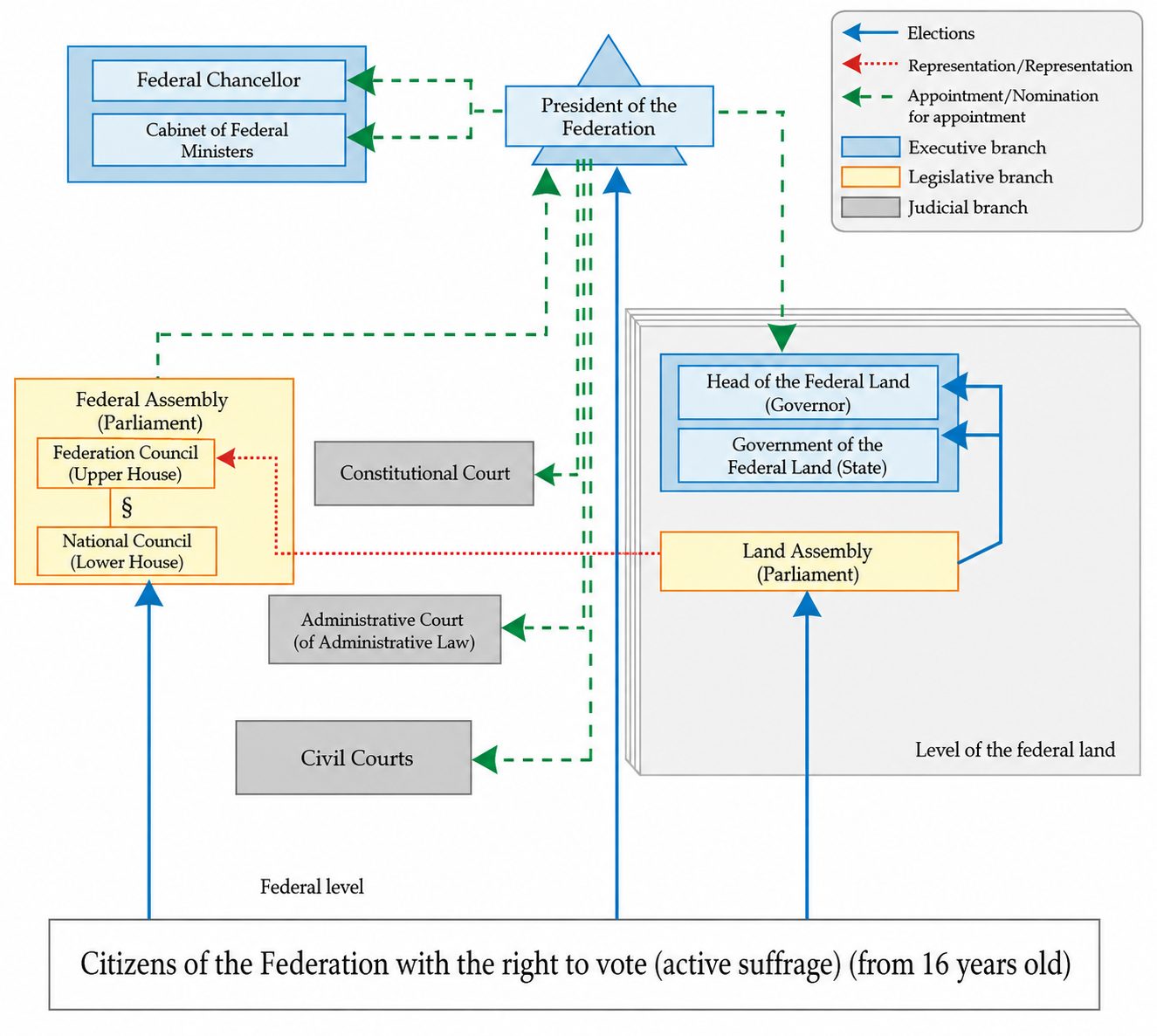
The Austrian Parliament consists of two chambers: the Nationalrat and the Bundesrat (Article 24).

I. The Bundesrat (literally “Federal Council”) is the upper house of the Austrian Parliament. Its members are delegated by the state parliaments (Landtage). Thus, the composition of the Bundesrat depends on the relative strength of parties in the state parliaments (a land is a region in Austria). Parties are elected by the Landtage for the duration of the respective legislative period of the Landtag. Changes in the composition of the Bundesrat are possible after every election in the state parliaments. Therefore, the Federal Council does not have a legislative period, but has been continuously sitting since 1945.

Ministers who are members of the Federal Council are not required to belong to the Landtag that sends them (pursuant to Article 35.2), however, they must have the right to vote in it and meet the criteria for possible election (Article 35.2). Also, unlike their colleagues from Germany, members of the Federal Council have a free mandate, meaning they are not restricted in how they vote2.
There are a total of 61 people in the Federal Council. The states are represented in the Federal Council in proportion to the population of citizens in the state (Article 34.1), with the minimum number of delegates for one state being 3 representatives, and the maximum being 12 (Article 34.2). A new calculation of mandates takes place every ten years based on the results of the population census. It then determines how many representatives each state can send to the Federal Council. Thus, there is no fixed total number of members of the Federal Council3. As an example, we can cite the mandate calculation as of February 6, 20244:
- Burgenland and Vorarlberg – 3 delegates each;
- Carinthia and Salzburg – 4 delegates each;
- Tyrol – 5 delegates;
- Styria – 9 delegates;
- Upper Austria – 10 delegates;
- Vienna – 11 delegates;
- Lower Austria – 12 delegates.

Mandates are elected on the basis of proportional representation, however, at least one of them must be allocated to the party that holds second place in terms of the number of deputies in the Landtag, and in the event that several parties have an equal number of deputies, to the party that took second place in terms of the number of votes cast by voters in the last Landtag elections. In the event of a tie between several parties, the matter is decided by drawing lots (Article 35.1). Upon the expiration of the Landtag’s term of office or after its dissolution, the members of the Federal Council delegated by it retain their functions until the new Landtag holds elections to the Federal Council (Article 35.3).
The functions of the Federal Council are minimal and are related to the control of legislative decisions. All bills pass through the Federal Council, but some of them can be rejected if the representatives of the Federal Council speak out against their adoption (Article 42.2). The National Council (Nationalrat) has the opportunity to re-adopt the initial decision by a simple majority vote, but this requires the approval of at least half of the deputies (Article 42.4). If the Federal Council disagrees with the position of the National Council, it must submit a reasoned objection. This objection must be forwarded to the National Council by the President of the Bundesrat in writing and within eight weeks after the receipt of the legislative decision by the Federal Council (Article 42.3).
However, there are laws that must necessarily be considered and approved by the Federal Council. We are talking about constitutional laws or provisions contained in ordinary laws that can be adopted by the National Council only in the presence of at least half of the members and by a two-thirds majority of the votes cast (Article 44.1). Such constitutional laws, on the basis of which the competence of the states in the field of legislation and executive activity is restricted, also require the approval of the Federal Council in the presence of at least half of its members and by a two-thirds majority of the votes cast (Article 44.2).
The Federal Council does not participate in the adoption by the National Council of laws concerning:
- The rules of procedure of the National Council;
- The dissolution of the National Council;
- The Federal Finance Act, management of the federal budget;
- Provisional trusteeship within the meaning of Article 51.4 on finances or the disposal of federal property;
- The assumption or modification of the Federation’s liability;
- The adoption or modification of the financial obligations of the Federation or the approval of the draft federal estimate (Article 42.5).
II. The Nationalrat (literally “National Council”) is the lower house of the Austrian Parliament. The National Council has 183 members5, who are elected by citizens entitled to vote under a proportional system, with voting allowed from the age of 16 (Article 26.1) and running for election from the age of 18 (Article 26.4).

Every party that wants to enter the National Council must receive a minimum of four percent of the vote nationwide6 (this figure is considered a percentage threshold, which prevents small parties from entering parliament to avoid fragmentation of the party system, which could weaken parliament). The only exception: if a party secures a mandate obtained in a regional electoral district. Such a mandate is called basic. If a party achieves this, it can enter the National Council even if it receives below the required 4 percent threshold nationwide (however, the chance of such an outcome for small parties is low, so only large parties have a chance to win seats in regional electoral districts)7.
Austria uses an open-list system, meaning people vote not only for a party list but also for candidates within the list, indicating them by degree of preference, which increases the chance for popular candidates to be elected.
Functions of the National Council
1. Legislative function. Bills are introduced in the National Council at the proposal of its members, the Federal Council, one-third of the members of the Federal Council, or the Federal Government. The Federal Council may submit legislative proposals to the National Council through the Federal Government (Article 41.1). Also, every proposal received from one hundred thousand citizens entitled to vote, or from one-sixth of the citizens of three states, must be transmitted by the Central Election Commission for discussion by the National Council (Article 41.2).
The Federal Parliament has exclusive spheres of legislation in which it can regulate and ensure the implementation of socio–economic, legal, and political aspects of public life (Articles 10, 14, 15). Since there are quite a few of them, let us designate some of them:
- The Federal Constitution, in particular, elections to the National Council and the conduct of election campaigns in accordance with the Federal Constitution; jurisdiction over constitutional matters;
- Foreign relations, including political and economic representation abroad, the conclusion of all state treaties, the coordination of borders, trade in goods and commerce with foreign countries, customs matters;
- Regulation and supervision regarding entry into and exit from the Federation: immigration and emigration, passport matters, deportation, deprivation of entry rights, eviction, and extradition;
- Federal finances, in particular, state taxes levied exclusively or partially for the benefit of the Federation; monopolies;
- Monetary circulation: credit, stock exchange, and banking matters; measures and weights, standards, and assays;
- Civil law, including the law of economic associations, with the exception of laws establishing administrative restrictions for foreigners regarding the purchase and sale of land plots; criminal law regulation, with the exception of regulation (legal regulation) of administrative liability and proceedings in the sphere of administrative activity relating to the sphere of the states’ own competence; justice; institutions for the protection of society from persons who have committed crimes; resolution of disagreements in the field of administrative jurisdiction, copyright; liquidation or seizure of property (expropriation) if it does not affect issues of the states’ and the state’s own competence; the field of activity of notaries, lawyers, and other specialists in the legal sphere;
- Maintenance of public peace, order, and security, including the provision of first aid, excluding the activities of local law enforcement agencies; legal regulation of associations and assemblies; acts of civil status, including birth registration and change of surname; activities of immigration police; control over weapons, ammunition, and explosives;
- Commercial branches of the economy and industry; state agencies of the Danube Steamship Company and private intermediary organizations; the fight against unfair competition; patent matters, protection of designs, marks, and other trademarks; activities of patent attorneys; engineering and issues regarding specialists in the field of civil engineering; chambers of commerce, crafts, and industry; the establishment of professional representations operating throughout the territory of the Federation, with the exception of those related to the field of agriculture and forestry;
- Railway transport, aviation, and navigation, if it does not fall under the operation of Article 11; automobile matters; issues concerning roads declared by federal law as motorways due to their importance for transit traffic with roads of federal significance; activities of traffic police; water and vessel police, if it also does not fall under the operation of Article 11; mail, telegraph, and telephone; verification for compliance with environmental standards of infrastructure projects in which a significant impact on the environment is assumed and in which, according to administrative regulations, the routes of paths, railway tracks, and other infrastructure objects are determined;
- Mining; forestry, including pastures; water law; regulation, verification of the condition and maintenance of reservoirs in order to ensure safety and the functioning of navigation and timber rafting during floods; dam construction; construction and maintenance of waterways; standardization and unification of electric power installations and structures, development of safety measures in this area; legal regulation of high-voltage power lines passing through the territory of two or more states; regulation of energy engineering; geodesy;
- Labor law, if it is not covered by Article 11; social and contract insurance; professional chambers of workers and employees, with the exception of those that exist in agriculture and forestry;
- Healthcare, with the exception of funeral services, as well as the organization of the sanitary service and ambulance units; however, in medical institutions and sanatoriums, resorts, and other places of recreational rest, only the implementation of sanitary supervision is conducted; measures to prevent the impact of potentially harmful substances and impurities on the environment and humans; ensuring air purity without prejudice to the competence of the states in the sphere of heating; proceedings for the disposal of hazardous waste, regarding other waste — only in case of a need to issue uniform regulations for their elimination; veterinary matters; food matters, including quality control of food products; regulation of the transportation of seeds and plant crops, feed, fertilizers, and pesticides, as well as related equipment; control over the admission of the above to local markets and points of sale of products;
- Specialized scientific–technical archive and library service; issues related to the theaters of the Federation, with the exception of their construction; protection of monuments; religious activity; population census, while preserving the right of the states to conduct any statistical counts within their administrative borders, as long as they do not serve the interests of only one country; foundations, if their goals go beyond the interests of a separate state or if they were not previously under the autonomous management of the states;
- Organization of federal police, gendarmerie, and leadership over them; establishment and formation of other protection units, with the exception of public protection corps; regulation of the armament of security units and the right to use weapons;
- Military matters; issues related to the record-keeping and elimination of damage caused by war, the care of combatants and their loved ones; care for war graves; implementation of a complex of necessary measures to ensure unified leadership of the economy during wartime and, in particular, the supply of the population with basic necessities;
- Establishment of federal bodies and related agencies; civil service law of federal employees and staffing of their positions;
- Demographic policy in the field of child benefit payments and compensations in the interests of the family;
- School matters, as well as the regulation of aspects of upbringing in boarding schools and student dormitories, unless otherwise established in the following paragraphs.
There is also a part of the Federation’s legislation which is related to the fact that the states are engaged in executive activity on the following issues (Article 11):
- Citizenship;
- Professional representations, if they do not fall under the operation of Article 10, with the exception of representations in the field of agriculture and forestry, as well as in the field of tourist mountaineering and the organization of sports training, which is in the sphere of the states’ own competence;
- Housing provision, with the exception of any construction work and building reconstruction;
- Traffic police;
- Sanitary-hygienic measures;
- Inland navigation regarding concessions for navigation, navigation structures, and generally binding rights regarding the construction and operation of such objects, if they are not located on the Danube, Lake Constance, Lake Neusiedl, and not on sections of border waterways; maritime police located on inland water routes, with the exception of the Danube, Lake Constance, Lake Neusiedl, and border sections of other waterways;
- Verification for compliance with environmental regulations of projects assuming a significant impact on the environment; if there is a need to issue uniform regulatory acts, then the approval of such projects is required.
One of the norms of federal legislation is a referendum on issues of fundamental or all-Austrian significance, regulated by federal legislation, according to Article 49b. It is held in the event that the National Council makes a decision about this at the request of its members or the Federal Government after preliminary discussion in the Main Committee (a committee for discussion with the government). Any issues about the electoral process on which a court or another administrative body is obliged to make a decision cannot be the subject of a popular poll.
The demand, within the meaning of paragraph 1, must contain a proposal for a motion on the matter underlying the consultation of the people. This motion must consist either of a single question to be answered with “yes” or “no”, or of two alternative proposed solutions.
A consultation of the people is conducted by applying Articles 45 (the decision is taken by a simple majority of the valid votes cast) and 46 (a referendum is ordered by the Federal President). Every person who has reached the age of 16 on the day of the vote, who possesses active voting rights in elections to the National Council, has not been sentenced to imprisonment for more than one year, and has their main residence in a municipality within the territory of the Federation, has the right to vote. The federal electoral authorities are obliged to submit the results of the vote to the National Council and the Federal Government.
2. Political treaties, as well as agreements regulating the contractual basis of the European Union, may be concluded only with the approval of the National Council, insofar as they amend or supplement laws and do not fall under the operation of Article 16, paragraphs 1 and 2. If such treaties (written commitments with neighboring states or their constituent parts) regulate matters within the states’ own competence, they additionally require the approval of the Federal Council (Article 50.1).
3. The National Council adopts the Federal Finance Act; the draft submitted by the Federal Government forms the basis for its debate (Article 51.1).
4. Vote of no confidence in the government (Article 74). The National Council can withdraw its confidence from the Federal Government or its individual members by an explicit resolution. A vote of no confidence is an effective instrument of political control, as its passage signifies that the federal government or one of its members no longer enjoys the support of the majority in the National Council. In this case, the federal government or the respective federal minister is removed from office by the Federal President.

Such a decision is taken by a simple majority, provided that half of the members of the Nationalrat are present. Upon a written request by one-fifth of the members of the National Council, the vote on the introduced motion of no confidence is postponed to the next working day.
For the adoption of most decisions, the presence of at least one-third (1/3) of the members and a simple majority of the votes cast is required in the National Council and the Federal Council (Articles 31 and 37.1.).
The National Council can be dissolved for three reasons:
- The Federal President can dissolve the National Council, but the Chancellor can order this only once and for the same reason. In this case, new elections must be organized by the Federal Government in such a way that the newly elected National Council can convene no later than the hundredth day after its dissolution (Article 29.1).
- The National Council may, before the expiration of its term of office, decide on its own dissolution by passing a law. In this case, after the dissolution and upon the expiration of the period for which the National Council was elected, its term of office continues until the day the newly elected National Council meets (Article 29.3).
- If, in a referendum related to the President, citizens vote to retain the President, which will be discussed later.
One can also highlight an organ such as the Federal Assembly, which is a joint sitting of the National Council and the Federal Council. Its primary function is swearing in the Federal President or deciding on a declaration of war (Article 38).

The Federal Assembly is convened by the Federal President, with the exception of several cases specified in the fundamental law of the country (we will talk about them a little later). The execution of official duties is alternately conducted by the President of the Federal Council and the President of the National Council.
Head of state
The head of state of the Republic of Austria is the Federal President of Austria. The Federal President is elected by the people of Austria on the basis of equal, direct suffrage by secret ballot (Article 60.1). If only one candidate stands for election during the electoral process, the vote must take the form of a vote “for” or “against” the candidate.
Any person may become Federal President, provided that they have the right to be elected to the National Council and have reached 35 years of age on the day of the election (Article 60.3).“`

Until 2011, members of imperial houses or their families could not be elected president8. This measure was introduced to prevent the restoration of the rule of the House of Habsburg-Lorraine, which had ruled Austria for several centuries.
The Federal President is elected for 6 years; re-election for a subsequent term can take place only once (Article 60.5). The powers of the Federal President are quite broad, but the main ones can be systematized9:
1. External representation:
- Representation of the Republic abroad;
- Conclusion of international treaties;
- Procedure for the implementation of international treaties through their approval;
- Diplomatic and consular law.
2. Federal legislation:
- Convening of the National Council;
- Closing of sessions of the National Council;
- Dissolution of the National Council;
- Convening of the Federal Assembly;
- Determination of the number of members sent to the Bundesrat (Federal Council) by each state;
- Conducting referendums on legislative enactments;
- Organization of consultations of the people;
- Notarization of the constitutional formation of federal laws (the act must be signed by the Federal Chancellor).
3. Federal Government:
- Appointment of members of the federal government and state secretaries;
- Swearing-in of members of the federal government and state secretaries, issuance of certificates of their appointment;
- Dismissal of members of the federal government and state secretaries;
- Transfer of substantive management of agendas of the Federal Chancellery and its own federal ministers;
- Appointment of a provisional federal government or a provisional federal minister.
4. Federal states:
- Swearing-in of state governors;
- Dissolution of the Landtag. Each Landtag can be dissolved by the Federal President on the proposal of the Federal Government and with the consent of the Federal Council. The consent of the Federal Council must be given in the presence of half of its members and by a two-thirds majority of the votes cast. Representatives of the state whose parliament may be dissolved cannot participate in the vote.
5. Crisis competencies:
- Relocation of supreme federal bodies from Vienna to another location during exceptional circumstances;
- Relocation of the National Council from Vienna to another location (the location must be within the territory of the Federal Republic) during emergency circumstances;
- Emergency law.
6. Federal army:
- Command of the federal armed forces;
- Right of disposal over the federal armed forces;
- Appointment of respective officials.
7. Administration:
- Appointment of federal civil servants and related representatives;
- Conferral of official titles on federal civil servants and federal officials;
- Numerous individual appointment powers under various federal laws.
8. Jurisdiction:
- Appointment of ordinary judges and prosecutors, as well as judicial representatives in federal state courts;
- Inauguration of the President and Vice President of the Constitutional Court and the Administrative Court;
- Execution of decisions of the Constitutional Court;
- In exceptional cases: mitigation of punishment imposed by judges, limitation of legal consequences, and expungement of criminal records by way of pardon, termination of criminal proceedings against persons prosecuted in an official capacity for criminally punishable acts;
- Legitimation of illegitimate children.
9. Other “notarial” functions:
- Swearing-in of the President of the Court of Audit;
- Swearing-in of members of the Ombudsman Board.
10. Granting of honorary rights:
- Awarding of orders, including the Decoration of Honour for Services to the Republic of Austria or for significant contributions to science and art;
- Creation and conferral of professional titles;
- Approval of Promotiones sub auspiciis Praesidentis rei publicae (translated from Latin — “graduations under the auspices of the President of the Republic”) and awarding doctoral candidates who have completed the highest form of doctoral studies (often called “honorary doctorate”) with a ring of honor. This award is the highest possible recognition for academic achievement in Austria;
- Conferral of the highest official title on civil servants upon retirement.
Doctoral studies — specialized programs in higher educational institutions for training scientific personnel.
Despite quite an impressive scope of powers, the president does not possess great freedom of action. Thus, according to Article 67, all acts authorized for the Federal President, unless otherwise provided by constitutional legislation, are carried out on the basis of proposals from the Federal Government or the federal minister authorized by this government. The law determines the extent to which the Federal Government itself or the competent federal minister itself in these cases is bound by the proposals of other bodies.
All decisions of the Federal President, unless otherwise established by constitutional legislation, require the signature of the Federal Chancellor or the competent federal minister to ensure their validity. That is, essentially, the institution of countersignature exists in Austria, regulating the powers of the president.“`
Countersignature or countersigning (from Lat. contra – against and signo or assigno – to sign) — the approval and signing by the Prime Minister or an authorized minister of a regulatory act already approved by the head of state or parliament. After this, the regulatory act is officially endowed with legal force10.
Countersignature is also provided for decisions of the Federal Assembly, which are authenticated by its President and subsequently approved by the Federal Chancellor (Article 40).

The Federal President leaves office for two reasons.
- On the basis of a referendum (Article 60.6). A referendum shall be held if the Federal Assembly so demands. The Federal Assembly shall be convened for this purpose by the Federal Chancellor, provided that the National Council has decided on the demand. For a decision by the National Council, the presence of at least half of its members and a two-thirds majority of the votes cast are required. If the proposal is approved, the National Council is prevented from the further execution of duties by the Federal President. The rejection of the decision to remove the Federal President by referendum is considered as their re-election and entails the dissolution of the National Council, whereby the total duration of the Federal President’s term of office cannot exceed twelve years.
- Accusation of a crime (Article 63). Official prosecution against the Federal President is permissible only with the consent of the Federal Assembly. An application for legal proceedings against the Federal President must be submitted by the competent authority to the National Council. If the National Council declares itself in favor of this, the Federal Chancellor is obliged to convene the Federal Assembly immediately. If the Federal Assembly supports the investigation, the case is referred to the Constitutional Court, which decides on the charge (Article 142.2a). If the Constitutional Court upholds the charge and finds it to accord with the truth, the president steps down11.
There is also a third option — resignation of one’s own accord, but the problem with this method is that the implementation of such a condition is not provided for by the Constitution, which is why this principle exists in theory, but it is rather controversial due to the absence of specific defining conditions. However, if there are circumstances that prevent the Federal President from exercising their own duties, all of their functions pass to the Federal Chancellor (Article 64.1).
However, if the president cannot work for a period of 20 days or if they have been removed by a referendum, the functions of the Federal President are assigned to a college — the President, the Second President, and the Third President, i.e., the Presidents of the National Council. A similar provision applies if the office of the Federal President remains vacant for a long time. The college entrusted with exercising the functions of the Federal President takes decisions by a majority of votes. The duty of chairing the college is assigned to the President of the National Council, who also acts as its official representative.
If any circumstances arise that prevent one or two Presidents of the National Council from fulfilling the necessary obligations, or if their positions remain vacant for a long time, the college has the right to vote and make decisions without their participation; in that case, in the event of an equality of votes, the vote of the higher-ranking President is decisive. In the event that the office of the Federal President becomes vacant for a prolonged period, the Federal Government must immediately appoint elections for a new Federal President. After the elections have been held, the college must convene the Federal Assembly to swear in the Federal President.
Government
The Federal Government of Austria consists of the Federal Chancellor, the Vice-Chancellor, and other federal ministers (Article 69.1). It is a collegiate body, as the Federal Government is capable of making decisions in the presence of more than ½ of its members at a meeting (Article 69.3). Members of the Federal Government may also be members of the National Council12, but most deputies surrender their mandate in the Nationalrat when they assume government posts.
The Federal Government consists of the following ministries13:
- Federal Chancellery;
- Federal Ministry for Art, Culture, the Civil Service and Sport;
- Federal Ministry of Agriculture, Forestry, Regions and Water Management;
- Federal Ministry for Climate Action, Environment, Energy, Mobility, Innovation and Technology;
- Federal Ministry of Defence;
- Federal Ministry of Education, Science and Research;
- Federal Ministry for European and International Affairs;
- Federal Ministry of Finance;
- Federal Ministry of the Interior;
- Federal Ministry of Justice;
- Federal Ministry of Labour and Economy;
- Federal Ministry of Social Affairs, Health, Care and Consumer Protection.
The Federal Chancellor is the head of government, and the Vice-Chancellor is the deputy and performs the work of the chancellor if the latter cannot work for certain reasons.

The Federal Chancellor and, on their proposal, the remaining members of the Federal Government are appointed by the Federal President (Article 70.1), but without the National Council the government cannot de facto be formed. Because of this, the parliamentary majority is closely intertwined with the federal government. For this reason, top officials represented by the majority of parties in the National Council are often met in government offices. So deputies from the ruling parties set as their goal the support of the government and the promotion of their plans and projects against the opposition14.
Three methods are used for the resignation of the government or its constituent ministers:
- Removal by the Constitutional Court of members of the Federal Government in connection with a violation of the law — by resolution of the National Council (Article 142.2b);
- If the National Council passes a resolution expressing a vote of no confidence in the Federal Government or its individual members, the Federal Government or the respective federal ministers must be removed from the performance of their duties. For the adoption of such a resolution by the National Council, the presence of at least half of the members of the National Council is required (Article 74.1,2);
- The Federal President can independently dismiss the Federal Government or the Chancellor. To implement this, a corresponding proposal is not required, and the dismissal of individual members of the Federal Government is carried out on the instruction of the Federal Chancellor (Article 70.1).
If the Federal Government has resigned, the president must entrust the management of the administration to members of the former government or top officials of federal departments and charge one of them with chairing the provisional Federal Government until a new government is formed (Article 71). Further conduct of administration may be delegated to a state secretary subordinate to the outgoing federal minister, or to a senior official of a federal ministry. This provision applies mutatis mutandis in the case of individual ministers leaving the Federal Government. The person entrusted with the function of administration carries the same responsibility as a federal minister.

The Constitution also provides a substitution mechanism within the government:
- The Vice-Chancellor substitutes for the Federal Chancellor in the entire scope of their competence;
- If both the Federal Chancellor and the Vice-Chancellor are unable to be present and exercise their powers, the Federal President charges one of the most senior members of the Federal Government with exercising the functions of the Federal Chancellor.

If a federal minister is temporarily unavailable, they must charge the designated state secretary or a senior official of the respective federal ministry with representing them; such authorization of representation must be communicated to the Federal President and the Federal Chancellor (Article 73.1). The stay of a federal minister in a member state of the European Union is not considered an impediment to the performance of their duties.
States (regions)
Austria consists of nine states, pursuant to Article 2.2, which are called states (Burgenland, Carinthia, Lower Austria, Upper Austria, Salzburg, Styria, Tyrol, Vorarlberg, Vienna (the only city-state in the country, as well as the capital of Austria)).
Vienna is the capital of Austria. Its municipal council performs the functions of the Landtag, the city senate — the functions of the state government, the mayor — the functions of the state governor, the magistrate — the functions of the city administration, and the magistrate director — the functions of the state administration director (Article 108).

The competence of the Federation covers the laying down of basic principles, while the competence of the state covers the enactment of implementing laws and execution regarding the following matters (Articles 12, 14):
- Poor relief; population policy aspects not falling under Article 10; maintenance of public care institutions (shelters, sobering-up centers); social welfare for maternity; operation of medical institutions; development and implementation of preventive measures in health resorts and overcrowded recreation places; protection of natural sources from pollution;
- Public institutions for extrajudicial conflict mediation;
- Land reform, in particular agrarian operations and resettlement;
- Protection of plants against diseases and pests;
- Electricity supply, unless falling under Article 10;
- Labor law; protection of workers engaged in agriculture and forestry.
Federal competence also includes legislation in the field of the school system and education, while it is the duty of the states to enact implementing (that is, carried out in accordance with a specific program) laws and ensure their enforcement in the following matters:
- Determination of the composition and structure of boards formed within the federal school authorities in the territory of a specific administrative district;
- External organization (construction, organizational form, establishment, maintenance, closing, location, class size, class hours) of public compulsory schools;
- Organization of dormitories for students in public schools;
- Professional requirements for employment in states, municipalities, or municipal associations for appointment as educators in kindergartens, children’s homes, and dormitories intended primarily for pupils of general education schools.
Exclusive powers of the states are represented in the following areas15:
- In the field of the state constitution;
- In building law, in the provision of housing subsidies;
- In spatial planning, nature conservation, and landscape protection;
- In tourism and public events;
- In waste management control;
- In kindergartens and after-school child care;
- In municipal law.
Why is the federal system structured this way? The reason is that Austria-Hungary was largely constructed as a unitary state, which made the country’s political system largely centralized. This was reflected during the formation of the Republic of Austria, but the country also features functioning institutions that ensure federalism, and besides the primary organs of state power, one can highlight, for example, the conference of state governors, in which the federal chancellor also participates. Another example of federalism in action is the conference of sectoral state ministers with the participation of the relevant federal minister, as well as conferences of other high-ranking federal and state officials16.
The Federal Government and the states may also conclude agreements and regulate joint activities in specific policy areas (“15a agreements”).

Until 2012, the Federal Government had the right to object to or participate in the enactment of state laws in certain cases. Today, the government has virtually ceased using this option, as this right was strictly limited as part of a comprehensive constitutional reform. The Federal Government can still challenge only state legislative enactments concerning tax policy. The Federal Government also gives consent to the approval of legislative acts relating to the organization of state administration bodies (in particular, district administrations)17.
Laws passed by the Landtag must be compatible with both the Federal and the state constitution. Otherwise, 1/3 of the members of the Landtag have the right to appeal to the Constitutional Court and challenge the adopted law on the grounds of its alleged unconstitutionality.
Legislative power belongs to regional parliaments (Landtage). The Constitution itself contains very precise requirements for the structure of parliamentarism at the state level. State constitutions regulate the tasks and powers of regional parliaments in such a way that uniformity exists both at the federal and state levels.
The following provisions apply in the process:
- Principles of equal, direct, and secret proportional representation;
- Legal status of members of the Landtag through the principle of a free mandate, as well as immunity and incompatibility of the mandate with other public functions;
- Process of state legislation.
Rules for elections to the Landtag, according to the Constitution, determine the specific structure of electoral law in the respective federal state. The number of members of the Landtag can be established without any federal restrictions. In eight federal states, state constitutions provide that the Landtag must be re-elected no later than after five years. Only in Upper Austria is the legislative period six years.
A Landtag may be dissolved by the Federal President on the recommendation of the Federal Government and with the consent of the Federal Council (but only once for the same reason).
State parliaments elect the governments of these same states and, depending on the balance of power in the newly elected state parliament, determine their representatives in the Federal Council. The executive function on the territory of the state is exercised by the government, which heads the state administration18. The head of government is the governor.
While the Federal Government is appointed by the Federal President, regional governments and governors are elected by the state parliaments. The constitution of each state regulates the structure of the government, the number of its members, and the procedure for conducting elections.

Some federal states provide for a “proportional government” — the most powerful parties are represented in the state government in accordance with their share of votes received. While in the past such proportional governments existed in all federal states except Vorarlberg, today single-party or coalition governments dominate in the states. Proportional governments are provided for only in Lower Austria and Upper Austria. Vienna has a special system: the state government is represented proportionally, but it includes “executive” city councilors and government members without their own area of responsibility (“without portfolio”).

A special feature of the Republic of Austria is “indirect federal administration”. This means that the states not only participate in federal legislation through the Federal Council, but are also responsible for compliance with federal laws. “Indirect administration” also means that administrative tasks of one legal entity (the Federal Government) are carried out by the authorities of another legal entity (the states). In this case, the state authorities under the leadership of the governor act not on behalf of the region, but on behalf of the Federal Government.
Administrative division of Austria
According to the Constitution, the Republic of Austria is a federation. At the same time, the territorial structure of Austria is divided into three levels:
- States (which we wrote about above);
- Districts, statutory cities;
- Municipalities.
Each level carries a certain responsibility primarily for fulfilling general state administration tasks assigned to it by federal or state laws.
Districts
Districts are local organizations of the second level of executive power. As a rule, they represent associations of small towns and villages (large cities are not included in this list). District authorities are the primary contact point between residents and the state regarding the regulation of most government norms that go beyond municipal competence: marriage certificates, driver’s licenses, passports, permits for assemblies, hunting permits, contacts with public health employees — all this involves interaction with district administrative authorities.

Statutory cities
Statutory cities are a type of city that are similar to ordinary urban agglomerations in terms of territorial structure, but by status they are designated as districts.
A municipality with a population of at least 20,000 residents may, upon its request, be granted its own statute (charter) under state legislation, provided this does not jeopardize state interests. A city with its own statute must fulfill the tasks of both municipal and district administration (Article 116.3).
Municipalities
Municipalities have the lowest level of territorial organization in the hierarchy. They may consist of one or several settlements. The Constitution specifies two organizations representing the interests of municipalities: the Austrian Association of Municipalities and the Austrian Association of Cities and Towns (Article 115.3).
The Constitution also details the basic structure of a municipality:
- The municipal council, which is the general representative body. Its electoral process is carried out by the citizens belonging to the municipality who possess active voting rights;
- The municipal board (city council), and in cities with their own charter — the city senate;
- The mayor.
The mayor, members of the municipal board (city council, city senate), and other appointed municipal authorities are responsible to the municipal council for the execution of their tasks falling within the municipality’s own sphere of competence (Article 118.5).
The municipality’s sphere of competence consists of its own scope of activities and powers transferred to it by the Federation or the Landtag. In this context, according to the Constitution, the municipality is responsible for fulfilling public administration tasks regarding the following aspects (Article 118.3):
- Appointment of municipal authorities to the extent that this does not restrict the competence of superior elective bodies; regulation of internal organization for the purpose of carrying out the tasks facing the municipality;
- Appointment of municipal employees and exercising operational oversight without prejudice to the jurisdiction of supra-local disciplinary, qualification, and inspection commissions;
- Local security police (Article 15, paragraph 2); police ensuring order at public events;
- Traffic management within the municipality, local traffic police;
- Crop protection police;
- Local market police;
- Public health police, in particular ambulance and rescue services, as well as funeral affairs and cemeteries;
- Public morals police (the primary function is suppressing actions and omissions that, according to established social views, are immoral; in particular, supervision of prostitution is carried out)19;
- Local building police, unless its activities concern buildings belonging to the Federation and serving public events (Article 15, paragraph 5); fire police; local spatial planning;
- Institutions for extrajudicial conflict mediation;
- Voluntary offering of movable property for sale.

The delegated sphere of activity transferred to municipalities includes matters that the municipality must handle in accordance with federal laws, directions of the federal government, or state laws (Article 119.1). At the request of a municipality, the performance of individual powers belonging to its own sphere of competence may be transferred by ordinance of the state government or the governor to a state authority. If, on the basis of such an ordinance, competence is to be transferred to a federal authority, this requires the consent of the Federal Government. If, on the basis of an order of the governor, competence is to be delegated to a state authority, this requires the consent of that state’s government. Such an ordinance must be rescinded as soon as the reason for its adoption ceases to exist (Article 118.7).
Associations of municipalities
Municipalities may unite through the conclusion of a joint agreement to perform a specific range of tasks. However, such an agreement requires the approval of the supervisory authority (Article 116a). Approval must be granted in the form of a special ordinance, provided that the lawful agreement of the participating municipalities:
- Does not impede the resolution of issues in the field of public administration or the functioning of the participating municipalities as self-governing units;
- Is based, in the case of fulfilling municipality tasks as subjects of private law, on expediency, profitability, and economy in the interests of the participating municipalities.
Professional chambers
One of the main features of any democratic country is the presence of various self-governing bodies, which are, in their essence, elective within a specific field. Such an example can be considered “professional chambers”. Their function comes down to uniting individuals of a certain profession, protecting their interests, and consulting public administration bodies in spheres of professional activity20. The main difference between this state association and trade unions is that membership in the Chamber is mandatory for all employees.
This model exists in a number of countries, for example: in Luxembourg21, Germany22, the Czech Republic23, partially in Russia (in the form of the Chamber of Advocates24 and the Chamber of Notaries25). Each chamber has its own characteristics, however, it is in Austria that this model is of great importance in the form of “social partnership”, which is expressed in a system of cooperation between economic groups of employers, employees, and the government26.
The Austrian Chamber of Labour represents special Labour Chambers, which exist at both regional and federal levels. Their main duty is to represent and promote the social, economic, professional, and cultural interests of employees2728.

From this follow the following powers of the Chamber29:
- To give opinions on draft laws and bills, as well as to submit reports and proposals to legislative bodies;
- To submit proposals to administrative authorities, provide comments on draft regulations, and participate in public administration in another manner provided by law;
- To send its own representatives to corporations and other institutions, as well as to nominate candidates, provided this does not violate the law;
- To participate in all activities related to labor relations or contributing to the improvement of the economic and social condition of workers and their families; to establish, manage, or support organizations implementing these programs;
- To support facilities in matters of education, culture, environmental protection, consumer protection, leisure, health protection and promotion, housing construction, and full employment promotion;
- To participate in economic measures taken by economic administration, in particular in the approval of prices for goods or services of any kind in competition regulations;
- To participate in scientific research concerning the situation of workers;
- To provide information on all matters related to the interests of employees;
- To support the activities of electoral groups in the general assembly;
- To represent the interests of workers in international relations through expert opinions, proposals, and other legal participation rights, as well as to maintain relations with international organizations;
- To monitor compliance with the provisions of labor law, social security law, and worker protection rules;
- To set up centers for vocational training and legal protection of youth;
- To advise voluntary professional associations capable of concluding collective agreements and bodies representing the interests of companies, as well as to cooperate with them in order to promote the social, economic, professional, and cultural interests of workers.
The Chamber of Labour represents the following categories of the population:
- Blue-collar and white-collar workers;
- Trainees;
- Unemployed persons, provided they have worked as part of the Chamber for at least 20 weeks or received unemployment benefits for 52 weeks or a longer period;
- A portion of freelancers;
- Domestic workers;
- Leaders of professional associations of workers entitled to collective bargaining;
- Workers of enterprises operating under the management of agricultural and forestry commercial and economic cooperatives.

This chamber does not include social groups that already have their own representative bodies, structurally and functionally similar to the Chamber of Labour. Such groups include:
- Physicians30;
- Pharmacists31;
- Civil engineers32;
- Trainee lawyers, notaries33;
- Law enforcement personnel34;
- Religious figures35.
Chambers of Labour consist of the following bodies36:
- President of the Bureau. Each regional chamber of labour is headed by a President. They are elected by the Plenary Assembly of the respective chamber of labour and are the highest political representative of workers in the respective federal state;
- Plenary Assembly (“Labour Parliament” of the Chamber of Labour). The composition of this political body is formed by the members of the Chamber of Labour every five years through elections. Members of the parliament of the Chamber are chamber councillors. In the general assembly, there may be a different number of seats depending on the size of the federal state and the number of members. The Plenary Assembly makes decisions on budget regulations, closing of accounts, and monitoring the implementation of procedures in the Chamber of Labour. The Plenary Assembly usually meets twice a year;
- Bureau. Consists of the president and vice-presidents of the respective regional chamber, who are also elected by the Plenary Assembly. The Bureau prepares discussions in the Executive Council and addresses particularly important issues;
- Executive Council. Consists of the President, Vice-Presidents, and other members of the chamber council elected by the Plenary Assembly. The board may be represented by a different number of chamber councillors (from 9 to 19 people, including the President and their deputies) depending on the size of the federal state. The Executive Council sends councillors of the regional Chamber of Labour to the General Assembly of the Federal Chamber of Labour, establishes committees (on social, financial policy, labor law, youth protection, social security, education, or women’s employment), and makes decisions on important financial matters, as well as oversees the appointment or dismissal of the board director. The Board of Directors meets once a month;
- Committees;
- Technical committees;
- Audit Committee. It checks the management of the Chamber of Labour for compliance with legal provisions, Financial Regulations, and other norms issued in accordance with the Constitution.

Chambers of Labour function for 5 years. Upon expiration of this term, elections to the Plenary Assemblies must start, which are conducted by direct and secret ballot in accordance with the principles of proportional representation.

Voting rights must be exercised by voting in a polling station or by postal voting. To be elected to the Plenary Assembly, the following requirements must be met:
- Be 19 years of age;
- Have previously been in an employment relationship that served as the basis for membership in the Chamber, or have worked for at least six months during the last two years (if the person currently does not have the opportunity to work);
- Possess Austrian citizenship.
In total, between 50 and 180 councillors can run for the General Assembly (depending on the state).
They are elected there according to a proportional system, that is, according to special lists. Trade union groups (and not parties) participate in this event, while the parties themselves may be associated with the elected groups to varying degrees.

Regional chambers of labour, in turn, form the Federal Chamber of Labour — an all-Austrian umbrella organization. The President of the Federal Chamber is elected by the General Assembly from among its presidents by a simple majority of votes.
The Federal Chamber consists of the following bodies:
- President. Is the head of the Federal Chamber of Labour, elected by the General Assembly from among the presidents of the regional chambers of the states;
- Executive Board of the Federal Chamber of Labour. In this collegial body, the nine presidents of the state chambers are represented. The Executive Board prepares reports for the General Assembly, manages personnel matters, deals with organizational aspects, and monitors the implementation of resolutions;
- General Assembly. Is the highest body of the Federal Chamber of Labour. It determines the policy course at the federal level in accordance with the interests of the labor chambers. Consists of nine presidents and 58 councillors of state chambers from all federal states.
Every worker who is part of the Chamber of Labour is obliged to make a contribution in the amount of 0.5% of the wage amount for membership in the organization. Exempt from monetary fees are:
- Unemployed persons;
- Workers on maternity leave;
- Persons receiving an income below the allowable threshold;
- Trainees.
Economic professional chambers
Entrepreneurs also have two separate chambers: Chambers of Agriculture37 and Economic Chambers of Austria38 (the counterpart of the latter in our country is the Chamber of Commerce and Industry)39.

Practically every entrepreneur can participate in the electoral process of a specific organization. While the election in the Chamber of Agriculture is relatively democratic (based on universal, equal, and secret suffrage in accordance with the principles of proportional representation)40, the Economic Chambers have a number of problems41:
- Voters vote directly only for “primary organizations”, of which there are only 857 in total. The remaining levels are determined by extrapolation (transferring results obtained from observations of one part of a phenomenon to another part of it) of mandates won in these primary elections;
- Unequal mandates. In individual professional organizations, mandates have different indicators, and this difference can be quite significant. Sometimes just one vote is enough for a mandate, while elsewhere you need to get more than 100 votes;
- Entrepreneurs who are members of several chambers also have more opportunities to exercise voting rights in elections;
- Unevenness of sectoral representation: 6,000 industrial companies receive the same number of mandates as 250,000 commercial enterprises.
As noted by Austrian political scientist Hubert Sickinger, this situation makes the chamber electoral system strange and non-transparent, and largely serves as a guarantee that the industrial group will not submit to the masses of one-person companies42.
This state of affairs causes criticism and leads to proposals for reforming the electoral system. Thus, the party of Austrian “Greens” proposes the abolition of such controversial practice, offering instead to make elections direct and eliminate the principle of sectoral representation, which, in their opinion, should make the Economic Chambers more democratic43.
Conclusion
Austria is an example of a democratic state with a high level of rule of law, where in addition to ordinary political institutions, an important role is played by bodies representing various professional groups. It is also a state in which the federal structure, owing to its history, is more centralized than in Germany, and we can see an example similar in many respects to the Russian one, but having taken a democratic path.
We thank Alexander Stirtzen for assistance in writing the article.
- Bundesrecht konsolidiert: Gesamte Rechtsvorschrift für Bundes-Verfassungsgesetz, Fassung vom 06.02.2024 // Rechtsinformationssystem des Bundes (RIS) (https://www.ris.bka.gv.at/default.aspx). [Electronic resource]. URL: https://www.ris.bka.gv.at/GeltendeFassung.wxe?Abfrage=Bundesnormen&Gesetzesnummer=10000138 (Accessed: 06.02.2024).
- Mitglieder des Bundesrats // Österreich Parlament (https://www.parlament.gv.at/). [Electronic resource]. URL: https://www.parlament.gv.at/verstehen/bundesrat/mitglieder/index.html#unvereinbarkeit_und_transparenz (Accessed: 04.02.2024).
- Mitglieder // Österreich Parlament (https://www.parlament.gv.at/). [Electronic resource]. URL: https://www.parlament.gv.at/verstehen/bundesrat/mitglieder/index.html (Accessed: 04.02.2024).
- Bundesrat // Österreich Parlament (https://www.parlament.gv.at/). [Electronic resource]. URL: https://www.parlament.gv.at/recherchieren/personen/bundesrat?R_WF=WP&M=M&W=W&BL=ALLE_BL (Accessed: 06.02.2024).
- Wahlen zum Nationalrat // Österreich Parlament (https://www.parlament.gv.at/). [Electronic resource]. URL: https://www.parlament.gv.at/verstehen/demokratie-wahlen/parlament-wahlen/wahlen-nr (Accessed: 06.02.2024).
- Nationalrat // Österreich Parlament (https://www.parlament.gv.at/). [Electronic resource]. URL: https://www.parlament.gv.at/verstehen/nationalrat/index.html (Accessed: 06.02.2024)
- Wahlen zum Nationalrat // Österreich Parlament (https://www.parlament.gv.at/). [Electronic resource]. URL: https://www.parlament.gv.at/verstehen/demokratie-wahlen/parlament-wahlen/wahlen-nr (Accessed: 06.02.2024).
- Wie wird die Bundespräsidentin oder der Bundespräsident gewählt? // Österreich Parlament (https://www.parlament.gv.at/). [Electronic resource]. URL: https://www.parlament.gv.at/fachinfos/rlw/Wie-wird-die-Bundespraesidentin-oder-der-Bundespraesident-gewaehlt (Accessed: 04.02.2024).
- Der Bundespräsident, seine Aufgaben und Rechte // Österreichischer Bundespräsident Alexander Van der Bellen (https://www.bundespraesident.at/). [Electronic resource]. URL: https://www.bundespraesident.at/aktuelles/detail/aufgaben-und-rechte (Accessed: 04.02.2024).
- V.E. Chirkin. Countersignature // Big Russian Encyclopedia. Volume 15. Moscow, 2010, p. 146. [Electronic resource]. URL: https://bigenc.ru/law/text/2093440 (Accessed: 04.02.2024).
- Wie wird man eigentlich Bundespräsident? // Österreichischer Bundespräsident Alexander Van der Bellen (https://www.bundespraesident.at/). [Electronic resource]. URL: https://www.bundespraesident.at/aktuelles/detail/wahl-und-amtszeit (Accessed: 04.02.2024).
- Bundesregierung // Österreich Parlament (https://www.parlament.gv.at/). [Electronic resource]. URL: https://www.parlament.gv.at/verstehen/politisches-system/bundesregierung/ (Accessed: 04.02.2024).
- Federal Ministries // Federal Chancellery Republic of Austria (https://www.bundeskanzleramt.gv.at/en.html). [Electronic resource]. URL: https://www.bundeskanzleramt.gv.at/en/federal-chancellery/the-austrian-federal-government/ministries.html (Accessed: 04.02.2024).
- Bundesregierung // Österreich Parlament (https://www.parlament.gv.at/). [Electronic resource]. URL: https://www.parlament.gv.at/verstehen/politisches-system/bundesregierung/ (Accessed: 04.02.2024).
- Bundesstaatliches Prinzip // Österreich Parlament (https://www.parlament.gv.at/). [Electronic resource]. URL: https://www.parlament.gv.at/verstehen/politisches-system/bund-laender/prinzip/ (Accessed: 04.02.2024).
- Akhmedov K.K. Study of Western European federal states (Austria, Germany, Switzerland, Belgium, Spain) in modern conditions // Symbol of Science: International Scientific Journal, 2020. — No. 4. — pp. 155-158.
- Landtage // Österreich Parlament (https://www.parlament.gv.at/). [Electronic resource]. URL: https://www.parlament.gv.at/verstehen/politisches-system/bund-laender/landtage/ (Accessed: 04.02.2024).
- Landesregierungen // Österreich Parlament (https://www.parlament.gv.at/). [Electronic resource]. URL: https://www.parlament.gv.at/verstehen/politisches-system/bund-laender/landesregierungen/ (Accessed: 04.02.2024).
- Sittlichkeitspolizei // Burgenländisces landesrecht (https://www.ris.bka.gv.at/default.aspx). April 10, 2023 [Electronic resource]. URL: http://www.burgenland-recht.at/A.NeueGemOWebSite/08a.%20Eigener%20Wirkungsbereich/Sittlichkeitspolizei.html (Accessed: 04.02.2024).
- Professional chambers // The Luxembourg Government (https://gouvernement.lu/en.html). November 25, 2019. [Electronic resource]. URL: https://gouvernement.lu/en/systeme-politique/chambres-professionnelles.html (Accessed: 04.02.2024).
- Ibid.
- Berufskammer: Verzeichnis aller Kammern im Überblick // firma.de (https://www.firma.de/). March 18, 2022. [Electronic resource]. URL: https://www.firma.de/unternehmensfuehrung/berufskammer-verzeichnis-aller-kammern-im-ueberblick/ (Accessed: 04.02.2024).
- Pavlína Šrubařová. Profesní komory (https://mylaw.cz/). November 23, 2018. [Electronic resource]. URL: https://mylaw.cz/clanek/profesni-komory-360 (Accessed: 04.02.2024).
- About the Federal Chamber of Lawyers of the Russian Federation // FPA (https://fparf.ru/). [Electronic resource]. URL: https://fparf.ru/fpa-rf/about/ (Accessed: 04.02.2024).
- General information // FNP (https://notariat.ru/ru-ru/). March 18, 2022. [Electronic resource]. URL: https://notariat.ru/ru-ru/federal-notary-chamber/info/ (Accessed: 04.02.2024).
- Die Österreichische sozialpartnerschaft [Electronic resource]. URL: https://www.sozialpartner.at/ (Accessed: 04.02.2024).
- Aufgaben der Arbeiterkammer // BUNDESARBEITSKAMMER (https://www.arbeiterkammer.at/index.html). December 29, 2021. [Electronic resource]. URL: https://www.arbeiterkammer.at/ueberuns/leistungen/Aufgaben_der_AK.html (Accessed: 04.02.2024).
- Bundesrecht konsolidiert: Gesamte Rechtsvorschrift für Arbeiterkammergesetz 1992, Fassung vom 06.02.2024 // RIS (https://www.ris.bka.gv.at/). [Electronic resource]. URL: https://www.ris.bka.gv.at/GeltendeFassung.wxe?Abfrage=Bundesnormen&Gesetzesnummer=10008787 (Accessed: 06.02.2024).
- Bundeskurien // Österreichische Ärztekamme (https://www.aerztekammer.at/). [Electronic resource]. URL: https://www.aerztekammer.at/bundeskurien (Accessed: 04.02.2024).
- Die Österreichische Apothekerkammer // Österreichische Apothekerkammer (https://www.apothekerkammer.at/). [Electronic resource]. URL: https://www.apothekerkammer.at/ueber-uns/organisation (Accessed: 04.02.2024).
- Aufgaben der Bundeskammer der ZiviltechnikerInnen // Bundeskammer der ZiviltechnikerInnen (https://www.arching.at/home.html). [Electronic resource]. URL: https://www.arching.at/ueber_uns/aufgaben_der_bundeskammer.html (Accessed: 04.02.2024).
- Das Notariat. Organisation und Aufsicht. // Die Österreichische Notariatskammer (https://www.notar.at/). [Electronic resource]. URL: https://www.notar.at/die-notare/kammern/ (Accessed: 04.02.2024).
- Die Wirtschaftskammer Österreich // WKO (https://www.wko.at/). [Electronic resource]. URL: https://www.wko.at/service/oe/wirtschaftskammer.html (Accessed: 04.02.2023).
- Bundesrecht konsolidiert: Gesamte Rechtsvorschrift für Arbeiterkammergesetz 1992, Fassung vom 06.02.2024 // Rechtsinformationssystem des Bundes (RIS) (https://www.ris.bka.gv.at/default.aspx). [Electronic resource]. URL: https://www.ris.bka.gv.at/GeltendeFassung.wxe?Abfrage=Bundesnormen&Gesetzesnummer=10008787 (Accessed: 06.02.2024).
- Entscheidende Organe der Arbeiterkammer // BUNDESARBEITSKAMMER (https://www.arbeiterkammer.at/index.html). [Electronic resource]. URL: https://www.arbeiterkammer.at/ueberuns/gremien/Organe_.html (Accessed: 04.02.2024).
- Organisation der Landwirtschaftskammer Österreich // LKonline (https://www.lko.at/). [Electronic resource]. URL: https://www.lko.at/organisation-der-landwirtschaftskammer-%C3%B6sterreich+2400+1037424 (Accessed: 04.02.2024).
- Die Wirtschaftskammer Österreich // WKO (https://www.wko.at/). [Electronic resource]. URL: https://www.wko.at/service/oe/wirtschaftskammer.html (Accessed: 04.02.2024).
- CCI RF today. // Chamber of Commerce and Industry of the Russian Federation (https://tpprf.ru/ru/). [Electronic resource]. URL: https://tpprf.ru/ru/about/ (Accessed: 04.02.2024).
- Landesrecht konsolidiert Oberösterreich: Gesamte Rechtsvorschrift für Landwirtschaftskammerwahlordnung 1973 // RIS (https://www.ris.bka.gv.at/). [Electronic resource]. URL: https://www.ris.bka.gv.at/GeltendeFassung.wxe?Abfrage=LrOO&Gesetzesnummer=10000102 (Accessed: 04.02.2024).
- So geht witrschaftskammer-wahl! // gruenewirtschaft.at (https://www.gruenewirtschaft.at/). July 19, 2018. [Electronic resource]. URL: https://www.gruenewirtschaft.at/2018/07/19/wie-die-wirtschaftskammer-wahl-funktioniert/ (Accessed: 04.02.2024).
- Luise Ungerboeck. Mahrer behält seinen Logenplatz in der Wirtschaftskammer // STANDARD Verlagsgesellschaft m.b.H. (https://www.derstandard.at/). February 29, 2020, 08:00. [Electronic resource]. URL: https://www.derstandard.at/story/2000115159318/mahrer-behaelt-seinen-logenplatz-in-der-wirtschaftskammer (Accessed: 04.02.2024).
- So geht wirtscgaftskammer-wahl! // Grüne Wirtschaft (https://www.gruenewirtschaft.at/). July 19, 2018. [Electronic resource]. URL: https://www.gruenewirtschaft.at/2018/07/19/wie-die-wirtschaftskammer-wahl-funktioniert/ (Accessed: 04.02.2024).