
Labor theory of value and its development
For a very long time now, noticeable debates have been flaring up in the Russian political space around the labor theory of value, which is most often used by Marxists. One could say that there are two points of view — that LTV is correct and that it is incorrect. How should social democrats treat it?
Before talking about the attitude toward the labor theory of value, we should define what the goal of a theory of value is, that is, what it is needed for. To put it simply, almost the most important goal of the labor theory of value was to understand how fair the payment received by participants in production is (this we understand from Marx’s reasoning about the “unpaid part of labor”, which, according to the LTV, the worker receives less than due). To understand how the price of a product or service is formed on the market, the theory of marginal utility works better. Everything depends on the goal: different theories achieve different goals better. And because of the difference in goals, one can talk about several types of value, as we will point out below.
Contents
What is the theory of marginal utility
The theory of marginal utility is an economic concept according to which the value of goods is determined by their utility, formed on the basis of subjective evaluations of the consumer1. Even with regard to the same need, a good can have different marginal utility (for example, the utility of bread for a well-fed person and for a hungry one). The marginal utility of any good denotes the benefit brought by the last unit of this good, with the last good usually satisfying the least important needs. At the same time, scarcity of a product is also considered a factor of value. Marginal utility increases with a shortage of a good and decreases with its excess. Subjective value is a personal evaluation of a product by both the consumer and the seller; objective value is the exchange proportions, prices, which are formed during competition in the market. As the needs of the subject are gradually satisfied, the utility of the thing for them falls.
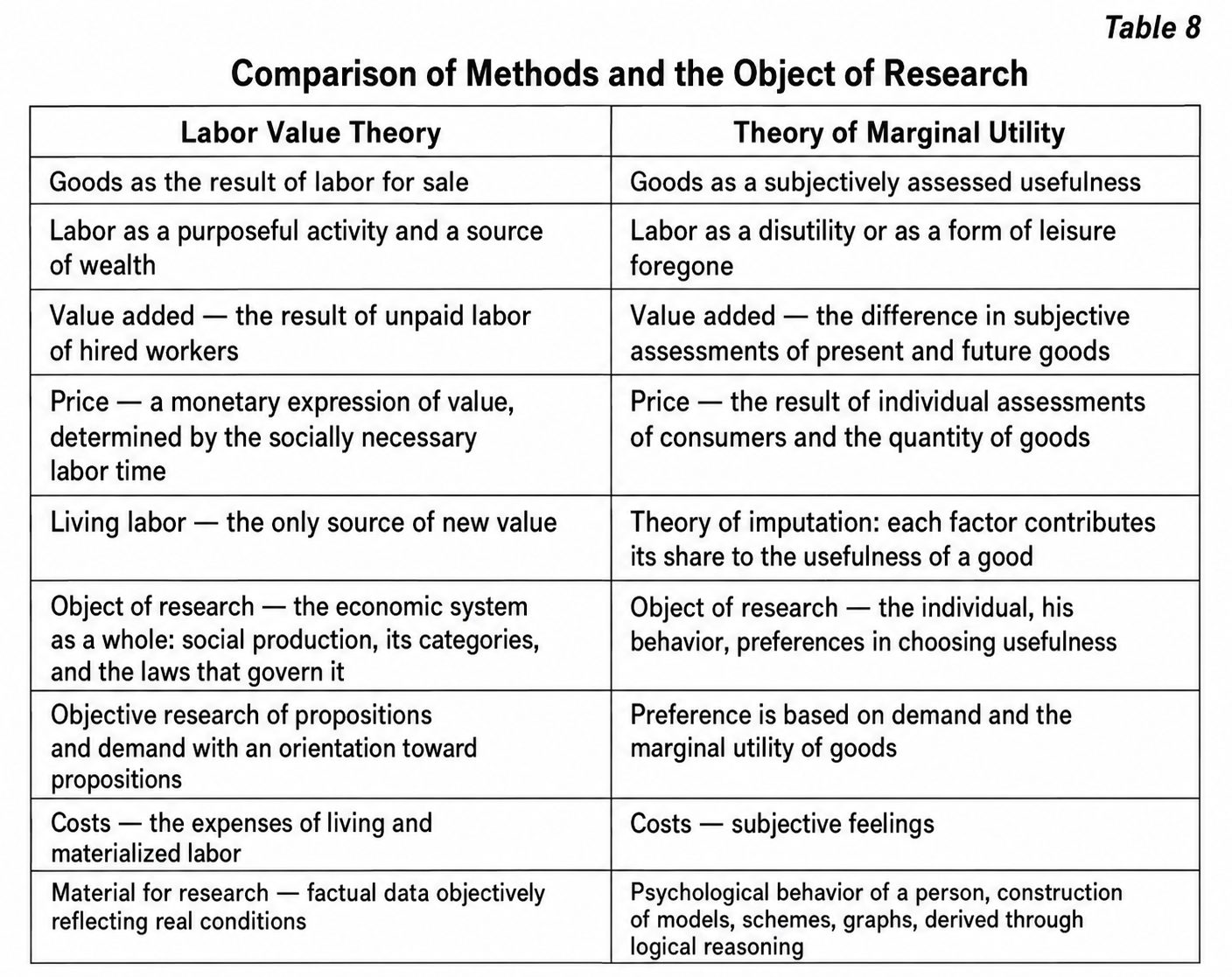
However, from the perspective of economists who developed the theory of marginal utility, “arguments about the equivalence and non-equivalence of exchange make no sense at all, since the value of both goods acts, as already said, from the point of view of a subjective-evaluative category. Ricardo’s theory was more convenient in this respect: it allowed not only to reason about a certain objective substance of value — for example, labor inputs, but also to measure them with a fully understandable yardstick — hours of labor time”2. Therefore, for arguments about the equivalence and non-equivalence of exchange, to evaluate the fairness of remuneration for labor, a different theory was required.
What is the labor theory of value
The labor theory of value (LTV) developed over many centuries. There is evidence that Aristotle3, Thomas Aquinas4, Ibn Khaldun5, William Petty6, John Locke7 theorized about it. For a long time, the LTV remained in an embryonic state; the authors agreed that labor definitely lies at the basis of the value of a commodity, and the more labor is invested in its creation, the higher its value. Adam Smith agreed with such conclusions, but believed that they lost their relevance in the capitalist era. Smith believed that if labor were the sole source of value, the capitalist would never be able to make a profit. David Ricardo disputes Smith’s assertion by pointing out that Smith does not distinguish between wages for labor, and labor itself. Ricardo believed that profit is achieved through savings on wages8. Note that David Ricardo was the first to suggest that the boundaries of market prices are determined by the value of labor, meaning by the latter not wages, but the amount of labor.

Karl Marx, introducing the concept of surplus value, relies significantly on Ricardo’s conclusions, essentially giving outlined forms to the latter’s reflections. Surplus value in Marx’s theory is nothing other than the unpaid labor of the worker: in his opinion, it is precisely what lies at the basis of the capitalist’s profit. Marx’s logic is as follows: if all capitalists had the privileged right to set a certain percentage above the cost of production, then in exchanging goods among themselves they would simply exchange production costs without making any profit. Which means that precisely in the process of producing a commodity, and not during sale, a certain value must be created that will serve as the source of profit. Considering the capital structure of an individual enterprise as an example, Marx concludes that the means of production cannot create this value, as they simply transfer their value to the product, whereas the labor of workers can. Marx agrees with Ricardo that the value created by a worker in production is higher than the value at which the capitalist evaluated his labor, and he calls the difference between them surplus value. Marx also agrees with Ricardo that value regulates the market price of a product, while noting that although the price may deviate from value, over a long period these deviations generally cancel out and commodities are sold at their values.
According to the definition of the Merriam-Webster dictionary, the labor theory of value is a theory that the value of a product is regulated by the quantity of labor necessary to produce it9. The Investopedia portal gives the following definition: an early attempt by economists to explain why goods exchanged for certain relative prices on the market, which suggested that the value of a commodity was determined and could be measured objectively by the average number of labor hours necessary to produce it10. According to the definition of Oxford Reference, it is a theory in Marxian economics that the value of goods and services is determined by the amount of direct and indirect labor time required for their production11. It is extremely difficult to find a definition among Marxists, who in principle do not particularly like to formulate definitions. On the whole, however, we see that the labor theory of value is a theory according to which the value of products is determined by the amount of labor invested in their production.
Marx identifies three ways to increase surplus value. The first way is extending the length of the working day, the second way is increasing the intensity of labor, the third way is reducing the time necessary to produce consumer goods for the working class12. The first two are fairly obvious and from them is formed absolute surplus-value, which is produced by prolongation of the working-day or by increasing the intensity of labor, whereas the third is of particular interest. Let us focus on it in more detail. Making assumptions about the nature of the value of goods, Marx comes to the conclusion that in the cycle of producing a final commodity at each stage, labor directed at creating value is spent on the commodity, and that the magnitude of value is determined by the amount of labor time socially necessary for its production, meaning by this “that labor-time which is required to produce an article under the normal conditions of production, with the average degree of skill and intensity prevalent at the time”13. From which he concludes — the higher the productivity of labor, the less time is needed to produce a commodity and the smaller its value. Consequently, if labor productivity at enterprises producing mass consumption goods is significantly increased, their value can be reduced, and therefore the value of the labor of all workers. Let us consider a specific example for clarity.

Suppose the working day is 8 hours, and a worker needs only 4 hours to create the value necessary to purchase consumer goods; in Marxist terminology, these 4 hours are called necessary labor time. It is this value that, according to Marx, is paid by the capitalist and constitutes the worker’s wages, while the remaining 4 hours the worker spends creating value that will be at the disposal of the capitalist; in turn, this time in Marxist terminology is called surplus labor time. It turns out that if mass consumption goods are made cheaper, the worker will need less than 4 hours to create the value necessary to purchase consumer goods, and the capitalist will be able to receive a larger surplus value, and, consequently, a larger profit. The surplus value considered in this example in Marxist literature received the name relative surplus-value14. Thus, relative surplus-value is surplus value produced by shortening the necessary labor time and altering the ratio between the magnitude of necessary and surplus labor time.
To calculate the magnitude of surplus value, Marx considers the organic composition of capital; he divides capital into constant and variable. Constant capital is the part of capital that constitutes the means of production (raw material, auxiliary materials, and instruments of labor), which does not alter its value in the process of production. Variable capital is labor power, which alters its value in the process of production. The magnitude of the change in variable capital is surplus value. The ratio of surplus value to the magnitude of advanced variable capital (in other words, expenditure on workers’ wages), as well as the ratio of surplus labor time to necessary time, as well as the ratio of unpaid labor to paid labor, is the rate of surplus-value, which, in turn, is an expression of the degree of exploitation of labor.
In addition to the rate of surplus-value, Marx introduces the concept of the rate of profit, defined by him as the ratio of surplus value to the magnitude of total capital (constant and variable). Let us consider the connection between the rate of surplus-value and the rate of profit using a specific example. Suppose there are two enterprises with different organic compositions and equal amounts of capital.
Capital of the first enterprise: 80c + 20v
Capital of the second enterprise: 90c + 10v
c – constant capital;
v – variable capital.
Suppose that the degree of labor exploitation (rate of surplus-value) at the enterprises is equal. Let the working day be equal to 8 hours and let workers spend half of the working day satisfying their material needs (this time is paid by the capitalist in the form of wages), and the remaining half day on the capitalist — directly forming surplus value. In that case, the rate of surplus-value is calculated using the following formula:
Rate of surplus-value = (surplus labor time / necessary labor time) * 100% = (4 / 4) * 100% = 100%
This means that in the process of production, variable capital doubles, increasing by the amount of surplus value. And the second half of this capital comes at the disposal of the capitalist. Let us calculate the rates of profit for the two enterprises:
Rate of profit = (surplus value / constant capital + variable capital) * 100%
1st enterprise:
Rate of profit = (20 / 100) * 100% = 20%
2nd enterprise:
Rate of profit = (10 / 100) * 100% = 10%
Thus, Marx discovered a clear connection between the organic composition of capital (the ratio of constant and variable capital) and the rate of profit. It turns out that with an equal rate of surplus-value, the smaller the portion of variable capital in total capital, the smaller the surplus value and, accordingly, the lower the rate of profit. This connection can also be reformulated as follows: capitals of equal magnitude, but of different organic composition, yield different profits. However, empirical observations showed that capitals of equal magnitude in different branches of industry yielded equal average profit. And Marx was aware of this:
We have thus shown that in different branches of industry different rates of profit obtain, corresponding to the differences in the organic composition of capitals, and, within certain limits, to their different periods of turnover; that therefore, even with the same rate of surplus-value, the law holds good (as a general tendency) only for capitals of the same organic composition, assuming equal periods of turnover, that profits are proportional to the magnitudes of the capitals, and that equal capitals in equal periods of time yield equal profits. The argument rests on the basis which has hitherto been the basis of our whole research — that commodities are sold at their values. On the other hand, there is no doubt that, in reality, apart from unessential, accidental, and mutually compensating differences, differences in the average rate of profit do not exist between different branches of industry, and could not exist without destroying the whole system of capitalist production. It would seem, therefore, that the theory of value is incompatible with the actual process, incompatible with the real phenomena of production, and that for this reason we must give up the attempt to understand the latter15.
That is, Marx saw this contradiction, but considered it only apparent (with which, however, a number of his critics disagreed, in particular, Böhm-Bawerk). Moving from the level of individual enterprises to the level of economic sectors, Marx concludes that the level of enterprise profit on average should be the same. He arrives at this conclusion based on the logic according to which, in a competitive market, capitals seek to occupy niches that provide maximum profit, but over time the market reaches a balanced state and the level of profit equalizes across all sectors. Marx cements this new conclusion in the form of the concept of the general average rate of profit. Marx obtains the value of the average rate of profit by considering all enterprises as a single whole, summing the constant and variable capitals of all enterprises, and calculating the average values of constant and variable capitals, which, in turn, allows him to calculate the value of the average rate of profit.
Let us again consider a specific case, returning to the example with two enterprises.
Total capital of two enterprises = (80c + 20v) + (90c + 10v) = 170c + 30v
Average capital of two enterprises = 85c + 15v
Average rate of profit = (15 / 100) * 100% = 15%
In order to substantiate the equality of profit for capitals equal in magnitude, Marx introduces the concept of the price of production. The price of production is defined by him as the sum of the cost of production and average profit. Marx claims that it is precisely the prices of production that determine the prices of goods. That is, Marx believes that commodities can be sold above and below their value, determined by the invested labor of workers, and the coincidence of the value of a commodity with its price of production is merely accidental, ensured by the coincidence of the organic composition of an enterprise’s capital with the average organic composition of all enterprises.
Returning to the example with two enterprises, we arrive at the following conclusions:
- The 1st enterprise, possessing a larger variable capital (20v), will sell its goods below value, because the enterprise’s rate of profit = 20%, while the selling price will be determined by the average rate of profit = 15%;
- The 2nd enterprise, possessing a smaller variable capital (10v), will sell its goods above value, because the enterprise’s rate of profit = 10%, while the selling price will be determined by the average rate of profit = 15%;
- The selling price will coincide with value if, with the same amount of capital, its variable part equals the variable part of the average capital of enterprises (15v).
Having put forward the theory of prices of production in Volume 3, Marx nevertheless does not abandon his proposed law of value from Volume 1. Marx claims that “rates of profit are originally very different” and that their equalization into a general rate of profit “is the result and cannot be the point of departure”. This thesis of Marx assumes that there exists a certain past state in which the “conversion of values into prices of production”, which in turn leads to the equalization of rates of profit, was not yet observed, meaning that in this state only the law of value operates — goods are sold at their values.

Böhm-Bawerk made an attempt to establish such a state logically16, defining, according to Marx, the prerequisites for the equalization of rates of profit — the existing dominance of the capitalist mode of production and competition as a factor exerting a leveling action. He proposed considering a situation in which two workers themselves own the means of production and exchange goods with each other — in this case, the goods are not products of capital. Suppose the first worker has technically more complex equipment for production, and therefore more expensive, while the second worker has the simplest, and hence cheaper, equipment, with the workers working on average the same amount of time. Suppose the workers produce the means of production for themselves. Since the means of production of the 1st worker are more complex, let us suppose that their production requires 5 working years, and let the processing of the necessary raw materials by the means of production into finished products be carried out by the worker in the 6th year. In this case, the 1st worker will receive remuneration for their labor only upon completion of 6 years. At the same time, the 2nd worker can produce the necessary means of production and the finished product in a month, and consequently receive their remuneration precisely after the expiration of one month.
Marx’s hypothesis assumes that the prices of goods of the 1st and 2nd types are set exactly in proportion to the quantities of labor expended on them, so the product of six years of labor of the 1st type is sold for exactly as much as the sum of the products of six years of labor of the 2nd type is sold for. From which it follows that in the branch of production of the 1st type, the worker is satisfied with the very same sum as the 2nd worker for all 6 years of work, but with a postponement of 6 years. Böhm-Bawerk notes the implausibility of the equality of remunerations of the 1st and 2nd worker, since a long-term delay in payment requires compensation, not to mention that hardly all producers could agree to wait for remuneration for several years. Böhm-Bawerk draws a logical conclusion — different branches of production are not equally accessible to all producers. Branches requiring the least preliminary expenditure of means of production are accessible to all; branches of production with a high requirement for capital are accessible to a narrower number of workers. And this circumstance must lead to a situation where supply in branches with a high requirement for capital will be limited. As a result, the prices of their products will exceed the level of those branches of production that do not require expensive and complex means of production.
Shortcomings of the LTV
As already noted, the strongest shortcoming of the LTV is the contradiction into which Volumes 1 and 3 of “Capital” enter with each other, namely — the contradiction between the theory of value and the theory of the average rate of profit and prices of production. Neither Marx nor his followers were able to explain this contradiction logically, while critics of “Capital”, such as Böhm-Bawerk17, thoroughly dissected Marx’s arguments with which he attempted to “cover up” the contradiction, and came to the conclusion that the two theories are mutually incompatible, and consequently, Marx’s emphasis on the correctness of the theory of the average rate of profit leaves no possibility of using the theory of value to calculate the values of goods, which calls into question the practical applicability of the LTV for price formation.
It should be noted that the LTV does not possess a well-formalized methodology for calculating surplus value, which is why attempts to apply it to measure the exploitation of workers lead to rather contradictory results. Let us consider the results of Marxists’ calculations using the example of a relatively recent analysis in one of the prominent American Marxist media outlets. There, Marxists evaluated the level of exploitation in such a major company as Apple. The article was published in 2019 on the Socialist Economist website under the title “A Marxist Analysis of the iPhone”18. As an example, the authors took the production of the iPhone X. It was calculated that with a market price of the iPhone at $1000, equipment expenses in the production of one device amounted to $370.89 (that is, constant capital C), expenses on employee wages — $24.55 (variable capital V). Surplus value (S), that is, the unpaid labor of workers, amounted to $603.5:
S = T — (C + V) = $999 – ($370.89 + $24.55) = $603.56
S — surplus value;
T — market price;
C — constant capital;
V — variable capital.

Here it is necessary to make a reservation right away that, generally speaking, the latter calculation was made by the authors in an extremely crude manner, because, according to Marxist theory, price can differ from value (we will say more about this below), and $999 is nothing other than the price of the final product put up for sale. Using the formula S / V, the degree of exploitation S / V = 24.6 was obtained, that is, as a percentage, it turned out that the unpaid labor of workers exceeded the paid labor by 2458%.
An incredible figure. Exceeding, according to the authors, by 25 times the degree of exploitation of textile workers in Marx’s time. In other words, the conclusion is proposed that the position of workers in the 21st century in a major corporation complying with the labor code is much worse than the position of the virtually disenfranchised proletariat in the middle of the 19th century (information on this topic is given in Friedrich Engels’s book “The Condition of the Working Class in England”), which did not know what an 8-hour working day was and in whose time child labor was an absolute norm and was even more in demand due to its low cost. Another conclusion made by the authors is that Apple workers earn their wages in a negligibly small time compared to their full working day. In other words, they would have to receive their average wages of $4,500 in a matter of minutes of their labor, while all the rest of the working day they simply “gifted” to the capitalist in the form of surplus value. Thus, we can say that the Marxist methodology for measuring the exploitation of workers shows an extremely poor dynamic in the position of workers; according to it, it turns out that the position of the working class has worsened many times over compared to Marx’s time, whereas in reality there has been a significant improvement in both working conditions and the material position of workers over the last 150 years.
It must be said that the LTV is inclined to accuse entrepreneurs and capitalists of appropriating surplus value (“capital appropriates ‘other people’s’ science, just as it appropriates other people’s labor”19, “I shall use the word profit for the whole amount of the Surplus value extracted by the Capitalist”20). Based on the example we provided with the calculation of the level of exploitation at Apple, let us analyze this thesis and try to evaluate how true it is. Thus, capitalists are those who own the means of production. In the modern world with joint-stock companies, capitalists no longer own the means of production directly; however, they can control and even manage it — simply by holding company shares. Capitalists receive income from stock dividends, that is, a kind of reward for purchasing/holding company shares. Apple has issued 4 billion shares. At the same time, the total amount of dividends per year per share is $3.0421 (it is worth noting that these are nearly record-high dividend payouts per year compared to the previous years of 2014-2018). Thus, capitalists withdraw $12.16 billion a year from the enterprise for their expenses. Is that a lot? In absolute terms, it might seem so. However, Apple’s net income in 2019 was $55.26 billion22. It is worth noting that under the crude calculation made by Marxists, it is precisely this profit of $55.26 billion that is considered surplus value, the unpaid labor of workers. However, we see that the capitalists’ share in such surplus value is only 22%. What happens to the remaining 78%? It is set aside as a reserve for the company’s future expenditures on research and development (R&D) and employee salaries.


Here some Marxists might object — after all, according to Marx, the worker advances their time to the capitalist, that is, works for free for a whole month, creating value from the very first day, and receives payment for labor only at the end. However, the point is that in the 21st century, the production of complex goods differs fundamentally from the production of pins in the 19th century. The manufacturing cycle of smartphones lasts a year or more. During which the employer must pay for the labor of workers from the very beginning of the chain — from conducting scientific research, design, and prototyping to the direct assembly of finished components. And despite the fact that the value of labor is added at each stage, the sale of its results will occur only at the very end, so in fact, in modern large corporations, wages are advanced to the worker, rather than the worker’s time to the employer. And, as is easy to understand, the surplus value produced by workers in one year is simply transferred in the form of advanced wages to the next, plus a reserve is formed in case of production disruptions, missed deadlines, recalls of already manufactured products due to identified defects, and for expenses on implementing innovations.
The LTV in its established form reduces the labor of an entrepreneur to a combination of managerial functions — searching for the best suppliers, selecting personnel, pricing policy in accordance with market analysis, searching for a buyer for the product, and so on, which ordinary hired managers could perform at the same level. Thus, followers of the theory believe that the capitalist’s remuneration should not exceed the salary of a manager or several managers whose work he performs. Marx himself generally believed that an entrepreneur should receive as much as a worker:
Of course, in order that the capitalist may function as a capitalist, he too must be present, hence he too must live and consume. But to do this, he actually needs to consume only as much as a worker — and therefore this form of the circulation process assumes no more23.
However, in such a case, factors such as initiative, ideas, taking on risks, and the absence of income guarantees are not taken into account. Unlike hired managers, an entrepreneur cannot treat their business as merely a workplace. A manager can perform the required minimum of work simply to avoid being fired. For an entrepreneur, such an option is impossible — the entrepreneur assumes all financial risks and must devote themselves fully to their business if they do not want to be left with nothing or even fall into a debt pit; an entrepreneur’s income, unlike a manager’s salary, is also not guaranteed by the labor code. Thus, the work of an entrepreneur is more than just a set of managerial functions; it is also a combination of qualities that are quite rare and largely relate to psychology, which must certainly be rewarded. There are cases when an entrepreneur invested, for example, a million rubles in creating a business, and the business brought a loss of 700 thousand rubles, because only 300 thousand were returned to him. How in this case does he exploit his workers? The LTV provides no answer. And this is not its only drawback.
For example, says Marx, the labor of a wage-worker in a piano factory is productive labor, while the labor of the same worker invited by a piano owner for a set fee to tune the instrument is unproductive (vol. 26, part I, p. 142).
Such a distinction introduced considerable confusion into economic theory. Indeed: if, say, artists give a concert at their own risk and receive all the proceeds themselves, then their labor service is unproductive, but if on the same stage they perform by agreement with an impresario who gets some “profit” from the concert, then their labor instantly transforms into productive labor. In the first case, they sell living labor; in the second, their labor power. In all these constructions of Marx, explicit artificiality is evident24.
Another shortcoming of the LTV is that a good into which a minimal amount of labor has been invested can turn out to be very valuable on the market and can be exchanged for the monetary equivalent of a good into which a huge amount of labor has been invested (for example, a randomly found diamond can be sold for an amount equal to the cost of a high-tech Mercedes E-Class). Non-labor factors can also influence the price — in Böhm-Bawerk’s famous example, a bottle of wine simply standing in a cellar grows in value. These discrepancies were formulated during the development of the theory of marginal utility, to which Marxists respond with the thesis that price and value are different terms, essentially inventing their own definition that contradicts dictionaries (we already know that this technique is applied by them not only here). The theory of marginal utility indeed gives us an understanding of how market prices are formed. However, it in no way gives us the opportunity to evaluate the fairness of labor remuneration. It serves a completely different purpose, which is why we immediately outlined the importance of the goal.
However, the LTV also cannot answer the question of how much money an entrepreneur underpays or overpays a worker. To calculate this, we need a modernized LTV that takes into account all the above-mentioned gaps, accounting for, perhaps, thousands of factors and full information on expenses/income, where expenses alone might look something like this:
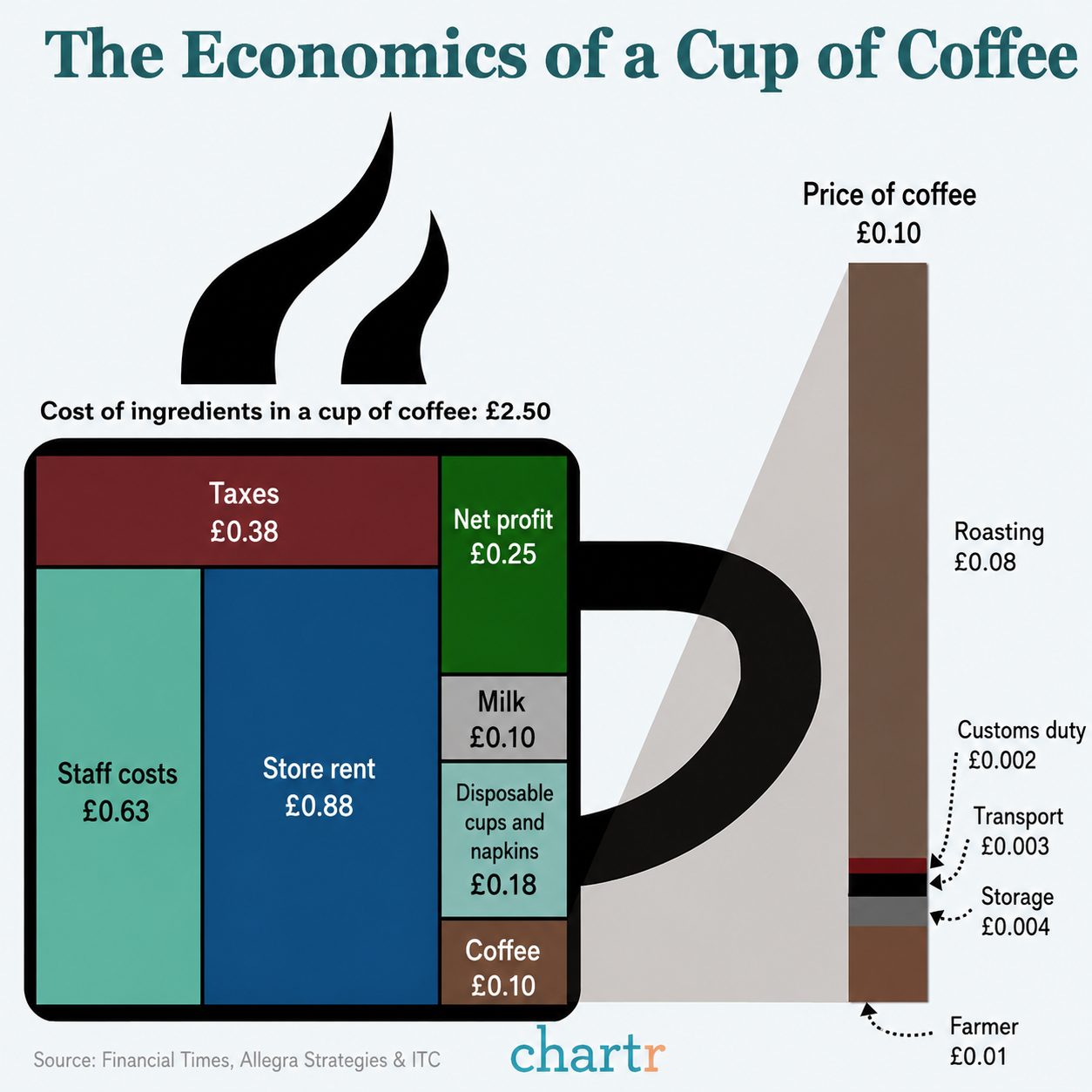
And here is a somewhat different assessment, much less competent, based on which it is not difficult to conclude that the entrepreneur underpays their workers.
Theoretically, it is quite possible to calculate all these data, but these would be time-consuming and cumbersome calculations. However, even then we will not be able to evaluate the value of intellectual labor — the labor of an entrepreneur and the labor of, for example, designers or engineers. After all, it is obvious that, for example, the work of Giorgetto Giugiaro will be much more in demand, and therefore will be better paid than the work of an ordinary designer from Vologda or Bari. It is also obvious that Bill Gates’s labor is much more valuable than the labor of some entrepreneur who cannot make a profit. But this can only be understood through their market demand as personnel and the products created with their participation. For these reasons, the price of a product is usually determined primarily by the market — it is simply easier and more accurate. Demand determines and adjusts the price on the market.
Such regulators as the market and demand also exist to determine the fairness of labor remuneration — these are the trade union and political struggle of workers. If workers fight for higher wages and better working conditions, as well as elect governments that tax entrepreneurs more, it means they believe they are underpaid and have a demand for a higher level of social justice. If workers elect governments that reduce taxes on wealthy citizens and do not engage in trade union struggle, it means they believe there is no issue with pay. There is one clarification here — this is relevant only for democratic states. In authoritarian states, workers do not strike or form trade unions, but this is not because they are satisfied with everything, but because their attempts at organization are suppressed, and their rights to express their position are not guaranteed. Therefore, for this regulator to work, workers must fight for the establishment of a democratic regime.
We do not claim that in all cases when workers strike, it is an indicator of exploitation and unfair pay. After all, it is obvious that if workers make a mistake and demand such wages for themselves that cause the enterprise to operate at a loss, they will soon lose the enterprise, their jobs, and their wages. The demands of workers must be adequate to reality and allow the enterprise to have funds for investment in development, as well as paying for the labor of other people who increase the efficiency of the enterprise (suppliers, entrepreneur, advertisers, and so on — provided that they do their job efficiently). The adequacy of demands is sometimes revealed in the course of interaction with the employer, and sometimes empirically.
Four types of value
Everyone who has had discussions on this topic with Marxists knows that they try to cultivate the concept of value and price as completely different terms. Thereby, they introduce terminological confusion and a divergence from dictionaries that treat value and price as synonyms. Even the Soviet Ozhegov dictionary provides the following as one of the meanings of the word “value” [стоимость]: “monetary expression of the value of a thing, price”25. Let us bring clarity to this question.
A product/service can have four main types of value — expected cost price, final cost price, expected selling price, and final selling price (that is, what should be called exchange value, since establishing a real rather than fictional exchange value is possible only upon the completion of an exchange; here we also do not mention their subtypes, such as average final selling price). The labor theory of value is suitable for calculating the cost price and the expected selling price, but not for establishing the final selling price. Because both types of cost price and the expected selling price are calculated based on the invested labor. The methodology for calculating the final selling price is completely different and depends not only on the amount of invested labor, but also on the demand for the product in the market. If a product or service is not in demand, this devalues the labor invested in them. Unclaimed labor is not socially useful. And the responsibility for this lies with its organizer.
The expected selling price, in essence, is what Marxists call value, and the final selling price is the classic price.
Workers have the right to hold an entrepreneur accountable in the event of a disproportionate discrepancy between the four types of value of the goods and services they produce. For example, if the final selling price is lower than the final cost price, this means that the enterprise’s strategy is unprofitable and carries threats of job and time loss for all participants in the enterprise. On the other hand, if the final selling price is significantly higher than the final cost price, this means the possibility of disproportionate profit appropriation by the entrepreneur, and an opportunity for workers to demand greater participation in profits.
Summary
It would be incorrect to say that the labor theory of value is meaningless, but using it is acceptable only taking into account other research and the modern situation. Overall, we can say that today the labor theory of value can be relevant for performing both the task of assessing the fairness of labor remuneration and for calculating the cost/price of a product or service in the market, but only subject to the following conditions:
- When using it, one must recognize that value is created not only by workers, but also by entrepreneurs;
- The theory must take into account that value can come not only from labor, but also from circumstances (for example, a randomly found expensive resource, or a quickly ceased minting of a coin that made this coin rare and valuable);
- It must recognize the role of subjective regulators — the market and the struggle of workers. If a product is not in demand in the market, its value decreases; if workers do not fight in any way for an increase in their wages, then their amount also decreases;
- It should be taken into account that surplus value is not spent in full on the needs of the capitalist, and a significant part of it is directed to the development of technologies, or to other expenses. Only the part of surplus value spent on the overconsumption of the capitalist can be used in calculating the degree of exploitation of workers;
- The theory must recognize the contribution of intellectual labor, rather than taking scientific discoveries and engineering breakthroughs for granted — ideas carry a huge charge of development, often thousands of times exceeding the cost of remuneration to scientists and researchers;
- It must recognize the existence of surplus value as a natural phenomenon underlying progress — it is natural for a human to give more than to receive. The accumulation of knowledge, skills, capitals is the basis for the development process;
- We should abandon the representation of the concepts of “value” [cost] and “price” as different. There are four types of value, but when using the term “value” [cost], we understand by it the same as by the term “price”. To refer to the other three types, specification should be used, clarifying which form of value is being discussed.
Such a modernized LTV should stimulate workers to engage in trade union and political struggle, which ultimately will positively affect their pay.
This, of course, will complicate vulgar generalizations that would allow recognizing any form of cooperation between workers and employers as exploitation, even if the latter go into a loss in the process, or if the cooperation is mutually beneficial. Does this mean that unfair appropriation does not exist? No, in individual cases we can talk about the presence of such appropriation, namely, firstly, in cases where the growth of consumption (personal or group, as with the nomenklatura in the USSR) of employers exceeds the growth of consumption of their workers. Note that not in cases of profit growth. Because profit can be used for investment in the development of production, which ultimately, with successful implementation of these investments, will have a positive effect on all participants in production. Secondly, one can speak of exploitation in cases where investments in the development of production are not effective due to the employer’s mistakes. For example, if the latter believes that production efficiency will increase due to the installation of golden Orthodox crosses at the facility — this is an absolutely ineffective expenditure of joint funds with workers, committed due to personal stereotypes of the manager. It thereby deprives workers of funds and an increase in production efficiency, which ultimately can be equated to exploitation.
The fate of the world is in the hands of the working class and largely depends on its knowledge and consciousness. Workers are obliged to control their employers through trade unions and foreign employers through workers’ (usually social-democratic) parties in parliament. This control must be constant. It would be a mistake to succumb to the deception of utopian populists promising a system where workers can relax and control no one, without conducting a social struggle. What happens in these cases we have seen on the example of the USSR, when instead of a relaxed utopia, a dictatorship of the nomenklatura was obtained.
- G. D. Gloveli. Marginal utility theory // Big Russian Encyclopedia. Vol. 27. Moscow, 2015, p. 402
- Y. Shishkov. Marx without a halo // Nauka i Zhizn (www.nkj.ru). 1998. [Online resource]. URL: https://www.nkj.ru/archive/articles/10849/ (Accessed: 15.06.2023).
- A. MacIntyre. Whose Justice Which Rationality. Notre Dame: University of Notre Dame, 1988. p. 199.
- L. Baeck. The Mediterranean tradition in economic thought. New York: Routledge, 1994. p. 151.
- I. M. Oweiss. “Ibn Khaldun, the Father of Economics”. Arab Civilization: Challenges and Responses, 1988.
- Vernon L. Parrington. Main Currents in American Thought, 1620-1800. Vol. I. Book Two, Part One, Chapter III. Benjamin Franklin: Our First Ambassador. 1927.
- J. Locke. Works: In 3 vols. — M.: Mysl, 1988.
- D. Ricardo. On The Principles of Political Economy and Taxation, 1817.
- Labor theory of value // Merriam-Webster (www.merriam-webster.com). [Online resource]. URL: https://www.merriam-webster.com/dictionary/labor%20theory%20of%20value (Accessed: 15.06.2023).
- The Investopedia Team. Labor Theory of Value // Investopedia (www.investopedia.com). [Online resource]. URL: https://www.investopedia.com/terms/l/labor-theory-of-value.asp (Accessed: 15.06.2023).
- Labor theory of value // Oxford Reference (www.oxfordreference.com). [Online resource]. URL: https://www.oxfordreference.com/display/10.1093/oi/authority.20110803100046490 (Accessed: 15.06.2023).
- Karl Marx, Capital, Vol. 1, Part 4, Ch. 10, p. 115
- Karl Marx, Capital, Vol. 1, Part 1, Ch. 1, p. 25
- A. V. Buzgalin, A. I. Kolganov, O. V. Barashkova. Classical Political Economy, Ch. 9., p. 167
- K. Marx. Capital. A Critique of Political Economy. Volume III. Part II. Chapter VIII. Different Compositions of Capitals in Different Branches of Industry and Resultant Differences in Rates of Profit.
- E. v. Böhm-Bawerk. Karl Marx and the Close of His System. – London: T. Fisher Unwin, 1898. – p. 48-64.
- E. v. Böhm-Bawerk. Karl Marx and the Close of His System. – London: T. Fisher Unwin, 1898.
- E. Ahmet Tonak. A Marxist Analysis of the iPhone // Socialist Economist (www.socialisteconomist.com). September 29, 2019. [Online resource]. URL: http://www.socialisteconomist.com/2019/09/a-marxist-analysis-of-iphone.html (Accessed: 15.06.2023).
- K. Marx. Capital. A Critique of Political Economy. Volume I. Book I: The Process of Production of Capital. Part IV, Chapter XV, Section 5.
- K. Marx and F. Engels. Works. Second Edition. Volume 16. — p. 141. / Karl Marx. Value, Price and Profit, 1865.
- Dividend History // Investor Relations – Apple (investor.apple.com). [Online resource]. URL: https://investor.apple.com/dividend-history/default.aspx (Accessed: 15.06.2023).
- Apple Financial Performance // TAdviser (www.tadviser.ru). October 29, 2021. [Online resource]. URL: https://www.tadviser.ru/index.php/Статья:Финансовые_показатели_Apple (Accessed: 15.06.2023).
- K. Marx. Capital. A Critique of Political Economy. Volume II. Book II: The Process of Circulation of Capital. Part I, Chapter I, Section III.
- Y. Shishkov. Marx without a halo // Nauka i Zhizn (www.nkj.ru). 1998. [Online resource]. URL: https://www.nkj.ru/archive/articles/10849/ (Accessed: 15.06.2023).
- S. I. Ozhegov, N. Y. Shvedova. Explanatory Dictionary of the Russian Language: 80,000 words and phraseological expressions / Russian Academy of Sciences. V. V. Vinogradov Institute of the Russian Language. — 4th ed., expanded. — 944 p. — Moscow: A TEMP LLC, 2006. — p. 768.