
“Robbery of the Third World”
In order to dissuade citizens from the need to follow the proven path of developed and successful countries like Sweden, Switzerland, and Germany (we mean specifically the path that the FRG took after 1945), conservatives and the nomenclature of Third World countries use quite a few propaganda theses and excuses, because in the event of repeating this path they would have to work, and specifically they could lose their power and the preferences it provides. But the most popular of these is the thesis that the wealth of developed countries is based on the "robbery" of poor countries. Is this proposition true? Let us figure it out.
Ivan, a peasant, envies his neighbor Boris because Boris has a goat. A fairy comes to Ivan and offers to fulfill one wish. What does he wish for? "I want Boris's goat to die".
On June 20, 2022, Russian dictator Vladimir Putin stated about the so-called countries of the “golden billion”: “Yes, of course, this ‘golden billion’ did not become golden by chance. It achieved a great deal. But it did not only occupy its positions thanks to some implemented ideas, to a large extent it occupied its positions due to the robbery of other peoples — both in Asia and in Africa”1. Echoing Putin are various kinds of statists like Tsargrad, which declares a “Russia-led uprising of countries striving for sovereignty against the suffocating hegemony of the West, which wants to continue robbing the rest of the world through neocolonial methods”2. Even before them, various Marxists and Marxist-oriented commentators claimed similar things: for example, the neomarxist Immanuel Wallerstein claimed that “the wealth of the North is to a very large degree the result of the transfer of surplus product from the South”3.
Most often, such statements are presented without evidence, but in other cases the evidence usually boils down to the following list (feel free to add to this list in the comments):
- “Offshoring of production”;
- “Kropotkin’s axiom” or a zero-sum game;
- Presence of foreign capital in the country;
- The logic of surplus value;
- Philosophical works of proponents of world-systems analysis like Wallerstein;
- The “So you are a racist” technique;
- Appeals to the colonial past;
- Policies of the IMF and the World Bank.
It can be said that together they constitute the “evidence base” of dependency theory, that is, the theory that “periphery” states grow poorer as a result of their resources and capital draining into rich countries of the “core”. We will expand on what these arguments are in more detail. Let us examine why using many of these stereotypes or sets of them, which circulate widely in society, as proof is unacceptable, and later we will refute the main thesis itself.
Contents
- “Offshoring of production”
- “Kropotkin’s axiom”
- Presence of foreign capital
- Logic of surplus value
- Wallerstein and company
- “So you are a racist”
- “Colonial past”
- CFA franc
- IMF and World Bank
- What makes the theory wrong as a whole?
- What are the true causes of the wealth of nations?
- Whose interests does the theory express?
- Conclusion
“Offshoring of production”
According to this thesis, “Europe and the US produce nothing / almost nothing”, “all production has been moved to the Third World” (in support, the speaker’s Chinese T-shirts / sneakers may be cited, with the speaker failing to consider that he sees Chinese T-shirts because he buys precisely such products or products in that price range), so, accordingly, others produce everything for them, and their wealth can only be based on robbing other countries.
This thesis is based on a falsification. According to actual figures, developed countries produce more goods per capita than developing ones. They export a lot — thus, with a population of 10 million people, Sweden ranked 31st in the world in exports of products in 2018, while Egypt, with a population of nearly one hundred million, ranked only 68th4. Taken together, Sweden, Norway, and Denmark (with a combined population of around 22 million people) exported more than India, whose population is 1.35 billion people. Not to mention Germany, which is one of the world leaders in goods manufacturing. In Deloitte’s Global Manufacturing Competitiveness Index, Sweden ranks 13th in the world, Finland ranks 24th, and Germany ranks 3rd5. If we take total manufacturing figures according to World Bank data, then Sweden, Norway, Denmark, and Finland combined (around 28 million people) produce more than Brazil with its population of 209 million6.

Claims sound strange that workers at Volvo, Nokia, IKEA, LEGO, and other high-tech and popular industries are richer because they rob African farmers or Vietnamese weavers, and not because their labor is more highly skilled and the organization of labor in their countries is at a much higher level. The top 5 world leaders in agricultural exports as of 2007 were the US, Netherlands, Germany, France, and Canada7, despite the fact that in the US the agricultural sector accounts for less than one percent of GDP8. That is, even in agricultural production, developed countries surpass Third World countries. They simply have more accumulated knowledge and a more advanced organization of labor.
The example of the Netherlands must be shocking to proponents of dependency theory. After all, a country ranking 131st in the world by area, which moreover is poorly suited for growing crops, is the second largest exporter of them in the world. National Geographic describes the example of farmer Jacob van den Borne, who harvests more than 20 tons of potatoes per hectare compared to the global average of 9 tons9. Wageningen University is considered the world leader in agricultural research. In the Netherlands, they use an alternative soil substrate that guarantees the destruction of any fungus (which could destroy the crop)10, create floating farms, autonomous tractors, scanning drones, reduce water usage by 90%, develop new animal feeding methods11, and so forth. But according to proponents of the “robbery” theory, developed countries are wealthy not because of such innovations in economic organization, but because they rob camel traders. If you acknowledge that the Netherlands is rich in food due to the high level of development of its agriculture, and not because it takes tomatoes away from South Africa, then why are you unwilling to acknowledge that this country is richer overall for similar reasons?
Financial Times analyzed the issue using the example of the UK auto industry, showing that in 2017 the share of British components was 44%, with the rest mostly coming from EU countries12 (using data from the UK Automotive Council). As Francisco Riberas from Gestamp noted, for many parts, especially large ones, it is unprofitable to produce them far from the assembly site due to high logistics costs. In this study, one can read where various parts are manufactured, and this completely contradicts the stereotype of “a Europe that produces nothing”.
Until the 1980s, China and many other developing countries produced extremely few goods, while the standard of living in developed countries was growing — we showed this, for example, in our article about social democratic parties around the world. This is an additional argument showing that the wealth of developed countries does not depend on the industry of Third World countries and “offshoring of production”.
Thus, we see that the thesis that “Europe produces nothing”, and that all or most of production has been moved to Third World countries, is a falsification. Developed countries produce a great deal, and significantly higher per capita than Third World countries. This largely explains their higher level of wealth.
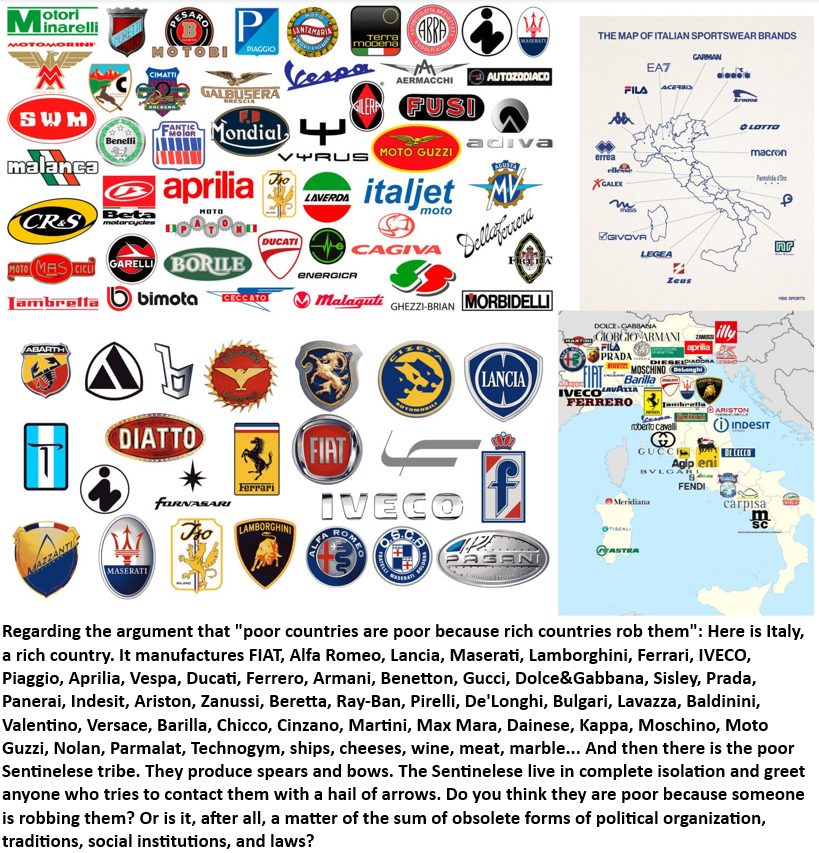
Some may say that a portion of the goods previously produced in Europe are now produced in other countries by subsidiaries of European companies and imported into Europe. And Europeans who used to make T-shirts no longer make them (although this is untrue — they still do, just in smaller quantities), meaning that production has been offshored. Let us respond to this objection. First, T-shirts are sewn in Europe. It is enough to visit Europe, especially places like Prato, to see this for oneself. Second, in some cases, instead of sewing T-shirts, Europeans generally transition to higher-skilled labor, meaning they continue to work and produce goods and services (for example, computer programs or mobile applications that increase the efficiency of manufacturing goods and providing services, or creating automated manufacturing). That is, Europe has not started producing less; only the structure of produced goods and services has changed.
Third, this sewing of T-shirts is generally higher-skilled labor for the countries where these factories open. Compared to agriculture, the textile industry has historically been considered a step forward13 and a factor in raising prosperity. Therefore, such “offshoring of production”, on the contrary, increases the prosperity of Third World countries, and in no way means that Europe has begun producing less. However, we will touch upon this further below.
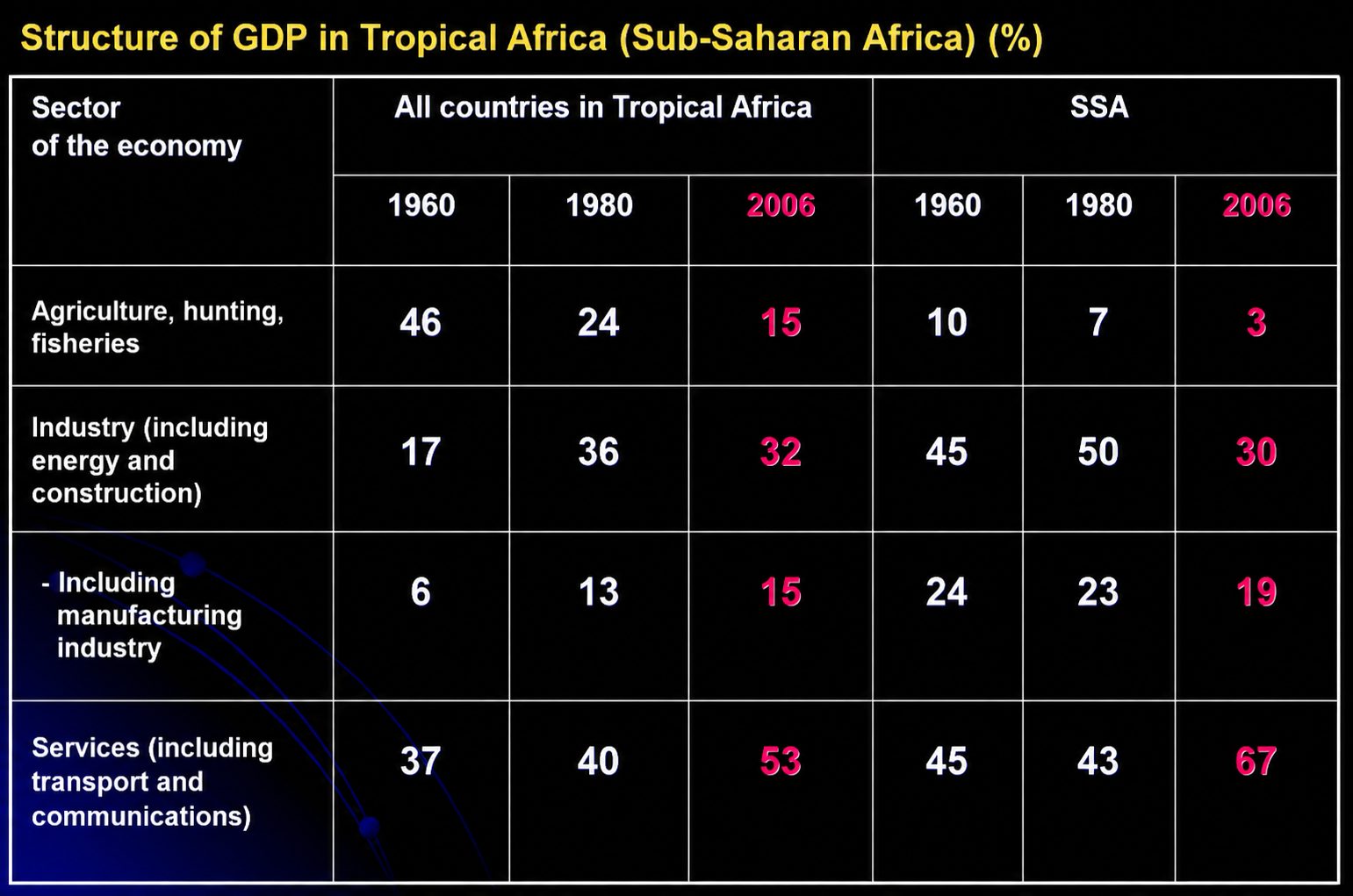
Sometimes, as proof of “offshoring of production”, statistics are cited showing how the share of industrial production in a developed country’s GDP has declined, implying that this country produces nothing and robs everyone. This is called interpreting facts to suit one’s interests — in the late 20th century, goods production began to decline and give way to the service sector globally, including in developing countries. For example, even in Sub-Saharan Africa, the share of industry in GDP fell from 50% in 1980 to 30% in 2006, while the share of services grew from 43% to 67% over the same period14. Does this mean Sub-Saharan Africa is robbing everyone? No, in fact, the decline of the industrial sector in the global economy is as much an objective economic process as the widespread decline of the agricultural sector was in its time. Nobody went hungry in developed countries when agriculture came to account for only 1-2% of their GDP.
“Kropotkin’s axiom”
Is the homeless person under my window still not poor enough for me to be rich?
In his work “The Conquest of Bread”, anarchist theorist Prince Peter Kropotkin expressed the following idea: “the riches of the few are derived from the poverty of the many”15. The prince cited no sources in support, considering lengthy reasoning with appeals to “common sense” in the style of “a moment’s thought is enough to see” or “What was the baron doing to enrich himself? He looked for peasants, poor people”. The idea proved popular, especially among people with a semi-criminal mindset who cannot accept that it is possible to earn money through skill, or that it is possible to create, say, wooden furniture by cutting down a tree in a forest and processing it. After all, accepting such a thought means that increasing prosperity can also be achieved through labor, and a lazy individual or an individual with a semi-criminal mindset does not want this — it is more convenient for them to believe that wealth is achieved only through robbery, as this implies no obligation to work for this individual and gives them excuses not to work. Thus, for example, communist Konstantin Syomin likes to claim: “for someone to have a full stomach, someone else’s stomach must be empty, someone must be robbed”16. And from this it follows that since Europeans have a “full stomach”, this alone is proof that they robbed someone, because according to “Kropotkin’s axiom” there is no wealth not based on someone else’s poverty.
Why is “Kropotkin’s axiom” nonsense? First, because wealth can be based on a country simply producing more, as we demonstrated in the previous section. That is, this already refutes “Kropotkin’s axiom”. Second, for “someone to have a full stomach”, as Syomin put it, one can engage in gathering, hunting, or cultivating agricultural crops. And for this, one does not need to rob other people, nor does someone else need to have an empty stomach. That is, Syomin’s claim is a hoax.
It is amusing that Europe was more developed than many other parts of the world even before contacting them — before the discovery of the Americas, before establishing direct links with India, and so forth. How could it exploit them before even knowing of their existence? It is simpler to admit that development is not tied to “exploitation” than to answer this question.
Let us model a situation in which two groups of people — let us call them social democrats (who do not share the theory of neocolonialism) and communists (who share this theory) — end up on two uninhabited islands. The first group knows that wealth is created by many factors, the most important of which is the proper organization of labor. This group begins to create labor tools, build huts on the shore, build boats, create hunting and fishing gear, a bath with drainage for bathing, cookware for preparing and storing food, and so forth. The second group knows that prosperity can only be achieved through robbery, so they steal collected berries from one another. The first group is significantly richer than the second. According to “Kropotkin’s axiom”, it turns out that this is because it robs the second group. However, this is absolute nonsense, since in this case the group of social democrats is richer than the group of communists thanks to the proper organization of labor and knowledge of its proper application. And these groups do not contact each other at all, in any way.
If we accept “Kropotkin’s axiom”, this means that we deny the possibility of a cooperative and cooperative economy becoming rich “ethically” (from the standpoint of Marxism). After all, without robbery, they will not be able to get rich. Which is an admission of the impossibility of ethically building both a cooperative and a socialist economy. And, in fact, a wealthy society in principle. So for anarchists and communists, it should be a blessing that “Kropotkin’s axiom” is wrong.
Presence of foreign capital
Syomin must be eating food away from poor African children, otherwise what does he live on, since he produces nothing
Often, the thesis about “robbery” is proved merely by the presence of foreign brands in a country or the share of foreign capital in local enterprises. A typical example: a person walks through a city and sees McDonald’s fast-food restaurants, concluding from this: that means all the profits from them go to the US!
Such a conclusion stems from a lack of basic knowledge about the principles of doing business. For example, McDonald’s, like many other brands, is a business based on a franchise system. This model means that there is a franchisor (in this case, McDonald’s Corporation), which sells a franchise to individuals willing to invest in opening a business using its model — they are called “franchisees”17. As a rule, these are local businessmen or simply individuals who have the appropriate capital (in the case of Russia, these might be, for example, former nomenklatura officials). These individuals invest their money into creating a business under the franchise, and, accordingly, they receive the profits from it. The corporation itself receives only an upfront lump-sum fee and a monthly royalty payment for using the franchise. Only these amounts “go to the US”.
Moreover, these amounts are paid not just like that, “for nothing” — the franchisee uses an already proven business model provided by the franchisor, which helps them save money that they could have lost by learning from their own mistakes. The franchisee uses a well-established brand, which saves on advertising costs. Often, the franchisor also provides staff training and offers other forms of useful assistance. That is, the cooperation turns out to be mutually beneficial for both the franchisee and the franchisor, so talking about some kind of “robbery” here would be incorrect — in exchange for money, a service is provided, sometimes a very highly qualified one.
Foreign capital investments in themselves are also not proof of “robbery”. Simply because if foreign capital invests in a country that relies on agriculture and builds a plant that produces cars, a successful enterprise can thereby be created that will provide people with jobs, and after the investments pay off, workers will be able to demand higher wages, receiving more than those employed in agriculture (the exact reasons why industry brings in more money than agriculture or resource extraction can be read in detail in the works of economist Erik Reinert18). Due to the synergy effect, wages of citizens employed in other sectors will also rise. The country will become more developed, and this is precisely not “robbery”, but the opposite. For this reason, many economists speak of the importance of attracting investment into the country. Communist leaders themselves understood this, too: Vladimir Lenin, who cursed capitalists for “imperialism”, spoke somewhat differently after coming to power.
Thus, Lenin himself was ready for frankly disadvantageous terms with receiving a mere 2% royalty share, just to open production, providing people with jobs, goods, and the opportunity for enterprises to effectively influence the economy in the future. Thereby admitting that foreign capital does not make a state poorer, but on the contrary, makes it richer even under such unfavorable conditions, and therefore there can be no talk of any “robbery” here.
Chinese communists during Deng Xiaoping’s era also decided to abandon populist slogans about the “harm of foreign capital” and, after the famine during Mao Zedong’s rule, decided to attract foreign investment in the 1980s. Preferential taxes, import licensing, preferential tariffs were established, and it was permitted to create not only joint ventures with minority and majority ownership, but also wholly foreign-owned enterprises19. The volume of foreign investment in China’s economy grew to $10.2 billion by 1988, and to $105.7 billion by 2010. What was the outcome? Loss of sovereignty by China and enslavement by foreign corporations, impoverishment of citizens due to siphoning of funds? The outcome was the exact opposite. Domestic industries began to rise in China, citizens became significantly more prosperous compared to the period of Mao Zedong, and cities became more developed.

Opponents of foreign capital also fail to take into account taxes, salaries, the share of local shareholders, or many other factors that allow money to remain in the country. In Australia, the volumes of foreign capital are very high, and a 1983 Soviet guidebook reported that in 1970 the share of British capital accounted for 47% of foreign investment, North American accounted for 39%, and in the early 1980s North American capital accounted for up to 70% of foreign investment. From this, the guidebook drew the following conclusion:
“Transnational corporations shamelessly loot Australia’s treasures and enrich themselves by exploiting its people20“.
Despite this “exploitation” and “shameless looting”, Australia is a country with one of the highest standards of living in the world (you can see this by checking its rank across the indicators we listed in this article), which completely shatters the arguments of dependency theory proponents.
It is also usually ignored that businessmen from Third World countries can easily own enterprises in developed countries. For instance, Chinese investors own or at various times have owned Volvo, the Inter Milan and AC Milan football clubs, and so forth — their capital is very widely represented in Europe21. Does this mean that capital is being siphoned from Europe to China? Partially it goes in both directions, but its scale is far too tiny to noticeably affect the economy as a whole. What is more, many states control foreign investment very successfully, including through rules requiring a local investment partner, as Ha-Joon Chang notes:
Many of today’s rich countries, especially countries like Japan, Korea, Taiwan and Finland, strictly regulated FDI until their own companies built up the capacity to compete in the world market. For example, if the Japanese government had opened up its car industry to FDI in the late 1950s, as it was strongly advised to do after the failure of Toyota’s first exports to the US [18], local car-making would have been wiped out or swallowed up by American or European TNCs, given the state of the industry at the time. (In 1955, General Motors alone produced 3.5m cars, while the whole Japanese car industry produced only 70,000.)
<…>
Many governments have put regulations on which sectors FDI can go into. They have also demanded that TNCs have a local investment partner (the so-called joint venture requirement) and devised rules on how much of a joint venture can be owned by the foreign investor. In most sectors, foreign companies were not allowed to own the majority of a company. Many governments made it a condition of investment that TNCs transfer technology to local joint-venture partners (the technology transfer requirement) or train local workers (the local content requirement) [19].
Having put such regulations in place, Japan, Korea, Taiwan and China have been particularly successful — allowing, and even welcoming, FDI in certain areas, but maintaining strict regulations so as to ensure that benefits are maximized and costs minimized22.
Logic of surplus value
The spread of Marxist ideology has led many people to consider any profit generation and any entrepreneurship as robbery. Even if the entrepreneur reinvests all profit or operates at a loss. This analogy is incorrect, as we demonstrated in our article on the labor theory of value. By no means can one speak of unfair labor remuneration in all cases — such a claim can be made exclusively in cases where the entrepreneur keeps amounts that do not correspond to the level of their qualifications as an organizer of production.
In the exact same way, one cannot always speak of unequal exchange. Proponents of dependency theory sometimes cite resource-rich DR Congo, which is one of the poorest countries, as an example of unequal exchange. It is usually claimed that this country is extremely rich in resources yet very poor, meaning it is being robbed by developed countries. However, they completely overlook, first, the fact that the lion’s share of a product’s value is most often created not by the resource itself, but by its processing. That is why DR Congo should not be richer than industrial countries if it merely sells raw materials without manufacturing goods from them. Second, authors of such claims do not allow for the possibility that the poverty of ordinary citizens in that country might be primarily linked to the appropriation of most income from resource sales by local elites (above all, local authoritarian regimes). Instead of holding these elites accountable, blame is placed on those who buy resources at their market price (when you go to a store and choose cheaper pasta, it does not mean you are robbing pasta manufacturers; shifting all responsibility onto the buyer is not the best practice). This logic is flawed; it serves only to justify local elites, though we will certainly return to this point later.

Marxists themselves define neocolonialism as the transfer of surplus value through trade23, meaning that one party is the seller and the other is the buyer. A seller usually strives to sell for more, while a buyer usually strives to buy for less — this is a normal situation. We can be 100% sure that anyone who disagrees with this does not pay more for goods in a store than their listed price. And that is correct. The buyer is not to blame if the product offered by the seller is not worth more than the buyer is willing to pay. The seller is to blame for their own low income, just as the elites of Third World countries are to blame for failing to organize industry in their countries in a way that produces goods highly valued in the market.
Wallerstein and company
Some proponents of dependency theory refer their opponents to the works of authors from the world-systems analysis school as proof. Perhaps the most famous of them is Immanuel Wallerstein (references are also made to Samir Amin, Andre Gunder Frank, and several other authors). Let us examine some of his assertions as an example. We shall start with the statement cited above that “the wealth of the North is in very large part the result of the transfer of surplus product from the South”24, which Wallerstein makes in his book “After Liberalism”. How is this statement substantiated? Are any examples or data provided? None. The author writes: “it is this fact that over several centuries has led us to the crisis of the system”, meaning that this “fact” would seem to be the foundation for the premise of his book, requiring solid substantiation. Yet Wallerstein provides no proof whatsoever for this “fact”, mentioning it as if its existence were self-evident and indisputable. He offers many beautifully constructed phrases such as “it is not a matter of charity fixing injustices, but of rational restructuring”, pleasing to the eye of those who wish to feel like intellectuals while reading, but omits the most important thing — the data.
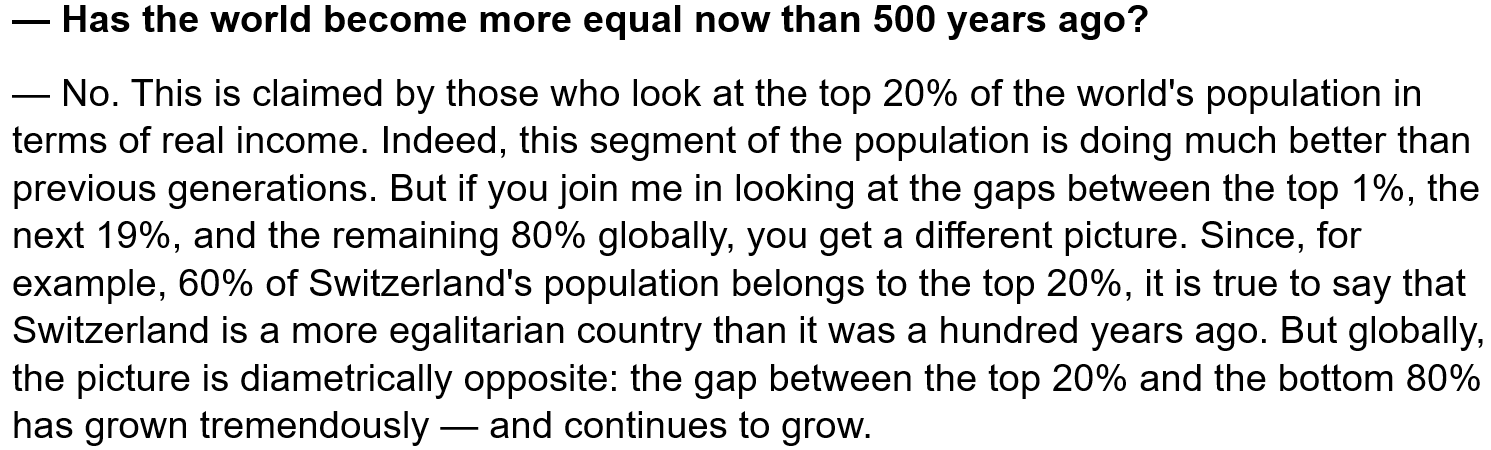
The book “After Liberalism” contains quite a few questionable expressions such as “Leninist ideology was a fig leaf for Wilsonian ideology”25 (given the radical differences in the policies of Vladimir Lenin and Woodrow Wilson, this sounds wild), “Marxism-Leninism as a reformist strategy died”26 (so it turns out it was reformism!). Wallerstein claims: “All the enthusiastic shouts about the triumph of democracy around the world in 1989 will not long obscure the absence of any serious prospect for economic transformation on the periphery of the capitalist world-economy”27. Is the professor unaware of the rapid growth of the “Asian Tigers”, or the gradual growth of countries like Uruguay and New Zealand? Supposing that by that time he could not have known about Lula’s success in Brazil or Slovenia’s successful path, there is still a large number of examples he could not have failed to know about. In the presence of these examples, talking about the “absence of prospects” is simply unprofessional. Not to mention that the professor provides no examples of such “shouts”, leading one to think that he simply invented a straw man. Indeed, it is interesting to know who was talking about the “triumph of democracy around the world” when countries like China, Iran, and Cuba still remained. Such opinions may have been expressed, and even then they bore no relation to reality, but clearly not for the reasons Wallerstein writes about.
Using an analysis of this level, Wallerstein concludes: “what will happen to the rest of the Third World? There won’t be much good there”. One does not need exceptional analytical skills to suggest that many poor countries will remain poor in the coming years. But what solutions does the guru of world-systems analysis offer to poor countries? The path of Uruguay, the path of Japan? No. The professor offers an “Ithna-Ashari type option” and a “Saddam Hussein option” (as well as an “option of individual resistance via physical relocation”)28. “Economic changes require the use of military force”29, he writes. An astonishing narrowness of thinking for a man who claims to know economics! Wallerstein is so confident that Saddam Hussein’s actions were not a mistake that he practically repeats the exact same claim about it twice:
So why did Saddam Hussein embark on this path [the invasion of Kuwait]? I don’t believe that he miscalculated. I think he calculated well. He was gambling for high stakes30.
How was Saddam Hussein to estimate his risks and therefore his chances of success? I do not think he miscalculated31.
Dmitry Travin, Candidate of Sciences in Economics, notes: “Peripheral countries today suddenly find themselves at the center of development, and this fits poorly both with world-systems analysis and with dependency theory, to which Wallerstein also once paid tribute. According to Wallerstein… the core exploits the periphery. But precisely during the decades that the world has been reading books dedicated to world-systems analysis, China and many other countries have leaped forward dramatically”32.
World-systems analysis divides countries mostly into “core” and “periphery” (some are categorized by them as “semi-periphery”). Which countries are the “core”, and which are the “periphery”? Finding clear criteria is extremely difficult in both Wallerstein and the other founder of world-systems analysis, Fernand Braudel; different representatives of the school have different lists of countries that should be categorized as core, periphery, and semi-periphery. This means that where to assign a particular country depends on the personal opinion of Wallerstein or another world-system analyst. If Wallerstein needs it to be — the country will be core, if he doesn’t — periphery. This alone says a lot about the degree of scientific rigor of world-systems analysis. Compare this with a scientific classification — for example, to classify a country as a full democracy, an assessment of its compliance with more than 60 different indicators is required33.

Perhaps Wallerstein is simply a bad example of a representative of the world-systems analysis school, and others can offer far more useful research? The reality is quite the opposite. Wallerstein and Braudel are the most intellectual representatives of this movement, which is easy to see by reading the works of, for example, Samir Amin. And if you reach the utterances of representatives like Andrei Fursov, they will amaze you even more.
Opening Samir Amin’s book “The Liberal Virus”, one can assess from the very first pages the degree of impartiality of this researcher, who calls those adhering to liberal ideology “schizophrenics” (“the virus caused a curious schizophrenia in its victims”), the ideology itself a “disease”, economics a “pseudoscience that is more akin to wizardry”, and promises a future Holocaust for all humanity if it does not follow his advice. Amin invents straw men from the very first pages:
Obviously, the most ‘advanced’ country, in which politics is entirely at the service of the economy — clearly the United States — is presented to ‘everyone’ as the best model34.
While many, including in the US itself, consider the Nordic model to be the best (examples include Daron Acemoglu35, Bernie Sanders36). However, Amin is still diplomatic compared to Izborsk Club member and world-system analyst Andrei Fursov, who asserts: “what Hitler failed to do, the Anglo-Saxons are trying to achieve today”37. In the same interview, Fursov called Klaus Schwab’s work “The Fourth Industrial Revolution” a document scarier than “Mein Kampf”, claimed that the Russian army is fighting “against the Ukronazi regime created by the Post-West as a bridgehead and simultaneously a battering ram against Russia”, and also declared that the overseas masters of Ukrainians “as a maximum program are planning the final solution to the Russian question, and the means of solution is no longer liberalism, but neo-Nazism seasoned with neo-paganism and Satanism”. Fursov is certain: “the situation is like in 1941, only then there was Hitler, the Third Reich, and the Nazis, while today it is the heirs of Hitler, the Globorreich, and a hybrid of Nazism and Trotskyism”. As the reader has already noticed, Fursov can safely be recommended to fans of comedy shows.
Overall, it can be noted that the school of world-systems analysis is mostly a collection of anti-American publicists and propagandists (which benefits the nomenclature of authoritarian countries, as this theory serves its interests). The only author in the WSA school who significantly surpasses Wallerstein, and therefore all its other representatives, is its founder Fernand Braudel. However, what is amusing here is that Braudel’s views provide us with material against dependency theory. Thus, in the work “Civilization and Capitalism, 15th-18th Century” (Volume 3, “The Perspective of the World”), Braudel acknowledges that at the end of the 14th century there was only one center of the world-system — Venice (chapter “A world-economy centered on Venice”38). Today, almost all of Europe is the center, as well as other countries — the USA, Canada, Japan, South Korea, Australia, Israel, and so forth. It turns out that the center expands with every century, and therefore, it is not a matter of division into core and periphery, but simply a matter of the level of development. All countries in the world can achieve the degree of development corresponding to the “core”, and there is no zero-sum game here.
“So you are a racist”
Sometimes from proponents of the “robbery” theory one can hear expressions roughly to the following effect: “so Third World nations are themselves to blame for being poor? So you are a racist!” This is a substitution of concepts, because most often no claim is made that any nations or races are incapable of being rich. The best proof of this is the example of the DPRK and South Korea, where the exact same people live in completely different conditions and under completely different levels of prosperity. Therefore, the claim about immutable properties of nations or races is usually invented on behalf of an opponent by a clever demagogue counting on the opponent taking the bait and defending a thesis attributed to them. In reality, the blame lies primarily with incompetent local governments, incompetent economic and intellectual elites. The blame lies with the policies they conduct and support, the lack of knowledge about normal progressive policy that gradually leads countries out of poverty. The spread of ideas like dependency theory contributes to preserving this lack of knowledge.
For the exact same reason, the grievances of dependency theory proponents are also groundless when they lose their composure and allow themselves expressions like: “in Bangladesh children sew Nikes in hellish conditions, in the Congo children die in the mines, and you say there is no robbery!” These cases are connected primarily with the absence of normal labor legislation in these countries, meaning the responsibility lies once again with local governments and elites, not with developed countries. Corporations from developed countries generally act in accordance with local laws. Yes, they do nothing to solve local problems, but that is not their area of competence, but the competence of local governments and opposition. So that children do not sew Nikes in Bangladesh under hellish conditions, the local government must ban child labor and ensure both the enforcement of this ban and the ability of parents to support their children. Why should third parties solve these problems and foster paternalism and a lack of desire to fight for one’s rights in Bangladesh?
However, foreign companies sometimes fight to improve welfare and protect the rights of citizens in the countries where they operate, even though nothing obligates them to do so. An example is William Browder, founder and CEO of the investment fund Hermitage Capital Management, who engages in combating corruption and crimes of Russian officials and is the main prosecutor of Sergei Magnitsky’s murderers39. In addition, developed countries try to develop the Fair Trade movement, which encourages citizens to buy goods only from companies that provide decent working conditions for their employees. But they cannot force all companies to establish better conditions — they simply lack the power to do so.
We have already mentioned the existence of examples like South Korea or Uruguay for Third World countries, which show that poor countries can become more successful and developed. How do proponents of dependency theory explain their success? By prudent political and economic development? Not at all. Arguments are brought forward that South Korea, Japan, Germany, and Italy were provided assistance by the USA. However, firstly, these arguments actually refute the myth about the “robbery” of Third World countries, since it turns out that the democratic USA was pouring money in rather than pumping it out. Secondly, if we speak of South Korea, most of the aid was provided to it during the period from 1953 to 196040, and economic growth rates at that time were low41. The low efficiency of the regime at the time did not allow for effective development. South Korea would make its breakthrough in the 1980s.
If we talk about the “Marshall Plan”, today it will be very amusing to remember that previously government-aligned propagandists who promoted the “robbery” theory claimed that it was through this program that the USA carried out the plunder of the countries receiving aid. On December 18, 1948, German communist Wilhelm Pieck stated at a meeting with Joseph Stalin: “The Marshall Plan means the robbery of Germany”42. Propagandist M.V. Lavrichenko wrote in 1950: “the American war machine with the help of the ‘Marshall Plan’ pumps strategic materials out of the Marshallized countries and their colonies, creating stockpiles designated for military purposes”43. The title of the first chapter of his book read: “The Marshall Plan — a plan for the political and economic enslavement of Western Europe by American imperialism”. It was claimed that “right-wing socialists… plunged their countries into bondage to US monopoly capital”, that this plan “was doomed to failure from the very start”, that “it was not aid, but direct robbery by American monopolies of the peoples of Marshallized countries of Western Europe”, after which the latter “were left penniless”. Hardly today, when the positive role of the Marshall Plan in post-war European recovery is virtually universally recognized, can all these incantations evoke anything other than laughter. Likely in the same way will the writings of representatives of the world-systems analysis school, lamenting the expansion of capital into African countries, be read from the future.
It is advantageous for state propaganda to attribute the success of developed countries to neocolonialism rather than to the competence of their governments. For if it turns out that the reason for success lies in competent policy, this puts its own government and its own elites at risk, as they will be accused of incompetence. The “robbery” theory simultaneously provides an explanation for poverty that shields elites from criticism and stirs up hatred toward an external enemy, which strengthens the cohesion of the oppressed masses with the elites, making it an ideal propaganda tool.
“Colonial past”
Sometimes one also hears that developed countries are rich because they robbed colonies in the past. During that time, supposedly, they accumulated wealth and capital. This argument is also nonsense, as it does not explain what kind of colonial empire was possessed by one of Europe’s wealthiest countries — Switzerland. It is unclear what colonies were possessed by another wealthy country — Finland. And one can hardly explain Denmark’s wealth by the “robbery” of Greenland. One wonders who the Danes were robbing in that case, unless they were taking fish from polar bears. On the other hand, the two countries that extracted huge amounts of gold from the New World and, perhaps, engaged in plunder more than all others from this perspective — Spain and Portugal — had become some of the poorest countries by European standards by the beginning of the 20th century (Portugal in 1892 even declared bankruptcy44 and even today remains the poorest country in Western Europe). As we can see, historical experience shows by no means that colonial countries grew rich — there is no direct correlation between wealth and the extraction of resources from colonies.
It should also be mentioned that even before subjugating colonies, European states were more developed than the countries they so easily subjugated.
Moreover — many developed countries are themselves former colonies. These are the USA, Canada, Australia, New Zealand, South Korea, Singapore. To these one could conditionally add Finland, which was part of the Russian Empire with the status of a province, or Ireland, which was under British control. Today, the average Finn is significantly wealthier than the average Russian, and Ireland leads the UK in the Human Development Index. We can go even further. Britain itself was a colony of Rome in the past, and the Netherlands was a colony of Spain. As we can see, being colonies did not prevent these countries from prospering, while the fact of possessing such colonies did not help Rome and Spain very much. All of the above makes the claim that “developed countries are rich because they robbed colonies in the past” completely contradictory to reality.
Countries such as Ethiopia and Liberia were never colonies. Iran, Mongolia, Thailand, Turkey — they also have no colonial past behind them. However, despite this, they do not stand out with remarkable economic success compared to their neighbors (China prior to Deng Xiaoping’s reforms also belonged here). From this follows the conclusion that a colonial past in itself does not affect the standard of living and development in a country. Every country is capable of building its own prosperity, and then it will not have to complain about “robbery”.
CFA franc
Another popular thesis goes roughly as follows: France continues to rob Africa because many African countries use the CFA franc as their currency. This thesis is also untenable, since African countries can opt out of using the CFA franc, as Guinea, Madagascar, and Djibouti did45. In 2020, France and African countries generally agreed on a gradual phase-out of the CFA franc46. It will be gradually replaced by the new ECO currency47. France was blamed for maintaining some control over the CFA franc to ensure its convertibility. However, the harm of such control is far from obvious — for instance, in Zimbabwe, where there was no currency control by France and where the Zimbabwean dollar circulated, hyperinflation in mid-November 2008 reached 79.6 billion percent48, causing the local currency to collapse altogether and temporarily cease to be used (being replaced by the more stable US dollar), while unemployment in the country reached 94%49. But “fighters against colonialism” will blame this not on the policies of dictator Mugabe and his government, but on the USA, whose currency helped the country not to be left without a monetary system entirely.

IMF and World Bank
We also encounter the viewpoint that, even if developed countries do not rob poor ones, they still hinder their development because the IMF and the World Bank, dependent on developed countries, provide developing nations with loans on favorable terms but demand in return the implementation of specific economic measures50 that have shown their ineffectiveness (as was admitted even by former World Bank chief economist Joseph Stiglitz51). Erik Reinert, whom we have already mentioned, thinks the same way: “the economic situation in poor countries worsened when the UN handed over responsibility for global development to the World Bank and the IMF”52. Indeed, there is a grain of truth in these claims, as Reinert demonstrated in his research.

At the same time, the blame lies, of course, primarily not with the IMF and the World Bank, but with the governments of developing countries that take loans, and under such conditions at that. Secondly, the lending terms of these structures are generally more favorable than market terms. Developing countries have the option to take loans from other entities, but the IMF and the World Bank provide them on more advantageous terms53 (in addition to sometimes forgiving54 and restructuring debts). Finally, thirdly, these two structures have already begun to abandon the practices recommended by the “Washington Consensus”: for instance, the World Bank report “Economic Growth in the 1990s: Learning from a Decade of Reform” acknowledged that in many cases these recommendations fell short of expectations55, and in April 2011, Dominique Strauss-Kahn, head of the IMF, declared the collapse of the “Washington Consensus” and stated that its fundamental principles proved to be unviable and even dangerous56. As of today, the editorial team of “Logika Progressa” possesses no evidence that compliance with these recommendations is still required.
What makes the theory wrong as a whole?
Commercial: Residents of Villabajo have a poor dishwashing detergent, so the celebration in Villarriba continues, while in Villabajo they are still washing dishes.
Communists: The residents of Villarriba are simply robbing the residents of Villabajo.
First and foremost, the theory is rendered incorrect by the lack of evidence. After all, to prove that the prosperity of developed countries is based on the plunder of poor countries, one must, first of all, calculate the profit (specifically the net profit, after tax payments) of enterprises in Third World countries owned by First World companies. Subtract the portion of profit that goes to local partners. Then calculate the same metrics for capital originating from Third World countries — how much finance is “pumped” in the opposite direction, and subtract that too. Next, calculate what percentage of GDP the resulting amount constitutes for the state. In doing so, one must not forget to account for humanitarian aid sent by developed countries to Third World nations. That will yield the share of “robbery” in the wealth of developed democracies (and here we are even giving a handicap by assuming that any profit constitutes “robbery”, which is untrue). It might not be zero, but as a share of developed countries’ wealth, it would likely amount to less than one percent. At present, the editorial team of “Logika Progressa” is aware of no such studies; if the reader knows of any, please share, since over many years of discussion with proponents of this theory, the maximum that could be obtained was the fictional works of Immanuel Wallerstein.
Most Marxist works attempting to prove this theory are based on selective data. For instance, the resource Lenin Crew published a translation of Zak Cope’s book “Divided World Divided Class”. In it, the author writes that capitalists exploit farmers and workers in Third World countries — but where is the proof that local companies are not doing this, where are the numbers showing the foreign capital share in these economies? Instead of these genuinely crucial metrics, a pile of obscure indicators appears, often intricately multiplied together. The calculations in it are generally performed incorrectly. They are based on assumptions: “if we assume that FDI rates remained constant since then”, “assuming that non-wage price share in the OECD is 62%” (it is completely unclear where this figure was taken from). Among the assumptions underlying the calculations: “the following calculation assumes that only industrial and service workers in non-OECD countries receive wages and, moreover, at least 50% of them are fully unemployed and receive no wages at all (see tables VI and VII with global employment data)”. This data is incorrect. Table VII, which should have contained these figures, is plucked out of thin air — the source cited by the author contains only regional GDP data, with not a word about employment indicators. According to Statista.com, the highest unemployment rate in Africa in 2022 was in South Africa at 33.51%, whereas in Kenya, for instance, this indicator stood at 5.53%57. Similar data is reported by the World Bank58.
Furthermore, the authors calculate “super-exploitation profits” as follows: foreign investments in non-OECD countries are taken, an average rate of return is taken, and it turns out that all this income flows into OECD countries. That is, this data is not real, but hypothetical. To help the reader better understand what this looks like — imagine that your income as a worker was determined based on the average worker’s wage across the entire world in general. Also, the calculations of “super-exploitation” completely fail to account for at least the following:
- Charitable and humanitarian aid to Third World countries;
- Forgiven debts to Third World countries;
- Migrant remittances back home (these are substantial amounts — for India alone in 2014, migrant remittances reached 70.4 billion US dollars59);
- How much of these funds is redistributed in favor of the OECD “middle class”. Perhaps all these funds settle in the pockets of big capital. Why then speak so confidently about an impact on the living standards of “First World” workers?
And this is only a fraction of potential uncounted factors. That is, we can see that the calculations were performed using an ideological method rather than a scientific one. The author ignored the above indicators and selected assumptions convenient for himself, which indicates either his low level as a researcher, or deliberate deception of the reader, or the fact that his goal was not to conduct an objective study, but to prove his point of view. The extreme complexity of the calculations provided by him and, in some cases, the lack of connection between them (thus, the author writes that “at least 81 percent of OECD net profits are derived from imperialism”, and it is completely unclear where this figure suddenly came from) suggest that the author relies on a gullible reader who will not look deeper, figure things out, and rack their brains, but will simply decide that the author is extremely smart and believe him on that basis.
The author writes: “Imperialism enables monopolists to extract extra value embodied in natural goods from colonial and neocolonial farmers, while never paying them wages”. How should one understand this? Do farmers always work for free? But, for example, the Sustainability Initiative of South Africa reports that the minimum wage for farm workers in South Africa in 2020 was 18.68 South African Rand per hour60.
Another position of the author is also interesting: “Socialists usually assume that if a person receives a salary, they are inevitably subjected to exploitation. At the same time, if one worker can purchase the product of ten hours of labor of another worker by spending only one hour of their labor on it, then this worker receives a material benefit from the exploitation of another worker”. It turns out, dear reader, that if you ever bought a cheap product or a product made in Third World countries, you are an exploiter, a class enemy. For “anti-imperialists”, even workers have now become bourgeois and exploiters: “when workers, in alliance with imperialist political forces, seek to maintain their bourgeois status, on which their income and working conditions depend, it can be said that they actively exploit the proletariat”. Sales consultants, cashiers, and merchandisers are also written out of the proletariat: “labor employed in sectors of the economy related to the circulation and distribution of goods (not including the transportation of goods and components necessary for the production of goods) is unproductive”. Waiters, court employees — all these are wrong workers: “moreover, along with the labor of workers involved in the mechanism of social reproduction (police, judiciary, clergy, etc.), labor used for personal consumption (cooks, waiters, sales assistants, etc.) is also unproductive”. An ideology based on such claims is not just dangerous to society — it is incorrect.
A more logical calculation method would be to take gross national product (gross national product or gross national income) and subtract gross domestic product (gross domestic product) from it, since GNP differs from GDP in that the latter does not include income earned by residents of a country from investment abroad (minus income earned domestically by nonresidents)61. That is, according to the logic of proponents of the “plunder” theory, “core” countries should have a significantly higher GNP than GDP, while “periphery” countries should have a significantly lower one. Let us compare the corresponding GNI62 and GDP63 figures according to World Bank data for a number of countries.
For the USA, these figures are $23,617,113 million and $23,315,080 million respectively. The difference is about 1.3%. The figures for Germany are $4,411,027 million and $4,259,934 million. The difference is 3.5%. The case of Switzerland is the opposite — its GNI is smaller than its GDP ($797,464 million and $800,640 million respectively). The difference is about 0.4%. Finland’s figures are $302,896 million and $297,301 million. The difference is roughly 1.88%. On the other hand, Ghana’s figures are $75,637 million and $77,594 million (a 2.52% difference). Algeria’s figures are $159,457 million and $163,044 million (a 2.2% difference). For India, they stand at $3,126,862 million and $3,176,295 million (the difference is 1.57%), while Bangladesh has a higher GNI than GDP — $438,175 million versus $416,264 million (a 5.26% difference). We thus see that the GNI of rich countries is not necessarily higher than their GDP (just as the GNI of poor countries is not necessarily lower than their GDP), but these figures are rather insignificant and hover around a couple of percent. At the same time, we have not yet taken into account many factors — humanitarian aid or forgiven debts, which should equalize the difference even further.
Furthermore, developed countries send substantial financial assistance to Third World countries. In 2017 alone, the UN raised $13 billion in aid for African countries64, and in 2021 this figure reached $83 billion65. In 2019, the European Union raised 1.6 billion euros for humanitarian purposes66. However, developed countries help not only Africa — for instance, in 2000–2006, the European Union allocated 4.875 billion euros to the TACIS program, which was aimed at developing CIS countries67. As Komsomolskaya Pravda wrote, in Russia this money was squandered without launching many development projects68, after which the European Parliament shut down the assistance program. Aid is raised everywhere, down to schools — for example, economist Erik Reinert recalls:
In the autumn I was to lead a fundraising drive among Norwegian school children; we were raising money to build schools in the Andes. It happened like this: for one day, school children in Norway, Sweden, and Finland were released from classes and gathered donations. Materials for building small school buildings were then bought with these donations69.
Ha-Joon Chang also cites data pointing to a high volume of remittances specifically to developing countries:
Since the early 2000s, remittances have surged. As I mentioned, they currently stand at around $300 billion, almost three times the official foreign aid given by rich countries to developing ones (around $100 billion). In absolute terms, the biggest recipient of remittances in 2010 was India ($54 billion). It was closely followed by China ($52.3 billion). Mexico ($22.1 billion) and the Philippines ($21.4 billion) were distant third and fourth. Other developing countries with high remittances include Nigeria, Egypt, and Bangladesh. Some rich countries — France, Germany, Spain, and Belgium — also showed high remittance figures70.
We also provided examples of such assistance regarding Russia in an article on anti-Westernism. Why, then, does this money reach the citizens of the recipient countries so poorly? The reason lies in the local elites, criminal and corrupt. For example, Egypt, as economists Daron Acemoglu and James Robinson note, is poor precisely because it was ruled by a narrow elite that organized the economy in such a way as to enrich itself at the expense of the rest of the population. Political power in the country was concentrated in one set of hands and used to enrich the ruling elite — for instance, President Mubarak himself, whose fortune was estimated at $70 billion71. Another example is Sierra Leone’s Prime Minister Siaka Stevens, who came to power in 1968 and nationalized the diamond mines and the business of the De Beers company72. As a result, income from diamond mining began flowing to Stevens himself and his associate Jamil Mohammed, who managed the National Diamond Mining (Sierra Leone) Ltd company through the government73. Former President of the aforementioned DR Congo, Mobutu Sese Seko, possessed a fortune of $5 billion, owned a 16th-century castle in Spain, a 32-room palace in Switzerland, residences in Paris and on the French Riviera, as well as in many other countries74 (in 1973–1974, he carried out the nationalization of many Western firms75). All this money is not invested in the economy (it goes toward creating a system of personal luxury and privilege) and, accordingly, does not multiply. We observe approximately the same in Russia. The only colonists and occupiers of Third World countries are their own governments and elites.
On the whole, we can see that imbalances in the international movement of financial flows are present, but there are no grounds to believe that they amount to substantial figures, and, consequently, we cannot assert that some countries are rich at the expense of plundering others. The flaw of this theory has also been proven in practice. After all, not a single state governed by “fighters against US hegemony”, anti-globalists, opponents of integration into the global economy and foreign investment, has become successful.
What are the true causes of the wealth of nations?
Practice shows that many people truly do not understand how it is possible to become richer without plundering anyone. How do countries create wealth in that case? We have already examined this question in articles on why some countries are rich and others poor and on how to achieve economic growth. If a state pursues a policy that aligns with at least one of these articles, it will become richer. If a state implements these measures half-heartedly, making gross mistakes, it will grow rich slowly. If a state implements catastrophic practices — a planned economy, mass nationalization, authoritarianism — in most cases it is only a matter of time before it becomes poorer.
The most famous studies on the causes of the wealth of nations by authoritative experts — the work by Daron Acemoglu and James Robinson, “Why Nations Fail: The Origins of Power, Prosperity, and Poverty”, as well as the work by Erik Reinert, “How Rich Countries Got Rich… and Why Poor Countries Stay Poor” — state that the wealth of nations is linked to the policies pursued by the state, rather than the plunder of others. There are very many factors — the structure of the judicial system, the structure of the political system, the laws being passed, investments in the scientific sector, and so on. However, studying and accounting for them is much more difficult than explaining everything by “plunder”.
Whose interests does the theory express?
What conclusions for citizens of poor countries logically follow from the theory that developed countries are rich due to the plunder of poor ones? It logically follows from it that one must fight developed countries (in some cases up to their destruction), that foreign capital must be expelled, that economic ties with developed countries must be reduced. Will the working class win from this? The working class will lose from this. It will lose jobs, access to advanced goods, will lose in wages due to the general decline of the economy, and, possibly, will become cannon fodder in showdowns over the “revision of the world order”.
Will poor countries become rich in the event that developed countries disappear? They may cease to be relatively poor, since if there is no one to compare with, part of yesterday’s poor will be able to become relatively rich. It is unclear for what period, as they will immediately be declared enemies and culprits of their poverty by the “new poor” (and this struggle may in perspective have many iterations). But one can say with a very high degree of probability that in absolute values they will not become richer, except perhaps in the case of looting, which will not cover the costs of economic and political, let alone military, struggle. The absence of developed countries, meanwhile, will block access to practices that ensure the creation of new technologies, which will hit economic development.
The real beneficiary is the nomenklatura. It will get the opportunity to take foreign capital into its hands (directly or by registering it under acquaintances), gets the opportunity to blame its own incompetent leadership not for the low standard of living, but an external enemy, and, electrifying society with hatred toward this external enemy, use this for the purpose of strengthening its power and preserving stolen wealth. So dependency theory is not left-wing — it is flesh of the flesh of the nomenklatura and saturated with the interests of the nomenklatura. It is one of the most popular explanations for why we are obliged to live worse than others, along with geographical determinism.
For example, what we are talking about, we see in the above-mentioned book translated by Lenin Crew: “in Third World countries, an absolute indispensable prerequisite for development and progress in all social spheres is the creation of a united front including all classes that can be united to fight imperialism”. That is, the author calls on the working class of the Third World to unite with its nomenklatura, with dictators — the real oppressors — in order to fight the “West”. Where is the interest of the working class here? Nowhere. Here one can clearly see the interest of local officials and dictators.
Conclusion
The theory that developed countries are rich due to the plunder of poor countries has no convincing evidence, but has a lot of demagogic pseudo-evidence that fails fact-checking. This is a theory that reflects the interests of the nomenklatura, appealing to militant poverty, militant illiteracy displayed among those masses who do not wish to work and conduct trade union and political struggle, but wish to be relatively rich, for whom there remains only an easy, but bloody path — to make sure that there are no rich people. This is a harmful theory that deprives citizens of incentives to change and improve the political system of society, to fight for their rights (after all, it turns out that all this is meaningless if the path to prosperity lies through plunder), leading them down a dead end. Therefore, a social democrat should not share its tenets.
We thank Artyom Kuznetsov for his help in writing the article.
- Putin called the idea of the “golden billion” neocolonial and racist // TASS (tass.ru). July 20, 2022, 17:33. [Online resource]. URL: https://tass.ru/politika/15264159 (Accessed: 18.06.2023).
- S. Latyshev. A sensation that went unnoticed: the UN has “written off” Ukraine // Tsargrad (tsargrad.tv). August 25, 2022, 17:30. [Online resource]. URL: https://tsargrad.tv/articles/sensacija-kotoruju-ne-zametili-oon-spisala-ukrainu_612158 (Accessed: 18.06.2023).
- I. Wallerstein. After Liberalism / Ed. by B.Yu. Kagarlitsky. — 256 p. — Moscow: Editorial URSS, 2003. — p. 250.
- Exports — Country Comparison — TOP 100 // IndexMundi (www.indexmundi.com). [Online resource]. URL: https://www.indexmundi.com/g/r.aspx?v=85&t=100 (Accessed: 30.08.2020).
- 2016 Global Manufacturing Competitiveness Index // Deloitte (www2.deloitte.com). [Online resource]. URL: https://www2.deloitte.com/in/en/pages/manufacturing/articles/global-manufacturing-competitiveness-index.html (Accessed: 30.08.2020).
- Manufacturing, value added (current US$) // World Bank Group (www.worldbank.org). [Online resource]. URL: https://data.worldbank.org/indicator/NV.IND.MANF.CD?most_recent_value_desc=true (Accessed: 30.08.2020).
- M. Ataman Aksoy, Francis Ng. The Evolution of Agricultural Trade Flows // ResearchGate (www.researchgate.net). January 2010. [Online resource]. URL: https://www.bbc.co.uk/news/business-38843341 (Accessed: 30.08.2020).
- Structure of the euro area economy // European Central Bank (www.ecb.europa.eu). [Online resource]. URL: https://www.ecb.europa.eu/mopo/eaec/html/index.en.html (Accessed: 30.08.2020).
- Frank Viviano. This tiny country feeds the world // National Geographic (www.nationalgeographic.com). [Online resource]. URL: https://www.nationalgeographic.com/magazine/2017/09/holland-agriculture-sustainable-farming/ (Accessed: 30.08.2020).
- Jesse Rintoul. Farming for the future: why the Netherlands is the 2nd largest food exporter in the world // DutchReview (dutchreview.com). August 20, 2020. [Online resource]. URL: https://dutchreview.com/news/innovation/second-largest-agriculture-exporter/ (Accessed: 30.08.2020).
- Nick Skillicorn. How the Netherlands has innovated agriculture to become the world’s #2 exporter of food // Idea to Value (www.ideatovalue.com). December 17, 2018. [Online resource]. URL: https://www.ideatovalue.com/curi/nickskillicorn/2018/12/how-the-netherlands-has-innovated-agriculture-to-become-the-worlds-2-exporter-of-food/ (Accessed: 30.08.2020).
- P. Campbell, M. Pooler. Brexit triggers a great car parts race for UK auto industry .. // Financial Times (www.ft.com). July 30, 2017. [Online resource]. URL: https://www.ft.com/content/b56d0936-6ae0-11e7-bfeb-33fe0c5b7eaa (Accessed: 30.08.2020).
- E.S. Reinert. How Rich Countries Got Rich… and Why Poor Countries Stay Poor. — 384 p. — Moscow: Higher School of Economics Publishing House, 2016. — p. 171-173.
- Structure of the economy and agriculture of Africa // MGIMO (mgimo.ru). [Online resource]. URL: https://mgimo.ru/upload/docs_6/econom_agro-africa.pdf (Accessed: 30.08.2020).
- P. Kropotkin. The Conquest of Bread. — Petersburg-Moscow: Golos Truda, 1919. — p. 63.
- Enemy of the State. Mikhail Svetov — Po-zhivomu (55:56) // YouTube (www.youtube.com). May 3, 2019. [Online resource]. URL: https://www.youtube.com/watch?v=lSfusnK6uB4 (Accessed: 30.08.2020).
- V.V. Simonov. Franchising // Great Russian Encyclopedia. Volume 33. Moscow, 2017, pp. 600-601.
- E.S. Reinert. How Rich Countries Got Rich… and Why Poor Countries Stay Poor. — 384 p. — Moscow: Higher School of Economics Publishing House, 2016.
- PRC: from world importer to world exporter of capital // World and National Economy (mirec.mgimo.ru). 2012. [Online resource]. URL: https://mirec.mgimo.ru/2012/2012-01/knr-ot-mirovogo-importera-do-mirovogo-eksportera-kapitala (Accessed: 18.06.2023).
- O.N. Anichkin, L.I. Kurakova, L.G. Frolova. Australia — 133 p. — “Mysl” Publishing House, 1983. — p. 77.
- A. Afonsky. Welcome. The Chinese are taking over Europe. The US doesn’t mind // Lenta (lenta.ru). July 6, 2018, 00:01. [Online resource]. URL: https://lenta.ru/articles/2018/07/06/china_buys_europe/ (Accessed: 19.06.2023).
- Ha-Joon Chang. Economics: The User’s Guide / Ha-Joon Chang; trans. from English by E. Ivchenko; [sci. ed. E. Kondukova]. — 322 p. — M. : Mann, Ivanov and Ferber, 2015. — p. 283-284.
- G. Trosman, Egor Radaykin, Z. Cope, Y. Dergunov. Divided World. Divided Class: Chapter II // Lenin Crew (lenincrew.com). September 26, 2018. [Online resource]. URL: https://lenincrew.com/divided-world-2/ (Accessed: 19.06.2023).
- I. Wallerstein. After Liberalism: Trans. from English / Ed. by B.Y. Kagarlitsky. — 256 p. — M.: Editorial URSS, 2003. — p. 250.
- Ibid., p. 121.
- Ibid., p. 205.
- Ibid., p. 122.
- Ibid., pp. 25-27.
- Ibid., p. 26.
- Ibid., p. 181.
- Ibid., p. 226.
- D. Travin. Wallerstein’s system: how Modernity was created // Economy Times (economytimes.ru). September 4, 2019, 14:09. [Online resource]. URL: http://economytimes.ru/gumanitarnyy-kontekst/sistema-vallerstayna-kak-sozdavalsya-modern (Accessed: 19.06.2023).
- Democracy Index 2020: In sickness and in health? // Economist Intelligence (www.eiu.com). [Online resource]: https://www.eiu.com/n/campaigns/democracy-index-2020/ (Accessed: 15.12.2021).
- S. Amin. The Liberal Virus: Permanent War and the Americanization of the World. — 168 p. — Moscow: “Evropa” Publishing House, 2007. — p. 12.
- D. Acemoglu. Social Democracy Beats Democratic Socialism // Project Syndicate (www.project-syndicate.org). February 17, 2020. [Online resource]: https://www.project-syndicate.org/commentary/social-democracy-beats-democratic-socialism-by-daron-acemoglu-2020-02/russian (Accessed: 19.06.2023).
- C. Moody. Bernie Sanders’ American Dream is in Denmark // CNN Politics (edition.cnn.com). February 17, 2016, 11:26. [Online resource]: https://edition.cnn.com/2016/02/17/politics/bernie-sanders-2016-denmark-democratic-socialism/index.html (Accessed: 19.06.2023).
- A. Fursov. Andrei Fursov: What Hitler failed to do, the Anglo-Saxons are trying to achieve today // Izborsk Club (izborsk-club.ru). April 29, 2022, 11:26. [Online resource]: https://izborsk-club.ru/22708?ysclid=l7cebuxg3q58647361 (Accessed: 19.06.2023).
- F. Braudel. Civilization and Capitalism, 15th-18th Century, Vol. 3. The Perspective of the World. — 679 p. — Moscow: Progress, 1992. — p. 121.
- D. Volchek. Bill Browder: “To hit the very heart of the Putin regime” // Radio Liberty (www.svoboda.org). August 25, 2022. [Online resource]: https://www.svoboda.org/a/uiljyam-brauder-udaritj-v-samoe-serdtse-putinskogo-rezhima-/32002357.html (Accessed: 23.06.2023).
- Charles R. Frank, Jr., Kwang Suk Kim and Larry E. Westphal. Economic Growth in South Korea since World War II // National Bureau of Economic Research (www.nber.org). [Online resource]: https://www.nber.org/system/files/chapters/c4063/c4063.pdf (Accessed: 23.06.2023).
- Oleksandr Zholud. South Korea: the real reasons for tremendous growth // VoxUkraine (voxukraine.org). April 3, 2017. [Online resource]: https://voxukraine.org/ru/koreya-prichiny-grandioznogo-rosta (Accessed: 23.06.2023).
- E. Zhivinin. Transcript of Stalin’s conversation with German communists. // spichka.media (spichka.media). September 25, 2020. [Online resource]: https://spichka.media/stalin-and-german-communists/ (Accessed: 19.06.2023).
- M.V. Lavrichenko. The “Marshall Plan” and the Ruin of Western European Agriculture. — 215 p. — Moscow: Gospolitizdat, 1950. — p. 16.
- M.E. Mata. “Portuguese public debt and financial business before WWI”, Business and Economic Horizons (BEH), Prague Development Center (PRADEC), vol. 3(3), pages 1-18, October 2010.
- A. Nzaou-Kongo, M. Biankola-Biankola. International Law and Monetary Sovereignty: The Current Problems of the International Trusteeship of the Cfa Franc and the Crisis of Sovereign Equality. // Zenodo (zenodo.org) October 10, 2020. [Online resource]: https://zenodo.org/record/4076300#.ZFAE9s5By3A (Accessed: 19.06.2023).
- France and West Africa announced the abandonment of the CFA franc. This decision is called historic // RFI (www.rfi.fr). December 22, 2019, 12:37. [Online resource]: https://www.rfi.fr/ru/франция/20191222-франция-и-западная-африка-объявили-об-отказе-от-франка-кфа-это-решение-называют-ист (Accessed: 23.06.2023).
- M. Mahanta. Colonialism’s last breath: Africa’s move to dump the CFA Franc // TFIGlobal (tfiglobalnews.com). March 27, 2024. [Online resource]: https://tfiglobalnews.com/2023/03/27/colonialisms-last-breath-africas-move-to-dump-the-cfa-franc/ (Accessed: 19.06.2023).
- Steve H. Hanke and Alex K. F. Kwok. On the Measurement of Zimbabwe’s Hyperinflation // Cato Institute (www.cato.org). [Online resource]: https://www.cato.org/sites/cato.org/files/serials/files/cato-journal/2009/5/cj29n2-8.pdf (Accessed: 23.06.2023).
- Unemployment rate in Zimbabwe reached 94% // NewsRu.com (www.newsru.com). January 29, 2009, 16:30. [Online resource]: https://www.newsru.com/finance/29jan2009/zimbabwe.html (Accessed: 23.06.2023).
- Ha-Joon Chang. Economics: The User’s Guide / Ha-Joon Chang; transl. from English by E. Ivchenko; [sci. ed. E. Kondukova]. — 322 p. — Moscow: Mann, Ivanov and Ferber, 2015. — p. 130.
- J. E. Stiglitz. Globalization and Its Discontents / transl. from English by G.G. Pirogov. — 304 p. — Moscow: National Public Science Foundation, 2003.
- E.S. Reinert. How Rich Countries Got Rich… and Why Poor Countries Stay Poor [Text] / transl. from English by N. Avtonomova; ed. by V. Avtonomov; Higher School of Economics. — 4th ed. — 384 p. — Moscow: HSE Publishing House, 2016. — (Economic Theory). — p. 271.
- Commonly Asked Questions about the World Bank Group // The World Bank Group (web.worldbank.org). [Online resource]: http://web.worldbank.org/archive/website00903F/WEB/OTHER/70483401.HTM (Accessed: 15.04.2023).
- The Paris Club of creditors forgave all of Afghanistan’s debts // Banki.ru (www.banki.ru). March 17, 2010, 19:49. [Online resource]: https://www.banki.ru/news/lenta/?id=1809753 (Accessed: 19.06.2023).
- Economic growth in the 1990s: learning from a decade of reform // Open Knowledge Repository (openknowledge.worldbank.org). [Online resource]: https://openknowledge.worldbank.org/server/api/core/bitstreams/86d1e8c7-daed-5808-8fb6-cb126f13d65c/content (Accessed: 23.06.2023).
- A. Bashkatova. Globalism with a human face // Nezavisimaya Gazeta (www.ng.ru). April 6, 2011, 00:00. [Online resource]: https://www.ng.ru/economics/2011-04-06/1_globalizm.html (Accessed: 19.06.2023).
- G. Saifaddin. Unemployment rate in Africa as of 2022, by country // Statista (www.statista.com). August 3, 2022. [Online resource]: https://www.statista.com/statistics/1286939/unemployment-rate-in-africa-by-country/ (Accessed: 22.09.2022).
- Unemployment, total (% of total labor force) (modeled ILO estimate) – South Africa, Nigeria, Kenya // World Bank Group (data.worldbank.org). April 25, 2023. [Online resource]: https://data.worldbank.org/indicator/SL.UEM.TOTL.ZS?locations=ZA-NG-KE (Accessed: 19.06.2023).
- E. Shcherbakova. The largest volumes of remittances flow to India — 70 billion US dollars // Demoscope (www.demoscope.ru). issue May 4-17, 2015. [Online resource]: http://www.demoscope.ru/weekly/2015/0641/barom03.php (Accessed: 19.06.2023).
- Minimum Wage in Agriculture // SIZA (siza.co.za). [Online resource]: https://siza.co.za/minimum-wage-in-agriculture/ (Accessed: 19.06.2023).
- Gross national product (GNP) // Encyclopedia Britannica (www.britannica.com). [Online resource]: https://www.britannica.com/topic/gross-national-product (Accessed: 19.06.2023).
- GNI (current US$) // World Bank Group (data.worldbank.org). [Online resource]: https://data.worldbank.org/indicator/NY.GNP.MKTP.CD (Accessed: 22.06.2023).
- GDP (current US$) // World Bank Group (data.worldbank.org). [Online resource]: https://data.worldbank.org/indicator/NY.GDP.MKTP.CD (Accessed: 22.06.2023).
- В прошлом году ООН удалось предотвратить голод, угрожавший 20 миллионам человек в Африке // UN News (news.un.org). June 11, 2018. [Online resource]: https://news.un.org/ru/story/2018/06/1332142 (Accessed: 20.06.2023).
- Investment flows to Africa reached a record $83 billion in 2021 // UN News (news.un.org). June 9, 2022. [Online resource]: https://unctad.org/news/investment-flows-africa-reached-record-83-billion-2021 (Accessed: 19.06.2023).
- EU adopts record budget for humanitarian aid in 2019 // European Commission (ec.europa.eu). January 16, 2019. [Online resource]: https://ec.europa.eu/echo/news/eu-adopts-record-budget-humanitarian-aid-2019_en (Accessed: 15.08.2020).
- Европейская Комиссия. Руководство «Объединение финансирования программ Тасис и ИНТЕРРЕГ» // European Comission (ec.europa.eu). [Online resource]. URL: https://ec.europa.eu/regional_policy/archive/interreg3/documents/tacis_ru.pdf (Accessed: 13.07.2020).
- Максим Чижиков. Россию обвинили в растрате 5 млрд. евро // Комсомольская Правда (www.kp.ru). April 22, 2006, 02:00. [Online resource]. URL: https://www.kp.ru/daily/23695/52314/ (Accessed: 13.07.2020).
- E.S. Reinert. How Rich Countries Got Rich… and Why Poor Countries Stay Poor [Text] / trans. from English by N. Avtonomova; ed. by V. Avtonomov; National Research University “Higher School of Economics”. — 4th ed. — 384 p. – M.: Higher School of Economics Publishing House, 2016. — (Economic Theory). – p. 32.
- Ha-Joon Chang. Economics: The User’s Guide / Ha-Joon Chang; trans. from English by E. Ivchenko; [sci. ed. E. Kondukova]. — 322 p. — M. : Mann, Ivanov and Ferber, 2015. – p. 291.
- D. Acemoglu, J.A. Robinson. Why Nations Fail: The Origins of Power, Prosperity, and Poverty / Daron Acemoglu, James A. Robinson; trans. from English by Dmitry Litvinov, Pavel Mironov, Sergey Sanovich. — 575 p. — Moscow: AST Publishers, 2015. — p. 11.
- E. Johnson. Blood Diamonds: The Conflict in Sierra Leone // Stanford University (web.stanford.edu). December 6, 2022. [Online resource]. URL: https://web.stanford.edu/class/e297a/Conflict%20in%20Sierra%20Leone.htm (Accessed: 20.06.2023).
- D. Acemoglu, J.A. Robinson. Why Nations Fail: The Origins of Power, Prosperity, and Poverty / Daron Acemoglu, James A. Robinson; trans. from English by Dmitry Litvinov, Pavel Mironov, Sergey Sanovich. — 575 p. — Moscow: AST Publishers, 2015. — pp. 371-382.
- J. Brooke. Mobutu’s Village Basks in His Glory // The New York Times (www.nytimes.com). September 29, 1988. [Online resource]. URL: https://www.nytimes.com/1988/09/29/world/mobutu-s-village-basks-in-his-glory.html (Accessed: 20.06.2023).
- Democratic Republic of Congo profile – Timeline // BBC News (www.bbc.com). January 10, 2019. [Online resource]: https://www.bbc.com/news/world-africa-13286306 (Accessed: 23.06.2023).