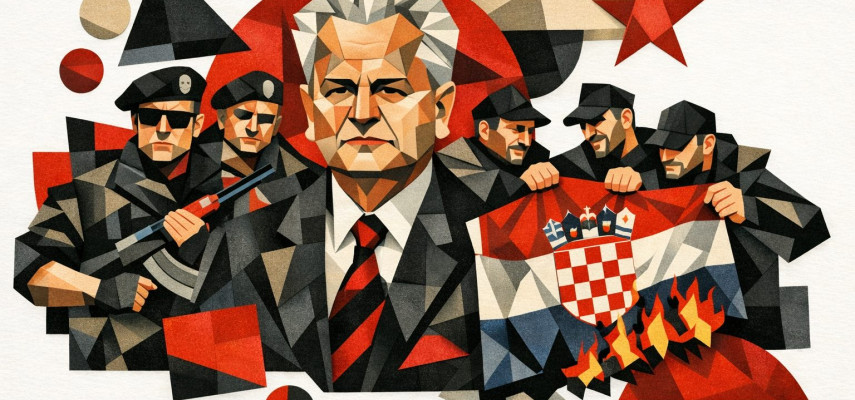
“NATO aggression in Yugoslavia”
In Russia today, the prevailing opinion is that in 1995 and 1999 the NATO military-political alliance committed aggression against Yugoslavia. This thesis was actively spread by various statist media outlets in the 1990s, and spread so massively that it became almost an axiom in Russian society, the accuracy of which no one even considers questioning. Since very few people try to check the facts, let us do it in this article.
Everywhere in Russia, people talk about “NATO aggression”. For instance, the TASS news agency, controlled by the Russian regime, reported on the “anniversary of NATO aggression”1, and even some university journals allow themselves to use this precise term2. We, however, will begin with a description of the situation in which NATO military action on the territory of Yugoslavia took place. It occurred against the backdrop of the Yugoslav Wars, which began in 1991 and were at that time the bloodiest in Europe since 1945. The background to the conflict is quite extensive, and in our article on internationalism we wrote that its cause lay to a large extent in the national policy pursued by Josip Tito. He expected to “sit on two chairs” — both to preserve national identities and to prevent nationalists from seceding into independent states. The result of such an inconsistent policy in the future would be the transformation of Yugoslavia into a testing ground for ethnic cleansing.
Contents
Background
Under Tito’s dictatorship, Yugoslavia’s national policy was built on the principles of “proletarian internationalism” and an ethno-territorial federation3. The state consisted of national republics, and it was logical that the nomenklatura of these republics saw advantages in separation and independence from federal authorities, and possessed the means to achieve them through mechanisms designed to strengthen “national consciousness”. Consequently, nationalism and nationalist organizations in the republics grew stronger. The first “warning sign” was the Croatian Spring in the late 1960s4 (not counting the situation in Kosovo, which we will discuss later). The events of the late 1960s and early 1970s in Croatia, Slovenia, and the autonomous province of Kosovo, according to Slavic scholar K.V. Nikiforov, formed the first major internal crisis of socialist Yugoslavia.

How did the party dictatorship respond to this internal state crisis? Konstantin Nikiforov writes: “Relying on the army, J. Broz Tito ‘purged’ the republican party organizations of all sorts of deviations and re-strengthened his power. But these events made a strong impression on him. He even stated that he did not agree with the decisions of the ‘liberal’ 6th Party Congress… The course toward strengthening the role of the party was finally solidified at the 10th Congress of the LCY (May 1974). Tito decided to overcome the crisis moments in the country’s development in precisely this way, stating that if anything in Yugoslavia should be unified, it was the party, which must be strengthened. If earlier, in the notorious principle of democratic centralism, the first component was emphasized, now the emphasis clearly shifted to the second. The conclusion was drawn that the state under socialism must also play a very important role in managing the material processes of societal development. In fact, it was a matter of curtailing the self-management principles that were originally intended to stimulate the process of the wither away of the state”5.
The last serious attempt to approach the resolution of the internal crisis ideologically took place in 1977. The 1974 Constitution of the SFRY turned out to be monstrous in size and amorphous in content; Yugoslav self-management socialism stalled and moved along a typically socialist vector of stagnation, as in the rest of the socialist camp. Edvard Kardelj published the book “Direction of Development of the Political System of Socialist Self-Management”, in which the author introduced the concept of “pluralism of interests” in a socialist society. “However, it was difficult to talk about any kind of pluralism in a one-party political system. In any case, Kardelj’s ideas received no practical development. He himself soon fell ill and died in 1978”6, Nikiforov concludes.

In 1986, the Belgrade newspaper “Večernje novosti” published the Memorandum of the Serbian Academy of Sciences and Arts7, which became the manifesto of Serbian nationalists. The scandal caused by the memorandum proved to be so powerful in Yugoslavia that SANU received a public flogging and was deprived of celebrating its centennial anniversary8. In 1989, the Slovenian Democratic Union was established9, demanding the creation of an independent Slovenia.
After the League of Communists of Yugoslavia ceased to exist as a unified party in 1990 as a result of disagreements between the republican nomenklaturas, multi-party elections were held, in most of which the nationalists won10; republics began to secede from Yugoslavia. On December 23, 1990, a referendum was held in which Slovenia’s independence was supported by 88.5% of voters11, and in May 1991, a referendum took place in Croatia, where 94% voted for independence12.
Tension was also observed in Serbia. The extreme nationalist government of Slobodan Milošević, seeing the inevitable collapse of Yugoslavia, began a targeted propaganda campaign against various peoples of Yugoslavia in order to preserve and, if possible, expand its own state. Thus, after the shooting of fellow soldiers by Azem Kelmendi, a Kosovo Albanian by origin, the Serbian media exaggerated the scale of the tragedy and emphasized its anti-Serb orientation (ignoring the fact that only one of the four killed was a Serb)13.

In February 1990, in Knin, Croatia, Jovan Rašković founded the Serb Democratic Party, whose program was aimed at changing the regional division of Croatia in accordance with the interests of ethnic Serbs14, which was subsequently accompanied by mass demonstrations by the Serb population. Later, the court would show that the propaganda campaign of the Croatian Serbs was directed from Belgrade, where Milošević had won the election15. In Croatia, under the influence of the aforementioned events, nationalist Franjo Tuđman won, and after gaining political power, he embarked on repressions against Serbs on an ethnic basis16. The situation was becoming increasingly tense.
Slovenia, on whose territory there were no significant places of local residence of ethnic minorities, avoided a conflict situation similar to the situation in Croatia. While in 1991 47,401 Serbs lived in Slovenia (2.3% of the total population)17, in Croatia there were 581,663 Serbs (12.2% of the total population)18. For Belgrade in the person of Milošević, this circumstance was decisive for exerting pressure on public order in Croatia. The Serbian far-right, such as the Serb Volunteer Guard (better known as “Arkan’s Tigers”), also understood this.

In Slovenia… former Communists, having changed their political and ideological guidelines quite easily, were able to block the breakthrough of nationalists and other radical groups into power and carried out decisive socio-economic reforms. Today Slovenia is a modern European country with a high standard of living and economic development19.
However, before moving on to the development of events, let us note that in parallel with this, another issue was maturing — the Kosovo issue. From time immemorial, many different nationalities arrived in the Balkan Peninsula, the main ones being the Slavs and Illyrians. Byzantium was in a constant struggle with Bulgaria and Raška (the ancient prototype of the Serbian state). In the 13th century, Raška strengthened its influence and conquered Kosovo. It became an important cultural and religious center for the Slavs. However, in 1389 the territory of Kosovo passed to the Ottoman Empire; independent Serbian principalities suffered defeat. Despite the defeat, the Battle of Kosovo Field became an event of immense importance for the Serbs in terms of national self-determination and self-consciousness20.
At the same time, alongside the Serbs, Albanians also lived in these places. The first mentions of their activities in the Balkan Peninsula date back to the 11th century, and at the end of the 12th century an independent Albanian state, Arbanon, arose21, which existed until 1255. Albanian principalities also participated in the Battle of Kosovo Field against the forces of the Ottoman Empire, fighting on the side of the Serbs. Some Albanian principalities in Kosovo still retained independence, but already at the end of the 15th century they were completely subjugated by the Ottoman Empire and Islamized, unlike the Serbs, who migrated en masse from these places due to religious persecution. In 1937, Yugoslav historian Vaso Čubrilović, an advocate of creating a “Greater Serbia”, published a memorandum titled “The Expulsion of the Arnauts”, where he proposed methods for expelling Albanians from the territories of Kosovo and Metohija, mentioning the “Albanian problem”, which apparently had its roots in the Middle Ages. After the Turkish victory, cultural assimilation of some Balkan peoples occurred: Bosniaks, Albanians, and others, which later served as the cause of hostility that erupted into an ethno-religious conflict. On this background, claims of the “historical land of the Serbs” look inappropriate overall.
On April 7, 1939, Fascist Italy occupied Albania22, after which it did the same with the territory of Kosovo and Metohija, where the Italians were warmly welcomed by the Albanians, who had been subjected to ethnic discrimination there. Mussolini’s regime decided to establish a puppet fascist government in Albania and include a significant part of Kosovo and Metohija, as well as Western Macedonia and the border areas of Montenegro into “Greater Albania”. As a result of the policy of the puppet fascist regime of Albania, tens of thousands of Serbs and Montenegrins were forced to flee these lands, and tens of thousands of Albanians were settled in their place. On March 6, 1945, after the liberation of the territories from the fascists by the National Liberation Army of Yugoslavia, a “decision on the temporary prohibition of the return of colonists to their former places of residence” was adopted, after which many Serbs lost their lands and did not return23. Thus, the blame for creating the conflict situation here lies primarily with the Italian fascists led by Mussolini, but a certain share of responsibility also belongs to the Communists led by Tito. However, the oppression of Albanians in Kosovo and Metohija has not been sufficiently studied — perhaps the root of the problems lies in that as well.
After the war, the situation retained and intensified its conflict-generating nature. The Albanian dictator Enver Hoxha complained that Kosovars had no connection with Albania24, no chance of joining Albania, and the Kosovars were also dissatisfied with this. Nationalism grew. Yugoslav state security under the leadership of Aleksandar Ranković suppressed with repressions those who maintained ties with Albania25. Albanians held demonstrations demanding that the province be granted the status of a republic and a new constitution be adopted. These demonstrations were dispersed. Despite the fact that in 1974 Kosovo received autonomy and new rights, the protests continued. Their climax was the riot of students at the University of Pristina in 1981 and the subsequent anti-Serb riots, in response to which the authorities sent troops to suppress the Albanian nationalists.
The persistent unrest of the Albanians in Kosovo eventually led to a counter-movement in Serbia. The center of the Serbian national movement became the Serbian Academy of Sciences and Arts, which accused the Communist Party of 45 years of anti-Serbian activity, of creating an anti-Serbian coalition in Yugoslavia. The beginning of Perestroika in the USSR also shook the position of Communists throughout Eastern Europe, including Serbian ones. In such an atmosphere, the leader of the League of Communists of Serbia S. Milošević began to use nationalism to solidify his position in the republic, to rehabilitate the Communist Party in the eyes of the Serbian population. Exploiting the damaged national feelings of the Serbs, Milošević presented his party as the chief defender of Serbian interests in Kosovo. In many ways, he succeeded. At one time in Serbia, a peculiar cult of Milošević even began to form.
At the end of 1988, Milošević, with the help of largely stage-managed demonstrations against bureaucracy, managed to replace the leadership in Vojvodina and Montenegro with his own placemen. Similar attempts were made in Bosnia and Herzegovina. Directed by Milošević, the Greater Serbian boom and the increased influence of Serbia in Yugoslavia alarmed the leadership of the two most developed republics — Slovenia and Croatia. In Slovenia, they openly stood up in defense of the Albanian separatist movement. Milošević’s attempt at the end of 1989 to send 100,000 Serbs to Ljubljana to hold a “rally of truth” there about the situation in Kosovo was viewed as an interference in internal affairs. The Slovenian security services prevented the rally from taking place, which led to a boycott of Slovenian goods by Serbia.
The final break between the republics occurred at the 14th Extraordinary Congress of the LCY, which began its work in January 1990. After the Serbian majority of the congress rejected the Slovenian delegation’s demand to reorganize the party on confederative principles, the delegates from Slovenia refused to continue work and left the congress. Without the Slovenian Communists, delegates from Croatia and Bosnia and Herzegovina also did not want to continue work. A break was announced at the congress, but it never resumed its work. The collapse of the unified all-Yugoslav Communist Party had far-reaching consequences. Politically, nothing bound the Yugoslav republics anymore26.
Outbreak of violence
Borders are always dictated by the strong, never by the weak. We simply consider it as a legitimate right and interest of the Serb nation to live in one state27.
In 1990, the Serb National Council made the decision to hold a referendum on the autonomy of Serbs in Croatia28. Croatian authorities declared the referendum illegal and promised to prevent it by all possible means. The result was armed clashes and the declaration of a state of emergency in the city of Knin. At the beginning of the conflict, political methods and economic levers were used (Serbia cutting off the electricity supply to Slovenia, a Serbian boycott of Slovenian goods, and so on). Subsequently, the population began arming itself on its own, not without assistance from the republican authorities.

The conflict was divided into several stages:
- Ten-Day War, as a result of which Slovenia gained independence;
- War in Croatia (1991-1995);
- Bosnian War (1992-1995).
As admitted by the president of the Republic of Serbian Krajina Milan Martić, sentenced to 35 years in prison, the Serbian side was the first to start using force29. At the beginning of the Bosnian War, Serbs besieged the capital of Bosnia, Sarajevo. Over the 3 years of the siege, artillery and sniper shelling killed more than nine thousand people, a third of whom were civilians30 (one of the streets came to be known as “sniper alley”31). Both sides engaged in ethnic cleansing and genocide of the civilian population. The top leadership of Serbia did not conceal its misanthropic ambitions: Radovan Karadžić and other representatives of the Bosnian Serbs called for the removal of all “non-Serbs” from power, their discrimination, and the subsequent physical destruction of all Muslims up to their complete disappearance323334. Radovan Karadžić’s associate Biljana Plavšić, sentenced by the ICTY to 11 years in prison, declared that “Muslims are a genetic defect on the Serbian body”35, and called the persecution of people of non-Serb nationality a “natural phenomenon”36. The following words also belong to her:
There are 12 million Serbs in the world, and even if half of them die on the battlefield, the remaining six million will reap the successful fruits of our struggle37.
Nationalists on each side claimed various “grand projects” for restructuring the former Yugoslavia. The most coveted part was Bosnia and Herzegovina, diverse in all respects.

Bosnia and Herzegovina’s referendum on independence in early 1992 was ignored by Bosnian Serbs. Then, after independence was recognized by EC countries, a civil war exploded across the country. Bosnian Serbs proclaimed the Republika Srpska, claiming 65% of the territories in the country, intending to unite with the Republic of Serbian Krajina (in Croatia), self-proclaimed on December 19, 1991; its ultimate goal was joining the FRY as a 3rd member, alongside Serbia and Montenegro. The Croats founded the Croatian Community, and the Bosnian Muslims — Western Bosnia38. For several years, these self-proclaimed political entities would cause massive bloodshed through a wide spectrum of military operations, genocide, and cleansings.
In July 1995, Serb forces captured the mining town of Srebrenica, after which they killed up to 8 thousand local Muslims within a few days39. The Serb authorities tried in every way to conceal the scale of the genocide they were committing by moving corpses to various mass graves40. Mass executions took place with the actual connivance of UN peacekeepers, who were responsible for maintaining one of the “safe areas” here41. Prior to 2022, this ethnic cleansing was commonly referred to as the largest mass murder in Europe since World War II42. Concentration camps were opened, such as the Bosnian Serb-run Omarska concentration camp, as well as Keraterm, Foča, Sušica, and Luka concentration camps43. In them, among other things, women were beaten, tortured, and raped, such as the Bosniak Nusreta Sivac44. There were also concentration camps operated by Bosniaks — for instance, Čelebići and Dretelj, where similar crimes were committed45. Later, in 2010, the Serbian Parliament voted for a resolution condemning the mass murder of Bosnian Muslims in Srebrenica in 199546.
It should be noted that Serbian President Slobodan Milošević was a true model of an African-style dictator. Having become president, Slobodan tried to provide his family with a luxurious life. First of all, he bought a huge villa in Belgrade. It cost him only 1,112 dollars. In reality, the residence was worth 110 thousand dollars, but one of the largest state banks covered the price difference47. The Swiss authorities reported that 100 million Swiss francs were found in frozen accounts of people close to Slobodan, and the former president himself pumped about five billion dollars out of the country — almost half of the foreign debt of the country that Milošević ruled for ten years. Milošević’s son admitted: “Dad never scolds me. He was angry only when I crashed the first two race cars; he forgave me for the remaining ten”48. Milošević was helped to break into high-level politics by his friend Ivan Stambolić. Later, he would be killed by a group of eight officers from the Special Operations Unit on Milošević’s orders49.
NATO operation in 1995
In 1995, after a series of artillery shell explosions at the Sarajevo Markale market in August 199550, which killed more than 100 people, the NATO alliance, seeing the powerlessness of UN peacekeepers, conducted Operation Deliberate Force, thereby forcing the Serbs to join peace talks51, which concluded with the signing of the Dayton Agreement in the same year52.
The NATO military operation aimed to end the massive bloodshed in order to put an end to the civil war in Yugoslavia in 1991–1995. Tens of thousands of people, including civilians, died in this conflict (the total figures of casualties will be given below). Therefore, statists, portraying this as NATO aggression, spread disinformation. It was a peacekeeping operation aimed at saving the citizens of the former republics of Yugoslavia from the war unleashed by local nationalists. Which was accomplished — the bloody civil war stopped at the end of 1995 only as a result of the intervention of representatives of the international community53. According to the Dayton Agreement, the supreme body of authority in Bosnia and Herzegovina was established — a 3-person presidency, one each from Bosniaks, Croats, and Serbs. 2/3 of the delegates of the Parliamentary Assembly were to be elected from the Muslim-Croat Federation of Bosnia and Herzegovina, and 1/3 — from the Republika Srpska54. The interests of all ethnicities were thus represented in the state.
Intervention in the Kosovo War in 1999
Croats and Bosniaks managed to win a peaceful life for themselves, as Slovenes had earlier, but it did not come to the rest of Yugoslavia (which existed from 1992 to 2006 as the Federal Republic of Yugoslavia). In 1990, a new Constitution of the Republic of Serbia was adopted, in which autonomous rights for Kosovo were curtailed, in particular the right to “autonomous lawmaking” and to its own symbols of autonomy55.
Why did it happen that they decided to infringe upon the rights and freedoms of the autonomy? The answer to this question is very painful for Russian statists — because the power of Slobodan Milošević consolidated and became absolute. After the 8th session of the Central Committee of the League of Communists of Serbia at the end of September 1987, Milošević got rid of Dragiša Pavlović, Chairman of the Belgrade City Committee of the party, and Ivan Stambolić, President of the Presidency of the Republic of Serbia56. The latter patronized Milošević, built his career, and promoted him to the top echelons of power; in gratitude, the mentee did not simply throw Stambolić out of politics, but also ordered his murder in 2000. The order was executed in August 2000 by the Special Operations Unit (Frenki’s men) on Fruška Gora.

Milošević inspired actions against local authorities in Vojvodina, Kosovo, and Montenegro. Replacing the leadership of assemblies with his own placemen opened the way to anti-democratic amendments to the Constitution of Serbia: “The autonomous provinces of Kosovo and Metohija (as the autonomous province of Kosovo now came to be called) and Vojvodina lost the attributes of statehood (which they received under the 1974 Constitution) and once again became merely territorial autonomies. The provinces could no longer exercise the right of veto regarding constitutional changes, and the powers of their legislative, executive, and judicial authorities were narrowed. On this issue, there was effectively a return to the norms of the 1963 federal constitution”57.
The reaction was not long in coming. Kosovo Albanians began a struggle for separation from Serbia. At the moment the amendments to the Constitution were adopted, according to official data alone, 22 demonstrators and 2 policemen were killed as a result of protests in Kosovo, with 92 and 121 injured respectively; a large number of vehicles were burned, and 2 helicopters and 4 armored personnel carriers were damaged58. Likely, the problem could have been resolved using methods similar to those Tony Blair used in Northern Ireland (we wrote about this here) — unblocking peaceful and consensus-based negotiations, granting broad autonomy, and providing their own parliament. However, the Yugoslav government was unable or unwilling to do this. The reason was the nationalist positions of the Serbian elite and its desire by all means not to lose the “core and cradle of the Serbian state”59.

Kosovars, having discovered a corridor of opportunities during discussions about the future structure of Yugoslavia, held an independence referendum in 199160, the results of which were not recognized. From 1989, Kosovo Albanian leader Ibrahim Rugova adhered to a policy of nonviolent protest against the curtailment of autonomy61; however, after the Dayton Accords were concluded without taking into account the situation in Kosovo, he had to yield to his more radical opponents. In 1996, the Kosovo Liberation Army was created, which began attacks on Serbian police and officials. The escalating situation in Kosovo attracted the attention of the UN; on March 31, 1998, UN Security Council Resolution 1160 was adopted, condemning the excessive violence by Serbian police forces and terrorist acts by the KLA, and calling for the start of a dialogue to determine the political status of the province and its possible change62.
The Serbian authorities again decided to respond not by granting broad autonomy, but with mass violence that had already become traditional for them, the result of which by the end of the Kosovo War of 1998-1999 was the destruction of nearly 500 villages and the murder of almost 10,000 civilians63 (according to other data — about 13,50064); the total number of refugees is estimated by Human Rights Watch at 850,000 people65, and some sources put it at 1.45 million66. Systematic ethnic cleansings began67. Numerous Albanian and Serbian cultural sites were also destroyed or damaged. After the war, mass graves of Kosovo Albanians killed by Yugoslav security forces during ethnic cleansings began to be discovered and investigated in Serbia outside Kosovo68.

On September 23, 1998, the UN Security Council adopted Resolution 1199, calling on the parties to cease fire69, and the NATO alliance began planning an air operation if military actions did not cease within 96 hours70. The Yugoslav government agreed to a truce in Kosovo, which assumed the withdrawal of Yugoslav army units to places of permanent deployment. However, already in January, Yugoslav security forces resumed operations, and the world quickly learned about the Račak massacre on January 15, 1999, the victims of which were 45 Albanians71. As a result, the rhetoric of statists regarding the lack of a UN mandate or authorization for the NATO operation sounds groundless: the Serbian side was the first to violate the obligations imposed on it by the UN. According to Human Rights Watch, democratic countries tried until the last moment not to use severe measures against Yugoslav forces, and decisive actions were canceled whenever Slobodan Milošević made concessions72. Also, statist propagandists sometimes claim that there was no massacre in Račak at all (despite the fact that the entire world recognizes its existence as a fact), that is, they spread falsifications.
The government of Slobodan Milošević offered resistance to international observers in their investigations, attempted to order the head of the Verification Mission in Kosovo to leave the country, and called Supreme Allied Commander Europe Wesley Clark a war criminal73. The UN Security Council adopted Resolution 1207, which condemned the failure of the Federal Republic of Yugoslavia to cooperate with the ICTY74. The international community initiated peace talks in Rambouillet, but Milošević refused to attend them, whereas the KLA agreed to attend. Taking into account the fact that the UN resolution had not been complied with, NATO demanded the deployment of its troops in Kosovo to ensure that operations against the Albanian population would not recur. The Serbs responded to these proposals and to proposals for granting autonomy to Kosovo with a refusal and by conducting military exercises75.
In response to this, NATO, convinced of the impossibility of resolving the conflict peacefully and the inadequacy of the Milošević government, launched Operation Allied Force against the Serbian armed forces subordinate to him. The NATO operation resulted in the end of the Kosovo War and the establishment of peace in the Balkans. Kosovo gained de facto independence, and in 2008 – de jure. The KLA was demilitarized. The number of civilian victims of Operation Allied Force is estimated at about 500 people76. At the same time, this includes, for example, 87 Albanians whom Serbian troops used as human shields in Koriša77; in some cases, missiles were knocked off course due to equipment failures.
The declaration of independence of Kosovo and Metohija led to tens of thousands of Serb refugees, the destruction of Serbian heritage sites, and cases of persecution of the non-Albanian population. However, the blame for this lies not with NATO, but with the incompetence of the right-wing Yugoslav government, which failed to prevent the conflict. After the end of the wars, the problem of harassment and repression on ethnic grounds remained, although today it has virtually disappeared. Blaming NATO for ethnic repression after the end of the war is extremely strange — after all, NATO does not have state power in these territories and has no right to determine the policy of local authorities. This would require an occupation, but since the military actions were not aggression but a peacekeeping operation, an occupation was impossible; consequently, it was also impossible for the NATO alliance to determine the policy of the former Balkan republics.
Russian nomenklatura did not like NATO’s intervention aimed at stopping the slaughter. Initially, Russia condemned the military actions of the Serbs, voted for all UN Security Council resolutions, and in Resolution 1199 directly accused Yugoslavia of committing crimes against humanity. But due to the strong positions of the statists, such rhetoric faded away. The statists began to support Serbia, along the way portraying themselves as its defender. Back in 1999, the “u-turn over the Atlantic” by Russian Prime Minister Yevgeny Primakov78 took place, who was flying on a visit to the US and canceled the visit in protest against NATO’s intervention in the situation.
Likely, the statists tried the situation on themselves and realized that they might not be allowed to drown their political opponents in blood with impunity, which caused their displeasure. On March 26, 1999, the Russian side initiated a vote in the UN Security Council on a resolution condemning NATO’s actions as aggressive, but it gathered only three votes — Russia itself, the PRC, and Namibia79 — and was rejected. The PRC largely joined the resolution due to a tragic incident with its own embassy in Belgrade, when bombs mistakenly fell not on the Yugoslav Federal Directorate for Supply and Procurement located nearby, but on their embassy. Thus, this operation is not officially regarded by the international community as aggression.
Unfortunately, the Serbian authorities proved to be incompetent and sought to resolve problems by force rather than consensus, and for this the Serbian people paid a heavy price, suffering from the Yugoslav wars most of all.
Court
After the end of military actions, both Serbian and Croatian, as well as Bosnian criminals were brought to trial. First and foremost, these were Serbs Slobodan Milošević, Ratko Mladić, Radovan Karadžić, Vojislav Šešelj, Goran Hadžić; Croats Slobodan Praljak, Milivoj Petković, Mirko Norac; Bosnians Jadranko Prlić, Rasim Delić, Edib Buljubašić, and others. In total, during the tribunal’s existence, 142 judicial proceedings were conducted against more than 160 accused (including 92 against Serbs, 33 against Croats, 8 against Kosovo Albanians, 7 against Bosnian Muslims, and 2 against Macedonians)80. Some of the accused of various nationalities were acquitted, or they were released early.

A little later, in 2015, with the assistance of the EU and the US, a specialized judicial chamber and prosecutor’s office for Kosovo were established, setting as their goal the consideration of possible KLA crimes against civilians in Kosovo from January 1, 1998, to December 31, 200081. Among the main suspects were Hashim Thaçi (considered one of the founders of the KLA), Salih Mustafa, Jakup Krasniqi, Kadri Veseli, Rexhep Selimi, and others82. All of them are accused of involvement in committing war crimes and crimes against humanity. According to available data, judicial proceedings have been fully completed regarding the case of Salih Mustafa, who was sentenced to 26 years in prison with a requirement to pay €207,000 to victims in reparations8384. The case of Hashim Thaçi, Kadri Veseli, Rexhep Selimi, and Jakup Krasniqi is at the pre-trial stage, but charges of war crimes and crimes against humanity have already been brought against them85.
Sometimes in Russia, the opinion is voiced that international courts were directed against the Serbs. The facts state the opposite — first, not only Serbs were among those convicted, and second, many Serbs were acquitted, for example, President of Serbia Milan Milutinović, Miroslav Radić, Momčilo Mandić, or Momčilo Perišić. The very fact that there were more Serb defendants merely indicates that they committed more crimes (which is not surprising given the history of the conflict). It would be extremely strange if, in a situation where one side commits more crimes, the court decided to try an equal number of people from all nationalities simply so that nationalists would not be offended. A court is a place where people are tried for crimes. For instance, the Bosnians understood this and were the first to hand over their own criminals to the Hague Tribunal86. It is also important that after the war, as we have already mentioned, Bosnia and Herzegovina took into account the interests of other nationalities, and their highest state authority is the Presidency, which includes one Bosnian, one Croat, and one Serb. The Bosnians did not demand an ethnically homogeneous Bosnian state to the bitter end, did not cling to nationalism, and did the right thing.
“Depleted uranium”
In a certain kind of media working to discredit NATO (primarily Russian), attempts are regularly made to find information that would make it possible to accomplish such a task. One example of the disinformation ideological struggle is the creation of the ideologeme about “depleted uranium”. It consists of the claim that the NATO alliance used depleted uranium during the bombings, and therefore committed a crime.
Newspaper headlines in the media resonate with deep and apocalyptic tones. We will allow ourselves to present a few choice ones to the reader’s judgment:
- Vesti.ru: “Thousands of Italian soldiers poisoned by depleted uranium”, “Due to NATO an epidemic of cancer occurred”, “A Serb and an Italian — on the terrible consequences of the use of depleted uranium”;
- RIA Novosti: “Ministry of Health of Serbia spoke about what the use of depleted uranium by NATO led to”, “Ministry of Defense described the consequences of NATO strikes with uranium bombs on Yugoslavia”, “Bocan-Kharchenko: the West wants to bury the topic of NATO’s uranium aggression in Serbia”;
- Radio “Sputnik”: “More than in Hiroshima”: they want to bring NATO to justice for uranium bombs in Serbia”, “General: uranium shells for Ukraine are more dangerous than those used in Yugoslavia”, “How depleted uranium “enriched” the flora, fauna, and population of Serbia…”
In the Russian Wikipedia, a full-fledged article on “Use of depleted uranium munitions by the US military” has been written, whereas in all other languages as of December 2022 it is absent.
Extremely hypocritical is the position of such critics, who are not interested in the tens of thousands of victims of the conflicts prior to NATO’s intervention.
Studies have shown the following: health risks for humans due to chemical toxicity and radiation from depleted uranium arise only upon its ingestion or inhalation, while no uptake of depleted uranium from the environment following the use of DU munitions has been observed87. Despite statements by representatives of Russian delegations claiming long-term contamination of soil, water, and air88, scientific studies have determined that possible risks to terrestrial and aquatic ecosystems are in fact very low. The UN Commission also concluded that no clinically significant pathology related to radiation exposure from depleted uranium was found89.
A 2022 report by the WHO Regional Office for Europe, “Inequalities in childhood cancer in the WHO European Region”, analyzed the causes of cancer incidence and mortality across different regions90. High rates of malignant tumors were identified in Croatia and Serbia, while both Croatia and Serbia noted significant decreases in age-standardized cancer incidence rates. However, the main fact here is that Croatia, on whose territory depleted uranium was not used, had the same indicators for cancer diseases as Serbia.
The US Department of Defense, the US Department of Veterans Affairs, the United Nations, and NATO have conducted investigations into the effects of depleted uranium, and it concluded that the risk to human health from depleted uranium is in most cases negligible91. The Pentagon has also previously cited WHO data when stating that this material has a negligible health impact92. The US widely uses depleted uranium, for instance, in the armor of its tanks, as counterweights for aircraft, and so forth93 — if we are to believe the statists, it turns out that they want to harm their own military and the health of their own soldiers? Finally, depleted uranium is also used by Rosatom, and the state corporation’s executives proved to the public that it poses no danger94. We will not dissect the remaining arguments of anti-American propaganda here, but we strongly advise the reader to thoroughly understand the essence of each of them before making any assertions.
Conclusion
The NATO alliance did not commit military aggression in Yugoslavia and did not initiate military actions — on the contrary, it came to a country where military actions were already underway, had led to the deaths of tens of thousands of people, and stopped this mass bloodshed. The alliance had nothing to do with the start of these wars. The number of victims of the Yugoslav Wars is estimated at at least 140 thousand people in killed alone95. The number of victims of NATO operations in 1995 and 1999 — as we wrote above, about 500 civilians in 1999, about 300 military personnel in 199996, and about 30 civilians in 199597, as well as an accurately unestablished number of military personnel in 1995. Shortly after the operations in the Balkans, mass killings ceased and peace was established.
The only aggressors in this war are the nationalists and former nomenklatura members of the Yugoslav republics, mainly Serbs, who unleashed a slaughter against their former fellow citizens. The Kremlin became terrified that if they needed to use mass violence involving the army and paramilitary groups in their own country, NATO would subdue them by force and hand them over to the Hague Tribunal, where they would be tried as international criminals. For this reason, a campaign about “NATO aggression” was unleashed in media controlled by the Kremlin and other authoritarian regimes and parties. Those “leftists” who support this campaign are thereby defending the Russian nomenklatura, the nationalists of the Yugoslav republics, and ethnic cleansings.
We would like to thank Alexander Shtertsen, Adam Kvizok, Nikita Malinovskiy, and Artyom Kuznetsov for their help in writing this article.
- Anniversary of NATO aggression. How the bombings of Yugoslavia began // TASS (tass.ru). March 24, 2021, 10:00. [Electronic resource]. URL: https://tass.ru/mezhdunarodnaya-panorama/10972795 (Date of access: 28.07.2023).
- NATO Aggression against Yugoslavia: International Law, Military-Strategic, and Geopolitical Consequences [Text] / E.G. Ponomareva, A.V. Frolov // MGIMO Review of International Relations . – 2019. – № 2 (65). – pp. 32-56
- S.A. Romanenko. The Dissolution of Yugoslavia: A Conspiracy or a Historical Inevitability? // Politeia. – 1998. – № 2(8). – pp. 159–178.
- V.S. Putyatin. Croatian Spring // Great Russian Encyclopedia 2004-2017 (old.bigenc.ru). [Electronic resource]. URL: https://old.bigenc.ru/world_history/text/5847015 (Date of access: 05.06.2023).
- Yugoslavia in the 20th Century: Essays on Political History / Ed. by K.V. Nikiforov. – Moscow: “Indrik”, 2011. P. 735.
- Ibid., p. 742.
- J. Pavkovic. The Crisis of the Yugoslav Federation and the “Memorandum of the Serbian Academy of Sciences and Arts” // Bulletin of Mariupol State University. Ser.: History. Political Science. – 2013. – Issue 7-8. – pp. 76-84
- Yugoslavia in the 20th Century: Essays on Political History / Ed. by K.V. Nikiforov. – Moscow: “Indrik”, 2011. P. 750.
- N.N. Starikova. Slovenian Writers and the “Velvet Revolution” // Slavic Almanac. — 2015. — № 1-2. – p. 221
- J. Mitrievska. “Founding Elections” and Political Transit in the Countries of Former Yugoslavia // Social-Economic Phenomena and Processes, 2015. № 8.
- N.N. Starikova. Slovenian Writers and the “Velvet Revolution” // Slavic Almanac. — 2015. — № 1-2. — p. 222
- Encyclopedia of Countries of the World / Ed.-in-chief N.A. Simoniya. – 1319 p. – Moscow: Ekonomika, 2004. — P. 427.
- S. Biserko. An ideological and political watershed or ethno-nationalism becomes state policy // Helsinki Committee for Human Rights in Serbia (www.helsinki.org.rs). September-October 2007. [Electronic resource]. URL: http://www.helsinki.org.rs/hcharter_t17a01.html (Date of access: 03.06.2023).
- Ivo Goldstein. Croatia: A History. – 281 p. – London: C. Hurst & Co. Publishers, 1999. – p. 214.
- International Tribunal for the Prosecution of Persons Responsible for Serious Violations of International Humanitarian Law Committed in the Territory of Former Yugoslavia since 1991. Case No. IT-03-72-S // International Criminal Tribunal for the former Yugoslavia (www.icty.org). June 29, 2004. [Electronic resource]. URL: https://www.icty.org/x/cases/babic/tjug/en/bab-sj040629e.pdf (Date of access: 05.06.2023).
- Memorandum on the violation of human and civil rights of the Serbian people in the Republic of Croatia // United Nations Digital Library System (digitallibrary.un.org). March 7, 1995. [Electronic resource]. URL: https://digitallibrary.un.org/record/227019/files/E_CN.4_1995_164-RU.pdf?version=1 (Date of access: 29.07.2023).
- Population by ethnic affiliation, Slovenia, Census 1953, 1961, 1971, 1981, 1991 and 2002 // SURS (www.stat.si). [Electronic resource]. URL: https://www.stat.si/popis2002/en/rezultati/rezultati_red.asp?ter=SLO&st=7 (Date of access: 28.07.2023).
- Population by ethnicity, 1971 – 2011 censuses // Državni zavod za statistiku (web.dzs.hr). [Electronic resource]. URL: https://web.dzs.hr/Eng/censuses/census2011/results/htm/usp_03_EN.htm (Date of access: 28.07.2023).
- J. Mitrievska. “Founding Elections” and Political Transit in the Countries of Former Yugoslavia // Social-Economic Phenomena and Processes, 2015. № 8.
- K. Milewski. Kosovo. Impact of the war in Ukraine on Serbian politics // Centrum Stosunków Międzynarodowych (csm.org.pl). [Electronic resource]. URL: https://csm.org.pl/kosovo-impact-of-the-war-in-ukraine-on-serbian-politics/ (Date of access: 03.06.2023).
- K. Limanov. Albania // Encyklopédia Krugosvet (www.krugosvet.ru). [Electronic resource]. URL: https://www.krugosvet.ru/enc/strany_mira/ALBANIYA.html (Date of access: 03.06.2023).
- V.I. Kosik. The Fate of Kosmet (History and Present) // St. Tikhon’s University Review. Series II: History. History of the Russian Orthodox Church. 2008. Issue 1 (26). – pp. 70-90.
- Ibid.
- Letter of E. Hoxha to the CC AUCP(b) on the background of the emergence of the Kosovo issue and methods for its solution // Eastern Europe in Documents of Russian Archives, 1944–1953. – 1004 p. – Moscow; Novosibirsk: Sib. khronograf, 1998. – Vol. 2: 1949–1953. – p. 209
- P. Zhukov. Kosovo — a Conflict Land // Istoriya.RF (histrf.ru). [Electronic resource]. URL: https://histrf.ru/read/articles/kosovo-zemlya-konfliktnaya (Date of access: 03.06.2023).
- History of Southern and Western Slavs: electronic educational and methodological complex for students of the History Faculty specializing in 1-21 03 01 “History (by fields)”. In 4 parts. Part 4. Contemporary History of the Southern Slavs from 1914 to the present / V.N. Kukharenko, A.P. Salkov; BSU, History Faculty, Department of History of Southern and Western Slavs. – 111 p. – Minsk : BSU, 2018. – pp. 61-62.
- Doder, Dusko; Branson, Louise. Milosevic: Portrait of a Tyrant. — Simon & Schuster, 1999. — P. 81.
- Yugoslavia in the 20th Century: Essays on Political History / Managing Editor K.V. Nikiforov. — 888 p. — M.: “Indrik”, 2011. – p. 779.
- Trial Proceedings // Home United Nations International Criminal Tribunal for the former Yugoslavia (www.icty.org). February 15, 2006. [Electronic resource]. URL: https://www.icty.org/x/cases/martic/trans/en/060215ED.htm (Date of access: 03.06.2023).
- Exactly 25 years ago, the war in Bosnia ended — the bloodiest interethnic conflict in Europe since World War II // Meduza (meduza.io). December 14, 2020, 13:47. [Electronic resource]. URL: https://meduza.io/feature/2020/12/14/rovno-25-let-nazad-zakonchilas-voyna-v-bosnii-samyy-krovavyy-mezhetnicheskiy-konflikt-v-evrope-so-vremen-vtoroy-mirovoy (Date of access: 29.07.2023).
- Sarajevo: Inside ‘sniper alley’ // BBC News (www.bbc.com). April 5, 2012. [Electronic resource]. URL: https://www.bbc.com/news/av/uk-17390057 (Date of access: 29.07.2023).
- F. Hartmann. A statement at the seventh biennial meeting of the international association of genocide scholars // Helsinki Committee for Human Rights in Serbia (www.helsinki.org.rs). July 2007. [Electronic resource]. URL: http://www.helsinki.org.rs/hcharter_t16a02.html (Date of access: 03.06.2023).
- R. Caprile. Mladic, i diari dell’orrore “Sterminare i musulmani” // La Repubblica (www.repubblica.it). September 15, 2010. [Electronic resource]. URL: https://www.repubblica.it/esteri/2010/09/15/news/mladic_musulmani-7088218/ (Date of access: 03.06.2023).
- S. Biserko. Editorial: “We shall take vengeance against the turks” // Helsinki Committee for Human Rights in Serbia (www.helsinki.org.rs). January-February 2007. [Electronic resource]. URL: http://www.helsinki.org.rs/hcharter_t07a01.html (Date of access: 03.06.2023).
- Serbian “Iron Lady” released // BBC News Russian Service (www.bbc.com). October 27, 2009. [Electronic resource]. URL: https://www.bbc.com/russian/international/2009/10/091026_plavsic_release (Date of access: 29.07.2023).
- Biljana Plavšić. Biographical background // RAPSI (apsinews.ru). [Electronic resource]. URL: https://rapsinews.ru/international_publication/20091027/190774776.html (Date of access: 03.06.2023).
- Ibid.
- Jan Egbert. Controversial Political Issues from the Perspective of Modern History [transl. from German by M. A. Elizaryeva]. M.: Political Encyclopedia, 2014. P. 188–189.
- International Tribunal for the Prosecution of Persons Responsible for Serious Violations of International Humanitarian Law Committed in the Territory of Former Yugoslavia since 1991 // International Criminal Tribunal for the former Yugoslavia (www.icty.org). August 2, 2001. [Electronic resource]. URL: https://www.icty.org/x/cases/krstic/tjug/en/krs-tj010802e.pdf (Date of access: 29.07.2023).
- I. Antic. Samir and Ryad had the right to live // Helsinki Committee for Human Rights in Serbia (www.helsinki.org.rs). May-June 2011. [Electronic resource]. URL: http://www.helsinki.org.rs/hcharter_t36a05.html (Date of access: 03.06.2023).
- Exactly 25 years ago, the war in Bosnia ended — the bloodiest interethnic conflict in Europe since World War II // Meduza (meduza.io). December 14, 2020, 13:47. [Electronic resource]. URL: https://meduza.io/feature/2020/12/14/rovno-25-let-nazad-zakonchilas-voyna-v-bosnii-samyy-krovavyy-mezhetnicheskiy-konflikt-v-evrope-so-vremen-vtoroy-mirovoy (Date of access: 29.07.2023).
- ‘May we all learn and act on the lessons of Srebrenica’, says secretary-general, in message to anniversary ceremony // UN Press (press.un.org). July 11, 2005. [Electronic resource]. URL: https://press.un.org/en/2005/sgsm9993.doc.htm (Date of access: 03.06.2023).
- Thomas Cushman, Stjepan Mestrovic. This Time We Knew: Western Responses to Genocide in Bosnia – 422 p. – New York and London: New York University Press, 1996. – p. 368.
- The Courage to Testify: Nusreta Sivac // Remembering Srebrenica (srebrenica.org.uk). [Electronic resource]. URL: https://srebrenica.org.uk/survivor-stories/the-courage-to-testify-nusreta-sivac (Date of access: 03.06.2023).
- C. Hedges. Balkan War Crimes: Bosnia Is First to Turn In Its Own // The New York Times (www.nytimes.com). May 3, 1996. [Electronic resource]. URL: https://www.nytimes.com/1996/05/03/world/balkan-war-crimes-bosnia-is-first-to-turn-in-its-own.html (Date of access: 03.06.2023).
- Serbian parliament apologized for the mass murder in Srebrenica // Lenta.ru (lenta.ru). March 31, 2010, 06:43. [Electronic resource]. URL: https://lenta.ru/news/2010/03/31/apology/ (Date of access: 03.06.2023).
- Criminal President. How the leader of Yugoslavia ordered the murder of his friend for the sake of office and what he spent billions from the state budget on // Lenta.ru (lenta.ru). June 5, 2021, 00:01. [Electronic resource]. URL: https://lenta.ru/articles/2021/06/05/slobodan/ (Date of access: 03.06.2023).
- Milošević “Clan” // Izvestia (iz.ru). March 17, 2006, 13:38. [Electronic resource]. URL: https://iz.ru/449556/klan-miloshevichei (Date of access: 03.06.2023).
- Criminal President. How the leader of Yugoslavia ordered the murder of his friend for the sake of office and what he spent billions from the state budget on // Lenta.ru (lenta.ru). June 5, 2021, 00:01. [Electronic resource]. URL: https://lenta.ru/articles/2021/06/05/slobodan/ (Date of access: 03.06.2023).
- Operation Deliberate Force // AFSOUTH (www.afsouth.nato.int). December 16, 2002. [Electronic resource]. URL: http://www.afsouth.nato.int/factsheets/DeliberateForceFactSheet.htm (Date of access: 10.11.2008).
- Roger Cohen. Conflict in the Balkans: the overview; NATO presses Bosnia bombing, vowing to make Sarajevo safe, The New York Times (August 31, 1995).
- Dayton Agreement // Great Russian Encyclopedia (bigenc.ru). May 23, 2022, 21:57. [Electronic resource]. URL: https://bigenc.ru/c/deitonskie-soglasheniia-b643da (Date of access: 29.07.2023).
- M.Y. Martynova. The Balkan Crisis: Peoples and Politics. – M., Stary sad. 1998. P. 11.
- Dayton Agreement // Great Russian Encyclopedia (bigenc.ru). May 23, 2022, 21:57. [Electronic resource]. URL: https://bigenc.ru/c/deitonskie-soglasheniia-b643da (Date of access: 29.07.2023).
- K.A. Polovchenko. Genesis of the Kosovo and Metohija Problem: Constitutional and Legal Research // Social-Political Sciences. 2017. No. 2. – pp. 120-124.
- Yugoslavia in the 20th Century: Essays on Political History / Managing Ed. K.V. Nikiforov. – M.: “Indrik”, 2011. P. 751.
- Ibid., p. 752.
- Modern Serbian State. 1804–2004. Chronology. Belgrade, 2004. P. 407.
- S. Biserko. Kosovo finals // Helsinki Committee for Human Rights in Serbia (www.helsinki.org.rs). January-February 2007. [Electronic resource]. URL: http://www.helsinki.org.rs/hcharter_t01a01.html (Date of access: 29.07.2023).
- Kosovo (Jugoslawien), 30 September 1991: Unabhängigkeit // Database and Search Engine for Direct Democracy (www.sudd.ch). [Electronic resource]. URL: https://www.sudd.ch/event.php?lang=en&id=ks011991 (Date of access: 29.07.2023).
- The Kosovo conflict // Encyclopedia Britannica (www.britannica.com). [Electronic resource]. URL: https://www.britannica.com/place/Serbia/The-Kosovo-conflict (Date of access: 03.06.2023).
- Resolution 1160 (1998) adopted by the Security Council at its 3868th meeting, on 31 March 1998 // Human Rights Library- University of Minnesota (hrlibrary.umn.edu). [Electronic resource]. URL: http://hrlibrary.umn.edu/resolutions/SC98/R1160SC98.html (Date of access: 29.07.2023).
- The Kosovo conflict // Encyclopedia Britannica (www.britannica.com). [Electronic resource]. URL: https://www.britannica.com/place/Serbia/The-Kosovo-conflict (Date of access: 03.06.2023).
- M. Domanovic. List of Kosovo War Victims Published // Balkan Transitional Justice (balkaninsight.com). December 10, 2014, 16:26. [Electronic resource]. URL: https://balkaninsight.com/2014/12/10/kosovo-war-victims-list-published/ (Date of access: 29.07.2023).
- Under orders: War Crimes in Kosovo. 4. March-June 1999: An Overview // Human Rights Watch (www.hrw.org). [Electronic resource]. URL: https://www.hrw.org/reports/2001/kosovo/undword-03.htm (Date of access: 29.07.2023).
- Human Rights in Kosovo: As Seen, As Told. Volume I, October 1998 – June 1999 // OSCE (www.osce.org). November 5, 1999. [Electronic resource]. URL: https://www.osce.org/odihr/17772 (Date of access: 03.06.2023).
- B. Tončić. A bloody modus operandi // Helsinki Committee for Human Rights in Serbia (www.helsinki.org.rs). September-October 2013. [Electronic resource]. URL: http://www.helsinki.org.rs/hcharter_t50a05.html (Date of access: 03.06.2023).
- Inhuman treatment of people and illicit trafficking in human organs in Kosovo // Parliamentary Assembly of the Council of Europe (assembly.coe.int). January 7, 2011. [Electronic resource]. URL: https://assembly.coe.int/nw/xml/XRef/Xref-XML2HTML-en.asp?fileid=12608&lang=en (Date of access: 03.06.2023).
- Resolution 1199 (1998) // Human Rights Library- University of Minnesota (hrlibrary.umn.edu). September 23, 1998. [Electronic resource]. URL: http://hrlibrary.umn.edu/resolutions/SC98/R1199SC98.html (Date of access: 03.06.2023).
- Following Decision on the ACTORD // NATO (www.nato.int). October 13, 1998. [Electronic resource]. URL: https://www.nato.int/docu/speech/1998/s981013a.htm (Date of access: 03.06.2023).
- Under orders: War Crimes in Kosovo. 2. Background // Human Rights Watch (www.hrw.org). [Electronic resource]. URL: https://www.hrw.org/legacy/reports/2001/kosovo/undword-01.htm (Date of access: 29.07.2023).
- A week of terror in Drenica // Human Rights Watch (www.hrw.org). [Electronic resource]. URL: https://www.hrw.org/legacy/reports/1999/kosovo/Obrinje6-05.htm (Date of access: 29.07.2023).
- A Kosovo Chronology // PBS (www.pbs.org). [Electronic resource]. URL: https://www.pbs.org/wgbh/pages/frontline/shows/kosovo/etc/cron.html (Date of access: 29.07.2023).
- Security Council condemns failure of Federal Republic of Yugoslavia to execute arrest warrants issued by Former Yugoslavia Tribunal // UN Press (press.un.org). November 17, 1998. https://press.un.org/en/1998/19981117.sc6597.html (Date of access: 03.06.2023).
- A Kosovo Chronology // PBS (www.pbs.org). [Electronic resource]. URL: https://www.pbs.org/wgbh/pages/frontline/shows/kosovo/etc/cron.html (Date of access: 29.07.2023).
- Civilian Deaths in the NATO Air Campaign – Summary // Human Rights Watch (www.hrw.org). [Electronic resource]. URL: https://www.hrw.org/reports/2000/nato/Natbm200.htm (Date of access: 29.07.2023).
- A Kosovo Chronology // PBS (www.pbs.org). [Electronic resource]. URL: https://www.pbs.org/wgbh/pages/frontline/shows/kosovo/etc/cron.html (Date of access: 29.07.2023).
- Evgenia Nazarets. Premier in everything // Radio Liberty (www.svoboda.org). June 26, 2015. [Electronic resource]. URL: https://www.svoboda.org/a/27094926.html (Date of access: 29.07.2023).
- South-Eastern Europe in an era of cardinal changes / Ed. by A.A. Yazkova. – 352 p. – M.: “Ves Mir” Publishing House, 2007. – p. 317.
- International Criminal Law: textbook for universities / A.V. Naumov, A.G. Kibalnik, V.N. Orlov, P.V. Volosyuk. – 4th ed., rev. and add. – 509 p. – M.: Yurayt Publishing House, 2019. – p. 412.
- Background // Kosovo Specialist Chambers & Specialist Prosecutor’s Office (www.scp-ks.org). [Electronic resource]. URL: https://www.scp-ks.org/en/background (Date of access: 04.06.2023).
- Cases // Kosovo Specialist Chambers & Specialist Prosecutor’s Office (www.scp-ks.org). [Electronic resource]. URL: https://www.scp-ks.org/en/cases (Date of access: 04.06.2023).
- Salih Mustafa found guilty of war crimes and sentenced to 26 years of imprisonment // Kosovo Specialist Chambers & Specialist Prosecutor’s Office (www.scp-ks.org). December 16, 2022. [Electronic resource]. URL: https://www.scp-ks.org/en/salih-mustafa-found-guilty-war-crimes-and-sentenced-26-years-imprisonment (Date of access: 04.06.2023).
- Trial panel i orders Salih Mustafa to pay €207,000 in reparations to victims // Kosovo Specialist Chambers & Specialist Prosecutor’s Office (www.scp-ks.org). April 6, 2023. [Electronic resource]. URL: https://www.scp-ks.org/en/trial-panel-i-orders-salih-mustafa-pay-eu207000-reparations-victims (Date of access: 04.06.2023).
- Hashim Thaçi et al. // Kosovo Specialist Chambers & Specialist Prosecutor’s Office (www.scp-ks.org). [Electronic resource]. URL: https://www.scp-ks.org/en/cases/hashim-thaci-et-al (Date of access: 04.06.2023).
- C. Hedges. Balkan War Crimes: Bosnia Is First to Turn In Its Own // The New York Times (www.nytimes.com). May 3, 1996. [Electronic resource]. URL: https://www.nytimes.com/1996/05/03/world/balkan-war-crimes-bosnia-is-first-to-turn-in-its-own.html (Date of access: 04.06.2023).
- Depleted Uranium // Public Health (ec.europa.eu). [Electronic resource]. URL: https://ec.europa.eu/health/scientific_committees/opinions_layman/depleted-uranium/en/l-3/9.htm (Date of access: 04.06.2023).
- K.Y. Gavrilova. Statement by the Head of the Delegation of the Russian Federation at the Vienna Negotiations on Military Security and Arms Control // OSCE (www.osce.org). September 14, 2022. [Electronic resource]. URL: https://www.osce.org/files/f/documents/1/0/527481.pdf (Date of access: 04.06.2023).
- Depleted Uranium // United Nations (www.un.org). [Electronic resource]. URL: https://www.un.org/disarmament/convarms/depleted-uranium/ (Date of access: 04.06.2023).
- Inequalities in childhood cancer in the WHO European Region // World Health Organization (apps.who.int). [Electronic resource]. URL: https://apps.who.int/iris/handle/10665/358835 (Date of access: 04.06.2023).
- Depleted uranium // Encyclopedia Britannica (www.britannica.com). [Electronic resource]. URL: https://www.britannica.com/technology/depleted-uranium (Date of access: 04.06.2023).
- Uranium or weapon “X”? // BBC Russian Service (news.bbc.co.uk). January 13, 2001, 18:33. [Electronic resource]. URL: http://news.bbc.co.uk/hi/russian/sci/tech/newsid_1116000/1116006.stm (Date of access: 29.07.2023).
- Depleted Uranium // Environmental Protection Agency (www.epa.gov). [Electronic resource]. URL: https://www.epa.gov/radtown/depleted-uranium (Date of access: 04.06.2023).
- A. Ignatjeva. Rosatom invited environmentalists to its facilities for handling depleted uranium hexafluoride // Neftegaz.ru (neftegaz.ru). November 15, 2019, 4:03. [Electronic resource]. URL: https://neftegaz.ru/news/nuclear/506345-rosatom-priglasil-ekologov-na-svoi-predpriyatiya-po-obrashcheniyu-s-obednennym-geksaftoridom-urana/ (Date of access: 04.06.2023).
- Transitional Justice in the Former Yugoslavia // ICTJ (/www.ictj.org). January 1, 2009. [Electronic resource]. URL: https://www.ictj.org/publication/transitional-justice-former-yugoslavia (Date of access: 04.06.2023).
- 754 Victims of NATO Bombing // Humanitarian Law Center (www.hlc-rdc.org). March 23, 2018. [Electronic resource]. URL: http://www.hlc-rdc.org/?p=34890&lang=de (Date of access: 04.06.2023).
- Robert C. Owen. Operation Deliberate Force: A Case Study on Humanitarian Constraints in Aerospace Warfare. [Electronic resource]. URL: https://projects.iq.harvard.edu/files/carrcenter/files/owen2001.pdf (Date of access: 29.07.2023).