
Collective ownership of enterprises and whether the transition to it is necessary
Many modern leftists are distinguished by a desire to create a society without private entrepreneurs — for example, through the transfer of enterprises to a collective form of ownership and management. For some of them, this desire was inherited from Marxist times. However, it is extremely important here, firstly, to determine by what methods such a transition can be carried out. And after that, to understand whether these methods will be effective.
What distinguishes a democratic socialist from a social democrat? The main difference between them lies in the following: the first believes that private entrepreneurs must disappear (in this case it does not matter whether immediately or over time). In this case, they will be replaced by cooperatives or the state (today the point of view that they should be replaced by cooperatives is becoming more popular, since the overwhelming part of the experience of state takeover turned out to be a failure, which we mentioned in the article on nationalization), and then socialism will arrive. Socialism, as we have already examined, is defined by the majority of sources as a socio-economic system based on public or state ownership. In this sense, democratic socialism is an attempt to remain on Marxist positions in the main issue, either demonstrating this openly or denying it (Marxism in its time proclaimed the departure from private property as one of its key goals1). Although in some cases we are dealing with democratic socialism as an heir to the traditions of utopian socialists.
The modern social democrat does not share this point of view. He advocates for a mixed economy, and for him, the forms of organization of enterprises are not what matters, but rather the result they lead to: if joint-stock enterprises have higher wages, better working conditions, and better and more competitive products, then for him these enterprises will be better. This must be decided, among other things, in the course of fair competition between these forms. To put it in the words of one market Marxist, it does not matter what color the cat is, as long as it catches mice. We also wrote about other differences between social democracy and democratic socialism in the article on what social democracy is.
Contents
Terminological issues
The issue of cooperatives and collective ownership remains insufficiently studied to this day. Therefore, unfortunately, there is no clearly defined and universally recognized system of terms here. First of all, one should distinguish between collective ownership, shareholder ownership, worker self-management, and cooperative economy. Some sources classify shareholder ownership as collective. However, for example, the Finam dictionary considers collective ownership to be “a form of ownership in which all members of a community have equal rights to its possession and use, as well as equal participation in disposing of the results of labor”2. The Great Legal Dictionary also notes that “usually, collective ownership is understood as ownership belonging to cooperatives”3. We will use this definition of collective ownership. We consider it a mistake to classify shareholder ownership as collective forms, since there can be a single shareholder, or the difference in the size of the shareholding between holders can be so radical that it invalidates the “collectiveness” of their ownership in many senses. Therefore, we will use the following division of ownership:
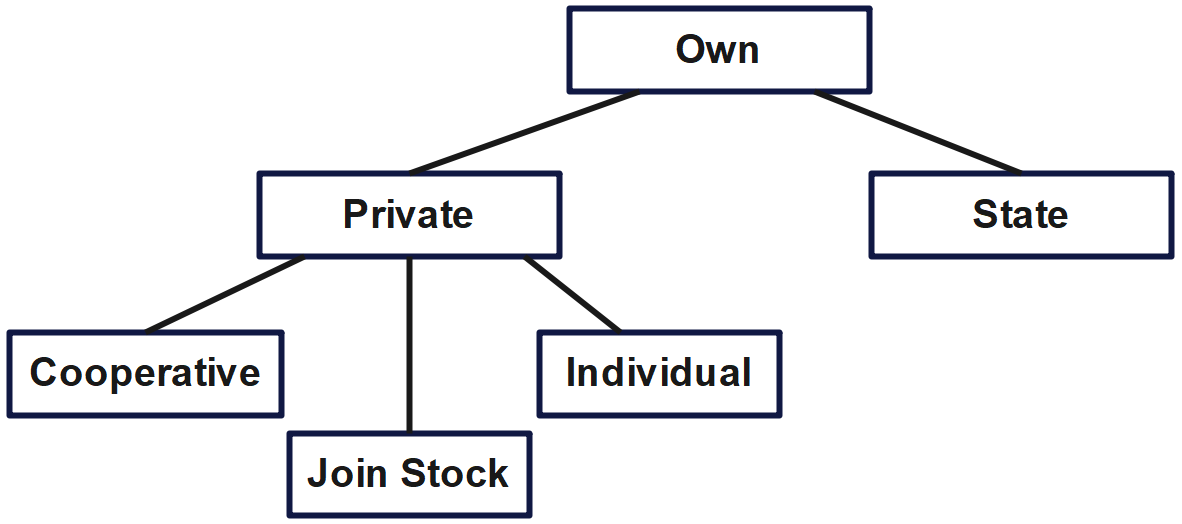
Here one should note the high flexibility of the shareholder form of ownership. Thus, if the controlling stake in a company belongs to the state (the shareholder form does not exclude such a scenario), then it would be more correct to classify the form of ownership of this company as state-owned, and if to one person — as individual. We draw attention once again to the fact that we use a model in which the shareholder form of ownership is not classified as collective.It is also difficult to find a term to describe an economy in which the overwhelming majority of enterprises will be organized on the principle of collective (or cooperative) ownership. Due to the lack of such a term at our disposal, we agree to designate such an economic system as a “cooperative economic system” or, simply put, a “cooperative economy”. For brevity, we will also designate the transition to such a cooperative economy by the term “socialization” (note also that this term may refer to nationalization).
Methods of transition
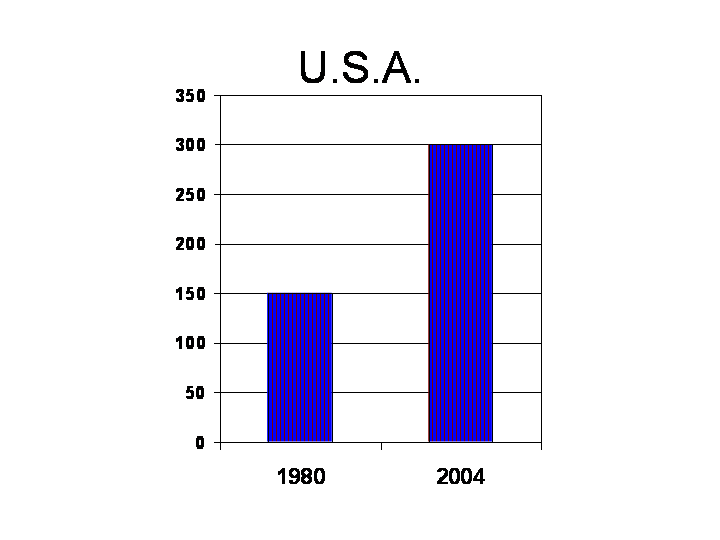
How can the transition to a cooperative economy be achieved? By and large, there are three main ways. The first is that cooperatives must win in fair competition. In fact, under standard social democracy, the conditions for this are already in place. For instance, even in a country with a less developed welfare state like the United States, the absolute number of cooperatives is growing4. Therefore, social democrats choose this path, which represents an “above the fray” stance — letting practice and competitive mechanisms reveal the best way of organizing (while nonetheless taking a set of measures that we will outline at the end of the article). This path also implies the possibility that an ultimate victory for collective forms will not happen, and they will occupy only a certain niche among a diversity of economic forms. But democratic socialists themselves seem to sense full well that there are few prerequisites for a complete transition, so this option is unlikely to suit them, as in that case it would be more logical for them to stand on social-democratic positions.
The second method is the transition to a cooperative economy “from above” by force. Simply put, this implies issuing orders that enterprises are now becoming cooperative. Either immediately or gradually. However, it would be madness to implant one of the forms of organization of enterprises from above if its higher efficiency has not been proven. This would mean a drop in the productivity of the entire economy, which will lead to economic problems (if not a catastrophe). This is equivalent to voluntarily reducing the efficiency of one’s own economy. Not to mention the fact that such orders will cause sharp rejection by those who do not wish to work within the framework of a cooperative economy (both entrepreneurs and workers – however, we will return to this), up to a real threat of civil war or an ultra-right coup. And if in Sweden socialists, faced with the opposition of non-socialist parties, decided to back down during an attempt to implement the Meidner plan, in Chile they decided not to back down, which led to the military coup of Augusto Pinochet. Therefore, deciding the outcome of competition between business and cooperatives from above means creating a real possibility of economic and political catastrophe.
It may be quite reasonably pointed out to us that, firstly, efficiency indicators may relate not only to the productivity of enterprises, and if we are talking about such efficiency indicators as providing better working conditions, they do not necessarily lead to victory in competitive struggle. It is for this reason that we will also examine this question further—whether working conditions will necessarily be better in cooperatives. Secondly, it may be argued that the lack of society’s transition to cooperatives may be connected not with their low efficiency, but with the difficulty of the transition process itself. For example, the transition to a single world language could be very useful, and the fact that it has not yet been switched to does not prove its inefficiency. However, we will note to this that, nevertheless, processes that could quite possibly end in a transition to a single language are being observed; they simply may take a large amount of time. In our opinion (and we will explain this further), the prerequisites for a universal transition to cooperatives are significantly fewer.
The third method is increased support for cooperatives. Creating more favorable conditions for them (tax breaks), financial stimulation (subsidies), and so on. Only by being based on such a method can democratic socialism be viable (because with the first method, one can wait forever for the victory of cooperatives, and the second leads to nothing but failure). At the same time, the economic expediency of this path is highly dubious. Why create obstacles for one sector (and benefits for one sector effectively mean the presence of obstacles for another, as they create a competitive advantage) if you have no certainty that the other is more efficient (and we do not have such certainty)? Why subsidize a sector that may turn out to be less efficient? This makes sense if it ultimately gives us significant advantages in improving the standard of living. However, if it does not, then this is simply an illiterate expenditure of state funds and tools. In the same situation, social democrats could invest in manufacturing, innovation, and science and win much more; their economy would simply be more efficient, the level of prosperity higher, and democratic socialists would fail. And for what? For their confidence that a cooperative economy is fairer? But social democracies have demonstrated such a level of reduction in social inequality that further reduction becomes simply harmful to development (we wrote here that the reduction of inequality has its limits, upon crossing which it enters into contradiction with the possibilities of economic development). Why, instead of a proven, working path, choose another — as we will see later, far from the most reliable?
We have working methodologies for reducing social inequality through the taxation system, which have been repeatedly tested in practice. And there is a concept of a cooperative economy that has not yet worked successfully anywhere. It would seem that making a choice in favor of the second example is a folly that has no reasonable basis. Why then do democratic socialists insist so fundamentally on this option?
Efficiency of cooperatives
We know examples of efficient cooperatives. Many can be cited — for example, the Mondragon Corporation, Associated Press, and John Lewis have long operated as cooperatives; Israeli kibbutzim can also be included here. Some believe that all of them are proof that cooperatives are more efficient as a form of ownership. However, this is incorrect logic — one can cite a sufficient number of, for example, very efficient joint-stock and even state-owned enterprises, but this alone will not prove that these particular forms of organization are more efficient. An indicator can only be a competently conducted comparison of forms of organization.

The first alarming factor is that the Socialization Committee, created by the Swedish Social Democrats in 1920 and tasked with studying the possibility of socializing enterprises, did not reach a conclusion about its necessity even after 15 years5. The committee studied the attempts of Finnish Social Democrats to organize a socialist economy during the Finnish Civil War, the Soviet experience, the ideas of Austrian Social Democrats, and so on. It was decided that the socialization of enterprises would not ensure the fulfillment of the Social Democrats’ goals — the creation of a free, prosperous, and fair society. Therefore, until the emergence of the Meidner Plan, Swedish Social Democrats did not consider the possibility of socializing enterprises. During almost 50 years in power in Sweden, the local Social Democrats did not carry out either the nationalization of industry or the mass buyout of enterprises by workers, and right-wing governments in the period from 1976 to 1982 engaged in nationalization much more extensively. This did not prevent Sweden from becoming one of the models of a welfare state, and the whole world from talking about the “Swedish model”.

The attempt to implement the Meidner Plan ended in failure. The project was extremely negatively received by non-socialist parties and ambiguously accepted in the labor environment (Rudolf Meidner himself wrote that the labor movement turned out to be unprepared to fight for this project6), and the SAP lost the upcoming parliamentary elections. Citizens did not want to turn the country into a testing ground for socialist experiments. After the Social Democrats returned to power, wage-earner funds were indeed created in small numbers, however, according to some estimates, this experiment did not ultimately contribute to strengthening the role of workers in production7, and its liquidation in 1991 went almost unnoticed. Subsequently, the Swedish Social Democrats correctly reasoned that they should stick to the initially conducted research.
Various studies do not provide unambiguous grounds to believe that the cooperative form of enterprise ownership is more efficient than the joint-stock or individual form. For example, comparisons of various forms of enterprises in the US plywood industry, conducted in the study by Ben Craig and John Pencavel, “Participation and Productivity: A Comparison of Worker Cooperatives and Conventional Firms in the Plywood Industry”, showed that the collective form of ownership “leads neither to significant efficiency gains nor to efficiency losses”8. In general, the authors arrive at the quite logical conclusion that if a significant superiority of cooperatives were observed, it is quite likely that they would dominate the industry9. A study by John Logue and Jacqueline Yates says, firstly, that very often worker ownership of enterprises turns out to be purely nominal, and secondly, regardless of this, in general, no positive effect exerted by collective forms of ownership on the productivity of an enterprise is observed10. At the same time, the authors note that in developed countries, for example in the USA, a positive influence of collective forms on productivity is observed if sufficient preparation of firm employees in the legal sense and in terms of understanding business management has been carried out. Other studies also say that a positive influence is observed only in those cases where the level of employee involvement is high not only at the highest but also at the grassroots level11. That is, if there is no initiative and desire among the broad working masses to participate in the management of enterprises and financial participation in their life, and there is also no corresponding knowledge, the transfer of their enterprise to collective forms of ownership will not yield advantages.
A broad study of cooperatives and conventional firms in France conducted by Fathi Fakhfakh, Virginie Pérotin, and Mónica Gago shows that “worker cooperatives are on the whole as productive as, or perhaps more productive than, conventional firms in most industries”12 — in this study one can see that in some industries cooperatives perform better, in others — conventional firms, but no clear advantage of either form is observed. A study by Spanish scholars asserts that “the average wage in the cooperative sector is lower than the average wage in capitalist firms”13, however, lower wages can be compensated for by more favorable working conditions. This is confirmed by a study published in the Industrial and Labor Relations Review, according to which the average wage in cooperatives is approximately 14% lower than in conventional “capitalist” enterprises14. Finally, the Human Resource Management Journal also notes that the results of various studies show that the difference in efficiency between the two types of firms (conventional firms and employee-owned firms) is insignificant15.
It should be noted that here we try not to take into account studies conducted by organizations that are somehow connected to the cooperative movement, or that could be biased due to connections with other interested forces.
There are some studies that reveal an advantage of cooperatives in efficiency, such as a study of the wine sector in the northwestern region of Italy16 (at the same time, the authors note that the issue requires further analysis to draw any conclusions). Some studies also talk about the presence of a positive impact of cooperatives on regional development, but in any case we are not talking about results significant enough to conclude that it is necessary to force the transition to this form. The recommendations that we will give in the conclusion of the article will be quite sufficient. The presence of studies that view cooperatives positively does not negate the presence of a significant number of studies that do not give an unambiguous answer about efficiency, which means we also cannot give such an answer. As for the difference between social democracy and democratic socialism, we have, for example, the opinion of one of the most authoritative economists of modern times, a specialist in development economics, Daron Acemoglu. In his article “Social Democracy Beats Democratic Socialism”, he writes:
Most recent efforts to socialize production (for example, in Latin America) relied on anti-democratic mechanisms… To simplify, European social democracy is a system that regulates the market economy, rather than replacing it… Such a system did not just avoid socializing the means of production. On the contrary, it supported the market economy, because it allowed productive firms to flourish, invest, and expand at the expense of less competitive rivals. Because wages were set at the sectoral level, a firm that increased productivity received direct benefits (that is, profits) from it. Unsurprisingly, under such a system, productivity in Sweden gradually grew, and Swedish companies became highly competitive in export markets… what is actually needed is not market fundamentalism or democratic socialism, but social democracy. America needs effective regulation to curb the concentration of market power. We need to strengthen workers’ rights, as well as systems of public services and social protection. Finally, last (but not least): America needs a new technology policy ensuring that the trajectory of economic development serves the interests of each and every one. None of this can be achieved by socializing firms, especially in an era of globalization and companies that rely on technology17.

Sometimes the efficiency of cooperatives is argued through studies that speak of their higher survival rate in market conditions, but this indicator is not an obvious proof of efficiency. Sometimes it is more efficient to close an enterprise and open a new one than to artificially support the life of an enterprise that has lost its efficiency or to work with low efficiency for a long time. In a society with a high level of unemployment, a high survival rate can be an important indicator. However, in a society with high economic “liquidity”, when losing a job is not something negative due to the fact that new enterprises are constantly opening and a new job can be found easily and quickly, company survival will not be a tangible plus. One can open and quickly close 10 different companies that will produce far more goods with a better ratio of output to time spent for their employees than 5 companies that operate continuously. The higher survival rate of cooperatives may be linked not to their efficiency, but to the fact that people could have invested their savings in equipment, and therefore are willing to work while “tightening their belts” so as not to lose a lot of money on attempting to sell equipment on the secondary market. But working while “tightening one’s belt” is not efficient work.
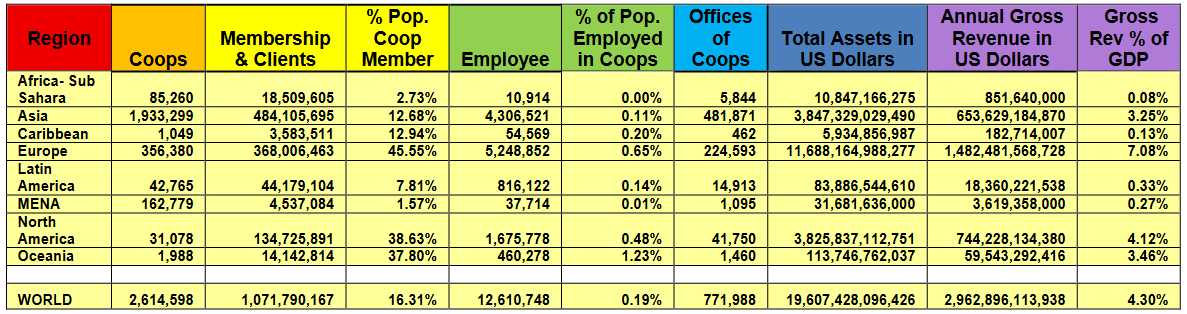
Besides studies, we have another indicator that should not be overlooked — the share of cooperatives in the economy. After all, if collective enterprises were more efficient, it would be logical to conclude that they would displace joint-stock and individual ones in the course of fair competition. However, as a UN report shows, the share of cooperatives in world GDP was in 2012 only about 4.3% (in Europe — 7.08%)18. A study by Georgeanne Artz and Younjun Kim found that in 2007 in the US, the ratio of worker cooperatives to the total number of companies was only about 0.004%19. Even Greg Brodsky, co-director of the Start.coop fund, believes that “despite the many advantages of cooperative business, the cold, hard reality is that 99.9% of new enterprises are still owned by traditional owners”20. All these figures force us to approach the issue of collective forms of ownership more cautiously.
Competition in the market for organizational forms leads to the survival of structures that best meet the requirements of the economic environment. At the same time, for each type, a niche is found within which it turns out to be more efficient than others. But its advantages can be negated by conditions prevailing in other sectors. Some sectors of the economy can be populated mainly by corporations, some — by partnerships, some — by cooperatives, etc. The picture of the distribution of organizational forms does not remain unchanged. The search for a new niche caused by sharp technological or institutional shifts is both painful and lengthy. If it ends unsuccessfully, this organizational form begins to occur less and less frequently and gradually leaves the stage.
Thus, there are no absolute advantages of one type of firm over all others; each form of ownership has its own set of transaction costs, which under certain conditions can make it the most efficient21.
Why is the share of cooperatives small? This may be related to Leibenstein’s X-inefficiency. X-inefficiency, briefly speaking, is a situation where, due to insufficient effort, a firm achieves a result at greater costs than it could have if it were more X-efficient. That is, if workers and managers worked better, if the organization of the firm were clearer and contributed more to its development, and so on. Management as a discipline is largely aimed at solving the problem of X-inefficiency. Professional management is carried out, for example, by business consultants, and statistics show that the effect of their consultations is very high22. So high that it is reflected as a significant component in growth through sales growth associated with an increase in X-efficiency without an increase in resource use. And here two important nuances arise. Firstly, cooperatives are more prone to the disease of direct democracy — even greater vulnerability to populists than representative democracy (which we will discuss further below). That is, it can be assumed that they are more likely to choose an illiterate, but at first glance attractive solution, than a professional, but difficult one to choose. Boards of directors, on the other hand, as professional managers to whom management issues are delegated, are more likely to make competent decisions under a normal organization of the system of their appointment (actually, among other things, for this reason representative democracy is more efficient). Secondly, while for traditional firms methods of increasing X-efficiency exist and are known, for cooperatives there are few of them and they accumulate slowly.
It may be answered to us that cooperatives originated recently, and this is the reason why they have not yet displaced other forms of ownership. However, the date of creation of the first cooperatives depends on what is considered a cooperative. Thus, the Soviet textbook on political economy considered that “for a long time primitive man lived mainly by gathering food and hunting, which were carried out collectively, using the simplest tools. What was jointly obtained was jointly consumed”23, and also cited the example of collective labor that Nikolai Miklouho-Maclay observed in the 19th century among the Papuans of New Guinea. Karl Marx also wrote about “primitive type of collective or cooperative production”24. We are not even speaking about later examples — thus, the Philadelphia Area Cooperative Alliance considers no less a person than Benjamin Franklin himself (this is the middle of the 18th century) as the creator of the first American cooperative, and also cites other examples from the end of the 18th and early 19th centuries25. Even in Russia, we have heard of such an experience as the Great Artel of Exiled Decembrists (although it can hardly be classified as a worker cooperative). Even if we do not attribute primitive societies to cooperative forms, more than 200 years is a period quite sufficient.
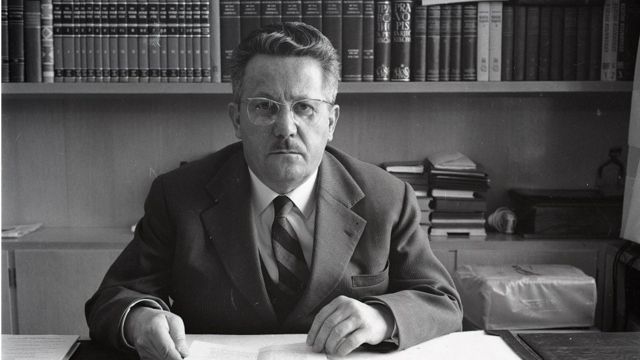
Have there been examples of a cooperative economy in history? Doctor of Economic Sciences Girsh Khanin cites the experience of Yugoslavia as an example, characterizing it as “the only long-term and mass experience of collective self-management in foreign countries of socialist orientation”26. Although one can hardly speak of collective ownership in Yugoslavia: property was rather state-owned, but enterprises were managed by workers who at the same time participated in profits27. What was the result of the Yugoslav experience? At first, the results were successful and in 1952-1965 the country’s economy experienced a “golden age”, second in terms of annual GNP growth rates only to Japan. But as noted in the journal “Historical and Economic Research”, the miracle turned out to be short-lived, and by 1962 a combination of factors such as excessive credit expansion, a rapid decline — and possible depletion — of personal savings of the population, and the failure of attempts to align the volume of industrial production with the boom in consumer demand caused such serious consequences that the miracle of the 1950s could not survive them. An interesting fact was noticed by economist Saul Estrin: growth was highest during the 1950s and early 1960s (approximately 13% per year), when state planning was in its prime, and halved with the increase in enterprise autonomy in 196528.
Khanin writes that “the slowdown of economic development in the 1970s, huge economic failures in the 1980s, and the political collapse of Yugoslavia in 1990 caused disillusionment with this experience. In addition to economic failures, the inability of self-managed enterprises to become a political pillar of socialism was disappointing: it fell (except in Serbia and Montenegro) as quickly and almost without resistance as in the countries of state socialism”29. Already by the 1970s, imbalances in the economy had formed (to which we will return further below), inflation reached an annual rate of 18.8%30 (which significantly exceeded the European average), and one of the fathers of Yugoslav socialism and the self-management system, Edvard Kardelj, shortly before his death in 1979 said that “our system is terrible and wrong”31. At the same time, criticism of the self-management system was taboo: for example, dissident Jovan Opacić was imprisoned in 1989 on charges of “committing a crime against socialist self-management… and against the reputation of Yugoslavia”32. At the same time, in that same year of 1989, during meetings between Ante Marković and US President George H. W. Bush, Yugoslavia, in exchange for a new financial aid package, agreed to broad economic reforms, including, among other things, the abolition of companies in collective ownership and managed by workers33. Khanin also points to evidence that the income gap under the Yugoslav system was huge34 (despite the fact that official data on income differentiation were not published). This could be related to the fact that instead of achieving the ideal of democratic self-management, a technocratic elite arose and began to manage enterprise operations35.
Of course, the Yugoslav political system was authoritarian, which reduces economic efficiency. But Yugoslavia did not achieve as impressive and long-term economic performance as some of the “developmental dictatorships”, which gives grounds to assume that worker self-management does not provide tangible advantages in economic development.
With all of the above, it is important to note that employee profit sharing, employee ownership participation, collective ownership, and socialization of property are four different entities. It would be a mistake to claim that if cooperatives are efficient, then this means that the transition to collective forms of ownership will also be efficient. After all, in the first case, cooperatives are created “from below”, and in the second — “from above”. In the first case, we are dealing most often with enterprises where the workers themselves wanted to create enterprises from scratch in precisely this format, were themselves engaged in their creation and went through all stages of their creation, and, accordingly, know perfectly well how to manage an enterprise through precisely such an organizational form. All of this is often absent in the second case. Accordingly, with such a difference in conditions, the results cannot be identical either. And assuming that in the absence of knowledge and a sufficiently high level of desire the results will be worse than in their presence will be completely logical. The aim of this article is to clarify the expediency of the transition to a cooperative economy, rather than to clarify the efficiency of employee profit sharing: that is a separate question.
However, the very lack of tangible advantages of cooperatives and worker self-management in economic efficiency is not yet a reason to say that the transition to a cooperative economy is unnecessary. There are other factors here that need to be taken into account. Of course, the first of them is that the very process of changing the ownership form of an already operating enterprise can have a negative effect. We will touch upon this later. Another factor is that cooperatives can positively affect the standard of living through a fairer distribution of power and resources. Things are not smooth with this either — we have already mentioned above that the study of Spanish cooperatives did not show their advantage in wage levels. The study of the experience of operating cooperatives (of which there is not so much yet) also does not allow us to assert a significantly fairer distribution of power and resources.
The question of efficiency is not idle. After all, some essentially propose that the state finance the buyout of enterprises by workers, which, naturally, will require huge expenditures. Even if we assume (which would be very presumptuous) that after changing the ownership form such an enterprise will be as efficient as consciously created from scratch cooperatives, the difference with the efficiency of an enterprise with an individual ownership form will be small at best (if we make a “concession” and believe those studies that say cooperatives are more efficient), but significant state budgets will be spent on this. This is simply an illiterate expenditure of state finances, which will already be limited, and which could be spent on implementing measures that will yield a significantly greater effect.
Mondragon experience
One of the most successful and well-known associations of cooperatives in the world is the Mondragon Corporation. This is indeed a very decent experience and generally successful. However, Galina Rakitskaya’s article “The Left’s Myth of Mondragon” shows why this experience most often does not solve those problems that democratic socialists believe it should solve. After all, there is a widespread opinion that cooperatives will allow solving social problems and contradictions on a conflict-free basis, fairly distributing income, and that the workers themselves will manage and make all decisions.

First, as in Yugoslavia, the need arose to delegate most issues to the administrative stratum (delegation is inevitable to save time): “Formally, workers have all the rights and opportunities to manage the cooperative. But in reality, in most cooperatives there are groups (administration or specialists) that prepare decisions. Taking advantage of the passivity of the workers, their insufficient awareness of the state of affairs (often the administration deliberately filters and distorts information), as well as the excessive gullibility of the workers, these groups one way or another pass the decisions they consider necessary. And far from always are these decisions beneficial to the entire collective, to the workers… In order for industrial democracy to be real rather than formal, conscious activity of workers, their desire to delve into all affairs of the cooperative, and the ability to organize within the cooperative itself are required. The workers of Mondragon cooperatives do not yet have enough of such activity and such skills”36.
That is, there are bosses in Mondragon cooperatives. Just as in joint-stock or individual enterprises. It would be an illusion to believe that a cooperative means the absence of a boss. But, unlike joint-stock and individual enterprises, there are no trade unions in Mondragon; moreover, their creation is prohibited: “trade unions cannot protect the rights and interests of workers if the workers are members of a cooperative… Laws defining the rights of trade unions, union members, as well as labor legislation in Spain apply only to wage workers”37. Holding strikes is also prohibited. The illusions of socialists that under cooperatives there will be no strikes and social conflicts were dispelled by the 1974 strike, when more than 400 cooperative members went on strike. They protested against the introduction of such changes in remuneration that created an unfair, from their point of view, differentiation of earnings. The administration fired the strike leaders (more than 20 people), and the general assembly did not protect the fired employees and supported the decision of the administration. The rest of the strikers were fined (in the amount of a monthly salary). And regarding strikes, a special internal decision was made prohibiting them.
Mondragon is not the only place where the introduction of a managerial stratum is observed. This is normal for very many types of cooperatives. For example, Doctors of Economic Sciences Alexander Sobolev and Sergey Khmelev cite the following opinion: “recently, a change in the organizational forms of cooperatives toward their increasingly creating hybrid structures has been observed. To be more competitive and act as international organizations, many cooperatives implement managerial entrepreneurship”38.
It is noted that “state guarantees in the field of labor, duration and regime of working hours, pension provision, etc. — all this is not for worker-owners (cooperative members). Provisions of sectoral agreements between trade unions and entrepreneurs also do not apply to cooperative members. Cooperatives were forced to create their own social security system”39. It is logical that in the event of bankruptcy of cooperatives, workers will be left without a pension. However, these are features of Spanish legislation — implementation of another model is also possible, according to which the state collects funds for the pension fund.
Legislative regulation of cooperative activity is generally a complex issue. We are all used to an 8-hour workday, and it would be foolish to set it for cooperatives — after all, workers there must decide for themselves what workday to establish. Will it not happen that as a result (say, if an unfavorable economic situation arises) a significant part of the workers will overwork significantly, which will lead to greater dissatisfaction with the economic system?
It would be a mistake to assume that the Mondragon Corporation exists without employing hired labor. It hires a considerable number of workers who, accordingly, do not have the right to vote at meetings and do not participate in profits. Under Spanish law, cooperatives cannot hire more than 10% of workers of the total number of their participants, but, as Rakitskaya notes, “literature mentions that in fact in Spanish cooperatives, including Mondragon ones, this norm is one way or another bypassed and more hired workers work in cooperatives than the law permits”. This allows us to conclude that in a cooperative economy, if hiring is not prohibited, cooperatives will hire workers who, of course, will occupy a lower position in society than even cooperative employees, not to mention the administration of the wealthiest cooperatives.
Are the wages of cooperative workers higher than those of hired workers? Here is how things stand with this question:
In Mondragon, they strive to ensure that the wages of workers in cooperatives do not lag behind the wages of workers in private capitalist enterprises — from the level provided for in agreements between trade unions and employers at enterprises of a similar industry profile. But, I repeat, the wage level, according to the laws, can be lower for cooperative members than at enterprises of other ownership forms. Low wages, a longer workday — this is completely legal if such is the will of the decision-making bodies in the cooperatives of the Mondragon group… A cooperative member, while working, receives only wages. A part of the profit is distributed among the cooperative members in proportion to their labor contributions — the level of remuneration and hours worked. Twenty years ago, a rule was introduced: a worker cannot use their share of the profit at any time they want. It is transferred to special individual accounts, and the accumulated amount can only be received upon resignation, including upon retirement. A cooperative member can periodically receive cash only in the form of bank interest accrued on the amount in their individual account40.
That is, a cooperative worker, just like a hired worker, has bosses, and just like a hired worker, has a salary. In the exact same way, there is a group of individuals to whom management functions are delegated, and in the exact same way, this group has its own interests that differ from the interests of the worker (only trade unions and strikes are banned). Thus, the real standard of living of a worker-owner (cooperative member) differs little from the standard of living of a hired worker41, and practice has forced Mondragon to make a serious departure from that utopian concept of a cooperative painted by democratic socialists.
What is the real wage disparity within a cooperative? Rakitskaya asserts: “The wage differences among various categories of workers in Mondragon cooperatives seem small: 1 to 4.5; in some cooperatives — 1 to 6. The tariff rate of manual non-mechanized workers is taken as a unit. However, the wages of the corporate management staff can exceed this minimum by 15 times”. Furthermore, hired workers are not included here — that is one. Only wage differences are indicated here — that is two (the difference in received profits is not included here). That is, the real gap can be much larger and exceed the gap in Scandinavian countries during the periods of the greatest influence of social democracy.
Some cooperative advocates claim that the average CEO salary among European companies is $7 million a year and the ratio of CEO-to-worker pay is 129:142. Meanwhile in Mondragon it is 9 to 1. But at the same time, it is mentioned there that the average value across Europe is “distorted by high-earning companies on the continent”. And companies are taken not only from developed social democracies, but also from various countries with right-wing policies, like Poland or Hungary. For an objective calculation when comparing with the social-democratic model, one should compare companies similar to the Mondragon Corporation by turnover, and preferably in developed social democracies like Denmark, as well as include Mondragon’s hired workers in the comparison. It seems that in this case, the comparison will look entirely different.
A little about mystifications
Regrettably, many Russian supporters of a cooperative economy are often deceived by various kinds of mystifications. One of such mystifications is the so-called “Chartaev system”:
The fantastic data cited in Chartaev’s articles and reproduced by his followers regarding the results of applying the model in 1985-1993 are astonishing. According to Chartaev, during the first three years, costs decreased fourfold and continued to decrease further, albeit less rapidly. Labor productivity grew 64 times; as for the characteristic of the growth in the standard of living, he claims that this indicator was an order of magnitude higher than in the country as a whole (without citing figures), and in confirmation of this he refers to an excess of birth rate over mortality and a huge volume of housing construction (commissioning 60 three-story houses for cooperative members in a single year)43. These data are still being reproduced in the works of Chartaev’s followers. True, even his great admirers, the more experienced economists Kolganov, Malyarov, and Rudyk, were embarrassed to cite these figures and provide others, more plausible: in the period from 1985 to 1993, with an unchanged number of workers, production volume increased by more than 14 times, labor productivity by 3 times (instead of 64 times according to Chartaev!), and the size of the administrative staff was reduced by 7 times44. However, here too a colossal discrepancy arises between individual indicators: with a 3-fold growth in labor productivity and the previous number of workers, production should have grown by 3 times as well, or the number of workers should have increased by 5 times, rather than remaining unchanged.
The provided data indicate that we are dealing, most likely, with a mystification that trapped many Russian supporters of collective self-management. It leaves a sad impression that this mystification remained unexposed. Perhaps it was beneficial not only to Chartaev, but also to his allies in the republic’s power structures45.
Also, in 2004, anti-globalization activist Naomi Klein along with her team released the film “The Take”, about the takeover of a factory in Argentina by workers. This created major PR for the worker self-management model, and the author of this article remembers how in Russian left-wing circles in the early 2010s this film was popularized in every way. The example of the Fasinpat factory was presented as proof of the success of collective ownership. In the film, many words were said in the spirit that the factory was working great, but the government, courts, and police bought by the capitalists wanted to take the enterprise away from the workers. The reality turned out differently — in 2009, the governor allocated 23 million pesos to buy out the factory from the former owners46 to transfer it to the cooperative. In the same year, it turned out that the factory was not so economically efficient and ended the financial year with liabilities exceeding 4 million pesos, while delayed payments to suppliers increased from 60 to 90 days47. The former president of Fasinpat stated that they could not continue working unless the government helped them. In 2014, reports appeared that the factory was operating at 20% of its capacity and urgently needed loans48. And, although cooperative representatives claimed they were not going to fire anyone, in 2021 media reported that instead of 400 people, only 150 work there today49; the factory’s official website indicated on Wikipedia, however, contains only advertisements for sexual services:

If we are talking about Russia, people usually recall the coffee cooperative “Chernyi”, which enjoyed very good media coverage, with some outlets even claiming that this coffee shop was created on socialist ideals50. Indeed, this is a good experience; the cooperative’s business is expanding, it produces quality products, and there is no mystification in its success. However, one should not be deceived and take it as a path toward improving the standard of living: in the very same interview where the founder of the cooperative said that he was building communism in the cooperative, he also admitted that for now they work 6 days a week51. In 2013, The Village wrote that at “Chernyi” they work 60 hours a week52. In 2021, a post appeared in the cooperative’s public page on the social network VK stating that they were looking for a person in production, with a salary of 35,000 rubles a month53 (though in the case of this vacancy it was already about 4 working days a week). Profit sharing was not mentioned in the job description, although a rather detailed description was given. From this, we can conclude that the cooperative uses hired labor, which we also heard about regarding Mondragon. The same publication, The Village, wrote that “in August ‘Chernyi’ operated at a loss — it lost 150,000 rubles; in September it made a profit of 27,000 rubles. Not too much for five co-founders: by law, in a cooperative, profits must be divided among them”54. From which we assume that the profit in this cooperative is divided among the co-founders, rather than among all employees.
Such examples tell us that one should take a critical stance toward reports claiming that a single example (or a few isolated examples) of an enterprise is proof of the superiority of collective ownership forms, and take nuances into account.
We cannot fail to mention that regarding cooperatives, certain individuals resort to various demagogic techniques — thus, communist Alexander Tarasov states in response to Galina Rakitskaya’s study of the Mondragon Corporation: “a union, by definition, is an organization of hired workers designed to protect the collective interests of these workers (as the weaker party in a social conflict) from the actions of the owners of the means of production. But the workers of Mondragon cooperatives are those very owners of the means of production. That is, according to Rakitskaya, they must fight against themselves”55. The manipulation here is built, as is often the case with communists, on inventing their own definition. For there are no generally accepted definitions of a trade union according to which it fights only with the owners of the means of production. A trade union can also fight against the state and against management in production, that is, other workers. That is why communists scratch their heads and express surprise where, with an objective approach to the issue, nothing surprising can be found. Had they not used invented definitions, there would be no problems.
Often socialists advocate for the socialization of enterprises on the grounds that it will be better for the employees. Let us first understand whether the workers themselves want this. How to formulate the question correctly? When talking about collective ownership, profit sharing is presented as its indispensable attribute, but they forget to mention that it also means sharing in losses. Yet this is precisely the case. The question posed to workers should sound as follows: do you want to participate in the profits and losses of the enterprise? A question asked taking into account only one of these two factors would be a deception of the respondents, concealing critically important information.
Unfortunately, we are unable to find surveys on this topic — let this be an idea for sociologists. Therefore, we cannot speak about the opinion held by the majority of workers, but we have examples that allow us to conclude that at least some of them would disagree.
Workers may express a favorable attitude toward collective management and ownership, mistakenly taking it only for profit sharing. Consider the experience of DuPont’s fibers division. In 1988, the company introduced an incentive pay plan for the division’s employees. Workers were to contribute a portion of their annual raise to a special fund until it contained 6 percent of their annual pay. Profits were to be distributed through a bonus system depending on how effectively the division operated. Bonuses were awarded in proportion to profit growth—the more profit the division’s activities brought in, the higher the payouts the workers received56. Some workers immediately expressed concern about “gambling” with a small, yet noticeable portion of their annual pay even before the plan took effect57. This concern was temporarily ignored when in 1989 profits exceeded projections and workers received $19 million in bonuses. But during the 1990 recession, the fiber division’s profits fell short of projections, and workers were set to lose part of their earnings under the incentive pay plan. The prospect of this loss did not suit the division’s 20,000 employees, who criticized the initiative. As a result, DuPont was forced to cancel the incentive plan, allowing the workers to avoid losses as well as future profit sharing.

Actually, this problem harbors immense danger. Especially considering that, for example, in the US 20% of businesses fail within two years, 45% within the first five, and 65% within the first ten years58. Democratic socialists, if they carry out the socialization of enterprises, will almost guaranteed have to face a very large number of dissatisfied workers.
Furthermore, collective ownership will imply that workers’ incomes will not be stable. Their wages will constantly change. Yet, for example, in Russia, stability became the main factor when choosing a job, according to a survey by the Rabota.ru portal, gaining 67% — more than high wages, which were chosen by 63% of respondents59. Another survey — by the AlfaStrakhovanie analytical center — showed that 73% of Russians during the pandemic do not want to open their own business due to fear of losing the social and financial stability that steady employment gives them60. Here is an example of a popular comment in online discussions:
And is hired work not working for oneself? I’m tired of this “working for the boss” talk. It was serfs who worked for a “boss” — the landlord. Now any hired employee gets a salary and spends it on themselves. Also, hired work provides opportunities for professional self-development, and that is working for oneself too. On the other hand, running your own business can also be called working for a boss, except the client plays the role of the boss. And your own business is far from a guarantee of super-profits. Many people with their own business get into such debts that hired employees only see in a nightmare. In short, in both cases you can earn big money, and in both cases you can go broke61.
Indeed, with a stable salary, a person can make plans for the future, to save money to buy something important. If there is no such stable salary, planning anything is difficult, and not everyone will be satisfied with such earnings — it is more convenient for such people to work receiving a fixed wage. Democratic socialists, as it turns out, fail to take into account the opinion and desire of these people, who are likely present in very many enterprises.
Another problem is that far from all workers express a desire to participate in managing the enterprise. This is quite understandable — instead of spending a significant number of hours a week participating in meetings, developing an enterprise strategy, and actually understanding the issues to be voted on, an ordinary person would prefer to spend those hours pursuing their own interests, of which they may have a great many: spending time with family or friends, birdwatching in the park, playing football, and so on. This assumption was confirmed by practice in Yugoslavia. As candidate of economic sciences Dmitry Travin notes, “the scariest thing for market socialism became the clear reluctance of people to participate in management… Everyone thought about wages, about goods that could be bought with them, but by no means about creating an effectively functioning self-managing society. The dream of forming a new human being collapsed in Yugoslavia (just as in the USSR)”62. The journal “Historical and Economic Research” wrote about this:
Workers’ opportunism was noted by many experts. Some even noted that workers of self-managed enterprises began to perceive their place on the staff as a perpetual annuity. Workers’ councils in enterprises did everything possible to preserve existing jobs and protect wages from any reduction and from inflation. In turn, directors tried to appease workers and made populist decisions, while enterprises consumed resources without investing them in modernization63.
Workers lacked genuine interest in enterprise management. In the joint work of Travin and Otar Marganiya, “European Modernization”, such features of the Yugoslav experience are noted:
The main reason why people did not feel like masters of production was the objective impossibility of the self-management system. Even in the presence of control over management by workers’ councils, the incompetence of the general masses made conscious and creative participation in making crucial decisions impossible. “Decisions on production, purchases, sales, etc.”, noted the leading specialist on the Yugoslav economy L. Sirc, “require expertise and information, and therefore in practice they remain in the hands of directors”64.
In practice, enterprise directors, of course, understood perfectly well that the collective could not manage the enterprise. Any attempt to achieve real self-management would have led to no decisions being made at all [we already mentioned problems of this kind in the article on direct democracy — A.R.]. But directors nevertheless had to reckon with the opinion of the collective. Therefore, they maneuvered on a narrow path running between the collapse of production and the rejection of management by workers. As a result, a peculiar system of pseudo-consensus was formed, in which management took into account some of the most important demands of the workers, but in daily activities actively manipulated the votes of members of the working collective. Instead of a system of self-management, a system of director dominance formed, creating the illusion that the enterprise was managed by its workers.
<…>
Practice has shown that workers are seriously ready to discuss only issues of working conditions and pay [which in developed countries they already discuss without any self-management and collective ownership through trade unions — A.R.], as for everything else, “management details” remained at the discretion of the administration. Members of the working collective sought to move quickly to a vote in order to pass even a decision whose meaning they had not yet properly grasped. As a rule, this was a decision proposed by the director.
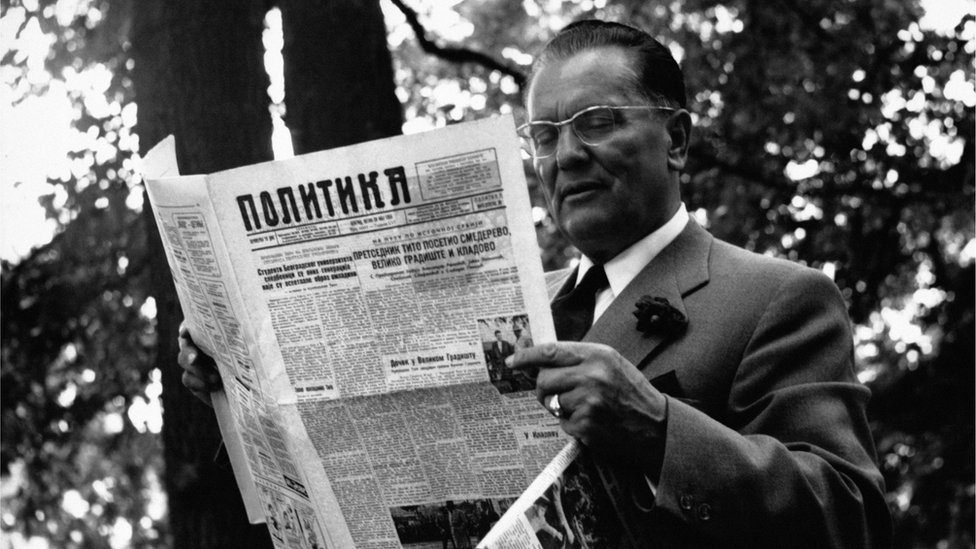
Such a consensus was short-lived. If workers found out that decisions made without serious thought for some reason did not work to satisfy their short-term interests, the issue arose again in one form or another and could even lead to conflicts. From time to time, workers went on strike. Tito, who believed that the self-management system should work in practice, was surprised by this: “Who are you striking against? Against yourselves”. Workers, however, did not feel that by striking and demanding high wages they were harming precisely themselves65.
Indeed, researchers note that “when making investment decisions, workers in self-managed firms were even more subject to short-term priorities at the expense of strategic ones than capitalist hired directors and top managers”66. And it is quite logical that they delegated issues of administration, strategy, and a significant portion of important production decisions to the director, while actually engaging only in those issues that could be expected of them through trade unions within a regular mixed economy. The vulnerability of workers to populism was also noted:
The collective was supposed to elect members of the workers’ council for a one-year term. However, there was always a lack of competent people for these positions, mainly due to the poverty and economic backwardness of Yugoslavia. Since meetings of the workers’ council took place after work and were unpaid, they were often perceived as a burden or hard labor. It happened that handfuls of people dominated and continuously worked in the councils, often getting there due to their popularity rather than professionalism67.
We could observe something similar in the Russian experience. When Nornickel was privatized in 1994, workers received 25% of the enterprise’s shares, but they could not take full advantage of this type of investment, and many sold those shares68. Some lacked the desire, some the ability to manage shares, and some the desire to learn how to manage shares. Workers did not show these qualities to a sufficient degree. As we know, public opinion placed the responsibility for the reforms of the 1990s on the reformers. In fact, democratic socialists will need to try very hard to carry out their reforms in such a way as not to become political corpses.
Sobolev and Khmelev note regarding the Russian experience in agriculture that “cooperatives are not perceived positively, which is why a bottom-up cooperative movement is practically absent… small landowners have no significant demand for cooperative organizations. The number of production cooperatives has sharply decreased and continues to noticeably decline, and with such trends, in the foreseeable future they will be reduced to a very small group. Post-Soviet organizations of Centrosojuz are also experiencing huge difficulties, despite their lenient jurisdiction and non-profit status: their numbers, as well as economic performance indicators, are also declining, and most importantly — this consumer cooperation is in a state of deep, prolonged crisis due to the loss of its identity”69.
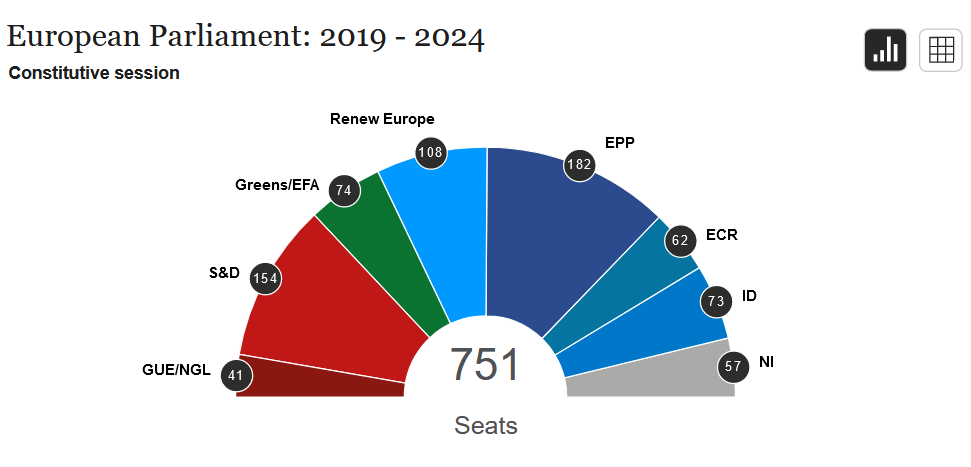
In addition to all of the above, one should also not forget how society in developed democracies views the prospect of socializing enterprises. We have already written above about what such demands turned into for the Social Democrats of Sweden, but we also know that in other European countries democratic socialists usually get a fairly small number of votes in elections — for example, in the European Parliament as of 2023 they hold only 5,46% of seats70. That is, electoral statistics show that the ideas of socialization do not yet have broad support among the masses, and democratic socialists should address this problem.
Other problems
The first problem of the transition to a cooperative economy is, of course, the aforementioned reluctance of a portion of workers to participate financially in the life of the enterprise (that is, both in profits and in losses), as well as in management. And we do not know how significant this portion is. Some workers hold liberal views, some fundamentally do not accept collective property. If we transition an enterprise to collective property, it means we compromise the interests of these people. One could say that these people are mistaken and their point of view is merely a result of propaganda, so it can be disregarded, but as we saw above, there are no grounds to assert this. Such a point of view has every right to exist, and ignoring it, that is, transitioning enterprises to collective property while a portion of the workers at these enterprises do not want this, is preparing a social explosion. If the left has learned anything from the experience of Salvador Allende in Chile, they should abandon this idea.

The reluctance of workers to participate in management inevitably leads to the emergence of a managerial stratum to whom management issues will be delegated. Which, in fact, is what happened both in Yugoslavia and in Mondragon. Socialists, of course, believe that they will manage to make everyone want to participate in production management. That is, to make everyone have the same values and views. We will simply remind that absolutely all attempts to do this ended in failure. And that even under the most totalitarian regimes, even in the DPRK, there are people who hate the main political line. Therefore, supporters of the non-cooperative model will remain. For example, there was a strike in Mondragon, which may baffle socialists — who are they striking against if the workers manage things there? The point is that the division of labor is inevitable, as is delegation, and directors appear in cooperatives. In essence, the difference from joint-stock forms of ownership here is small.
It should also be added that the initiative to create a business and the business idea usually belong to an entrepreneur — they can also belong to a cooperative, but creating a cooperative usually requires more time to agree on conditions and obligations, to monitor the fulfillment of these obligations, to draw up documents, and so on. Many of those who created a business in partnership with someone can share their experience of problems created by their partner, up to and including appropriating the entire business for themselves (those who have not created one can familiarize themselves with the experience of, for example, creating the social network Facebook, reflected including in the famous 2010 movie “The Social Network”), so all conditions and obligations must be carefully thought out, and this requires spending time and, often, money on a lawyer.
The second problem of a cooperative economy is that its proponents believe it helps to smooth out inequality more effectively, but in addition to inequality within the cooperatives themselves, they forget about inequality between enterprises. Some enterprises, such as educational institutions, may receive tiny profits or no profits at all. Accordingly, their workers will earn little money. On the other hand, workers in certain sectors of the economy — for example, the oil industry — will receive very high salaries in a cooperative economy. And the gap between their leadership and schoolteachers will likely be substantial. We know that, for example, in Yugoslavia, increasing the share of profit remaining at the disposal of enterprises accelerated the growth of wage differentiation71. Unsurprisingly, in some organizations, even a phenomenon such as passing jobs down by inheritance to children was recorded72. In the Mondragon Corporation, it was also noticed that “the gap between the incomes of workers on the one hand, and specialists and managers on the other, is gradually widening”73.
Under a cooperative economy, social inequality will run mainly along occupational lines, rather than along “employer-employee” lines. This will, in all probability, lead to the political dominance of certain professional guilds that will be interested in monetizing this dominance, which will lead to the dismantling of the cooperative economy (with which the professional groups deprived by it will also be dissatisfied by that time) and a return to a mixed economy. Alternatively, the new ruling class of society will become the administrators of cooperatives, who will be even more interested in formalizing the cooperatives into their own property.
Thirdly, many believe that purely logically the collective form of ownership should be more efficient — after all, if workers share in the profits, they feel their own benefit from working better. However, as a rule, other factors are overlooked in this case — for example, if a worker sees that other workers are working less, then he himself will also see no incentives to work better. After all, in that case it turns out that he shows more initiative, works with higher quality and productivity, but the benefit from this will be received not by him, but, for the most part, by the rest of the workers. This deprives the incentive to work more productively (especially if a person sees that other workers work little), but another one may appear: to work less than the rest, because in that case, by working less, the worker will still get as much money as the rest (this is the so-called “free-rider problem”, and enough has been written about it). Also, in addition to the already mentioned weakness of workers for populism identified during the practical implementation of worker self-management (which in itself is not a critical flaw, otherwise not a single democratic system in the world could demonstrate efficiency), it is logical to assume that if some members of a cooperative expect their participation in the company to be short-lived, they may then show reluctance to vote for investments that will yield a return for the cooperative in a longer perspective. Or, even worse, they may promote projects that bring short-term benefits, but dilute the cooperative’s capital. This may explain the short duration of successful results in Yugoslavia. Therefore, we should look not at logical arguments, but at the results of practical experiments. And they are not unambiguous.
Our country has a monstrous experience of collectivization, when peasants were herded into collective farms because it seemed logical to a certain group of political adventurers that collective farms would represent a more efficient form of organization than private farms, that everyone in the collective farm would work together, and there would be no kulak oppressors. This began with voluntary collectivization and ended in mass starvation and mass deaths of people during the period of collectivization. To this it is usually answered that collectivization was carried out incorrectly then. But how justified is the confidence that this time it will be carried out correctly? Today we consider it necessary to stay away from the ideas of imposing collective forms of ownership “from above”.
Fourthly, it is a mistake to believe that cooperatives represent some morally higher environment or lead to its emergence as such. For instance, in San Francisco trash collection cooperatives, workers of Italian descent resisted the growing presence of Hispanic and Black workers, demonstrating discrimination against them74. As we saw in the example of Mondragon, they also use hired labor and ban strikes. Furthermore, during the 2009 crisis, one of Mondragon’s cooperatives, Irizar, decided to leave the corporation because it did not want to support the group’s loss-making cooperatives75. It can be assumed that in a cooperative economy, a clash of interests between cooperatives will be inevitable.
Fifthly, democratic socialists themselves are unlikely to be pleased with the results of the transition to collective ownership. In their view, cooperatives are a deliverance from “wage slavery” and from bosses, but bosses will remain, as will hired labor (which is not an evil, but a logical result of the division of labor; the elimination of the division of labor is a step toward a primitive society, a rejection of the achievements of human civilization, which would be more in line with anarcho-primitivists). As we can see above, any significant positive changes are also not guaranteed, and a lot of effort will be invested. A positive reaction from the workers is not guaranteed, as they will necessarily place the responsibility for all negative results of their buyouts of enterprises on the “reformers” (and, most likely, will hate collective forms of ownership as well as democratic socialists themselves), while positive ones will most likely not be obvious enough to be noticed.
Sixthly, using the example of the Marxist Alexander Tarasov, we can see that Marxists will declare even this form of organization “exploitative”. As we know, Tarasov reacted negatively to the Mondragon experience, voicing such a comment to Rakitskaya’s text: “The entire text demonstrates that Mondragon cooperatives are part of the capitalist economy, they function according to market rules, workers’ rights in them are restricted and violated, and, moreover, workers are forced into auto-exploitation. Why after this ‘Mondragon’s experience is our experience’ and ‘workers can be proud of it’? God only knows… The liberation of labor in an individual enterprise is, by definition, impossible. These are the basics of Marxism”76. Therefore, we know who will be the first to declare democratic socialists enemies of the people, with whom one should deal using traditional communist methods. Marxists and democratic socialists themselves will most likely declare the experience in case of failure (and its likelihood is real) treasonous.
Seventhly, we already have an optimal and working model — this is joint-stock ownership under social democracy with strong trade unions and progressive taxation. Social democracy works, and this has been proven in practice. In the article on social-democratic economics, we wrote about the possibility of limiting the maximum number of shares in one hand, this measure will be quite sufficient to create a fairer economy without sacrificing efficiency.
Joint-stock ownership is highly liquid: someone’s withdrawal of their share from a business does not require the consent of the other co-owners, the obtaining of which is necessary in partnerships and cooperatives. In addition, joint-stock ownership serves as a good form of protection against “extortion”: a shareholder can sell his assets, but at the same time the specific assets themselves will not go anywhere from the firm, remaining in the “team”. Finally, the separation of the risk-taking function (the right to residual income) and the management function (the right to make most residual decisions) makes it possible to select the most talented managers regardless of how large or small their personal wealth is… Weighing the pros and cons of the joint-stock form of ownership, most specialists in the economic theory of organization come to the conclusion: although absolute controllability of managers is unattainable, the joint action of internal and external disciplining mechanisms limits the potential for opportunistic behavior and reduces the severity of the problem. The benefits associated with this organizational form outweigh its costs77.
Eighthly, speaking of transitioning enterprises to collective forms of ownership, we must clearly understand that this transition must always, in any case, occur with the consent of the owner and in the absence of pressure on him. In any other case, it is a gross violation of property rights, and the protection of property rights is one of the most important, key factors in creating a prosperous society. This is confirmed by the most authoritative researchers — such as Daron Acemoglu or James Robinson, as we wrote here and here (these articles cover the topic in more detail). In a society where your business can be taken away at any moment, there will be no developed entrepreneurship. And there are a huge number of examples where the lack of protection of private property led to an economic disaster. When enterprises are bought out by workers in the absence of good will from the previous owner, all trade secrets (connections with suppliers, clients, logistics organizers, and so on) may leave with the owner, and the efficiency of the enterprise’s operation will noticeably drop. What constitutes a trade secret is usually the most valuable. Thus, the secret of the Coca-Cola drink formula is known to only a few people in the world78. Logically, if the socialization of the enterprises of this corporation takes place without their voluntary consent, the company will not be able to produce the same drink, and the consequences could be unpredictable.
Ninthly, the success of stimulating the development of cooperatives through financial injections into this sphere from the state is questionable. Thus, Sobolev and Khmelev note regarding the Russian experience in agriculture that “attempts to launch a cooperative movement in the countryside clearly failed, since the state’s efforts to launch this movement as a whole occurred and continue to occur by creating cooperatives ‘from the top down'”79. Alexander Kurakin, Senior Researcher at the Center for Agrarian Studies of the RANEPA and the Laboratory for Studies in Economic Sociology at the HSE University, and Timur Gusakov, Researcher at the Center for Agrarian Studies of the RANEPA, wrote about cooperation for the magazine “Agrotechnics and Technologies” that “the national project breathed life into agricultural cooperation, but as soon as the state moderated its attention and support, the created cooperatives began to disappear as quickly as they were created. Moreover, the number of SACCs varies quite significantly across different regions of Russia. Here, attention to the development of the cooperative movement by local authorities plays a key role, many of whom perceive Moscow’s directives formally. But even where officials approach the matter creatively, success is far from always guaranteed. For example, there were interesting projects in the Belgorod region, but, unfortunately, they failed”80. By the national project, they mean the project “Development of the Agro-Industrial Complex”, when, for example, 8.1 billion rubles were allocated for the development of the network of agricultural consumer cooperatives, cooperatives were allocated 90 times more loans compared to 2005, and 2,134 agricultural processing, procurement, supply and sales, processing, and credit cooperatives were created81. As a result, many cooperatives were created “for the plan”, under pressure from the district administration, and overall “the PNP ‘Development of the Agro-Industrial Complex’ cannot radically change the socio-economic situation in the countryside”82. And here we are talking about the results of stimulating the creation of cooperatives, and not about transferring already operating enterprises to collective forms of ownership “from above”, where the problems can be even more serious (since in case of failure, already working enterprises could be lost).
In 2018, the portal Milknews reported that “the number of cooperatives in Russia is decreasing annually, and the number of actually functioning associations is falling even more. According to Rosstat, in our country at the moment there are fewer than 8 thousand agricultural cooperatives. Since 2010, the number of cooperatives in Russia has decreased, but year after year statistics show little dynamics. According to the Ministry of Agriculture, since 2012 the number of registered APCs in Russia has decreased by almost 2 thousand, ACCs (consumer cooperatives) — by one and a half thousand, and in fact the number of functioning ACCs has become 866 fewer”83. One of the problems named was “imposing cooperation from above”. Russian and Dutch specialists wrote that “the producers themselves are not always interested in cooperation, and it remains, rather, an exotic phenomenon than a familiar one”, “unlike Western agrarian cooperatives, a significant part of their Russian counterparts were created and managed with the help of local authorities. They arose ‘from above’, whereas in Western European countries they were formed by the ‘market players’ themselves. In many regions of Russia, such organizations became ‘projects’ of the district administration”, “in classic — the same Western European — agricultural cooperatives, the property belongs to their members. In Belgorod ones (with all the similarity of legislation) — the cooperative is actually managed by a small group of leaders. At the same time, the main mass of participants in the association is passive”84.
The journal “Young Scientist” also cited the Perestroika experience: “The first step toward the revival of cooperatives was taken in 1986, when the law ‘On State Enterprises’ was adopted. The purpose of this law was to create conditions for workers to receive additional earnings; production cooperatives at enterprises were supposed to create additional incentives to work. But the implementation of this law did not produce the expected results; it led to the deformation of the social principles of cooperation: the use of hired labor in cooperatives and the orientation of cooperation activities toward profit maximization”85. At the same time, according to Kurakin and Gusakov, “our country before the October Revolution demonstrated impressive success in this field”86 (referring to agricultural cooperation). Conclusions suggest themselves that not the imposition of cooperation by the state, but the creation of conditions for the creation of cooperatives by citizens themselves can yield real results in this area.
Tenthly, even the most developed economies of the world are cautious in experiments with transferring enterprises to collective ownership. The same countries that do not belong to the most successful countries with the highest indicators of standard of living (Russia belongs to these, having already served enough as a testing ground for economic experiments) should for a start at least repeat their success, and only then try to surpass it. If they cannot even follow the path of developed democracies, then what better result can we talk about? Why do Marxists and their like-minded peers take from the works of Marx not rational thoughts (such as the one according to which “the country that is more developed industrially only shows, to the less developed, the image of its own future”87), but ideas failed in practice about abandoning private property and entrepreneurship? In Russia at the moment it is necessary, first of all, to create a social democracy on the European model, and only then, years later, think about experiments with property (or not think about them). Such risky and dangerous experiments should be carried out by “headliners” among social-democratic states. Sweden did not succeed, but Russian democratic socialists believe that… Russia will succeed! However, for our country for now there have been enough experiments with forms of ownership, at this stage we just need to learn the best from others, and not follow a “special, chosen path”, like various failed states.

Eleventhly, we have listed only those problems of which we are aware. How many future problems are we not yet aware of? It is obvious that schemes such as state financing of enterprise buyouts are a real Klondike for scammers. For example, enterprising people will look for ways to get money to buy out an enterprise, after which they will quickly bankrupt it and get a job at another enterprise — thus, they will simply receive a very large lump-sum payment from the state, and the state will incur a large loss. Another example — persons carrying out the distribution of financing for enterprise buyouts will be able to inflate the buyout price, and split the difference with the right people, which will also hit the public budget very hard. It is possible to agree on the buyout of enterprises that exist only on paper. But there can still be many such loopholes for enrichment at the expense of society. In general, one can make huge money on this and become new oligarchs. Another example — the publication Milknews wrote about the imperfection of Russian legislation in the field of cooperatives. It mentioned that “in Sweden, for example, the distribution of cooperative income is clearly defined — all participants have one vote and one share”88, while in Russia different rules apply. Developing adequate legislation in this area will take years.
It should also be noted that the social-democratic movement, which calls for a transition to a cooperative economy, will scare away potential supporters who do not share this requirement. Such a movement will attract the electorate of democratic socialists, but it will not be able to attract enough of the audience of social democrats, who do not desire a transition to socialism, but desire social democracy.
Summary
What conclusions follow from all of the above? First, cooperatives, if created from scratch by workers, are not bad, but not so good that the transition to them should be forced. Rather, it is necessary to provide a clearly regulated procedure for creating cooperatives, ensure simplicity of registration and reporting for them, and also convey information about how they are created and how they work to as many people as possible. We know from research that the effectiveness of cooperatives is influenced by the legal and business literacy of their workers. This is also confirmed by the Yugoslav experience:
Self-management performance, to be sure, depends on a firm’s collective. If the people are energetic and enthusiastic, it will likely succeed; if the people are demotivated or incompetent, failure is likely. The degree of involvement in the firm’s affairs, as was found, tended to decline over time. And workers were more occupied with problems within their immediate view rather than truly strategic problems of developing their enterprises. Differences in the level of competence and creativity of personnel predetermined differences in the results of self-management for different firms89.
From this it follows that information and educational measures are acceptable, moreover on a mass scale, as well as through facilitating the conduct of cooperative business. This is achievable through the following measures:
- Introduction into the school curriculum of a block explaining the principles of operation of cooperatives;
- Creation of a federal TV channel owned by the national federation of cooperatives and telling about the work and problems of cooperatives around the world, about methods of increasing productivity, methods of ensuring fairness of income distribution and management in cooperatives, etc.;
- Creation of an Internet portal that allows cooperators to find partners for creating a cooperative;
- Simplification of registration and improvement of legislation in the field concerning the activities of cooperatives;
- Creation of a research center studying the experience of organizing cooperatives, conducting relevant research, and developing the most effective models of cooperative management;
- In the case of Russia, the transition of several major state media outlets to a cooperative form following the example of the Associated Press is possible;
- Conduct an open experiment with the buyout of enterprises by workers. Choose from 10 to 300 enterprises among those where: a) the trade union can formulate a plan and management structure of the enterprise, b) the workers by an overwhelming majority support the transition of the enterprise into their collective ownership, c) the owner is ready to sell the enterprise. Provide worker collectives with financial assistance in buying out the enterprise. If the experiment shows that after several years of operation the enterprise has improved economic indicators and indicators of worker well-being, overall offsetting public expenses, it is possible to expand its scope and take a larger number of enterprises. And carry out the expansion gradually.
The second conclusion is that one should not immediately, without such experimental checks fully open to criticism and the press (including the global press), carry out the transition of enterprises to a collective form of ownership “from above”. At the moment, it cannot be argued that cooperatives are more efficient than joint-stock enterprises. Nor do we have objective evidence of greater well-being of cooperative workers. There can also be plenty of problems observed in them — strike bans, inequality. At the same time, what Marxists consider a problem (for example, hired labor) also remains in them. That is, changing forms of ownership does not solve problems; the struggle of workers solves them. Practice shows that cooperatives are a complex tool that requires a high level of involvement and competence of workers in order to be effective. Also, far from all workers would like to work under such a model. Is it worth it for the state to carry out the buyout of enterprises by workers if the change in the form of ownership will not give the economy benefits in development (while, if the buyout is conducted with errors, the consequences can be catastrophic)? From the point of view of a democratic socialist, it is worth it, since one of their values is the establishment of socialism. From the point of view of a progressive social democrat, it is not worth it, since the establishment of socialism is not included in the list of their values, and forms of ownership are not important to them, what is important is whether they bring an improvement in the standard of living.
There is no point in investing significant funds in the buyout of enterprises by workers (and significant funds will be required for this) when the invested funds will give a better effect if invested in manufacturing, the development of civil society (including the strengthening of trade unions), or education. Social democrats first need to develop civil society, establish education and industry, resolve the issue with the tax system, and only after solving these problems think about supporting cooperatives. Nor is there any point in providing tax incentives to cooperatives — fair competition with equal conditions must be ensured between cooperatives and joint-stock enterprises, only in this way will we create an environment in which a more efficient form will give society more production. We should not subsidize the creation of cooperatives specifically, spending state budgets simply so that there are no businessmen. This is called “cutting off your nose to spite your face”. In our platform there should be a demand for subsidies for the manufacturing industry and, if a cooperative is such and meets our requirements, subsidizing it is possible. But we should not give it preference simply because it is a cooperative, preference should be given to those enterprises that will be more efficient and at the same time provide their workers with better conditions.
Third conclusion. The participation of enterprise workers in profits, enterprise management, and ownership of a portion of shares is a separate issue. All of this can be effective. In order to give an answer to this question, a separate study is required. This article considers issues of a different nature, namely the expediency of transitioning to a cooperative economy and the buyout of enterprises by workers with the help of the state.
Engaging in the investment of state funds in the buyout of enterprises by workers and the provision of benefits to cooperatives should be done by democratic socialists; this is not the business of social democrats. Otherwise, social democrats lose their identity, engaging in what a completely different movement — democratic socialists — engages in or should engage in; they lose specifically their potential supporters. Democratic socialists should take on the risks for experiments with property. Social democrats, on the other hand, should implement what definitely works and will give a positive effect, especially since in modern Russia a huge number of transformations will have to be implemented.
We thank Artyom Kuznetsov for assistance in writing the article.
- K. Marx, F. Engels. Collected Works. 2nd edition. Volume 4. – 615 p. – M.: State Publishing House of Political Literature, 1955. – p. 438.
- Collective ownership: basic concepts and terms // Finam.ru (www.finam.ru). September 18, 2005, 17:34. [Electronic resource]. URL: https://www.finam.ru/dictionary/wordf016D10002B/ (accessed: 13.12.2022).
- V.N. Dodonov. Great Law Dictionary / V.N. Dodonov, V.D. Yermakov, M.A. Krylova — 790 p. — M.: INFRA-M, 1998
- Olga Prushinskaya. Worker Co-ops Show Significant Growth in Latest Survey Data // Fifty by Fifty (www.fiftybyfifty.org). February 18, 2020. [Electronic resource]. URL: https://www.fiftybyfifty.org/2020/02/worker-co-ops-show-significant-growth-in-latest-survey-data/ (accessed: 18.12.2022).
- Timothy A. Tilton. Why don’t the swedish social democrats nationalize industry? Scandinavian Studies, Spring 1987, Vol. 59, No. 2, Rethinking the Welfare State (SPRING 1987), pp. 142-166
- I.N. Viktorov. Economic democracy in Sweden (1970-1980s) // Imagines mundi: almanac of research in general history of the 16th-20th centuries. – Ser. Albionica. Iss. 1. – Yekaterinburg: Ural University Press, 2001. – p. 121-134.
- Ibid.
- Ben Craig & John Pencavel, 1995. “Participation and Productiviy: A Comparison of Worker Cooperatives and Conventional Firms in the Plywood Industry”, Brookings Papers on Economic Activity, Economic Studies Program, The Brookings Institution, vol. 26(1995 Micr), p. 158.
- Ibid., p. 159.
- J. Logue, J. Yates. Productivity in cooperatives and worker-owned enterprises. Ownership and participation. Make a difference! – Kent State University, Ohio Employee Ownership Center, 2005. – p. 54.
- Georgeanne M. Artz, Younjun Kim. Business Ownership by Workers: Are Worker Cooperatives a Viable Option? // Iowa State University, Department of Economics. Working Paper No. 11020. November 2011 – p. 18.
- F. Fakhfakh, V. Pérotin, M. Gago. Productivity, Capital and Labor in Labor-Managed and Conventional Firms // TEPP – Institute for Labor Studies and Public Policies, 2011. – p. 20.
- J. Clemente, M. Díaz-Foncea, C. Marcuello, M. Sanso-Navarro. The Wage Gap between Cooperative and Capitalist Firms: Evidence from Spain. Annals of Public and Cooperative Economics, Vol. 83, Issue 3, pp. 337-356, 2012.
- J. Pencavel, L. Pistaferri, F. Schivardi. (2006). Wages, Employment, and Capital in Capitalist and Worker-Owned Firms. ILR Review, 60(1), p. 23.
- Ernest O’Boyle, Pankaj C. Patel, Erik Gonzalez-Mulé. (2016). Employee ownership and firm performance: a meta-analysis: Employee ownership: a meta-analysis. Human Resource Management Journal, 26(4). – p. 18.
- A. D’Amato, G. Festa, A. Dhir and M. Rossi. (2022), “Cooperatives’ performance relative to investor-owned firms: a non-distorted approach for the wine sector”, British Food Journal, Vol. 124 No. 13, pp. 35-52.
- Daron Acemoglu. Social Democracy Beats Democratic Socialism // Project Syndicate (www.project-syndicate.org). February 17, 2020. [Electronic resource]. URL: https://www.project-syndicate.org/commentary/social-democracy-beats-democratic-socialism-by-daron-acemoglu-2020-02/russian?barrier=accesspaylog (accessed: 15.10.2020).
- Measuring the Size and Scope of the Cooperative Economy: Results of the 2014 Global Census on Co-operatives // United Nations (www.un.org). April 2014. [Electronic resource]. URL: https://www.un.org/esa/socdev/documents/2014/coopsegm/grace.pdf (accessed: 18.12.2022).
- Georgeanne M. Artz, Younjun Kim, 2011. “Business Ownership by Workers: Are Worker Cooperatives a Viable Option?”, Iowa State University, Department of Economics. Working Paper No. 11020. November 2011. – p. 23.
- Greg Brodsky. The 3 Reasons We Don’t See More Cooperatively Owned Businesses // Medium (medium.com). July 29, 2020. [Electronic resource]. URL: https://medium.com/start-coop/the-3-reasons-we-dont-see-more-cooperatively-owned-businesses-e0172217e7ed (accessed: 06.01.2022).
- A.B. Tarushkin. Institutional Economics. Textbook. – 368 p. – SPb.: Piter, 2004. – p. 33.
- H. Leibenstein (1999). Allocative Efficiency vs. “X-Efficiency” // Landmarks of Economic Thought. Vol. 2. Theory of the Firm. SPb.: Economic School, pp. 432-447.
- K.V. Ostrovityanov, D.T. Shepilov, L.A. Leontiev, I.D. Laptev, I.I. Kuzminov, L.M. Gatovsky. Political Economy. Textbook. – 638 p. – M.: State Publishing House of Political Literature, 1954. – p. 15.
- K. Marx and F. Engels. Works. Second edition. Vol. 19. – 670 p. – M.: State Publishing House of Political Literature, 1961. – p. 404.
- Philadelphia Co-op History // Philadelphia Area Cooperative Alliance (philadelphia.coop). [Electronic resource]. URL: https://philadelphia.coop/phillycoops/philacoophistory/ (accessed: 08.01.2022).
- G. Khanin. Self-management and collective ownership: a panacea or a great illusion? Part 2. History, motivation and argumentation // Svobodnaya Mysl (www.svom.info). August 2022. [Electronic resource]. URL: http://www.svom.info/entry/645-samoupravlenie-i-kollektivnaya-sobstvennost-panace/ (accessed: 06.01.2022).
- A.S. Genkin. Successes and failures of the “Yugoslav experiment” / A.S. Genkin // Historical and Economic Research. — 2015. — Vol. 16, No. 3. — p. 502.
- Estrin S. Yugoslavia: The Case of Self-Managing Market Socialism / S. Estrin // Journal of Economic Perspectives. – 1991. – Vol. 5, – no. 4. – P. 187-194.
- G. Khanin. Self-management and collective ownership: a panacea or a great illusion? Part 2. History, motivation and argumentation // Svobodnaya Mysl (www.svom.info). August 2022. [Electronic resource]. URL: http://www.svom.info/entry/645-samoupravlenie-i-kollektivnaya-sobstvennost-panace/ (accessed: 06.01.2022).
- D. Travin. European Modernization: In 2 vols. Vol. 2 / D. Travin, O. Marganiya. – 572 p. – M.: AST Publishing House LLC; SPb: Terra Fantastica, 2004. – p. 236.
- E.V. Matonin. Josip Broz Tito / Evgeny Matonin. – 462 p. – M.: Molodaya Gvardiya, 2012. – p. 422.
- Liotta P. H. Paradigm Lost: Yugoslav Self-Management and the Economics of Disaster [Electronic resource] / P. H. Liotta // Balkanologie. — 2001. — Vol. 5, no. 1-2. — Access mode : http://balkanologie.revues.org/681
- A.S. Genkin. Successes and failures of the “Yugoslav experiment” / A.S. Genkin // Historical and Economic Research. — 2015. — Vol. 16, No. 3. — p. 511.
- Karadjis M. Yugoslav Market socialism: from heyday to collapse // http://mihalisk.blogspot.ru/2005/08/yugoslav-market-socialism-from-heyday.html (accessed: 03.03.2016).
- A.S. Genkin. Successes and failures of the “Yugoslav experiment” / A.S. Genkin // Historical and Economic Research. — 2015. — Vol. 16, No. 3. — p. 508.
- The Left’s Myth of Mondragon: (A Worker Collective Farm Under Capitalism): Materials for training seminars of the School of Industrial Democracy / Galina Yakovlevna Rakitskaya; … Institute for Prospects and Problems of the Country, Russian Academy of Natural Sciences. – 2nd ed. – M.: School of Industrial Democracy under the IPPS, 1998. – 26 p.; 21 cm. – (Industrial Democracy; No. 15).
- Ibid.
- A.V. Sobolev, S.A. Khmelev. Features and significance of cooperatives in agriculture // Scientific Publishing Center INFRA-M (naukaru.ru). [Electronic resource]. URL: https://naukaru.ru/ru/nauka/article/44774/view (accessed: 06.01.2022).
- The Left’s Myth of Mondragon: (A Worker Collective Farm Under Capitalism): Materials for training seminars of the School of Industrial Democracy / Galina Yakovlevna Rakitskaya; … Institute for Prospects and Problems of the Country, Russian Academy of Natural Sciences. – 2nd ed. – M.: School of Industrial Democracy under the IPPS, 1998. – 26 p.; 21 cm. – (Industrial Democracy; No. 15).
- The Left’s Myth of Mondragon: (A Worker Collective Farm Under Capitalism): Materials for training seminars of the School of Industrial Democracy / Galina Yakovlevna Rakitskaya; … Institute for Prospects and Problems of the Country, Russian Academy of Natural Sciences. – 2nd ed. – M.: School of Industrial Democracy under the IPPS, 1998. – 26 p.; 21 cm. – (Industrial Democracy; No. 15).
- Ibid.
- R. Lovato. Could Co-Ops Solve Income Inequality? // The Craftsmanship Initiative (craftsmanship.net). Summer 2020. [Electronic resource]. URL: https://craftsmanship.net/could-co-ops-solve-income-inequality/ (accessed: 06.01.2022).
- Chartaev M. Union of owners-co-owners // Alternatives. 1996. No. 2. – p. 86
- Kolganov A., Malyarov O., Rudyk E. What is the potential of the Chartaev system? Instead of an afterword. // Alternatives. 1996. No. 2. – p. 89
- G. Khanin. Self-management and collective ownership: a panacea or a great illusion? Part 2. History, motivation and argumentation // Svobodnaya Mysl (www.svom.info). August 2022. [Electronic resource]. URL: http://www.svom.info/entry/645-samoupravlenie-i-kollektivnaya-sobstvennost-panace/ (accessed: 06.01.2022).
- Zanon: Es ley N° 2656 la expropiación de la fábrica // Neuquen informa (www.neuqueninforma.gob.ar). September 27, 2012. [Electronic resource]. URL: https://www.neuqueninforma.gob.ar/zanon-es-ley-n-2656-la-expropiacion-de-la-fabrica/ (accessed: 06.01.2022).
- Grave situación financiera de la cerámica Fasinpat // LM NEUQUEN (www.lmneuquen.com). April 13, 2013. [Electronic resource]. URL: https://www.lmneuquen.com/grave-situacion-financiera-la-ceramica-fasinpat-n61104 (accessed: 06.01.2022).
- Fasinpat funciona al 20% por no acceder a créditos // LM NEUQUEN (www.lmneuquen.com). March 1, 2014. [Electronic resource]. URL: https://www.lmneuquen.com/fasinpat-funciona-al-20-no-acceder-creditos-n216657 (accessed: 06.01.2022).
- Fasinpat: 20 años de resistencia y gestión obrera en Neuquén // Antena Libre (www.antena-libre.com.ar). December 1, 2021. [Electronic resource]. URL: http://www.antena-libre.com.ar/2021/12/01/fasinpat-20-anos-de-resistencia-y-gestion-obrera-en-neuquen/ (accessed: 08.01.2022).
- Cooperative “Chernyi”: how philosophers created a coffee shop on socialist ideals // Wanderlust (wanderlust.wtf). [Electronic resource]. URL: https://wanderlust.wtf/cooperative-chernyi (accessed: 08.01.2022).
- Ibid.
- Red plague: New cooperators against capitalism // The Village (www.the-village.ru). October 23, 2013. [Electronic resource]. URL: https://www.the-village.ru/business/experiment/152747-co-ops-are-the-new-black (accessed: 08.01.2022).
- There is a job! Looking for a person to join us in production… // Cooperative Chernyi (vk.com). August 27, 2021. [Electronic resource]. URL: https://vk.com/wall-53745983_4039 (accessed: 08.01.2022).
- Red plague: New cooperators against capitalism // The Village (www.the-village.ru). October 23, 2013. [Electronic resource]. URL: https://www.the-village.ru/business/experiment/152747-co-ops-are-the-new-black (accessed: 08.01.2022).
- G. Rakitskaya. The Left’s Myth of Mondragon // Saint-Juste (saint-juste.narod.ru). [Electronic resource]. URL: http://saint-juste.narod.ru/mondragon.html (accessed: 06.01.2022).
- Nancy L. Perry, Here Come Richer, Riskier Pay Plans, Fortune, December 19, 1988, pp. 50-58.
- All Eyes on Du Pont’s Incentive Pay Plan, Wall Street Journal, December 5, 1988, p. A-1.
- Table 7. Survival of private sector establishments by opening year // U.S. Bureau of Labor Statistics (www.bls.gov). [Electronic resource]. URL: https://www.bls.gov/bdm/us_age_naics_00_table7.txt (accessed: 08.01.2022).
- Russians named the main factors when choosing a new job // RIA Novosti (ria.ru). March 21, 2022, 04:07. [Electronic resource]. URL: https://ria.ru/20220321/rabota-1779193822.html (accessed: 08.01.2022).
- Poll: most Russians during the pandemic preferred hired work to their own business // TASS (tass.ru). [Electronic resource]. URL: https://tass.ru/obschestvo/12832339 (accessed: 06.01.2022).
- Which is better: working for yourself or as a hired employee? // Tinkoff Journal (journal.tinkoff.ru). February 22, 2022. [Electronic resource]. URL: https://journal.tinkoff.ru/discuss/naem-ili-na-sebya/ (accessed: 06.01.2022).
- D. Travin. Great Reformers. Josip Broz Tito. In Search of a Third Way // Delo (www.idelo.ru). December 6, 2008. [Electronic resource]. URL: http://www.idelo.ru/527/22.html (accessed: 06.01.2022).
- A.S. Genkin. Successes and failures of the “Yugoslav experiment” / A.S. Genkin // Historical and Economic Research. — 2015. — Vol. 16, No. 3. — p. 505.
- Sirc L. The Yugoslav Economy under Self-management. N.Y., 1979 – p. 44.
- D. Travin. European Modernization: In 2 vols. Vol. 2 / D. Travin, O. Marganiya. – 572 p. – M.: AST Publishing House LLC; SPb: Terra Fantastica, 2004. – pp. 233-234.
- A.S. Genkin. Successes and failures of the “Yugoslav experiment” / A.S. Genkin // Historical and Economic Research. — 2015. — Vol. 16, No. 3. — p. 504.
- A.S. Genkin. Successes and failures of the “Yugoslav experiment” / A.S. Genkin // Historical and Economic Research. — 2015. — Vol. 16, No. 3. — pp. 503-504.
- Part of Nornickel’s shares will transfer to its employees // TASS (tass.ru). September 17, 2022, 16:56. [Electronic resource]. URL: https://tass.ru/ekonomika/15784761 (accessed: 06.01.2022).
- A.V. Sobolev, S.A. Khmelev. Features and significance of cooperatives in agriculture // Scientific and Publishing Center INFRA-M (naukaru.ru). [Electronic resource]. URL: https://naukaru.ru/ru/nauka/article/44774/view (accessed: 06.01.2022).
- 2019 European election results // European Parliament (www.europarl.europa.eu). July 02, 2019, 10:00. [Electronic resource]. URL: https://www.europarl.europa.eu/election-results-2019/en/tools/widget-country/2019-2024/ (accessed: 08.01.2022).
- A.S. Genkin. Successes and failures of the “Yugoslav experiment” / A.S. Genkin // Historical and Economic Research. — 2015. — Vol. 16, No. 3. — p. 502.
- Zukin S. Self-Management and Socialization // Yugoslavia in the 1980s. London, 1985. – p. 91.
- The Left’s Myth of Mondragon: (A worker collective farm under capitalism): Materials for training seminars of the School of Labor Democracy / Rakitskaya Galina Yakovlevna; … Institute of Prospects and Problems of the Country, Russian Academy of Natural Sciences. – 2nd ed. – M.: School of Labor Democracy under IPPS, 1998. – 26 p.; 21 cm. – (Labor Democracy; No. 15).
- Ben Craig & John Pencavel, 1995. “Participation and Productivity: A Comparison of Worker Cooperatives and Conventional Firms in the Plywood Industry”, Brookings Papers on Economic Activity, Economic Studies Program, The Brookings Institution, vol. 26(1995 Micr), p. 159-160.
- C. Monoz. All in this together // The Economist (www.economist.com). March 29, 2009. [Electronic resource]. URL: https://www.economist.com/business/2009/03/26/all-in-this-together (accessed: 07.01.2022).
- G. Rakitskaya. The Left’s Myth of Mondragon // Saint-Juste (saint-juste.narod.ru). [Electronic resource]. URL: http://saint-juste.narod.ru/mondragon.html (accessed: 06.01.2022).
- P.S. Lemeshchenko. Developing firm: interdisciplinary framework of analysis // Scientific papers of Donetsk National Technical University. Econ. Series – Donetsk, 2013. – P. 197-210 (1 p.l.).
- Who knows the secret formula of Coca-Cola? // Coca-Cola Great Britain (www.coca-cola.co.uk). January 10, 2020. [Electronic resource]. URL: https://www.coca-cola.co.uk/our-business/faqs/who-knows-the-secret-formula-of-coca-cola (accessed: 08.01.2022).
- A.V. Sobolev, S.A. Khmelev. Features and significance of cooperatives in agriculture // Scientific and Publishing Center INFRA-M (naukaru.ru). [Electronic resource]. URL: https://naukaru.ru/ru/nauka/article/44774/view (accessed: 06.01.2022).
- A.K. Kurakin, T. Gusakov. Agricultural cooperation in Russia and abroad // Agro Investor (www.agroinvestor.ru). January 25, 2018. [Electronic resource]. URL: https://www.agroinvestor.ru/opinion/article/29287-selskokhozyaystvennaya-kooperatsiya-v-rossii/ (accessed: 07.01.2022).
- S.Yu. Barsukova. Priority national project “Development of the Agro-Industrial Complex”: idea and implementation // HSE Publications (publications.hse.ru). [Electronic resource]. URL: https://publications.hse.ru/pubs/share/folder/06ss13f8j3/62649125.pdf (accessed: 08.01.2022).
- Ibid.
- Artyom Falchev. 5 problems of cooperation: why can’t we build Russian Valio? // Milknews (milknews.ru). [Electronic resource]. URL: https://milknews.ru/longridy/5-problem-kooperacii.html (accessed: 08.01.2022).
- A. Kurakin, O. Visser. Will agricultural cooperatives help feed city dwellers // Scientific and educational portal IQ (iq.hse.ru). [Electronic resource]. URL: https://iq.hse.ru/news/205783953.html (accessed: 08.01.2022).
- K.V. Aleksandrova. Development of cooperation in Russia // Young Scientist (moluch.ru). December 18, 2014. [Electronic resource]. URL: https://moluch.ru/archive/80/14539/ (accessed: 07.01.2022).
- A.K. Kurakin, T. Gusakov. Agricultural cooperation in Russia and abroad // Agro Investor (www.agroinvestor.ru). January 25, 2018. [Electronic resource]. URL: https://www.agroinvestor.ru/opinion/article/29287-selskokhozyaystvennaya-kooperatsiya-v-rossii/ (accessed: 07.01.2022).
- K. Marx and F. Engels. Works. Second edition. Volume 23. — 907 p. — M.: State Publishing House of Political Literature, 1960. — p. 9-10.
- Artyom Falchev. 5 problems of cooperation: why can’t we build Russian Valio? // Milknews (milknews.ru). [Electronic resource]. URL: https://milknews.ru/longridy/5-problem-kooperacii.html (accessed: 08.01.2022).
- A.S. Genkin. Successes and failures of the “Yugoslav experiment” / A.S. Genkin // Historical and Economic Research. — 2015. — Vol. 16, No. 3. — p. 504.