
“Life was good under Stalin”
In this article, “Logic of Progress” examines a stereotype promoted by Stalinist propagandists in the interests of the nomenklatura. It claims that under the dictatorship of Joseph Stalin, the USSR had a high standard of living. Is that really the case?
When we examined the achievements of the Bolsheviks, we noted that the standard of living under their rule generally increased, and the NEP period was relatively progressive compared to most of the rest of Russian history. However, in 1929, Joseph Stalin assumed full power, as we showed in a separate article. What was the standard of living under him? Economic growth had already been set in motion by the Bolsheviks, and reforms in the sphere of the welfare state were also largely carried out by them; Stalin did not play any particularly special role here. So how did people live at that time?
Stalinists claim that everything was excellent. Alexander Usovsky, in his book “God save Stalin! Tsar of the USSR Joseph the Great”, citing the words of Valentin Berezhkov, writes:
If one were to list the products, beverages, and goods that appeared in stores in 1935, my Soviet contemporary would probably not believe it. Black and red caviar stood in wooden tubs at quite affordable prices. Enormous carcasses of salmon and trout lay on the counters, meat of all kinds, hams, piglets, sausages whose names no one now remembers, cheeses, fruits, berries — all of this could be bought without any queues and in any quantity1.
We wrote in the relevant article that for the nomenklatura under Stalin there was real communism (at the expense of the rest of the population). Valentin Berezhkov worked in the central apparatus of the People’s Commissariat for Foreign Affairs, that is, he was a member of this “mafia” and could hardly have said anything different. Joseph Stalin himself, on November 17, 1935, in a speech at the First All-Union Conference of Stakhanovites, stated: “Life has become better, comrades. Life has become more cheerful”2. Let us check, based on objective sources, whether life really became better.
Contents
- Food consumption
- Housing
- Transition of part of education to a paid basis
- Anti-worker legislation
- Inflation, increase in production norms
- Tax on childlessness
- Pensions
- Shortages
- Famine
- Pressure on the institution of the family
- Abolition of holidays
- Stalin’s personal initiative
- Opinions of USSR citizens
- Conclusion
Food consumption
Throughout the entire period of Joseph Stalin’s rule, the level of consumption of basic food products by Soviet citizens never even reached the level of 1928–29. According to a report by the Central Statistical Administration of the USSR, the Institute of Economics of the Academy of Sciences of the USSR, and the Institute of Nutrition of the Academy of Medical Sciences of the USSR to N.A. Bulganin on per capita consumption of basic food and industrial goods in the USSR3:
- Consumption of grain products (bread converted into flour, flour, cereals, pasta) in 1928 amounted to 214 kilograms per capita per year, in 1940 – 195 kilograms, in 1950 – 172 kilograms;
- Consumption of vegetables and melons in 1928 amounted to 72 kilograms per capita per year, in 1940 – 67 kilograms, in 1950 – 51 kilograms;
- Meat and lard – 32 kg in 1928, 24 and 26 kilograms in 1940 and 1950 respectively;
- Milk and dairy products – 182 kilograms in 1928, 143 and 172 in 1940 and 1950 respectively.
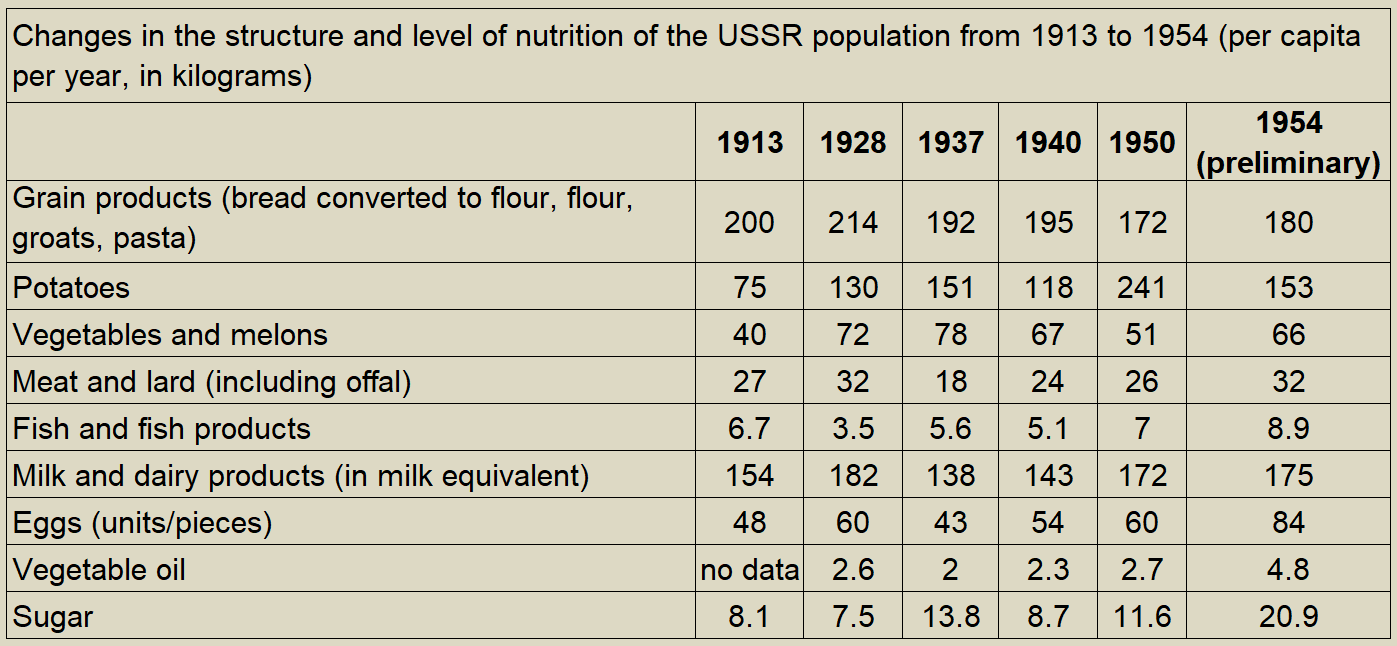
Only the consumption of potatoes increased significantly. And this does not take into account the ever-growing gap in consumption between the nomenklatura and the working population. The report of the Central Statistical Administration concluded: “The actual dietary norms of the population of the USSR are below scientific standards for all products except grain products and potatoes. It is necessary to ensure a more rapid increase in the diet [of the population] of the USSR in milk and dairy products, meat, fish, eggs, fruits, vegetables, and melons”4.
Already in April 1929 (in the same month when the Stalinists at the plenum crushed the last opposition “Bukharin group”), Stalin’s government introduced bread ration cards, by the end of the year — for all types of food products, and then for some industrial goods as well5. The rationing system lasted until 1935.
According to Vladimir Polevanov, the number of sets of 9 basic food products that could be purchased with one salary in 1927 amounted to 19.29. As a result of Stalin’s domestic policy, by 1940 this figure had decreased to 8.28, and in 1947 (when postwar devastation added to the problems) it reached its minimum for the entire 20th century — 4.85. By 1953 it was brought up to 14.45, which was still lower than the 1927 level6 (despite the fact that after the Civil War Soviet Russia did not receive reparations, whereas Stalin’s USSR did receive them from several countries).
The number of cattle (one of the key indicators of agricultural development) under Stalin only declined. According to the already mentioned report of the Central Statistical Administration:
As of January 1, 1928, per 100 people in the USSR there were 40 head of cattle, including 20 cows, 71 sheep and goats, and 15 pigs; and as of January 1, 1954, there were 28 head of cattle, including 13 cows, 59 sheep and goats, and 17 pigs7.
The greatest decline occurred during the years of the first “Stalinist” Five-Year Plan (1928–1932), according to a memorandum addressed to I.V. Stalin with the main data from the livestock census dated May 4, 1932: “the reduction in livestock over the past four years amounts to: working horses — 4.7 million head (20.9%), cattle — 27 million head (38.3%), including cows — 7.7 million head (24.9%), young stock and oxen — 19.6 million (4.9%), sheep — 82 million head (61.7%), and pigs — 11.5 million head (44.1%)”8. In total, more than 150 million head of livestock were lost (in some regions the losses were simply catastrophic — for example, in Kazakhstan in 1933 the livestock population decreased by almost 91% compared to 19299). Without Stalin’s collectivization (which should be examined separately), these 150 million head of livestock could have been preserved in the country’s economy.
Housing
In 1930, the average living space per person in Moscow was 5.5 square meters, and by 1940 it had decreased to almost 4 square meters1011. In the provinces, the housing situation was often even worse. For example, in Donbas already in the mid-1930s, 40% of workers had less than 2 square meters of living space per person12. In 1953, the average housing norm in Soviet cities was 4.5 square meters per person13. Doctor of Historical Sciences Vladimir Gorlov notes:
Only the fortunate citizens lived in separate apartments: scientists, writers, famous actors, officials who inhabited high-rise buildings and Stalin-era houses with decorative moldings in the vicinity of Gorky Street. Orders for separate apartments were also given to distinguished workers — Stakhanovites, shock workers. There was an acute housing crisis, and therefore even the best connections and social status did not make it possible to obtain a separate apartment. Government officials were overwhelmed with requests and complaints from Soviet citizens about the lack of suitable housing14.
And only in the era of Nikita Khrushchev “did something enter the everyday life of Soviet citizens that had been unheard of under I.V. Stalin — a separate apartment for a family… Khrushchev’s five-story buildings became a salvation for millions of Soviet citizens who lived in basements, barracks, overcrowded communal apartments. If they had not been built, for decades millions of our citizens would have continued to live in basements”15. At the same time, it should be noted for the sake of fairness that Joseph Stalin inherited the problem of an acute housing crisis from the Bolsheviks, and they, in turn, from the tsarist government. Therefore, the very emergence of the crisis cannot be blamed on him. What can be criticized is the lack of tangible progress, which contradicts the myth of the efficiency of the planned economy and the high standard of living under Stalin.

According to the collection “Results of the implementation of the First Five-Year Plan for the development of the national economy of the USSR”, in 1929 the total housing stock in Soviet cities amounted to 162.46 million m²16, while in 1940 (according to a report by the Central Statistical Administration of the USSR to L.M. Kaganovich on the condition of the urban housing stock in 1940–1952) it amounted to 167.2 million m²17. That is, over 11 years of a planned economy in peacetime, no noticeable progress occurred. Doctor of Engineering Sciences and specialist in the history of Stalinist architecture Dmitry Khmelnitsky reports:
From the 1953 report it is clear that over 30 years the housing situation in the USSR sharply deteriorated. According to calculations from 1928, in order to reach the sanitary norm by the end of the first Five-Year Plan, it was necessary to build 100 million m² of housing. In 1953, 96 million m² were still lacking to reach the same norm. In addition, 18 million m² of housing were located in barracks, which even by Soviet standards could not be considered permanent housing. It should also be taken into account that in 1928 about 26 million urban residents lived under such conditions, while in 1952 about 80 million did18.
From the aforementioned report of the Central Statistical Administration of the USSR to Lazar Kaganovich it also follows that in 1940 only 47% of housing space was equipped with running water, and by 1952 this percentage had decreased to 46. Sewerage was available in 40% of housing space in 1940 and 41% in 195219.
Transition of part of education to a paid basis
On October 2, 1940, after the mass destruction of socialists by Stalin’s group, the Resolution of the Council of People’s Commissars of the USSR “On the introduction of tuition fees in the upper grades of secondary schools and in higher educational institutions of the USSR and on changes in the procedure for awarding scholarships” was issued20, which, firstly, in violation of the Constitution, deprived low-income families (numerous in such a poor country) of the opportunity to complete secondary education and obtain higher education, and also abolished scholarships for everyone except those “showing excellent performance”. The ban, of course, did not apply to the nomenklatura. Here is how Wolfgang Leonhard, the son of a German communist who fled to the USSR and was studying at a university at the time, recalled it:
I had been studying at the institute for four weeks when, on the morning of October 3, 1940, there was suddenly a sharp turn in all student life.
Someone who had happened to get up earlier brought a newspaper and was now banging on the doors, shouting: “The scholarships have been abolished!”
— You’ve gone mad, idiot! — said my roommate, but still began to dress quickly. I followed his example. When we went out into the corridor, the disturber was already surrounded by a group of students. Holding “Pravda” in his hands, he was reading aloud the decree of the Presidium of the Council of People’s Commissars of the USSR on the introduction of tuition fees in the upper grades of schools and in higher educational institutions.
“Taking into account the rise in the material well-being of the working people”, he began to read. Such an introduction did not promise anything good.
At first, it was about the introduction of tuition fees in the last three grades of the ten-year school. Then came the blow directed at us.
“The following tuition fees are established in higher educational institutions of the USSR:
a) In higher educational institutions located in Moscow, Leningrad, and the capitals of the union republics — 400 rubles per year;
b) In higher educational institutions located in other cities — 300 rubles per year;
c) In music, art, and theater higher educational institutions — 500 rubles per year.
Tuition fees in these educational institutions must be paid in equal installments twice a year: by September 1 and by February 1.
Note: Payment for the first half of the 1940/41 academic year must be made no later than November 1 of this year”.
The faces of those present grew long. Not only because tuition fees had been introduced at all, but above all because the first payment had to be made by November 1.
— Only 27 days! — someone said. It sounded hopeless.
We were already calculating in our minds how we could save part of our stipend to pay the money when the next blow followed: by the same decree, our monthly stipends were abolished. From then on, they were to be granted only to top-performing students21.
On the website “Historical Materials” there is a collection of other documents confirming the introduction of paid education22.
Anti-worker legislation
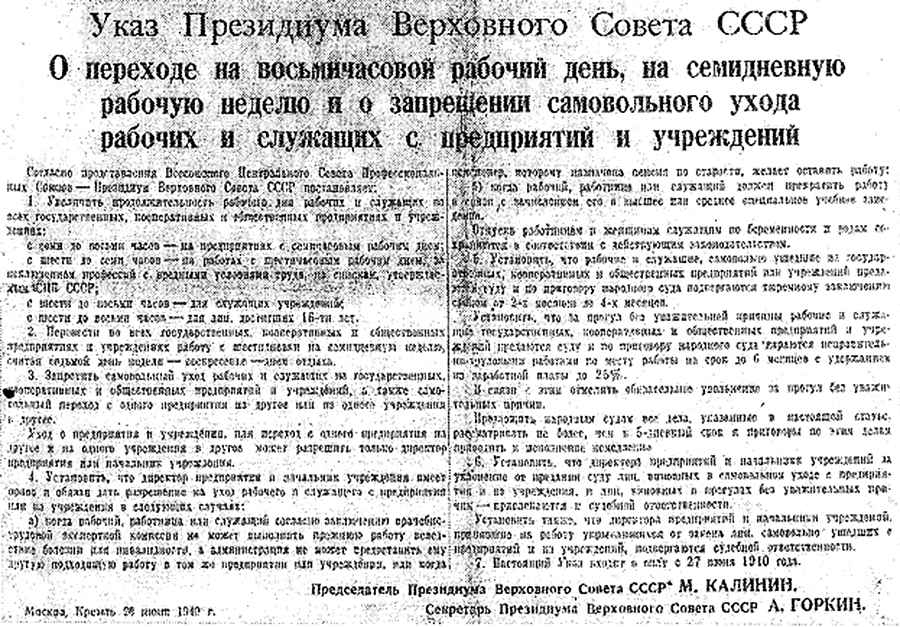
On June 26, 1940, the Decree of the Presidium of the Supreme Soviet of the USSR “On the transition to an eight-hour working day, to a seven-day working week, and on the prohibition of unauthorized departure of workers and employees from enterprises and institutions” was issued23. You can ознакомиться yourself with its full text (it is available in open access online); briefly summarizing its essence, the following measures were introduced:
- An increase of the working day by 1–2 hours per day (as we already noted in the article on the reforms of the Bolsheviks, in 1928 a transition to a 7-hour working day had begun);
- “To prohibit unauthorized departure of workers and employees from state, cooperative and public enterprises and institutions, as well as unauthorized transfer from one enterprise to another or from one institution to another”;
- “Workers and employees who have unauthorizedly left state, cooperative and public enterprises or institutions shall be brought to trial and, by the verdict of a people’s court, subjected to imprisonment for a term of 2 to 4 months”;
- “To establish that for absenteeism without valid reason, workers and employees of state, cooperative and public enterprises and institutions shall be brought to trial and, by the verdict of a people’s court, punished with corrective labor at the place of work for a term of up to 6 months with a deduction of up to 25% from wages”.
Under this decree alone, in just two and a half years, from June 26, 1940 to January 1, 1943, 5,121,840 people were convicted24. By the time it was repealed, the number of convicted Soviet citizens, according to historians’ estimates, had reached 18 million, reports “Kommersant”25. With this decision, Stalin’s government effectively equated workers with serf peasants. Here is how workers themselves reacted to this decree:
A worker of the spinning factory of the melange combine (Ivanovo), Korneva E.I., on October 20, 1942, was 30 minutes late for work because, having no clock, she overslept. Upon learning that she was being brought to trial for absenteeism, Korneva did not go to work for 4 days, writing the following explanation to the shop начальник: “I am not going to work only because I overslept by 30 minutes due to not having a clock, and you want to bring me to trial, and I feel offended, I have been working for 10 years and have never been late. Since I will have to pay anyway, I will rest for another 3 days, at least there will be something to answer for26.
The attitude of Stalin’s government toward ordinary workers is also confirmed by Wolfgang Leonhard:
On June 26, 1940, an appeal by the Central Council of Trade Unions appeared on the front page of “Pravda”, proposing to increase the working day at enterprises from seven to eight hours, and in institutions from six to eight. The working day for adolescents aged 16 to 18, who until then had had a six-hour working day, was also to be increased to eight hours.
Instead of the “six-day week”, the trade unions proposed reintroducing a seven-day week.
However, the trade union leadership did not limit itself to proposing an extension of the working day and working week; it also proposed abolishing the freedom to choose one’s place of work…
<…>
Soon the law was supplemented by an order of the People’s Commissariat of Justice dated July 22, 1940, according to which being 20 minutes late was classified as absenteeism and punished by “compulsory corrective labor” at the place of work for a term of up to six months, with a deduction of up to 25 percent of wages.
The “twenty-minute law” had incredible consequences. From the pupils of our former orphanage who worked at enterprises, I learned what was happening there. It was terrible. Transport connections were so poor that delays of more than 20 minutes occurred even without any fault on the part of the workers. But no evidence helped. Enterprise directors themselves trembled with fear. The number of those brought to trial and sentenced to “compulsory corrective labor” grew continuously”27.
This criminal law was repealed only under Nikita Khrushchev by the Decree of the Presidium of the Supreme Soviet of the USSR of April 25, 1956 “On the abolition of judicial liability of workers and employees for unauthorized departure from enterprises and institutions”28. In general, as Doctor of Historical Sciences Mikhail Voslensky notes, “Stalin gradually introduced such a fierce anti-worker legislation as Europe had long not known”29. Until 1960, the working week in the USSR amounted to 48 hours30.
Inflation, increase in production norms
For Stalin’s group, it was not enough to bind workers to factories and punish them for absenteeism and lateness, and on June 26, 1940, Resolution of the Council of People’s Commissars of the USSR No. 1099 “On increasing production norms and reducing piece rates in connection with the transition to an 8-hour working day” was issued31. It prescribed “to increase production norms and reduce piece rates in proportion to the increase in the length of the working day”. Such a resolution was introduced to ensure that, while working more, a worker would not receive higher wages and at the same time would not produce less.
In addition, Special report No. 4 of the INO OGPU on wage delays at industrial enterprises of the Soviet Union as of October 21, 1930, reported: “Delays in the payment of wages continue to occur at a significant number of industrial enterprises of the Union, including at a number of the largest enterprises in the main branches of industry”32. The same report notes that in 20 days of October, 29 strikes involving 5,300 participants were recorded and provides an extensive list of enterprises where “wages for September have not been fully paid”. The words of one of the workers at a production conference are cited:
Due to the untimely payment of wages, the work of the factory is disrupted, winter is approaching, and the workers are without shoes and clothing. Food is extremely poor, workers are starving, the government is not fulfilling its obligations33.
This problem was resolved by Stalin’s group, as we have already seen, through anti-worker legislation and repression.
The Soviet economist Nikolai Valentinov, who in 1922-1928 was deputy editor-in-chief of the Supreme Council of the National Economy’s publication “Trade and Industrial Gazette”, in his works provided data on the significant rise in living standards in the 1920s and spoke critically about living standards and wages in the 1930s, under Stalin’s dictatorship:
Insisting that in 1925 “workers ate as never before the war”, I showed how the position of workers changed by 1937, at the end of the second five-year plan. From 1925 to 1937, nominal wages increased 5.5 times, while the cost of food increased, at a minimum, 8.8 times. In terms of food prices, the average wage in 1937 was not 48 rubles, as in 1925, but only 28 rubles. The share of food in the wage of the head of a working family was 51 percent in 1925 and 87 percent in 1937. For the same quantity of food products, a working family man had to work 88 hours in 1925, and 151 hours in 1937. I add that 1937, compared with the years 1930-1936, was considered a relatively prosperous year34.
Tax on childlessness
During the war, Stalin’s government realized that it needed a large amount of “expendable material” for wars and factories, and therefore decided to increase the birth rate. However, it did so not through subsidies for young families, but in a different way — through a tax on childlessness. On November 21, 1941, the Decree of the Presidium of the Supreme Soviet of the USSR “On the tax on bachelors, single and childless citizens of the USSR” was issued35, which prescribed withholding about 5% of wages from childless individuals. Stalin likely borrowed this idea from Benito Mussolini, who introduced similar measures in 192736.
Was this tax perhaps connected with the hardships of wartime? On the contrary, after the war and until the collapse of the USSR, this tax was not abolished. In 1949, for example, it was increased for the rural population, as a result of which rural residents without children paid 150 rubles per year, those with one child — 50 rubles, and those with two children — 25 rubles per year37.
Pensions
In 1931, a Resolution of the Central Executive Committee and the Council of People’s Commissars “On amendments to the legislation on pension provision for education workers, medical and veterinary workers for length of service” was issued, which tightened the conditions for receiving pensions for certain important professions (doctors and teachers) and contained the following provisions:
To extend to 10 years the period of Soviet service for education workers, medical and veterinary workers, and agronomists required to qualify for a length-of-service pension.
<…>
If a pensioner has wage income or other earnings, the amount of the length-of-service pension shall be reduced so that the pension together with earnings does not exceed the average monthly wage of the pensioner for the last 12 months prior to the granting of the pension38.
War veterans were also affected. As early as 1947, the Stalinist Presidium of the Supreme Soviet of the USSR issued the decree of September 10, 1947 “On benefits and privileges granted to those awarded orders and medals of the USSR”, which abolished, effective January 1, 1948, allegedly “at the request of the award recipients”, the following privileges: monetary payments associated with orders and medals of the USSR; the right to free travel for recipients of USSR orders on railway and water transport; the right to free travel for recipients of orders and medals of the USSR on trams in all cities of the USSR; preferential payment terms for housing occupied by recipients of USSR orders in buildings of local Soviets39.
Shortages
The transition by Joseph Stalin to a planned economy generated all the problems of the Soviet economy that we discussed in a separate article, and which became one of the causes of the collapse of the USSR. Among them was the problem of shortages, which was already described by André Gide when recounting his trip to the Soviet Union in the mid-1930s40. Around the same time, the famous “avoska” shopping bags appeared, a name coined in 1935 by Arkady Raikin: one of his characters was an ordinary man who would take a string bag out of his pocket and say, stroking it, “Maybe I’ll manage to get something…”41
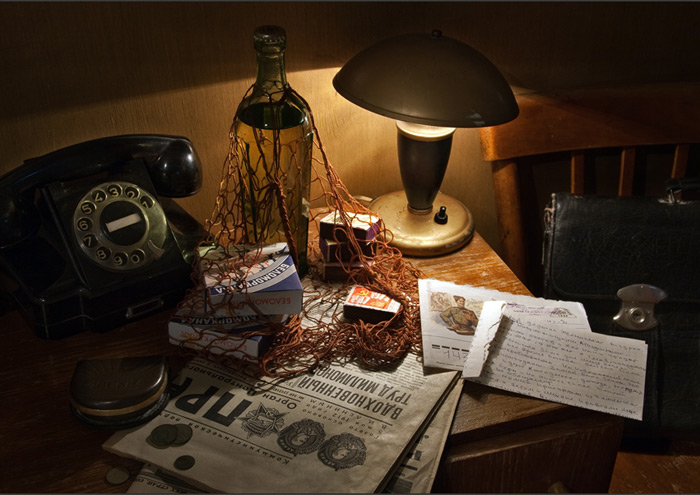
Vadim Shefner recalled that in the 1930s this word became very popular:
In those years, the word “blat” crept into everyday life, and “blatmeisters” appeared, that is, clever operators who obtained everything they wanted through connections. And the shopping bag was renamed the “avoska” — maybe it would be possible to bring home in it something that was not issued on ration cards42.
From a letter to Vyacheslav Molotov from a resident of Kyiv, N.S. Kovalev:
The issue of clothing in Kyiv is extremely severe. Shameful things are happening. Thousands of people line up at shops for textiles and ready-made clothing already from the evening. <…> Under these conditions, speculation flourishes terribly, along with arbitrariness of the police, and it is said not without bribes. One’s heart tightens at such “order”. How much dissatisfaction and curses there are. An honest worker, even if in great need, cannot buy underwear, trousers, and other essentials, except from speculators at double the price43.
The heads of the city planning office of the city of Volsk write to their deputy in the Supreme Soviet of the USSR, Deputy Chairman of the Council of People’s Commissars Andrei Vyshinsky:
Both in the city and at the factories, including the leading ones, i.e. the cement plants, there are long queues for bread. The so-called live queue that used to be practiced is not regulated by anyone, as a result of which the population takes the initiative by introducing lists of those in line. Most often, the queue number is written on the hand. In order to guarantee receiving bread (there is not enough bread for the entire population), queues are formed from 2-3 a.m. until the store opens, that is, until 7-8 a.m. That is, people stand for 7-8 hours in temperatures of minus 35-40 degrees. Along with the adult population, children are also in the queues44.
From NKVD reports:
Dzerzhinsky Department Store. The gathering of the public began at 6 a.m. Crowds were located on nearby streets, tram and bus stops. By 9 a.m., about 8 thousand people were in the queue45.
On the emergence of the concept of “blat” precisely under Stalin, Pyotr Gaitzuk from Novgorod writes to Andrei Vyshinsky:
Not having connections is equivalent to being deprived of everything everywhere. In a shop you will get nothing. To your lawful demands you will receive a clear answer. If you make a request, they will be blind, deaf and mute toward you. If you need to obtain, that is, to buy goods in a shop, you need connections. If it is difficult or impossible for a passenger to obtain a railway ticket, it is easy and simple to get one through connections. If you live without an apartment, never appeal to the housing administration or the prosecutor’s office, but rather acquire at least a small connection — and an apartment will immediately be found. If you want to arrange your personal affairs at work excellently, at someone else’s expense, violating all justice and legality, again turn to connections. And finally, if you appeal to a representative or employee of a state, public or cooperative organization to resolve some personal issue. Try to achieve anything without connections. You will exhaust yourself, but achieve nothing. It has entangled many officials. Connections have become almost legalized, they have come into fashion, acquired the right of citizenship and dominance46.
Famine
Stalin’s economic policy led to the mass famine of 1932–193347 in the USSR; another mass famine broke out after the war in 1946–194748. While in most cases on the territory of Russia the main cause of famine had been not the actions of the authorities but rather their inaction or exceptional circumstances (as in the famines of 1921–1922 and 1946–1947), in 1932–1933 it was precisely the actions of the government that led to famine, according to many historians, including Doctor of Historical Sciences Viktor Kondrashin:
In the context of famine years in Russian history, the peculiarity of the famine of 1932–1933 lies in the fact that it was the first “organized famine” in its history, when the subjective, political factor became decisive and dominated over all others. … Among the complex of causes that produced it, there was no natural factor comparable to the others, which had been characteristic of the famines of 1891–1892, 1921–1922, and 1946–1947. In 1932–1933 there were no natural disasters such as the great droughts of 1891, 1921, and 194649.
Due to crop failure and the crisis of grain procurements, ration cards for bread consumption were introduced in February 1929, and on January 13, 1931 the rationing system was officially extended to other food products and essential non-food goods50. Stalinist collectivization failed to quickly resolve the problem, and the rationing system remained in force until 1935. At the same time, distribution was hierarchical: there were four supply lists — “special”, first, second, and third (consumers on the first two lists, representatives of the nomenklatura, received 70–80% of the goods supplied to trade). Comparisons by Doctor of Historical Sciences Alexander Vdovin show that in material terms the Soviet “elite” was then at the level of the upper strata of the Western middle class51.
According to estimates by Russian scholars, demographic losses in 1932–1933 due to reduced birth rates, worsening of diseases associated with hunger, deportations, and repressions amounted to 3.531 million people in Ukraine, 1.3 million in Kazakhstan, 0.4 million in the Volga region, 1 million in the North Caucasus, and 1 million in other regions. At the same time, direct losses from famine (in the Volga region) accounted for approximately three quarters, with 365,722 direct victims of famine and indirect losses due to declining birth rates in the same region amounting to 115,665 people52.
According to the conclusion of a commission of the State Duma, in the territories of the Volga region, the Central Black Earth region, the North Caucasus, the Urals, Crimea, parts of Western Siberia, Kazakhstan, Ukraine, and Belarus, “about 7 million people died from hunger and diseases associated with malnutrition” in 1932–1933, the cause being “repressive measures to ensure grain procurements”, which “significantly aggravated the severe consequences of the crop failure of 1932”53.
Some peoples of the Soviet Union suffered more from Stalin’s rule, others less. According to Doctor of Historical Sciences Alexander Alekseenko, human losses in Kazakhstan due to famine amounted to 47.3%54 — that is, almost half of the republic’s population. Overall, the famine of the Stalin era deserves a separate article.
Pressure on the institution of the family
In 1930, abortions were made subject to payment55, and by the decree of the Central Executive Committee and the Council of People’s Commissars of the USSR of June 27, 1936, they were banned altogether56. Almost immediately, illegal abortions became an important sector of the shadow economy. Criminal abortions became the norm. As a result of the fact that illegal abortions were often performed by people without medical education, many women became infertile. The ban on abortions was lifted only in 1955.

On July 8, 1944, a decree of the Presidium of the Supreme Soviet of the USSR was adopted, according to which divorce was allowed only through a court with subsequent approval of the decision by a higher court, and the fees charged for filing a divorce were increased57, which significantly complicated the divorce process and led to many families remaining unhappily married to each other.
Abolition of holidays
Many holidays that had been celebrated under the Bolsheviks and were days off became working days again under Joseph Stalin. Most of them are listed by Doctor of Historical Sciences Mikhail Voslensky:
I remember how we — schoolchildren — were reluctantly corrected by our Pioneer leaders when we mechanically recited that our homeland was the country with the shortest working day in the world: it no longer was. The number of working days increased: instead of the five-day cycle (4 working days and 1 day off), a six-day cycle was introduced, and in 1940 — a seven-day working week with an eight-hour working day, 48 hours. The monthly vacations promised after the revolution were reduced to 12 working days. The number of holidays decreased: first, religious holidays — Easter and Christmas — were abolished, then revolutionary holidays were struck out; January 22 — the anniversary of “Bloody Sunday” of 1905 (later joined by January 21 — the anniversary of Lenin’s death), March 18 — the Day of the Paris Commune — became working days; the anniversary of the February Revolution of 1917 and International Youth Day ceased to be celebrated… The rapidly reduced number of non-working days in the USSR was further cut by the organization of subbotniks and voskresniks — days of unpaid labor58.
As a result, quite soon, through the efforts of Stalin’s government, only three holidays remained non-working throughout the year — the Day of Remembrance of Lenin, May Day, and Revolution Day59. Even New Year’s Day was a working day from 1929 to 194760.
Stalin’s personal initiative
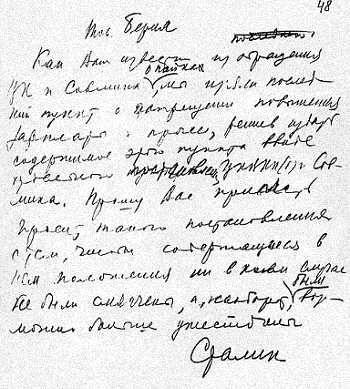
Some interpreters of historical events suggest that Joseph Stalin had nothing to do with the above-mentioned principles of anti-people policies; however, for example, his note to Lavrentiy Beria dated September 12, 1946, in which he insists on tightening anti-people measures, indicates otherwise:
Comrade Beria
As you know from the appeal of the Central Committee and the Council of Ministers regarding rations, we removed the last paragraph about prohibiting wage increases and the like, deciding to issue the contents of that paragraph as a separate resolution of the Central Committee of the VKP(b) and the Council of Ministers. I ask you to send a draft of such a resolution so that the provisions contained in it are in no case softened but, on the contrary, are made as strict as possible.
Stalin61.
In general, a similar stereotype from the series “Stalin is not guilty of anything” was examined in an article about the alleged innocence of the general secretary in mass repressions, where it is clearly shown that power in the country during the Stalin period was centralized and key decisions were controlled from the center.
Opinions of USSR citizens
A large part of the information about the real attitudes of workers and peasants was destroyed – the nomenklatura possessed exceptionally broad power at that time. However, some archives survived – for example, the Smolensk Archive with secret documents of the Western Regional Committee of the All-Union Communist Party (Bolsheviks), which during the Second World War was captured by the Germans and taken to Germany, and after the war ended up in the United States National Archives. The following are the opinions of the people in the late 1930s (quoted from Mikhail Voslensky’s book “Nomenklatura”, who in turn cites the report of Pyotr Demenko, secretary of the Kozelsk district party committee):
Voeyodin, Potrosovsky village council: “I have nothing to say about Trotsky. It is not for us to judge this. In general, there is nothing useful here. You are deceiving us; there is no fabric or footwear”. Voeyodin demonstratively left the meeting.
In the collective farm “Svobodny Trud” of the Maklinsky village council, Yeremina spoke at a meeting with the following speech: “You say life has become cheerful, but you take from a cow, take from a pig, take from a sheep, take from the house, take from the yard. What kind of cheerful life is this?”… In the collective farm named after March 8 of the Grishinsky village council, Alyoshina Evdokiya Savelievna, a former party candidate and former disenfranchised person, conducts vile agitation. “Back under the landowner you worked and got money right away, but now you work in the collective farm all year and get nothing”… Gorelikov Vasily, collective farm “Svobodny Trud” of the Matchinsky village council: “Do not pay the self-tax, anyway this money will go to filling the bellies of the commissars”62.
And even more specifically. Expelled party member “Lagutin said that the Bolsheviks are scum”63. The wife of teacher Akimov, while speaking with collective farmers at the moment when Sergei Mironovich Kirov was killed, stated: “It’s a pity that Stalin was not killed”.
And even more threatening: “Novikov Nikolai, collective farm named after Stalin, Matchinsky village council, former party candidate. ‘If they now give us weapons, we will turn them against the party and the government’”6465.
This was also confirmed by party members. Thus, one of the former key Stalinists, Martemyan Ryutin, wrote in 1932:
The resolution states that the well-being of workers and toiling peasants is growing year by year. In reality, their well-being over the past four years has deteriorated enormously. The real wages of the average worker currently amount to no more than 25% of the real wages of 1927. The expenditure portion of the budget of the middle-peasant (collective farmer) for family needs in commodity rubles is currently 3–4 times lower than in 1926–1927. This was the result of Stalin’s adventurist, anti-Leninist policy. A worker goes for weeks without seeing a gram of meat, butter, or milk; for a yard of printed cotton he is forced to stand in queues for many hours; it is impossible to buy a fork, a glass, or a spoon anywhere. Stalin, in contrast, promotes rest homes and an increase in the number of working family members, but rest homes already existed in 1927 and functioned better than they do now66.
Former acquaintances of Stalin himself wrote to him in large numbers saying that they were in need of money. Here is an excerpt from a letter by one of his seminary comrades, Kelbakiani: “Comrade Soso! If you only knew how much I am in need at present, I am sure you would not leave me without attention. I am old now, have no income, and am in need”67. One of his teachers, Malinovsky, requested the assignment of a personal pension, “so that in the twilight of my days I may have the bare necessities and die with the happy awareness that my Great Student did not leave me in need”68.
An idea of the situation in the country under Stalin’s economic system can also be obtained from citizens’ letters to the country’s top leadership. Here, for example, is one such letter addressed to Vyacheslav Molotov:
Dear Vyacheslav Mikhailovich!
Once again someone’s criminal hand has disrupted the supply system in Moscow. Again there are queues from the night for fats, potatoes have disappeared, there is no fish at all. At the market everything exists, but only in small quantities and at four times the price. As for consumer goods, endless queues are mostly made up of unemployed people, some idle “stone-faced” men and janitors, early cleaners, or the jobless. Now there are also collective farmers, who often store their purchases in chests as if they were currency. What is a working person supposed to do? We do not have time to stand in queues for hours or pay exorbitant market prices. Vyacheslav Mikhailovich! Is it really impossible to regulate the supply of food and consumer goods? We ask you, as our deputy, to help eliminate all kinds of manipulations and lack of culture in supply, because queues develop the worst qualities in people: envy, malice, rudeness, and exhaust people completely.
With highest respect, S. Abuladze. December 19, 1939.69
And here is an excerpt from a letter written by a 9th-grade student, Boris Morozov, to Anastas Mikoyan:
…I told my mother that we would not even wait for the end of the 2nd Five-Year Plan before we would have as much manufactured goods as we wanted. But the 2nd Five-Year Plan passed, the 3rd began, and my predictions did not come true – there was no manufactured goods and there still isn’t. Sometimes they bring it, and people crush each other in crowds. Why there is no fish, I cannot figure out myself. We still have seas, and they are the same as before, but back then there was as much fish as you wanted and of any kind, and now I have even lost my idea of what it looks like. Meanwhile, we are leasing out [our seas] to the Japanese so that he can fertilize his fields with fish. Finally, where has the bread gone? It seems we harvested 6 billion poods of grain. If you calculate it, that’s more than 35 poods per person. There was no prolonged war, yet for two months there has been no bread. Either this outrage is only in the Gomel region, or across the whole country. And yet we want to build a communist society, whose main principle is “from each according to his ability, to each according to his needs”. Furthermore, newspapers write that in France, England, and Germany the bourgeoisie is abolishing the ration card system, which the proletariat dislikes. And in our country, where the proletariat has triumphed, in a country whose fields our fathers and mothers bled on, a real ration system is now being introduced – railway workers and station workers (porters and others) issue bread from Gomel (apparently for the entire population), receive it by cards (for individuals), driving away outsiders, teachers receive bread from their own canteen, etc. And who gave them the right to disgrace the country! We still want to win in the coming battles when two systems collide – capitalist and socialist. No, under such conditions and such provision we will never win, never build communism!
I ask you, dear Anastas Ivanovich, to answer all my questions: why is there no fabric, cereals, fish, shoes, sugar, sweets, matches, why has bread disappeared? I await your answer with impatience. Morozov. My address: BSSR, Gomel Region, Buda-Koshelevo station, Stalin School No. 1, 9th grade “A”, Boris Ivanovich Morozov70.
A huge number of such letters are stored in the archives71, and all of them testify to the inability of the Stalinist economy to provide people with the most basic necessities.
Conclusion
According to estimates by economist Sergei Prokopovich, the highest standard of living of the Russian worker in the first half of the twentieth century was reached in 1928. In 1932 it had fallen by approximately 20% compared to the 1928 level. In 1936 it was more than twice as low, and by 1941 it was almost three times lower than the 1928 level72. Doctor of Historical Sciences Sergei Nefedov confirms: even in the 1930s there was no progress in food consumption; on the contrary, there was a decline in consumption to a level close to the minimum norm73.
In this article we did not examine in detail the facts of lawlessness, the absence of democracy and freedom of speech, the possibility of ending up in camps, and other violations of human rights, although these are also important indicators affecting the standard of living.
All the facts presented above demonstrate that during the dictatorship of Joseph Stalin the standard of living in the USSR significantly decreased compared to the late 1920s. At the same time, in separate articles we discussed the widespread corruption in Stalin’s USSR, and in the series of articles on the nomenklatura we described the privileges of this class. Thus, despite the overall economic growth declared by Soviet statistics, it did not have a positive impact on the well-being of the majority of the population.
- A.V. Usovsky. God Save Stalin! Tsar of the USSR Joseph the Great – 448 p. – Moscow: Eksmo, 2013
- Speech at the First All-Union Conference of Stakhanovites, November 17, 1935 // I.V. Stalin. Collected Works. Volume 14
- RGAE. F. 1562. Op. 33. D. 2313. L. 164–185. Certified typewritten copy with signatures of employees of the Central Statistical Administration of the USSR
- Ibid.
- History of the rationing system in Russia. Reference // RIA Novosti (ria.ru). March 19, 2009, 16:19. [Electronic resource]. URL: https://ria.ru/20090319/165394395.html (accessed: 08.03.2020).
- V.P. Polevanov. Russia: the price of life // “Economic Strategies”, No. 1, 1999. – pp. 102-103
- RGAE. Fund 1562. Inventory 33. File 2313. Sheets 164-185. Certified typed copy with signatures of employees of the Central Statistical Administration of the USSR
- RGAE Fund 1562, Inventory 1, File 727, Sheets 89-99
- Sarah Cameron. The Hungry Steppe. Famine, Violence, and the Making of Soviet Kazakhstan – Cornell University Press, 2018. – p. 200
- S. Fitzpatrick. Everyday Stalinism. Social History of Soviet Russia in the 1930s: the city / [trans. from English by L.Yu. Pantina]. – 2nd ed. – 336 p. – Moscow: ROSSPEN; Foundation of the First President of Russia B.N. Yeltsin, 2008. – pp. 58-59.
- Communal country: the formation of Soviet housing and коммунal services (1917–1941) [Text] / I.B. Orlov: Higher School of Economics; Moscow; 2015. – p. 190
- E.A. Osokina. Behind the facade of “Stalinist abundance”: Distribution and the market in supplying the population during the years of industrialization. 1927–1941. – 271 p. – Moscow: ROSSPEN, 1999. – p. 125.
- O. Khlevniuk. Stalin. The life of a leader: a biography. – 464 p. – Moscow: AST-CORPUS, 2015. – p. 26.
- V.N. Gorlov. N.S. Khrushchev and the transition to mass housing construction in the Soviet Union // Bulletin of the Moscow Region State University. Series: History and Political Sciences. 2017. No. 1. – pp. 71–72.
- Ibid., p. 79.
- Results of the implementation of the First Five-Year Plan for the development of the national economy of the USSR – 276 p. – Leningrad, Moscow: State Publishing House “Standardization and Rationalization”, 1933. – p. 186.
- Report of the Central Statistical Administration of the USSR to L.M. Kaganovich on the condition of the urban housing stock in 1940–1952. August 18, 1953. Secret. // RGAE. Fund 1562. Inventory 33. File 1682. Sheets 88-99. Attached Sheets 88-132
- Dmitry Khmelnitsky. Khrushchev’s reforms. What happened to Soviet architecture in the 1950s? // Gefter (gefter.ru). March 17, 2017. [Electronic resource]. URL: http://gefter.ru/archive/21563 (accessed: 08.03.2020).
- Report of the Central Statistical Administration of the USSR to L.M. Kaganovich on the condition of the urban housing stock in 1940–1952. August 18, 1953. Secret. // RGAE. Fund 1562. Inventory 33. File 1682. Sheets 88-99. Attached Sheets 88-132
- Collection of decrees and orders of the government of the Union of Soviet Socialist Republics No. 27 – p. 910
- Wolfgang Leonhard. Revolution devours its children. – London: Overseas Publications Interchange Ltd, 1984. – pp. 91-92.
- On paid education in 1940 // Project “Historical Materials” (istmat.info). [Electronic resource]. URL: http://istmat.info/node/18266 (accessed: 08.03.2020).
- RTsKhIDNI. F. 17. Op. 2. D. 676. Ll. 41–42ob. Typeset text without certification marks
- Report of the USSR Prosecutor’s Office to V. M. Molotov, G. M. Malenkov, A. Ya. Vyshinsky on the number of those convicted under the decrees of June 26, 1940 and December 26, 1941 – State Archive of the Russian Federation. F. R-8131. Op. 37. D. 3147. L. 5-10. Copy
- Evgeny Zhirnov. “40.7% of workers convicted for absenteeism” // Kommersant (www.kommersant.ru). Magazine “Kommersant Vlast” No.16 of April 26, 2010, p. 58. [Electronic resource]. URL: https://www.kommersant.ru/doc/1353083 (accessed: 08.03.2020).
- Report of the USSR Prosecutor’s Office to V. M. Molotov, G. M. Malenkov, A. Ya. Vyshinsky on the number of those convicted under the decrees of June 26, 1940 and December 26, 1941 – State Archive of the Russian Federation. F. R-8131. Op. 37. D. 3147. L. 5-10. Copy
- Wolfgang Leonhard. The Revolution Devours Its Children. – London: Overseas Publications Interchange Ltd, 1984. – pp. 80-81.
- Collection of laws of the USSR and decrees of the Presidium of the Supreme Soviet of the USSR (1938 – July 1956) / ed. by Candidate of Law L.I. Mandelshtam – 500 p. – Moscow: State Publishing House of Legal Literature, 1956. – p. 374.
- M.S. Voslensky. Nomenklatura. The ruling class of the Soviet Union. – 624 p. – Moscow: “Sovetskaya Rossiya” jointly with MP “Oktyabr”, 1991. – p. 224.
- History of changes in the working week in Russia. Reference // RIA Novosti (ria.ru). April 27, 2011, 14:53. [Electronic resource]. URL: https://ria.ru/20110427/368728816.html (accessed: 08.03.2020).
- Resolution of the Council of People’s Commissars of the USSR of June 26, 1940 (SP USSR 1940, No. 16, Art. 386)
- Central Archive of the FSB. F. 2. Op. 8. D. 658. L. 227-232. Original // “Top Secret”: Lubyanka to Stalin on the situation in the country (1922-1934), vol. 8, part 1, 1930, Moscow, 2008 – pp. 572-575
- Ibid.
- N. Valentinov. NEP and the Crisis of the Party. Memoirs. – 256 p. – New York: Telex, 1991. – p. 116.
- Collection of laws of the USSR and decrees of the Presidium of the Supreme Soviet of the USSR (1938 – July 1956) / ed. by Candidate of Law L.I. Mandelshtam – 500 p. – Moscow: State Publishing House of Legal Literature, 1956. – pp. 335-336.
- Hamish Macdonald. Mussolini and Italian Fascism – Stanley Thornes (Publishers) Ltd. – p. 27
- Bulletin of the Supreme Soviet of the USSR. 1949. No. 12; GAPK. F. 181. Op. 14. D. 485. L. 4; D. 468. L. 2
- Collection of laws and orders of the Workers’ and Peasants’ Government of the USSR for 1931 – Moscow: Printing House “Soviet Legislation” – pp. 358-359
- Collection of laws of the USSR and decrees of the Presidium of the Supreme Soviet of the USSR (1938 – July 1956) / ed. by Candidate of Law L.I. Mandelshtam – 500 p. – Moscow: State Publishing House of Legal Literature, 1956. – pp. 300-301.
- Return from the USSR // André Gide. Collected Works: in 7 vols. Vol. 7: If It Die; Et nunc manet in te / Trans. from French by E. Grechanaya; Return from the USSR / Trans. from French by A. Lapchenko; Commentary by S. Zenkin. – 480 p. – Moscow: TERRA – Book Club, 2002. – pp. 356-357.
- Leonid Koval. Meetings with Arkady Raikin // Latvijas Universitāte (www.lu.lv). [Electronic resource]. URL: https://www.lu.lv/materiali/studiju-centri/jsc/resursi/134-143.pdf (accessed: 08.03.2020).
- N. Lebina. Soviet Everyday Life: Norms and Anomalies. From War Communism to the Grand Style / Natalia Lebina. – 488 p. – Moscow: Novoe literaturnoe obozrenie, 2015. – p. 49.
- Svetlana Kuznetsova. “About 8 thousand people were in the queue” // Kommersant (www.kommersant.ru). Magazine “Kommersant Vlast” No.28 of July 19, 2010, p. 56. [Electronic resource]. URL: https://www.kommersant.ru/doc/1407605 (accessed: 08.03.2020).
- Ibid.
- Ibid.
- Ibid.
- V.V. Kondrashin. The Famine of 1932–1933: The Tragedy of the Russian Countryside – 519 p. – Moscow: ROSSPEN; Boris Yeltsin Presidential Foundation, 2008.
- V.F. Zima. The Famine in the USSR of 1946–1947: Origins and Consequences – 265 p. – Moscow: Russian Academy of Sciences, 1996.
- V.V. Kondrashin. The Famine of 1932–1933: The Tragedy of the Russian Countryside – 519 p. – Moscow: ROSSPEN; Boris Yeltsin Presidential Foundation, 2008. – p. 331.
- A.I. Vdovin. USSR. History of a Great Power (1922–1991) – 768 p. – Moscow: RG-Press, 2018
- Ibid.
- Population of Russia in the 20th Century. In 3 vols. / Vol. I. – 463 p. – Moscow: ROSSPEN, 2000. – pp. 271-274.
- Statement of the State Duma “In Memory of the Victims of the Famine of the 1930s in the USSR” // Database “Regulatory Legal Acts of the Federal Assembly of the Russian Federation” (duma.consultant.ru). Moscow, April 2, 2008. [Electronic resource]. URL: https://duma.consultant.ru/files/955838 (accessed: 09.03.2020).
- A.N. Alekseenko. The Population of Kazakhstan in 1926–1939 // Computer and Historical Demography: Collection of Scientific Works. Barnaul, 2000. – p. 16
- History of bans and permissions of abortions in Russia // RIA Novosti (ria.ru). August 3, 2010, 09:35. [Electronic resource]. URL: https://ria.ru/20100803/261197627.html (accessed: 08.03.2020).
- Decree of the Central Executive Committee and the Council of People’s Commissars of the USSR of June 27, 1936 “On the prohibition of abortions, increasing material assistance to women in childbirth, establishing state assistance to large families, expanding the network of maternity homes, nurseries and kindergartens, strengthening criminal penalties for non-payment of alimony and certain changes in divorce legislation” // Collection of Laws and Decrees of the Workers’ and Peasants’ Government of the USSR, 23.07.36, No. 35, art. 309
- A.G. Volkov. Selected Demographic Works [Text]: collection of scientific articles / comp. and ed. A.G. Vishnevsky; National Research University “Higher School of Economics”. – 567 p. – Moscow: HSE Publishing House, 2014. – p. 303
- M.S. Voslensky. Nomenklatura, The Ruling Class of the Soviet Union. – 624 p. – Moscow: “Sovetskaya Rossiya” jointly with MP “Oktyabr”, 1991. – p. 224.
- Yevgeny Antonyuk. Grandfathers used to rest: holidays that disappeared and were forgotten // LIFE (life.ru). September 3, 2017, 12:21. [Electronic resource]. URL: https://life.ru/p/898791 (accessed: 08.03.2020).
- How the dates of New Year celebrations changed in Russia // TASS (tass.ru). November 29, 2019, 12:51. [Electronic resource]. URL: https://tass.ru/info/7226993 (accessed: 08.03.2020).
- Politburo of the Central Committee of the VKP(b) and the Council of Ministers of the USSR. 1945–1953 / Compiled by O.V. Khlevnyuk, J. Gorlitsky, L.P. Kosheleva, A.I. Minyuk, M.Yu. Prozumenshchikov, L.A. Rogovaya, S.V. Somonova. – 656 p. – Moscow: ROSSPEN, 2002. – p. 210.
- National Archives, Washington, D. C. Smolensk Archive Microfilm, RS921, sheets 307–308
- Ibid., sheet 300
- Ibid., sheet 305
- M.S. Voslensky. Nomenklatura, The Ruling Class of the Soviet Union. – 624 p. – Moscow: “Soviet Russia” jointly with MP “October”, 1991. – pp. 524–525.
- Stalin and the crisis of the proletarian dictatorship // M.N. Ryutin. I Will Not Kneel / compiled by B.A. Starkov. – 351 p. – Moscow: Politizdat, 1992. – pp. 153–154.
- RGASPI. F. 558. Op. 11. D. 879. L. 45.
- RGASPI. F. 558. Op. 11. D. 876. L. 12.
- RGAE, f. 7971, op. 16, d. 77, l. 207–208
- RGAE, f. 7971, op. 16, d. 76, l. 169–170. Certified copy. Written not earlier than December 1939 and not later than February 1940.
- Supply crisis of 1939–1941 in letters of Soviet people. – Questions of History, 1996, No. 1
- S.N. Prokopovich. The National Economy of the USSR. Volume 2. – 355 p. – New York: Chekhov Publishing House, 1952. – p. 121.
- S.A. Nefedov. Changes in the level of food consumption as a result of collectivization // Bulletin of Tambov University, Series: Humanities, 2011, No. 6 (98)