“Stalin is not responsible for the repressions”
Previously, Stalinists either denied the very fact of mass repressions or tried to convince the public that these mass executions and arrests were justified, claiming that crime had increased many times over in the country during the postwar economic recovery period (1920s–1930s). However, after facing setbacks on these fronts, they shifted to a new concept, which asserts that Joseph Stalin was not responsible for these repressions, even if they were indeed unjust.
Historians of a pro-Stalin orientation sometimes claim that Joseph Stalin either did not take part in the repressions or was not their initiator. Thus, Yuri Zhukov’s work “Another Stalin” argues that the “witch hunt” was initiated by party officials, which is what led to the mass repressions. In the article on Yuri Zhukov’s falsifications, we analyzed this version in detail, which he borrowed from the American revisionist historian Arch Getty. Here Stalinists align themselves with various fascists, Rodnovers, and other conservatives such as Yarogor Smirnov, who writes in the book “The magic of governance. The russian version”:
Of course, it must be acknowledged that different things happened in those times, including repressions, but, as historical documents (and not fictional narratives) irrefutably prove, Stalin himself had nothing to do with the beginning of the repressions1.
However, this thesis was not entirely invented by Arch Getty — it was the official version of the Stalin era, which held that repressions did occur, but were justified, and became mass-scale due to “excesses at the local level”. As is well known, Joseph Stalin himself shifted the blame onto Nikolai Yezhov, which gave rise to the derogatory term “Yezhovshchina”. Aircraft designer Yakovlev quotes Stalin as saying about Yezhov: “He destroyed many innocent people. We shot him for that”2. Doctors of Historical Sciences Yuri Felshtinsky and Georgy Chernyavsky regard the word “Yezhovshchina” as “a false term, apparently invented by Stalin himself”3. In any case, Doctor of Historical Sciences Andrei Sokolov notes that this term “emerged already at that time, ‘in the immediate aftermath of events’, after the name of the then People’s Commissar of the NKVD Yezhov, onto whom the Stalinist leadership decided to shift the blame for ‘certain excesses’ of the campaign organized from above to ‘identify and expose enemies of the people’, and to distance itself from it”4. In other words, the idea that “Stalin is not responsible for the repressions” originates from official Stalinist propaganda. The academic community, neither in Russia nor in the rest of the world, recognizes this thesis. There is a separate lecture on such views, known as historical revisionism:
Contents
What is meant by this?
When Joseph Stalin is accused of being the initiator of the repressions, it does not, of course, mean that he was the first statesman in Russian history to use violence against his political opponents. Political violence in Russia has a long history, but perhaps the most inexcusable were the political repressions of Nicholas I, who, after the events of the French Revolution, rejected the path of democratization. Nevertheless, this does not absolve those who continued to pursue policies of repression after him.
Therefore, when Stalin is blamed for political repressions, what is meant are those repressions that he himself initiated. First and foremost, these are the events of the so-called Great Terror (1937–1938), because against the scale of this campaign, all other repressions, including earlier Stalinist ones, appear less significant.
What do we actually mean when we use the phrase “Stalinist repressions”? Many mistakenly include the events of the Red Terror and the 1920s, but in the article on the state coup of Joseph Stalin we showed that until 1929 the General Secretary did not possess full power. Consequently, the Red Terror and the political processes that took place in the 1920s cannot be attributed specifically to Stalinist repressions. We examined the causes of the terror in the article on how political terror began in Russia. Political cases of 1929–1934, such as the Shakhty Trial or the Industrial Party case, should also be considered as separate phenomena, when political repressions in the USSR were not yet mass-scale and were partly a continuation of the targeted terror characteristic of Russian politics for many decades before that (after the execution of the Decembrists), and partly an experimentation by Stalin’s group with new methods of initiating political cases (however, this requires a separate discussion). The events of the collectivization period are also a separate phenomenon with their own causes.
The fundamental difference between the Stalinist Great Terror and the Red Terror is that it was carried out in peacetime, that is, the possibility of avoiding it was incomparably greater — after the end of the Civil War, the Bolsheviks largely abandoned the policy of terror, and this contributed to economic recovery in the 1920s (we wrote about this here).
Finally, to refute the claim that Stalin had no connection to the beginning of the repressions, it is sufficient to examine just one of the campaigns he initiated to eliminate political opponents. Therefore, we will take the largest of them — the Great Terror.
Who is responsible for the repressions?
The history of the Great Terror begins with the murder of Sergei Kirov on December 1, 1934. As we will see from further testimony, Joseph Stalin instructed state security officials to look for a “Zinovievite trail” in the case and personally shaped the composition of the “terrorist centers”. When the desired trail was “found” (through deception of suspects and the use of coercive methods to extract confessions5; the methods of investigation under Stalin deserve a separate article), this was followed by the elimination of many prominent figures of the Bolshevik Party during the “Moscow Trials”. Later, closed letters of the Central Committee of the All-Union Communist Party (Bolsheviks) would be sent to localities, the texts of which we will present below and which provoked the writing of denunciations, forming the basis for the mass destruction of communists, which we discussed here. The destruction of so-called “kulaks”, former members of the White movement, and certain other groups was sanctioned by NKVD operational order No. 004476. There are numerous documents bearing Joseph Stalin’s own signature that demand executions — we will also present them below. Thus, all available data and testimony indicate that the “Great Terror” began with Stalin’s directives, and the subsequent processes of its expansion were supported and controlled by him (virtually on a daily basis — as Nikolai Yezhov stated: “I must say that under the daily leadership of the Central Committee, the NKVD smashed the enemies quite effectively”7). Doctor of Historical Sciences, chief specialist of the State Archive of the Russian Federation Oleg Khlevniuk describes the mechanism of the repressions:
A careful study of such campaigns makes it possible to identify their general, repeatedly tested algorithm. Everything began (and this is important to emphasize) with the center (most often Stalin) setting the goals of the campaign and assigning specific tasks. Then followed the mobilization of the apparatus to carry out these tasks by extraordinary methods, which implied a wide spread of “excesses”. As a result, the campaign reached the level of a crisis, at the peak of which the limits of retreat — overcoming the “excesses” — were determined. The retreat was the task of a counter-campaign, a kind of exit from terror. At this stage, some of the executors of the terror, turned into “scapegoats”, were themselves subjected to repression, and formal slogans of “restoring legality” were proclaimed. The situation stabilized, and the goals of the campaign were declared achieved8.
At present, we do not have strong direct evidence of Stalin’s involvement in the murder of Sergei Kirov (although many historians, for example Doctor of Historical and Philosophical Sciences Mikhail Voslensky9, believe that there is a sufficient amount of indirect evidence). However, the level of initiative shown by Stalin in searching for “terrorists” and their “accomplices” gives us grounds to assume that if this murder had not occurred, some other event would have served as the trigger for the beginning of mass terror. Now let us turn to the evidence that we do have.
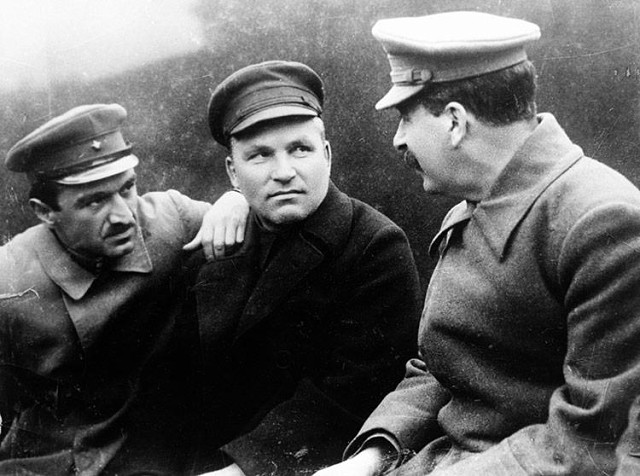
Testimonies of participants
There is direct testimony from NKVD officials themselves indicating that the initiator of the mass terror was Joseph Stalin. Thus, at the February-March plenum of the Central Committee of the All-Union Communist Party (Bolsheviks) in 1937, Nikolai Yezhov stated:
“First”, comrade Stalin began, as I remember now, he summoned me and Kosarev and said: “Look for the killers among the Zinovievites”. I must say that the Chekists did not believe this and, just in case, hedged their bets by also pursuing another line, a foreign one, in case something might turn up there10”.
Stalin’s initiative is also confirmed by the words of one of the deputy people’s commissars of internal affairs of the NKVD, Yakov Agranov:
“Yezhov summoned me to his dacha. It must be said that this meeting had a conspiratorial character. Yezhov conveyed Stalin’s instruction regarding the mistakes made in the investigation of the case of the Trotskyist center and ordered that measures be taken to uncover the Trotskyist center, to expose the clearly undiscovered terrorist group and Trotsky’s personal role in this matter. Yezhov posed the question in such a way that either he himself would convene an оперативное совещание, or I should intervene in this case. Yezhov’s instructions were specific and provided the correct starting thread for solving the case11”.
If this is not enough, one can cite an excerpt from the speech of Matvei Shkiryatov at the 18th Party Congress, where he became a member of the Central Committee of the All-Union Communist Party (Bolsheviks) in the year the congress was held (1939):
“It was necessary to teach the party to recognize and expose the enemy, wherever he might be and whatever position he might have infiltrated. It was necessary to give the entire party clear and precise directives on how to fight these enemies, and to mobilize our entire party for the struggle. And only thanks to the fact that in this difficult work we cleansed our party of these most vile traitors, that we mobilized the party masses and non-party working people in our work, that we were guided by the directives of our Central Committee of the All-Union Communist Party (Bolsheviks), the directives of comrade Stalin, we further strengthened and united our party. This work of purging the ranks of the party from enemies who had infiltrated it was led by comrade Stalin. He warned us, comrades, and the entire party about the new methods of the enemies that they used in their struggle against the party and the Soviet people. Comrade Stalin instilled in every party organization, in every party member, the skills of fighting enemies, fostered in the Bolsheviks the deepest hatred for enemies and readiness to deal with them mercilessly, wherever the enemy might be and whatever position he might occupy12”.
Minister of State Security Viktor Abakumov, in his final statement at trial on the eve of his execution, also insisted: “…I did nothing on my own. Instructions were given by Stalin, and I carried them out”13.

Pavel Sudoplatov, who at the time of Stalin’s death held the rank of lieutenant general of the Ministry of Internal Affairs and had worked in the NKVD in the second half of the 1930s, recalled that “all secret liquidations of double agents and political opponents of Stalin, Molotov, Khrushchev in 1930–1950 were carried out by order of the government”14. He also testifies that far from all archives and documents became accessible to the public during Perestroika (contrary to the propaganda of Stalinism, which presents the matter as if the authorities did not attempt to conceal the crimes of the Stalinist period):
Alexakhin took from the prosecutor’s office three sealed envelopes containing unreviewed operational materials that had been seized from my office safe during the search in 1953. He handed the envelopes over to Serov’s secretariat and never saw them again. I cannot recall everything that was in my safe, but I know for certain that it contained records of sanctions by the then top leadership — Stalin, Molotov, Malenkov, Khrushchev, and Bulganin — for the liquidation of undesirable persons and, in addition, records of our intelligence agency’s cases regarding penetration through Zionist circles into government spheres and into the community of scientists engaged in research on atomic energy.
Later, in 1988, when Alexakhin, together with two intelligence veterans, petitioned for a review of my case, they referred to this episode. They advised me to keep silent and not to compromise the party even further by bringing such unsightly matters to light15.
Materials from official investigations
Olga Shatunovskaya, who participated in the Special Commission of the Central Committee of the CPSU headed by Nikolai Shvernik (Chairman of the Presidium of the Supreme Soviet of the USSR under Stalin), wrote in 1989 about the circumstances of Kirov’s murder:
During our investigation, in Stalin’s personal archive, a document written in his own hand was discovered, containing lists of two fabricated Trotskyist-Zinovievite terrorist centers — the Leningrad and Moscow ones. Moreover, Zinoviev and Kamenev were initially placed by Stalin in the Leningrad center, then moved to the Moscow center, as were other participants of the fictitious centers. This document was handed to us by the head of Stalin’s personal archive as top secret.
A forensic handwriting examination by the USSR Prosecutor’s Office confirmed that the manuscript was written personally by Stalin. Two employees of the Leningrad NKVD directorate testified that on December 3, 1934, Stalin summoned them with files on Zinovievites and Trotskyites. In addition, Stalin had a list of 22 former oppositionists, which the head of the NKVD directorate, Medved, had presented to S. M. Kirov for approval of arrest. However, Kirov refused to sanction it. In the presence of these NKVD officers, Stalin himself fabricated the composition of the terrorist centers16.
That is, we see that it was Stalin who “indicated the trail” of Kamenev and Zinoviev, who were eliminated in 1936. Against them, the so-called First Moscow Show Trial was launched, followed by the Second and Third. Already on January 26, 1935, Stalin signed a Politburo resolution on the deportation of 663 former Zinoviev supporters from Leningrad to northern Siberia1718. One of the documents demonstrating how Stalin managed the repressive processes is a note to N. I. Yezhov dated January 17, 1938:
To comrade Yezhov.
1. The Socialist-Revolutionary line (Left and Right together) has not been unraveled. Fishman and Paskutskiy are misleading the NKVD. If Belyov had not himself begun to unravel the SR line, the NKVD would still be in the dark. Belyov said something, but not everything. Paskutskiy, Uritsky, and Fishman must supplement Belyov’s testimony. It should be borne in mind that a considerable number of SRs remain in our army and outside it. Does the NKVD have records of SRs (“former ones”) in the army? I would like to receive them as soon as possible. Does the NKVD have records of “former” SRs outside the army (in civilian institutions)? I would also like to receive them within 2–3 weeks.
2. What has been done to identify SRs based on Ryskulov’s known testimony?
3. What has been done to identify and arrest all Iranians in Baku and in Azerbaijan?
4. For reference, I inform you that at one time the SRs were very strong in Saratov, Tambov, Ukraine, in the army (command staff), in Tashkent and in Central Asia in general, in the Baku power stations, where they are still present and engaged in sabotage in the oil industry.
You must act more quickly and more intelligently.
5. A very important task: to strengthen the regions of the Far Eastern Territory with new Chekist forces from outside. This is much more important than strengthening the regions of Kazakhstan, which can be done in the next stage19.
On the basis of all the above, we conclude that the initiative for the beginning of mass terror belonged to Joseph Stalin. His signature is also found on hundreds of execution lists, so he could not have been unaware of the destruction of a huge number of people.
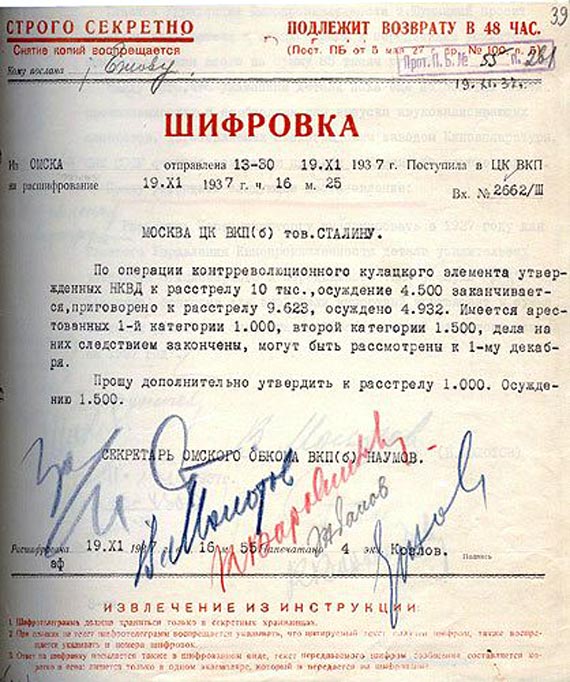
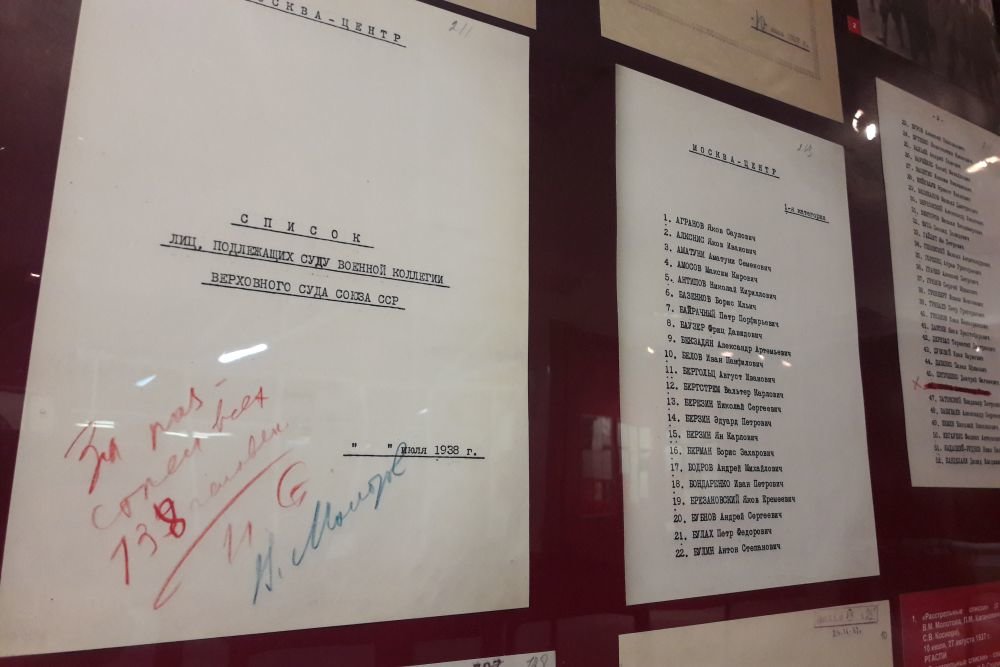
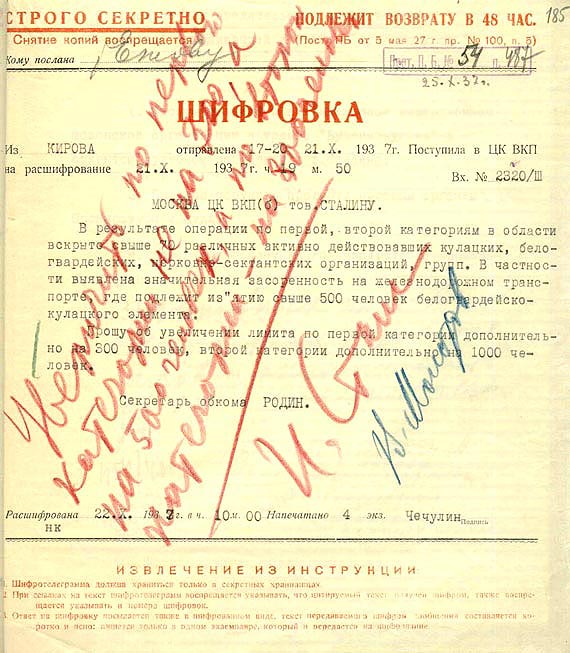
A total of 383 such lists have been preserved for the period from February 27, 1937 to September 29, 1938. Stalin’s signature appears on 357 of them20.
It was Stalin who initiated the repressions, and he also approved executions. Those who doubt this can read Stalin’s report “On the shortcomings of party work and measures to eliminate Trotskyist and other double-dealers”21, in order to understand who set the machinery of repression in motion. There are also Politburo decisions signed by Stalin with instructions: “The Central Committee of the All-Union Communist Party (Bolsheviks) proposes within five days to submit to the Central Committee the composition of the troikas, as well as the number of persons subject to execution”22.
Opinions of historians
Doctor of Historical Sciences Andrei Sokolov: “as was later established quite clearly and on the basis of documents, Stalin and his entire entourage bear direct responsibility for what was happening, while Yezhov was merely an ardent and diligent executor of the guiding directives”23.
Doctor of Historical Sciences Yuri Rubtsov: “It has been documented that Stalin received daily transcripts of interrogations of those arrested, and often summoned the People’s Commissar of Internal Affairs Yezhov and his deputy M. P. Frinovsky, who was directly involved in fabricating the charges, for reports. Thus, the versions popular among Stalinists, according to which the General Secretary knew nothing about the repressions and therefore had no opportunity to intervene in anything, have absolutely no basis whatsoever”24.
Doctor of Historical Sciences Mikhail Voslensky: “Yezhov was an executor. Any Stalinist nomenklatura official would have done the same in his place. This does not mean that Yezhov is unjustly regarded in the USSR as the bloodiest executioner in Russian history. It only means that any Stalin-appointed official was potentially such an executioner”25.
Doctor of Historical Sciences Oleg Khlevnyuk: “After the opening of the archives, we learned that the essence of the Great Terror of 1937–1938 consisted of several mass punitive operations. Decisions on their organization were made by the Politburo under Stalin’s leadership”26, “…Stalin devoted a significant part of his time to the direct management of the OGPU–NKVD–MGB organs, and in certain periods, for example during the terror of 1937–1938, the majority of his time. He personally initiated all major repressive campaigns, developed their plans, and carefully controlled their implementation. He directly directed the fabrication of numerous political trials and ‘cases’, and in some instances was the author of their сценарий. He studied interrogation protocols of the arrested with attention and deliberation, as shown by his marginal notes, which were sent to him in enormous quantities. He personally sanctioned the executions of many people — both those unknown to him and those he knew personally”27.
“Who wrote four million denunciations?”
Both Stalinists and right-wing liberals also like to ask Dovlatov’s question: “Who wrote four million denunciations?”28 This is used to support the manipulative short thesis about the “worthless and coarse population of Russia”, supposedly prone to informing on others, which in turn is used to justify the incompetent governance of the country by these political forces. However, we know exactly where the four million denunciations came from. First, investigators often incited people to testify against others (for example, Yan Rudzutak, in his final statement at trial, claimed that “the methods of investigation are such that they force one to invent and falsely accuse innocent people, not to mention the accused themselves”29). Secondly, a closed letter of the Central Committee of the All-Union Communist Party (Bolsheviks) “Lessons from the events connected with the foul murder of Comrade Kirov” dated January 16, 1935 (also included in Stalin’s collected works) is publicly available, where supporters of the party opposition are equated with White Guards. And it gives a hint: “In such a large party as ours, it is not difficult for several dozen or hundreds of degenerates to hide, those who have broken with Lenin’s Party and have, in essence, become collaborators of the White Guards”30.
The hint was apparently not sufficiently understood at the local level, and in 1936 another closed letter of the Central Committee of the All-Union Communist Party (Bolsheviks) “On the terrorist activities of the Trotskyist-Zinovievist counterrevolutionary bloc” dated July 29 was sent to regional committees, territorial committees, republican Central Committees, city and district committees of the party. Its tone accused “insufficiently vigilant” comrades and explicitly demanded greater “vigilance”:
The Central Committee of the All-Union Communist Party (Bolsheviks) considers it necessary to bring to the attention of all party organizations the facts of terrorist activity by Trotskyists and Zinovievists and once again to draw the attention of all party members to the struggle against the remnants of the most vicious enemies of our Party and the working class, and to the tasks of further strengthening Bolshevik revolutionary vigilance.
The Central Committee draws the attention of all party members to the fact that even after the murder of Comrade Kirov, in certain party organizations, as a result of insufficient vigilance, enemies of the Party were able, under the cover of Communist membership, to continue their terrorist activity.
Only the lack of proper Bolshevik vigilance can explain the fact that Trotsky’s agent Olberg, who arrived from Berlin in 1935, with the help of hidden Trotskyists Fedotov and Elin, who held leading positions in the apparatus of the Gorky regional party committee, was able to legalize himself and organize a terrorist group preparing the assassination of party leaders.
Only the lack of Bolshevik vigilance can explain the fact that in some district party committees of Leningrad (Vyborg district), expelled Trotskyists and Zinovievists were already able in 1935 to be reinstated in the Party, and in some cases to penetrate the party apparatus and use it for their vile terrorist purposes.
Only the lack of Bolshevik vigilance can explain the fact that Trotskyists and Zinovievists had established a strong foothold in a number of research institutes, in the Academy of Sciences, and in some other institutions in Moscow, Leningrad, Kiev, and Minsk.
Finally, only the lack of Bolshevik vigilance can explain the fact that some of the arrested members of terrorist groups in a number of party organizations passed party document verification and were left in the ranks of the Party.
<…>
An indispensable quality of every Bolshevik under present conditions must be the ability to recognize the enemy of the Party, no matter how well he may be disguised.31
Those who read it immediately understood that those who disobeyed and failed to inform on anyone would themselves fall under suspicion. Moreover, the authors of denunciations at that time did not yet know that few people would actually verify suspects for real criminal conduct, and many, given the scale of Stalinist propaganda, considered it possible that “terrorists” had indeed infiltrated Soviet organizations. Stalinists, to their regret, will not be able to blame the population of the USSR for bloodthirstiness, since it was the Stalinist leadership itself that compelled people to write denunciations.
What happened to those who, in important positions, dared to ignore directives from the center ordering them to search for enemies and deal with them? From an interview with Vladimir Khaustov, Doctor of Historical Sciences and head of a department at the FSB Academy:
V. KHAUSTOV: …there were people who, upon receiving the operational order – I would like to mention first of all the head of the NKVD of the Kalinin region, Dombrovsky – after receiving Order No. 447, he did nothing.
N. BOLTYANSKAYA: But how was that possible? He must have fully understood that if not him, then he would be next.
V. KHAUSTOV: And he did not understand that his deputy wrote a letter to Yezhov stating that Dombrovsky was doing absolutely nothing, that every morning he would take a stack of newspapers, come to his office, read them, drink coffee and say: “Wait. Maybe everything will calm down”. That is, the man understood that a monstrous order had been issued. And it was enough for his deputy to write a letter for Dombrovsky to be immediately arrested.
N. BOLTYANSKAYA: And his fate? Was he shot?
V. KHAUSTOV: Of course, shot.32
Terror abroad
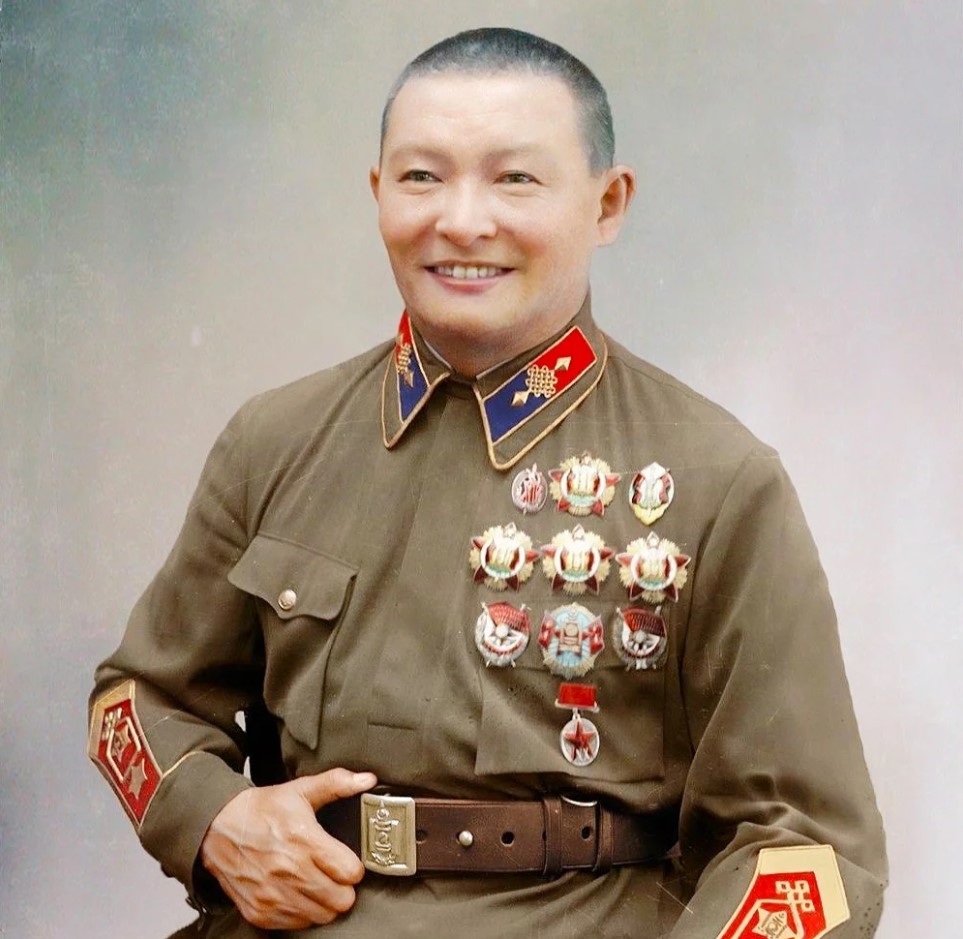
Stalin was also involved in organizing repressions in other countries. In the Historical Museum of Ulaanbaatar there is a copy of a letter from Khorloogiin Choibalsan to Nikolai Yezhov, in which he thanks Stalin and Yezhov for assistance in organizing political repressions in Mongolia:
With the direct assistance of your adviser Comrade Chopian and instructors, and with the full support of the Plenipotentiary Representative of the USSR Comrade Tairov, I was able to carry out through the Central Committee of the MPRP and the Government all necessary political and economic measures to stop the growth of the lamas, and to undermine their political and economic influence on the population. In practice, we managed to implement Comrade Stalin’s advice — to prepare and carry out five show trials against the upper strata of the lamas, on charges of treason, espionage, and preparation of an armed uprising. These trials seriously discredited the higher lamas.33
There is also a resolution of the Politburo of the Central Committee of the All-Union Communist Party (Bolsheviks) P53/106 dated September 19, 1937, which states: “To accept Comrade Frinovsky’s proposal on the organization of a special troika consisting of Choibalsan, the Minister of Justice, and the Secretary of the Central Committee of the MPRP to review cases against Mongolian lamas”.34
Conclusion
The Moscow trials and the repressions of the Great Terror, which also included the mass destruction of socialists, were initiated by Joseph Stalin and carried out under his control, which is documented and confirmed by the majority of reputable historians. The innocence of the General Secretary is a manipulative short thesis of the conservative propaganda machine, which seeks to reframe the repressions into a legitimized domain and prepare the ground for new waves of repression that, in the event of a political and economic transformation of the “general line”, would allow the restoration of former nomenklatura privileges through the expropriation of those who were repressed.
Stalinists still retain several lines of retreat — above all, the manipulative theses that “repressions did exist, and even if they were initiated by Stalin, they were justified”, and that “repressions did exist, and even if they were initiated by Stalin and even if they were unjust, life nevertheless improved under Stalin”. The “Logic of Progress” project has cut off these lines of retreat in separate articles, where we demonstrated that the repressions mostly affected innocent people, and that the standard of living, compared to the era of collective leadership during the NEP period, deteriorated.
We can also note that if Stalin had truly not supported the repressions and had not been their initiator, he would have rehabilitated the innocently convicted; he had full power to do so. However, we see that rehabilitations only began after the General Secretary’s death. That is the first point. Second, after Stalin’s death, mass repressions were stopped and even condemned. Both direct and indirect evidence indicates that the mass repressions of the Great Terror era were carried out on Stalin’s initiative.
- Yarogor Smirnov. The Magic of Governance. The Russian Version – LLC “Napisano Perom”, 2017
- A. S. Yakovlev. The Purpose of Life. (Notes of an aircraft designer). 2nd ed., expanded – 623 p. – Moscow: Politizdat, 1969. – p. 509.
- Yu. G. Felshtinsky, G. I. Chernyavsky. Across Centuries and Countries. B. I. Nikolaevsky. The Fate of a Menshevik, historian, Sovietologist, a key witness to epochal changes in Russia in the first half of the 20th century. – 544 p. – Moscow: Tsentrpoligraf, 2012
- A. K. Sokolov. A Course in Soviet History, 1917-1940. – 270 p. – Moscow: Vysshaya Shkola, 1999. – p. 229
- N. I. Kapchenko. Political biography of Stalin. Volume II (1924-1939). – 720 p. – Tver: Information and Research Center “Soyuz”, 2006. – p. 567-571.
- Operational order of the People’s Commissar of Internal Affairs of the USSR N. I. Yezhov No. 00447 “On the operation to repress former kulaks, criminals, and other anti-Soviet elements”. July 30, 1937. Archive of the President of the Russian Federation. F. 3. Op. 58. D. 212. L. 52-54. Copy. Typescript. // Lubyanka. Stalin and the Main Directorate of State Security of the NKVD. Stalin’s Archive. Documents of the highest organs of party and state power. 1937-1938. Ed. by Acad. A. N. Yakovlev; comp. V. N. Khaustov, V. P. Naumov, N. S. Plotnikova. – 736 p. – Moscow: MFD, 2004. – p. 273-282.
- Document No. 362. Letter from N. I. Yezhov to the Politburo of the Central Committee of the All-Union Communist Party (Bolsheviks) to I. V. Stalin. 23.11.1938. RGASPI. F. 17. Op. 3. D. 1003. L. 82—84. Copy. Typescript. Published in “Historical archive”. 1992. No. 1. p. 129—130
- O. Khlevniuk. Stalin. Life of one leader: a biography. – 464 p. – Moscow: AST-CORPUS, 2015. – p. 68.
- M. S. Voslensky. Nomenklatura. The ruling class of the Soviet Union. – 624 p. – Moscow: “Sovetskaya Rossiya” jointly with MP “Oktyabr”, 1991. – p. 93.
- From the speech of comrade Yezhov. March 3, 1937. Materials of the February–March plenum of the Central Committee of the All-Union Communist Party (Bolsheviks), 1937 // Voprosy istorii. 1995. No. 2. pp. 16–17
- Rehabilitation: Political trials of the 1930s–1950s / Under the general editorship of A. N. Yakovlev. – 461 p. – Moscow: Politizdat, 1991. – p. 178.
- 18th Congress of the All-Union Communist Party (Bolsheviks). March 10–21, 1939. Stenographic report. – 742 p. – OGIZ. State Publishing House of Political Literature, 1939. – p. 175.
- Yu. V. Rubtsov. Stalin’s Marshals. – 352 p. – Rostov-on-Don: “Phoenix”, 2002. – p. 194.
- Pavel Sudoplatov. Intelligence and the Kremlin. Notes of an unwelcome witness. — 507 p. — Moscow: TOO “Geya”, 1996. — p. 329.
- Ibid., p. 453.
- Letter from O. G. Shatunovskaya to A. N. Yakovlev regarding the circumstances of the murder of S. M. Kirov. 12.06.1989 // RGANI. F. 5. Op. 102. D. 1000. L. 26-28. Original. Typescript.
- O. V. Khlevnyuk. Politburo: mechanisms of political power in the 1930s. – 304 p. – Moscow: “Russian Political Encyclopedia” (ROSSPEN), 1996. – p. 143.
- V. V. Shelokhaev. A book for teachers. History of political repressions and resistance to unfreedom in the USSR. – 504 p. – Moscow: Publishing house of the association “Mosgorarkhiv”, 2002. – p. 127
- Archive of the President of the Russian Federation. F. 3. Op. 24. D. 330. L. 18. Original. Typescript.
- Stalin’s lists (stalin.memo.ru). [Electronic resource]. URL: http://stalin.memo.ru (accessed: 10.02.2020).
- “On the shortcomings of party work and measures to eliminate Trotskyist and other double-dealers. Report at the Plenum of the Central Committee of the All-Union Communist Party (Bolsheviks), March 3, 1937” vol. 14
- Politburo decision of the Central Committee of the All-Union Communist Party (Bolsheviks) No. P51/94 of July 2, 1937 // AP, 3-58-212, l. 32.
- A. K. Sokolov. A course of Soviet history, 1917–1940. – 270 p. – Moscow: Vysshaya Shkola, 1999. – p. 229
- Yu. V. Rubtsov. Stalin’s Marshals. – 352 p. – Rostov-on-Don: “Phoenix”, 2002. – p. 98.
- M. S. Voslensky. Nomenklatura. The ruling class of the Soviet Union. – 624 p. – Moscow: “Sovetskaya Rossiya” jointly with MP “Oktyabr”, 1991. – p. 97.
- O. Khlevnyuk. Stalin. The life of a leader: a biography. – 464 p. – Moscow: AST-CORPUS, 2015. – pp. 210–211.
- Ibid., p. 69.
- Collected Works. Sergey Dovlatov. Vol. 2. – 2038 p. – Moscow: Azbuka, 1999. – p. 73
- Note by R.A. Rudenko to the Central Committee of the CPSU on the rehabilitation of Ya.E. Rudzutak. December 24, 1955. Rehabilitation: how it was done. Documents of the Presidium of the CPSU Central Committee and other materials. In 3 volumes. Volume 1. pp. 294-295. RGANI. F. 3. Op. 8. D. 359. L. 116–119. Copy. Typewritten.
- Closed letter of the Central Committee of the All-Union Communist Party (Bolsheviks) “Lessons from the events connected with the foul murder of Comrade Kirov”. January 18, 1935. // Rehabilitation: Political processes of the 1930s–1950s / Ed. A.N. Yakovlev. – 461 p. – Moscow: Politizdat, 1991. – p. 192.
- Ibid., p. 210.
- Vladimir Khaustov. Stalin and mass repressions / In the Name of Stalin. Host: Natella Boltyanskaya // Ekho Moskvy (echo.msk.ru). December 13, 2008, 20:08. [Electronic resource]. URL: https://echo.msk.ru/programs/staliname/559174-echo/ (accessed: 11.02.2020).
- S. L. Kuzmin. History of Baron Ungern: an attempt at reconstruction. – 659 p. – Moscow: Association of Scientific Publications KMK, 2011. – p. 356.
- RGASPI. F. 17. Op. 162. D. 22. L. 7.