
How society works and what changes it
The belief that everything is predetermined by a single factor is an intellectual plague today, one that prevents people from maintaining sound judgment and critical thinking, and from understanding the path to a successful society. We often hear statements like "the main thing is to change the economy", "legalizing LGBT rights will not change life in the country in any way", "our country cannot become rich because of the climate", and so on. These stereotypes prevent people from understanding that building a successful society requires working on a multitude of different factors that influence one another, and that there are a large number of groups of these factors. We will endeavor to describe these groups in this material.
In many ways, this article is intended to supplement what has already been written by Daron Acemoglu and James Robinson in their work “Why Nations Fail: The Origins of Power, Prosperity, and Poverty”, which we have already reviewed in one of our articles. In this article, we will attempt to list all the institutions and all the components that, in our view, influence the level of prosperity of a given society.
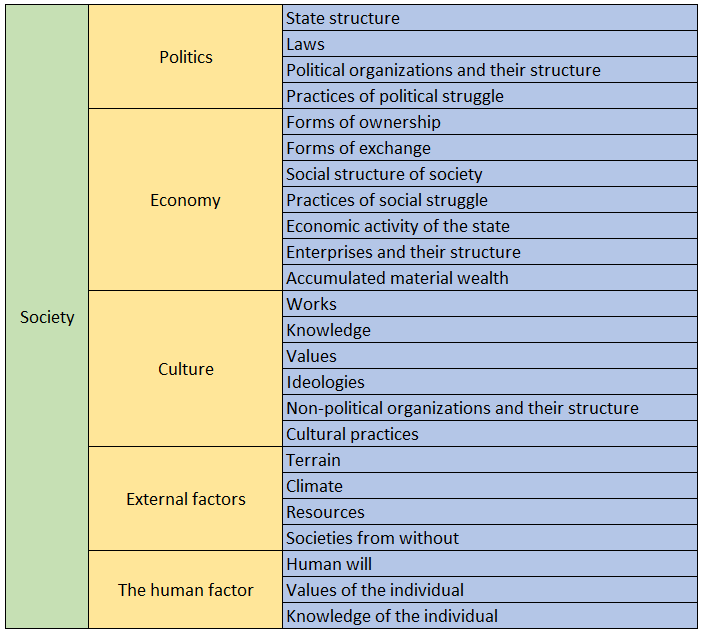
The functioning of society is influenced by five major groups of factors: politics, economics, culture, external factors, and the human factor. Regarding the types of work of the first three groups of factors, there is a fairly clear and well-known division. Political factors can be implemented through authoritarian, democratic, and anarchic methods. Economic factors can be implemented through the prism of the concepts of a planned economy, a regulated market, and an unregulated market. The implementation of cultural factors, meanwhile, can be conservative, progressive, or entirely unprincipled and based on instincts.
Politics
What is politics? By the definition of Britannica, it is the activities associated with the governance of a country or area, especially the debate or conflict among individuals or parties having or hoping to achieve power1. According to the definition of the Great Russian Encyclopedia, it is one of the spheres of human activity in which states and public institutions realize their goals and interests2. The sphere of politics is not only the struggle for power, its retention, and its use, but also the reconciliation of interests (cooperation, bargaining, negotiations, finding mutually acceptable solutions). Conditionally, politics can be divided into the following subgroups of factors: state structure, laws, political organizations and their structure, and practices of political struggle.
State structure. By this, we mean how the state is organized, that is, the totality of institutions governing a specific territory, which possesses the capacity to create laws regulating the behavior of people within the limits of that territory and is supported by tax revenue. It can take the form of a monarchy or a republic, a democracy or an authoritarian regime, a parliamentary or presidential democracy, and so on. What matters is the quantity and size of state structures, the number of powers they possess, the distribution of powers among them, the remuneration of state officials, the regulations acting within these structures, the methods of forming their composition, the organization of the judicial system, and much more. For example, a state may be burdened by superfluous bureaucratic structures, and in one state a hundred officials may perform the same volume of work as four hundred officials in another state, while also receiving ten times less money for it. It is obvious which of the two states will develop more successfully, all other things being equal. Or, for example, one of the state structures (for instance, the presidential administration in Yeltsin’s Russia) may have an extremely high number of powers, which eventually leads over time to the subordination of other structures to it and the change of the political regime from hybrid to authoritarian. Everything in the state structure — from the working hours in an individual structure to the organization of elections for governing bodies — exerts its percentage of influence on the final effectiveness of the state system.

A typical example of the influence of the state structure on the development of society is the methods of power transition in democracies versus authoritarian regimes. In the former, power usually changes through elections. In the latter, changing power is extremely difficult, as a result of which, in the event of the current power’s incompetence, the average standard of living and the level of citizens’ freedoms will fall for quite a long time.
Laws. Laws operating on the territory of the state exert a significant influence on the level of prosperity of society. For example, if certain types of fraud are not prohibited in this territory, it is quite likely that they will flourish, which will cause harm to society. Or, it may be prohibited in a society to insult the authorities, as a result of which there will be very little criticism of the authorities, and the authorities will not be aware of their weak points; as a result, work will not be properly conducted on them, and this will negatively reflect on the level of prosperity of society. For example, the passage of the Civil Rights Act of 1964 in the USA changed the country — before this, segregation existed in the USA, but after the law was passed, society in that country became noticeably more egalitarian.
Political organizations and their structure. Here, we are talking primarily about political parties and movements. The structure of a state may be democratic, and democracy may be ensured within it, however, if the overwhelming majority of parties and movements within it are fascist, the establishment of fascism becomes a matter of time. Therefore, without strong democratic, progressive parties, democracy will not work and will degenerate into authoritarianism. The more democratic parties there are, where highly qualified personnel with the will to implement progressive values prevail, the more prosperous the state will be. The more authoritarian, populist, and simply incompetent political organizations there are in a society, the less successful it will be. But it is also important how these parties are organized, whether intra-party democracy is implemented within them — if not, then there is a risk of their degeneration and their quick conversion into ineffective organizations. There are different examples of the influence of political organizations on the development of states — the NSDAP exerted a huge influence not only on Germany but on the entire world, yet this influence was destructive. The influence of the SAPS and the “Home for the People” concept it introduced proved positive for Sweden and set a worthy example for other countries.

Practices of political struggle. Practices used by the opposition and the government in political struggle exert an influence on society. If the authorities suppress the opposition and falsify elections, the opposition may respond with terror, which can lead only to an increase in violence in society, an increase in the popularity of authoritarian methods, the opposition’s adoption of authoritarian methods, and a bloody revolution, after which the opposition, poisoned by wild authoritarianism of power, may become no better than the previous authorities, if not worse. At the same time, if the opposition applies only non-violent methods of resistance, this can play out negatively if the authorities are not inclined toward negotiations. In Ukraine, the culture of protest was developed more strongly than in Russia or Belarus, and as a result, the opposition there was able to change the government. In our article about the history of democracy in Russia, we provided examples of how the use of the practice of individual terror as a method of political struggle negatively influenced the development of Russian society.
Economy
In accordance with the definition of the Great Russian Encyclopedia, the economy includes human relations in the process of economic activity and the methods of distributing resources (natural, labor, financial, and production) in society3. The Britannica Dictionary states that an economy is a system by which goods and services are produced, sold, and bought in a country or region4. In general, by economy, we mean the production of material goods and services, the organization of this production, and how people in society gain access to them. After all, ultimately, the level of life and prosperity depends precisely on how many material goods and services people have, as well as their quality. Conditionally, economic factors can be divided into forms of ownership, forms of exchange, the social structure of society, practices of social struggle, the economic activity of the state, enterprises and their structure, and accumulated material wealth.
Forms of ownership. Usually, ownership is divided into state and private (the latter also includes collective ownership). The distribution of ownership in society between these two forms and their subspecies ultimately influences the standard of living in the country. In the article on nationalization, we already wrote that societies where state ownership prevails have not shown high efficiency, although there are sectors where state ownership is preferable (for example, in the case of natural monopolies). The correct balance between forms of ownership in each sector is one of the keys opening the way to normal development. You can read about how forms of ownership influence the level of prosperity of society in our article on private property.
Forms of exchange. Here, the division lies between the market system (characteristic of a free market or a mixed economy) and the system of centralized distribution of goods (usually, supporters of a planned economy try to implement it, although market forms of exchange, as a rule, still remain). Attempts to transition to direct barter and the liquidation of monetary relations usually lead to dire consequences for the economy, as they are a step backward in the development of society. Therefore, to create a prosperous society, it is important to successfully oppose such attempts. You can read about the influence of the form of exchange on the standard of living, for example, in our article on the planned economy.
Social structure of society. The level of development of a society is influenced by its social composition — which social groups exist within it and how high the concentration of resources is in the hands of one or several groups. For example, with an overly large number of law enforcement personnel, repressive laws and practices are more likely to prevail in society. With the presence of organized crime and strong criminal structures, a significant number of citizens will engage in robbery, significantly lowering the level of prosperity of society. A high level of social inequality is also dangerous, as we have already written here.
Practices of social struggle. We have already written that there is a struggle for interests between social groups, but this struggle can take various forms. These groups can be divided and hostile toward each other, or they can possess a high degree of unity against elites and cooperate with one another. They can conduct trade union struggles, battles through the courts, and strikes. Or they can be passive or engage in class terror (in which useful personnel will also be destroyed), in which case the welfare of society will decline. For example, in the USA, special agent of the Treasury Department Eliot Ness created a special group in the late 1920s to fight the mafia (previous attempts had ended in failure due to corruption in the police), known as “The Untouchables”, and they succeeded in putting the most famous gangster, perhaps of all time, behind bars — Alphonse Capone5, which became a turning point in the fight against the mafia in the USA. Undoubtedly, this positively influenced the welfare of American society. In post-Soviet Russia, however, according to the testimony of former FSB officer Alexander Litvinenko, the security structures themselves were engaged in criminal operations6, which could not but negatively affect its development.
Economic activity of the state. State intervention in the economy can either hinder or facilitate its development — it depends on what kind of intervention it is and what policy is being pursued. We have already written here about which forms of state intervention are capable of stimulating economic development. In those societies where the state applies effective practices of intervention in the economy, society usually becomes more prosperous than where practices that have proven their ineffectiveness are used, or where the state does not intervene in economic development at all.
Enterprises and their structure. The more effective, profitable enterprises and businesses (especially those working for export) there are in a country, the more goods that country will produce, and, under a democratic system, the more goods it will provide for its citizens. Within the country, due to competition and their large number, goods will be cheaper and more accessible to a wide range of citizens. The welfare of citizens is also influenced by how these enterprises are structured — whether they are owned by a small number of people or by broad strata of citizens, whether decisions are made by one owner or by a board of directors with the participation of the enterprise’s employees, and so on. The more egalitarian the structure, the greater the number of citizens who benefit from the work of the enterprises, and the lower the social inequality. Of course, egalitarianism is permissible only up to the point where it does not catastrophically affect the efficiency of the enterprise. Furthermore, not all enterprises and businesses are socially useful. For example, there is no benefit to the development of society from fraudulent structures like MMM — it is simply a redistribution of money in favor of persons with skills in fraud. Whereas corporations headquartered in Silicon Valley in the USA not only pay significant taxes to the budget but also attract the best personnel from around the world, provide highly paid jobs, create infrastructure, and so on.

Accumulated material wealth. The level of development of a society is also influenced by the amount of already accumulated material wealth, as well as the experience of accumulating it. Naturally, if there are two countries — one already rich and one still developing — they will not be in the same conditions. It will be easier for an already rich country to develop further. The experience of accumulating wealth also has an influence — for example, if a country is accustomed to accumulating wealth through the export of resources, it may encounter problems with development after these resources are depleted. Therefore, to build a prosperous society, it must be able to not only extract but also process resources. Two states may both pursue competent and correct policies in all spheres of public life, but if one of them is initially significantly richer than the other, it will most likely remain richer, due to the wealth accumulated earlier.
Culture
According to the Great Russian Encyclopedia, culture is the historically evolved way of life of people, including values and norms, beliefs and rituals, knowledge and skills, customs and institutions, techniques and technologies, ways of thinking, acting, interacting, and communicating, and so on7. A group of cultural factors influences how certain phenomena are perceived and analyzed in a given society, and on what basis knowledge is used to draw conclusions and propose solutions (sometimes one may hear this referred to as a “mentality”, however, we will use the term “culture”). The prosperity of a society strongly depends on its knowledge and the distribution thereof, on the values accepted in the society, and so on. We will divide cultural factors here into works, knowledge, values, ideologies, non-political organizations and their structure, and cultural practices.
Works. The development of society is influenced by various products of human creativity — books, films, brief theses, statements, symbols, and so on (the list of these products is extremely extensive). For example, the Bible had a significant influence on the world, becoming one of the factors in the formation of Christianity. “Das Kapital” significantly influenced human development, as it was one of the factors due to which communist regimes became entrenched in significant territories of the planet. The works of Carl von Clausewitz influenced the principles of warfare. If a country has a significant amount of literature that effectively teaches people about house construction, production organization, and public administration, all of this will positively affect the country’s level of development. At the same time, the more low-quality literature that spreads misconceptions, the more noticeably this will hinder development. Knowledge and values are transmitted through works. Therefore, the creation of works that carry useful knowledge and values is one of the methods for increasing the welfare of society.
From economic determinists, one can sometimes hear that statements, calls, and other elements of speech and culture do not influence the development of society. This is an unscientific point of view — for example, associate professor of economics at Harvard University David Yanagizawa-Drott proved the influence of “Radio Télévision Libre des Mille Collines” (RTLM) on the genocide in Rwanda. Based on the physical laws of radio wave propagation, he derived a rather interesting formula. Since RTLM had two transmitters at its disposal — one in Kigali and the other on the mountain peak of Muhe — and Rwanda is indeed covered entirely with mountains, the mountains block the path of radio signals. Therefore, in some settlements, there is no reception or only partial coverage. Using a relief map, the scientist easily calculated the signal level at every point in the country. Based on data on exactly how many people in each settlement were convicted of genocide, he revealed that the number was much higher in areas with strong radio reception than in places where there was no signal. Thus, the economist publicly proved the influence of radio propaganda on the outbreak of the massacre between the Tutsi and Hutu8.
Knowledge. A person may know that walking with an uncovered throat in cold, windy weather is fraught with a cold, and this knowledge will help them not to get sick, which means working more and producing more goods for society. This is the simplest example of the influence of knowledge on the development of society. The more people in a society know about the dangers of dictatorship, know about methods of fighting corruption, and have a large amount of knowledge in their professional field — in short, the more positive knowledge they have, the more developed the society will be. There is not only positive but also negative knowledge. For example, if a person is told about some “way to win at a casino” that is incorrect, and they believe it, the person has acquired negative knowledge. This negative knowledge can seriously damage their financial state, which, if they had positive knowledge, they could have spent on matters more useful to them and to society. Knowledge can also manifest in the form of stereotypes and unwritten rules of society. The difference between works and knowledge is that the former, as a rule, exist in oral or written form, while the latter exist in the minds of people, constitute their view of the world, and influence the actions they perform.
A large part of the knowledge of a society’s residents is formed by the education system that has developed in that society (most often it consists of state education, which is part of the state system, and private educational institutions, which can be classified as enterprises). Through it, citizens receive knowledge about how to perform mathematical calculations, how to read and write, and receive knowledge about historical experience, works, traditions, values, ideologies, cultural practices, and so on. The education system is an extremely powerful lever of influence on the culture of society as a whole, allowing this culture to be gradually changed (similar functions are performed by the media). Possessing control over this lever, the state can, to a significant extent, form either a society of free people or a fascist society in general.
Values. The development of society is influenced by the values prevailing within it. If a society as a whole preaches the values of human life, high quality of life, equality, high environmental standards, and other progressive values, this society will strive for the realization of these values and, accordingly, achieve more tangible successes in their implementation. If, however, the values of territorial seizure, “unity of society”, paternalism, and other conservative values prevail in it, it will be better at achieving their realization (though in today’s world even this is not necessarily the case — since an aggressor can be put in their place, and they will not only acquire nothing but will lose what they had), but the realization of progressive values will be significantly worse. Values set goals for society. Various studies confirm the influence of values on the development of society9.
Ideologies. It is also important which ideologies and which systems of views prevail in society, and how strong a role they play. They contribute to the emergence and dissemination of various knowledge, works, values, and traditions, and can be formalized into political and non-political organizations. Usually, there are several or many of them in society. For example, some researchers believe that Lutheranism influenced the formation of the “Scandinavian model”10, others note that Protestantism influenced the economic development of certain societies11, and so on. Ideologies can influence the level of development of society both generally positively and negatively (depending on what kind of values and knowledge they carry).
Non-political organizations and their structure. Usually, a large number of groups of people operate within a state, united into various kinds of organizations whose main goals are not related to obtaining political power. Examples: trade unions, religious organizations, historical societies, football fan communities, artists’ associations, literary clubs, drawing circles, sports clubs, dog clubs, chess clubs, and so on. Certain views and knowledge may prevail in these organizations, and then they will be the distributors of these views and knowledge; furthermore, these organizations can express their social position on one issue or another, and in extreme cases, mobilize their members for one activity or another.
Cultural practices. A significant influence on the development of society is exerted by the language that citizens possess and use to obtain knowledge. The level of knowledge of a society directly depends on this. For example, if all citizens understand only Zulu, and there are very few works containing positive knowledge in Zulu, it will be difficult for such a society to succeed in construction, high-tech manufacturing, and so on. If all citizens speak English fluently, they have the widest access to knowledge of the most diverse profiles (the higher the level of language knowledge — the easier the access to the knowledge expressed in it). Traditions can also be included here: various customs, habits, and holidays accepted in a society can have some influence on its development. Also included here is how prepared a society as a whole is to contact other societies, how actively it exchanges knowledge with them, conducts trade, and so on.
If, on the whole, the culture of a society is more democratic than authoritarian, the chances of that society transitioning to a democratic political system increase. The mastery of a country’s cultural space by democrats and the displacement of authoritarians from it is the path to a stably democratic society. However, if the majority of society desires authoritarianism, this desire will be realized in practice at the local level and, over time, may be realized on the scale of the entire society.
External factors
There is a multitude of factors that are extremely difficult, and in some cases even impossible, to influence; however, it is nonetheless possible to reduce their influence on the prosperity of a society to minimal levels by improving other factors. We have already written about this in the article on geographical determinism — external factors cannot serve as an excuse for a society’s lack of success.
Terrain. The natural conditions of a country’s territories influence how it will develop — they may be located in mountainous terrain, they may be mostly flat, the state may be an island, or it may be landlocked. A significant portion of its lands may be unsuitable for permanent human habitation (for example, a desert), or it may be quite fertile (like chernozem). Plants that are successfully used in everyday life may grow in this terrain, and dangerous animals (like wolves) or those helpful to humans (like horses) may inhabit it. Landscape had a noticeable significance for development in the initial periods of human history, but today its influence is minimized — for instance, mountainous and landlocked Switzerland is one of the most successful countries in the world, as is New Zealand, which is remote from many states and shaken by seismic activity.
Climate. The climate of the territories where a society is located also matters. It can be very cold for most of the year, or it may never be cold at all. It can be prone to natural disasters (tornadoes, tsunamis, earthquakes). It can be very hot, very windy, very rainy, and so on. Usually, every inhabited area has its pros and cons in this sense.
Resources. The construction of a state’s economy often depends on the resources available in its territories. The extraction of valuable resources, such as oil or diamonds, can influence the development of a state — it can both increase its budget and lead to a so-called “resource curse”, when a kind of “resource mafia” emerges that appropriates the income from resource extraction for itself and blocks any attempts to interfere with this, including through political levers. For example, Norway or the UAE benefit from the sale of resources, while Russia or Congo may do so to a much lesser extent (this is evidenced by the difference in the standard of living).
Societies from without. Much in a state’s policy depends on the neighbors surrounding it. If a neighboring state is an aggressive authoritarian regime that constantly threatens invasion, creates and sponsors self-supporting political movements within neighboring societies, and engages in disinformation and destabilization of society (which is what, for example, Russia does in relation to Ukraine), this creates significant difficulties in development. If, however, the surrounding states pursue a peaceful policy and are inclined toward mutually beneficial cooperation, this can noticeably help in development.
The human factor
Finally, the last group of factors is the human factor. Many underestimate the significance of this factor, but it is very high. For example, the social-democratic movement in Russia is currently experiencing a shortage of SMM specialists. If we had such a specialist, the promotion of our ideas would have proceeded significantly faster. And yet, there are many such specialists in Russia; they only lack the will to develop the social-democratic movement, and many of those who have the will lack the necessary knowledge. George Bernard Shaw once expressed that “democracy cannot rise above the level of the human material of which its voters are made”12. Here he turned out to be right — an ideal political system will be of little use if a society fails in the areas of culture and the human factor.
Human will. Will, the desire to change something, has always moved progress forward — both scientific and political. Human will and knowledge allowed humanity to subjugate the power of electricity, the power of steam, and the power of the atom. It is human will and knowledge that subjugated the elements — fire, water, air; they sent man into space, and they created forms of energy much more powerful than the strength of any living creature.
The will of individuals such as Vladimir Lenin and Leon Trotsky allowed the Bolsheviks to dismantle democracy and establish authoritarianism in Russia, while the Social Democrats of Russia at that moment did not have such individuals who possessed the will, knowledge, and skills. Julius Caesar’s decision to cross the Rubicon is one of the textbook examples of the influence of human will on history (his taking of this decision marked the beginning of the civil war between the supporters of Caesar and the supporters of Gnaeus Pompeius in Rome13). In order for a society to be prosperous, it is necessary to have a sufficient number of individuals who set themselves the goal of achieving prosperity for this society. Moreover, some individuals do not have sufficient resources for their influence to be significant, while others do. In societies where the psychology of a loser — “I cannot influence anything”, “there are too few of us to change anything”, and so on — is massively cultivated and imposed, the level of prosperity, other things being equal, will be lower than in societies where human will is cultivated. The will of one person or many people (especially those united in organizations) can create knowledge, create the laws of society, and change its structure. Therefore, human will is a factor that triggers metamorphoses in very many other factors.
Values of the individual. A person may possess enormous willpower, but the channel in which this will is directed — toward prosperity or toward destruction — depends on the values they are guided by. One may be guided by the values of equality and social justice, while another may desire the enslavement of other nations and people. The prosperity of a society is influenced by how many strong-willed individuals set themselves progressive goals, how many adhere to conservative values, and how many people have no values or principles at all.
Knowledge of the individual. A person may possess will and even the right values, but still strive to realize them through negative knowledge or misconceptions. And this can greatly harm the realization of their values. This applies not only to knowledge about politics, society, and ideologies but also to various kinds of skills applied in practice. A master of their craft — for example, a technician capable of repairing any refrigerator — thereby positively influences society, unlike an unskilled specialist who will leave the refrigerator in a non-working state and will still demand money for it. By doing so, they waste their own time, their client’s time, and, in the event of a court case, the time of other people. And this time could have been used to create public goods. Money is wasted that could have been spent on something more useful. Therefore, incompetent representatives of various professions, in general, exert a negative influence on society (and even more so people who do not possess any skills useful to society), while competent ones who deliver results — other things being equal — are much more useful for creating a prosperous society. Here we can also include experience. Experience, provided that a person truly acquires and reflects upon it, allows one not to repeat mistakes, allows for more efficient use of time, and enables the creation of various goods.
How society works
The factors listed above exert a direct or indirect influence on each other — for example, a society’s laws can influence how forms of property are organized, and this organization, in turn, can influence what laws will be adopted in the future. Most often, one of the factors influences a multitude of other factors. For example, if we are talking about the influence of ideologies, in the case of the popularity of communist ideology in society, corresponding political organizations may appear; under its influence, laws will be adopted that may gradually change the state structure, which in the end may lead to the breakdown of existing forms of property, exchange, the social structure of society, and so on. At the same time, the structure of dominant ideologies in a society can also be influenced by many factors — the number of popular works in the spirit of a particular ideology, the social structure of society, the human will of individual personalities and their groups, the values of society, and so on.
In this regard, we see that changing any single one of these factors is insufficient for building a successful society. Work on almost all factors is necessary. For example, a parliamentary democracy in itself provides quite a bit, but it is only one aspect of state structure, and it alone is clearly insufficient for building a prosperous society.
We see this well in the example of India, which possesses a parliamentary democracy and a mixed economy — it would seem this should stimulate the growth of prosperity in the country (and indeed, the standard of living and the economy in India are growing, just by no means at the rates one would like). But India is held back by such factors as the social structure of society (remnants of the influence of the archaic caste system), the lack of a truly progressive, strong social-democratic party, insufficiently competent economic activity of the state, the low quality of the education system14, and so on.
The good news for us as social democrats is that we can exert an influence on the development of society even without holding state power. Of course, this influence will be incomparably smaller, but with the proper and constant application of human will, it will grow. We can gradually change culture in a social-democratic direction, and it, in turn, will influence politics.
“Logic of Progress” is an example of such an impact. As a product of the application of the will of a certain number of people, LP creates works (articles, notes, agitation materials) that influence the knowledge and values of individual people, contributing to the creation of a coherent ideology and political organizations that will be capable of influencing other organizations, political practices, and so on. In this way, a chain reaction is triggered, which later may lead to a change in state power and even the state structure as a whole. That is, human will is a factor that should not be underestimated.
And with human will, as with the human factor in general, there are very tangible problems in Russia. A great many do not manifest any will at all in a political sense and remain apolitical, caring only for their own personal good. A significant part of people possess negative knowledge and fight for it. Destructive ideologies and false beliefs hold enormous influence among us. And this is one of the reasons for our country’s lag.
Conclusion
Thus, we see that in order to significantly raise the level of a state’s development and the standard of living within it, we must work on a very extensive complex of factors, and not just on the economy or politics. The omission of work on a multitude of factors became the cause of the failure of previous attempts to build democracy in Russia. We can begin work on this right now, without possessing state power — to the best of our abilities. In one of our articles, we have already described methods of political struggle — these are examples of possible influence on the functioning of society. This is work that must be carried out.
Society consists of a huge number of mechanisms, and political parties compose huge programs with the aim of showing by what methods they will attempt to engage as many of these mechanisms as possible. Such a program will also be held by a future European-type social-democratic party in Russia.
- Politics // The Britannica Dictionary (www.britannica.com). [Electronic resource]. URL: https://www.britannica.com/dictionary/politics (Accessed: 15.10.2022).
- N.A. Sakharov. Politics // Great Russian Encyclopedia. [Electronic resource]. URL: https://bigenc.ru/world_history/text/3154284 (Accessed: 15.10.2022).
- T.G. Leonova. Economy // Great Russian Encyclopedia. [Electronic resource]. URL: https://bigenc.ru/economics/text/4927030 (Accessed: 15.10.2022).
- Economy // The Britannica Dictionary (www.britannica.com). [Electronic resource]. URL: https://www.britannica.com/dictionary/economy (Accessed: 15.10.2022).
- Eliot Ness // The Britannica Dictionary (www.britannica.com). [Electronic resource]. URL: https://www.britannica.com/biography/Eliot-Ness (Accessed: 15.10.2022).
- A. Litvinenko. LPG – Lubyanka Criminal Group – New York, GRANI, 2002. – 264 p.
- V.M. Mezhuev, A.V. Konstantinov. Culture // Great Russian Encyclopedia. [Electronic resource]. URL: https://bigenc.ru/philosophy/text/2120919 (Accessed: 15.10.2022).
- D. Yanagizawa-Drott. Propaganda and Conflict: Evidence from the Rwandan Genocide // University of Oxford (academic.oup.com). November 21, 2014. [Electronic resource]. URL: https://academic.oup.com/qje/article-abstract/129/4/1947/1853091 (Accessed: 18.10.2022).
- R. Rutten, J. Gelissen. Social Values and the Economic Development of Regions // ResearchGate (www.researchgate.net). June 2010. [Electronic resource]. URL: https://www.researchgate.net/publication/232888961_Social_Values_and_the_Economic_Development_of_Regions (Accessed: 18.10.2022).
- V. Studentsov. Three sources of “Scandinavian socialism”. Part II. Lutheranism as a precursor // Svobodnaya Mysl (svom.info). August 2022. [Electronic resource]. URL: http://svom.info/entry/1226-tri-istochnika-skandinavskogo-socializma-chast-ii-/ (Accessed: 18.10.2022).
- M. Weber. The Protestant Ethic and the Spirit of Capitalism. 2nd ed., exp. and rev. — 656 p. — Moscow: “Russian Political Encyclopedia” (ROSSPEN), 2006.
- George Bernard Shaw. Aphorisms / compiled by K. V. Dushenko. — Moscow: Eksmo-Press, Eksmo-Market, 2000.
- V.O. Nikishin. Rubicon // Great Russian Encyclopedia. [Electronic resource]. URL: https://bigenc.ru/world_history/text/3517723 (Accessed: 18.10.2022).
- Quality education // UNICEF (www.unicef.org). [Electronic resource]. URL: https://www.unicef.org/india/what-we-do/quality-education (Accessed: 18.10.2022).