How Stalin created the nomenklatura
Many Stalinists claim that Joseph Stalin fought the nomenklatura as best he could, but it appeared on its own and prevented him from performing the good deeds he so wanted to do. In this article, we will prove that not only did Stalin not fight the nomenklatura; on the contrary, he is its creator and the person who shaped its "class consciousness."
The layer of government officials is quite ancient and universally widespread, yet it plays a special role in the history of Russia. In the Russian Empire, serfdom lasted longer than in most developed countries, and even upon its abolition, peasants redeemed land at prices far higher than market rates1, while the best lands often remained with the landlords, including lands with vital infrastructure2. As the magazine “Kommersant” notes, by the beginning of the 20th century, approximately 20 million peasant households owned the same amount of land as 30 thousand landlord estates3. The October Revolution took place in a country where the nobility was a strong class, and the dominant ideology was noble, not bourgeois.
Contents
Background
After the Bolshevik party came to power, the old bureaucratic layer was replaced by a new one; however, one could not say that a nomenklatura in the classical sense of the term had formed yet — mechanisms for appropriating national income and converting it into personal privileges had not yet been developed, and the layer of officials itself was not all that numerous. Nevertheless, it was precisely the fault of the Bolsheviks that conditions for the emergence of the nomenklatura were created.
The Soviet system was built in such a way that leadership personnel were “recommended” from above (this will be discussed later). When selecting administrative personnel, the main criterion was “political characteristics” rather than professionalism. That is, between a strong but “bourgeois” professional and an incapable but pro-Bolshevik cadre, the choice was made in favor of the latter. In his time, Lenin, when selecting personnel, was interested in their qualities “a) in terms of conscientiousness, b) from a political position, c) knowledge of the business, d) administrative abilities…”4. Mikhail Voslensky, a Doctor of Historical Sciences and leading researcher of the nomenklatura, testifies:
This principle of personnel policy generated not just obedience to the will of superiors in the fortunate appointees, but a stormy desire to curry favor, if only to become indispensable in this way. Moreover, to curry favor did not mean to work well, but meant to do well what the superiors who appointed — and consequently had the power to dismiss from the post — desired.
<…>
Arbitrarily appointed according to “political characteristics” and very easily replaceable, these officials were ready to curry favor in every way before those who appointed them, in order to hold on and receive even higher posts.
Who was this appointer and, consequently, the potential master of the rapidly growing nomenklatura?
Stalin concentrated all matters of appointing leadership personnel in the country in the hands of himself and his apparatus. Thus, under the cover of the primacy of “political characteristics” during personnel selection, Stalin created a situation in which the entire new nomenklatura automatically turned out to be devoted personally to him5.
Such criteria remained until the very end of the USSR (for example, at the 27th Party Congress in 1986, the Second Secretary of the CPSU Central Committee, E.K. Ligachev, noted: “Among the most important criteria for selecting personnel, we place the political qualities of the worker in the first place”6). And in the 1920s, the principle of selection based on “political characteristics” awaited the appointment of Joseph Stalin to the post of General Secretary of the Bolshevik Party, and the date of this appointment can be considered the beginning of the formation of the nomenklatura in the USSR. It was Stalin who began to build a subordinate scheme where personnel were selected who silently executed directives from above and did not contradict the leadership, which ultimately led to the fact that major state decisions came from one person, and the state apparatus itself consisted of careerists who did not have their own opinion in politics. As Voslensky notes, Lenin’s first criterion — regarding the conscientiousness of personnel — “clearly seemed superfluous to Stalin and was no longer put forward when approving nomenklatura workers”7. We have already examined in detail in the article about Stalin’s coup d’état some of the mechanisms by which appointments were carried out.
Stalin created a system of selecting leadership personnel in the party and state. It led him to power and remained his main achievement.
Stalin first set out some general considerations about this system at the 12th Party Congress in 1923, presenting the organizational report of the Central Committee to the delegates: “…it is necessary to select workers so that there are people in the posts who know how to carry out directives, who can understand directives, who can accept these directives as their own, and who know how to implement them. Otherwise, politics loses its meaning, it turns into waving one’s hands”, Stalin said8. The main idea, therefore, was to place zealous executors of directives in responsible political posts in the country. For this, Stalin explained, “it is necessary to study every worker down to the bones”9, it is necessary “to know the workers, to be able to grasp their merits and shortcomings”1011.
The creation process
The creation of the nomenklatura began in April 1922 with the appointment of Stalin to the post of General Secretary of the Party Central Committee (similar posts had previously been held by, among others, Yakov Sverdlov and Vyacheslav Molotov). In August of the same year, at the 12th Party Conference, the number of party workers in the apparatus, which was effectively subordinate to the Central Committee Secretariat, was reported for the first time. There were 325 people in Moscow, 2,000 in the provinces (guberniyas), and 6,000 in the districts (uyezds); in addition, there were 5,000 secretaries of party committees in the townships (volosts) and at large enterprises, totaling 15,325 people12.
In the aforementioned report at the 12th Party Congress, Stalin announced: “Heretofore, matters were conducted in such a way that the work of the Uchraspred [Account and Assignment Department] was limited to recording and distributing comrades among the district, provincial, and regional committees… now the Uchraspred cannot be confined within the framework of district, provincial, and regional committees… It is necessary to cover all branches of administration without exception”13.
This is exactly what the General Secretary proceeded to do. In 1922, the Central Committee’s Uchraspred made over 10,000 appointments14. In 1923, he expanded this work. The department created 7 commissions to review the staff composition of key state and economic bodies: in industry, cooperatives, trade, transport and communications, in financial and land agencies, in educational bodies, in administrative-soviet agencies, and in the People’s Commissariats of Foreign Affairs and Foreign Trade15. Most of these processes are described in great detail by Mikhail Voslensky:
Leading positions in party committees are elective according to the party charter. A way to bypass this clause of the charter was easily found: the leading party bodies “recommend” persons subject to election to those below them. For example, the candidacies of secretaries of volost party committees were recommended by the provincial committee, and the candidacies of secretaries of the provincial committee were recommended by the Central Committee Secretariat. The Secretariat conducted intense work on the selection and transfer of these new “governors”: in 1922, 37 provincial committee secretaries were transferred, and 42 new ones were “recommended.” It is telling that the same Central Committee Secretariat recommended candidates not only to those below it, but also to the body above it — the Central Committee Orgburo, which made decisions on filling top posts in the party and state. Thus, the Secretariat, led by Stalin, centralized in its own hands the matter of appointments to the most responsible leadership positions in the country.
The vigorous activity of Stalin’s Secretariat and its Uchraspred cleared the path for the logical creation of a new situation in the party apparatus. This was outlined by Trotsky in a letter to the Central Committee on October 8, 1923, and in his work “The New Course”, published in December 1923.
Noting that even in the years of War Communism, the system of appointments in the party did not constitute even a tenth of the size it had reached, Trotsky emphasized that this system made appointed secretaries independent of local party organizations. The workers of the party apparatus no longer have — or at any rate do not express — their own opinion, but instead agree in advance with the opinion of the “secretarial hierarchy”. As for the mass of ordinary party members, the decisions of this hierarchy are simply handed down to them in the form of orders16.
<…>
After Lenin’s death, the “Lenin Enrollment” into the party was announced. As a result, by May 1924 (the 13th Party Congress), the number of its members had almost doubled compared to April 1922 (the 12th Congress): from 386,000 to 736,000. Half of the party now consisted of recruits — only they were not of the “Lenin”, but of the Stalin enrollment. They were alien to the old Leninist guard, which had grown gray in exile and emigration, no matter how much that guard had degenerated by that time. The recruits did not join the ranks of those who get exiled, but of those who do the exiling; they did not join to make a revolution, but to occupy good positions after the revolution had been made. They were potentially Stalin’s men. On his book “The Foundations of Leninism” — his claim to the role of systematizer and interpreter of Lenin’s theoretical views — Stalin pointedly wrote: “To the Lenin Enrollment I dedicate”.
The Central Committee Secretariat continued to unfold its work on forming the nomenklatura. For 1924, there are figures available: that year, there were about 3,500 positions whose filling had to be carried out through the Central Committee, and about 1,500 positions to which departments made appointments with notification to the Central Committee Uchraspred17. Even more extensive was the nomenklatura of provincial, volost, and other party committees. In 1925, the paid party apparatus of the AUCP(b) consisted of 25,000 people — one for every forty communists. In the Central Committee apparatus alone, there were 767 people18.
Meanwhile, in 1924, the Uchraspred merged with the Central Committee’s Organization and Instruction Department. As a result, the Orgraspred Department was formed, which became effectively the main department in the Central Committee apparatus. Orgraspred, which Stalin placed under L.M. Kaganovich, formed both the party and state nomenklatura, and the number of appointments to leadership positions in the state apparatus outweighed the others: in the period from the end of 1925 (the 14th AUCP(b) Congress) to 1927 (the 15th Congress), Orgraspred made 8,761 appointments, of which only 1,222 were to party bodies.
In 1930, Orgraspred was again divided into two departments: the Organization and Instruction Department, which dealt with appointments and transfers in the party apparatus, and the Appointments Department with a number of sectors (heavy industry, light industry, transport, agriculture, soviet institutions, foreign cadres, etc.), which handled the formation of the nomenklatura in the state apparatus. Stalin characterized the “party command staff” in a military fashion: “In the composition of our party, if we have in mind its leading layers, there are about 3,000-4,000 top leaders. This is, I would say, the generalship of our party. Then come 30,000-40,000 middle-level leaders. This is our party officer corps. Then come about 100,000-150,000 of the lower party command staff. This is, so to speak, our party non-commissioned officer corps”19.
The future generalissimo obviously included in the first group all members of the Central Committee of the AUCP(b), the Central Committees of national communist parties, and regional and provincial committees; in the second — members of district and city party committees; in the third — secretaries of primary party organizations, and members of their committees and bureaus. Thus, this was only partially about the nomenklatura — in the first two groups — and a significant part of the party apparatus was not taken into account at all. As was often the case, the figures cited by Stalin meant nothing. But the hierarchical thinking that permeated the process of creating the nomenklatura was reflected in these words very clearly20.
If, in the time immediately following Stalin’s appointment as General Secretary, the party apparatus consisted of about 15,325 people, then soon there were 100,000-150,000 people in the “lower party command staff” alone, according to Stalin himself. Doctor of Historical Sciences and chief specialist of the State Archive of the Russian Federation, Oleg Khlevniuk, confirms that it was Stalin who concentrated in his own hands all the work of placing nomenklatura personnel:
From Stalin’s hands, young appointees received immense power — the power of little dictators. They disposed of the fates and lives of millions of people. The allocation of significant resources and the operation of gigantic enterprises depended on them. They merged into a special caste that lived by its own laws and in its own privileged world. This caste did not know hunger, material deprivation, the terrible housing crisis, or primitive healthcare. They lived under guard in their enormous apartments and dachas, and sped past overcrowded public transport in official cars. They and their loved ones did not stand in multi-hour queues at empty Soviet shops. Their salaries and tax-exempt additional payments (so-called “envelopes”) exceeded the beggarly earnings of ordinary citizens by tens of times. The fees of nomenklatura Soviet writers amounted to hundreds of thousands of rubles, and in some cases reached a million a year, which was many thousands of times higher than the incomes of Soviet peasants. The feeling of belonging to an all-powerful state corporation and of one’s own significance turned young heads. Heads that were perhaps honest, but not burdened by compassion, reflection, or an understanding of the “other”.
Entry into the nomenklatura world depended exclusively on Stalin, on his favor and support. The terrible fates of arrested predecessors, as well as the ongoing repressions, only strengthened the gratitude toward Stalin among those who were fortunate enough to survive21.
The displacement and destruction of the Bolshevik Party
A significant part of this nomenklatura created by the leader continued to think relatively independently and snapped back strongly at Stalin’s illiterate policies (we proved the mediocrity of the General Secretary’s internal policy in this article). The General Secretary realized that anti-Stalinist speeches by supporters of Martemyan Ryutin and Sergei Syrtsov were only a small fraction of possible communist opposition, given that there were also a significant number of former supporters of Trotsky and Bukharin in the country. This threatened Stalin with the loss of power. There seemed to be only one way out — the destruction of all independently thinking socialists (we described the results of this mass destruction of socialists here) and their replacement with careerists without their own opinions, “executors of directives” for Stalin. After this, the very nomenklatura in its classical sense was to be formed — numerous, with its own class interests, privileged, and without principles. It was formed as a result of the repressions of 1937–1938. Voslensky provides statistics on how this ultimately affected the composition of the ruling party:
Remember, in 1930, among the secretaries of regional, territorial, and national communist party committees, 69% had pre-revolutionary party experience? Yet just 9 years later, in 1939, 80.5% of those holding these posts had joined the party after 1924, that is, after Lenin’s death. And the remaining 19.5% were by no means members of the organization of professional revolutionaries: 91% in this group were under 40 years old, meaning they were minors during the revolution. The group of district and city party committee secretaries that followed them looked the same: 93.5% with service dating after 1924, 92% under 4022.
<…>
A comparison of data on the XVII Party Congress (1934), officially called the “Congress of Victors”, and the XVIII Congress (1939) is highly telling.
Remember, at the XVII Congress, 80% of the delegates joined the party before 1920? Five years later, at the XVIII Congress, half of the delegates turned out to be under 55 — in 1920, they were still schoolchildren23. At the XVII Congress, out of 71 members of the Central Committee, only 10 were elected to this body for the first time, and they were mostly people with pre-revolutionary experience. At the XVIII Congress, out of 71 members of the Central Committee, almost two-thirds — 46 people — were elected for the first time, and of them, only four had pre-revolutionary experience (including Yezhov’s deputy, Shkiryatov). Of the candidates for membership in the Central Committee elected at the XVII Congress, less than half were entering this body for the first time, but at the XVIII Congress, they numbered 64 out of 67, including only two with pre-revolutionary experience24.
There is nothing surprising in this. Here is what Khrushchev reported at the closed session of the XX Congress of the CPSU: “Out of 1956 delegates… 1108 were arrested on charges of counter-revolutionary crimes (56.6%)”25. Among them were, to use the officially accepted term, 97 “illegally repressed” members and candidate members of the Party Central Committee elected at the XVII Congress (out of a total of 139 people); in addition, 5 committed suicide and 1 (Kirov) was killed in an assassination attempt. Of these 97 destroyed (almost 70% of the Central Committee’s composition), 93 were liquidated in 1937–1939. They were often killed in entire groups: more than half of them were shot in 8 days26.
The XVII Congress was in fact not a “Congress of Victors”, but a congress of the doomed. The XVIII Congress became the Congress of Victors.
Not only the composition of the Central Committee and party congresses, but statistical data on the composition of the CPSU as a whole testify to the ferocity of the class-formation process in the USSR. In 1973, there were only 702 members in the CPSU with party experience dating back to before 1917. Yet at the beginning of 1917, there were 80,000. Between March and October 1917 alone, 270,000 people joined the Bolshevik Party, and in November–December 1917, after the Bolsheviks came to power, undoubtedly many more. How many of those who joined in 1917 lived until 1973? 3,340 people27.
Thus, over these years, more than 90% of those communists who fought and won under Lenin’s leadership disappeared. What happened to them: did they die a natural death? But the average (average, not maximum!) life expectancy in the USSR was 67 years. Normally, 25-30% of these communists (most of whom were young people in 1917) should have lived until 1973, not 1%.
<…>
What is the historical meaning of the fact that during the Great Terror (Yezhovshchina), Stalin’s appointees slit the throats of the Leninist Guard? It is that in the ruling layer of society, communists by conviction were replaced by communists by name28.
Even many Stalinists complain that the nomenklatura “degenerated” and consisted for the most part of people who viewed communist ideology merely as a tool for earning money and obtaining privileges. But the creation of such a class consciousness is the direct result of Joseph Stalin’s actions.
However, it should also be said that Stalin’s policy largely did not contradict the interests of the nascent nomenklatura. At the time of his appointment as General Secretary, the situation in the country had the following characteristics:
- Democratic institutions were not developed;
- The experience of the War Communism era showed the possibility of managing resources through state power.
This led to the emergence of people who wanted, firstly, to obtain power for long-term use, and secondly, to regain, with the help of this power, the ability to manage the economy, even in peacetime. This would allow them to become the country’s new elite. During the time of the so-called “Lenin Enrollment” (which was, in fact, Stalin’s, as we have already understood), a large number of such people flooded into the party. Stalin realized that if these people were given power (appointments to high positions, the struggle against demands for rotation of power and other democratic demands) and resources (through the establishment of a planned economy, which allowed nomenklatura members to concentrate the distribution of resources in their hands), then these people would support him in the struggle for his own power and dictatorship.
Stalin’s appointees were Stalin’s men. But he was also their man. They constituted the social base of his dictatorship, not out of touching love for the dictator-Georgian: they counted on him to ensure their collective dictatorship in the country. Obsequiously carrying out the leader’s orders, they business-like assumed that these orders were being issued in their interests. Of course, he could drive away and liquidate any of them individually, but Stalin could in no way go against the nomenklatura layer as a whole. Ruthlessly destroying entire social groups — NEPmen, kulaks, the clergy — Stalin diligently looked after the interests of his appointees, the strengthening of their power, authority, and privileges. He was the protégé of his protégés and knew that they would steadily carry out his will only as long as he carried out their will.
The will of the Stalinist guard was to ensure its undivided and firm rule in the country. The Trotskyist arguments about “permanent revolution”, which had once deceived hopes for a world revolution and had been an attempt to galvanize them, did not suit the Stalinists who were settling into power. They did not want to be temporary rulers and place their future in dependence on new events that were poorly amenable to their control. Stalin hastened to clothe this will of his appointees in a solidly sounding formula: “building socialism in one country”29.

In a separate article, we have already examined how Stalinism expresses the interests of the nomenklatura, and how a part of it continued its fight for Stalinism after the collapse of the USSR. These are the direct heirs of the very mafia that destroyed entire layers of society, engaged in robbing the people, starved the population of the USSR, organized torture for those who disagreed, and so on. The nomenklatura was engaged in this under Stalin and justifies all these crimes now.
Distribution of privileges to the nomenklatura under Stalin
The nomenklatura would not have been satisfied with mere promises — in exchange for its support, it required actions toward ensuring its privileges. And Stalin took such actions. In 1931, as one of the “six conditions”, he called for creating for the “core of the command staff of our industry” an “appropriate environment, without sparing money for this”30. Mikhail Voslensky establishes the time period when the nomenklatura began to be gifted with privileges:
Taking advantage of the fact that the first half of the 30s was a period of the rationing system for food and manufactured goods, additional allowances for the nomenklatura, closed distributors, special canteens, and special rations were introduced31.
From 1920, the so-called “party maximum” (partmaximum) was in effect in the party — a decree of the All-Russian Central Executive Committee that established a single fixed salary scale for all communists, including party, soviet, trade union, and economic leaders. The maximum level of their salaries was not supposed to exceed the salary of a highly skilled worker. Vadim Rogovin recalls the situation with the party maximum:
The actual abolition of the party maximum occurred at the end of 1929, and it was officially liquidated by a secret decree of the Politburo on February 8, 1932. Even E. Varga, who held responsible party posts in the 20s and 30s, recalled that he did not know the time of the abolition of the party maximum, the very existence of which was omitted in all Stalinist and post-Stalinist textbooks on party history. However, he emphasized with complete certainty that after the abolition of the party maximum in the 30s, “a radical stratification of Soviet society began, depending on salaries. One by one — in accordance with their importance to the Stalin regime — privileged layers were distinguished”32.
Today, this decree has been declassified; it can be found in Protocol No. 87 of the Politburo of the Central Committee of the AUCP(b) from February 8, 1932, and it is called “On rates for communist-businessmen and engineering-technical personnel.” It states directly: “Abolish the existing practice of limiting the payment of communist specialists, who work in their specialty both in production and in management, cooperative-trade, planning, and design organizations of all branches of the national economy, with the party maximum”33. The son of the First Secretary of the Central Committee of the Communist Party of Uzbekistan, Akmal Ikramov, recalled how his family, at Stalin’s insistence, was moved to a luxurious house with caryatids above the copper doors and with Corinthian columns in the dining room. He also mentioned the party maximum:
Having erased the very memory of the party maximum, Stalin bought, bribed, and corrupted his associates, the communist-leaders in the center and in the provinces. The more blood he shed, the more important it was for him to create around himself a caste that lived not like the people, but in such a way that people would strive into this caste for all sorts of goods34.
1932 was a year of terrible famine in Ukraine — Stalin was still trying to bribe the nomenklatura so that its members would not decide to get rid of his leadership. By decrees that were not to be published, he subsequently carried out salary increases for members of the nascent nomenklatura class. One of these decrees became available to researchers as a result of the fact that after the war, the archive of the Smolensk Regional Committee of the AUCP(b) for the pre-war years, which had been taken to Germany by the Nazis, ended up in the United States of America:
Not for publication. Decree No. 274 of the Council of People’s Commissars of the USSR and the Central Committee of the AUCP(b) of February 11, 1936, “On increasing the wages of leading district workers”.
The Council of People’s Commissars of the USSR and the Central Committee of the AUCP(b) decree:
1. To increase, effective February 1, 1936, the salary rates for chairmen of District Executive Committees and first secretaries of District Party Committees for 50% of districts up to 650 rubles and for the remaining 50% up to 550 rubles; for deputy chairmen of District Executive Committees and second secretaries of district committees, respectively, up to 550 rubles and 450 rubles; for heads of land, trade, and financial departments, managers of district branches of the State Bank, heads of the culture and propaganda departments of district committees, and secretaries of the district committees of the Komsomol, respectively, up to 500 and 400 rubles.
2. To establish for the chairmen of 250 district executive committees and first secretaries of 250 district committees of the AUCP(b) of the largest districts, according to a special list approved by the Orgburo of the Central Committee of the AUCP(b), salary rates in the amount of 750 rubles; for deputy chairmen of district executive committees and second secretaries of district committees of the AUCP(b) of these districts — 650 rubles.
3. To implement the increase in salary rates within the limits of the budgets approved for 1936.
Chairman of the Council of People’s Commissars of the USSR Molotov
Secretary of the Central Committee of the AUCP(b) Stalin35.
The division of the USSR’s population into “white people” — the nomenklatura — and the subhumans, the riff-raff, also began under Joseph Stalin. For example, in the 1930s, special schools were created for the children of the nomenklatura:
After the October Revolution, it was proclaimed that there would be a single labor school for all children in the Soviet state without distinction. The desire to separate the nomenklatura offspring from ordinary children manifested itself at the moment of the Stalinist nomenklatura’s ascent to the heights of power in the late 1930s, when special schools were suddenly created. Officially, they were supposed to train cadres of future young commanders of the Workers’ and Peasants’ Red Army, as the Soviet Army was then called, but in fact, these were privileged schools where they began to accept, primarily, sons from high-ranking, by no means worker-peasant, families. My classmate mentioned earlier, Rafka Vannikov, the son of the Deputy People’s Commissar of the Defense Industry, was immediately transferred to such a school. Girls from noble families began to be concentrated in several so-called “model schools”, which were difficult to get into36.
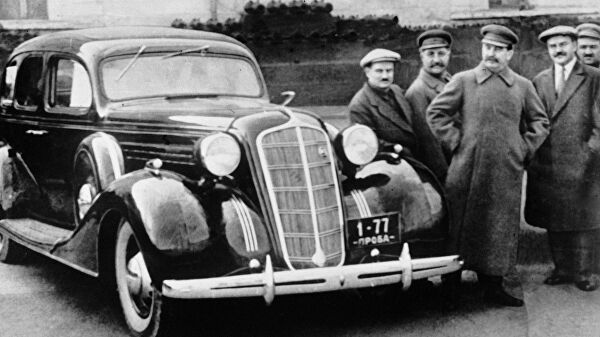
Many people know that in modern Russia, certain series of license plates are treated specially — owners of cars with such plates are usually not bothered for trifles. Of course, most people are rightly annoyed by this tradition, which is one of the symbols of corruption and injustice in the country. This tradition began in the time of Joseph Stalin:
The first series of special license plates in the USSR appeared in pre-war times. For example, in 1939–1941, Red Army vehicles received plates with the letter A and five digits. And the plates of government vehicles began with the letters MA. Naturally, there could be no talk of any registration actions involving the installation of government plates on private cars. Just as in 1946–1959, when the cars of high-ranking officials received Moscow plates of the series MA, MSh, and EO37.
Finally, Stalin also actively practiced what was almost direct bribery of leading officials:
Stalin instituted yet another, even more illegal payment for his nomenklatura — the so-called “packet”. In addition to a salary, the cashier would bring to the office of a nomenklatura official a stack of money in an envelope, which was recorded in a special ledger. The stack was not necessarily thick: I remember that in the early 50s, the assistant to the head of the Soviet Information Bureau, Yuri Volsky, received a ridiculous sum in his packet — 50 old rubles. But the principle was important. Having received the right to a nomenklatura packet, Volsky, as the Soviet press puts it, looked confidently to his tomorrow — and was not mistaken: he became the USSR ambassador to Argentina, and then to Mexico and Jamaica, and finally, the head of the Latin American Department of the USSR Ministry of Foreign Affairs.
The “packet” was so secretive that party dues were not even paid on it. After Stalin’s death, this payment, which resembled a bribe, was abolished and replaced with other benefits38.
We have already written about “packets”, as well as how Stalin’s group turned a blind eye to rampant corruption in exchange for political loyalty, here.
Conclusion
Joseph Stalin is the creator of the nomenklatura class in its final form. It was under him that the very privileged, corrupt, and totalitarily-thinking class that manages Russia today was formed. Stalinists will say: “But wait, Stalin shot officials, which means he fought the nomenklatura”. In a separate article, we examined that the overwhelming majority of the repressed were not corrupt officials, but innocent people, many of whom were guilty only of trying to fight against Stalin’s policy and the formation of the nomenklatura.
- N.A. Rubakin. Russia in Figures. Country. People. Estates. Classes. An experience of statistical characterization of the estate-class composition of the Russian state’s population. (Based on official and scientific research). – 216 p. – St. Petersburg: “Vestnik Znaniya” Publishing House (V.V. Bitner), 1912. – p. 130.
- Abolition of Serfdom // Istoriya.rf (histrf.ru). [Electronic resource]. URL: https://histrf.ru/lenta-vremeni/event/view/otmiena-kriepostnogho-prava (accessed: 05.08.2020).
- Konstantin Smirnov. The Great Sterile Reform // “Kommersant Vlast” Magazine No. 8 of 02.27.2001, p. 24. [Electronic resource]. URL: https://www.kommersant.ru/doc/169589 (accessed: 05.08.2020).
- V.I. Lenin. Complete Collected Works. Fifth Edition. Volume 53. Letters June-November 1921 – 545 p. – Moscow: Publishing House of Political Literature, 1970. – p. 97.
- M.S. Voslensky. Nomenklatura, the Ruling Class of the Soviet Union. – 624 p. – Moscow: “Sovetskaya Rossiya” jointly with MP “Oktyabr”, 1991. – pp. 84-85.
- “Pravda”, 02.28.1986
- M.S. Voslensky. Nomenklatura, the Ruling Class of the Soviet Union. – 624 p. – Moscow: “Sovetskaya Rossiya” jointly with MP “Oktyabr”, 1991. – p. 125.
- Twelfth Congress of the RCP(b). April 17-25, 1923. Stenographic report. – 903 p. – Moscow, 1968. – p. 63.
- Ibid.
- I.V. Stalin. Works. Volume 6. – 430 p. – Moscow: State Publishing House of Political Literature, 1947. – p. 277.
- M.S. Voslensky. Nomenklatura, the Ruling Class of the Soviet Union. – 624 p. – Moscow: “Sovetskaya Rossiya” jointly with MP “Oktyabr”, 1991. – pp. 85-86.
- CPSU in resolutions and decisions of congresses, conferences and plenums of the Central Committee. Volume two. 1917-1922. – 606 p. – Moscow: Publishing House of Political Literature, 1983. – pp. 595-596.
- Twelfth Congress of the RCP(b). April 17-25, 1923. Stenographic report. – 903 p. – Moscow, 1968. – pp. 63-64.
- Merle Fainsod. How Russia is Ruled – 575 p. – Harvard University Press; First Edition edition (1953)
- Soviet intelligentsia: history of formation and growth (1917-1965). – Moscow, 1968. – pp. 136-137
- Merle Fainsod. How Russia is Ruled – 575 p. – Harvard University Press; First Edition edition (1953)
- Soviet intelligentsia: history of formation and growth (1917-1965). – Moscow, 1968. – p. 139
- Merle Fainsod. How Russia is Ruled – 575 p. – Harvard University Press; First Edition edition (1953)
- On the shortcomings of party work and measures to liquidate Trotskyite and other double-dealers. Report by Comrade Stalin at the Plenum of the Central Committee of the AUCP(b) on March 3, 1937 // RGASPI, f. 558, op. 11, d. 1084, ll. 35-55. Original with corrections by I.V. Stalin.
- M.S. Voslensky. Nomenklatura, the Ruling Class of the Soviet Union. – 624 p. – Moscow: “Sovetskaya Rossiya” jointly with MP “Oktyabr”, 1991. – pp. 87-89.
- O. Khlevniuk. Stalin: A Biography of a Dictator. – 464 p. – Moscow: AST-CORPUS, 2015. – pp. 205-206.
- Merle Fainsod. How Russia is Ruled – 700 p. – Harvard University Press, Cambridge, MA (1963)
- XVIII Congress of the All-Union Communist Party (b). March 10-21, 1939. Stenographic report. – 742 p. – OGIZ, State Publishing House of Political Literature, 1939. – pp. 693-733.
- Soviet Historical Encyclopedia. Ed. E.M. Zhukov. Volume 7, Karakeev-Koshaker. – 1022 p. – Moscow: “Soviet Encyclopedia” Publishing House, 1965. – pp. 706-707.
- N.S. Khrushchev. On the Cult of Personality and Its Consequences. Report to the XX Congress of the CPSU. Moscow, February 25, 1956. Published: 1989 – “Izvestia TsK KPSS”, No. 3
- See “Izvestia TsK KPSS”, 1989, No. 12, pp. 86-87
- “Pravda”, July 17, 1973
- M.S. Voslensky. Nomenklatura, the Ruling Class of the Soviet Union. – 624 p. – Moscow: “Sovetskaya Rossiya” jointly with MP “Oktyabr”, 1991. – pp. 99-103.
- M.S. Voslensky. Nomenklatura, the Ruling Class of the Soviet Union. – 624 p. – Moscow: “Sovetskaya Rossiya” jointly with MP “Oktyabr”, 1991. – pp. 89-90.
- I.V. Stalin. Works. Volume 13. July 1930-January 1934. – 423 p. – Moscow: State Publishing House of Political Literature, 1951. – pp. 67-68.
- M.S. Voslensky. Nomenklatura, the Ruling Class of the Soviet Union. – 624 p. – Moscow: “Sovetskaya Rossiya” jointly with MP “Oktyabr”, 1991. – p. 321.
- V.Z. Rogovin. Power and Opposition – 400 p. – Moscow: “Partnership ‘Journal Theater'”, 1993. – pp. 217-218.
- RGASPI. F. 17. Op. 3. D. 871. Ll. 19-26.
- Znamya. 1989. No. 5. pp. 38-39
- USA National Archives, Mischellaneous Russian Collection. Call number 10732, microcopy N Т88, roll number, 1List 57
- M.S. Voslensky. Nomenklatura, the Ruling Class of the Soviet Union. – 624 p. – Moscow: “Sovetskaya Rossiya” jointly with MP “Oktyabr”, 1991. – p. 326.
- A.A. Bogomolov. Leaders of the USSR in the revelations of associates, guards, and servants – Moscow: Astrel, 2011
- M.S. Voslensky. Nomenklatura, the Ruling Class of the Soviet Union. – 624 p. – Moscow: “Sovetskaya Rossiya” jointly with MP “Oktyabr”, 1991. – pp. 276-277.