
Concept of a cyberparty for social democrats
Social democratic ideas are gradually beginning to spread in Russia, and sooner or later this spread will reach its logical development in the form of creating a party. But how can it be created under an authoritarian, reactionary regime? Is the cyberparty concept the solution?
For social democrats, legal activity of a political party in accordance with the laws of the country has always been a priority. And it was precisely such a model that was a priority for Russian social democrats until recently. Talk of creating a social democratic party had been going on since 2021, and we believed that if we avoided aggressive criticism and offered constructive proposals, we would have a small (5-10%), but still a chance to register a party and participate in elections, demanding the expansion of their democratic nature. However, events in Ukraine definitively showed that Russian statists are clearly set on exterminating any threat to their power and do not intend to share it with anyone, but intend, on the contrary, to squeeze out the remnants of any democratic forces from power. This intention is demonstrated quite clearly, and it explains the persecution of democratic media, the scaling back of democratic institutions, and so on.
Under these conditions, it is obvious that the party will not be registered — most likely, it will not simply be denied registration, like Alexei Navalny’s “Russia of the Future”1, but will also be crushed just like Ukraine, and forced to repent, like former President Dmitry Medvedev and social conservative Sergei Mironov, who seem to have gone mad and are bending over backward to show that they are even more radical in terms of statism than the authorities themselves. We also cannot forget that the SDRP was liquidated twice “from above”. And in the current environment, openness of the party will mean not openness to society, but openness to repression by security forces. Such a prospect cannot suit us, and indicates that the only remaining way to function is underground, as an unregistered party. All the more so because a significant portion of the experience of social democratic parties under authoritarian regimes tells us that the underground existence of a party under a dictatorship is what social democratic parties eventually come to one way or another. This was the case with the PSOE in Spain, this was the case with the Broad Front in Uruguay, and this was the case with the Italian Socialist Party. The Workers’ Party of Brazil was created underground, the Socialist Party of Portugal was created in exile, and, it must be said, social democratic parties often operated partially in exile.
Underground conditions are inevitably linked to the need for secrecy, and in modern conditions this means anonymity. We will have to register the party only after the democratization of the regime, which will be forced (as in the case of the fall of the USSR), or after the fall of the regime. Our tasks are, first, to bring this moment closer through the organized conduct of an information struggle. Second, by that moment we must become the largest and most influential social democratic party in the country. Third, we must prepare everything necessary for the normal functioning of a legal party — a program, a charter, a draft Constitution, a strong theory, campaign materials, and so on. Fourth, in the event of growth in the membership of our organization, opportunities for more decisive maneuvers will emerge.

The question, however, is how to act in underground conditions today. Here we will have to go through trial and error — on the whole, Russian society is politically illiterate, and we too do not claim to be considered fully literate right now. However, it is necessary to try some new forms of organization, and let us try to understand how a social democratic party in Russia should be organized under new conditions.
Contents
What is a cyberparty?
In 2001, political scientist Helen Margetts proposed supplementing the typology of political parties with the term “cyber party”. She notes that cyber parties are those parties that use web technologies to strengthen interaction between voters and the party more than traditional membership practices2. The reader “Parties and Elections” also notes that direct network relationships between a party and its voters replace the institution of formal party membership, which significantly transforms its very structure. Among their advantages cited are relatively low capital intensity and accessibility for parties with limited resources3. Cyberparties, or network parties, have recently appeared relatively often and achieved certain successes — for instance, the creation of the Hungarian right-wing party “Jobbik” began with the development of the portal jobbik.hu, and in the Netherlands Geert Wilders managed to become Prime Minister by creating the Party for Freedom, which formally consisted of him alone, but generated support for itself and recruited non-registered party members using online technologies4. In 2010, Italian showman Beppe Grillo created the “Five Star Movement” party based on his blog, which soon became the leading party in the ruling coalition (it is also noted that “the active use of social networks correlates in a certain way with election results. It was the activity of the Italian party with its extravagant leader that brought it staggering success in the national elections to the Italian parliament”5).
Parties belonging to network parties gain up to 25% of the vote in elections to representative bodies, which, considering their short history so far, is a phenomenal result. In Hungary, rapidly moving toward authoritarianism, the “Jobbik” party in late 2020 had 10% support according to polls6 (before merging with other opposition), which shows the possibility for a cyberparty to function under conditions of authoritarianism. At the same time, the concept of a cyberparty until now has been used mainly by populist forces that lacked a clear system of views. Progressive social democrats, on the other hand, possess in many respects (not in everything, but in many respects) an already formed basis for a system of views, outlined in the articles of “Logic of Progress”, which can be an additional plus for our cyberparty if one appears.
Operating principles
While there are a huge number of statists in the country and very few social democrats, we will not have enough people in the organization. As we learned from the article on the history of democracy in Russia, the formation of democratic institutions in our country begins with enlightenment. With the work of educational communities, study groups — such as the “Unofficial Committee”, the Grand Propaganda Society, dissident circles, democratic media, with the use of such practices as “going to the people”, the “Banquet Campaign”. Without this, no uprisings, no granting of democratic freedoms “from above” will give us results. If there are no sufficiently numerous forces that can take this freedom and not let go, that can take advantage of it. If we achieve democracy, and society still desires a strong master, this democracy will be short-lived. Therefore, we need to organize educational work in such a way as to form a strong social democratic movement. And so that a social democratic activist represents a unit prepared for ideological struggle.
Therefore, historical experience itself dictates to us the need to create an educational organization that will later grow into a political one (for this, it will be necessary to have a certain amount of patience and diligence). Thus, the first principle is to stick to the concept of information work in the initial stages. Only when we have cells in every district of Moscow, in every major city of Russia, only then will we be able to move on to the next stage (exactly what it will be is better to decide closer to it, not now). Information work at this stage provides an important advantage: our activists will be sought out less. Security services will be far less likely to bother with bypassing the anonymity system that we intend to use for the sake of some agitator on a social network.
The second principle is anonymity. Every member of the party must strictly observe all anonymity requirements specified by us in this article. Before joining the party, you must create completely new accounts that are minimally connected to you, and invent a pseudonym under which you will act in the party. By observing these principles, we must create a Federal Chat of the party, as well as city, and then district chats in Telegram (or another messenger approved by the Parliamentary Assembly, which will be discussed later). Chats must be closed, that is, an outsider should not be able to enter there. Only a representative of the Admissions Committee, who conducts an interview and asks questions before inviting, can add someone to the chat. In the Federal Chat, decisions are made on creating working groups on a particular issue, on organizing information work, and discussions are held on theory and political news.
The concept of a network party implies that you do not need to leave your current party. Many do not want to leave the party they are currently in, for example, the CPRF or Yabloko, for the sake of a small new structure. However, joining a network anonymous party should pose no problem for them. This is all the better because at the moment Russian social democrats are scattered across various parties, but if enough people gather in our network party, there is a possibility that they will finally be able to separate into a distinct political force with its own identity.
First, we need to reach a certain level in terms of numbers. What to do next? It depends on the situation; various options are possible. The option in which one will have to resort to decisive measures is not excluded. The regime in Russia is becoming brutal not by the day, but by the hour. Absolutely anti-human calls are being made, and repressions in terms of severity (and in the future, it is not excluded that in terms of scale as well) may catch up with Stalin’s. We must honestly tell ourselves that if we are forced to sink to the level of slaves, then it is better to switch to methods of struggle more serious than protests, and you all understand what is being talked about. And in this case, a non-underground, public party is not suitable and puts all participants at risk. We are now forced to build a party keeping this option in mind. Therefore, foolish is the one who says that our party will engage only in talk! First, we need to recruit people, and only then will it be possible to think about other actions. And recruiting people is possible through information and network work.
The advantage of such a format also lies in the fact that there is no point in arresting someone in order to paralyze the work of the party — due to the high level of decentralization and the presence of structures in emigration, it will continue its work even if a significant percentage of its activists are discovered. And this further reduces the risks of persecution due to the weak effect from them.
Organization
Unfortunately, we do not have financial resources. Therefore, we cannot afford the luxury of creating a party with professional staff, even if we wanted to. However, the luxury of creating a party whose members do nothing is even more unavailable to us. Therefore, the only option for building a party in this situation is that only someone who devotes a certain portion of time a week to working in the party, or someone who pays dues, can be a member of the party. Whoever does not do this is expelled from the party for at least a month or at the discretion of the Ethics Committee (they are transferred to the list of potential supporters). A member of other parties can also be a member of the party.
Initially, we need a Federal Chat (which includes all members of the party) and cell chats. Joining the Federal Chat = joining the party; accordingly, the person joining must share all points of the party program. Cells should be created initially in major cities (for example, in Moscow and Saint Petersburg) and a cell in emigration. The party is divided into groups of 5 people (“fives”, by analogy with “threes” in the PSR party), from which regional cells are formed. In the event that in some region (here and below, by region we mean any city with a population of more than 100 thousand people and the settlements belonging to it) there are not enough people to form one five, then party members in this region set themselves the task of forming a working five. In each region there is a coordinator elected by the cells; if there are more than four cells, for every four additional cells one more coordinator is elected.
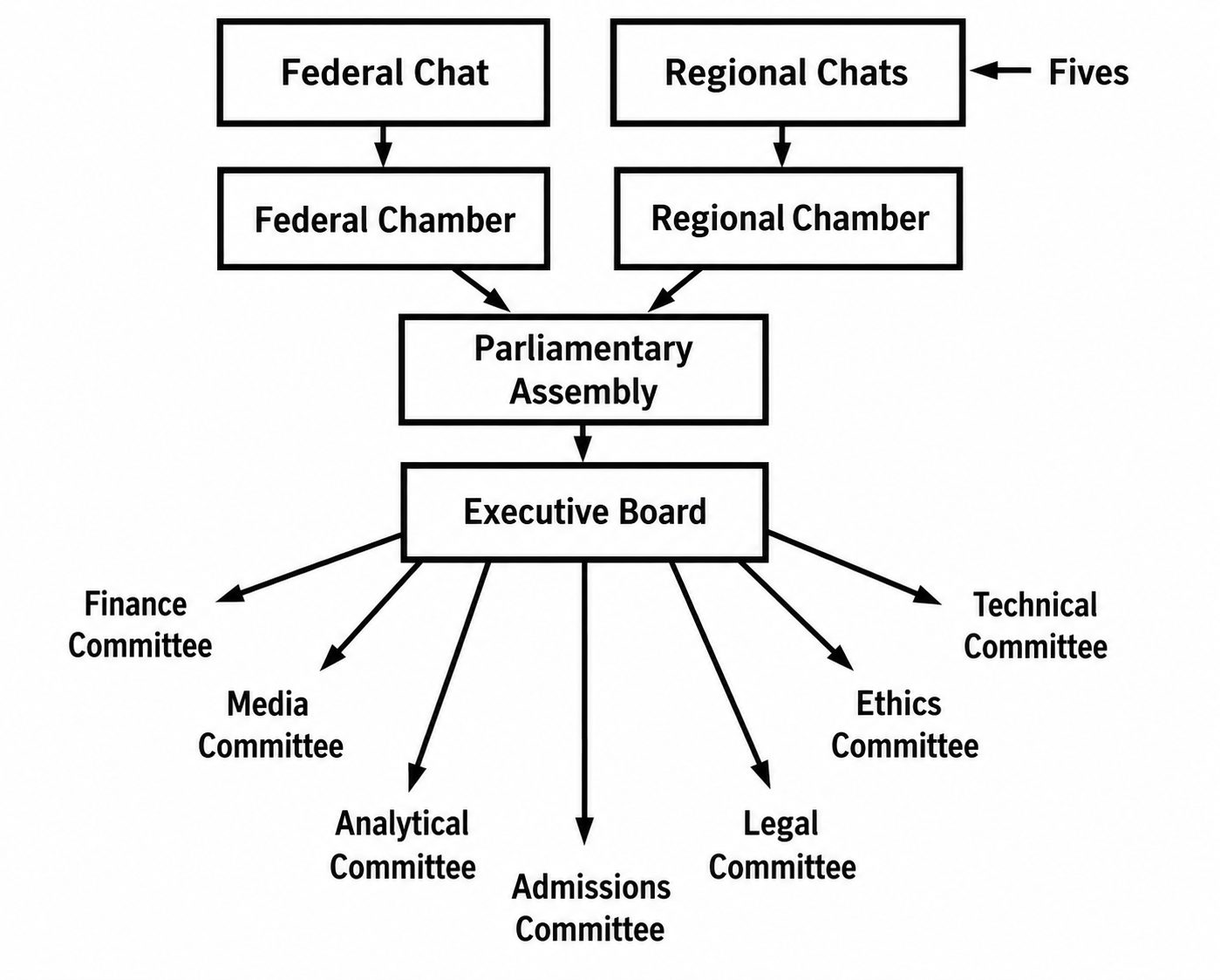
The structure of the party’s governing bodies is as follows: a bicameral Parliamentary Assembly consisting of the Federal Chamber and the Regional Chamber. This parliament forms and appoints the Executive Board. Elections to the Federal Chamber take place once every six months as follows: in the Federal Chat, candidates submit their program for the development of the party, attaching an anonymous vote with two options: “Approve” and “Disapprove”. If more people approve than disapprove, the candidate is nominated in the elections. The Federal Chamber can have at most the same number of people as the Regional Chamber. All coordinators from the regions enter the Regional Chamber. Every 3 months in each constituent entity, elections for a coordinator are held in the local chat (with anonymous voting), after which they are automatically included in the Regional Chamber. The size of the Regional Chamber varies depending on the number of regional cells. The Parliamentary Assembly forms the composition of the Executive Board. Such a structure helps the party better get used to and be ready for parliamentary struggle. Also, the electability of party governing structures is an absolutely necessary requirement. Few people will be interested in a party with leadership that cannot be elected.
Factions and platforms can be created in the party if they do not contradict the criteria of progressive social democracy (which will be discussed later).
Every 3 months, each of the “fives” compiles a report on its activities for this period (what was done, what successes, what difficulties) and sends it to the Analytical Committee of the Executive Board.
Executive Board
The Executive Board handles a number of various organizational issues aimed at expanding the party and its influence. It consists of the following 7 committees: financial, media, analytical, legal, ethics, admissions, technical.
Financial committee — engages in finding funding for party needs. This also includes the treasurer — a reliable person who holds the party’s finances and releases them at the request of the Executive Assembly.
Media committee — manages the website and social networks of the party. Creates campaign materials.
Analytical committee — formulates proposals for the development of the party based on the study of other parties’ experiences. Receives reports from all “fives”. Every 3 months, it drafts recommendations for the “fives” on what to engage in, proposing various options to choose from. If necessary, it sends recommendations to the Ethics Committee to expel people (who are not engaged in anything) from the party.
Legal committee — provides legal advice on party matters. In its spare time, it works on developing and refining the draft of the country’s Constitution and draft laws based on the party program.
Admissions committee — processes applications for party membership, forms “fives”, keeps track of the number of party members and their contact details (maintains communication with all “fives”).
Ethics committee — makes decisions on expulsion from the party. Receives and considers complaints about the rejection of membership applications. It can expel a person from the party only on the basis of a crime (embezzlement, election fraud, and so on) or non-compliance with the criteria of a social democrat. Complaints regarding attempted election fraud or the use of bureaucratic machinery practices (more on them later) can also be submitted to the Ethics Committee. Contacts of the members of the Ethics Committee must be available on the party website and in the description of the Federal Chat.
Technical committee — organizes events, congresses, elections.
In case of need to draft or edit the party program, a special working group is created. Compliance with the directives of the Assembly and the Board is mandatory for party members; however, they can appeal them to the ethics committee.
The party must have an identity. We do not need a party of Marxist social democrats; we do not need a party of patriotic social democrats. Patriotic social democrats may start supporting war, aggressive policy, and at a certain point may begin talking about the “orange threat”, “Banderites”, and other Kremlin narratives. A social democratic movement that includes Marxists already exists — that is LeftSD. Creating a similar organization means, first, creating a direct competitor to LeftSD, whereas it would be better to have, on one hand, an organization of social democrats that includes Marxists, and on the other hand, a party of social democrats without Marxists, in order to target different audiences. In the current situation, it is better to have two organizations attracting different audiences and cooperating with each other, rather than two identical organizations competing for the exact same audience.

Marxists and progressive social democrats hold diametrically opposed positions on one fundamental issue — the attitude toward private property. We consider private property an ordinary tool, and even a useful one, the reasons for which we explained in this article. Marxists, on the other hand, want private property not to exist (this is one of the fundamental pillars of Marxism). This disagreement is fundamental and will always breed discussions that are appropriate between two different parties, but entirely unnecessary within a single party, as they will hinder coordinated work, replacing it with discussion where it is not needed. Discussions on such matters should take place with a certain periodicity, rather than occupying a significant portion of time (thereby paralyzing the party’s work). It is more sensible to implement this between two parties rather than inside one.
And anyone who calls this a “lack of democracy” is hypocritical, as we are not opposed to democratic Marxists (who claim to stand for parliamentary democracy) having their own party. And we do not want national democrats or minarchists in our party either. This does not mean there is no democracy in the party. This means the party is not a populist “big tent” for everyone, lacking convictions and principles. There may be disagreements in the party on foreign policy, on the choice between internationalism and post-nationalism, on the choice between a peaceful and a revolutionary rise to power, and so on. But there are issues, such as private property and parliamentary democracy, that are the most under attack. Marxists try to present the “dictatorship of the proletariat” as democracy, and we cannot tolerate it when dictatorship is called democracy, slavery is called freedom, and ignorance is called strength. This is what leads to situations like Felipe González’s famous “either me or Marxism”.

Another reason is Marxist jargon. People visiting meetings or sitting in chat rooms will simply be scared off by Marxist dialect with incantations about the “capitalist bourgeois mode of production”, “international labor aristocracy”, “transition to socialism through raising the class consciousness of the proletariat”, and so on. The author of these lines has repeatedly observed how adequate people left meetings of organizations with such discussions in bewilderment because they could not listen to this elitist “thug jargon”, which is a sign of disrespect to those who do not speak it (since they might not understand what is meant, and they do not need to understand it, as this jargon is useless and everything explained with its help can be explained in normal language). We have no desire to observe similar scenes, nor to watch the departure of progressive social democrats who do not wish to be in the same party as Marxists, including for the above-mentioned reasons. As a result, we lose target people, while the opposition will not lose Marxists if they leave the SDR — they have plenty of options where to go (such as LeftSD).
If a person identifies as a Marxist, they will inevitably turn to studying the Marxist heritage, a significant part of which is not merely contradictory to social democracy, but harmful. If you want social democracy itself and European social democrats to be regularly attacked from within a social democratic party, up to declaring them and you “agents of the bourgeoisie” — please, build a party with Marxists, but in reality it is far more productive to spend time on something more useful.
In general, it is not entirely clear why Marxists are needed in a modern social democratic party. These are people with a different worldview, different goals. Social democrats want to build the Nordic model, want European integration. This is a tough path, like climbing Mount Everest. According to the experience of the author of this article, Marxists most often do not want to join the European Union because they are dissatisfied with its model, do not want to join NATO because they do not like it, and do not want to move toward the Nordic model because it is not ideal. They do not want to go to Everest with us; they want to go to Mount Olympus on Mars. And it is useless to explain to them that they should first climb Everest, that there are as yet no conditions to climb mountains on Mars, that when this base exists, perhaps this mountain will no longer be the highest goal. They do not want to listen to this. These are different people. While we climb Everest, they will complain that we went in vain, that all of this is useless, that we need to turn back and prepare for the mountains on Mars. And no one will reach the top. We need to choose — either the path to Europe, to the Nordic model, or Marxists in the party.
Furthermore, there is a probability that Marxists will drag communists, anti-Western fighters, and other lovers of dictatorships into the party (in order to strengthen their influence in the party). Marxists systematically engage in entryism. They join movements and gradually turn everything inside out. The website Marxist.news explicitly admits: “entryism is a tactic with which Trotskyist organizations are most often associated in principle… In the 1930s, Trotsky proposed the tactic of entryism as a way to overcome the isolation and weakness of Trotskyist forces through factional entry into mass reformist organizations”7. The Great Russian Encyclopedia notes that communist and social democratic parties most often fall victim to Trotskyist entryism8. Some Bolshevik manuals give the following directives: “Even during ‘peaceful’ development, it is very important for the party to obtain in a timely manner information of a secret and semi-secret nature about the decisions of the governing bodies of parties hostile to it, especially the social democratic one”9. Marxist.com testifies:
In 1975 MI5 carried out a “wide-ranging investigation” into the “extent of subversive penetration and influence in the Labour Party”; and at that point the secret services took notice of the growing strength of the Militant tendency.
The security services were alarmed at the growing influence of Militant inside the Labour Party:“Trotskyist entryism”… into constituency branches (CLPs) of the Labour party represents a direct threat to certain MPs and therefore to the ability of Labour MPs as a whole to resist subversive pressure on the Party and within the Party as a whole.
It estimated that Trotskyist influence was present in 9 CLPs in which the sitting Labour MP risked losing their seat, while there was some degree of Trotskyist influence in a further 67 CLPs. Cassimeris and Price conclude significantly:
“This was the first time that… MI5 had believed that Trotskyism posed a major threat not just to an existing political party, but, as Labour was then in power, potentially to the British state itself”.
<…>
Militant was able to grow and gain significant influence not only because of weak disciplinary procedures within the Labour Party, but because of the dedication of its members and strong internal discipline — a characteristic lacking in most other Trotskyist groups10.
As we can see, even if entryism is managed in the early stages, a confrontation with very organized and massive cases is possible in the future. All the more so because the current experience of building a party, which we are undertaking at the moment, shows that many Russian social democrats are still not liberated from sympathies toward communism, from chimeras like the rejection of private property, and from economic determinism.
And progressive social democrats are too few, and virtually any attempt of theirs to create their own movement will be accompanied by an influx of Marxist social democrats. To protect the party from entryism and possible mass joinings of people who are not social democrats at all, it is necessary that they conform to the party’s identity. What identity do we need? That of a modern, progressive social democratic party of the European type. Therefore, the document whose approval is mandatory for anyone joining the party must contain a clearly formulated direct indication of the non-Marxist nature of the party, similar to the following statement:
“We are a party of non-Marxist social democrats. We are consistent anti-fascists, anti-communists, anti-authoritarians. Humanistic values are more important to us than ‘state interests'”.
Accordingly, if a person does not consider themselves a social democrat (for example, if they declared so somewhere) — this is grounds for expulsion from the party. It is also necessary to expel from the party in the following fundamental cases:
- The person does not consider parliamentary democracy to be the preferred form of government;
- The person considers the state an “apparatus of coercion and/or robbery”, even if it is democratic (here we examined why this is incorrect);
- The person believes that developed countries are rich at the expense of “robbery”. Such individuals will never build either a successful country or a successful party, but will look for someone to blame for their failures;
- The person advocates for a “broad left” rather than the concept of a “broad coalition“;
- The person considers the NATO alliance a “tool of imperialism”. For now, practice shows that attitude toward NATO is a reliable measure of political adequacy;
- The person incorrectly answers the question “Whose Crimea?”. If the question about the attitude toward NATO helps weed out sympathizers of destitute dictatorships, then this question just as effectively helps weed out vatniks.
It is also important for the person to identify as an anti-communist, anti-Marxist, anti-authoritarian, anti-fascist, anti-racist. Sometimes it is obvious whether a person fits these requirements, but there are cases when, for instance, a person says one thing to party comrades to avoid expulsion, but says another behind their backs. And remains in the party to pull it toward “broad-leftness” and Marxism, rather than to develop it. In these cases, the ethics committee must decide.
Certain important aspects of the experience gained
The first negative experience we gained during the creation of the party is the drive to use “bureaucratic machinery practices”. By this is meant primarily behind-the-scenes decision-making, bypassing the general chat. Influencing votes by calling for voting for a desired option in private communication (or in social media private messages) must be banned. Arguments “for” and “against” should be presented and discussed publicly, for transparent and open discussion. General chats exist for this purpose. When a person writes to a party comrade in private messages — pressure is thereby exerted, as the person may feel uncomfortable refusing, may not want to “spoil relations”, conflict, or simply be too lazy to explain why they do not want to vote in the “right” way. In defense of “bureaucratic machinery practices”, the argument is sometimes made that the other side can also use pressure, but for the other side or those sympathizing with it, this may be unacceptable on ethical grounds, and it turns out that the balance tips in favor of the side using such practices. In addition, if two sides write to a person demanding to vote for different options, they may dislike such pressure, may dislike the possibility of “spoiling relations” with one of the sides in any case, which does not positively affect their desire to stay in the party.
The second negative experience concerns attracting “media” personalities. In the movement, there is a viewpoint that it is necessary to attract people to the party who possess a certain level of fame, so that their audience learns about the party and so that people can learn about the party through these individuals’ appearances in the media. It sounds reasonable, unless one detail is taken into account — there are practically no such people with progressive social democratic views in Russia (perhaps with the exception of Nikolai Kavkazsky, maybe). Under these conditions, inviting people who do not fully meet the criteria of progressive social democracy is proposed — democratic Marxists, patriotic socialists, and so on. This viewpoint is incorrect for the following reasons.
First, inviting such personalities scares away people who are non-Marxist social democrats. The latter think that this is another Marxist project disguised as social democracy, which, of course, will not arouse interest. Second, statements by people of this format can scare away our real target audience even more. For example, at the start of the initiative, proponents of “attracting media personalities” suggested inviting Boris Kagarlitsky. Kagarlitsky is a well-known figure and would add popularity to the party. But what kind of popularity would that be? It is no secret that even Stalinists are present among his audience. And attempts by such people to join would not be ruled out. In “Rabkor”, Boris Yulievich always pursued a “broad-left” policy. That is, people who are openly hostile toward social democracy write articles for him at times. To expect that he will behave somehow differently inside the SDR party requires convincing grounds.
Furthermore, for example, after the death of Mikhail Gorbachev, Kagarlitsky made a statement on the “Rabkor” public page writing that Perestroika was an “inadequate attempt to repeat and continue Khrushchev’s Thaw”, and summarized the activities of the former General Secretary as follows: “He betrayed without realizing he was committing betrayal, lost without ever understanding what game he was playing”11. Such statements within the outline of the Soviet myth of “Gorbachev the traitor” from an SDR member would cast a shadow over the entire organization and form an image for the organization as sympathizers of pro-Soviet reactionaries. And this is only one of the possible problems. This is what the policy of “attracting media personalities” without taking into account their political stance will lead to. Moreover, given the high authority of such figures and the presence of a considerable number of supporters, it is easy to predict that they would soon begin to dominate in the party, which means its complete reorientation toward their views, rather than their reorientation toward ours.
The goal of the progressive social democrats’ party should be to attract non-Marxist social democrats — they have nowhere to go, whereas Marxist ones have LeftSD. If the party is oriented toward accepting Marxists, we will lose such people, and they will again remain uninvolved in the political life of Russia. And the party will again become another failed project, a small sect whose activities will be limited to disputes about what Marx meant. This will be an experience, albeit an unsuccessful one. Attracting Marxist politicians will not bring popularity among “center-leftists”, among left-wing democrats. And that means the main goal of the party will not be fulfilled. Therefore, there is no need to look for “easy” ways; our path will be difficult and long, and one must be prepared for this and be aware of it. The creation of the party is already ahead of schedule — personally, the author of these lines expected that it would begin no earlier than 2025. We need not people who adapt to the situation, but people who reshape the situation. Therefore, we will have to train cadres ourselves.
Summary
The task of a party of this type is to create a broad and ramified network of cadres for creating a future legal Social Democratic Party after the collapse of authoritarianism. It is also the creation of a sufficient amount of propaganda material, as well as the preparation of a program of action (and possibly other documents — for example, the Basic Law). Or, upon recruiting a certain number of people, it will be possible to begin organizing protest actions. Even if we are a small number of people, with the proper level of organization and attitude, a lot can be done. Work on creating the party can begin when the admissions committee is formed. A priority task will also be to properly decide on the position of treasurer.
- Justice Ministry again refuses to register Navalny’s party // Radio Free Europe/Radio Liberty (www.svoboda.org). May 27, 2019. [Electronic resource]. URL: https://www.svoboda.org/a/29965717.html (accessed: 18.09.2022).
- Helen Margetts. The Cyber Party // Paper to workshop “The Causes and Consequences of Organisational Innovation in European Political Parties”, ECPR Joint Sessions of Workshops, Grenoble, 6-11 April 2001. — p. 9.
- Parties and Elections: A Reader / RAS. INION. Center for Social Scientific and Information Research. Department of Political Science, Department of Law. Moscow State Institute of International Relations (University) of the Ministry of Foreign Affairs of the Russian Federation; Executive Ed. and Comp. G.N. Andreeva, N.V. Anokhina, E.Yu. Meleshkina — Part 2. — 176 p. — M.: INION, 2004. — p. 62.
- Political Networks: Theory and Methods of Analysis: Textbook for University Students / L.V. Smorgunov, A.S. Sherstobitov. — 320 p. — M.: Publishing House “Aspect Press”, 2014. — p. 241.
- Ibid., p. 247.
- Hungary — National parliament voting intention // POLITICO (www.politico.eu). [Electronic resource]. URL: https://www.politico.eu/europe-poll-of-polls/hungary/ (accessed: 18.09.2022).
- Fourth International: a general history of political struggle (+video) // Official website of the Marxist Tendency (marxist.news). [Electronic resource]. URL: https://marxist.news/longrides/istoriya/chetvjortyj-internatsional-obshchaya-istoriya-vneshnej-i-vnutrennej-politicheskoj-borby/ (accessed: 18.09.2022).
- Fourth International // Great Russian Encyclopedia. Volume 11. Moscow, 2008, p. 446. [Electronic resource]. URL: https://bigenc.ru/world_history/text/2014571 (accessed: 18.09.2022).
- A.Yu. Neuberg. Armed Insurrection. — 212 p. — Moscow, Leningrad: State Social-Economic Publishing House, 1931. — p. 172.
- Steve Jones. How the British state came to view Militant as a “threat to national security” / Translated by I. Andreev // In Defence of Marxism (www.marxist.com). January 27, 2022. [Electronic resource]. URL: https://www.marxist.com/2022-01-27-10-06-49.htm (accessed: 18.09.2022).
- About Gorbachev // Rabkor, VK (vk.com). August 31, 2022, 10:57. [Electronic resource]. URL: https://vk.com/wall-48246439_74505 (accessed: 18.09.2022).