
Why a political organization needs funding
Without the growing popularity of democratic ideologies and movements in Russia, the authoritarian regime will most likely remain as it is, which is why anyone who does not wish to spend their whole life living under it should encourage this growth by supporting democratic organizations and media. Likewise, anyone who wants to see Russia set a course toward the standard of living of the Nordic countries should support the social democrats. In this article, we will try to explain why you need to support your preferred political force and the "Logic of Progress" journal in particular if you read us.
If any political force wants to achieve results, it inevitably faces the question of funding. It is a normal situation when all serious competing forces have financing, which they spend on ordering texts from authors, purchasing advertising, paying salaries to functionaries, and other expenses that allow increasing the organization’s efficiency. In this situation, those political forces that do not have funding are deprived of a decisive competitive advantage, and are practically guaranteed to be unable to win in the struggle. As the International Institute for Democracy and Electoral Assistance notes, political parties need financial resources to perform their functions. It is like fuel for the party mechanism. In some cases, parties can, for example, win or lose elections long before they take place simply because of the presence or absence of resources1. The impact of funding on political outcomes is also confirmed by research2.
If we look at political parties, we can notice that party funds exist/existed in all more or less significant parties — from systemic to revolutionary ones. “Yabloko” has them (settlement accounts3), the RSD has them4, the RSDLP(b) had them5, and so do many other parties and organizations. Without them, these parties and organizations simply would not be able to rent premises, order merch, hire lawyers for their activists, print materials, and so forth. The same goes for political media — for successful functioning, it is necessary to invest money in advertising, write many articles (often this means hiring authors and proofreaders), develop the website, and perform many other actions that usually require money or a huge amount of time.
Many for some reason are convinced that volunteer help will be enough for success. Simply put, those who share the ideology make their own contribution — for example, write articles — and thus it turns out that there is no need to buy anything or hire outside people. Anyone who is confident in the effectiveness of such an approach can be wished to try to achieve a result this way in practice (for example, to organize the process of promoting “Logic of Progress”). And then measure the effect. We can speak for ourselves: many years of political practice show that volunteer help is insufficient for truly significant results. Another social democrat — “Urban Projects” activist in Kazan Garry Yantsen — came to the same conclusion (paid activity is more effective than volunteering)6.
For a party to develop, for instance, its members must perform certain work. If there is little work on party development, the party will develop poorly. For party members to perform a sufficient volume of work, they need to be paid money. Because if they are not paid money and if party development is not their paid work, they will be forced to have a main job and engage in party work only in their free time. Practice shows that:
- This free time does not happen every day, and when it does, it is a maximum of a few hours (however, most often there is very little of it, and during this time one can barely manage to get one’s bearings in the situation);
- You have no right to demand that volunteers perform party work, because you do not pay them money and they do all the work on a voluntary basis. Even if you start demanding, they will simply take offense and leave the party. Since the party is not their boss, does not pay them money, and they have a main job that provides them with money for living;
- If the work is performed poorly, you must be able to block its use. In the case where volunteers do it, this often leads to resentment, misunderstanding, unnecessary division based on personal feelings, and so on. In the case of a transaction, the contractor is usually satisfied with the fact that, regardless of the use of their work, they receive money.
Furthermore, letting party members, for instance, handle the promotion of its social networks if they are not professionals is much less effective than having a professional do this work. We need to be able to delegate part of the work to professionals if we want to achieve results. How did the rather marginal Bolshevik party achieve a high level of organization and political success for itself? Largely due to what Vladimir Lenin deduced:
Look at the Germans: they have a hundred times more forces than we have; but they understand perfectly well that the “average” does not too frequently promote really capable agitators, etc. From among its ranks. They immediately try, therefore, to place every capable worker in conditions that will enable him to develop and apply his abilities to the utmost: he is made a professional agitator, he is encouraged to widen the field of his activity, to extend it from one factory to the whole industry, from a single locality to the whole country. He acquires experience and dexterity in his calling; he expands his outlook and increases his knowledge; he observes at close quarters the prominent political leaders from other localities and of other parties; he strives to rise to their level and combine within himself the knowledge of the working-class environment and the freshness of socialist convictions with professional training, without which the proletariat cannot wage a stubborn struggle against its admirably trained enemies. In this way, and in this way alone, is the Bebel and the Auer raised from the ranks of the working class. But what is to a large extent done automatically in a politically free country, must in Russia be done systematically by our organisations. A worker-agitator who is at all talented and “promises well” must not be left to work eleven hours a day in a factory. We must arrange that he be maintained by the Party; that he may go underground in good time; that he change the place of his activity, if he is to enlarge his experience, expand his outlook, and be able to hold out for at least a few years in the struggle against the gendarmes… When we have detachments of specially trained worker-revolutionaries who have gone through a long course of preparation (and, of course, revolutionaries “of all arms”), no political police in the world will then be able to contend with them7.
Lenin’s views eventually took shape as the concept of an “organization of professional revolutionaries”, which ultimately became a time bomb — yes, the Bolsheviks seized power in Russia (in this regard, the concept turned out to be supereffective), but formed into a special caste of society. This does not at all mean that the very principle of financing and participation of professionals in a political party is incorrect — many democratic parties hire professionals. For example, the US Democratic Party does this8. Rather, we must understand that a party should hire professionals, rather than allow them to form the party leadership out of themselves.
As for political media, although they differ significantly from parties in their tasks and structure, they likewise require funding, and in the exact same way, paid activity here will be more effective than volunteering. “Logic of Progress” created several polls with the aim of receiving voluntary help from subscribers not with money, but with action (for example, by writing texts):
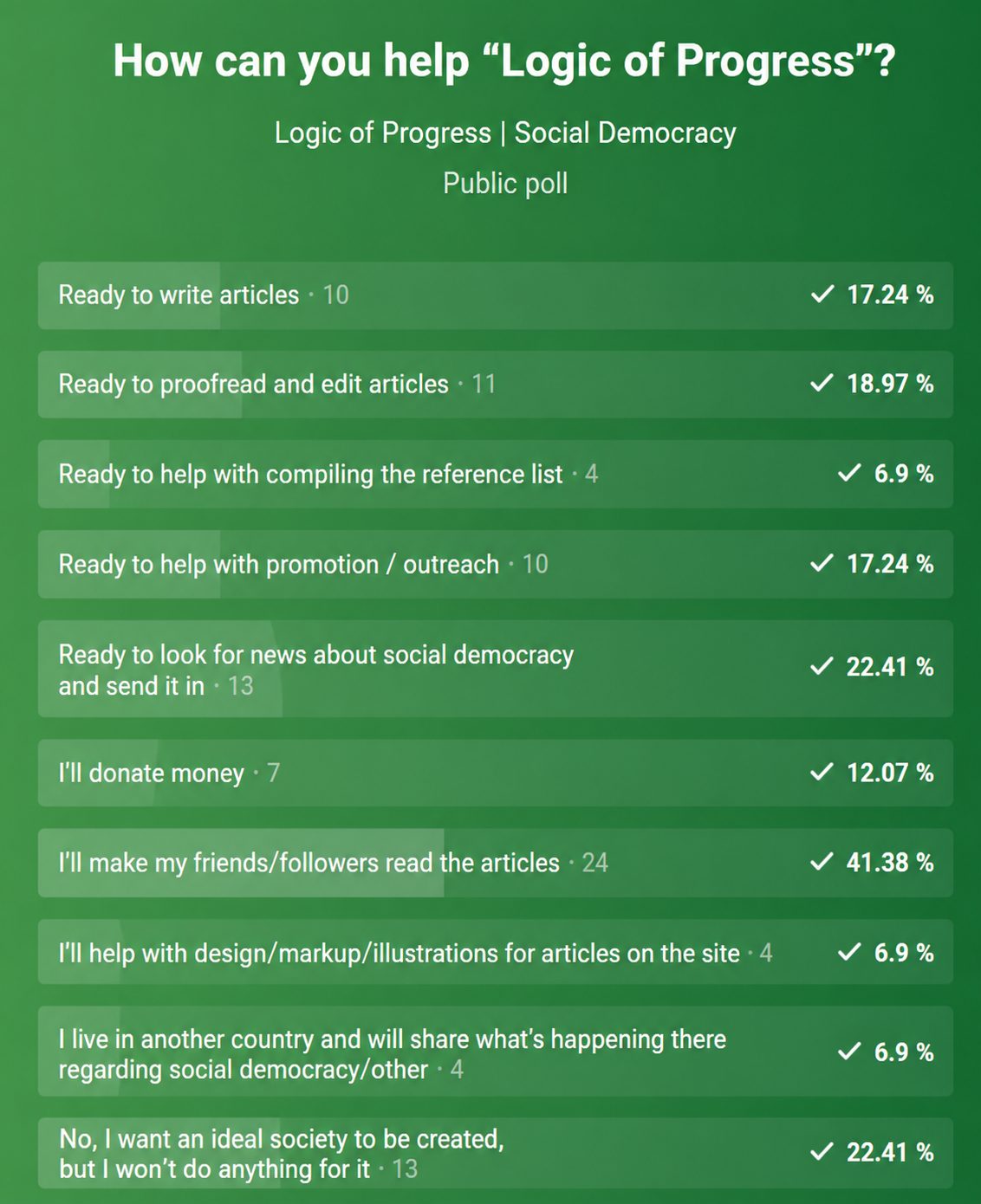
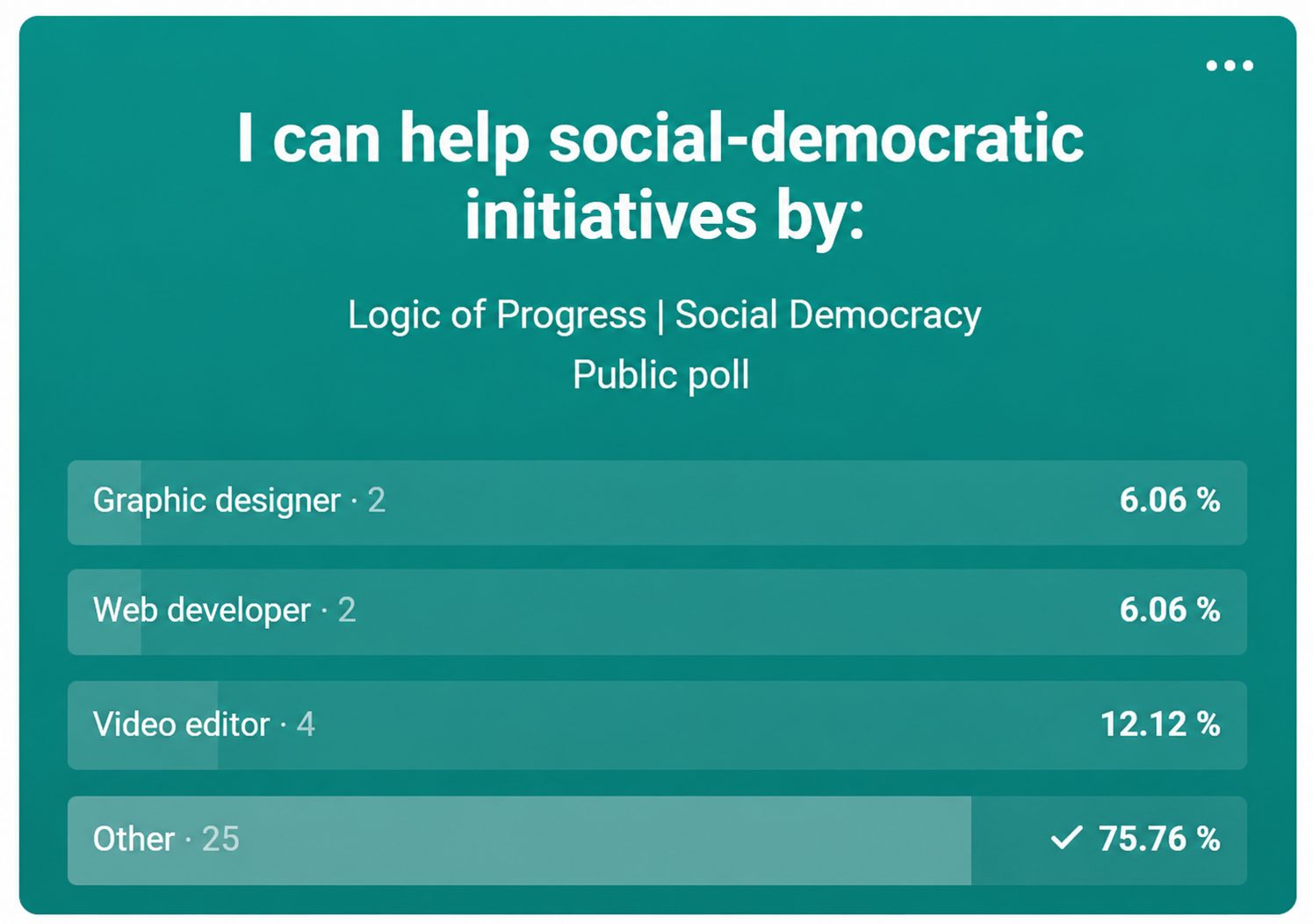
We managed to find authors, proofreaders, and even an SMM specialist. However, overall the results were extremely weak for the following reasons. First, it was necessary to message each person individually and convince them to participate, and far from everyone who voted in the polls responded. Some people promised to help, but ended up doing nothing. Some took on a task, and then either disappeared or said they would not be able to finish it. This disrupted all deadlines and wasted our time, which we could have used to much greater benefit. Second, those people who agreed to participate and actually helped us did so in their free time, so they very often did not complete the task on time. Writing a single article could take a week, but it could also take 15-18 months. Clearly, in such a mode, we will be able to achieve our goals in about 70-80 years, if we are lucky. Third, some authors submit an article, but its quality is such that a significant portion of the work has to be performed by the editor-in-chief (which, again, is a huge waste of time), and refusing to accept the article would be unethical.
Many specialists, such as an English translator and a designer, we ultimately did not find at all. Searching for a person who agrees can take months and even years; yet all the people who agreed to do translations were unable to translate a single article due to a lack of time, because people, as a rule, have work and studies. With narrower specializations, the situation is even worse. Obviously, if we do not find a professional translator, we will never have a translation of all the site’s articles.
Therefore, if you are a supporter of any organization or media outlet, your financial support means expanding their capabilities and, as a rule, influence. In the case of “Logic of Progress”, this is, firstly, an opportunity for us to pay for hosting and a domain, simply so that the site continues to be accessible. Secondly, it is an opportunity to hire an SMM specialist and/or buy advertising so that the popularity of the resource grows all the time. Thirdly, it is an opportunity to pay for the work of authors so that there are more new articles and posts/news. This is the most basic thing, but if we receive more finances, our capabilities expand even further — hiring an email marketer, an SEO specialist, and so forth. The popularity of social democracy will thus grow, more new media, organizations, and activists will appear, and after some time there will be enough social democrats to fight for power in the country in an organized manner.
“Logic of Progress” knows how to promote social democratic ideology — we started from absolute zero; of the resources social democrats had back then, there were only the LevSD movement and the “Social Democrats of Russia” VK page, both of which had very low popularity. Today, some of our articles have over 60,000 views, the VK page has over 1,700 subscribers, the Telegram channel has over 1,100, and social democratic resources are now gradually entering the “trend”, with quite a few social democrats in Russia now (most of this was achieved practically without outside investment; with investments, the results should be different). Another plus of ours is that our social democratic identity is stable. For 4 years now we have been running the journal and recently completed a cycle of studies designed to test whether social democracy really is the best option for us. Upon completing this cycle, our confidence in social democracy was not shaken, so now the probability that we will shift to other positions is extremely low. Anyone who supports young social democratic forces risks that they will shift to a different ideology, and the money spent, as it turns out, will be wasted.
However, our journal itself still supports new social democratic resources informationally. We would like to create a strong and popular resource that will lift up all the rest — precisely that “strong link” through which the whole chain can be pulled out. We all need to work on this. Right now, social democrats need to make a breakthrough; we imagine how to do this, but lack resources. Until now, we have not asked for readers’ financial participation (although some readers, to their credit, offered it themselves), but the time seems to have come. You can subscribe to our page on the Boosty service via the link, or donate a sum one-time. Do not put it off until later (who knows what restrictions the Russian regime will come up with in the future) and do not count on someone else solving the problem. Those who subscribe will receive additional perks — for example, access to a database of links to interesting articles and materials not from “Logic of Progress” (they are described in more detail on Boosty).
- Augustine Magolowondo, Elin Falguera, Zefanias Matsimbe. Regulating political party financing // The International Institute for Democracy and Electoral Assistance (www.idea.int). [Electronic resource]. URL: https://www.idea.int/sites/default/files/publications/regulating-political-party-financing-insights-from-praxis.pdf (Date of access: 02.09.2023).
- A.M. McKay. Fundraising for Favors? Linking Lobbyist-Hosted Fundraisers to Legislative Benefits. Political Research Quarterly, 2018, 71(4), 869–880.
- Charter of the Political Party “Russian United Democratic Party “YABLOKO” // Moscow Yabloko (mosyabloko.ru). 2016. [Electronic resource]. URL: https://mosyabloko.ru/sites/default/files/Yabloko_Ustav.pdf (Date of access: 02.09.2023).
- Charter // Russian Socialist Movement (anticapitalist.ru). November 16, 2015. [Electronic resource]. URL: http://anticapitalist.ru/ustav/ (Date of access: 12.02.2020).
- S. Rudnik, B.A. Pavlov, B.A. Starkov, V.S. Izmozik. The Authentic History of the RSDLP-RCP(b)-VKP(b). A Short Course. Without Omissions and Falsifications. — St. Petersburg: Piter, 2009. — p. 142
- Debates // Kazan // Elections of the Head of the Urban Projects Branch // YouTube (www.youtube.com). 17:46. July 20, 2020. [Electronic resource]. URL: https://www.youtube.com/watch?v=CB_HaoQg9vg (Date of access: 12.09.2020).
- V.I. Lenin. What Is to Be Done? Burning Questions of Our Movement // Collected Works. Vol. 5. — Moscow: Foreign Languages Publishing House, 1961. — pp. 471-472.
- Work with us // Democratic Party (democrats.org). [Electronic resource]. URL: https://democrats.org/take-action/work-with-us/ (Date of access: 02.09.2023).