
Why democracy is more effective than authoritarianism
With this article, we will try to settle the question of which political regime is more effective at raising both economic indicators and the standard of living: democracy or authoritarianism.
Democracy is a value in itself, as a self-respecting person wants to have the ability to choose the government, to have the ability to replace it if it performs its duties unprofessionally, and to have the ability to create a new party if the existing ones do not represent their interests. They want to delegate a vast number of political responsibilities to professionals in order to save their time, and to have the ability to remove those professionals. If, however, a person does not want to have the ability to change the government, does not want to choose, and, consequently, is ready to endure humiliation, to endure incompetent state managers capable of sending them to die for their whims or taking anything away from them — this is an unworthy person, essentially a slave, the property of a master, and by their own will at that. Such irresponsible people, whose negligence harms the whole of society, deserve the deepest contempt of self-respecting people.
However, this alone would be insufficient to recognize the necessity of democracy. After all, if authoritarianism provided prosperity and wealth instead of freedom, the desire to trade freedom and one’s own dignity for them could be partly understood. The question we are examining in this article therefore concerns whether democracy is more effective than authoritarianism for economic development and the growth of the standard of living. We should warn right away that our answer to the question “what is democracy?” was examined in another article. Democracy indices — for example, the index from The Economist1 — help determine whether the political regime in a country is democratic. We also draw attention to the fact that by democracy we mean specifically representative democracy, since direct democracy can hardly be categorized as a viable form of political system, which we wrote about here.
Efficiency indicators
Previously, the prevailing viewpoint in academic circles was that the level of democracy does not affect economic growth. However, not so long ago, authoritative economists Daron Acemoglu and James Robinson released a work that immediately became a “bomb” — “Why Nations Fail: The Origins of Power, Prosperity, and Poverty” (here we briefly examined its contents). This study identified inclusive institutions through which countries achieved prosperity, and democratic regime was recognized as one such institution. Later, Acemoglu released a new study that proved the link between democratization and successful economic growth — according to it, it turned out that, first, democracies grow on average 20% better, and second, have a much smaller gap in growth rates. This is also confirmed by a study by economists Heitor Almeida and Daniel Ferreira — the variance of economic growth indicators in autocracies is 4.5 times greater than in democracies2. Strictly speaking, under an authoritarian regime there is a small chance that the government will prove competent and sufficiently altruistic, but in most cases an authoritarian regime becomes corrupt and incompetent, leads the country to a decline in the standard of living and civil liberties, and changing it through bloodless means becomes extremely difficult. Therefore, anyone who chooses autocracy bears responsibility for the victims of a future revolution.
There are examples of successful authoritarian regimes, but there are far more examples of failed autocracies. This pattern is well illustrated in the words of the famous Russian political scientist Vladimir Gelman: “for every Lee Kuan Yew, there are ten Mugabes”3. Other studies confirm guesses about the effectiveness of democracies from the point of view of economic growth. For example, a study by the V-Dem Institute, which studies the quality of government performance, shows that in democratized regimes, GDP per capita increased by about 20% during the first 25 years of transition4.
The source of the consensus on the non-impact of the political system on economic development is the works56 of Harvard economist Robert Barro, who, using regression analysis, concluded that there are insufficient grounds to believe that an increase in political rights leads to an increase in economic growth. Getting ahead of myself, I will say that this article of mine is about a scientific paper that was published in 2019 and which refutes Barro’s conclusions. A truly stellar team consisting of Daron Acemoglu from MIT, Suresh Naidu from Columbia, Pascual Restrepo from Boston, and James Robinson from the University of Chicago published an article7 in which they show that democratization actually causes economic growth. An increase in the level of democratization leads to an increase in the country’s prosperity… The fact that Robert Barro did not find a correlation between democratization and growth does not mean at all that a causal relationship does not exist, nor does it mean that it does exist. Therefore, the work of Acemoglu and co-authors is also important from a methodological point of view. They show precisely a causal relationship, not a correlation8.
To summarize the research: democratization leads to slow but steady growth, while authoritarianism leads either to economic growth, if one gets lucky with the “lottery” and a competent autocrat comes to power, or to long years of poverty and lack of freedom, if one is unlucky (which, of course, happens much more often).
The higher efficiency of democracies is also supported by other evidence. If we take the top 50 countries by the Human Development Index for 20229 and compare them with the democracy index from The Economist, we will see that the overwhelming majority of the most developed countries are democracies. Only 5 countries in the top 50 are authoritarian (UAE, Bahrain, Saudi Arabia, Qatar, Kuwait — that is, countries whose wealth is based on the sale of natural resources), and 2 more are classified as hybrid regimes (Hong Kong and Turkey). That is, only 7 countries out of the top 50 are not democracies. Democratic governments also spend more on social protection10.
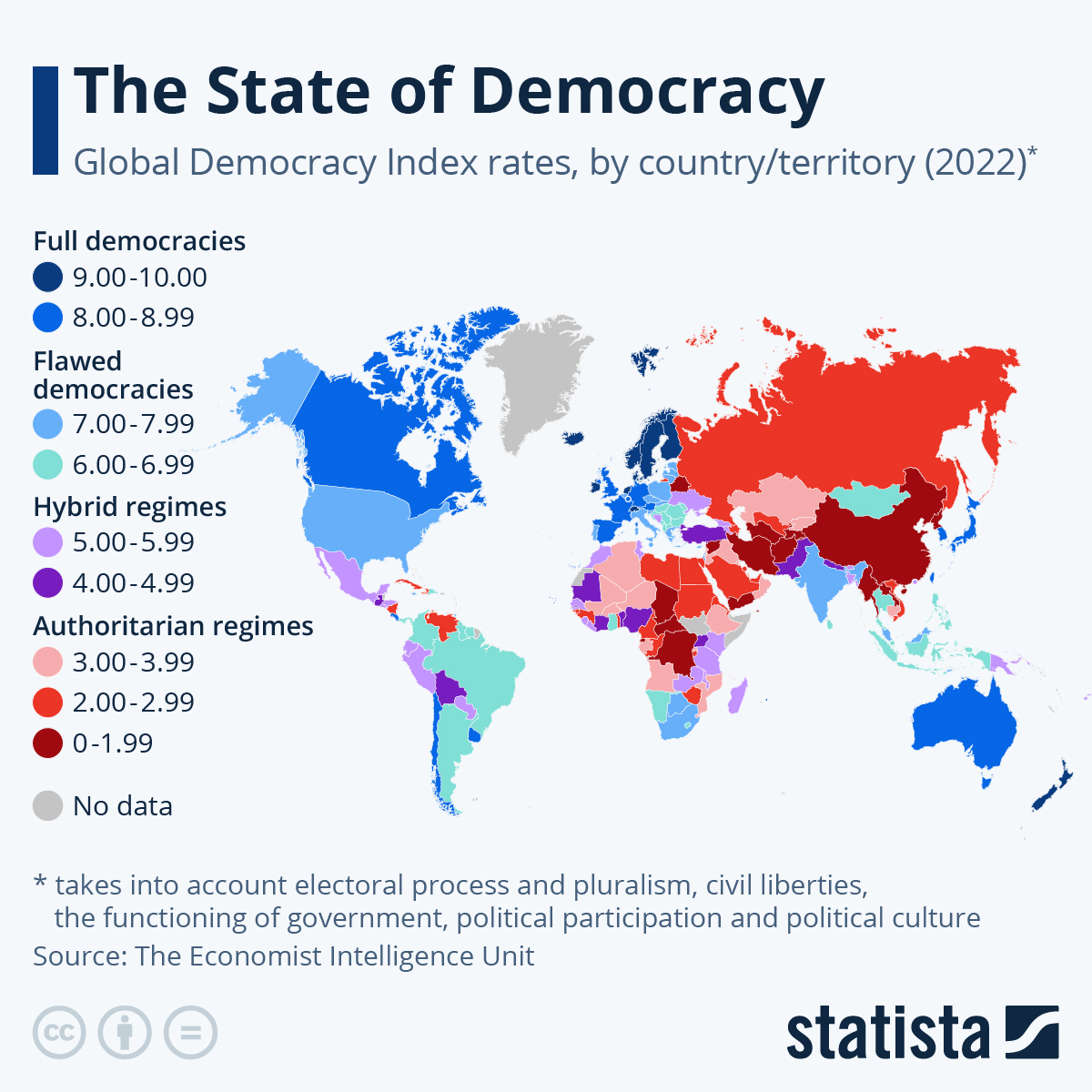
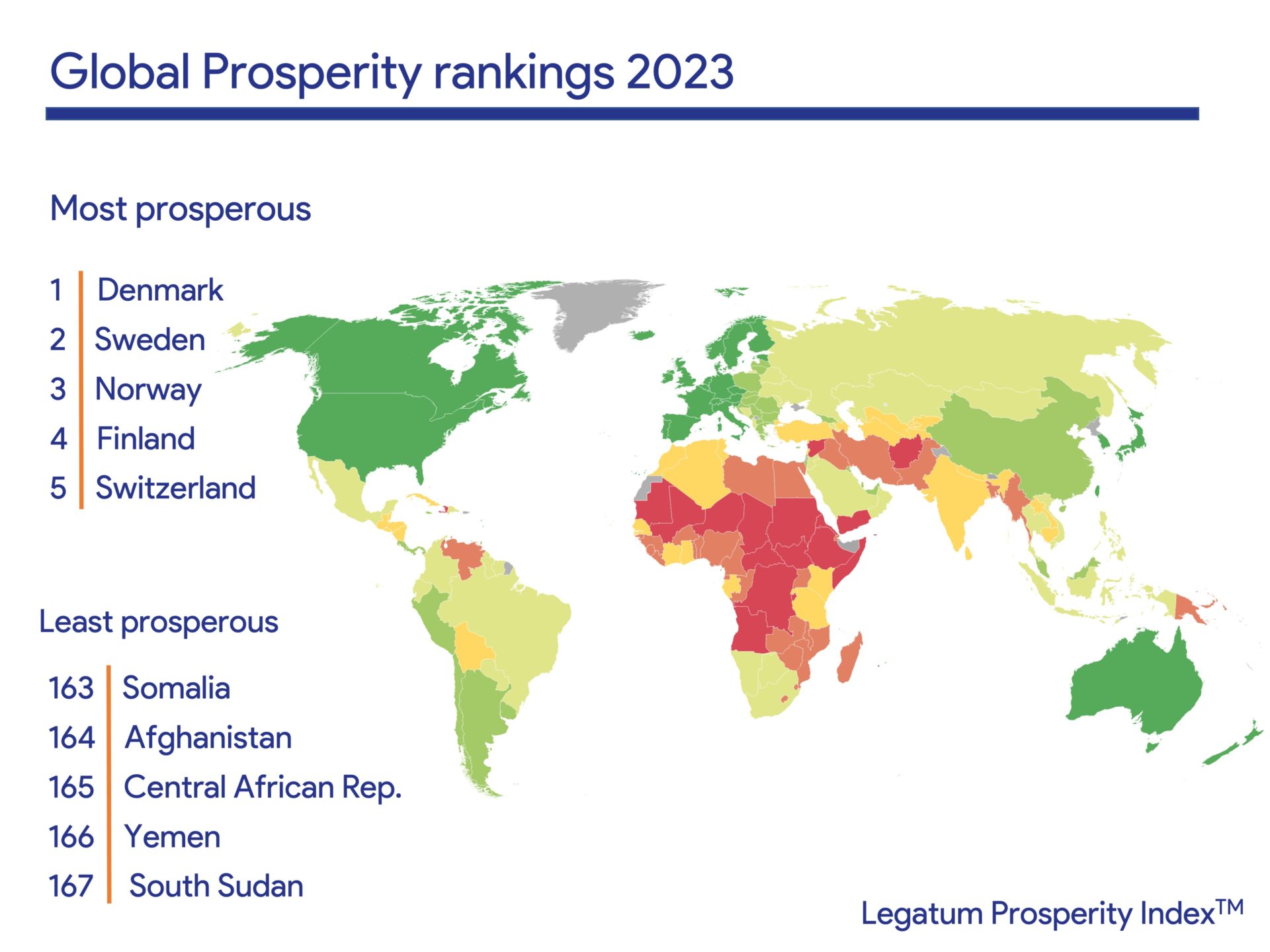
In the top 50 countries by prosperity index, the situation is even more illustrative11. Among the 50 countries, only 3 are not democracies: 2 authoritarian regimes (UAE and Qatar) and 1 hybrid (Hong Kong). Democratic countries are on average 60% better than authoritarian ones in terms of gender equality indicators12. Overall life expectancy in the first 10 years of an authoritarian country’s transition to democracy increases by an average of 3%13. Overall, under democratic rule, people live 11 years longer14. Authoritarian regimes spend less money on healthcare for their citizens15, which negatively affects their health. In addition, democratic countries demonstrate greater effectiveness in combating climate change16.
Democracies also dominate among the top countries in terms of the level of perception of corruption. It is democratic countries that are leaders in the effectiveness of the fight against corruption, in the level of press freedom, and in the level of the rule of law. A study by the V-Dem Institute proved the link between a low level of corruption and a high level of democracy17.

And all this despite the fact that authoritarian regimes falsify statistics to inflate their performance18. Luis Martínez’s study “How Much Should We Trust the Dictator’s GDP Growth Estimates?” based on satellite observation of nighttime lights shows that authoritarian regimes inflate their annual GDP growth statistics by roughly 35%19. Only in a democratic society can citizens know the actual situation of their country and government — there, the objectivity of statistical agencies is sustained by political competition, where the opposition is interested in statistical agencies reporting on the ruling party’s economic failures. At the same time, there is a huge number of other living standards indicators where democracies clearly prevail.
As we have written before, militarily the democratic bloc is more powerful than the authoritarian one, but despite this, democratic countries fight each other far less often, and this is another advantage of democracy. A reasonable person will not want to give up their life for who knows what in a war. If two countries are located in a region with a low level of democracy, the probability of an armed conflict increases by 70% compared to a pair of states located in a region with a high level of democracy20. Unsurprisingly, democracy wins in the world as a whole. Democratic regimes are gradually replacing authoritarian ones because they handle political tasks better. Here, for example, is a visualization of a study by the Our World in Data portal:
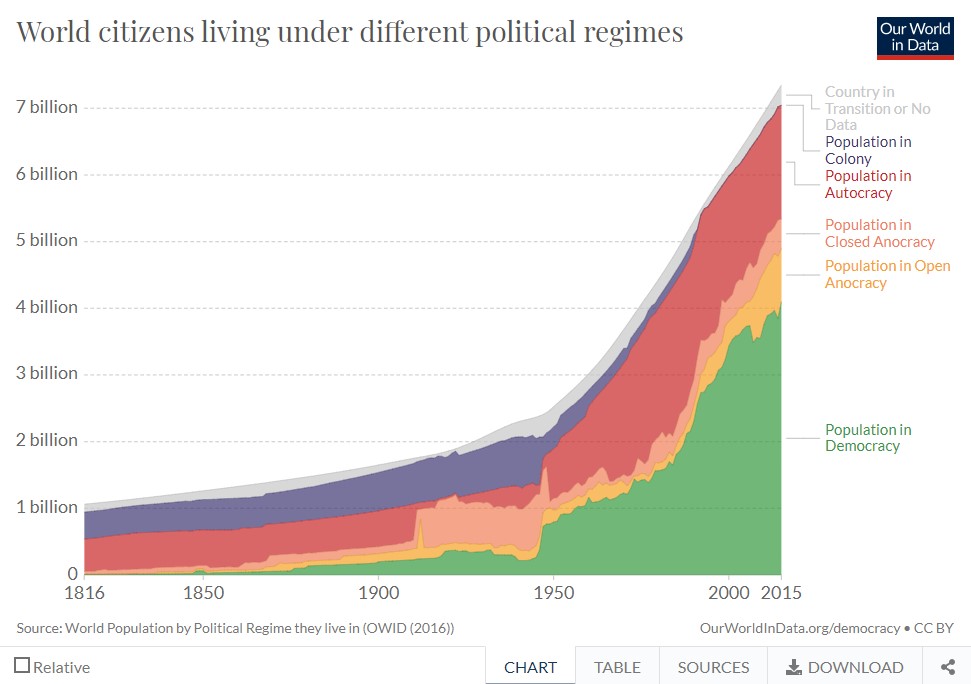
The Our World in Data study concludes that democratic countries are richer, people in them are healthier, and human rights are better protected in them21.
Probably the oldest major military clash between democracy and authoritarianism (adjusted for the era) is the Battle of Marathon, when an army consisting mostly of citizens of democratic Athens defeated a Persian army that significantly outnumbered it. We can also recall the so-called “Cold War”, in which democratic states proved their superiority over the authoritarian socialist bloc. The main reason for the superiority of democracy over authoritarianism is that democracy expresses the interests of the majority of citizens (while authoritarianism expresses the interests of a narrow stratum), as a result of which they display more diligence and will in struggle, and also have more room for creativity.
Candidate of Economic Sciences and Academic Supervisor of the Center for Modernization Studies Dmitry Travin notes:
Democracy in solving economic problems is indisputably more effective than authoritarianism in a stable society with established legal norms. In particular, a parliamentary republic turns out to be a good anti-corruption tool, since an opposition endowed with significant rights is interested in controlling the actions of officials appointed by its political opponents.
The struggle of various interest groups (linked to the authorities and to the opposition) minimizes abuses and prevents the adoption of outright brazen decisions to “saw up the budget”22.
Nobel laureate and one of the prominent researchers in the field of poverty and hunger Amartya Sen observed that never in world history has a famine with mass mortality occurred in functioning democracies23; moreover, all historical examples of mass famine happened exclusively in autocracies24. Economist Garett Jones notes that other researchers tried to refute Sen’s finding, but failed25. Thus, democracy is a guarantee against the occurrence of mass famine, and this is its huge advantage.
Also, mass killings carried out by the government are exceptionally rare in democracies26. Economist William Easterly of New York University led the creation of a database on this topic with data from around the world for the period from 1820 to 1998. The key conclusion was that “overall, a high level of democracy appears to be the single most important factor in avoiding large-scale mass killings”27. Easterly showed that it is enough for a country to have a level of democracy within the top 25% of the world’s countries to eliminate 99.9% of deaths resulting from government repressions. Thus, democracy is also a guarantee against mass killings committed by the government. And this is another one of its advantages.
Why does this happen? What are the reasons for the greater efficiency of democracy?
Reasons for efficiency
One of the main reasons for the efficiency of democracies is constant pressure on the authorities from the opposition, from competing parties. The opposition tries to monitor every misstep of the ruling party, and is ready to make a stir around it in order to score political points and raise its chances of winning the next election. Political competition has as positive an effect as economic competition — the “buyer” has a choice, the most talentless “producers” go bankrupt, and the rest are forced to make improvements to the “product” to remain competitive. The ruling party is under constant threat of losing office, which forces it to try to please the voter.
Therefore, both the ruling party and its managers try to regulate their work, clean out offending party members so as not to give the opposition a reason for a scandal. In this way, a natural political selection takes place. But it also occurs among parties. An incompetent party loses elections, and, if it continues to perform poorly, leaves the stage. Under an authoritarian regime, this is impossible — they will simply “shut the mouth” of the opposition, crush it by forceful methods, and continue to loot the budget without fear of any publicity. Even if those “at the top” of such a ruling party wish to fight corruption, the absence of political competition makes such a fight impossible.
That is why, by the way, all complaints that the democratic system is imperfect because political crises, protests, and social struggle occur within it are a thesis of agents of authoritarianism and utopian populism. It is precisely the fact that struggle takes place in democracies that allows them to be effective. And that is why all ideas about creating a “friendly opposition” like a “homogeneous government of left-wing parties” are doomed to failure. Democracy can realize its advantages only when there is real political competition.
Under a democratic system, there are always several different programs and options for the country’s development. Under an authoritarian system, if the political course chosen by the government is incorrect, the opportunity to turn off it without waiting for a tangible blow to the living standards for the country becomes very low. By various deceptive means — election fraud, the creation of puppet parties, and so on — the government continues to pursue the exact same political course (perhaps with minor changes), thereby aggravating the impending disaster. In the future, this leads either to a prolonged pursuit of an incorrect course (according to which critical damage occurs) or to a bloody revolution. Under a democratic system, the government changes bloodlessly and after a relatively short time of declining living standards. At the same time, opposition parties regularly propose reforms and an alternative program, which allows the country to discover problems and their solutions faster, and to react faster to changes. The principle “one head is good, but several heads are even better” works here — usually, several educated people can perform work better and faster than one. Under democracy, several emergency solutions are always ready. In the event of a catastrophic situation under democracy, the government is changed in elections, whereas in an authoritarian state it does not change, and the catastrophic situation will continue or even worsen. Of course, an authoritarian government can decide to make changes, but this happens, as a rule, rarely.
An authoritarian regime has full information neither about the real sentiments of its citizens (because the dissatisfied are afraid to say what they think) nor about the situation in the economy of its country or in the foreign policy environment (due to the fear of subordinates to contradict a boss whom they cannot change). Therefore, it possesses distorted information, and this reduces the quality of decisions made on its basis. In democratic countries, public servants can put their boss in their place if he is wrong. They are voters, and can choose another party instead of their boss’s party in the next elections. Therefore, the boss is forced to communicate with them respectfully as well. In authoritarian countries, it is different — the boss knows that only those higher up in the hierarchy can remove him, so he sycophantizes before them and is afraid to say anything they will not like. But with subordinates, he can behave however he wants. As a result, everyone is afraid to contradict their bosses, afraid to report uncomfortable information to them. The principle “I am the boss, you are the fool” starts to operate28. In the end, even the dictator at the very top is not dared to “gloom the mood” with uncomfortable truth.
Democracy reacts much faster to the need for change. If something in the politics and economy of the state works poorly, free media identify it, highlight it, and together with the opposition work out option solutions. These option solutions can be used both by the authorities and by the opposition to win elections. An authority that is incapable of effectively responding to ripe changes is replaced in elections.
If under democracy human rights are violated, a person can apply for protection to an opposition party. It will be beneficial for the latter to inform everyone that under the rule of the ruling party the rights of citizens are violated, and it will gladly publicize the incident, and there is a probability that this will help the one whose rights are being violated. Under authoritarianism, however, this person can apply only to the ruling party, under whose rule the arbitrariness occurs, and it is beneficial for it to hush up this arbitrariness, while punishing not the oppressor, but the oppressed. This suppresses the will of citizens to fight for their rights, which further expands the lack of rights.
Authoritarian leaders figured out long ago that economic growth most often ends with the establishment of democracy and the loss of power by them and the nomenklatura (as happened, for example, in South Korea). Therefore, the growth of the country’s economy is unbeneficial for them, and in some cases they even deliberately slow it down. For example, in the book “Why Nations Fail” (chapters “You Can’t Join the Train to Bo” and “Who Is Afraid of Industry?”), its authors provide examples of how authoritarian rulers like Franz Joseph I and Siaka Stevens did not issue permits for the construction of, or even completely destroyed, railways simply because “a revolution might arrive in the country along this railway”. So authoritarianism carries within itself the threat of deliberate destruction of the country’s future.
In authoritarian countries, a lot depends on the person who holds a particular position. And it often happens that what the predecessor did may fundamentally fail to coincide with the vision of the person who came to office, and then a significant part of the old work has to be wound down and started anew. In democratic countries, however, through constant consensus and taking into account everyone’s opinion, the general direction in which the country is moving, those concepts that have been developed, will not change, and if they do, then painlessly. This ensures a more purposeful development.
Democracy is the smallest (and perhaps the only) common denominator that takes into account the interests of all groups in society. Exaggerating: under “non-democracy”, non-democrats are happy, and democrats are unhappy. But under democracy, both democrats and non-democrats are happy, because the latter can choose not to exercise their civil liberties, not to go to elections and rallies, not to be feminists, not to unite in free democratic associations, not to enter into same-sex marriages, not to read the free press, and not to express their opinion. Vice versa — it does not work.
As for the argument that under democracy there will still be corruption and poverty. As in, “democracy is not a panacea”. Washing hands after using the toilet does not guarantee that you will not catch an intestinal infection. On average — yes, indeed, washing hands after using the toilet fantastically reduces such a probability; but it does not make protection one hundred percent, because one can still catch it, for example, from low-quality food, or by accidentally licking a finger.
Handwashing is not a panacea. You still need to cook food properly and look at the expiration date. But if you do all this with hands smeared in excrement — well, excuse me. Although, of course, there will always be exceptional people who manage not to wash their hands and not catch an infection for a long time. And yet the vast majority of people wash their hands after using the toilet.
It is the same with democracy. Democracy does not mean that corruption and poverty automatically disappear; democratic measures will be necessary to solve these problems. But it is practically impossible to effectively fight against corruption and poverty without having democracy29.
Due to the fact that an authoritarian system does not give dissidents hope of changing the country’s course in accordance with their views, and anyone can become a dissident, such people will more often betray the country and reveal its secrets to other countries, or even carry out subversive work. It is enough to recall the huge number of defectors from the USSR, including those who passed on military secrets. For example, former KGB Major Viktor Sheymov passed a significant amount of secret information to the US. He described his motivation as follows:
As a product of this [Soviet] society, I was brainwashed from childhood. I was a very loyal communist, very patriotic. But working in the KGB, you start getting objective information available to a narrow circle of trusted people, and it contradicts what you were taught before. You are able to see what the KGB does: it should protect Soviet people, but it does not. It works against them and the whole world. Now my goal was to cause maximum damage to the communist system30.
In authoritarian countries, a special social class is formed — the nomenklatura, which engages in siphoning money from citizens in exchange for public services that are strikingly inferior in quality to the services of states in democratic countries. In fact, they turn into a semi-criminal “protection racket” for the whole country.
Regarding the issue examined in this article, the arguments we made in favor of the term limits of power are also relevant. Because the rotation of power is one of the attributes of democracy.
Finally, authoritarian regimes are doomed to collapse, to suffer military and palace coups, simply due to the fact that people are different. They possess different political preferences, and this is normal. Under democracy, an outlet is given to these differences. But if a country is led for a long time by a group of people with the same political preferences, it means that during this time another group is quietly preparing their overthrow (since it is deprived of the opportunity to win elections). If opposition forces are not allowed to come to power legally, they will come to it illegally; that is, the lack of democracy can lead to a revolution or to a resemblance of a “palace coup”, where the one who comes to power is not the person who was able to convince the masses, but the one most adapted to behind-the-scenes intrigues.
Summary
The democratic system is more effective than the authoritarian one. It allows achieving higher economic results, higher living standards indicators. It is fairer, freer, far more favorable for people who have a sense of respect for themselves and others. Anti-democratic propaganda is conducted by dictators and the nomenklatura engaged in robbing countries and oppressing their citizens. Or by groups of individuals who aim to occupy a dictatorial post or enter the ranks of the nomenklatura. However, the facts show the incorrectness of their arguments, as well as the arguments of their propagandists and sympathizers.
We thank Artyom Kuznetsov for assistance in writing the article.
- Democracy Index 2020: In sickness and in health? // Economist Intelligence (www.eiu.com). [Online resource]. URL: https://www.eiu.com/n/campaigns/democracy-index-2020/ (Accessed: 08.11.2021).
- Heitor Almeida, Daniel Ferreira (2002). Democracy and the variability of economic performance. Economics and Politics, 14 (3). pp. 225-257.
- 2016 Program Graduate – Winner of the Essay Competition GAIDPARK – SUMMER 2016 // HSE (spb.hse.ru). July 19, 2016. [Online resource]. URL: https://spb.hse.ru/ba/political/news/186781268.html (Accessed: 06.04.2022).
- The Case for Democracy: Does Democracy Cause Economic Growth, Stability, and Work for the Poor? // V-Dem – Varietes of Democracy (www.v-dem.net). Policy brief, No. #27, 11 May 2021. [Online resource]. URL: https://www.v-dem.net/media/publications/c4d_1_final_2.pdf (Accessed: 04.04.2023).
- R.J. Barro. Democracy and growth // SpringerLink (link.springer.com). March 1996. [Online resource]. URL: https://link.springer.com/article/10.1007/BF00163340 (Accessed: 06.04.2022).
- R.J. Barro. Determinants of Democracy // SpringerLink (link.springer.com). December 1996. [Online resource]. URL: https://www.journals.uchicago.edu/doi/abs/10.1086/250107?journalCode=jpe (Accessed: 06.04.2022).
- D. Acemoglu, S. Naidu, P. Restrepo, A. Robinson. Democracy Does Cause Growth // University of Chicago Press (www.journals.uchicago.edu). February 2019. [Online resource]. URL: https://www.journals.uchicago.edu/doi/abs/10.1086/700936 (Accessed: 06.04.2022).
- B. Hoshimov. Democratization is the cause of economic growth // Gazeta.uz (www.gazeta.uz). December 29, 2020, 17:00. [Online resource]. URL: https://www.gazeta.uz/ru/2020/12/29/democratization/ (Accessed: 06.04.2022).
- Human Development Report 2021-2022 // United Nations Development Programme (hdr.undp.org). [Online resource]: https://hdr.undp.org/system/files/documents/global-report-document/hdr2021-22rupdf.pdf (Accessed: 06.04.2023).
- The Case for Democracy: Are Democracies Better for Social Protection of the Poor, Gender Equality, and Social Cohesion? // V-Dem – Varietes of Democracy (www.v-dem.net). Policy brief, No. #28, 11 May 2021. [Online resource]. URL: https://www.v-dem.net/media/publications/pb_28.pdf (Accessed: 04.04.2023).
- The 2023 Legatum Prosperity Index // Legatum Prosperity Index 2023 (www.prosperity.com). February 2023. [Online resource]. URL: https://www.prosperity.com/download_file/view_inline/4789 (Accessed: 06.04.2023).
- The Case for Democracy: Are Democracies Better for Social Protection of the Poor, Gender Equality, and Social Cohesion? // V-Dem – Varietes of Democracy (www.v-dem.net). Policy brief, No. #28, 11 May 2021. [Online resource]. URL: https://www.v-dem.net/media/publications/pb_28.pdf (Accessed: 04.04.2023).
- T.J. Bollyky, T. Templin. M. Cohen. D. Schoder. J.L. Dieleman, S. Wigly. The relationships between democratic experience, adult health, and cause-specific mortality in 170 countries between 1980 and 2016: an observational analysis // Lancet (www.sciencedirect.com). April 26, 2019. [Online resource]. URL: https://www.sciencedirect.com/science/article/pii/S0140673619302351 (Accessed: 06.04.2022).
- A. Patterson. Citizens of democratic countries live 11 years longer: UBC study Citizens of democratic countries live 11 years longer: UBC study // UBC (news.ubc.ca). June 21, 2016. [Online resource]. URL: https://news.ubc.ca/2016/06/21/citizens-of-democratic-countries-live-11-years-longer-ubc-study/ (Accessed: 06.04.2022).
- The Case for Democracy: Does Democracy Increase Global Health? // V-Dem – Varietes of Democracy (www.v-dem.net). Policy brief, No. #29, 11 May 2021. [Online resource]. URL: https://www.v-dem.net/media/publications/pb_29.pdf (Accessed: 04.04.2023).
- A. Inalci. Policy briefs: Evidence shows that democracy performs better // Democracy Without Borders (www.democracywithoutborders.org). March 31, 2022. [Online resource]. URL: https://www.democracywithoutborders.org/22413/policy-briefs-evidence-shows-that-democracy-performs-better/ (Accessed: 06.04.2022).
- The Case for Democracy: Does Democracy Improve Public Goods Provision? // V-Dem – Varietes of Democracy (www.v-dem.net). Policy brief, No. #33, January 2022. [Online resource]. URL: https://www.v-dem.net/media/publications/C4D_PB_33_final.pdf (Accessed: 06.04.2023).
- The Case for Democracy: Democracies Produce More Transparent and Higher-Quality Data // V-Dem – Varietes of Democracy (www.v-dem.net). Policy brief, No. #34, January 2022. [Online resource]. URL: https://www.v-dem.net/media/publications/C4D_PB_34_final.pdf (Accessed: 06.04.2023).
- Luis R. Martínez. How Much Should We Trust the Dictator’s GDP Growth Estimates? // Journal of Political Economy 2022, 130:10, 2731-2769. June 2021. [Online resource]. URL: https://bfi.uchicago.edu/wp-content/uploads/2021/07/BFI_WP_2021-78.pdf (Accessed: 28.10.2023).
- A. Inalci. Policy briefs: Evidence shows that democracy performs better // Democracy Without Borders (www.democracywithoutborders.org). March 31, 2022. [Online resource]. URL: https://www.democracywithoutborders.org/22413/policy-briefs-evidence-shows-that-democracy-performs-better/ (Accessed: 06.04.2022).
- Max Roser. Democracy // Our World in Data (ourworldindata.org). [Online resource]. URL: https://ourworldindata.org/democracy#world-maps-of-political-regimes-over-200-years (Accessed: 18.09.2020).
- Dmitry Travin. Is democracy always good? // Open University (openuni.io). [Online resource]. URL: https://openuni.io/course/8-course-7-1/lesson/3/material/759/ (Accessed: 18.09.2020).
- Amartya K. Sen, Development as Freedom (New York: Oxford University Press, 2001), p. 16
- B. Hoshimov. Democratization is the cause of economic growth // Gazeta.uz (www.gazeta.uz). December 29, 2020, 17:00. [Online resource]. URL: https://www.gazeta.uz/ru/2020/12/29/democratization/ (Accessed: 06.04.2022).
- G. Jones. The Big Benefits of a Small Dose of Democracy // Stanford University Press (www.sup.org). [Online resource]. URL: https://www.sup.org/books/extra/?id=28088&i=Chapter%201%20Excerpt.html (Accessed: 06.04.2022).
- G. Jones. The Big Benefits of a Small Dose of Democracy // Stanford University Press (www.sup.org). [Online resource]. URL: https://www.sup.org/books/extra/?id=28088&i=Chapter%201%20Excerpt.html (Accessed: 06.04.2022).
- William Easterly, Roberta Gatti, and Sergio Kurlat, “Development, Democracy, and Mass Killings”, Journal of Economic Growth 11, no. 2 (2006): 137.
- “In the nomenklatura system, the concept ‘I am the boss, you are the fool’ still rules” // Kommersant (www.kommersant.ru). [Online resource]. URL: https://www.kommersant.ru/doc/4984591 (Accessed: 06.04.2022).
- Why is democracy better than non-democracy? // Masa Media (masa.media). [Online resource]. URL: https://masa.media/ru/site/pochemu-demokratiya-luchshe-ne-demokratii (Accessed: 06.04.2022).
- V. Sharapov. “I was brainwashed from childhood” A KGB major fled to the US and revealed all Soviet secrets. For treason he was promised a million dollars // Lenta.ru (lenta.ru). December 10, 2019, 00:01. [Online resource]. URL: https://lenta.ru/articles/2019/12/10/sheimov/ (Accessed: 06.04.2022).