
Why it is worth abandoning communism in favor of social democracy
In this article, we will explain why communism has far fewer chances to effectively influence politics from the standpoint of benefit for the majority of people than social democracy, and for what specific reasons the Russian left should upgrade and transition from communism to social democracy (as has already been done in developed countries). There are at least 16 such reasons.
It is unlikely that communists could write a similar article about social democracy without resorting to demagogic tricks and falsifications. We, on the other hand, can substantiate why the left should abandon communism and transition to social democracy, just as the majority of them did in developed countries. If you are a communist, you should read this article, compare it with the arguments of communists, and draw a conclusion, appealing not to “devotion to the idea”, but to common sense. Remember that it is always better to abandon your misconceptions than to live with them all your life and allow them to determine your destiny. The fact that you remain devoted to misconceptions is unlikely to bring any benefit to you or other people.
In the most developed societies of modernity, authoritarian movements like communists and fascists have long been marginalized, becoming in the eyes of society mere strange sects. The place of these movements in the political arena has been taken by democratic movements of various flanks – on the one hand, social democrats, democratic socialists, social liberals, and on the other hand, right-liberals and moderate conservatives. This is due to a higher level of education and the knowledge, scholarly works, and experience accumulated by society. What kind of knowledge is this? Among other things, these are the arguments that we will describe below.
Contents
- Does not express the interests of the working class
- Communist states have failed
- The reputation of communism is stained with blood
- Outdated theory
- No work on mistakes
- Communism is dead
- Social democracy is more effective
- Social democrats are more resistant to criticism from the right
- The lies of communists
- Communist taboos
- The non-negotiability of communists
- A regression towards the Stone Age
- Juvenile maximalism
- Financing issues
- Communists have no coherent action plan
- Social democrats need people
- Conclusion
Does not express the interests of the working class
Communist politics does not express the interests of wage workers, since they are interested in raising their standard of living, not in the redivision of property. They do not care by what methods improvements are achieved, and in the event that the standard of living is high, it does not matter to them in whose name property is registered. This was understood back then by Doctor of Historical and Philosophical Sciences Mikhail Voslensky:
Suddenly, intellectuals who have just proclaimed Marxism an inviolable dogma appear before the worker and declare: “Your point of view is not at all that of your class. We, the intellectuals, will teach you your class interest”.
Isn’t it strange? Not only strange, but suspicious. And the more you listen to the reasoning of these nimble intellectuals, the more suspicious it becomes.
Indeed: what is a worker’s point of view? He wants to increase his earnings and improve his working conditions. For this, he is ready to wage a struggle, uniting with other workers. So why is this not the class interest of the worker?
“This is trade unionism”, the intellectuals intimidate with an incomprehensible, but apparently abusive word. “This is a betrayal of the interests of the working class!”
What then are these interests, according to the intellectuals who have appeared? It turns out that they consist in having a party led by them, the intellectuals, come to power in the state. Excuse me, whose class – or group – interest are these intellectuals trying to “introduce” into the consciousness of the worker: his or their own1?
Indeed, although communists like to assure that they express the interests of the working class, in reality they express above all their own interests. The ban on other parties carried out by communist parties did not express the interests of the working class, since it is in the interest of the latter to have a choice between several parties for which it can vote. Communists want to deprive the working class of this choice, which benefits only themselves, since they gain power, and without competitors at that.
Also in the interests of communists is their economic policy. A significant part of them advocates for nationalization, that is, the transfer of property into the hands of officials, which means — considering that they will build an authoritarian system — into the hands of communists. After that, it will be possible to manage financial flows, build state dachas for themselves, and so on. Part of the communists, however, believes that enterprises should pass into collective property. There is also a small part of communists who believe that communism can be achieved not through dictatorship, but through parliamentary democracy. Communists who fulfill both of these conditions have come closest to expressing the interests of wage workers. However, if we ask workers whether they want to take on not only the income but also the losses of enterprises (which will be inevitable under a collective form of property), as well as the work of organizing the enterprise (decisions on investments of obtained income, negotiations with suppliers, hiring personnel, and so on), it turns out that they do not wish to do this (we covered the problems of such a transition in more detail in this article). This is understandable — otherwise, they would have wished to be businessmen rather than employees, since it is easier and more understandable for many people to work for a salary rather than engage in commerce. Therefore, such communists still express the interests of workers to a lesser extent than social democrats.
This is also confirmed by the practice of implementing communist policy in life. Communists in the USSR claimed that the liquidation of private business expresses the interests of workers and peasants, but the real sentiments of these groups are given, for example, in the collection of documents “Ryazan Village in 1929–1930: Chronicle of Vertigo”, which contains various documents of the collectivization era (such as reviews from OGPU district departments to the party leadership). These are opinions regarding Ryazan only2:
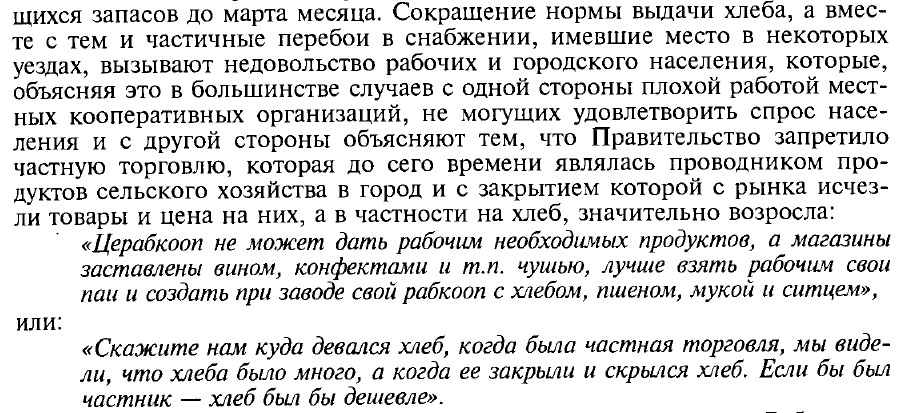
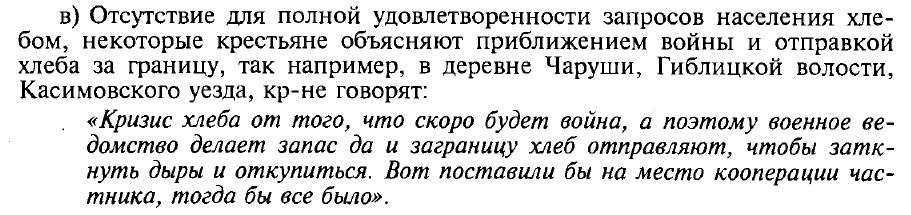
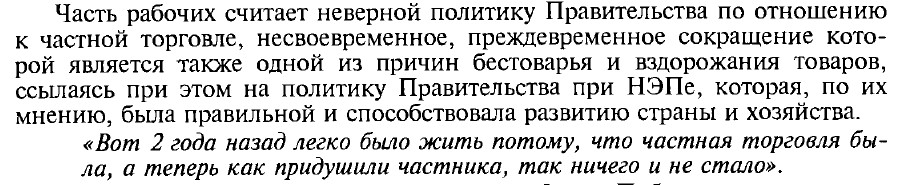
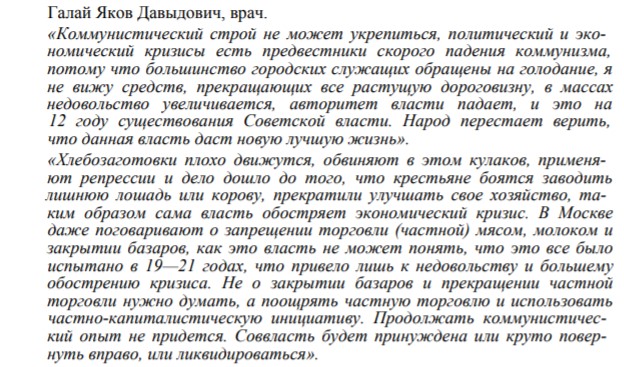
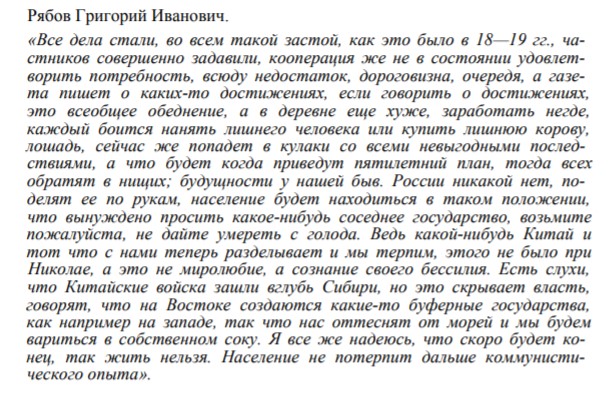
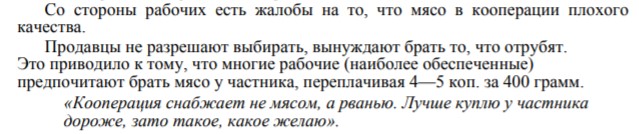
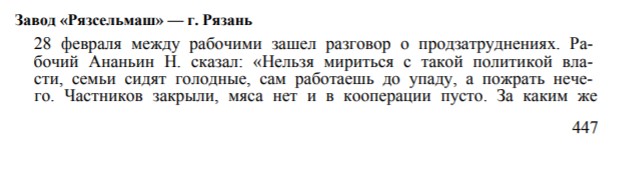
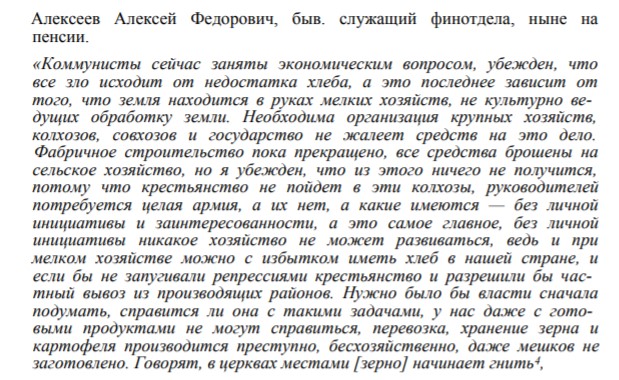

All this is because workers and peasants want not a redivision of property, not the liquidation of business, but an improvement in their standard of living. If this improvement comes with private enterprises, then this is precisely in their interests. Therefore, they need social democratic policy, not communist policy. In addition, the working class does not need property equality either. Communism advocates for the “abolition of classes” (Vladimir Lenin wrote that “the real meaning of the demand for equality is merely the demand for the abolition of classes”3). The dictionary of “scientific communism” states that “legal equality itself cannot be thoroughly consistent unless it is based on the actual social equality of people”4, and that under communism there will be “social homogeneity of communist society and the full social equality flowing from it”. However, in our article on equality we cited research data according to which people stand not for social equality, but for social justice (as well as other arguments in favor of social justice against social equality). They prefer fair inequality to unfair equality. Therefore, the ideas of social democracy, which speaks out for social justice rather than social equality, will always be more viable. Social democrats are more resistant to accusations of “egalitarianism”, and more sympathy is expressed for their policy in the field of inequality. Although, of course, one should not rely solely on the opinion of people, which may well be mistaken. The lack of usefulness of social equality is proved primarily by the practice of attempts to achieve it, which we will examine further.
Sometimes communists say that they do not advocate for egalitarianism and that under them people will not be equal in property and well-being. But then it is unclear why such communists criticize social democracy for not implying social equality and the abolition of classes, and have not yet transitioned to social democracy.
Communists may answer to this that “the abolition of classes is not egalitarianism”. However, the very concept of social class is very blurred. It existed even before the Leninist definition of class, and accordingly, the leading classic of communist ideology Karl Marx did not use the Leninist version. The Great Russian Encyclopedia informs us that social classes are “large groups of people occupying similar positions in the economic structure of society. The differences between these groups, which condition the social inequality of classes, lie in the nature and size of ownership of the means of production and the produced product, as well as in the level of material well-being”5. According to this definition of class (more scientific than the Leninist one, since it is not ideologized), social classes will always exist as long as there is a difference in the level of material well-being. Especially if the division of labor continues to remain and representatives of individual professions can be more well-off than others and occupy a special place in the organization of production. From this it follows that the abolition of classes without egalitarianism is impossible.
Communist states have failed
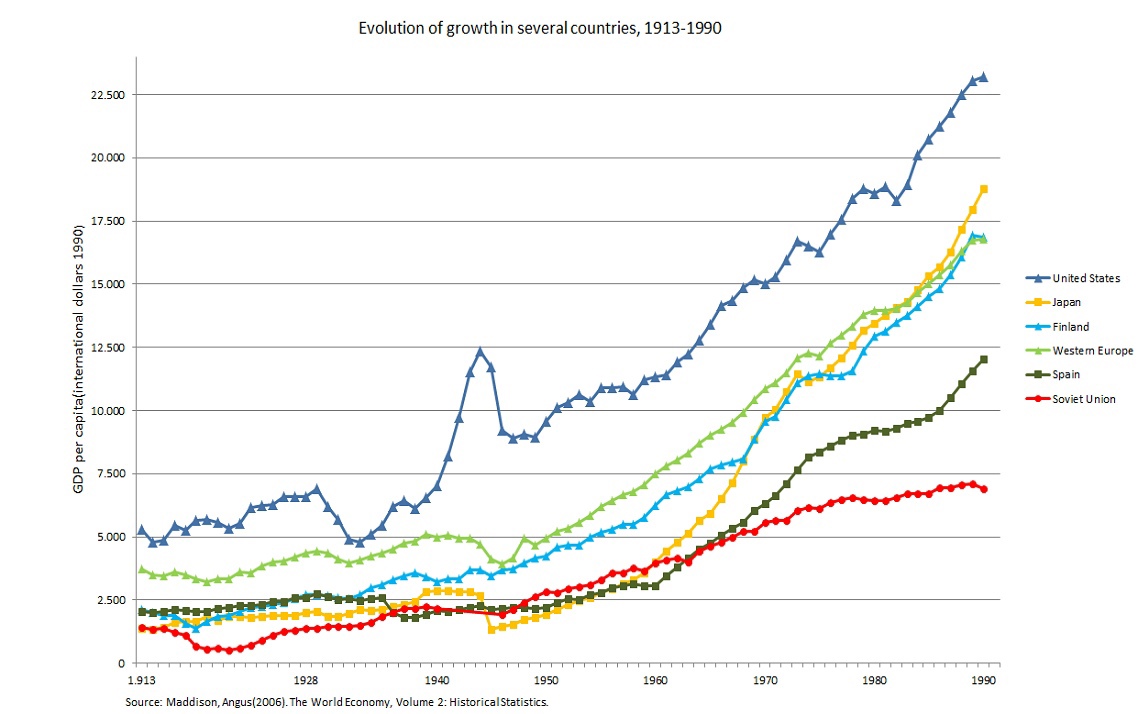
Communist parties came to power in 24 countries6: these are Russia, Mongolia, Tannu Tuva, Bulgaria, Yugoslavia, Albania, Poland, Romania, Hungary, Czechoslovakia, East Germany, Vietnam, North Korea, China, Cuba, South Yemen, Cambodia, Laos, Angola, Ethiopia, Mozambique, Grenada, Afghanistan, Upper Volta (in many cases not without the participation of USSR troops). Today, only 5 countries with a communist party in power remain7: these are China, Cuba, Laos, North Korea, and Vietnam. In those countries where the communist party was removed from power, this was due to its political and economic failures. We have already written articles about the standard of living under Joseph Stalin and in the later USSR, so the reader knows what kind of failures are being referred to among other things. However, current countries with the power of the communist party also do not stand out with successes — for example, in the 2020 Human Development Index8 China ranks 85th in the world, Cuba ranks 70th, Vietnam ranks 117th, Laos ranks 137th (there is not enough data to calculate the rating of North Korea), despite the fact that, for example, in China communists have been in power continuously since 19499, that is, for more than 70 years. It is impossible not to admit that this is an absolute failure.
China has achieved certain successes in economic development, but at the cost of abandoning communist economic policy. Relatively good results were shown by the USSR during the NEP and Burkina Faso (Upper Volta) in the era of Thomas Sankara, but the result was the same — a bureaucratic coup d’état (in the first case under the leadership of Stalin, in the second under the leadership of Blaise Compaoré) and the destruction of communist leaders (in the first case, the mass extermination of the Bolsheviks, in the second, the assassination of Thomas Sankara and his supporters). There is not a single country where the communist project ended with the achievement of a high standard of living and the building of a viable society. To justify these failures, communists have to go to great lengths, inventing various demagoguery or resorting to conspiracy theories, which ultimately portrays them in a bad light.
As a rule, the authoritarian rule of the communist party leads to the formation of the nomenklatura, which begins to rob citizens, and ultimately abandons communist ideology, or, while continuing to declare commitment to it, pursues quite right-wing policies (as in China). To avoid the formation of the nomenklatura, the left needs to abandon communist authoritarianism and transition to a democratic system, which leads to social democracy.
As for social democrats, their projects have not only not failed — they occupy top spots in various standard of living indicators (more on this later). And if anyone manages to move society’s development to a new stage, it will be social democrats with their gradual development, not communists with their desire to rush ahead of the train. In disputes with the right, communists are helpless because all their projects are failing. In disputes with social democrats, the right is helpless, since the most successful states are social democracies where social democrats were in power for many years.
The reputation of communism is stained with blood
Many communist parties, after coming to power, unleashed mass terror during which a multitude of people were killed. For example, we analyzed that during the Stalinist terror in the USSR, a huge number of innocent people were destroyed. A similar thing happened in China under the rule of Mao Zedong, in Cambodia under the rule of Pol Pot, in Ethiopia under the rule of Mengistu Haile Mariam, and so on. All these people headed communist parties. This terror stemmed from the communists’ intolerance of other people’s opinions (they believe that the onset of communism is necessary and inevitable, and everyone who does not want this is an enemy), from their commitment to an authoritarian political system, from the lack of a normal value system in which the inviolability of human life is a core value. The political rivals of communists remind them of their involvement in these crimes at every convenient moment, forcing them to make unconvincing excuses and wriggle out of it, as a result of which outside listeners are often even more convinced of their bloodthirstiness.
According to some estimates, the number of victims of communist regimes in various countries approaches the mark of one hundred million people10, among whom are also communists themselves (it would be interesting to see what figure the communists themselves would estimate for the number of victims of communist party regimes). The collection of such data on social democracy is simply impossible, since parties sharing this ideology did not organize mass terror, and it is extremely difficult to count any significant number of victims (although communists bend over backward to find at least a few dozen people whose deaths can be blamed on social democrats, which is why, for example, myths about the murder of Rosa Luxemburg and Karl Liebknecht by social democrats are created). Accordingly, social democrats do not have to take responsibility for mass murders, and they do not have to justify them. A social democrat will not find himself in such a foolish situation as the communist Andrey Rudoy, who stated during a debate with Egor Prosvirnin that his great-grandfather was shot, but he is still a communist.
The transition from communists to social democrats means that you will not have to justify cannibalistic policies, mass murders, and make a laughingstock of yourself. You will not have to rejoice that your great-grandfather was shot, and blush (physiologically) when one of your friends says that there were repressed individuals among their relatives.
Outdated theory
The theory of communists is built on 19th-century books and pseudoscientific propaganda books that have no value in the scientific community. Sometimes it is diluted with world-systems analysis, which is often based on speculative conclusions rather than the scientific method. To classify a country as part of the core or the periphery, the subjective opinion of Immanuel Wallerstein or another luminary of world-systems analysis is needed (we wrote about this in more detail here). To classify a country as a developed democracy, an assessment of its compliance with more than 60 different indicators is required11. This alone can say a lot about the degree of scientific validity of world-systems analysis. But one way or another, the foundation consists of the works of Karl Marx and Friedrich Engels, where a significant part of the theses are outdated from a scientific point of view, which we examined in a separate piece. Communists are forced to defend long-unviable concepts like a planned economy or the withering away of the state (we will talk more about this later).
The theory of social democrats is built on the works of modern recognized scholars, such as Thomas Piketty or Daron Acemoglu. Communists, on the other hand, often declare scientists inconvenient to them to be “bourgeois scientists”1213, but scientists are generally just scientists, and it is precisely the communists who are ideologized. For example, regarding Doctor of Historical Sciences and State Archive of the Russian Federation employee Oleg Khlevniuk, individual communists write that he is “from the perestroika cohort of historians who were the first to defect to the liberals”14. However, it is enough to compare the texts of Khlevniuk and the communists to understand who is writing with bias. Many hypotheses of Marxism that communists use as the foundation of their theory have not come true or have been refuted by practice. Neither the dictatorship of the proletariat nor the withering away of the state corresponded to their declared essence in practice — instead of the dictatorship of the proletariat, a dictatorship of the nomenklatura was obtained, and instead of the withering away of the state — its strengthening (which even Joseph Stalin noted15), and, of course, none of this led to communism. But did the communists abandon these concepts that failed the test of experiments? No. They continue to consider the classical works of Marxism as a source of political truth. To the remarks of social democrats that these concepts have failed, they state that “an airplane didn’t fly right away either”. But in order for the airplane to finally fly, changes were made to its design, and serious ones at that. If you keep building the exact same airplane that failed to fly, it will never fly. If, however, you make changes to the communist airplane so that it flies, social democracy is what you get. As for the theory of social democrats, it not only works in practice, it is a modern theory and uses the latest achievements of modern science in the fields of politics, culture, and economy.
No work on mistakes
Ah, they didn’t shoot enough, didn’t finish off enough!
So now be angry and fuss,
Get into the metro, drive cars,
Hang around the entrance past midnight16.
If you ask communists what they will change compared to the Bolsheviks to prevent the rise of a new Stalin and/or the collapse of the USSR, you will practically never hear convincing practical proposals. Some Stalinists claim that Stalin, as it turns out, “didn’t shoot enough”17 — meaning he didn’t kill enough dissidents. Such Stalinists cannot be perceived by sane people as anything other than maniacs. In the very best case, some Trotskyists will say that they will not abolish the party maximum, will ensure the rotatability of power, will not conduct mass recruitment into the party, and so on. However, without political competition (which is largely ensured by economic competition), democratic institutions, an independent press, and other mechanisms to ensure democracy, nothing will prevent the nomenklatura from, say, abolishing the party maximum. All this was attempted to be implemented in the USSR (the platform of the Bolshevik-Leninists for the 15th Party Congress18), but the nomenklatura crushed the supporters of these measures. Therefore, all these proposals are unlikely to be implemented in practice this time either. Communists do not have a solution to these problems. Those who try to introduce changes into the theory are often accused of “revisionism” and “opportunism”. Social democrats, on the other hand, despite not having such critical problems, are constantly improving — for example, social democrats learned a lesson from the rise to power of the Bolsheviks and Hitler, and now allow for the restriction of authoritarian parties. Another example is the abandonment of many provisions of Marxism by social-democratic parties. Candidate of Political Sciences Nikolai Rabotyazhev, leading researcher at the Department of Political Theory at MGIMO, emphasizes that social democrats react very flexibly and adapt to changing conditions:
There is reason to believe that European social democracy will be able to find a way out of this situation and overcome the considerable difficulties it has faced in the era of globalization. The guarantee of this is the ability repeatedly demonstrated by social democrats not to close their eyes to reality, to learn from their own and others’ experience, and to timely revise outdated ideas19.
That is, social democrats work on their mistakes, and successfully so, while communists do not.
Communism is dead
After the collapse of the Soviet bloc, the global communist movement collapsed along with it. There have been no new communist revolutions for a long time, countries under the rule of communist parties are becoming fewer and fewer (today there are only 5 of them20, and at least one of them — North Korea — has practically abandoned the idea of communism21), and those that exist are becoming less and less communist. Nowadays, communist parties in most countries are extremely marginal and small sects that have virtually no influence on politics in their countries. The public page “Western Left” in late December 2020 made a selection reflecting the popularity of these parties in Europe at that time.
In fact, today there is no global communist movement. Nor are there any prerequisites for it to recover. Most communist revolutions took place with the help of the USSR (which no longer exists) — the exception here is, properly speaking, Russia, where the communists came to power thanks to a difficult military situation.
As for social democrats, the international they belong to — the Progressive Alliance — is perhaps the most powerful international association of parties in the world. It includes parties such as the US Democratic Party, the SPD, the social-democratic parties of Northern Europe, the Australian Labor Party, and so on22. It is this that is the left international that has not lost its relevance.
Social democracy is more effective
Social-democratic countries are leaders in most standard of living indicators. This eloquently proves: social democracy works, and works effectively. Communist countries have never achieved such success in their history. They usually demonstrate relatively low standard of living indicators, as was the case in the USSR, and as is currently observed in China or Vietnam (for example, in the 2020 Social Progress Index, Vietnam ranks 88th, and China brings up the rear of the first hundred countries altogether23). Social-democratic countries have never experienced such mass famine as in the communist USSR, China, or Ethiopia, nor have they experienced repression on such a scale, while the results are more successful. Therefore, communists are defenseless in disputes with the right, while social democrats always have something to say. Of course, communists can promise a universal paradise in the future, but this resembles a financial pyramid. Any sane person understands that, for example, a man with a beer belly cannot suddenly become like Arnold Schwarzenegger in his prime — this will be preceded by many stages of progress. Similarly, an impoverished society cannot instantly become a paradise with an abundance of goods and services — gradual progress must be observed. The absence of such progress among communists leads all sane people to the conclusion that communists will not be able to achieve universal well-being.
Social democrats are more resistant to criticism from the right
Modern right-wing forces have adapted to new conditions nowadays, and the Russian right mostly no longer supports authoritarianism and mass murder, being rather liberal-conservatives (for example, the right from “Society.Future” recognize the need to build democratic institutions24). Such right-wingers have few weak points left. Most often, their weak points remain the defense of high inequality, the denial of the need for welfare state institutions, and the support of various kinds of stereotypes. Communists can criticize them for this, but the right has a traditional trump card—playing the card of communist experience (the USSR and other states where communists ruled). This trump card gives them victory in disputes with communists in advance. In the case of social democrats, however, the right finds itself in a defensive position, since social-democratic countries are leaders in the standard of living, and the main trump card of the right disappears.
Furthermore, the right cannot accuse social democrats of populism and anti-democracy either. Often, radical forces resort to populism and anti-democracy simultaneously, both from the right (for example, Hungarian Prime Minister Viktor Orbán25) and from the left (the most striking example would be the idol of communists Vladimir Lenin with the slogan “all power to the soviets, factories to the workers, land to the peasants”). Moderate democratic forces, including social democrats, have always obeyed the rules of democracy and the rotation of power, and in case of defeats, they drew conclusions from them, which we can see in the example of the German SPD.
The lies of communists
To defend the unviable dogmas of their theory, communists are forced to resort to using various unprincipled techniques — some of them were analyzed by us in the article with myths about social democrats, and many of them were also examined in the sections “Stalinist Legendarium” and “Nomenklatura”. The lies of communists were satirized by George Orwell — “doublethink” in his novel “1984” can be considered a satire on the double standards that prevailed in Stalin’s USSR. Many examples of conceptual substitution were analyzed by Doctor of Historical and Philosophical Sciences Mikhail Voslensky in his work “Nomenklatura”26. Social democrats do not need to defend all these legends and myths, putting themselves in a knowingly losing position in a discussion. Lies and doublethink will only work within your narrow audience — outsiders will easily see the illogic and manipulativeness of your theses, which is why even the strongest of them will not work, as we clearly see in any debates of Andrey Rudoy.
Doublethink means the power of holding two contradictory beliefs in one’s mind simultaneously, and accepting both of them. The Party intellectual knows in which direction his memories must be altered; he therefore knows that he is playing tricks with reality; but by the exercise of doublethink he also satisfies himself that reality is not violated. The process has to be conscious, or it would not be carried out with sufficient precision, but it also has to be unconscious, or it would bring with it a feeling of falsity and hence of guilt. Doublethink is the cardinal sin of Newspeak, because the Party deliberately uses conscious deception while firmly and honestly pursuing its aims. It follows that it is necessary to repeat conscious lies, and to believe in them sincerely; to forget any inconvenient fact, and then, when it becomes necessary, to drag it back into consciousness for as long as it is needed; to deny the existence of objective reality, and yet to take account of it, in spite of the denial, and to reckon with it. Even in using the word “doublethink” it is necessary to exercise doublethink. For by using the word you admit that you are tampering with reality; but by exercising doublethink you erase that admission from your memory27.
Communist taboos
A communist is restricted from doing a great deal. It is often possible to observe a representative of this movement shamefully buying an iPhone and being forced to dress deliberately tastelessly, because everyone knows that he criticizes the consumer society (that is, high consumption rates, which are one of the indicators of a high standard of living). He is not allowed to go to protests, because this is a “fight between a toad and a viper”28 and one group of bourgeoisie against another. He is also not allowed to vote, because the elections are bourgeois29. Emigrating to developed countries is haram, because people will ask why not to North Korea, Cuba, or China. He is not allowed to collect donations and earn money from advertising, because he becomes a petty bourgeois. Trade union struggle is trade unionism and opportunism30, because improving conditions under “capitalism” increases its survivability, and a communist must fight for revolution and the establishment of a communist dictatorship. In fact, a real communist is one of the most disenfranchised and downtrodden members of society. A communist most often has never worked in a factory himself, but is a student, an office worker, or a member of the intelligentsia, yet at the same time he must say everywhere (and does say) that he stands for the power of workers and their dictatorship over everyone else. Communists cannot take money from businessmen and cannot accept them into the organization, since they are against the “bourgeoisie”. And then they have two paths — either not have the resources to create a strong party, or hypocritically spit on their principles, cooperating with the “bourgeoisie” and saying completely different things in public (it is known that business representatives such as Savva Morozov were among the sponsors of the Bolshevik Party).
If a social democrat goes to general civil protests, participates in elections, in the trade union struggle, and so on, other social democrats will not accuse him of betrayal, since nothing of this contradicts the theory of social democracy, even on the contrary — it is an integral part of it.
The trade union movement cannot be divorced from the fundamental tasks of the struggle for the emancipation of labor from capital. And therefore, only those unions that recognize the revolutionary class struggle for socialism through the dictatorship of the proletariat can be full members of trade unions31.
The non-negotiability of communists
Communists most often do not advocate for a parliamentary republic — they advocate either for a dictatorship, or for “people’s democracy”, or for various forms of “direct democracy”. In none of these cases will there be a real opposition — in the first case it will simply be banned, in the second only pocket opposition figures of the communists will be allowed, the third case is simply a “con game”, since communists, just like in the case of the soviets, will simply subjugate all organs of direct democracy to themselves. Since communists are afraid of a strong opposition and do not recognize its necessity, they do not need long-term political allies, since they will turn out to be unnecessary later anyway. From this stems their relatively high level of sectarianism — they classify participation in general civil protests as a “bourgeois protest”32, often accuse other communists of opportunism and bourgeois degeneration, and so on. Most of them will not participate in a broad coalition, the necessity of which we justified in a separate article (even attempts to create the so-called “broad left” ended in failure). This seriously reduces their chances of defeating the authoritarian regime — small communist parties are incapable of defeating it due to the fact that they are very small, and they will not be able to become large enough due to the reasons listed in this article.
Social democrats, on the other hand, are ready to be part of a broad coalition and general civil protest. Communists criticize this position — in their opinion, this will not allow social democrats to achieve political success because they will not play a leading role in the general civil protest, and because in the event of the fall of authoritarianism, the right will “crush” the social democrats in the elections. This is incorrect, since social democrats will have chances of winning. The history of social-democratic parties shows that they often did not play a leading role at the initial stage of the struggle for the establishment of democratic institutions, but won and gained power after their establishment. For example, the British Labour Party initially had very few seats in parliament, but over time achieved a huge advantage (in 1900 – only 2 seats33, and in 1945 already 393 seats34). The same applies to the Australian Labor Party or the Social Democratic Party of Sweden. The victories of democratic protests open the road for social democrats to electoral victories. That is, the communists’ criticism of social democrats’ participation in the general democratic protest and parliament is built on ignorance of history. History, however, shows that social democrats are capable of participating in general civil protests, in parliament, and after the establishment of a democratic form of government, they often gain power.
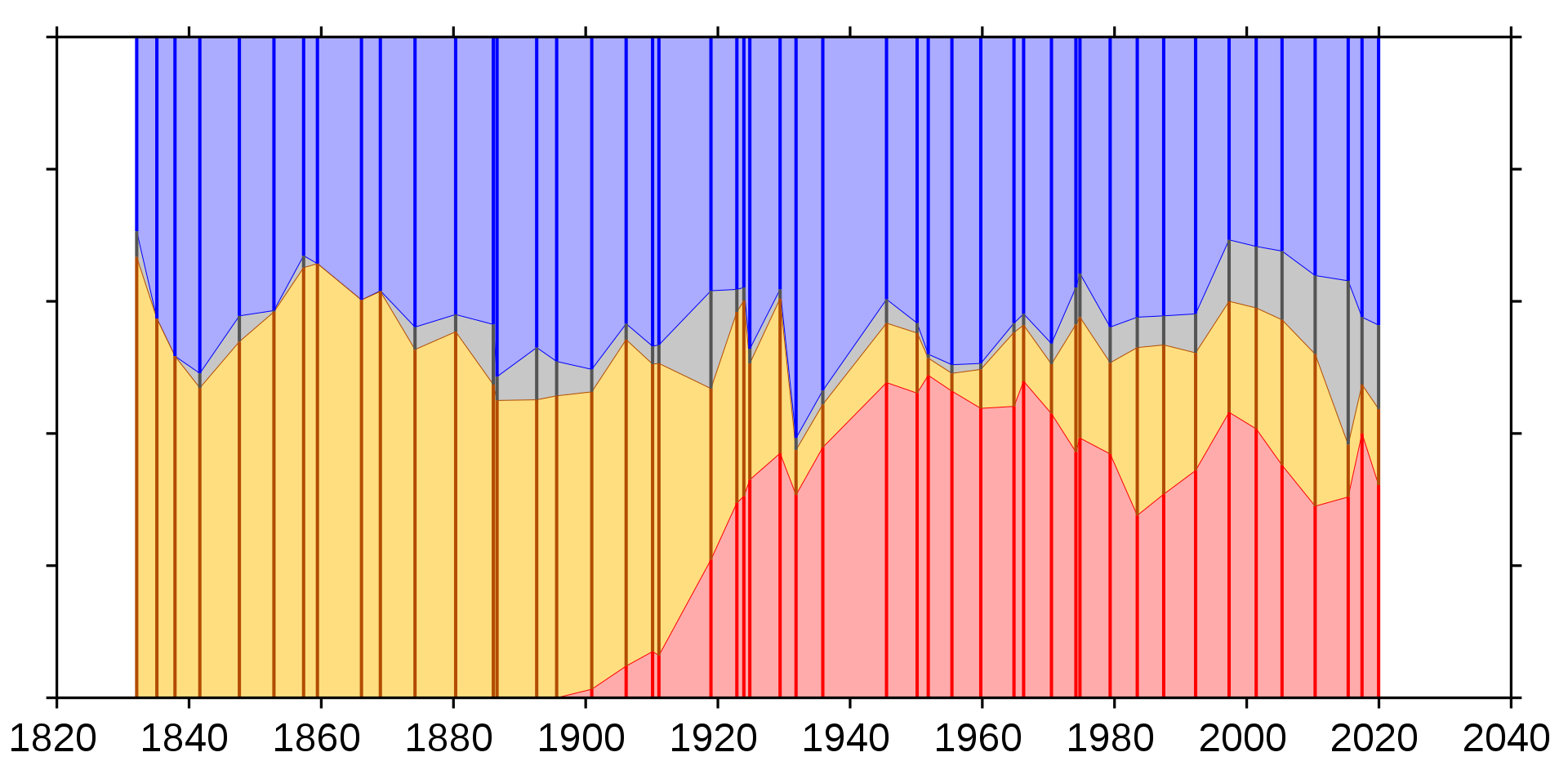
The communists themselves have practically never been able to win a countrywide victory in democratic elections. We know examples of elections to the Constituent Assembly or the first free elections in the territory of the “people’s republics” in Eastern Europe, or the presidential elections in Russia in 1996. In all these elections, the communists lost, often even under the most favorable scenarios for themselves. Realizing their unpopularity and weakness, they hope that one day they will have enough strength to overthrow the authoritarian power themselves, after which they will ban opposition parties, publications, channels, and so on, as they already did after the coup of November 7, 1917.
A regression towards the Stone Age
Communists want to abolish the state and private property, which is expressed in the following postulates:
Every state is a “special force for the suppression” of the oppressed class. Consequently, every state is neither free nor a people’s state35.
The theory of the Communists may be summed up in the single sentence: Abolition of private property36.
However, in the corresponding articles we showed why these concepts are incompatible with economic development and the growth of the standard of living (here about the state, and here about private property). Communists look to “primitive communism” (Marxist social science defined primitive communism as a society characterized by the absence of private property, classes, and the state, where all members stand in an equal relation to the means of production with an egalitarian distribution of a share of the social product37), and indeed, the rejection of such institutions as the state and private property will bring society closer to this state, since there will be no one to perform the functions of the state, and citizens’ property becomes unprotected from organized force. As practice shows, social democrats improve what works, while communists destroy what works and build what will not work. Communists want to return to pre-state forms of existence, which as a result of human development were superseded by state forms as more viable ones.
In order to effectively carry out reforms, a high level of the rule of law is needed — without it, adopted laws will be significantly harder to implement. Communists have never known how to ensure a high level of the rule of law. For them, the party and the idea of communism have always been above the law. For example, the communist public page “Vestnik Buri” states that “law can never be higher than the economic system”38.
Mr. Vyshinsky, in his high capacity as Prosecutor General, defining the Soviet concept of justice, writes: “Like any organ of Soviet power, Soviet justice is an organ for the effective implementation of Soviet policy”… in his work “Criminal Procedure” Mr. Vyshinsky writes that a Soviet judge (I quote) “must not merely follow legal logic, he must constantly remember that the law is nothing other than an expression of party policy”. In practice, this means that a Soviet judge, in the event that the law comes into conflict with the general line of the party, must unhesitatingly sacrifice the application of the law in order to unconditionally obey the instructions of the party, which is the supreme law.
Thus, we see that the judge, the main person administering justice, must not reckon with the law; the supreme law for him is the command of the party…39
And under such conditions, society will operate not by law, but “by informal rules”, that is, by party policy. If laws are not properly enforced, then all measures taken by communists for the transition to communism will not be properly enforced either, and it becomes unfeasible. The difference of social democrats here is that they do not abandon such inventions of mankind as the state and private property, and they know how to use them for the realization of progressive values. They do not place their idea above the laws. Their policy does not threaten disaster and a regression in development, which will with a high degree of probability occur as a result of the abandonment of these institutions. And they do not need to defend crazy ideas like a planned economy or the withering away of the state.
In addition, the promises of a “stateless society and all-people’s property” have always turned out to be a deception. Instead of withering away, communist states grew to unprecedented proportions, penetrating all spheres of human life. And “all-people’s property” turned into the property of the party nomenklatura and the Law “On the Protection of Property of State Enterprises, Collective Farms, and Cooperatives and the Strengthening of Public (Socialist) Property”, better known as the Law of “Three Spikelets”, with sentences ranging from 10 years in camps to execution for attempting to use “people’s” property.
Juvenile maximalism
Sometimes one gets to hear communists making claims against social democrats for not building a paradise with rivers of milk and honey, a 4-hour workday, and free Bentleys in developed countries like Scandinavia or Germany, where everyone is happy without exception. This can be accompanied by statements like: see, people went out to protest there, so everything is very bad there and workers are oppressed. Although this may be a normal struggle for improving conditions — it is rather bad where people are not allowed to protest.
The roots of this attitude lie in a combination of infantile thinking and insufficient erudition, a lack of knowledge of how the world works. For example, sometimes a five-year-old child may demand that their parents buy a toy worth 130,000 rubles, despite the parents earning 40–50 thousand a month. The parents explain to the child that they do not have enough money, to which the child says that they should just have more money then. They reply that it will not work out for them, but the child, due to a lack of knowledge about real life and how it works, concludes that the parents are simply bad and do not want to buy them this toy.
The reality, however, is that one has to evaluate conditions and capabilities. Social democrats in developed countries may want a 4-hour workday, robotization, free houses, and flights, but they cannot secure all this by mere desire alone. Achieving such tasks requires huge, painstaking work:
- A political force (party) in parliament and on the ground that sets such tasks for itself in perspective;
- Strong personnel within such a party who compel the party to set such tasks;
- Developed democratic institutions that allow such party to enter parliament and local government bodies, and to carry out reforms that make the realization of such tasks possible;
- Ensuring broad support for this party;
- The level of technological development of the country that makes the realization of such tasks possible;
- Qualitative analysis: what makes the implementation of social-democratic tasks easier and what complicates it. Which measures have proven effectiveness and which have proven ineffectiveness.
This is at a minimum. And at the same time, one will have to fight against those political forces whose goal is the enrichment of individuals or the seizure of power and privileges!
The infantile communist says: “no, this is all very difficult and takes too long, surely you can just get power immediately and have everything right away!” Yes, parents can also buy a child a toy for 130,000 immediately — take out a loan, steal, sell something from the house, and so on. And the child will have this toy. However, one should be aware that there will be consequences for this. If the parents stole this toy, they could be imprisoned; if they took out a loan, both the toy and something more serious could be taken away. Therefore, an adult understands that this toy is not needed at any cost. And it is better to do everything right, albeit gradually, than to get everything at once, but with consequences.
An adequate social democrat understands that if he wants to live in a developed and prosperous country, people are needed who will create and strengthen the party, fight for this party to set the right tasks, write high-quality analytical articles, and fight for democratic institutions. And he does some of this himself. A prosperous society is created not by childish demands for a 130,000-ruble toy or an immediate paradise, but by hard work, the components of which are indicated above. This applies to developed countries as well.
So the reasons why we do not yet have a 4-hour workday do not lie in social democracy as an idea, but in the fact that many believe people who promote unviable ideas, political strategists who sow apathy with theses like “nothing can be changed anyway” or “this is a fight between a toad and a viper”, in the organizational miscalculations of the social democrats themselves, in the organizational successes of the opponents of social democrats, in the reluctance of citizens to act, and in ignorance of what needs to be done. Rights are not given, rights are taken! And if you are no longer an infantile person and can understand that there will never be a time when someone comes and immediately makes a paradise without having to pay for it later, this is already a big deal in today’s realities.
Social democrats do not promise people a paradise and do not promise to create a world where there will be no crime, where one will not need to work, and so on. A mature person understands that the probability of this is extremely low (and possible only in the extremely distant future), and whoever promises this now is most likely a fraudster. Social democrats can hardly be suspected of this.
Financing issues
Since communists advocate for the abolition of private property (and, consequently, private business), despite their tricks like “well, we will temporarily allow small business” (for example, the manifesto of the Union of Marxists contains the demand “nationalization of at least large- and medium-scale production”40), there is no tangible trust from entrepreneurs towards them. They remember the fate of the peasants dubbed “kulaks”, who were proposed to be liquidated as a class:
To squeeze out the kulaks as a class, the policy of restriction and squeezing out of individual groups is insufficient. To squeeze out the kulaks as a class, it is necessary to break the resistance of this class in open battle and deprive it of the productive sources of its existence and development (free use of land, means of production, lease, the right to hire labor, etc.)41.
Therefore, business will for the most part not fall for communist tricks a second time — this can only be expected from rare representatives of it, or from the communistically inclined part of the nomenklatura. And since communists are cutting off their path to support even from small business, they will lack funding to create any significant party at all, and, consequently, to come to power.
Communists may respond to this that they will be sponsored by the working class. But things are not smooth here either. Those workers who have enough funds to sponsor political activity are hardly going to be eager to support forces that often call them the “bourgeois labor aristocracy”. They will not support the liquidation of private property, because they themselves have something to be taken away. If they have shares of enterprises and banks as a “safety cushion”, they will be against their socialization. They will not support political repression, because it is precisely the working people who are most vulnerable to it — they have nowhere to run and no one to stand up for them.
In the end, communists are doomed either to work only with the most marginal and poorest segments of the population, dooming themselves to the status of sectarians and outcasts, or to abandon their utopian views and become social democrats.
Communists have no coherent action plan
Communists do not know how they will gain power, nor what they will do with it afterwards. They only have abstract calls for revolution, but they do not create any underground militant organizations to seize power, they do not carry out bank expropriations, and they do not conduct agitation in the armed forces. This leads to the fact that most of them turn into revolutionary guardians. In the event that power falls into their hands, they do not understand how the political system will be structured — communists speak only of an abstract “greater democracy” (but cannot name specific measures that will ensure this, or else measures are proposed that are hardly enough to ensure even a hybrid regime, let alone full democracy) than the Soviet system, and various unintelligible concepts like decentralized planning and computer communism. They have no clear programs; at best, these are manifestos in the style of the “Union of Marxists” containing a bunch of errors. Communists cannot offer anything concrete other than populism.
Social democrats, on the other hand, have, for example, the Progressive Course (based on which the draft program was developed), viable role models, they have an idea of how the political system will be structured, how the economy and cultural policy will be structured, they think about what specific measures to take to fight corruption, increase the level of freedom of the press, and so on. They have an idea of what methods help to change power in an authoritarian state, and they work out various issues of political struggle. This is partly why communists have not been able to gain power in any country for decades, while social democrats regularly do so.
Social democrats need people
If a person does not transition to social democracy, this deprives it of personnel who remain in the communist movement. And personnel are needed — one needs to participate in elections, create trade unions, create mass media, fight for the establishment of democratic institutions, and take to the streets. Communism, however, often does not allow doing this: communists try to discredit elections in every possible way, claiming that they change nothing, that this is “bourgeois democracy”42, and so on. Some communists brand trade union struggle as “trade unionism” and “servicing” (for example, a 1940 political dictionary stated that trade union leaders “split the forces of the working class, hold back the strike movement, expel revolutionary workers from unions, ban the election of communists to leadership positions, and conduct an anti-Soviet campaign”43). When citizens fight for democratic institutions, communists say that they are not needed (because this is “bourgeois democracy”) and that the economy needs to be changed. Going out into the streets is forbidden because this is a “fight between a toad and a viper” and “one bourgeois group against another”. In a word, communism today has turned into a reactionary ideology whose followers take minimal part in opposition activity, and rather spread distrust of it and apathy, effectively supporting the current authoritarian power. Social democrats, on the other hand, actively support the opposition and protest movement, and it will be much more efficient for opposing the authorities if personnel transition from communists to social democrats — this way they will carry out more useful activity than waging class struggle from the couch.
Communists may ask: do we not need support? But in the 20th and 21st centuries in Russia, they had a lot of support, and the result is deplorable. If people massively go to the communists again, there will be no benefit from this for society again. Therefore, support should not be given to them.
Conclusion
In developed countries, communism has been almost completely displaced from the political field by social democrats; now developing countries, among which Russia can be counted, must go through this process. Above, we have given many reasons why this transition should be made, and it is better not to delay this process. One day, communists will wake up around the age of 35 and finally begin to impartially analyze why they have achieved nothing, and, quite likely, will realize that “everything we were lied to about turned out to be true”. It will be bitter to realize that 10–15 years of political life have been flushed down the toilet! Of course, for many this transition will be painful. Many are afraid of being called “traitors” or being told that they “flipped” (changed their coats) — these tools of manipulation are used by various sects to keep people with them. However, it is a good thing to cease communication with people who will call you a traitor for changing your views and for having views that differ from theirs. If the majority were convinced that the Sun revolves around the Earth, and someone figured out that this is not the case (and can prove it) — it is not they who “flipped”, but simply those accusing them of this who do not wish to develop and try to stop progress because they either cannot understand it or are afraid to admit to themselves that they were once wrong.
- M. Voslensky. Nomenklatura: The Ruling Class of the Soviet Union (2nd revised and enlarged edition). – 671 p. – Overseas Publications Interchange Ltd London, 1990. – p. 52.
- Ryazan Village in 1929–1930: Chronicle of Vertigo. Documents and Materials / Resp. ed.-comp. L. Viola, S. V. Zhuravlev et al. – 749 p. – M.: “Russian Political Encyclopedia” (ROSSPEN), 1998.
- V. I. Lenin. Complete Collected Works. 5th edition. Volume 41. May–November 1920. – 695 p. – M.: Publishing House of Political Literature, 1981. – p. 162.
- Scientific Communism: A Dictionary / V. V. Alexandrov, A. A. Amvrosov, E. A. Anufriev et al.; Edited by A. M. Rumyantsev. – 4th ed., ext. – 352 p. – M.: Politizdat, 1983
- V. V. Radaev. Social Classes // Great Russian Encyclopedia. Volume 14. Moscow, 2009, p. 237.
- M. S. Voslensky. Nomenklatura: The Ruling Class of the Soviet Union. – 294 p. – Moscow: MP “Oktyabr” – Soviet Russia, 1991. – p. 555.
- Matt Rosenberg. A List of Current Communist Countries in the World // ThoughtCo (www.thoughtco.com). April 11, 2020. [Electronic resource]: https://www.thoughtco.com/communist-countries-overview-1435178 (Accessed December 15, 2021).
- The next frontier. Human development and the Anthropocene // United Nations Development Programme (hdr.undp.org). [Electronic resource]: http://hdr.undp.org/sites/default/files/hdr2020.pdf (Accessed November 8, 2021).
- A. G. Yurkevich, A. A. Maslov. Communist Party of China // Great Russian Encyclopedia (bigenc.ru). [Electronic resource]: https://bigenc.ru/world_history/text/3959431 (Accessed December 15, 2021).
- The Black Book of Communism: Crimes, Terror, Repression – 768 p. – Moscow: Tri Veka Istorii, 1999
- Democracy Index 2020: In sickness and in health? // Economist Intelligence (www.eiu.com). [Electronic resource]: https://www.eiu.com/n/campaigns/democracy-index-2020/ (Accessed December 15, 2021).
- V. I. Tetyushev. Socialist Transformation of the USSR Economy and Bourgeois “Critics” – 216 p. – M.: Politizdat, 1978
- Kirill Novikov. The Period of Peaceful Coexistence with Bourgeois Science is Utterly Exhausted // Kommersant (www.kommersant.ru). August 21, 2006, 00:00. [Electronic resource]: https://www.kommersant.ru/doc/698963 (Accessed December 15, 2021).
- Petty Fraud of a Great Doctor of Sciences // Ihistorian (ihistorian.livejournal.com). May 27, 2010. 23:51. [Electronic resource]: https://ihistorian.livejournal.com/84343.html (Accessed December 15, 2021).
- I. V. Stalin. Report “The Results of the First Five-Year Plan” at the Joint Plenum of the Central Committee and Central Control Commission of the All-Union Communist Party (Bolsheviks) on January 7, 1933
- Yuli Daniel. Poems from Captivity. – 94 p. – Amsterdam: Herzen Foundation, 1971. – p. 60.
- “Little, they shot too little…” What today’s Stalinists dream of // Novye Izvestia (newizv.ru). January 17, 2019, 13:18. [Electronic resource]: https://newizv.ru/news/society/17-01-2019/malo-malo-rasstrelyali-o-chem-mechtayut-segodnyashnie-stalinisty (Accessed December 15, 2021).
- Draft Platform of the Bolshevik-Leninists (Opposition) for the 15th Congress of the All-Union Communist Party (Bolsheviks) (Party Crisis and Ways to Overcome It) // Communist Opposition in the USSR. 1923–1927 (from the archives of Leon Trotsky in four volumes). Vol. 4 (1927, July–December) / comp. Yu. Felshtinsky. – 280 p. – Chalidze Publications, 1988. – p. 148.
- N. V. Rabotyazhev. European Social Democracy in Search of Adaptation to a Changing World // Politeia, 2012, No. 3. – p. 165.
- Matt Rosenberg. A List of Current Communist Countries in the World // ThoughtCo (www.thoughtco.com). April 11, 2020. [Electronic resource]: https://www.thoughtco.com/communist-countries-overview-1435178 (Accessed December 15, 2021).
- North Korea has abandoned the ideas of communism // Lenta.Ru (lenta.ru). September 29, 2009, 15:03. [Electronic resource]: https://lenta.ru/news/2009/09/29/korea/ (Accessed December 15, 2021).
- Parties & Organisations. Political Parties and Associated Partners of the Progressive Alliance // Progressive Alliance (progressive-alliance.info). [Electronic resource]: https://progressive-alliance.info/network/parties-and-organisations/ (Accessed December 15, 2021).
- 2020 Global SPI Findings // The Social Progress Imperative (www.socialprogress.org). [Electronic resource]: https://www.socialprogress.org/static/8dace0a5624097333c2a57e29c2d7ad9/2020-global-spi-findings.pdf (Accessed November 8, 2021).
- Society. Future — Political Movement // Society Future (ob.community). [Electronic resource]: https://ob.community/ (Accessed December 15, 2021).
- Yaroslav Shimov. “To make one’s rule eternal”. Orban turns Hungary into mini-Russia // Radio Liberty (www.svoboda.org). April 9, 2018. [Electronic resource]: https://www.svoboda.org/a/29150117.html (Accessed December 15, 2021).
- M. S. Voslensky. Nomenklatura: The Ruling Class of the Soviet Union. – 294 p. – Moscow: MP “Oktyabr” – Soviet Russia, 1991.
- George Orwell. Prose of Despair and Hope: a novel, a fairy tale, essays. – 427 p. – Lenizdat, 1990. – p. 169
- Konstantin Semin. Between the Toad and the Viper. Topical // YouTube (www.youtube.com). May 15, 2019. [Electronic resource]: https://www.youtube.com/watch?v=4hWCk5mmwrk (Accessed December 15, 2021).
- Bourgeois Elections: Results // Politsturm (politsturm.com). March 21, 2018. [Electronic resource]: https://politsturm.com/burzhuaznye-vybory-itogi/ (Accessed December 15, 2021).
- Trade Unionism // Great Soviet Encyclopedia. in 30 vols. – 3rd ed. – M.: Soviet Encyclopedia, 1969–1986.
- V. I. Lenin. Complete Collected Works. Fifth Edition. Vol. 37. July 1918 – March 1919. – 747 p. – M.: Publishing House of Political Literature, 1969. – p. 433.
- Red Soviets — On the Struggle Against the Bourgeois Opposition and Bourgeois Power // Red Soviets (red-sovet.su). August 30, 2019. [Electronic resource]: https://red-sovet.su/post/4679/eliminating-the-bourgeois-opposition (Accessed December 15, 2021).
- David Butler, Gareth Butler. British Political Facts 1900–1985. Sixth edition. MacMillan Press, 1986. – p. 230.
- Martin Pugh. State and Society Fourth Edition: A Social and Political History of Britain since 1870. Fourth edition. – 417 p. – Bloomsbury, 2012. – p. 265.
- V. I. Lenin. Collected Works. 4th English Edition. Vol. 25. – Moscow: Progress Publishers, 1964. – p. 402.
- Karl Marx, Frederick Engels. Manifesto of the Communist Party // Marx/Engels Collected Works. Vol. 6. – Moscow: Progress Publishers, 1976. – p. 498.
- V. A. Popov. Primitive communism // Great Russian Encyclopedia (bigenc.ru). [Electronic resource]: https://bigenc.ru/ethnology/text/2711395 (Accessed December 15, 2021).
- Vestnik Buri // VK.com. December 23, 2021, 8:51. [Electronic resource]: https://vk.com/wall-73211733_321376 (Accessed December 26, 2021).
- B. Nosik. This Strange Paris Trial. – 256 p. – Moscow: Mosk. rabochiy, 1991. – p. 126.
- Union of Marxists. Manifesto of the “Union of Marxists” // VKontakte (vk.com). November 7, 2019. [Electronic resource]. URL: https://vk.com/@marxist_union-manifest-souza-marksistov (Accessed October 7, 2021).
- Article by I. V. Stalin “On the Problem of the Policy of Eliminating the Kulaks as a Class”. January 21, 1930. APRF. F. 3. Op. 30. D. 193. L. 12-12 ob.
- Edgar Sahakyan. On the Issue of Elections // Politsturm (politsturm.com). March 17, 2018. [Electronic resource]: https://politsturm.com/k-voprosu-o-vyborax-2/ (Accessed December 15, 2021).
- Political Dictionary. Edited by G. Alexandrov, V. Galyanov, and N. Rubinstein. – 671 p. – State Publishing House of Political Literature, 1940. – p. 577.