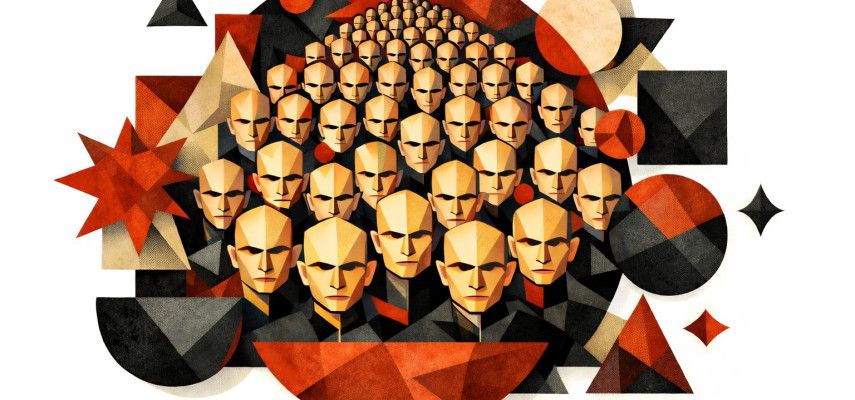
Social democrats and equality
There is some uncertainty regarding concepts such as equality and justice, which are considered among the demands of various democratic movements. Let us try to understand what equality and justice are, and what should be the demands of social democrats in practice.
From the motto “Liberty, Equality, Fraternity”, which was first voiced in Maximilien Robespierre’s speech on the organization of the National Guard1 (December 1790), one can conclude that the left and liberals, whose ideas largely stem from the ideas of the French Revolution, stand for equality. What is equality? According to the Ozhegov dictionary, this word has two non-mathematical meanings2. The first meaning is “complete similarity, likeness”. The second definition is: “the status of people in society ensuring their equal treatment under the law, equal political and civil rights, equal rights”. In English-language dictionaries, there is a divergence — for instance, Merriam-Webster provides a definition3 similar to the first meaning in Ozhegov, while the Cambridge Dictionary provides one similar to the second, concluding that equality is the right of people to have the same social status and to count on equal treatment4 (let us note that “the right to have the same social status” is not the same as simply “having the same social status”).
Progressive social democrats are cautious about these discrepancies and, as a rule, do not put forward the slogan of equality. After all, if the first definition is used, this word can be interpreted as a desire to make everyone identical — the same property, the same clothes, the same appearance, and so on. A significant part of this contradicts progressive values (which guide social democrats) — freedom, progress, and other important goals. Therefore, social democrats do not fight for equality, but for equal rights, comparable starting opportunities, and a fair distribution of wealth.
Economic equality
However, due to Robespierre’s not entirely successful wording and the motto formed under its influence, even many on the left perceive the demand for “equality” in a mathematical rather than a political sense and extrapolate it to many spheres of life, including property and income. However, economic equality is an unrealizable and unjust demand.
If people find themselves in a situation where everyone is equal, many experience irritation and resentment because the person who works with all their might does not receive worthy compensation for it. According to a study by the journal Nature, people strive not for equality, but for justice5, and prefer fair inequality to unfair equality. As the BBC notes, by trying to create a society without inequality in material status, we come into conflict with people’s ideas of justice, which can lead to the destabilization of that society6. Property equality conflicts with progressive values — progress and the fair distribution of capital. It deprives the economy of one of the important incentives for economic activity, and consequently, prevents the assurance of progress.
Since the 1980s, the position that has gained the most prominence is that the concept of “justice” should be used as the central base value, in contrast to or to clarify the concept of “equality”7.
Doctor of Law G. Komkova notes:
In Marxist-Leninist theory, two types of equality were distinguished: bourgeois (formal-legal equality of owners) and proletarian (the factual equality of a person in social and economic life). As a result of the victory of the socialist revolution, they believed, all forms of social inequality could be destroyed. However, the practice of socialist construction in the USSR and other countries of the socialist camp showed the erroneousness of this conclusion.
<…>
The main task of the social policy of the Soviet state was declared to be the process of bringing all classes and social groups of Soviet society closer together, the erasing of inter-class differences. In reality, everything was otherwise. In the Soviet era, the category of the elite (the nomenklatura), possessing special privileges, included persons holding staff positions in party bodies, as well as leaders of industrial enterprises, construction, transport, agriculture, defense, science, and culture8.
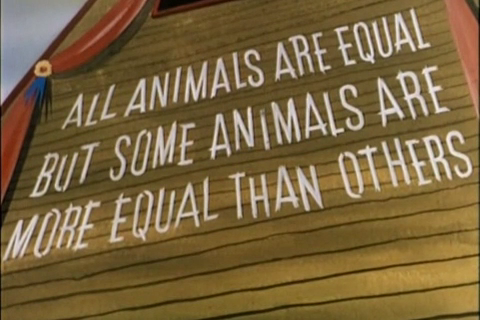
By virtue of the fact that people possess different aspirations and interests, a part of society is selfish and will always strive to ensure inequality, which the Soviet experiment demonstrated. At the same time, any attempt to remove egoism from human nature cannot end otherwise than with the construction of a totalitarian system (such systems showed, firstly, their non-viability, and secondly, their inability to solve the problem of inequality). Leontief Prize laureate John Kenneth Galbraith:
A fair society does not seek equality in the distribution of income. Equality is not consistent with human nature or the character and system of economic motivation. It is well known that people vary greatly in how much they want and know how to make money. At the same time, the source of that energy and initiative which serve as the driving force of a modern economy is partly not just the desire to have money, but the desire to surpass others in the process of earning it. <…> One thing is clear: a fair society must accept people as they are. However, this does not diminish the need for a clear understanding of the forces controlling the distribution of income, and the factors contributing to the formation of people’s attitudes toward related issues. Nor is there any reduction in the need for an understanding of how, from a purely practical point of view, a strategy for income distribution should be developed.
Firstly, there is no getting away from the fact that the modern market economy (according to terminology currently established) distributes material goods and income in a highly uneven manner, which not only causes negative social consequences but also interferes with its own normal functioning9.
Therefore, in the material sphere, social democrats stand for comparable starting opportunities, not “equality of outcomes”.
Legal equality
At the same time, social democrats stand for equal rights. What is this? The Universal Declaration of Human Rights states:
All are equal before the law and are entitled without any discrimination to equal protection of the law. All are entitled to equal protection against any discrimination in violation of this Declaration and against any incitement to such discrimination10.
This idea is also elaborated in Article 19 of the Constitution of the Russian Federation11:
- All are equal before the law and the court.
- The state guarantees the equality of rights and freedoms of man and citizen, regardless of sex, race, nationality, language, origin, property and official status, place of residence, attitude to religion, convictions, membership in public associations, as well as other circumstances. Any forms of limitation of the rights of citizens on the grounds of social, racial, national, linguistic, or religious affiliation are prohibited.
- Man and woman have equal rights and freedoms and equal opportunities for their realization.
In general, one can say that equality of rights is fully realized where a person with the highest social status, in the event of committing a crime, will be judged with the same severity as a person with the lowest social status (this is the highest degree of implementation of the rule of law). Countries with a high degree of realization of the rule of law exist — for instance, in 2020 in Israel, the sitting Prime Minister Benjamin Netanyahu found himself in the dock12, in the USA in 1974 the sitting President Richard Nixon was a defendant in court13, and in 1999 the sitting President Bill Clinton was fined more than 90 thousand dollars for giving false testimony14.
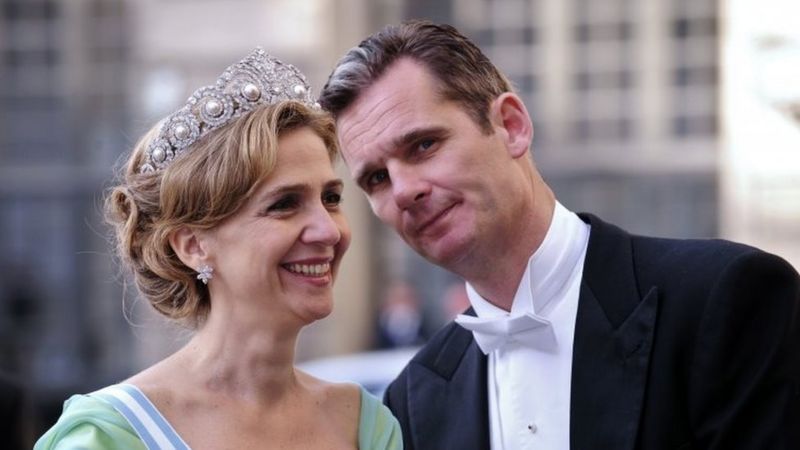
Legal equality is flawless from a moral point of view. If you ask people if they agree to be punished for, say, theft, while their neighbor is not, the vast majority will say they do not agree (if someone does agree, they can then be robbed without hindrance). By this, they express their agreement with the principle of legal equality and the rule of law.
It is also correct from the point of view of ensuring economic efficiency. As we already noted in the article on the causes of the wealth of countries, the rule of law and equal rights are among such causes. This is logical, as the impunity of elites (to which a low level of the rule of law leads) creates an increase in corruption and an increase in violations of the law by its representatives.
Justice
What is justice? According to the Great Russian Encyclopedia, it is “a general moral sanction of the joint life of people, considered predominantly from the angle of view of colliding desires, interests, and obligations”15. Many dictionaries provide a rather vague definition like “fair treatment of something”. We can assume that justice is the distribution of public goods (both material and intangible) and interactions in a manner that does not cause objections from the majority of people and does not contradict fundamental human rights.
In his “A Theory of Justice”, John Rawls formulates two principles of justice. The first principle is that “each person is to have an equal right to the most extensive basic liberty compatible with a similar liberty for others”16. The second principle states:
Social and economic inequalities are to be arranged so that they are both (a) to the greatest benefit of the least advantaged… and (b) attached to offices and positions open to all under conditions of fair equality of opportunity17.
Thus, Rawls’s theory implies that justice entails equal rights and comparable starting opportunities, but not absolute equality. The textbook “Foundations of Social Democracy” divides justice into justice according to labor and justice according to need18. Justice according to labor consists of the simple truth that whoever has worked more, or whose work is more valuable, should receive greater benefit from their work. However, the authors of the textbook also ask the question: “is the contribution of the chairman of the board of a firm to its economic success really so much greater than the contribution of a worker on the assembly line? Does a stock analyst really work more effectively than a nurse?”19 It is practically impossible to determine this, however, one can control that this discrepancy is not so strong as to conflict with general notions of justice, and simultaneously not so weak as to conflict with mechanisms of motivation.
Regarding justice according to need, “in this case, the criterion is what benefits different people should receive based on their social position. For example, a sick person needs a certain level of care. A healthy person cannot claim such care because such a need is absent in them or their need is not recognized by society. Most social services in accordance with the Code of Social Law are oriented toward justice according to need”20. All these factors exert influence on the social democrats’ understanding of justice.
The threat of high inequality
Speaking about the impossibility of economic equality, we simultaneously imply that inequality requires a reasonable balance that does not conflict with public perceptions of justice, as we noted above. After all, if a person performing organizational work (even if very efficient and important) receives hundreds of times more income than a conscientious worker or engineer, it will be justifiably perceived by the latter as an injustice, and manifestations of this injustice — for example, in the form of ostentatious luxury in lifestyle — will only strengthen this perception and lead to social tension and a lower level of happiness. As a Levada Center study showed, in 2015, 60% of Russians believed that income inequality is permissible only if the gap is not too large, and 28% stated that any inequality is harmful21. At the same time, 70% believe that it is impossible to honestly earn millions in Russia under the current system, which points to the perception of high inequality as an injustice.
High inequality also carries a danger for democracy. It is known that mass media strongly influence public sentiment and election outcomes. We also wrote about this in the article on press freedom. Media tell people how to think, how to vote, and what to do.
If there are people in a country with large surpluses of capital, they have the ability to create media outlets, finance parties, and hire people for political work — and, consequently, demand that they carry out certain actions. Thus, it turns out that this entire mass of politically active people expresses and transmits the will of one person, and this conflicts with the principles of democracy — after all, it turns out that one vote and one opinion are worth much more than the vote and opinion of an ordinary voter. Moreover, the concentration of resources in the hands of one person facilitates the processes of them seizing power and establishing a dictatorship. Therefore, high inequality contains an additional threat to democracy.
As we recall, many attribute the lobbying and advancement of Vladimir Putin to oligarch Boris Berezovsky — for instance, the well-known politician Boris Nemtsov noted that it was Berezovsky who “brought Putin to power, gave money to Putin, and provided information resources”22, and Lenta.ru wrote in 2000 that it was Berezovsky who “chose Putin as president”23. And Berezovsky himself said in Alexander Gentelev’s documentary “Oligarchs” that he “was one of those who suggested to Putin that he make the decision to become the president of Russia.” This is one example of how high inequality and large resources in the hands of separate individuals lead to the power of an authoritarian ruler.
The role of large German capital in the advancement of the NSDAP is also significant — for example, Elena Rzhevskaya, who participated in the identification of the bodies of Adolf Hitler and Joseph Goebbels, wrote that Hitler was “actively financed by industrial circles where Goering had firm ties. Without these funds, it would have been impossible to carry out all that which contributed to the growth of the movement and the strengthening of the party — these expensive election campaigns, the maintenance of paramilitary detachments, technically armed propaganda, the ‘Brown House’ in Munich, Hitler’s country residence in the mountains in Berchtesgaden, generous support for party functionaries by Hitler, and so on”24. The Encyclopedia of the Third Reich reports that Hjalmar Schacht played a significant role in financing Hitler’s campaigns25. It is very difficult for the broad masses of citizens to organize fundraising to create a counterweight to such campaigns. While the concentration of capital creates the opportunity to promote and bring to power a political force that expresses the interests of the few.
With a high level of inequality, relative poverty is created, even if in absolute terms the poverty level is decreasing and there is overall income growth. Cambridge University professor Ha-Joon Chang notes:
Today in rich countries, such as the US or Germany, few people suffer from absolute poverty. But we still talk about poverty in these countries because every society has certain standards of consumption that are considered necessary to maintain “decency”. This point of view dates back to the days of Adam Smith, who argued that things become necessities when society believes that “it would be disreputable for a creditable person, even of the lowest order, to be without them”. Thus, in a famous example, he said that a linen shirt “is not, strictly speaking, a necessary of life”, but “at present, in the greater part of Europe, a creditable day-labourer would be ashamed to appear in public without a linen shirt, the want of which would be supposed to denote that disgraceful degree of poverty”.
This conception of poverty is known as relative poverty… Defined in this way, relative poverty is inextricably linked to inequality. It is quite possible that a country, if it is rich enough, will not have absolute poverty, even if it has a very high level of inequality. However, in such a country, the level of relative poverty will be high26.
Some researchers, for example, Professor of Sociology Jan Delhey from the School of Humanities and Social Sciences at Jacobs University (Bremen, Germany), note that in societies with a low level of economic inequality, people feel more prosperous and happier27. There are several explanations for their aversion to inequality: this includes the associated growth of mutual distrust, increasing anxiety regarding one’s economic status, and concerns about brewing social conflicts. Severe inequality hinders the development of a sense of community — a feeling that citizens share similar values. This reduces mutual trust. Another connecting link may be the anxiety people feel, increasing with inequality, about their failure to meet the “social ideal” accepted in society. This negatively affects their self-confidence, sense of dignity, and self-esteem.
Finally, high inequality narrows the range of consumers of goods and services, ultimately hindering economic growth. For example, in 2017, IMF head Christine Lagarde stated that wealth disparity is one of the main brakes on international economic growth28. This is also confirmed by other IMF experts29. Many media outlets, such as Forbes30 or Business Insider31, note that the middle class is disappearing, which means the future generation will not have the opportunities that previous generations had. High inequality can indicate, for example, the unavailability of credit resources for the masses and fewer opportunities for investment in education and entrepreneurial activity. In conditions where the majority of citizens do not have enough capital to start an effective business, and a minority has enough to not worry about the efficiency of the business they are opening (less competition, more attempts), the competition is not won by the most efficient, but by the one who possesses comfortable starting conditions, and they can afford to be inefficient.
The well-known magazine The Economist wrote that inequality can hinder economic growth32 if, for example, the least affluent segments of society face difficulties in investing in education. It can threaten the level of public trust in policies to stimulate economic growth and lead to economic or financial instability. Prominent economists, such as Ben Bernanke and Larry Summers, argue that inequality may also contribute to a “savings glut” in the world, because the rich are less likely to spend an additional dollar than the poor. As savings accumulate, interest rates fall, raising asset prices and making it harder for central banks to manage the economy.
All the above-mentioned reasons oblige social democrats to fight against the growth of inequality, as well as against high inequality in principle.
Conclusion
In the article on tolerance and freedom, we explained that social democrats stand for freedom, and its implementation should not conflict with other progressive values. This same principle is applicable to equality — it is a goal only to the extent that it does not conflict with this very same list of values. We can and must demand the reduction of inequality in a society that is far removed from our notions of justice, however, we cannot demand a reduction of inequality so extreme that it poses a threat to progress. Therefore, the social-democratic demand for justice implies, rather, equal rights, the provision of comparable starting opportunities, and fair distribution.
- France in the United States / Embassy of France in Washington, D.C. // France in the United States (franceintheus.org). [Electronic resource]. URL: https://franceintheus.org/spip.php?article620 (accessed: 15.10.2020).
- S.I. Ozhegov, N.Yu. Shvedova. Explanatory Dictionary of the Russian Language: 80,000 words and phraseological expressions / Russian Academy of Sciences. Institute of the Russian Language named after V.V. Vinogradov. – 4th ed., supplemented. – 944 p. – Moscow: OOO “A TEMP”, 2006. – p. 638.
- Equality // Merriam-Webster (www.merriam-webster.com). [Electronic resource]. URL: https://www.merriam-webster.com/dictionary/equality (accessed: 15.10.2020).
- Equality // Cambridge Dictionary (dictionary.cambridge.org). [Electronic resource]. URL: https://dictionary.cambridge.org/dictionary/english/equality (accessed: 15.10.2020).
- Christina Starmans, Mark Sheskin, Paul Bloom. Why people prefer unequal societies // Nature (www.nature.com). April 7, 2017. [Electronic resource]. URL: https://www.nature.com/articles/s41562-017-0082.epdf (accessed: 15.10.2020).
- Bryan Lufkin. Fighting inequality. Are you sure it’s needed? // BBC News (www.bbc.com). July 11, 2017. [Electronic resource]. URL: https://www.bbc.com/russian/vert-fut-40558087 (accessed: 15.10.2020).
- Tobias Gombert, Julia Blesius, Christian Krell, Martin Timpe. Foundations of Social Democracy – p. 19. // Friedrich-Ebert-Stiftung (www.fes.de). [Electronic resource]. URL: https://library.fes.de/pdf-files/akademie/07650.pdf (accessed: 14.10.2020).
- G.N. Komkova. The concept of equality and inequality in Russian constitutional law [Text] // Leningrad Law Journal. – 2012. – No. 3. – p. 16-17.
- John Kenneth Galbraith. The Good Society. The Humane Agenda. – Boston, New York: Houghton Mifflin Company. – p. 59-60.
- Office of the Commissioner for Human Rights in the Russian Federation. Universal Declaration of Human Rights. – 40 p. – Moscow: Prospekt, 2019. – p. 8.
- Chapter 2. Rights and Freedoms of Man and Citizen // Constitution of the Russian Federation (www.constitution.ru). [Electronic resource]. URL: http://www.constitution.ru/10003000/10003000-4.htm (accessed: 15.10.2020).
- Marianna Belenkaya. Israel puts its own Prime Minister on trial // Kommersant (www.kommersant.ru). May 25, 2020. [Electronic resource]. URL: https://www.kommersant.ru/doc/4355748 (accessed: 15.10.2020).
- United States v. Nixon // Oyez (www.oyez.org). [Electronic resource]. URL: https://www.oyez.org/cases/1973/73-1766 (accessed: 15.10.2020).
- Robert L. Jackson. Clinton Fined $90,686 for Lying in Paula Jones Case // Los Angeles Times (www.latimes.com). July 30, 1999, 12:00. [Electronic resource]. URL: https://www.latimes.com/archives/la-xpm-1999-jul-30-mn-61021-story.html (accessed: 15.10.2020).
- A.A. Guseinov. Justice // Great Russian Encyclopedia. Volume 31. Moscow, 2016, pp. 98-99. [Electronic resource]. URL: https://bigenc.ru/philosophy/text/4160605 (accessed: 15.10.2020).
- John Rawls. A Theory of Justice. – 2nd ed. – Harvard University Press, 1999. – p. 266.
- Ibid., p. 266.
- Tobias Gombert, Julia Blesius, Christian Krell, Martin Timpe. Foundations of Social Democracy – pp. 32-33. // Friedrich-Ebert-Stiftung (www.fes.de). [Electronic resource]. URL: https://library.fes.de/pdf-files/akademie/07650.pdf (accessed: 14.10.2020).
- Ibid.
- Ibid.
- Inequality and incomes // Levada Center (www.levada.ru). July 14, 2015. [Electronic resource]. URL: https://www.levada.ru/2015/07/14/neravenstvo-i-dohody/ (accessed: 15.10.2020).
- Berezovsky: intellectual and manipulator // BBC News (www.bbc.com). March 24, 2013. [Electronic resource]. URL: https://www.bbc.com/russian/russia/2013/03/130324_berezovsky_death_reaction (accessed: 15.10.2020).
- Berezovsky regrets choosing Putin as president for the first time // Lenta.ru (lenta.ru). November 28, 2000, 15:36. [Electronic resource]. URL: https://lenta.ru/news/2000/11/28/berezovsky (accessed: 15.10.2020).
- E.M. Rzhevskaya. Goebbels. Portrait against the background of a diary. – 400 p. – Moscow: AST-PRESS KNIGA, 2004. – p. 115.
- S. Voropaev, A. Egazarov. Encyclopedia of the Third Reich. – 587 p. – Moscow: LOKID-MIF, 1996. – p. 517.
- Ha-Joon Chang. Economics: The User’s Guide / Ha-Joon Chang. – 322 p. – Moscow: Mann, Ivanov and Ferber, 2015. – p. 221.
- Social inequality makes people unhappy // IQ Scientific and Educational Portal (iq.hse.ru). May 28, 2014. [Electronic resource]. URL: https://iq.hse.ru/news/177667430.html (accessed: 20.08.2023).
- Middle-class crisis: what to do about wealth inequality? // BBC News (www.bbc.com). January 18, 2017. [Electronic resource]. URL: https://www.bbc.com/russian/features-38669074 (accessed: 15.10.2020).
- Vladislav Grinkevich. High inequality hinders economic growth // IQ Scientific and Educational Portal (iq.hse.ru). March 17, 2014. [Electronic resource]. URL: https://iq.hse.ru/news/177667995.html (accessed: 15.10.2020).
- Patrick W. Watson. The Middle Class Might Nearly Disappear In The Next Decade // Forbes (www.forbes.com). March 8, 2018, 14:06. [Electronic resource]. URL: https://www.forbes.com/sites/patrickwwatson/2018/03/08/the-middle-class-might-nearly-disappear-in-the-next-decade/#961fb53251e9 (accessed: 15.10.2020).
- Hillary Hoffower. The middle class is disappearing in countries around the world, and it means millennials won’t have the same opportunities their parents did // Business Insider (www.businessinsider.com). April 12, 2019, 16:55. [Electronic resource]. URL: https://www.businessinsider.com/personal-finance/middle-class-disappearing-among-millennials-oecd-2019-4 (accessed: 15.10.2020).
- How inequality affects growth // The Economist (www.economist.com). June 15, 2015. [Electronic resource]. URL: https://www.economist.com/the-economist-explains/2015/06/15/how-inequality-affects-growth (accessed: 20.08.2023).