Tolerance and social democracy
Sometimes social democrats are told that since they do not accept the oppression of different races, nationalities, or sexual orientations, they must therefore show tolerance toward supporters of dictatorship. Is this really the case?
Let us first consider what the term “tolerance” means in its dictionary sense. Efremova’s Explanatory Dictionary provides the following definition: “Indulgent forbearance toward someone or something (a different opinion, a different belief, etc.) as a mandatory condition for political pluralism”1. Dictionary.com interprets this term as “a fair, objective, and permissive attitude toward those whose opinions, beliefs, practices, racial or ethnic origins, etc., differ from one’s own”2. Thus, in common parlance, tolerance is a term used to describe collective and individual behavior consisting of not persecuting those whose way of thinking or actions does not coincide with one’s own. However, as we can see, Dictionary.com prefers to use the concept of a “fair attitude” instead of “not persecuting”. Let us try to understand what fairness means in this case.
Contents
What practice says
Are there states where the principle of non-persecution for a different opinion is implemented? If we take, for example, the United Kingdom, there is a list of organizations where membership or declaring oneself a member is a crime punishable by imprisonment of up to 10 years3. The list of organizations is quite extensive. In Germany, there are strict restrictions on Nazi ideology — for instance, they are expressed in paragraphs 86 and 86a of the German Criminal Code, which prohibit the distribution of propaganda materials of unconstitutional organizations, the use of Nazi symbols, uniforms, slogans, and forms of greeting4. In 1952, the Socialist Reich Party was banned in the country, and in 1956, the Communist Party was banned5. Do such strict restrictions against totalitarian organizations make Germany a less free country? In The Economist’s index of the most democratic countries for 2007, it ranked 13th in the world6. In the 2020 World Press Freedom Index, it ranked 11th in the world7. That is, it outperforms the USA, France, or the UK in rankings. Here, it is more correct to ask the question differently — do strict restrictions on totalitarian organizations make Germany a more free country? Because we can state that they certainly do not make it an unfree one.
Next, let us take Sweden, which ranks 3rd in the Democracy Index and 12th in the World Press Freedom Index. In this country, hate speech, namely the dissemination of threats and disrespectful statements directed against a group of people united by race, skin color, national or ethnic origin, belief, sexual orientation, or gender identity, is a criminal offense punishable by a fine or imprisonment for up to two years (up to four years in aggravating circumstances)8. Norway occupies the top spots in both freedom indices. Almost all manifestations of Nazism and neo-Nazism are described in the country’s Criminal Code (as amended in 2005, paragraphs 77, 135a, 185, 186) and are prosecuted under the law as “hate speech” or “discrimination” based on race, national, ethnic, or religious affiliation, gender/sexual orientation, and also serve as aggravating circumstances. This also applies to cases of using Nazi symbols, which is viewed as a “manifestation of hatred”, punishable by a fine or a prison sentence of up to 3 years9. The law states: “Any person who intentionally or by gross negligence publicly makes a discriminatory or hateful statement is liable to a fine or to imprisonment for a term not exceeding three years”10. Also, after World War II, a struggle was waged in the country against collaborators led by Vidkun Quisling; the “National Unity” party was banned, and Quisling himself was executed11.
Thus, we see that even in the freest states, there is no absolute freedom to do whatever one wants (including suppressing the freedom of others). This is the first conclusion. The second conclusion is that the prohibition and persecution of misanthropic ideologies do not hinder the level of freedom of speech and democracy in a country.
What is the essence of tolerance and freedom of speech
Why do the aforementioned countries have such restrictions? If we consider tolerance and freedom in their primitive understanding — in the sense that any statements and any way of thinking are permitted — then it turns out that it is permitted to call for the murder of people, and it is permitted to kill and rape. This means that the promotion of racial hatred, the promotion of repression, torture, and non-compliance with the law are permitted. That is, freedom in its primitive understanding can lead to murders and violence, which makes it harmful. But when we talk about freedom and tolerance, we should not mean tolerance toward, for example, murderers and rapists.
The paradox of freedom without restrictions is that it implies freedom for the suppression of freedom. Therefore, the concept of freedom without restrictions is unviable, and the question of what kind of restrictions should exist to ensure that the level of freedom is as high as possible and remains so is always on the agenda.
In politics, another definition is used. Liberty, as defined by the Declaration of the Rights of Man and of the Citizen, consists in the ability to do everything that does not harm another12. Only for such freedom and tolerance do social democrats advocate. Such freedom means that people who cause harm to another or are members of organizations that preach ideas that cause such harm do not fall under the requirement to ensure freedom. Another well-known principle logically follows from this principle: “No freedom for the enemies of freedom”. It consists of the following: those who advocate for freedom and human rights enjoy them, while those who advocate against freedom and human rights are deprived of them; thus, everyone receives what they wish, and herein lies true democracy and the expression of the wishes of every citizen.
But what harm is meant, and who are the enemies of freedom? By harm, we mean physical violence and coercion. This cannot include harm that a person has the opportunity to avoid. By enemies of freedom, we should understand totalitarian movements, supporters of dictatorship, and tyranny. Examining the paradox of tolerance will help to understand this in more detail.
The paradox of tolerance
When the concepts of permissiveness, freedom, and tolerance are applied in a primitive, broad sense, they inevitably lead to logical paradoxes. An example of a paradox is the liar paradox, where a person says, “I am always lying”. If this statement is true, then it turns out that he is lying, and therefore the statement is false. And if it is false, then it turns out that he is not lying, and therefore the statement is true. And thus, a vicious circle is created. A slightly different but similar principle of paradox applies to freedom — if we allow freedom, we also allow the suppression of freedom; accordingly, by allowing freedom, we create the opportunity to destroy freedom. Here is how Karl Popper, one of the most influential philosophers of science of the 20th century, explained this when describing Plato’s “paradox of freedom”:
Plato suggests that a free man may use his absolute freedom to trample first on the laws, then on freedom itself, by demanding the power of a tyrant. And this is a possibility not from the realm of fantasy — it has happened many times. Whenever this has happened, the intellectual positions of democrats who chose the principle of majority rule or another similar principle of sovereignty as the ultimate foundation of their political credo proved to be unstable. On the one hand, the principle they adopt requires them to oppose any rule other than majority rule and, consequently, to stand against a new tyranny. On the other hand, in accordance with the same principle, they should accept any decision reached by the majority, i.e., support a new tyrant13.
<…>
The so-called paradox of freedom shows that freedom in the sense of the absence of any limiting control must lead to a significant restriction of it, as it gives a bully the opportunity to enslave the meek. This idea was expressed very clearly by Plato, although somewhat differently and with entirely different goals.
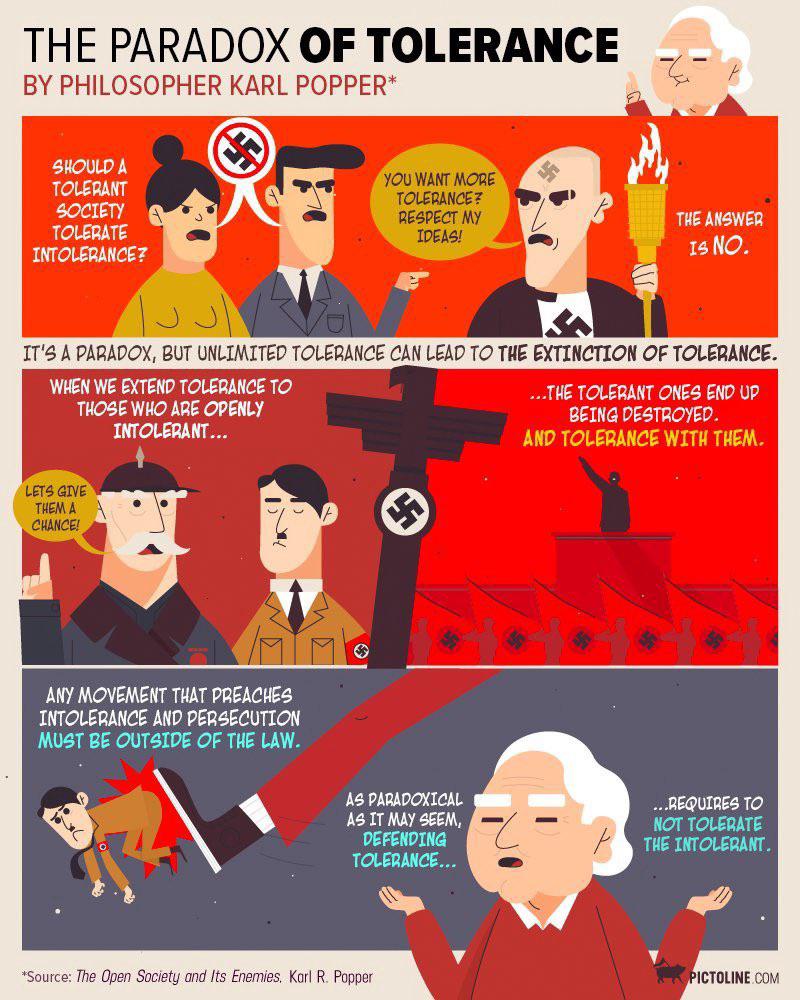
Less known is the paradox of tolerance: unlimited tolerance must lead to the disappearance of tolerance. If we are limitlessly tolerant even to the intolerant, if we are not prepared to defend a tolerant society against the onslaught of the intolerant, then the tolerant will be destroyed. This formulation does not imply, for instance, that we should always suppress the utterance of intolerant philosophies. As long as we can counter them by rational argument and keep them in check by public opinion, suppression would certainly not be the wisest action. But we should claim the right to suppress them if necessary even by force: for it may well turn out that they are not prepared to meet us on the level of rational argument and will begin by rejecting all argument. Perhaps they will forbid their followers to listen to rational arguments and will claim that these arguments are deceptive and that fists and pistols must be used to answer them. Therefore, in the name of tolerance, we should claim the right not to be tolerant of the intolerant. We should declare all movements that preach intolerance outside the law, and we should consider incitement to intolerance and persecution as a criminal offense, just as we consider incitement to murder, kidnapping, or the revival of the slave trade as a criminal offense14.
“How are we any different from them then?”
People who ask such a question have, in all likelihood, not even attempted to answer it for themselves. Because the differences are radical. Social democrats demand only the struggle against totalitarian ideologies, without infringing upon political diversity and the rights of democratic ideologies. They advocate for real political competition. Totalitarian ideologies advocate for the destruction of people, for a one-party system and dictatorship, while social democrats advocate against the destruction of people, against a one-party system and dictatorship. Those who claim that there are no differences between these positions are either deceivers or the deceived.
Another side of the question is that social democrats advocate against terror and the death penalty, therefore, intolerance toward supporters of totalitarian ideologies is not the same thing as their destruction. It is rather the aspiration to do everything possible to maximally limit their ability to speak out.
Supporters of totalitarian sects and movements also use similar demagoguery: what kind of democrats are you if you ban us? Just as any criminal can ask the question: what kind of freedom do you have if you ban me? However, democracy is not permissiveness. In this article, we provided a definition of democracy, and the banning of authoritarian movements does not negate democracy in any way.
In the end, if supporters of misanthropic ideas demand freedom of speech for themselves, the answer can only be that freedom consists of the ability to do everything that does not harm another. That is to say, there can be no freedom for the propaganda of misanthropic ideas. And tolerance and freedom of speech can only operate in relation to those people who do not call for actions that cause harm to other people.
- T.F. Efremova. New Dictionary of the Russian Language. Explanatory-derivational. – Moscow: Russkiy Yazyk, 2000
- Tolerance // Dictionary.com (www.dictionary.com). [Electronic resource]. URL: https://www.dictionary.com/browse/tolerance (accessed: 24.05.2020).
- Proscribed terrorist organisations // Gov.uk (www.gov.uk). 28 February 2020. URL: https://assets.publishing.service.gov.uk/government/uploads/system/uploads/attachment_data/file/869496/20200228_Proscription.pdf (accessed: 24.05.2020).
- German Criminal Code (Strafgesetzbuch – StGB) // Gesetze im Internet (www.gesetze-im-internet.de). 19 June 2019. [Electronic resource]. URL: https://www.gesetze-im-internet.de/englisch_stgb/ (accessed: 24.05.2020).
- In Germany, an attempt is being made for the second time to ban a neo-Nazi party // TASS (tass.ru). March 1, 2016, 14:10. [Electronic resource]. URL: https://tass.ru/mezhdunarodnaya-panorama/2707857 (accessed: 24.05.2020).
- Laza Kekic. The Economist Intelligence Unit’s index of democracy // The Economist (www.economist.com). 2007. [Electronic resource]. URL: https://www.economist.com/media/pdf/democracy_index_2007_v3.pdf (accessed: 24.05.2020).
- 2020 World press freedom index // Reporters without borders (rsf.org). [Electronic resource]. URL: https://rsf.org/en/ranking_table (accessed: 24.05.2020).
- Elin Hofverberg. Limits on Freedom of Expression: Sweden // The Library of Congress (www.loc.gov). June 2019. [Electronic resource]. URL: https://www.loc.gov/law/help/freedom-expression/sweden.php (accessed: 24.05.2020).
- On the situation with the glorification of Nazism, the spread of neo-Nazism, and other types of practices that contribute to the escalation of modern forms of racism, racial discrimination, xenophobia, and related intolerance // Ministry of Foreign Affairs of the Russian Federation (www.mid.ru). May 6, 2019, 9:30. [Electronic resource]. URL: https://www.mid.ru/ru/foreign_policy/humanitarian_cooperation/-/asset_publisher/bB3NYd16mBFC/content/id/3193903 (accessed: 24.05.2020).
- The Anti-Discrimination Act // Government.no (www.regjeringen.no). September 26, 2005. [Electronic resource]. URL: https://www.regjeringen.no/en/dokumenter/the-anti-discrimination-act/id420606/ (accessed: 24.05.2020).
- V.V. Roginsky. Quisling // Great Russian Encyclopedia. Volume 13. Moscow, 2009, p. 497
- F.F. Kokoshkin. Texts of the most important fundamental laws of foreign states. Part 1. – 117 p. – Moscow: Publishing house of M. and S. Sabashnikov, 1905. – p. 28.
- K.R. Popper. The Open Society and Its Enemies. Vol. 1: The Spell of Plato. – 448 p. – Moscow: Phoenix, International Foundation “Cultural Initiative”, 1992. – p. 163.
- Ibid., pp. 328-329.