
How to achieve economic growth
The two most important economic questions that the left poses to itself are, first, how to ensure economic growth for a country, and second, how to ensure that social inequality is reduced in the process. We will examine the first question in this article.
The reader will have to decide for himself whether he wants simple or useful answers to his questions – here, as in other economic affairs, answers are not simultaneously both simple and useful.
The well-known researcher Erik Reinert, in his economic bestseller “How Rich Countries Got Rich… and Why Poor Countries Stay Poor” (recognized by the World Economics Association as one of the fifty most influential books on economics over a hundred years1), notes that the “Washington Consensus” as well as the IMF and World Bank strategy, which promoted the concept of state non-interference, free market, and freedom of international trade, have suffered an absolute failure – instead of achieving a reduction in the wealth gap between countries, they have increased it.
The difference in standard of living between rich and poor countries 250 years ago was about 1 to 2. Today, the World Bank statistics show that a bus driver in Germany gets a real wage which is 16 times that of his colleague in Nigeria2.
We could see from a vast number of examples that the recommendations of the “Washington Consensus”, and consequently the concept of the free market, do not help third-world countries achieve development. For these countries, the free market concept turns out to be useless and even harmful.
The Washington Consensus was formulated by the English economist John Williamson in 1989 as a set of economic policy rules for Latin American countries. It expressed the mindsets of influential conservative officials in the American administration and international organizations (primarily focusing on an open economy and free-market capitalism), for whom they served as a policy tool, and this, in turn, ensured its public resonance. The idea was that without adopting such rules, it was difficult for countries to count on a favorable reception in Washington, and therefore on new loans, restructuring of old debts, or foreign investment3. Williamson himself as early as 1997 called the doctrines of Friedrich Hayek and Milton Friedman “quixotic”4. In 1994, the policy of following the recommendations of the consensus led to a crisis in Mexico, which allowed Paul Krugman to argue that the consensus bubble had begun to deflate5. A group of prominent American economists – Nobel laureates – also criticized shock therapy6. While countries that followed free market recommendations suffered crises and poverty (from the wave of crises in Asia in 1997 to the crisis in Argentina in 2001-2002), the economies of India and China, which ignored the consensus, grew.
However, the harm of the free market to economic development was obvious as far back as the 18th century, when the Italian economist Antonio Genovesi wrote: “there are those who by freedom of trade understand two things: an absolute freedom of manufacturers to produce wares, without any restriction on size, weight, form, colors, etc., and a no less absolute freedom of merchants to distribute, export and import whatever they please, without restrictions, without excises, without tariffs, without customs duties. But such freedom exists nowhere on Earth, it is found perhaps only on the Moon; and it is especially rare in countries that understand trade better than others”7.
We also examined the problems of the free market in a separate article. The story of the Washington Consensus showed that overcoming a country’s poverty and achieving significant economic growth is possible only with competent state policy and state intervention in the market. Let us look into what kind of intervention this should be, because not every intervention will be useful – there are plenty of types of intervention that will be disastrous. At the same time, we must immediately realize that economic growth is not the primary goal, but is merely an auxiliary tool for achieving well-being.
Contents
Creation of inclusive institutions
In the article on why some countries are rich and others are poor (based on the research of Daron Acemoglu and James Robinson, already known to our reader), we have already analyzed that the main reason lies in institutions. The creation of inclusive institutions and the elimination of extractive ones is a necessary base, a foundation for economic growth. On this foundation, one can already build the structure of an efficient economy. More complete information can be found in the article on institutions, while here we will only list the main actions to ensure economic growth.
Removal of past elites from power. If power has not changed in a country for a long time and it remains poor, it is always a consequence of the work of the country’s political and economic elites. Accordingly, if they remain at the helm of political and economic power, they will reproduce the practices that led to this poverty. For example, in Russia, the nomenclature, which was not removed from power in the 90s, began to reproduce the practices of backroom decision-making, using their political connections to seize power in politics and economics. Therefore, the managerial layer of the state apparatus must be replaced completely or almost completely. As Acemoglu and Robinson note, “a political regime change is the key to escaping poverty and, ultimately, the key to prosperity”8 and “the United Kingdom is richer than Egypt today because in 1688 (or 1688 to be exact, in England), there was a revolution that transformed the politics and then the economics of the nation”9. They also cite the example of Deng Xiaoping, whose group carried out a radical replacement of personnel in the Communist Party of China, and only after that did economic growth become possible. We propose to resolve this issue through a change of power and subsequent nomenclature lustration.
Creating a strong state, yet subordinated to the entire mass of citizens. Economically, the state is needed primarily to guarantee law enforcement and the rule of law, as well as to collect taxes and distribute them in a way that ensures economic growth. A weak state will not be able to curb crime (including organized crime, as we could see for ourselves from the example of the 1990s in Russia) and force big capital to pay taxes. That is, a state is required that is stronger than any of the existing groups in society and can subdue any group if it infringes upon the interests of others (this requires a certain centralization, i.e., a guarantee of the execution of government decisions – for example, if the government decides to introduce a progressive tax, the tax apparatus must start collecting it, and from everyone who falls under it, without exception). Here we examined most of the reasons why the state is necessary for society. But at the same time, an excessively “strong” state leads to the formation of a nomenclature and its suppression of the other classes of society. Therefore, it is also necessary to create counterweights that are ready, if necessary, to suppress this state and ensure its accountability (for example, to organize protests that will lead to the resignation of the government). These counterweights are, first of all, a strong opposition and trade unions. Erik Reinert notes: “economic growth requires a balance of countervailing powers between business and labor. A key element in creating wealth after 1848 was the power of the labor unions, which secured what we call a collusive spread of economic growth: the inhabitants of rich nations became rich by choosing to take out increased productivity in the form of higher wages rather than in the form of lower prices, as would have happened under perfect competition”10. In addition to opposition forces, these are other democratic institutions – for example, rotation of power, freedom of the press, the fight against corruption, and so on.
Providing incentives to create goods, services, and innovations. Most often, a person works or invents something to get money, and usually gets money to purchase something with it (there are also those who work for free, but let’s face the truth and say that there are far fewer of them). Thus, a social-democratic economy must provide guarantees for private property (here we explained why), the opportunity to get rich (this is not about excessive stratification, where a capitalist is hundreds of times richer than a worker, but about the fact that one who brings greater social utility should have greater material opportunities than one who brings less social utility), and confidence in the future (that is, to ensure confidence that a dictator, Marxists, or Nazis will not come tomorrow and carry out a redistribution of property – if there is a real threat of this, the incentives to work are lower). If we talk, for instance, about innovation, then in any society where the innovative sphere was the most developed, there was a very strong patent law. According to Acemoglu and Robinson, “new technologies are not the only engine of prosperity, but they are perhaps the most important one”11. They also note that “an economy based on forced labor, slavery, or serfdom almost always resists innovation”12. That is precisely why it must be based on material incentives.
Creating conditions for the production of goods, services, and innovations. Providing incentives is not enough. If you come to the desert to the Bedouins and say that they can get rich if they produce software – perhaps they will be interested in this, but this does not mean that, with all their desire, they will be able to produce any worthwhile software in the foreseeable future. In an economy, the appropriate conditions must first be created. In this case, we mean such conditions as the rule of law, reasonable laws, improvement of the standard of living and reduction of social inequality, circulation of elites (without it, the aforementioned opportunity to get rich disappears in practice), loyal lending, quality education, and so forth.
Equal rights for citizens. If some part of citizens is infringed upon in their rights, they are less likely to be able to provide competitive personnel, and then where there could have been, for example, 10 important inventors, we will get only 9. And if there are many disadvantaged groups, we might even get only 1 inventor or get none at all. This means that, all other things being equal, our economy will lose to those economies where equal rights for citizens are ensured.
Protection of competition, measures to combat the concentration of capital and power. Competition can be effective only where comparable forces compete. Where monopolies and oligopolies exist, the chances of new players are knowingly losing against their backdrop, and the monopolist reduces the quality of their services (an example is Yandex, which, in the absence of competitors, tests as many as 5 ad blocks before the organic search results13). Therefore, to create effective competition – both economic and political – social democrats must take measures to combat the concentration of capital and power.
An effective tax system. Taxes are one of the most important sources for financing state policies, including economic ones. Therefore, it is important to organize the tax system in such a way that every citizen pays taxes in accordance with the law. With an effective tax system and a capable state, even the collection of a progressive tax is not a problem.
The fortunate fact that taxes play a dual role – replenishing the treasury and helping to build industry – has for centuries been an extremely important factor in development. It was used by the United States, and it continues to be used now by many (especially small) countries14.
What are increasing and diminishing returns?
Before we move on to the issues of state regulation of the economy, we should explain that different sectors of the economy affect its development as a whole in different ways. Many people probably intuitively understand that resource-based and agricultural countries are usually poorer than those with a developed industry. The explanation for this lies in the concepts of increasing and diminishing returns.
The phenomenon of increasing returns consists in the fact that a number of sectors of economic activity are characterized by a decrease in unit costs of produced goods as the volume of production increases under unchanged technology15. Reinert gives the example of software – creating the first software disc can cost several million dollars, whereas creating all subsequent ones costs a few cents. Usually, industrial manufacturing is characterized by increasing returns, since the more mass-produced a product is, the cheaper, as a rule, the cost price of each of its units becomes. Reinert describes diminishing returns as follows:
Imagine now that a country (Norway, for instance) is better suited to grow carrots than the rest of the world. After the best agricultural lands of the country have been put into carrots, more and more marginal land has to be used. Each new ton of carrots will be more expensive to produce, but the world market price for carrots does not compensate for this. Thus, the more Norway specializes in growing carrots for the world market, the poorer it will become.
<…>
A nation specializing in raw materials will, according to the international division of labor, inevitably arrive at a point where the more it increases production, the higher the costs of producing each new unit become16.
Thus, a country’s prospects depend on what it produces. This was noticed as far back as Francis Bacon, who formulated the idea that the material condition of a people is determined by its “arts”, that is, whether it engages in hunting and gathering or pastoralism, agriculture or industry17. Reinert argues that all rich nations got rich in the same way, using the same strategy – they abandoned raw materials and diminishing returns in favor of manufacturing industry and increasing returns.
On the role of protectionism in the wealth of nations
Protectionism is, as is well known, a course of state regulation of foreign trade activity aimed at using various kinds of restrictions and prohibitions that make access to the domestic market of a given state difficult for foreign goods, reducing their competitiveness in this market and, as a consequence, providing favorable conditions for domestic producers of similar goods18. Erik Reinert writes that the classic path to achieving wealth for a country is a policy of state support for sectors with increasing returns:
Rich countries got rich because for decades, and sometimes centuries, their governments and ruling elite founded, subsidized and protected dynamic manufacturing and service industries. They all emulated the most prosperous countries of their time, developing production structures in areas where technological progress was concentrated.
<…>
The basic difference between rich and poor countries is that all rich countries went through a stage of development without free trade, which, when successful, led to free trade becoming beneficial to them19.
We know that one of the most successful economies in the world was the English economy. During the stage of its formation as such, many protectionist measures were taken – for example, the Navigation Acts of 1651 and 1660, which allowed the import of many goods exclusively on English ships and introduced other protectionist measures20. An edict of 1571 is known, according to which every Englishman, except for lords and other high-ranking figures, was obliged to wear on Sundays and holidays a “cap of wool, knit in England”21 (the so-called Monmouth cap). In 1699, English woollen cloth manufacturers, concerned about competition from the Irish, sent a petition to the English king asking to ban the export of woollen cloth from Ireland, and he granted their request (the “Wool Act”). As Reinert notes, the protectionist policy of the English authorities had been pursued since 1485, when Henry VII took the reins of an impoverished English Kingdom and taxed the export of raw wool in order to subsidize the production of woollen cloth. The economist William Ashworth also wrote: “If England/Britain had a unique path to industrialization, then the key to it is that its culture was not so much entrepreneurial and techno-centric as it was determined by an institutional system, in which the main role was played by excises (taxes) and a tariff wall”22. Adam Smith, who is often considered a reference point by proponents of the free market, praised the Navigation Acts, which protected England’s manufacturing industry and shipbuilding from Dutch competitors:
The act of navigation is, perhaps, the wisest of all the commercial regulations of England23.
Henry VII developed an extensive tool-box of economic policy. The first and most important tool was export duties, which ensured that raw wool was more expensive for foreign cloth producers than for English ones. In addition, novice woollen cloth manufacturers were exempted from taxes for a while, and also received a monopoly on trade in certain geographical areas for a limited period24.
The policy of protectionism for industrial development also played an important role during the implementation of the Marshall Plan, in contrast to the failed Morgenthau Plan (which envisaged turning Germany into an agrarian country):
The core of the plan was reindustrialisation; capital per se played a secondary role, the main strategy was to develop the industrial life of the country. To implement the plan, tariff protection of national industry was introduced, as well as strict rules regarding currency transactions. It was recognized that jobs needed long-term protection and that foreign currency was a valuable and scarce resource. In my native Norway, for example, the Marshall Plan led to a complete ban on clothing imports until 1956, as well as to strict restrictions on cash transfers abroad. Importing cars into the country for private use was prohibited until 196025.
The Norwegian historian John Sanness also describes a situation where, in 1847, the government of Norway decided to introduce specific tariffs on Swedish goods to protect local industry26. In Germanic languages, there is even the term “educational tariffs” (German: Erziehungszoll, oppfostringstoll). In the English language, the term “infant industry protection” existed previously, so from the name alone it was clear that this was a necessary measure.
The policy of protectionism also attracts investors, for whom it is advantageous to have the opportunity to compete only with local production. Reinert himself started a production in Finland and was an investor, which he describes:
One of the reasons I wanted to start a business in Finland was the tariff protection guaranteed to all national manufacturers in that country. However, being a potential foreign investor in the Finnish manufacturing industry, I needed a permit from the Ministry of Industry. Only after the Finnish Ministry consulted with my potential Finnish buyers, three major paint manufacturers, was I issued the appropriate permit. It stated that my company was prohibited from activities where I might compete with existing Finnish companies. Setting up a factory in an industry where there was no economic pressure, I was guaranteed the same support as industrial firms being organized at the same time in Ireland. It consisted of an almost free ownership right to the factory building, as well as a subsidy of 30% of wages in the first year of operation, 20% in the second, and 10% in the third. Today, I watch a whole army of highly paid economists explain to the world that the success of Ireland and Finland was a result of market magic27.
Ultimately, it turns out that at the initial stage of a sector’s development, a protectionist policy is necessary – it becomes harmful only when the sector becomes competitive on an international scale and is ready to find a market for its products in other countries.
Manufacturing industry and protectionism
As we have already mentioned, the creation of inclusive institutions is only the foundation. The presence of institutions, as proved by Acemoglu and Robinson, allows Botswana to be one of the most successful economies in Africa; we can also add that it helped the Georgian economy28, but it is unlikely to allow catching up with the leading European countries.
One of the main sources of a country’s wealth is the presence of manufacturing industry and high-tech sectors. This has been clear for a long time – for example, country A, selling 1 dollar’s worth of cotton to country B, could buy 6 dollars’ worth of clothing from country B, which was produced from the cotton bought for 1 dollar. It turned out that where country A earned 1 dollar, country B earned 5. For example, in 1558, the Spanish Minister of Finance Luis Ortiz described the current situation in a memorandum to King Philip II:
From the raw materials of Spain and the West Indies, particularly silk, iron and cochineal, which cost them but one florin, the foreigners manufacture finished goods which they sell back to Spain for between ten and one hundred florins. Spain is thus treated with greater insults by the rest of Europe than those we ourselves inflict on the Indians. In exchange for gold and silver, the Spaniards offer the Indians trinkets of greater or lesser value; but by buying back their own raw materials from foreigners at exorbitant prices, the Spaniards become the laughing-stock of all Europe29.
Luis Ortiz turned out to be right – while Spain exported raw materials (such as gold) from America and developed agriculture, those countries that created goods from its raw materials became rich, and Spain eventually lost its wealth. All the immense wealth that flowed into Spain did not stay there, but leaked further and settled in two places – in Venice and Holland, which differed from the rest of Europe in that a vast and diversified production was concentrated there and there was almost no agriculture. In 1581, John Hales wrote about the importance of industrial production for a country’s wealth: “What grossness of wit be we of… to suffer our own commodities to go out to be wrought by strangers, and then to buy them again at their hands!”30. Erik Reinert believes that no country has managed to become rich without a manufacturing sector and an advanced services sector. The interdependence of raw material extraction, its processing into a commodity, and the trade of this commodity ensured the well-being of the leading powers:
Venice and Holland controlled important raw material markets (Venice in salt, Holland in fish). Even at an early stage of development, when she was relatively poor, Venice fought furiously for her power in the salt markets. In Holland, salted and pickled herring was invented in the early fourteenth century, and a large market was created for it, controlled naturally by Holland. In addition, Venice and Holland established a highly lucrative international trade. Thus, the first wealth in Europe was based on a triple rent – a triple market power in economic activities that were conspicuously absent in poor European countries. These were manufacturing, a near-monopoly on an important raw material, and a profitable international trade.
<…>
By deploying massive state intervention in the economy, England built her own system of triple rent in manufacturing, foreign trade, and raw material production (wool).
<…>
The first large-scale industrial policy in human history used the deduction of what had made the rich areas of Europe rich – the idea that technological development in just one sphere within one geographical area could make a whole nation rich. King Henry VII of England, who came to the throne in 1485, grew up in Burgundy. There he noticed how rich the area was that engaged in the manufacture of woollen cloth. Both the wool and the chemical for clearing it (fuller’s earth, or aluminum silicate) were imported from England. When Henry took over his destitute kingdom, where wool production had for several years ahead been mortgaged to Italian bankers, he remembered his childhood on the continent. In Burgundy, not only the cloth manufacturers lived well, but also bakers and other artisans. The King realized that England was doing the wrong thing, and decided to make her a cloth manufacturer, not an exporter of raw materials31.
In 1791, the first U.S. Secretary of the Treasury, Alexander Hamilton, submitted to the government the Report on Manufactures of the United States32, in which he proposed a toolbox similar to the one used by Henry VII. Hamilton set the same goals for America: to increase the division of labor and expand the manufacturing sector. In many ways, Hamilton’s proposals were based on the experience of France, where the famous statesman Jean-Baptiste Colbert (1619 – 1683) developed industry and infrastructure of such a scale that they united the entire country. His goal was to unite France by creating perfect competition within it, and to protect increasing returns and labor-intensive industry from foreign competitors33. In the 18th century in Europe, Colbert was called none other than “the great Colbert”.
Reinert emphasizes that it is better to have an inefficient manufacturing industry than to have no industry at all. He gives the example of Australia, which protects its uncompetitive industry and as a result has a much higher standard of living than Peru, where an “inefficient” industrial sector, later abolished due to the recommendations of the Washington Consensus, had raised wages in the country to a level twice as high as that established in Peru by subsequent economic policy. The Norwegian economist believes that “if the industrial sector of a country is weak, one must work on its efficiency, not close the sector. This is probably the most important rule that has been forgotten since the arrival of the end of history in 1989”34.
On the role of innovation and the patent system
Innovation and the ability of a country’s industry to efficiently introduce it into mass production play a critical role in economic growth. Why? To put it simply, let us say that in 1900, cars belonged only to a small fraction of the chosen few. After the creation of the Ford Model T, they appeared among a large number of people. In the span from the moment when no one has a product to the moment when almost everyone has it, the industry producing it receives the greatest revenues. As soon as nearly everyone has a car, a dishwasher, and a telephone, the curve levels out because only product replacement is involved in the market. Therefore, the creation of new consumer goods, made possible by innovation, is capable of providing the most powerful impulse for economic development. Likewise, if an innovative cost reduction in production occurs, it also causes a growth of wealth in the place where it happens. For example, the city of St. Louis grew rich through the shoe and brewing industries:
In 1850 it took fifteen and a half hours of human labor to make a pair of shoes. When the productivity explosion hit shoe manufacturing and mechanization took over, it took only 1.7 hours to make the same pair of shoes in 1900. At this time the city of St. Louis, Missouri, became one of the richest in the United States based on shoe manufacturing and beer. ‘First in beer, first in shoes, and last in baseball’, went the saying about St. Louis, which hosted both the Olympics and a World Fair in 190435.
Great Britain reached the peak of power in the era of the steam engine and railways; in the era of electricity and heavy industry, Germany and the United States surged ahead, and thanks to the Ford system, America became the undisputed leader. In the work “Why Nations Fail” by Daron Acemoglu and James Robinson, it is described in detail how the building of the patent system led to a boom in innovation in Venice, England, and the United States. This is also mentioned by Reinert:
Towards the end of the 1400s (when Columbus sailed to America) the Venetians, who realized that progress was a byproduct of wars and public spending, created a new institution – patents. Inventors were given a seven-year period of monopoly on their inventions – the standard time for an apprenticeship under a master. They were able to capture the advantages of new knowledge that previously was considered a byproduct of major items of public expenditure. Progress was created by a dynamic imperfect competition. Around the same time, a sister institution to patents was founded, tariff protection, invented so that inventions could penetrate new geographical areas36.
Reinert also cites the examples of Ireland, which mastered specialization in information technology37, and Finland, which made a timely bet on the production of mobile phones (primarily, we mean the NOKIA company here). In countries that manage to catch a productivity explosion in any modern industry, a noticeable leap in real wages occurs. At the same time, progress must be continuous so that a country can maintain its leading position in the global economy:
In a global economy, maintaining a stable level of wealth is possible only through constant innovation. The producers of sailboats managed to rest on their laurels only until they were displaced by steamships, after which the entire built-up system of wages and labor relations collapsed. Schumpeter compared capitalism to a hotel where someone always lives in the luxury suites, but these guests are constantly changing. The best producer of kerosene lamps in the world became poor as soon as electricity appeared. The desire to maintain the status quo in such a situation inevitably leads to poverty38.
This is also part of the reason why countries dominated by a conservative ideology, aimed at preserving the existing order, have a high chance of becoming poor sooner or later. The good news here, however, is that countries with a progressive ideology can gradually break into the ranks of global economic leaders:
A Japanese economist, Saburo Okita, who became foreign minister in the 1980s… suggested that a poor nation could upgrade its technology by jumping from one product to the next while increasing knowledge intensity… Many years ago Japan started producing cheap clothing and achieved productivity that raised standard of living so sharply in the country (the collusive model) that it became unprofitable to produce clothing. Production moved to South Korea, and Japan began to develop the production of televisions. When the standard of living rose in South Korea, clothing production moved to Taiwan, where it existed until the same thing happened there – production costs became too high. Production moved to Thailand and Malaysia, then to Vietnam. By that time, many nations had used this industry to raise their standard of living; they all rode down a steep productivity curve and became wealthier39.
Moving towards leadership in innovative industries is possible through this kind of phased development of technology and manufacturing, which will allow for the development of many industries that will be ready to successfully implement innovative technologies to create high-demand goods.
Synergy
In many ways, the development of manufacturing ensures a rise in the standard of living through mechanisms of synergy. Productivity growth in manufacturing spreads in the form of rising wages first through the industrial sector and then across the entire economy:
People employed in sectors where productivity growth is impossible (such as barbers) became wealthier by raising prices for their services in line with rising wages in industry. Barbers in rich countries significantly increased their well-being, unlike their colleagues from poor nations. Thus, wages in the service sector rise on the wave of productivity in the industrial sector. The real wage of a barber came to depend on whom he shares the labor market with, rather than on his own efficiency. Over time, the wage ratio in the richest and poorest countries came to be 1:16. Barbers working in a labor market without manufacturing remained poor40.
The industrial sector creates a tax base, well-paying jobs (which it provides to educated people as well, making education in demand), ports, airports, roads, power plants, schools, hospitals, and the service industries needed to support it. It also increases the efficiency of raw material extraction, as well as agriculture:
Strategies that successfully helped the ‘first’ world nations get rich may not work in third world conditions. A winning strategy for raw material producers, particularly for peasants, might be turning to high-quality niche products; successful examples of this strategy are Italian Parmesan and Parma ham. It is quite possible to succeed in the production of agricultural products as well. However, successful production of raw materials always occurs alongside a successful industrial economy. Italian cheese and ham are produced in the same region (Emilia-Romagna) where Ferrari, Lamborghini, Bugatti, and Maserati cars are made. It is unlikely that poor nations, even if they start producing the best raw materials in the world in niche markets, will manage thereby to raise the wages of their citizens41.
On the freedom of international trade
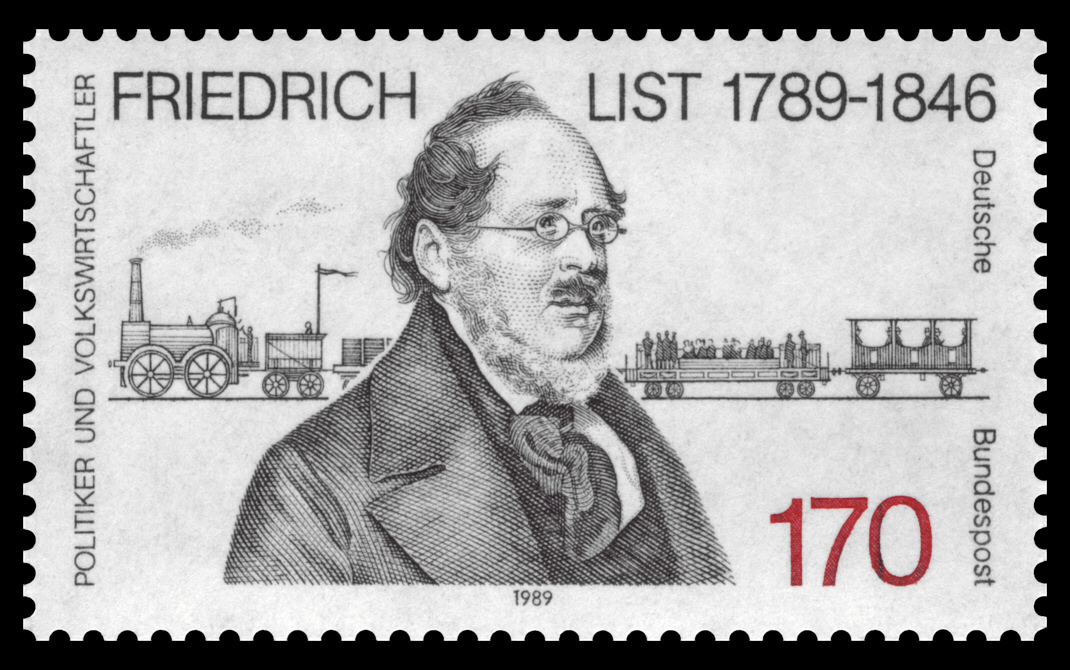
Does this mean that the absence of protectionism and freedom of international trade are always harmful and destructive? No, it does not. As early as the 1840s, the economist Friedrich List developed a recipe for “correct globalization”: free trade should be introduced after all countries of the world are industrialized; only then will it be beneficial to all countries without exception42. Trade should open up gradually to give the manufacturing sector of a poor trading partner time to adjust to it. As Reinert notes, this is precisely how the European Union integrated Spain into the EU in the 1980s; the integration was successful.
Once a country was sufficiently industrialized, the same factors that previously required protection (attaining increasing returns and developing new technologies) began to require large international markets for growth and prosperity. We see that successful protectionist policy carries the seeds of its own destruction: when successful, the protection that was initially so necessary for industry begins to hinder its productivity. This is what an Italian traveler who visited Holland in 1786 wrote: ‘As much as tariffs are useful for the initial development of a country’s industrial production, they become just as harmful when industrial production has already emerged’. This phrase is the key to understanding when free trade should be introduced43.
This means that protectionism in an industry should be introduced temporarily, after which it must be lifted. As for the free market and the laissez-faire concept, as we saw in the article about institutional economics and see in this article, the wealth of all rich economies is linked to state intervention in economic policy and active regulation.
Conclusion
How, in the end, will social democrats achieve economic growth? First, inclusive institutions must be built and extractive ones eliminated. After that, it is required to create a strong manufacturing industry and ensure the creation of innovation within the country (the Bolsheviks tried to do this without a foundation in the form of inclusive institutions, resulting in Stalin’s dictatorship and collapse; today’s nomenclature is also trying to do this by bypassing inclusive institutions, but this too will end in collapse). Here are the core rules of economic development under already established institutions proposed by Reinert (we have edited and supplemented them with the rules for emulating rich countries by the economist Philipp von Hörnigk, which he outlined44):
- The realization that “we are doing the wrong thing”. In this regard, patriotism with its country’s greatness and love for it is destructive; it prevents acknowledging the country’s flaws and correcting them;
- The closest scrutiny of the country’s land, the potential of its resources;
- A conscious pursuit of activities characterized by increasing returns; their support and protection. Identification of target activities (those that should be developed), as well as those that should be developed first and foremost (establishing stages of development);
- All resources existing within the country that cannot be used in their natural state should be processed within the country and sold in an already finished form;
- The introduction of a reasonable policy of protectionism (further on we will outline its main provisions) for target activities;
- Attracting foreign specialists to work in target activities and to improve the education system;
- Carrying out ideological work at the state level to promote domestic brands of goods (without resorting to patriotic slogans, but following the example of successful brand advertising);
- In the event that purchases of foreign goods are unavoidable, acquiring them as far as possible firsthand and/or in exchange for domestic goods;
- Foreign goods should, as far as possible, be imported in an unfinished state and completed inside the country, thereby allowing manufacturing workers to earn a living;
- Political suppression of the lobby of resource, trading, and agricultural sectors. These sectors must bear the main tax burden (but ultimately, the people employed in them will financially benefit due to the synergy effect);
- Exempting target activities from taxes;
- Providing target activities with cheap credits;
- Export subsidies for target activities;
- The creation of advanced patent law;
- The possible introduction of a tax or a total ban on the export of raw materials so that competing countries have to acquire raw materials at higher prices.
This means that the state must regulate imports and exports, support manufacturing industry in accordance with a strategic plan (indicative planning), and conduct a tax policy aimed at economic development. We also consider it necessary to provide a comparison between correct and incorrect protectionist policies:
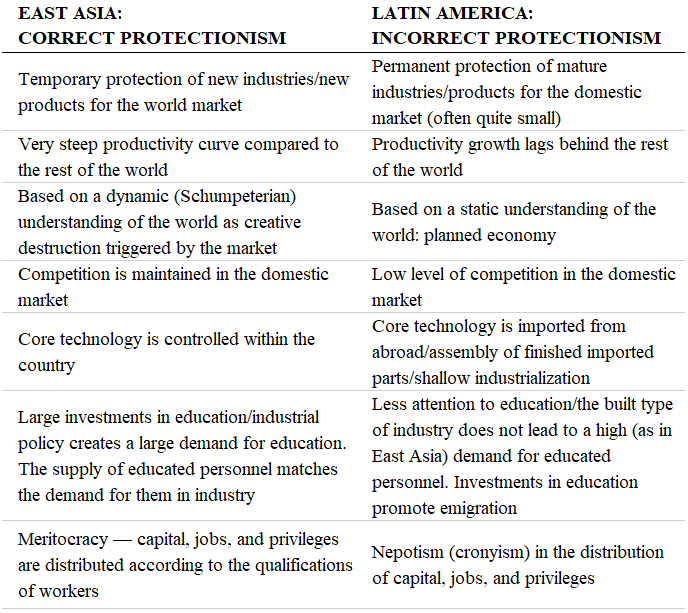
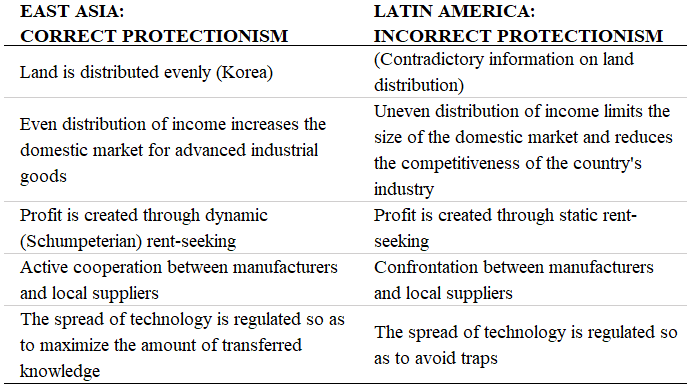
Here we have outlined the basic principles that social democrats need to implement in the economy to ensure its growth. This strategy can be applied by social democrats in all Third World countries with the aim of achieving a reduction in the wealth gap between nations and the defeat of poverty. On the whole, we described the social-democratic economic system in this article.
- Erik Reinert on economic strategies of successful nations (video) // Igor Sikorsky Kyiv Polytechnic Institute (kpi.ua). [Electronic resource]. URL: https://kpi.ua/ru/2019-04-04 (accessed: 04.07.2020).
- E.S. Reinert. How Rich Countries Got Rich… and Why Poor Countries Stay Poor [Text] / transl. from English by N. Avtonomova; ed. by V. Avtonomov; National Research University “Higher School of Economics”. 4th ed. – 384 p. – Moscow: Higher School of Economics Publishing House, 2016. – p. 173.
- O. Ananyin, R. Khaitkulov, D. Shestakov. The Washington Consensus: Landscape after the Battles // World Economy and International Relations, 2010. No. 12 – p. 15.
- See: Williamson J. The Washington Consensus Revisited. P. 50; idem. Did the Washington Consensus Fail? Speech at the Center for Strategic & International Studies. 06.11.2002. (http://www.iie.com/publications/papers/paper.cfm?ResearchID=488).
- Krugman P. Dutch Tulips and Emerging Markets // Foreign Affairs. 1995. V. 74. № 4. P. 31– 32, 35– 36, 38– 39.
- See: Statement of Intent by the Group for Economic Transformation // Studies on Russian Economic Development. 1994. No. 4; Reforms Through the Eyes of Russian and American Scientists. Ed. by O.T. Bogomolov. M., 1996.
- Antonio Genovesi. Storia del commercio della Gran Brettagna. 3 vols. Naples, 1757 – 1758. Vol. 1. P. 249.
- Daron Acemoglu. Why Nations Fail: The Origins of Power, Prosperity, and Poverty / Daron Acemoglu, James A. Robinson; transl. from English by Dmitry Litvinov, Pavel Mironov, Sergey Sanovich. – 693 p. – Moscow: AST Publishers, 2019. – p. 16.
- Ibid., p. 15.
- E.S. Reinert. How Rich Countries Got Rich… and Why Poor Countries Stay Poor [Text] / transl. from English by N. Avtonomova; ed. by V. Avtonomov; National Research University “Higher School of Economics”. 4th ed. – 384 p. – Moscow: Higher School of Economics Publishing House, 2016. – p. 325.
- Daron Acemoglu. Why Nations Fail: The Origins of Power, Prosperity, and Poverty / Daron Acemoglu, James A. Robinson; transl. from English by Dmitry Litvinov, Pavel Mironov, Sergey Sanovich. – 693 p. – Moscow: AST Publishers, 2019. – p. 365.
- Ibid., p. 236
- Marina Ibusheva. Yandex tests search results with five advertisements on top // SEONews (www.seonews.ru). February 18, 2020, 15:01. [Electronic resource]. URL: https://www.seonews.ru/events/yandeks-testiruet-vydachu-s-pyatyu-reklamnymi-obyavleniyami-sverkhu/ (accessed: 04.07.2020).
- E.S. Reinert. How Rich Countries Got Rich… and Why Poor Countries Stay Poor [Text] / transl. from English by N. Avtonomova; ed. by V. Avtonomov; National Research University “Higher School of Economics”. 4th ed. – 384 p. – Moscow: Higher School of Economics Publishing House, 2016. – p. 241.
- G.M. Sokolov. The phenomenon of increasing returns and the history of its study in the works of E. Reinert / In: The phenomenon of increasing returns in economics and politics: Collection of scientific papers. St. Petersburg: Aletheia, 2014
- E.S. Reinert. How Rich Countries Got Rich… and Why Poor Countries Stay Poor [Text] / transl. from English by N. Avtonomova; ed. by V. Avtonomov; National Research University “Higher School of Economics”. 4th ed. – 384 p. – Moscow: Higher School of Economics Publishing House, 2016. – p. 139-140.
- Ibid., p. 96.
- A.A. Yalbulganov. Protectionism // Great Russian Encyclopedia. Volume 27. Moscow, 2015, pp. 624-625. [Electronic resource]. URL: https://bigenc.ru/economics/text/3169035 (accessed: 04.07.2020).
- E.S. Reinert. How Rich Countries Got Rich… and Why Poor Countries Stay Poor [Text] / transl. from English by N. Avtonomova; ed. by V. Avtonomov; National Research University “Higher School of Economics”. 4th ed. – 384 p. – Moscow: Higher School of Economics Publishing House, 2016. – p. 29-30.
- M.P. Aizenshtat. Navigation Acts of 1651, 1660 // Great Russian Encyclopedia. Volume 21. Moscow, 2012, pp. 642-643. [Electronic resource]. URL: https://bigenc.ru/world_history/text/2243346 (accessed: 04.07.2020).
- Daron Acemoglu. Why Nations Fail: The Origins of Power, Prosperity, and Poverty / Daron Acemoglu, James A. Robinson; transl. from English by Dmitry Litvinov, Pavel Mironov, Sergey Sanovich. – 693 p. – Moscow: AST Publishers, 2019. – p. 249.
- William Ashworth. Customs and Excise. Trade, Production and Consumption in England 1640 – 1845. Oxford, 2003. P. 382.
- Adam Smith. An Inquiry into the Nature and Causes of the Wealth of Nations. Volume II – 473 p. – M., Leningrad: State Social and Economic Publishing House, 1935. – p. 39.
- E.S. Reinert. How Rich Countries Got Rich… and Why Poor Countries Stay Poor [Text] / transl. from English by N. Avtonomova; ed. by V. Avtonomov; National Research University “Higher School of Economics”. 4th ed. – 384 p. – Moscow: Higher School of Economics Publishing House, 2016. – p. 109-110.
- Ibid., pp. 211-212.
- Sanness John. Patrioter, intelligens og skandinaver. Norske reaksjoner på skandinavismen før 1848, Universitetsforlaget, Oslo, 1959.
- E.S. Reinert. How Rich Countries Got Rich… and Why Poor Countries Stay Poor [Text] / transl. from English by N. Avtonomova; ed. by V. Avtonomov; National Research University “Higher School of Economics”. 4th ed. – 384 p. – Moscow: Higher School of Economics Publishing House, 2016. – pp. 306-307.
- L.A. Burakova. Why Georgia Succeeded – 271 p. – M.: United Press LLC, 2011
- Luis Ortiz, Spanish Minister of Finance, to Felipe II: “Memorandum to the King to prevent money from leaving the Kingdom”, Madrid, 1558.
- Hales John. A Compendious or Briefe Examination of Certayn Ordinary Complaints of Divers of Our Countrymen in These Our Dayes: Which Although… in Some Partes Unjust and Frivolous, Yet Are All, by Way of Dialogue, Thoroughly Debated and Discussed. London, 1561 / 1751.
- E.S. Reinert. How Rich Countries Got Rich… and Why Poor Countries Stay Poor [Text] / transl. from English by N. Avtonomova; ed. by V. Avtonomov; National Research University “Higher School of Economics”. 4th ed. – 384 p. – Moscow: Higher School of Economics Publishing House, 2016. – pp. 108-109.
- Christopher Klein. The Spies Who Launched America’s Industrial Revolution // History (www.history.com). January 10, 2019. [Electronic resource]. URL: https://www.history.com/news/industrial-revolution-spies-europe (accessed: 04.07.2020).
- V.N. Malov. Colbert // Great Russian Encyclopedia. Volume 14. Moscow, 2009, p. 577. [Electronic resource]. URL: https://bigenc.ru/world_history/text/2621183 (accessed: 04.07.2020).
- E.S. Reinert. How Rich Countries Got Rich… and Why Poor Countries Stay Poor [Text] / transl. from English by N. Avtonomova; ed. by V. Avtonomov; National Research University “Higher School of Economics”. 4th ed. – 384 p. – Moscow: Higher School of Economics Publishing House, 2016. – p. 274.
- Ibid., p. 167.
- Ibid., p. 242.
- Anna Sharova. Silicon Valley of Europe: how Dublin became the IT center of the continent // Vokrug Sveta (www.vokrugsveta.ru). September 13, 2018, 04:02. [Electronic resource]. URL: http://www.vokrugsveta.ru/article/299871/ (accessed: 04.07.2020).
- E.S. Reinert. How Rich Countries Got Rich… and Why Poor Countries Stay Poor [Text] / transl. from English by N. Avtonomova; ed. by V. Avtonomov; National Research University “Higher School of Economics”. 4th ed. – 384 p. – Moscow: Higher School of Economics Publishing House, 2016. – p. 177.
- Ibid., pp. 171-172.
- Ibid., p. 175.
- Ibid., p. 328.
- List Friedrich. The National System of Political Economy. Kelly. New Jersey, 1991. The original German edition was published in 1841.
- E.S. Reinert. How Rich Countries Got Rich… and Why Poor Countries Stay Poor [Text] / transl. from English by N. Avtonomova; ed. by V. Avtonomov; National Research University “Higher School of Economics”. 4th ed. – 384 p. – Moscow: Higher School of Economics Publishing House, 2016. – p. 111.
- Hörnigk Philipp Wilhelm von. Oesterreich über alles wann es nur will. Das ist: wohlmeinender Fürschlag Wie mittelst einer wolbestellten Lands-Oeconomie, die Kayserl. Erbland in kurzem über alle andere Staat von Europa zu erheben, und more als einiger derselben, von denen andern Independent zu machen. Durch einen Liebhaber der Kayserl. Erbland Wolfahrt, no publisher, [Nuremberg], 1684.