“Monopolies do not arise in a free market”
One of the classic arguments against proponents of state non-interference is that without intervention, monopolies can form in the market (which leads to all the problems resulting from this). Recently, libertarians have been actively trying to dismiss this argument, taking advantage of the fact that, due to its apparent obviousness, almost no one has thoroughly analyzed it. In this article, we will attempt to elaborate on this argument and explain why proponents of non-interference are wrong.
Libertarians and other proponents of state non-interference claim that a free market does not tend toward monopoly and that any monopoly is a result of state activity. For example, the Vkontakte social network group “Classical Liberal” features an article titled “Resign yourself: monopolies do not form in a free market”, where the authors write (without citing sources outside of representatives of the Austrian School of Economics):
In a free market, monopolies do not form, and even if such a thing happens, the reason for this is consumer choice in favor of the product provided by the monopoly1.
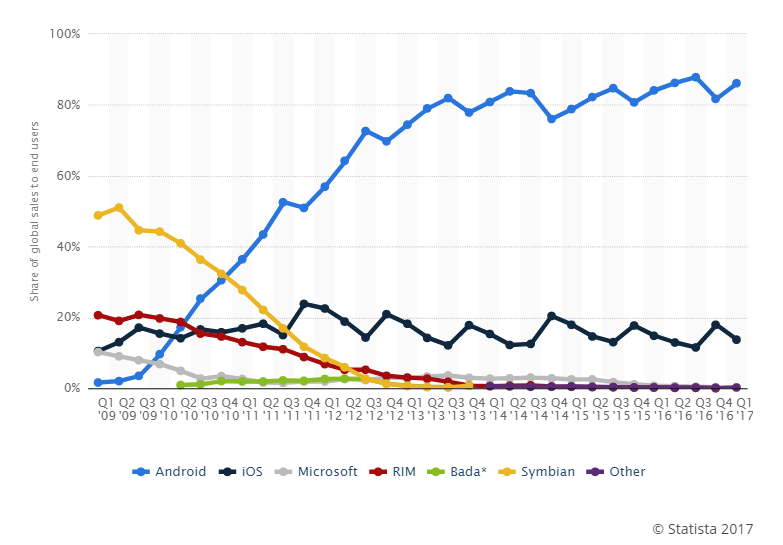
As evidence, the author of the article provides their own conviction, as well as Apple (acting within a state with antitrust legislation) losing its leading market share. One of the popularizers of this thesis is also the fiction writer Ayn Rand, who is not an economist; she included an article by Nathaniel Branden in her collection “Capitalism: The Unknown Ideal”, which stated:
One of the most common economic errors — propagated by Karl Marx and accepted today by many, including businessmen — is the claim that the development of monopolies is an essential and inevitable result of the functioning of a free, unregulated economy. Actually, the reverse is true: it is the free market that prevents the development of monopolies2.
It is amusing that already in the postscript to the preface of the collection, Rand wrote that “Nathaniel Branden has no further connection with me, my philosophy, or the magazine The Objectivist Newsletter”3. Moreover, the article did not cite any sources in principle, as Rand’s book does not particularly claim to be scientific. Here is another video from popularizers of the thesis:
https://www.youtube.com/watch?v=i3sNOW2DJEo
Let us examine whether a free market tends toward monopoly or not. Furthermore, since the concept of state non-interference has been pushed out of real policy today and exists only in the imagination of libertarians, we do not have the opportunity to examine ideal examples of a “free market” (in the relevant article, we also noted that this is an abstract demagogic construct, the definition of which can change depending on the situation — no matter what practical example of a free market implementation we criticize, libertarians can say it is the wrong one). Therefore, we take for consideration those cases that are closest to existing practice and where no intervention by antitrust agencies is observed.
Contents
Definitions
To begin, we need to define monopoly and a free market. So, monopoly, according to the Ozhegov dictionary, has several meanings, among which we are interested in: “An exclusive right to the production or sale of something, as well as exclusive use of something” and “A large association that arose on the basis of concentration of production and capital with the aim of establishing dominance in any field of the economy and obtaining maximum profit”4. The article by Doctor of Economic Sciences Andrey Kolganov in the Great Russian Encyclopedia gives this definition: “a situation (position) where a producer or seller supplies (produces) such a significant part of goods or services of a certain type that this allows them to influence the deviation of prices for them from the equilibrium level by establishing monopoly prices and extracting monopoly profit”5. In general, the definition from the GRE is quite successful and consistent with others.

What is a free market? According to the Dictionary of Business, it is “a market free from government intervention, in which prices rise and fall depending on supply and demand”6. “PostNauka” cites the words of economist Yaron Brook with reference to Serious Science: “A free market is a market free from state intervention, regulation, coercion, and force”7. We also noted here that some sources consider a free market to be one with minimal state intervention, meaning antitrust regulation is not included.
Examples of monopolies
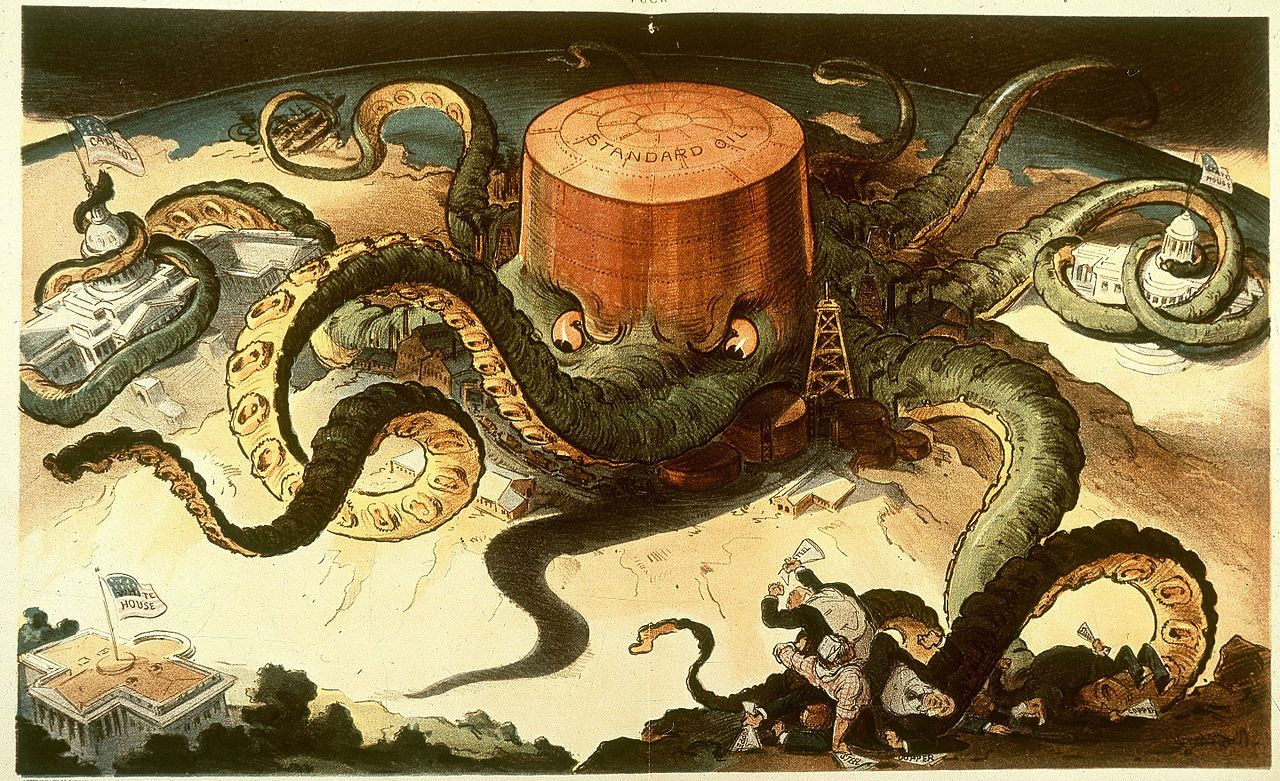
When monopolies are discussed, Standard Oil is often immediately recalled as one of the most famous. Founded in 1870 by John D. Rockefeller, by 1880 it controlled 90% of all oil refining in the United States8. The state intervened in this process only in 1911, recognizing the company as a monopoly in accordance with the enacted Sherman Act and splitting it into 34 companies.
In 1871, English entrepreneur Cecil Rhodes bought up most of the diamond mines in Southern Africa, after which he founded De Beers Consolidated Mines, and by the mid-1890s, Rhodes had created the Diamond Trading Company — a syndicate that controlled the majority of the world’s diamond trade9. The state did not interfere in these processes, unlike, for example, the situation in 2004, when the company pleaded guilty to cartel collusion, human rights violations, and other crimes.
If the market does not tend toward monopolies, then it turns out that all companies convicted of “price fixing” were convicted unjustly — that is, the judges are lying, the witnesses are lying, the states are lying, the eyewitnesses are lying, and the public is lying. In short, everyone is lying except for the libertarians.
The classifieds site Avito bought out the majority of its competitors — Molotok, Slando, OLX10 — and as early as 2022, the service itself reported with some pride: “86% of private sellers used Avito to sell goods in 2021, and in June 2022, 96% already used the platform for C2C trade”11. The Italian automobile company FIAT was founded by a group of entrepreneurs and was led by Giovanni Agnelli, Count Carlo Biscaretti di Ruffia, and financier Emanuele Cacherano di Bricherasio12. Gradually, the company became the largest in Italy and began to buy up other car manufacturers in the country. In 1969, Lancia was purchased; in 1979, Ferrari, Autobianchi, and Abarth became part of FIAT; in 1986, Alfa Romeo was bought, followed by Maserati13. Thus, FIAT became practically a monopolist in the production of Italian automobiles, as other mass-market brands were pushed out of the market; the state was also not involved in this process.
In 1961, entrepreneur Leonardo Del Vecchio founded the company Luxottica14. Today, it owns a large number of eyewear brands, such as Ray-Ban and Oakley, and dominates the market. As The Wall Street Journal columnist Brett Arends notes, the Oakley brand competed with Luxottica’s brands until the latter decided to stop selling their products in its stores, which led to a collapse in Oakley’s stock price, and ultimately Luxottica acquired the company15. The Los Angeles Times noted that, thanks to its monopoly position, the company sets markups on its products that can be as high as 1000%16.
Modern monopolies
Since the state has not yet adapted to regulate the internet, it is no surprise that it has become the most fertile ground for monopolies.
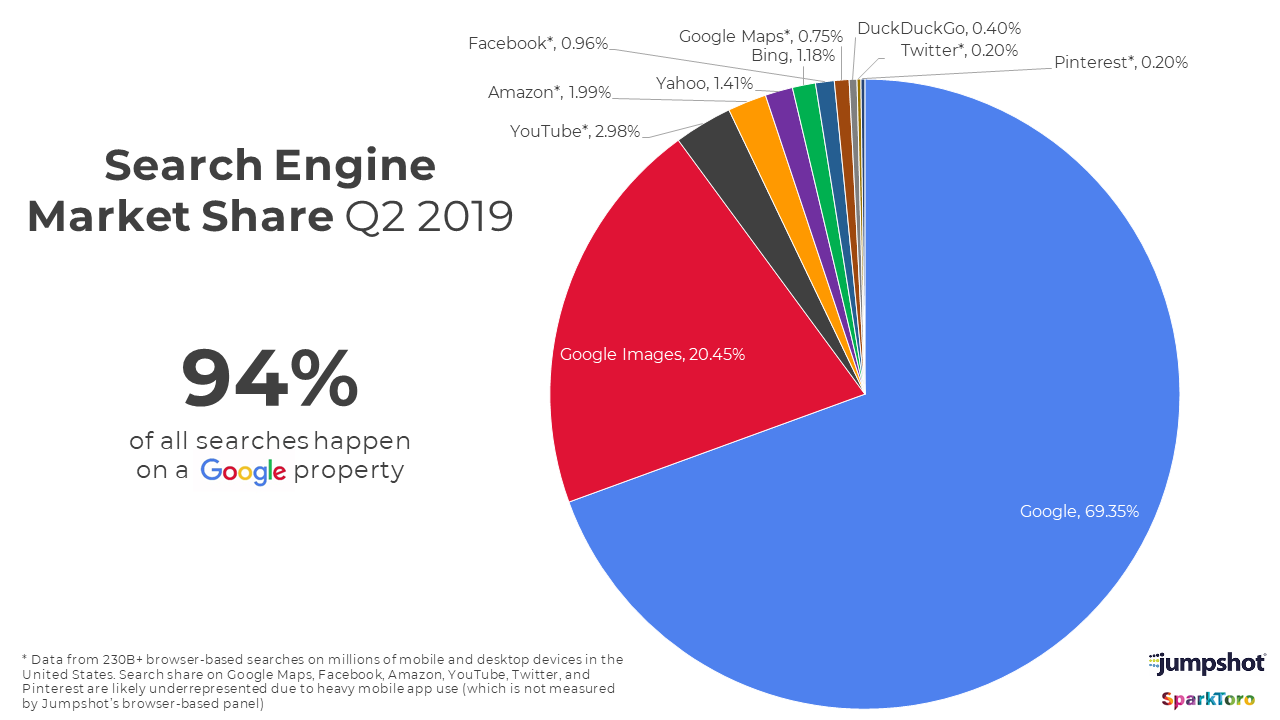
Google was founded in 1998 by young startup founders Larry Page and Sergey Brin. Today, as Britannica writes, more than 70 percent of global search queries are processed by Google alone17. Rarely does a company manage to control such a large share of the global market, rather than just the domestic one. Antitrust agencies turn a blind eye to this case, and for now, Google remains a monopolist in many markets.
Libertarians provide a large number of excuses on this issue; one example is: “Google is not a monopolist; it does not control prices”. This is incorrect — a company that possesses such a market share in search engines can, for example, exercise control over the cost-per-click in contextual advertising (how much to charge advertisers and how much to pay webmasters), and in most countries, neither the advertiser nor the webmaster can replace it with a competing system because the competing systems have a negligible number of users. People who work with contextual advertising will confirm this to you. Libertarians take advantage of the ignorance of such details on the part of a large portion of their listeners.
In 2004, several Harvard University students created the company Facebook. Today, it is the world’s largest social network18, which is constantly expanding — for instance, in 2012, the company acquired the social network Instagram for 1 billion dollars19; in 2014, Facebook bought the mobile messenger WhatsApp for more than 20 billion20; and it also bought the company Oculus21, the GIF service Giphy22, the app MSQRD23, and so on.[/html]
In 1994, banking professional Jeff Bezos founded the company Amazon24. In 2018, the company controlled nearly 50% of the U.S. online retail market25. In 2020, renowned entrepreneur Elon Musk called the company a monopolist and called for it to be broken up26.
In 1975, graduates of the prestigious private Lakeside School27 Bill Gates and Paul Allen founded the company “Micro-Soft”. Over time, their product — the “Windows” operating system—captured up to 90% of the global OS market28. One of the most prominent investigative journalists and consumer advocates in the U.S. — Ralph Nader — considers the corporation’s methods anti-competitive and anti-consumer, demanding antitrust intervention29. For instance, Microsoft has been accused of integrating the Internet Explorer browser into the Windows operating system in order to eliminate competition from the Netscape browser.
In 2020, a U.S. Congressional hearing took place where the aforementioned companies were accused of abusing their market position and violating antitrust laws. For example, Apple was accused of hindering the development of independent applications by setting high commissions in the App Store — from 15 to 30% — and in Mark Zuckerberg’s correspondence, a statement belonging to him was found: “we can always just buy any competitive startups”30.
How monopolies are created
Two main paths for creating monopolies are the result of introducing some innovation into production or as a result of victory in competitive struggles. Monopolies formed only by the first method are indeed often short-lived and last only until competitors master the new technology. Those monopolies that became such as a result of defeating competitors can “hold” the market for a very long time. Upon becoming a large player, a company strives to defeat competitors not only by improving the quality and price of its product (after victory, a reverse process may occur, as we saw above in the example of Luxottica’s markups), but also by the banal purchase of small competitors and adjacent companies, after which one can wait for the crisis of a large competitor and then acquire it as well. For example, General Motors, which initially included only the Buick brand, eventually acquired Oldsmobile, Cadillac, Oakland (which included Pontiac), Chevrolet, Opel, Vauxhall, and Holden; GMC, Saturn, and Hummer divisions were created, and shares of FIAT, Daewoo, Isuzu, Fuji Heavy Industries (which produced Subaru cars), and Suzuki were acquired31. The corporation once tried to buy the Ford brand as well, but the $8 million sum requested by Henry Ford did not suit them. GM was prevented from becoming a monopoly by the very large size of the American market, U.S. antitrust laws, and individual management errors. However, in 1966, 90% of automobile production accounted for the share of three brands — GM, Ford, and Chrysler32.
Having gained monopoly power, a company can oust competitors. For example, Microsoft, the owner of the Windows operating environment, can arbitrarily oust independent application developers from the market (or bar them from entry) by refusing compatibility for their software products with the operating environment.
A large company with a high market share and a geographically developed sales network is able to “punish” every individual local competitor (up to their elimination from the market) if, by lowering prices, they try to increase their market share. A significant market share also gives a large company the opportunity to “permanently” secure a circle of buyers for itself, forcing them to refrain from concluding contracts for the purchase of goods with any potential competitors of this large company by establishing such a refusal in the contract for a long period and providing for a large fine for its violation33.
Renowned economist and Cambridge University professor Ha-Joon Chang notes:
In a market with many competitors, producers cannot freely set prices, since a competitor always has the possibility to undercut them to a level after which any further price reduction will lead to losses. But a monopoly or oligopoly company possesses such power to decide (fully in the first case and partially in the second) what price to set depending on the quantity of products it produces… In the case of an oligopoly, companies unite into cartels, after which they behave like monopolists, setting a high monopoly price34.
The emergence of antitrust legislation
The processes of large players ousting smaller ones led to the emergence of antitrust legislation and competition law. The first of such laws was adopted as early as 1889 in Canada35. A year later, the Sherman Act was adopted in the United States, supplemented in 1914 by the Clayton Act. Today, as Vadim Novikov, a senior researcher at the RANEPA and member of the Expert Council under the Government of the Russian Federation, notes, “there are no large countries that do not have antitrust legislation”36.
If libertarians believe that the emergence of antitrust legislation in all major countries does not flow organically from the logic of an unregulated market’s development, then what is it caused by? There are two options — either all governments made a mistake, deciding to the detriment of their own economies (which contradicts common sense — in that case, at least a few states would not have done so, especially since it requires specific effort), or all governments made such a decision for selfish purposes, in overt or covert collusion with one another. Thus, libertarianism is nothing more than a conspiracy theory.
As Igor Artemyev, winner of the “Person of the Year” award in the “Person in Public Administration” category for 2011, and Alexei Sushkevich, Candidate of Economic Sciences, note, “antitrust regulation is as common and objective a phenomenon as, for example, the institution of taxation or a complex of public foreign trade protective measures, and questioning its right to exist can only occur to marginal (even in current transitional conditions) researchers”37. The Great Russian Encyclopedia also confirms that the emergence of antitrust legislation is caused by objective factors, and the period when it did not yet exist was marked by the flourishing of monopolies:
The emergence and development of monopoly as a mass phenomenon dates back to the late 19th and early 20th centuries. In addition to industrial monopolies, banking ones also emerged, which began to merge with the former, leading to the formation of financial capital. This initiated the trend of financial capital predominating over industrial. Very soon it was discovered that monopolies began to use not only economic but also non-economic methods to strengthen their monopoly power in the economy, including exerting influence on the state apparatus and methods of direct corruption. Monopolies sought to completely eliminate any competition in the industries in which they operated, ousting medium and small businesses. This caused a retaliatory reaction — antitrust legislation appeared with the aim of state protection of competitive conditions in markets38.
Svetlana Avdasheva, Deputy Director of the Institute for Industrial and Market Studies at the HSE, believes:
A policy of removing restrictions on competition must be implemented from above. Existing market participants are not interested in competition. Buyers are interested, but they are rarely informed about the restriction of competition and even more rarely act as a consolidated group capable of preventing or punishing collusion between sellers or the creation of barriers to market entry. In this context, centralized antitrust policy is a way of neutralizing the collective action problem.
<…>
The annual volume of government procurement in Russia is about 5 trillion rubles. International experience with cartels provides grounds to assume that participants in an agreement increase the price by 20% on average. We do not know the share of procurement suffering from prices raised as a result of an agreement, and we cannot reliably know it. Let us assume the probability of an agreement between procurement participants is at the 10% level — just for an example. If the threat of antitrust sanctions made it possible to reduce the probability of price collusion to even 8%, this would create an annual saving of state budget expenditures in the modest amount of 20 billion rubles. The size of the effect is an order of magnitude greater than today’s annual budget of the Federal Antimonopoly Service. That is, if all the activities of the FAS Russia were focused solely on identifying and punishing collusion in procurement — it would make sense to continue financing it39.
Conclusion
Libertarians and proponents of non-interference say that a free market will not lead to the emergence of monopolies, but we have provided a sufficient number of specific examples where monopolies emerged before the emergence of antitrust legislation and even under conditions of its existence before state intervention. Furthermore, according to their logic, it turns out that the emergence of antitrust legislation is not caused by objective factors, although it has been noted in all major countries. The facts we have cited allow us to conclude with a high level of confidence that without regulation, the market is not protected from the emergence of monopolies, and proponents of non-interference are a conspiratorial sect.
- Timofey Netesov. Resign yourself: monopolies do not form in a free market // Classical Liberal. Vkontakte (vk.com). February 4, 2019. [Electronic resource]. URL: https://vk.com/@classical_liberal-smirites-na-svobodnom-rynke-ne-obrazuutsya-monopolii (accessed: 04.09.2020).
- A. Rand. Capitalism: The Unknown Ideal / Ayn Rand; With additional articles by Nathaniel Branden, Alan Greenspan, and Robert Hessen; Trans. from English. – 422 p. – Moscow: Alpina Publishers, 2011. – p. 87.
- Ibid., p. 10.
- S.I. Ozhegov, N.Yu. Shvedova. Explanatory Dictionary of the Russian Language: 80,000 words and phraseological expressions / Russian Academy of Sciences. Institute of the Russian Language named after V.V. Vinogradov. – 4th ed., expanded. – 944 p. – Moscow: OOO “A TEMP”, 2006. – p. 365.
- A.I. Kolganov. Monopoly // Great Russian Encyclopedia. Volume 21. Moscow, 2012, p. 38. [Electronic resource]. URL: https://bigenc.ru/economics/text/2227805 (accessed: 04.09.2020).
- Business. Explanatory Dictionary. — Moscow: “INFRA-M”, Publishing House “Ves Mir”. Graham Betts, Barry Brindley, S. Williams et al. General editor: Doctor of Economics I.M. Osadchaya. 1998
- Yaron Brook. Free Market // PostNauka (postnauka.ru). February 8, 2017. [Electronic resource]. URL: https://postnauka.ru/faq/72340 (accessed: 04.09.2020).
- N.A. Sakharov. Rockefellers // Great Russian Encyclopedia. Electronic version (2018). [Electronic resource]. URL: https://bigenc.ru/world_history/text/5184648 (accessed: 04.09.2020).
- De Beers S.A. // Encyclopaedia Britannica (www.britannica.com). [Electronic resource]. URL: https://www.britannica.com/topic/De-Beers-SA (accessed: 04.09.2020).
- V. Zorina. How I sell things through the internet // Tinkoff Journal (journal.tinkoff.ru). September 29, 2020. [Electronic resource]. URL: https://journal.tinkoff.ru/kupila-prodala/ (accessed: 08.14.2023).
- The online C2C trade market grew by 25% over the year // Avito (www.avito.ru). September 22, 2022. [Electronic resource]. URL: https://www.avito.ru/files/file/press%20releases/22_09_2022_Rynok_online_torgovli_mezhdu_chastnymi_licami_vyros_na.pdf (accessed: 08.14.2023).
- Encyclopedia of Automobiles. Firms. Models. Constructions. – 576 p. – Moscow: ZAO “Book-Magazine Publishing House ‘Za Rulem'”, 2001. – p. 494.
- After the Three Italies: Wealth, Inequality and Industrial Change – Michael Dunford, Lidia Greco – p.193
- Our History // Luxottica (www.luxottica.com). [Electronic resource]. URL: http://www.luxottica.com/en/about-us/our-history (accessed: 04.09.2020).
- Sticker shock: Why are glasses so expensive? // CBS News (www.cbsnews.com). June 15, 2014. [Electronic resource]. URL: https://www.cbsnews.com/news/luxottica-eyewear-why-are-glasses-expensive/ (accessed: 04.09.2020).
- David Lazarus. Column: How badly are we being ripped off on eyewear? Former industry execs tell all // Los Angeles Times (www.latimes.com). March 5, 2019. [Electronic resource]. URL: https://www.latimes.com/business/lazarus/la-fi-lazarus-glasses-lenscrafters-luxottica-monopoly-20190305-story.html (accessed: 04.09.2020).
- William L. Hosch. Google // Encyclopaedia Britannica (www.britannica.com). [Electronic resource]. URL: https://www.britannica.com/topic/Google-Inc (accessed: 04.09.2020).
- Mark Hall. Facebook // Encyclopaedia Britannica (www.britannica.com). [Electronic resource]. URL: https://www.britannica.com/topic/Facebook (accessed: 04.09.2020).
- Facebook buys Instagram // Interfax (www.interfax.ru). April 10, 2012, 9:17. [Electronic resource]. URL: https://www.interfax.ru/business/240181 (accessed: 04.09.2020).
- Maria Mesropyan, Yana Shebalina. Buying WhatsApp cost Facebook $3 billion more // Vedomosti (www.vedomosti.ru). October 6, 2014, 19:28. [Electronic resource]. URL: https://www.vedomosti.ru/technology/articles/2014/10/06/facebook-zakryla-sdelku-po-priobreteniyu-whatsapp (accessed: 04.09.2020).
- Vadim Yelistratov. Facebook bought the creators of virtual reality glasses Oculus Rift for 2 billion dollars // TJ (tjournal.ru). March 26, 2014. [Electronic resource]. URL: https://tjournal.ru/tech/50222-facebook-oculus (accessed: 04.09.2020).
- Margarita Gerasyukova. There will be problems: who will be left without “GIFs” because of Zuckerberg // Gazeta.ru (www.gazeta.ru). May 18, 2020, 16:00. [Electronic resource]. URL: https://www.gazeta.ru/tech/2020/05/18/13087477/giphy.shtml (accessed: 04.09.2020).
- Elina Kirillova. For what amount did Facebook buy MSQRD? // Rusbase (rb.ru). March 12, 2016, 19:00. [Electronic resource]. URL: https://rb.ru/opinion/msqrd-facebook/ (accessed: 04.09.2020).
- Nikita Evdokimov. Mathematics, commerce, and space: a biography of Amazon founder Jeff Bezos // VC (vc.ru). July 28, 2017. [Electronic resource]. URL: https://vc.ru/flood/25490-bezos-about (accessed: 04.09.2020).
- Konstantin Khodakovsky. Amazon’s share of the U.S. online retail market is already 49% // 3Dnews (3dnews.ru). July 17, 2018, 9:15. [Electronic resource]. URL: https://3dnews.ru/972638 (accessed: 04.09.2020).
- Margarita Gerasyukova. “Monopolies are bad”: Musk demanded to “break up” Amazon // Gazeta.ru (www.gazeta.ru). June 5, 2020, 16:28. [Electronic resource]. URL: https://www.gazeta.ru/tech/2020/06/05/13108495/musk_vs_amazon.shtml (accessed: 04.09.2020).
- N.V. Rokachevskaya. Gates // Great Russian Encyclopedia. Electronic version (2017). [Electronic resource]. URL: https://bigenc.ru/economics/text/4420345 (accessed: 04.09.2020).
- I.V. Uryupin. Microsoft // Great Russian Encyclopedia. Volume 18. Moscow, 2011, p. 466. [Electronic resource]. URL: https://bigenc.ru/economics/text/2164159 (accessed: 04.09.2020).
- Policy Debate: Is Microsoft A Monopoly? // Baylor University (business.baylor.edu). [Electronic resource]. URL: http://business.baylor.edu/Tom_kelly/Microsoft%20monopoly.htm (accessed: 04.09.2020).
- Evgeny Delyukin. “They destroy independent business and do whatever they want”: heads of Google, Facebook, Amazon, and Apple testified to Congress // VC (vc.ru). July 30, 2020, 9:37. [Electronic resource]. URL: https://vc.ru/story/145955-razrushayut-nezavisimyy-biznes-i-delayut-chto-zahotyat-glavy-google-facebook-amazon-i-apple-dali-pokazaniya-kongressu (accessed: 04.09.2020).
- Dmitry Koshelnik. 109 years of General Motors // VC (vc.ru). June 30, 2017. [Electronic resource]. URL: https://vc.ru/transport/24754-gm-story (accessed: 04.09.2020).
- Great Soviet Encyclopedia. (In 30 volumes). Vol. 1. A-Angob. Ed.-in-chief: A.M. Prokhorov. 3rd ed. – 608 p. – Moscow, “Soviet Encyclopedia”, 1969. – p. 155.
- I.Y. Artemyev, A.G. Sushkevich. Foundations of the state’s antitrust policy // Economic Policy. 2007. No. 4. – p. 203.
- Ha-Joon Chang. Economics: The User’s Guide / Ha-Joon Chang. – 322 p. – Moscow: Mann, Ivanov and Ferber, 2015. – p. 253.
- Yves Bériault and Oliver Borgers. Overview of Canadian antitrust law // Canada Overview. McCarthy Tétrault (mccarthy.ca). [Electronic resource]. URL: https://marcomm.mccarthy.ca/pubs/antitrus_overview.pdf (accessed: 04.09.2020).
- Alexander Polivanov. Antitrust agencies as collections of anecdotes // Lenta.ru (lenta.ru). July 29, 2013, 13:31. [Electronic resource]. URL: https://lenta.ru/articles/2013/07/29/novikov/ (accessed: 04.09.2020).
- I.Yu. Artemyev, A.G. Sushkevich. Foundations of the state’s antitrust policy // Economic Policy. 2007. No. 4. – p. 206.
- A.I. Kolganov. Monopoly // Great Russian Encyclopedia. Volume 21. Moscow, 2012, p. 38. [Electronic resource]. URL: https://bigenc.ru/economics/text/2227805 (accessed: 04.09.2020).
- Does the market need antitrust policy // IQ Scientific and Educational Portal – National Research University “Higher School of Economics” (iq.hse.ru). November 20, 2012. [Electronic resource]. URL: https://iq.hse.ru/news/177671389.html (accessed: 04.09.2020).