
“Black people haven’t invented anything”
Racists like to ask, "What have Black people invented? Name a few inventions by Black people", in an attempt to prove that Black people are allegedly inferior and no match for white people. But just because racists lack erudition and don't know any Black inventors (often they can't even name white inventors either), it doesn't mean such inventors don't exist. It does mean, however, that one can ask these racists what they have personally invented.
One of the most popular stereotypes of the right is the brief thesis “Black people haven’t invented anything”, which implies that Black people are allegedly less developed than people with light skin color (which serves as a justification for restricting their rights or harassing those who do not support such restrictions). As a rule, the people who claim this have invented nothing themselves and therefore, by their own logic, are inferior — a striking degree of self-criticism.
For example, folk historian without an academic degree Yevgeny Ponasenkov, the scientific value of whose work goes no further than using words like “cheap trash” and “rabble”1, claims that Black people “created nothing”2.
This is yet another manifestation of Ponasenkov’s inadequacy as a researcher, and we will provide proof in this article. Representatives of pseudoscience in the 19th century claimed that Asians were backward, but then in the second half of the 19th and throughout the 20th century, a number of Asian states — Japan, and later South Korea, China, Singapore, and Taiwan — demonstrated the groundlessness of this idea. Like any insecure bully who, humbled by a stronger opponent, looks for a weaker target to assert himself, racists this time have latched onto Africans and Black people.

Inventions by black people
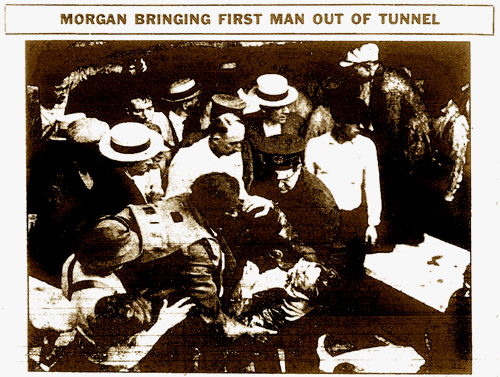
In 1892, Black inventor Sarah Boone received a patent for an improvement to the ironing board, which before her was simply a rectangular wooden block. The shape of the ironing board found in most homes today was designed specifically by her3. Black inventor Garrett Morgan developed and patented an effective gas mask model4, thanks to which many human lives were saved.
Automatic elevator doors are used everywhere today and were invented by African American Alexander Miles in 1887. One of the co-creators of the IBM PC in 1983 was Dr. Mark Dean, a Black man holding three of the nine patents related to that computer. He led the design team that developed the world’s first gigahertz processor. John Albert Burr received a patent in 1898 for a lawn mower with rotary blades5. A patent for a letter box was received by African American George Becket in 18926. Inventor Granville Woods held nearly 60 patents for various inventions7 (as a reminder, Yevgeny Ponasenkov does not have a single one). Augustus Jackson was an innovator in ice cream production — he is considered the first to develop an ice cream recipe without using eggs as an ingredient and the first to add salt to ice, allowing it to stay cold longer8. One could go on, but the examples provided already refute the arguments of the right.

If we talk about Africa, it was here that humans first used the simplest stone tools of the Oldowan type910, meaning they did not just use suitable objects, but also modified them according to their intended work function. “Homo habilis” can be called the “father” of all inventors. It was also here that humans began using hides as clothing, living in caves, and using fire, which at the time represented enormous progress. We also know about ancient civilizations such as the Nok (famous for its direct transition from the Neolithic to the Iron Age11 and terracotta sculptures12) or the Kingdom of Kerma.
According to Stanislav Drobyshevsky, Candidate of Biological Sciences and scientific editor of Antropogenez.ru, in one of the most ancient civilizations — Ancient Egypt — a significant portion of the population was “Negroid”13. But when the right are presented with examples of Ancient Egypt or Carthage, they usually backtrack, saying they mean not all of Africa, but only Sub-Saharan Africa. However, during the era of Ancient Egypt, Europe did not have such advanced civilizations either, yet that does not make Europeans inferior.
A bit more about culture
In the Middle Ages, several civilizations developed in Africa, such as the kingdom of Ethiopia, the Mali Empire, or Songhai (in the 15th-16th centuries). Buildings like the Djinguereber Mosque (1327), the Sankore Madrasah (presumably around 1327), the rock-hewn churches of Lalibela (approximately 13th century), the Chinguetti Mosque (13th-14th centuries), the Fasil Ghebbi fortress (17th century), and others were constructed here. Some on the right advocate for Christian civilization, yet the Kingdom of Aksum (modern-day Ethiopia, 4th century AD14) adopted Christianity earlier than any Western European country.
Black people are trailblazers in certain cultural fields, and musical styles such as rap15, jazz16, and funk17 are considered creations of Black culture. Few dispute the immense contribution to world culture made by such Black performers as Michael Jackson, Jimi Hendrix, Ray Charles, and Bob Marley. Figures like Malcolm X, Martin Luther King, Barack Obama, and Nelson Mandela exerted a significant influence on political processes in their countries and globally.
From the people who say that “Black people haven’t invented anything”, one almost never hears that “green-eyed people haven’t invented anything” or “mesomorphs haven’t invented anything”. That is, they are not interested in whether there is actually a correlation between physical traits and capabilities; these are simply naive people deceived by populists — they repeat whatever they are told. If populists said that green-eyed people hadn’t invented anything, they would repeat that after them. Antifascists, on the other hand, would have an opinion of their own.
Historical complexities
In Africa, state formation and territorial settlement occurred more slowly and less intensively than in Europe. For instance, Bantu tribes began penetrating Namibia only in the 16th century18, and on the territory of the Congo, the first state formations emerged only in the 13th-16th centuries19. Apparently, this is connected to the dispersal of Homo Sapiens in Europe, as a result of which the tribes remaining in Africa, having the opportunity to settle new lands through expansion rather than warfare, experienced a less acute need for a state than people in European territories. At the same time, these late-formed states did not have sufficient time to develop without external interference, since the colonization of Africa by Europeans began as early as the late 15th century20. High population density in Europe generated more large-scale wars, which stimulated the development of weaponry that made colonization possible.

Black people became subject to oppression on racial grounds, which slowed their development. Thus, Joshua Gee wrote in 1729 in “A Discourse on the Trade and Navigation of Great-Britain”:
That all Negroes shall be prohibited from weaving either Linnen or Woollen, or spinning or combing Wool, or working at any Manufacture of Iron, further than making it into Pig or Bar Iron, they be also prohibited from manufacturing Hats, Stockings, or Leather of any Kind… Indeed, if they set up Manufactures, the Government will be obliged to stop their Progress, and it can never be expected that it can be done with so much Ease as now21.
Colonists used harsh methods against Africans, such as the genocide of the Herero and Nama tribes in Namibia22 or the policies of King Leopold II of Belgium in the Congo. In the latter case, a 19,000-strong army turned the colony into a giant concentration camp, forcing local men to extract rubber, holding women hostage, and executing insurgents en masse. This policy also led to famine, and between 1880 and 1920, the population of the Congo dropped from approximately 20 million people to roughly 10 million23. The creation of bantustans, the implementation of apartheid policies24—all these were factors that did not conducive to Africans developing successfully. In South Africa, the colonial government even intentionally eliminated private property in order to turn Africans into cheap labor. Land was declared communal property, which was immediately taken under control by the chiefs. In 1940, economist George Findlay articulated the following postulate:
Tribal ownership is a guarantee that the land will never be properly worked and never really belong to the native people. Cheap labor must have a cheap breeding place, so let the Africans furnish it at their own expense25.
Black people transported to the United States were likewise in a state that did not facilitate invention or development — slavery persisted here until 1865, and segregation until the 1960s26.
The actions of colonizers on the continent led to the establishment of several new forms of extractive economic and political institutions, which remained in Africa even after the departure of the colonizers (though similar institutions existed there prior to their arrival as well). The Dutch expansion deep into South Africa and the establishment of a dictatorship there, followed by European rivalry over these territories, led to numerous wars. After the discovery of significant diamond deposits in 1867, and large gold deposits in Johannesburg in 1886, along with other mineral riches, the British immediately launched an expansion across all of South Africa. Resistance from the Orange Free State and Transvaal led to the famous Boer Wars in 1880-1881 and in 1899-1902, ending in 1910. Extractive institutions, including the widespread use of military force and coercion against the local population, coupled with the absence of sound mechanisms for democracy and the rule of law, as well as the means to build them, became fertile ground for military coups27 (of which, according to Doctor of Historical Sciences Gulnara Valiakhmetova, 68 were successful after 196028). Active support from the USSR29 and the West30 aimed at gaining influence in the region, which even led to war — for example, in Angola31 and Mozambique32 — and which disappeared as a phenomenon only after the end of the Cold War33, further fueled these conflicts.
In addition to the struggle between the Dutch and the British, the region’s development was influenced by the growth of the mining industry and an increase in the number of European settlements. This was particularly noticeable during periods of high demand for various food products, which created new economic opportunities for native Africans in agriculture and trade. Historian Colin Bundy described how the Xhosa people in Ciskei and Transkei reacted very quickly to these economic opportunities. As early as 1832, before the gold rush and European expansion began, a Moravian missionary in Transkei noted unprecedented economic activity in the province and an ever-increasing demand among Africans for European consumer goods. Civil Inspector John Hemming also described his visit to Fingoland in 1876, noting that Africans were actively building brick houses and planting entire fields of fruit trees34. With the development of the agricultural economy, rigid tribal institutions began to recede. There is also abundant evidence of shifts in land ownership forms. In 1879, an official in Umzimkulu noted that Africans had already purchased 38,000 acres of land at their own expense35. Three years later, he wrote that about 8,000 Africans had bought 90,000 acres of land for cultivation. One of the most striking examples of success is the story of Stephen Sonjica from Ciskei, a farmer who came from the poorest strata of society. Exceptionally important evidence confirming the economic dynamism and prosperity of African farmers during this period can be found in a letter from Methodist missionary W. J. Davis written in 1869. In a letter addressed to Britain, he related that he had raised £46 in cash for the Lancashire Relief Fund to combat the cotton famine. But between 1890 and 1913, economic growth came to a sudden halt because white colonizers did not want to compete with Black farmers when the latter drove down grain prices.

After that, the situation became even more pernicious. Whites needed cheap labor for the rapidly growing mining industry, which they could only obtain by impoverishing Black people. The testimony of George Albu36, president of the Association of Mines, before the Commission of Inquiry in 1897, well illustrates the logic of forced impoverishment into which Black people were driven. Albu explains how he decided to make labor cheaper simply by telling workers that their wages were being cut. Both objectives — eliminating competition for white farmers and securing cheap labor — were achieved in 1913 with the passage of the Natives Land Act. Anticipating Lewis’s dual economy concept, this law divided South Africa into two parts — a modern and prosperous one on one side, and an impoverished one on the other. The act allocated 87% of the land to white farmers, who made up only 20% of the population. The remaining 13% went to Black people37. The 1913 Act established apartheid, placing all economic and political rights in the hands of the white population. In this way, all economic incentives were destroyed. In 1951, tribal ownership was codified into law. The deprivation of property rights for Africans was followed by widespread impoverishment.
A wealth of data testifies to the decline in living standards following the Natives Land Act of 1913. Transkei and Ciskei entered a period of protracted economic decline. Mining company recruitment records collected by historian Francis Wilson show that this decline was characteristic of the South African economy as a whole. From 1911 to 1921, miners’ wages fell by 30%. Even in 1961, during a period of sustained growth, these wages were still 12% lower than in 191138. The apartheid system recognized that an educated Black person was a competitor to a white person, rather than just cheap labor for the mines and white farmers. As early as 1904, a job reservation system was introduced in the mining sector, under which Africans could not apply for a whole range of professions and positions. Overnight, Black people were forbidden from performing any job that was even remotely skilled in the mines. In 1926, the “color bar” was extended to the entire economy and remained in effect until the 1980s. South Africa closed off any opportunity for them to reap the economic benefits of education and refused to invest in the development of “Black” schools. This policy reached its peak in the 1950s, when the architect of apartheid, Hendrik Verwoerd, passed the Bantu Education Act. This led to significant disparities in living standards between whites and Blacks in the country, and in the 1970s, economic growth ground virtually to a halt.
Nevertheless, in the second half of the 20th century, European colonizers left Africa, and over time, several countries began to democratize and develop, ushering in economic growth. The fact that Africa lost a certain amount of time due to colonization, and that by the onset of colonization it lagged behind European countries in level of development, does not mean that it cannot become a developed continent. This will take several decades, and there is a high probability that democratic African countries will show very respectable results once that time passes.
Conclusion
Black people have scientific and cultural achievements; attempts to deny them are racist stereotypes based on a lack of erudition. Claims regarding an absence of inventions among Black people are direct fabrications and attempts to deceive a gullible listener. The less prominent number of inventions is tied to historical rather than biological factors. The fact that Black people have not surpassed light-skinned people in the number of inventions does not, in any case, make them any less complete as human beings, just as losing a championship does not make a sports team permanently inferior to the rest. In the exact same way, if brown-haired people have made more inventions, this does not make blondes or brunettes any less complete. Racism itself is likewise a fabrication, which we examined in greater detail in a separate article.
- Ksenia Krivotulova. “Did you think I wouldn’t outplay you? I will destroy you!” Scandalous Russian historian proclaimed himself a genius. The entire internet agreed with him // Lenta.ru (lenta.ru). April 6, 2020, 00:06. [Online resource]: https://lenta.ru/articles/2021/01/05/maestro/ (Accessed: 20.09.2021).
- Yevgeny Ponasenkov and Professor Melnik. Heated discussion on the topic of Black people // YouTube (www.youtube.com). July 18, 2020. [Online resource]: https://www.youtube.com/watch?v=aXTAE3Ba9Ys (Accessed: 20.09.2021).
- Thad Morgan. 8 Black Inventors Who Made Daily Life Easier // History (www.history.com). February 20, 2019. [Online resource]: https://www.history.com/news/8-black-inventors-african-american (Accessed: 20.09.2021).
- Ibid.
- Black History 2021 // JobTrain (www.jobtrainworks.org). [Online resource]: https://www.jobtrainworks.org/wp-content/uploads/2021/02/Black-History-2021-all-stories.pdf (Accessed: 20.09.2021).
- Mary Bellis. Black History Month – African American Patent Holders – B // ThoughtCo. (www.thoughtco.com). November 21, 2019. [Online resource]: https://www.thoughtco.com/african-american-patent-holders-b-4122701 (Accessed: 20.09.2021).
- Granville T. Woods – Inventions, Family & Facts // Biography (www.biography.com). April 2, 2014. [Online resource]: https://www.biography.com/inventor/granville-t-woods (Accessed: 20.09.2021).
- Augustus Jackson (1808-1852) // BlackPast (www.blackpast.org). June 21, 2021. [Online resource]: https://www.blackpast.org/african-american-history/people-african-american-history/augustus-jackson-1808-1852-2/ (Accessed: 20.09.2021).
- K.N. Gavrilov. Oldowan culture // Great Russian Encyclopedia. Volume 24. Moscow, 2014, p. 80. [Online resource]: https://bigenc.ru/archeology/text/2684426 (Accessed: 20.09.2021).
- S.V. Drobyshevsky. Transition to the systematic manufacture of tools. Oldowan industries // Antropogenez.ru (antropogenez.ru). [Online resource]: https://antropogenez.ru/zveno-single/124/ (Accessed: 20.09.2021).
- O.A. Klimanova, N.A. Bozhko et al. Africa // Great Russian Encyclopedia. Volume 2. Moscow, 2005, pp. 527-555. [Online resource]: https://bigenc.ru/geography/text/v/1841299 (Accessed: 20.09.2021).
- S.Ya. Berzina. Nok // Great Russian Encyclopedia. Volume 23. Moscow, 2013, p. 269. [Online resource]: https://bigenc.ru/archeology/text/2669670 (Accessed: 20.09.2021).
- Stanislav Drobyshevsky. On the races of Ancient Egypt and Nubia // Antropogenez.ru (antropogenez.ru). [Online resource]: https://antropogenez.ru/zveno-single/302/ (Accessed: 20.09.2021).
- A.V. Starikova, V.A. Popov et al. Ethiopia // Great Russian Encyclopedia. Volume 35. Moscow, 2017, pp. 505-514. [Online resource]: https://bigenc.ru/geography/text/4917478 (Accessed: 20.09.2021).
- Alan Light. Hip-hop. Music and cultural movement // Britannica (www.britannica.com). [Online resource]: https://www.britannica.com/art/hip-hop (Accessed: 20.09.2021).
- Gunther Schuller. Jazz // Britannica (www.britannica.com). [Online resource]: https://www.britannica.com/art/jazz (Accessed: 23.09.2021).
- Rickey Vincent. Funk // Britannica (www.britannica.com). [Online resource]: https://www.britannica.com/art/funk (Accessed: 23.09.2021).
- V.Yu. Zaytsev, O.A. Klimanova et al. Namibia // Great Russian Encyclopedia. Volume 21. Moscow, 2012, pp. 736-747. [Online resource]: https://bigenc.ru/geography/text/2247323 (Accessed: 20.09.2021).
- N.V. Vinogradova, O.A. Klimanova et al. Congo // Great Russian Encyclopedia. Volume 14. Moscow, 2009, p. 740. [Online resource]: https://bigenc.ru/geography/text/2088735 (Accessed: 20.09.2021).
- Portuguese Colonial Empire // Encyclopedia of World History (w.histrf.ru). [Online resource]: https://w.histrf.ru/articles/article/show/portugalskaia_kolonialnaia_imieriia (Accessed: 20.09.2021).
- E.S. Reinert. How Rich Countries Got Rich… and Why Poor Countries Stay Poor [Text] / trans. from English by N. Avtonomova; ed. by V. Avtonomov; National Research University “Higher School of Economics”. 4th ed. – 384 p. – Moscow: Publishing House of the Higher School of Economics, 2016. – p. 197.
- Sergey Romashenko. Germany officially recognized the genocide of the Herero and Nama tribes in Namibia // DW (www.dw.com). May 28, 2021. [Online resource]: https://www.dw.com/ru/germanija-oficialno-priznala-genocid-plemen-gerero-i-nama-v-namibii/a-57697245 (Accessed: 20.09.2021).
- Adam Hochschild. Leopold II King of Belgium // Britannica (www.britannica.com). [Online resource]: https://www.britannica.com/biography/Leopold-II-king-of-Belgium (Accessed: 20.09.2021).
- Daron Acemoglu, James A. Robinson. Why Nations Fail: The Origins of Power, Prosperity, and Poverty / Daron Acemoglu, James A. Robinson: [translated from English by Dmitry Litvinov, Pavel Mironov, Sergey Sanovich]. – 575 p. – Moscow: AST Publishing House, 2015. – pp. 297-301.
- C. Bundy. The Rise and Fall of the South African Peasantry. – Berkeley: University of California Press, 1972 – p. 262
- E.L. Nitoburg, N.E. Zvenigorodskaya et al. African Americans // Great Russian Encyclopedia. Volume 2. Moscow, 2005, pp. 559-560. [Online resource]: https://bigenc.ru/ethnology/text/1841915 (Accessed: 20.09.2021).
- Military coups in Africa. Dossier // TASS (tass.ru). November 15, 2017, 18:04. [Online resource]: https://tass.ru/info/4731722 (Accessed: 20.09.2021).
- G.N. Valiakhmetova. Authoritarianism and democracy in African countries // Institutions of direct and representative democracy: genesis of political regimes in the XX century: collection of materials of the Winter School, Yekaterinburg, January 4-15, 2000. Yekaterinburg: Ural University Press, 2000. pp. 157-165.
- Stepan Kostetsky. Red Sunset. The USSR gave African countries billions to fight the West. Why was this money wasted? // Lenta.ru (lenta.ru). January 18, 2021, 00:01. [Online resource]: https://lenta.ru/articles/2021/01/18/komms_africa/ (Accessed: 20.09.2021).
- A. Gromyko. “Cold War” as a factor in the development of international relations on the African continent in the 1960s–1970s: some patterns and historical lessons // Moscow University Bulletin. Series 25: International Relations and World Politics. Scientific Journal: Volume 8. N. 4. October-December 2016. – p. 130.
- Lando Josemanuel Gomes, Armando Luis Rosario Costa, O.Yu. Vashutina. Causes of the civil war in Angola // “Echo of the Russian People”: Reflection of 20th Century Russian History in Poetic and Song Creativity. Materials of the IV International Youth Scientific and Practical Conference. – Omsk: Omsk State Technical University, 2017. – p. 89.
- V.A. Shagalov. Civil War in Mozambique and the UN Peacekeeping Operation // Proceedings of Kazan University. Humanities Series Vol. 155. 2013. – Book 1. – pp. 257-259.
- V.M. Kassaye Nygusie, N.V. Ivkina. Features of Africa’s political development in the post-colonial period // Vestnik Российского университета дружбы народов. Series: International Relations. Volume 20, No. 1 (2020): Decolonization, Neocolonialism and Recolonization: On the 60th Anniversary of the Year of Africa. – p. 29.
- C. Bundy. The Rise and Fall of the South African Peasantry. – Berkeley and Los Angeles: University of California Press, 1979. – p. 46.
- Ibid, p. 89.
- Charles H. Feinstein. An economic History of South Africa: Conquest, Discrimination and Development.
- W. Arthur Lewis. Economic Development with Unlimited Supplies of Labour.
- Francis Wilson. Labour in the South African Gold Mines, 1911-1969