The Fourth Industrial Revolution and developed democracy
What will a social democratic state and its economy look like in the future? People used to think that communism would arrive and no one would work except robots. Just how feasible is that?
The measure in which society accepts technological innovations remains the main indicator of progress.
Political ideologies such as communism or anarchism (in its various forms) presuppose the existence of a model of society in the future that realizes all (or the majority of) human needs, and therefore it is viewed as a goal, as the embodiment of all the aspirations of these political ideologies. Most often, this model is called communism; occasionally, one can hear about other forms, such as anarcho-capitalism. The presence of such a “final model” allows its proponents to claim that their political competitors do not have an attractive model of the future. Sometimes such criticism can also be heard directed at social democrats. However, social democrats do have a “final model” — it is simply feasible, more realistic, and therefore fits better into the dynamics of societal development, but for this very reason, it is poorly perceived by the layman as something attractive. In this article, we will try to correct this by formulating the concept of a developed robotic democracy, but to do this, we must first understand what the Fourth Industrial Revolution is — a process that is happening right now and that makes the realization of our concept possible.
Contents
What is the Fourth Industrial Revolution
The definition of the term is given in the book by Klaus Schwab, president of the World Economic Forum in Davos and one of the main popularizers of the concept:
The Fourth Industrial Revolution: a collective term for a whole set of ongoing and impending transformations in the familiar systems surrounding us. While what is happening may not seem world-changing to those of us who observe small but noticeable changes in the usual way of life every day, in reality, everything is very serious. The Fourth Industrial Revolution, along with the First, Second, and Third Industrial Revolutions, opens a new chapter in the development of humanity. As before, its foundation is the mass spread of a whole series of cutting-edge technologies.
These advanced technologies build on the achievements of previous industrial revolutions, particularly the digital systems of the Third Industrial Revolution. We can identify twelve groups of new technologies… including artificial intelligence, robotics, additive manufacturing (3D printing), neurotechnologies, biotechnologies, virtual and augmented reality, advanced materials, and energy technologies. However, ideas and technologies that we do not yet know about will also play their part1.
After the Neolithic Revolution created a productive economy2, much later (and more precisely, over the last 250 years of human history) three industrial revolutions occurred. The first began in the British textile industry in the mid-18th century due to the mechanization of the spinning and weaving process and lasted from the 1760s to the 1840s. During this time, mechanization transformed all existing branches of industry and created many new ones — machine tools, steel mills, steam engines, and railways appeared.
The Second Industrial Revolution occurred between the 1870s and the 1930s, when a new wave of technologies continued economic growth and developed the success of the First Industrial Revolution. The radio, telephone, television, household appliances, and electric lighting demonstrated the transformative power of electricity. The internal combustion engine allowed for the creation of cars and airplanes, and subsequently their ecosystems — with new jobs and high-speed road networks. Breakthroughs also occurred in chemistry: the world received new materials, including thermosetting plastics. The Second Industrial Revolution marked the arrival of the modern world — from sanitation services to international air travel.
Starting approximately in the 1950s, breakthroughs began in information theory and digital computing. These technologies formed the core of the Third Industrial Revolution. The ability to store, process, and transmit information in digital form reformatted the majority of industrial sectors. Computers, the internet, and various portable digital devices entered our lives.
These industrial revolutions significantly increased the well-being of humanity. According to some calculations, since the beginning of the First Industrial Revolution, the average size of real income per capita in OECD countries has increased by 2,900%3. We are justified in assuming that the Fourth Industrial Revolution will also significantly impact the productivity of the global economy.
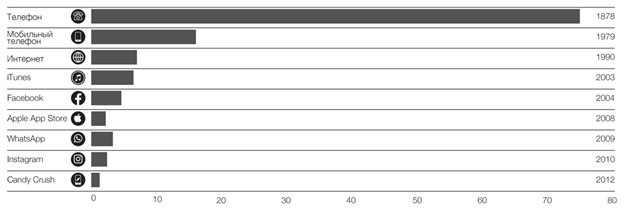
Each new industrial revolution not only accelerated human development but did so faster and faster. The graph below shows how many years it took for a particular technology to reach the figure of 100 million users. And although this is a fairly rough example, it well illustrates the speed of the spread of technologies. The Fourth Industrial Revolution will spread along the arteries of the third — via the internet. Its fruits will be accessible not only to developed countries but also to much poorer ones, which will be able to increase electricity production thanks to, for example, “smart grid” technology for wind turbines. This technology allows wind turbines to “communicate” with each other, optimizing their position so as to generate the maximum amount of energy together4.
Examples of technology implementation
There are four main physical manifestations of the prevailing technological megatrends that are obvious due to their materiality:
- autonomous vehicles;
- 3D printing;
- advanced robotics;
- new materials.
These material megatrends can be supplemented by a less material one — artificial intelligence.
When we talk about autonomous transport, we mean, first of all, cars. They are capable of moving independently, thanks to special software and sensors. Software controls the operation of all the car’s systems: steering, gear shifting, acceleration, and braking. Waymo launched a robotaxi service in San Francisco as early as 20215, and Yandex is also engaged in the development and testing of autonomous cars6. Perhaps in the future, autonomous vehicles will replace not only taxis but also public and even, to a significant extent, personal transport (except in cases where a person wants to enjoy driving a car or motorcycle). Taxi operators have already been largely replaced by services like Uber. Freight transportation may also switch to a driverless system — for example, the Russian Ministry of Transport had planned to begin testing autonomous trucks on the M11 “Neva” highway starting in 20227.
Of course, when we speak of Russian developments, one should allow for the fact that these ambitious plans were mainly announced before the events of February 2022. Their fate is currently quite murky.
However, driving is not limited to cars. For example, in Norway, a fully autonomous cargo ship, the Yara Birkeland, was recently created8, which is also free of harmful atmospheric emissions. The head of Russian Railways, Oleg Belozerov, stated that autonomous electric trains would begin running on the Moscow Central Circle (MCC) in 20249, and in Germany, similar trains have already been launched10. Unmanned aerial vehicles have been functioning for a long time, used for military purposes, and these days the company Airbus has already developed autonomous flight technology for passenger aircraft11, but it is still a long way from implementation. Most likely, this technology will be tested first on cargo aviation. Drones capable of performing freight transportation tasks also have prospects in this regard12 (they will be useful for delivering cargo to areas with poorly developed road infrastructure, or to offshore facilities).
3D printing is another technology that opens up significant prospects for us. In the article about the city of the future, we already mentioned the use of 3D printers in housing construction. Perhaps in the future, tableware and some furniture will not be purchased in a store but printed at home, especially since such opportunities already exist today13. It will also partially replace workers in production. Some companies — for example, Boeing and GE — produce new parts that simplify assembly14. 3D printing allows for the production of lighter parts by removing excess material and using lattice structures to reduce mass and improve heat dissipation. Quality control is also being improved. Whereas previously a few parts from a large batch were evaluated randomly, now online control systems are used that check the shape, tolerances, and material properties inside the part during the deposition of each layer.
One of the first harbingers of the replacement of human labor by machines was vending machines. They are gradually replacing street vendors and kiosks. The concept of a “staffless store” is being actively implemented in the world15 — that is, stores operating without cashiers, security guards, consultants, and so on. Robots are also replacing humans in production — for example, in 2015, the Chinese company Changying Precision Technology Company opened the first entirely robotic factory in human history16. Police today use robots to conduct search-and-rescue operations and even to neutralize armed criminals17, and the streets of Singapore were recently monitored by Xavier police robots18. Robots capable of servicing power lines are appearing19.
The company Moley Robotics has developed a robot kitchen that can prepare over 5,000 different dishes20. For now, the system costs more than 300 thousand dollars, but in the future, this figure will be significantly lower. In 2020, the “Shokoladnitsa” coffee shop chain began testing robot waiters21.
Robots are beginning to be used actively in agriculture. For example, robots have already been developed for weeding22, Agrobot robots for harvesting strawberries23, robots with seeding devices24, and so on.
Artificial intelligence is also not standing still and is developing. In 2016, one of the largest American law firms, BakerHostetler, hired a new employee — Ross Watson — and he was an artificial intelligence (the ROSS robot based on IBM’s Watson system)25. He can study a human case in a matter of moments, find matches in regulatory documents, and impartially provide a conclusion. Another example: in 2000, there were 600 stock traders in the New York office of the financial group Goldman Sachs. By 2017, only two traders remained, and the main work is performed by automatic trading programs26. Such a trend can be observed in dozens of Wall Street firms27.
The IBM Watson computer is already helping doctors make diagnoses while taking into account a patient’s genetic data and medical history28, and it can also create a cancer treatment plan29. State bureaucracy is gradually being replaced by portals like the Russian “Gosuslugi”30. AI may even displace journalists — according to predictions by Kristian Hammond, co-founder of Narrative Science, a company specializing in creating automated texts, by the mid-twenties of the current century, 90% of news texts will be created by an algorithm mostly without human intervention (of course, except for the development of the algorithm itself)31. Furthermore, algorithms are already performing the functions of news anchors today.
As we can see, developed countries and leading companies are already implementing the technologies of the Fourth Industrial Revolution. However, the dangers associated with this implementation may not be brought under control without a developed social democracy.
Danger and solutions
When seeing the scale of traditional professions being replaced by robots, the natural reaction of society is a fear of possible mass unemployment. New technologies destroy familiar ways of life, lifestyles, industries, and specific jobs. An archetypal example: the car killed the profession of a coachman. Indeed, the new technological revolution could provoke more upheaval than past ones. The reasons are the pace of change, the breadth and depth (a large number of radical changes are happening simultaneously), and the complete transformation of all systems32. Klaus Schwab notes:
There is also a lack of a coherent, positive and common global narrative that outlines the opportunities and challenges of the fourth industrial revolution, which is essential if we are to empower a diverse set of individuals and communities and avoid a popular backlash against the fundamental changes under way33.
Other experts also express concern:
To get a sense of what is happening, compare Detroit in 1990 (the main hub of traditional industry at the time) with Silicon Valley in 2014. In 1990, the total market capitalization of Detroit’s three largest companies was $36 billion, with $250 billion in revenue and a staff of up to 1.2 million people. In 2014, the total market capitalization of Silicon Valley’s three largest companies was significantly higher ($1.09 trillion) with about the same amount of revenue ($247 billion) and nearly ten times fewer employees (137,000 people)34.
It is not all so dismal, since robotization creates high-tech vacancies for the design and maintenance of these very robots. Humanity has already gone through something similar: when agriculture occupied the majority of production in the economy, if someone had claimed that in the future only 2% of people would be engaged in agriculture, this would most likely have elicited loud laughter — people would have thought that the vast majority of citizens in such a society would be unemployed. In the US at the beginning of the 19th century, people employed in agriculture accounted for about 90% of the workforce; today their share in the market does not exceed 2%35. But unemployment in the US in January 2022 was only 4%36. Just the same today, people will be horrified by the suggestion that only a few percent of the population might be employed in modern professions in the future. But they do not take into account the factor of new professions emerging. Furthermore, most economists agree that the positive effect of robotization will provide an opportunity to compensate workers for a potential negative effect through redistribution37. And at the same time, we must also take into account the fact that although the Fourth Industrial Revolution creates jobs in new industries, it creates fewer of them than previous revolutions38.
How can citizens be safeguarded in case the creation of new jobs does not keep pace with the replacement of workers by robots? How can citizens be provided with the confidence that will allow them not to fear the processes of the Fourth Industrial Revolution and not to oppose them? Schwab notes that “we need a new regulatory climate, without which the confident application of innovative technologies is impossible”39. That is, what is needed here is competent state policy and regulation, which include a powerful social security system (unemployment benefits, possibly a universal basic income40), state stimulation of the creation of new jobs, and retraining programs.
That is why the processes of the Fourth Industrial Revolution make progressive social democrats with their demands for the development of social security highly in demand. We must ensure both progress and people’s confidence in their future, regardless of the speed and breadth of this progress. The goal is a giant leap in improving human well-being and living standards, for which it will be necessary to reduce the costs of the destructive nature of scientific and technological progress through redistribution. We hope that the replacement of human labor with robotic labor will allow us to fight for the reduction of the workweek, the workday, and the lowering of the retirement age. At a certain level of economic productivity development, the demands for a three-day workweek and a six-hour workday become relevant.
The Fourth Industrial Revolution provides hope for the continuation of the development of human society, which has already led to a dramatic improvement in the quality of life for billions of people since 1800… To achieve this, the joint work of many stakeholders is necessary to accomplish three main tasks: to fairly distribute the benefits of technological breakthroughs, to curb their inevitable negative effects, and to guarantee that new technologies will expand rather than restrict the opportunities of all inhabitants of the Earth41.
What professions will disappear and what will remain
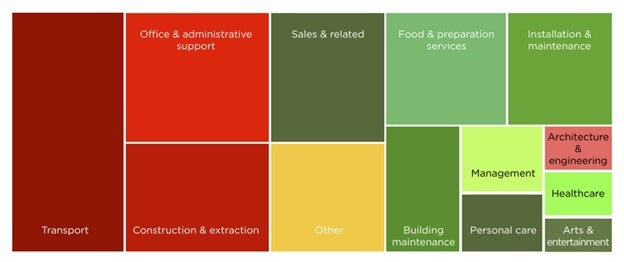
First of all, we note that accountants, cashiers, and telephone operators are already being replaced by machines, and these professions are among the first candidates for replacement by robotic labor. We can also assume that a considerable part of the professions associated with logistics and movement will be replaced by machinery. Taxi drivers, truck drivers, sailors, train conductors — all these professions may well disappear. Construction workers and laborers can be replaced by robots and 3D printers. For example, in China, Foxconn replaced 60,000 factory workers with robots in two years42. Pharmacy robots can replace pharmacists and (partially) doctors; besides, robots can replace farmers, caregivers, librarians, public catering workers, couriers, salespeople, auto mechanics, cooks, cosmetologists, and translators. Artificial intelligence can even partially replace teachers and journalists. Robotics is actively penetrating the military sphere (drones, UAVs, and so on) — quite possibly, in the near future, we will see armies that have no living people in them.
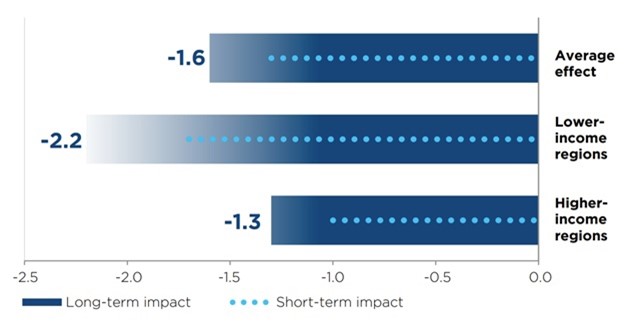
On the chart above, you can see that robotization most acutely affects poor regions. The fact is that as production and technology develop, the share of the service sector grows (just as production previously pushed out agriculture), and a robot will thus take away jobs from fewer people in industry. Moreover, robotization will create high-tech vacancies for the design and maintenance of these very robots. All this is quite relative, but some programmer will demand much more than, for example, a person “at the machine tool”. Accordingly, demand will increase, in particular for more creative professions: landscape design, urban planning, and so on.
At the same time, we must be aware that some professions cannot be replaced by automation even with the highest level of technology development. We will never be able to create a world in which no one works. Current AI will not be able to replace professions requiring compassion, original creativity, or social intelligence. Even neural networks that can generate some text or a picture will be used as a tool. Today’s AI can construct quite good texts that may be indistinguishable from ordinary ones, but they are built on the principle of the probability of the next word in a sentence. AI cannot “understand” the meaning of the entire text as a whole.
AI and robotics will not make humans redundant, but will change their tasks. With obvious exceptions (such as delivery drivers and supermarket cashiers), a relatively small percentage of jobs are subject to full automation. Instead, as research by AlphaBeta has shown, the most significant impact of AI and robots on the future labor market will be the automation of a number of repetitive or technical tasks, giving people more time for creative work and interpersonal interaction43.
Professions that require human judgment of human feelings will remain in demand. For example, a robot is unlikely to be as capable of humor as a live comedian (although the appearance of robot comedians is not excluded — this was played upon, for example, in the movie “Interstellar”), or as capable of sensing human needs as a live marketer. Robots are unlikely to be able to replace politicians. If they can replace athletes, then not all of them — it is unlikely to be interesting on a permanent basis to watch robots, for example, playing football (although at first, it will be a genuinely curious spectacle). Control over nuclear weapons or military command is unlikely to be entrusted to a machine — humanity has feared this at least since the movie “The Terminator”.
Most modern IT professions will remain: programmers, designers, cybersecurity specialists. Exercising control over robots (for example, the development of ethical standards) will most likely also not be handed over to a machine.
The decision-making mechanisms used by machine learning algorithms often remain opaque to human developers, raising questions about the acceptability of delegating authority to these algorithms. In the human world, trust is deeply tied to the justification of decisions. For example, even if AI were better than humans at predicting which prisoners will break the law again or which borrowers will default on a loan, we would not be satisfied with machine-made decisions unless they could explain them. This is especially true for algorithms that exhibit bias after processing datasets that reflect human bias. They can identify useful patterns, but without machine understanding, we will consider their decisions incorrect44.
It is noticeable that most of the professions that will continue to exist after the completion of the Fourth Industrial Revolution belong not to the set of physical wage laborers, but to intellectual wage labor. This suggests that it is precisely the social class of intellectual wage laborers (which can be designated for simplicity as the intelligentsia) that is the main driving force and social pillar of the coming society of the future. But what is this society of the future that we will have as a result of the new industrial revolution? We will write about this next, but for now, let us digress slightly to consider the possible impacts of future technologies on the human organism.
Neurotechnology, genetic engineering, and the human of the future
One of the interesting aspects of the Fourth Industrial Revolution is the possibility of improving the human being themselves. The previous three industrial revolutions improved labor productivity without significant changes to the human design itself — people began to live longer on average, but the maximum lifespan did not increase so radically. The Fourth Industrial Revolution may change the human being themselves: for example, a neuro-interface that improves overall brain performance by connecting additional capacities to it will allow an engineer to construct a blueprint with the power of thought, however crude that may sound. But the most interesting potential lies in genetic engineering — improving intelligence and physical abilities can, of course, lead to inequality, since wealthy parents will be able to edit the genome of their children so that their children will have intelligence, strength, and health superior to those of their “unedited” peers.
We may not see such a picture — any technology will become more and more accessible over time, and countries with a social state can secure such an operation for every child at the legislative level and finance it — this way, even the poorest segments of society will be able to afford children with enhanced intelligence.
Unfortunately, neurotechnology and genetic engineering will be available precisely in developed countries, and we will not be able to edit the genome of every citizen of Earth immediately. The tasks of biotechnology governance systems include respecting cultural and ethical norms, reducing potential biosecurity risks, strengthening trust and dialogue between interested groups, monitoring the impact on equality and issues of justice, and creating flexible and “soft” regulatory approaches.
Furthermore, robots in medicine will likely not replace people, but complement them, as they already do today — the production of automated medical systems increases particularly significantly in some years. The same principle applies here as in other industries where humans interact with humans. “Why should a nurse go down to the laboratory for a blood sample if its delivery can be automated?”. This principle is also applied in libraries — for instance, at the Helsinki Central Library, the book return process is automated — the reader drops the book onto a conveyor, from where it travels on its own to where it needs to go.
What is a developed robotic democracy
First of all, it should be noted immediately that the history of humanity is not linear. Its development could go backward in the event of a series of important victories by sharply reactionary forces, and even stop in the event of a conflict involving the use of nuclear weapons. Many — for example, the well-known science popularizer Carl Sagan — warn that if many future technologies fall into the hands of dictators, this could lead to the most severe consequences for all of humanity45. Therefore, the processes that lead us to make optimistic forecasts are by no means a guarantee that these forecasts will come to pass. If we do not fight for a just society of the future, if we allow reactionary, authoritarian, and populist forces to win, we may lose our chance for this society.
As we have already noted in the article about democracy, there has been a growth in the number of democratic countries and the development of democratic institutions in recent centuries. In this material, another tendency is indicated — the introduction of new technologies, such as robotics and artificial intelligence, into the global economy. The combination of these trends leads us to the fact that the society of the future will function in the form of a developed robotic democracy. What is it?
A developed robotic democracy consists of combining the maximum development of parliamentary democracy institutions, replacing the maximum number of manual labor professions with robotic labor, and simplifying intellectual labor through the improvement of Fourth Industrial Revolution technologies. It is this form of social organization, coupled with the realization of the city of the future concept, that represents the foundation for the broadest realization of progressive values that the planet Earth can afford us. It becomes the basis on which our demands for a three-day workweek and a six-hour workday will be feasible. In addition, it will also have a beneficial effect on the level of social justice — since all work that can be classified as insufficiently prestigious can be robotized, this opens up opportunities for us to further reduce social stratification.
In this society, there can be no place for authoritarian regimes, for states where a person is deprived of the opportunity to influence their own destiny, and where citizens are left at the mercy of tyrants, while free countries feel threatened by their armaments and aggressive foreign policy. An ideal structure is seen as the formation of continental associations along the lines of the European Union on each continent, with the inclusion of parliamentary republics that not only combine the best aspects of the political systems of modern Switzerland and Norway but also strive to increase the level of democracy. Such a system reduces the probability of wars, as we wrote in the article about foreign policy, and will allow for negotiations on arms reduction, redirecting resources into more useful sectors.
This same system allows us to begin the transition to an ecologically neutral economy and society, to provide conditions for socially and ecologically non-destructive progress, as well as for the realization of the concept of sustainable development. Automation can make it possible to realize the “green” dream of localizing production and minimizing environmental damage from transportation. The model of a robotic developed democracy will allow us to effectively respond to such challenges of the “Great Transformation” as the destructive nature of scientific and technological progress, globalization, climate change, and the growth of social inequality.
The space age
Of course, the history of humanity and its struggle for better living conditions cannot end here, since the resources of our planet are not limitless and constrain the far-reaching ambitions of our species. It is not yet known whether it will be possible to provide the entire population of the Earth with robots and the goods they produce, considering that the population is still increasing — resources may not be enough. Therefore, in the future, we must strive for the exploration of new planets, their terraforming and colonization. Among the possible future living spaces for humans, planets (Mercury, Venus, and especially Mars46), minor planets (Ceres), asteroids, and planet satellites (the Moon47, the satellites of gas giants, especially Titan48) are named. It is possible that colonization will be accompanied by the biotechnological improvement of humans, and the colonies will eventually become independent states. An important question is the possibility of the existence of primitive life in the Solar system. Humanity must act with regard to this possibility, since the terraforming of planets and even the introduction of Earth bacteria can be dangerous for hypothetical ecosystems.
Under conditions of exploring new planets, we can open up access to completely new resources, new technologies, and an even greater improvement in human well-being. The expansion of the possible habitable space makes ideas about the radical extension of human life sound reasonable, removing the aura of madness from them.
It is possible that the party system will undergo changes in such a society — specialized parties, which we can already observe today on the example of “green” parties (specializing in ecology) — say, “space” or “immortalist” parties, will be added to the traditional social democratic and liberal parties. The social democratic and liberal parties, in turn, will replace the conservative one (the need for which will disappear due to the fact that humanity will determine a list of inefficient political, cultural, and economic practices), and will differ primarily in details concerning issues of the state budget distribution. However, all this is mere speculation.
Conclusion
The Fourth Industrial Revolution that has begun promises us not only problems, but also huge opportunities. Coupled with democratization processes, it can raise the standard of living of humans much higher than today, can allow us to reduce working hours, and move to a new stage of development that opens up even more impressive prospects. However, for this to happen, humanity must pursue correct progressive policies and strive to achieve a developed robotic democracy.
We need to invest in science, medicine, and innovation, soften the blow for the populations most vulnerable to automation, and direct resources toward their retraining and education. Such policies are already being implemented in various countries — for example, in Canada, for people who lost their jobs in the mining industry due to automation, there are various public works programs where people are trained to work with alternative energy sources49, and biotechnology has received incredible funding thanks to the pandemic.
We express our gratitude for help in writing the article to Yakov Matyushin, Egor Chernyshev, and Artem Kuznetsov.
- Klaus Schwab. Shaping the Fourth Industrial Revolution / Klaus Schwab, Nicholas Davis. – 320 p. – Moscow: Eksmo, 2018. – p. 18-19.
- R.M. Nureev. Economic Comparative Studies (comparative analysis of economic systems): textbook / R.M. Nureev. – 710 p. – Moscow: KNORUS, 2017. – p. 271.
- McCloskey, 2016 // cit. by: Klaus Schwab. Shaping the Fourth Industrial Revolution: [translated from English] / Klaus Schwab, Nicholas Davis. – 320 p. – Moscow: Eksmo, 2018.
- M.S. Hossain, N.A. Madlool, N.A. Rahim, J. Selvaraj, A.K. Pandey, Abdul Faheem Khan. Role of smart grid in renewable energy: An overview // Renewable and Sustainable Energy Reviews. Volume 60, July 2016, Pages 1168-1184.
- K. Yanukevich. Waymo launched an autonomous taxi service in San Francisco // RBK Trends (trends.rbc.ru). October 25, 2021. [Electronic resource]. URL: https://trends.rbc.ru/trends/industry/6126390f9a79473d154cd294 (Accessed 03/26/2022).
- A. Chistyakov. How Yandex makes ordinary cars autonomous // Habr (habr.com). November 17, 2021, 14:07. [Electronic resource]. URL: https://habr.com/ru/company/yandex/blog/585444/ (Accessed 03/26/2022).
- Ministry of Transport to begin testing autonomous trucks on the M11 highway from 2022 // Izvestia (iz.ru). September 2, 2021, 7:31. [Electronic resource]. URL: https://iz.ru/1215919/2021-09-02/mintrans-nachnet-testirovat-bespilotnye-gruzoviki-na-trasse-m-11-s-2022-goda (Accessed 03/26/2022).
- Yara Birkeland // Yara (www.yara.com). [Electronic resource]. URL: https://www.yara.com/news-and-media/press-kits/yara-birkeland-press-kit/ (Accessed 03/26/2022).
- A. Korenyako, S. Burmistrova. Russian Railways named new deadlines for launching autonomous trains // RBK (www.rbc.ru). May 26, 2021, 00:00. [Electronic resource]. URL: https://www.rbc.ru/business/26/05/2021/60ad48509a794794feb560d5 (Accessed 03/26/2022).
- An autonomous train with no global analogues presented in Germany // Interfax (www.interfax.ru). October 11, 2021, 20:46. [Electronic resource]. URL: https://www.interfax.ru/world/796519 (Accessed 03/26/2022).
- N. Peshkova. Airbus developed autonomous flight technology for passenger aircraft // Forbes (www.forbes.ru). [Electronic resource] URL: https://www.forbes.ru/tehnologii/378115-airbus-razrabotala-tehnologiyu-bespilotnyh-poletov-dlya-passazhirskih-samoletov (Accessed 03/26/2022).
- Drones for transporting cargo weighing up to 80 kg to appear in Russia in 2022 across regions // RIA Novosti (ria.ru). March 3, 2020. [Electronic resource]. URL: https://ria.ru/20190925/1559090346.html (Accessed 03/26/2022).
- A.S. Balashev. What can be made on a 3D printer? Models for sale, home use, and other spheres // Tsvetnoy Mir (cvetmir3d.ru). May 15, 2021. [Electronic resource]. URL: https://cvetmir3d.ru/blog/primenenie/chto-mozhno-sdelat-na-3d-printere-top-25-idey/ (Accessed 03/26/2022).
- Klaus Schwab. Shaping the Fourth Industrial Revolution / Klaus Schwab, Nicholas Davis. – 320 p. – Moscow: Eksmo, 2018. – p. 169.
- Unmanned 24/7 Stores – An Overview of Concepts and Technologies // shopreme (www.shopreme.com). [Electronic resource]. URL: https://www.shopreme.com/blog/unmanned-24-7-stores-an-overview-of-concepts-and-technologies/ (Accessed 03/26/2022).
- E. Esperazus. China opened the first-ever factory without people // MK (www.mk.ru). August 30, 2015, 13:06. [Electronic resource]. URL: https://www.mk.ru/science/2015/07/30/kitay-otkryl-pervuyu-v-istorii-fabriku-bez-lyudeybrakodelov.html (Accessed 03/26/2022).
- Klaus Schwab. Shaping the Fourth Industrial Revolution / Klaus Schwab, Nicholas Davis. – 320 p. – Moscow: Eksmo, 2018. – p. 144.
- K. Yanuskevich. Xavier police robot appeared on the streets of Singapore // RBK Trends (trends.rbc.ru). October 13, 2021. [Electronic resource]. URL: https://trends.rbc.ru/trends/industry/613f04739a7947af25776881 (Accessed 03/26/2022).
- A.V. Taranov, M.S. Nurkenova, A.E. Kasenova. Power line maintenance robots capable of overcoming obstacles: current state analysis and challenges // Technical Sciences, 11-2 (38), 2019.
- British company with Russian roots Moley Robotics developed a robot kitchen for $333 thousand // VC (vc.ru). December 7, 2020. [Electronic resource]. URL: https://vc.ru/tech/184859-britanskaya-kompaniya-s-rossiyskimi-kornyami-moley-robotics-razrabotala-kuhnyu-robota-za-333-tysyachi (Accessed 03/26/2022).
- R. Khachatryan. “Shokoladnitsa” began testing robot waiters in two Moscow coffee shops // VC (vc.ru). October 30, 2020. [Electronic resource]. URL: https://vc.ru/food/172091-shokoladnica-nachala-testirovat-robotov-oficiantov-v-dvuh-moskovskih-kofeynyah (Accessed 03/26/2022).
- French engineers developed a weeding robot // 1000 ECOFARM (1000ecofarms.com). February 26, 2020. [Electronic resource]. URL: https://www.1000ecofarms.com/ru/magazine/id1926-2020-02-26-robot-propolnik-razrabotka-francuzskih-inzhenerov (Accessed 03/26/2022).
- A. Sofrygin. Agrobot. Unmanned strawberry robot from Spain // bespilot (bespilot.com). April 21, 2020. [Electronic resource]. URL: https://bespilot.com/news/687-agrobot-strawberry (Accessed 03/26/2022).
- TOP new agricultural robots of 2020 // GlavPakhar (glavpahar.ru). February 4, 2021. [Electronic resource]. URL: https://glavpahar.ru/articles/top-novyh-selskohozyaystvennyh-robotov-2020-goda (Accessed 03/26/2022).
- I. Bubnova. 10 professions where robots have already replaced humans // GeekBrains (gb.ru). December 28, 2017. [Electronic resource]. URL: https://gb.ru/posts/ai_vs_human (Accessed 03/26/2022).
- MIT Technology Review 2017 // cit. by: Klaus Schwab. Shaping the Fourth Industrial Revolution / Klaus Schwab, Nicholas Davis. – 320 p. – Moscow: Eksmo, 2018.
- Fortune 2017 // cit. by: Klaus Schwab. Shaping the Fourth Industrial Revolution / Klaus Schwab, Nicholas Davis. – 320 p. – Moscow: Eksmo, 2018.
- IBM technologies in healthcare // RBK (cognitive.rbc.ru). [Electronic resource]. URL: http://cognitive.rbc.ru/health-tech (Accessed 01/22/2022).
- A. Nikitin. IBM Watson created a cancer treatment plan in 10 minutes // Hightech (hightech.fm). August 14, 2017. [Electronic resource]. URL: https://hightech.fm/2017/08/14/watson-makes-treatmen (Accessed 03/26/2022).
- Russian government announced plans to overcome bureaucracy in the provision of public services // Izvestia (iz.ru). [Electronic resource]. URL: https://iz.ru/1167707/2021-05-22/v-pravitelstve-rossii-zaiavili-o-planakh-poborot-biurokratiiu-pri-okazanii-gosuslug (Accessed 03/26/2022).
- Shelly Podolny. If an algorithm wrote this, how would you know? // The New York Times, March 7, 2015.
- Ibid., p. 49.
- Klaus Schwab. The Fourth Industrial Revolution. – 209 p. – Moscow: Eksmo, 2019. — p. 18.
- James Manyika and Michael Chui. Digital era’s hyper-scale challenges // The Financial Times, August 13, 2014.
- Klaus Schwab. The Fourth Industrial Revolution. – 209 p. – Moscow: Eksmo, 2019. — p. 50.
- Monthly unemployment rate in the United States from February 2021 to February 2022 // Statista (www.statista.com). March 2022. [Electronic resource]. URL: https://www.statista.com/statistics/273909/seasonally-adjusted-monthly-unemployment-rate-in-the-us/ (Accessed 03/26/2022).
- https://www.igmchicago.org/surveys/robots-and-artificial-intelligence-2/
- Klaus Schwab. The Fourth Industrial Revolution. – 209 p. – Moscow: Eksmo, 2019. — p. 51.
- Klaus Schwab. Shaping the Fourth Industrial Revolution / Klaus Schwab, Nicholas Davis. – 320 p. – Moscow: Eksmo, 2018. – p. 12.
- Yury Kvashnin. Basic income for European countries: from theory to practice // Modern Europe, 2019, No. 3, pp. 171‒181
- Klaus Schwab. Shaping the Fourth Industrial Revolution / Klaus Schwab, Nicholas Davis. – 320 p. – Moscow: Eksmo, 2018. – p. 15.
- Ibid., p. 151.
- Ibid., p. 154.
- Ibid., p. 151.
- C. Sagan. Pale Blue Dot: A Vision of the Human Future in Space / Carl Sagan. – 406 p. – Moscow: Alpina Non-fiction, 2016. – p. 300-301.
- L. Karaseva. Terraforming: is it possible to change the climate on planets // RBK Trends (trends.rbc.ru). September 9, 2021. [Electronic resource]. URL: https://trends.rbc.ru/trends/futurology/605de94e9a7947b889e5dec5 (Accessed 03/26/2022).
- N.I. Gordienko. Astronautics: An Illustrated Guide. – 96 p. – Moscow: Eksmo Publishing House, 2017. – p. 39.
- Matt Davis. Top 4 candidates in our solar system for terraforming // Big Think (bigthink.com). November 7, 2019. [Electronic resource]. URL: https://bigthink.com/hard-science/terraforming-solar-system/ (Accessed 03/26/2022).
- Province offers $40M to offset job losses in Alberta coal industry // CBC (www.cbc.ca). November 10, 2017, 14:00. [Electronic resource]. URL: https://www.cbc.ca/news/canada/edmonton/coal-industry-transition-fund-1.4397751 (Accessed 03/26/2022).