Tony Blair and the myths about him
One of the most prominent figures of social democracy in the late 20th and early 21st centuries is the British politician Tony Blair. The list of his achievements is great, yet even today they are not eager to mention them even in the party whose leader he was. Like many other social democrats, among political opponents he is perceived as an enemy by both Marxists and the right. In this material, we will try to explain why.
Sir Anthony Charles Lynton Blair was the leader of the Labour Party of Great Britain from 1994 to 2007 and prime minister of the country from 1997 to 2007 (longer than any other Labour prime minister1). He entered the history of the social democratic movement as one of the main creators of “New Labour”, as well as an implementer of the ideas of the “Third Way” of social democracy, which caused rejection of him by Marxist social democrats. But the loudest criticism came from the communists.
“The Third Way” has another name — “New Labour”. This is the name for the policy of reforms carried out by Tony Blair. The goal of the reforms was to “give the party a new direction, especially in the early stages of his leadership”2 (for example, the successful campaign to repeal Clause IV of the party constitution, which committed it to accepting a policy of widespread public ownership of industry).
Largely due to the cultural hegemony of communists in the left spectrum of Russian public policy (and especially in the media space), a negative attitude toward Tony Blair has developed in our country. His intervention in the liquidation of Saddam Hussein’s dictatorship in Iraq also played a role — the Russian nomenklatura and its allies, apparently, sensed in this a danger to their power and “cushy” jobs. Thus, communists from the CPRF began to make regular attacks on Blair: articles on their official website accused Blair of “carrying out reforms beneficial to big capital”3. Here is another example of a falsifier from the CPRF, who transmits traditional communist myths about social democracy (many of them were reviewed by us here) one after another:
So who is Tony Blair? Whose interests did his policy realize? The interests of all citizens? Of one class? Of capital?
Let us briefly examine Blair’s biography, after which we will move on to his political activity as prime minister. Upon closer examination, it will turn out that his reforms had a beneficial effect on broad sections of society, and the majority of stereotypes about him are merely baseless or demagogic propaganda of political forces that oppose reforms carried out in the interests of the majority.
Contents
Early years
Tony Blair was born into the family of a lawyer and himself received a legal education, specializing in labor and commercial law. He began to take an interest in politics thanks to his wife, also a lawyer — Cherie Booth, whose parents were socialists4. In the late 1970s, he joined the Labour Party, despite the fact that social democrats at that time had suffered a heavy defeat by the conservatives, who went on the offensive in Great Britain for many years (from 1979 to 1992, Labour suffered defeats in parliamentary elections). Having entered the Labour shadow cabinet in 1988, Blair began to actively promote the idea that the party needed to change something in order to have the opportunity to win elections again and promote policy in the interests of the majority. One of his main targets became the traditional fetish of the left of the past — nationalization. Blair argued that it was completely unnecessary, and that it could be carried out not in the interests of the majority of citizens. He also relied on the work of sociologist Anthony Giddens, with whom they developed the concept of the “Third Way” for social democracy.
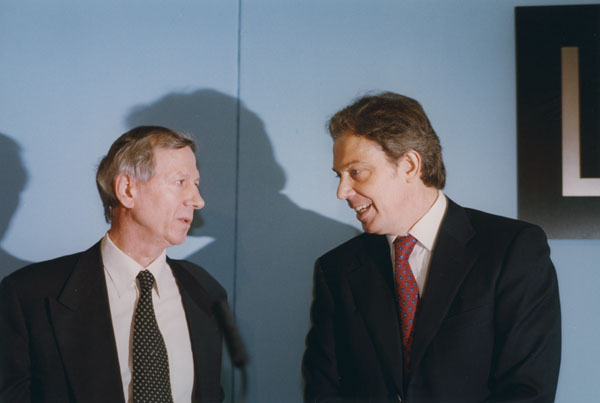
Anthony Giddens (born in 1938) currently has outstanding achievements in the development of sociological science. In particular, he developed the theory of structuration and an original holistic concept of modern society. Giddens is critical of Marxism, and his intellectual activity largely provided the theoretical justification for the new Labour policy. Some of his works have been translated into Russian (here are just some of his works: Giddens A. Sociology. M.: URSS, 1999; The same. Sociology. 2nd ed., completely revised and expanded. M.: Editorial URSS, 2005; The same. Fate, risk, and security // THESIS. 1994. No. 5. P. 107-134; The same. Politics, administration, and the state // Rubezh (almanac of social research). 1992. No. 3. P. 78-107; The same. The Constitution of Society: Outline of the Theory of Structuration. M.: Academic Project, 2003; The same. Runaway World: How Globalization is Reshaping Our Lives. M.: Ves Mir, 2004).
While the Old Labour made the “socialization of the means of production” its idol, Blair set progressive values as a guideline, as the Swede Nils Karleby had done (we wrote about this in the article with myths about social democrats). Blair believed that the direction of socialist thought based on a quasi-scientific Marxist view of socialism was mistaken. On the contrary, he put forward the idea of returning to a strategy closely connected with European social democracy. This strategy consisted of a social democratic policy based on the value system of ethical socialism5. Unlike the Marxist interpretation of socialism, the ethical model is not tied to time, is not restrained by economic determinism, and possesses the qualities of ideological flexibility, so in demand in the post-industrial era. Blair believed that it was necessary to abandon the concept of super-scale socialization of property in society, and for the sake of this, it was necessary to open a discussion about amending Article IV of the Labour Party Constitution6.
In 1992, John Smith was elected leader of the Labour Party and appointed Blair as shadow home secretary. When Smith suddenly passed away in May 1994, Tony Blair was elected party leader in July with the support of 57 percent of the vote. Having won leadership in the party, he implemented his idea, which found support among Labourites. This led to Labour’s abandonment of the worship of nationalization. Thus, Blair can be considered a true follower of Scandinavian-type social democracy, progressive social democracy, and a conduit of its ideas in the Labour Party.
Leadership in the party and the fight for parliament
By mid-1995, Blair had seriously updated the Labour Party’s platform. He abandoned the party’s stated commitment to the nationalization of the economy (having achieved the party’s amendment of Clause IV of its Constitution, which declared the nationalization of the means of production, distribution, and exchange to be the party’s main goal7). He faced the most powerful resistance from party traditionalists, who were prepared to see the party suffer defeats in political elections just to remain “faithful” to traditions and ideological dogmas that had lost their relevance. To emphasize the divergence from their views, Blair promoted the name “New Labour” for his concept. He looked just as confident in debates in parliament as he did in the fight against the party opposition, throwing stinging phrases at representatives of the ruling party:
Under his leadership, the Labour Party inflicted a crushing defeat on the Conservatives in the national municipal elections held in May 1995, and then achieved a convincing victory over the Conservatives in the general election in May 1997. The Labour Party rose sharply from a deep crisis to triumph, winning a majority of 179 seats in the House of Commons, the largest number of seats in the party’s history and the largest among all parties since 19358. The cabinet it formed proved to be highly inclusive — there were more women in it than ever before, and it also included the first minister in the country’s history to openly declare his homosexuality9. Blair himself became the youngest head of the British government since 1812.
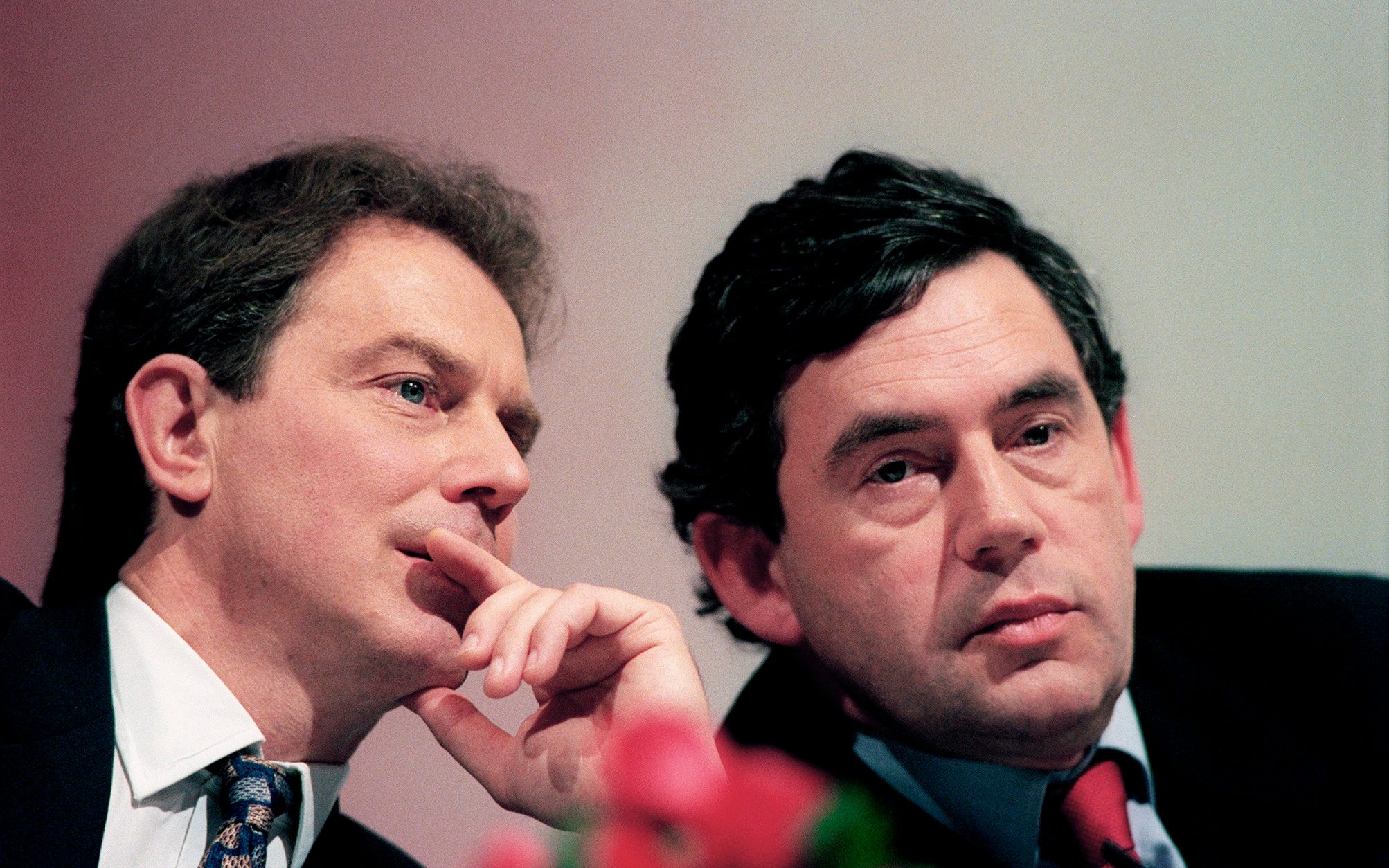
Here, Blair’s readiness for struggle and for persuading opponents should be especially noted. It is significant that he did not start creating his own separate movement, which would have had only his like-minded people and which would have likely been microscopic. That is what a group of like-minded people who broke away from the party did, creating the “Social Democratic Party” of Great Britain10. It did not find much success and over time dissolved into the Liberal Party. Blair decided to act differently.
He came into a party that seemed obsessed with nationalization, where there were many people who fiercely defended it, who left the party because of Blair’s policy, and who accused him of betrayal and other sins. And together with his like-minded people, he changed that party. And behind it — the entire country.
In power
During his first year in office, Blair organized referendums, which resulted in more rights being granted to the Scottish Parliament and the Welsh Assembly11, which were elected for the first time in 199912. The steps taken by the “New Labour” toward the decentralization of power opened the way for the gradual transformation of Great Britain from a unitary to a federal state. In 1998, Tony Blair held a referendum on establishing the London Assembly and an elective post of mayor of the capital (before him, the mayor in the city was not elected). In the same year, he signed the Belfast Agreement (“Good Friday Agreement”), which provided for the creation of autonomous government bodies, mandatory disarmament of militarized groups, including the Irish Republican Army (IRA), as well as amnesty for participants in the conflict13. Northern Irish people also received their own parliament, police reform, and the adoption of some other measures. But the most important acquisition of the Irish under Tony Blair was peace after long decades of bloody violence. This was a huge success.
In England itself, before Blair, the House of Lords (the upper house of parliament) consisted exclusively of hereditary peers. Thanks to his reform of the upper house of parliament, the number of hereditary peers was reduced to 9214; to be more precise, out of 750 hereditary peers, only 92 people retained their seats in the house (those who left the house gained the right to vote in parliamentary elections), along with 580 life peers, including bishops15. Under Blair, the Freedom of Information Act was also passed, which established the public right of access to information held by government bodies16. However, many of the democratic reforms that Blair planned were blocked. British society, where conservative views are very strong, was frightened by the scale of the changes he initiated.
Yet, Doctor of Political Science Alexey Gromyko emphasizes that under him, “the decentralization of power, the pluralism of opinions and political forces reached unprecedented scales, and the duration of the economic upswing broke all records”17. He also notes that Tony Blair was not associated with past Labour leaders, nor with past Labour policy, and consequently, not with their mistakes18. We will, however, discuss economic growth further on.
In 1998, the Labour prime minister passed the National Minimum Wage Act, which experts would later call the most successful government policy in decades19. After the Conservative policy in the 1980s, wages in some workplaces had fallen below what was considered a living wage. Here is how the minimum wage changed after the law came into force:

Blair’s cabinet also introduced a system of tax credits for low-income families20, the goal of which was to lift people out of poverty without hindering their incentives to seek work. Any single person earning less than £14,000 per year, any couple earning less than £19,000, and any applicant with children earning less than £40,000 were entitled to receive tax credits (in 2014, already after Blair, there were 4.6 million families receiving tax credits21). As a result of these reforms, between 1998/99 and 2012/13, the number of children living in families below the poverty line (defined as less than 60% of the median wage) fell from 35% to 19%22. Later, the Conservative Chancellor George Osborne would cut these benefits, but before that, he would admit how happy he was that he and David Cameron would not face Blair in an election (the reasons for which we will explain later), because he was a “Tory-destroying machine”:
If you are interested in quantitative calculations, the number of children living in relative poverty fell by 800,000 between 1997/1998 and 2009/2010, and in absolute poverty by more than 2 million23. The number of pensioners lifted out of relative and absolute poverty in the same period was about 500,000 and 3 million people, respectively. Blair’s government also supported workers’ rights — for example, in 1999, former miners suffering from work-related lung diseases were paid £2 billion in compensation24.
In May 2001, he was re-elected for a second term, winning a majority of 167 seats in the House of Commons — the most impressive majority in the history of British second-term elections25. In 2004, same-sex marriage was legalized in Great Britain; around the same time, Section 28 of the UK Local Government Act, introduced under Thatcher, which prohibited the “promotion of homosexuality”, was repealed. While Thatcher made hypocritical statements about her commitment to freedom, her government ordered local authorities to suppress materials that did not provide a negative assessment of homosexuality26. The number of homeless people between 1999 and 2002 fell by two-thirds (while from 2010 to 2018 under the Conservatives, it rose again by almost two and a half times)27. From March 1997 to March 2009, waiting lists for hospitalization in the NHS were reduced from 13 to four weeks28.
According to a report by the Institute for Fiscal Studies, as a result of Blair’s reforms, the poorest three-fifths of British citizens became wealthier, while the richest two-fifths saw their incomes reduced29. According to other data, the 10% poorest households increased their incomes by approximately 13%, while the 10% richest lost nearly 9%30. This was achieved in part by the introduction of an additional windfall tax on the “natural monopolies” that had been privatized under the Conservatives31. During Blair’s premiership, specifically in 2001, admission to many of Britain’s national museums was made free for everyone32.
From 1996/97 to 2009/10, the amount spent by the government on education increased in real terms by 83% — from £56 billion to £103 billion33, and spending on healthcare more than doubled in real terms from £64 billion to £136 billion. In no other 13-year period since the Second World War has the UK seen such a significant increase in spending in either of these areas. As a percentage of GDP, these figures were also at their highest. The number of medical personnel in the NHS increased by almost 80,000. The number of teachers in schools increased by almost 50,000, and support staff by almost 200,000. By 2010, Blair’s education reforms had borne fruit in the form of a massive increase in student achievement — 76% of English students achieved high grades in their GCSEs, compared to 45% in 199734.
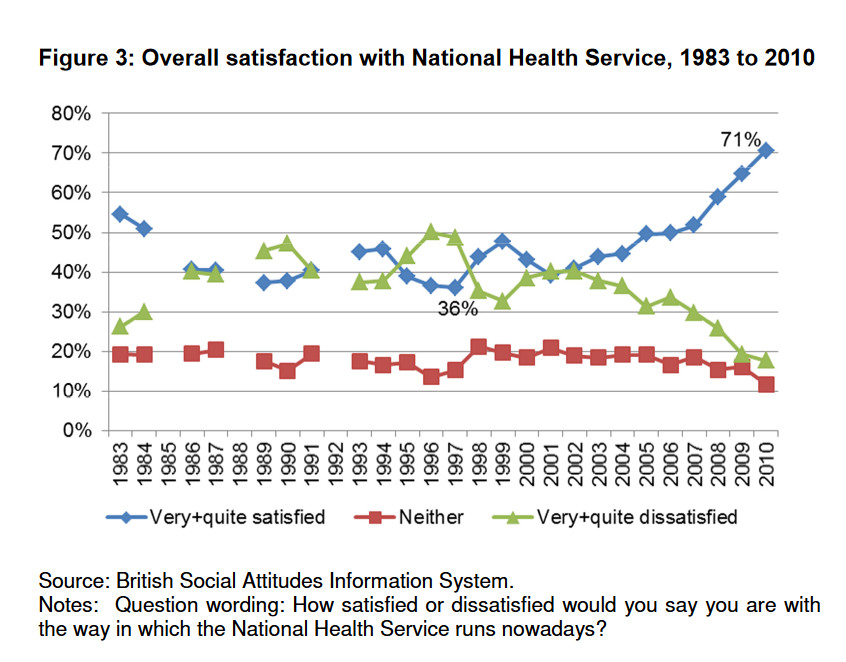
The Sure Start program, launched by Blair’s cabinet, opened about 3,500 children’s centers across the country35, with the aim of improving children’s health and education by providing relevant services. As later studies showed, this program reduced the number of hospital admissions and saved the budget millions of pounds36.
Naturally, the Conservatives were not fond of such budget spending on the broad segments of the population. However, usually sharp-tongued themselves, they could do nothing in the House of Commons debates against Blair, whose tongue proved even sharper:
Some of his reforms were, however, controversial. For example, the Higher Education Act 2004 introduced tuition fees at universities37, which many perceived as an attack on the social state. At the same time, the Office for Fair Access to Higher Education was created, financial assistance was provided to students, and students from low-income families were partially or fully exempted from tuition fees. Tuition costs, which had been between £1,300 and £4,985 per year before 1998, had fallen to £1,075 by 2001. Students were also eligible for a student loan, the amount of which could reach £4,000 at that time (and the British education system simplified the ability to repay this money). The idea behind introducing paid tuition was as follows: financial resources should be allocated not to university officials, who might spend them inefficiently or engage in corrupt activities, but to the students themselves. Thus, inefficient universities that students did not want to attend would receive nothing, while the activities of efficient ones would be stimulated. Those who have been in free public clinics have surely wondered whether it would be better if the state gave the money directly, allowing you to choose which clinic to go to. Of course, such an idea had its drawbacks. And yet, Blair’s government did not only increase public spending, it sometimes cut it too. It could not always just spend — to increase spending on important initiatives, it made decisions to cut spending in other areas. This is an inevitable consequence of limited resources, which every government faces.
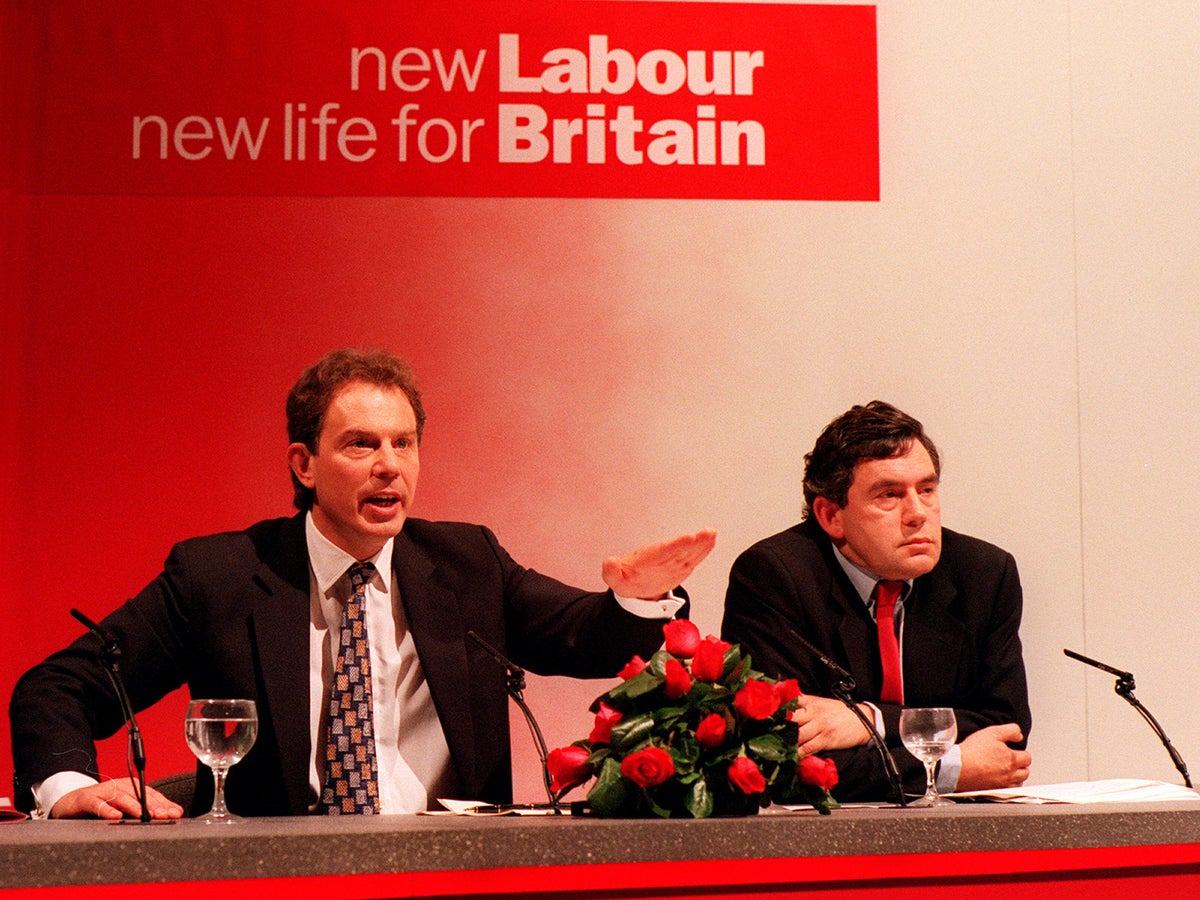
After the Iraq War, which we will discuss later, Blair faced intense media backlash from all sides. Traditionalists from his own party also turned against him, branding him a “war criminal”38. Eventually, in October 2004, under public pressure, he promised that he would not plan to run for a fourth term as prime minister, though he would stand for a third. In 2005, the Labour Party won the election again, but this time its dominance in parliament was sharply reduced. In February 2006, Blair suffered a defeat in parliament: a bill he proposed to make the incitement of racial hatred a criminal offense was rejected by a majority of one vote. In March 2006, political opponents decided to intensify the harassment of Blair related to the Iraq War and leaked information to the media alleging that certain wealthy entrepreneurs who had provided large secret loans to the Labour Party had received seats in the House of Lords, knighthoods, or other titles. Tony Blair himself was forced to give evidence on this case to the police, becoming the first serving head of government in British history to be questioned by Scotland Yard (London police). In July 2007, the Crown Prosecution Service, following an investigation, concluded that the Labour Party had not sold any titles39, and the allegations by Scottish nationalists proved baseless (this issue has been monitored in British society since 1925, when the Liberals led by Lloyd George were caught red-handed trading titles40). Following Labour’s election losses in the Scottish Parliament and local elections in England, Tony Blair resigned as prime minister on June 27, 2007. As Alexey Gromyko notes, “his decision to step down early does him credit as a politician, especially a politician at the pinnacle of power, who found the strength to subordinate personal interests to the interests of his organization”41.
As Britannica notes, Blair’s decade in power was marked by continuous economic growth42. This became yet another collapse of the stereotype that “the left cannot achieve economic growth”. Between 1997 and 2007, more than 3 million new jobs were created in the country43. Blair’s policy proved so successful that, according to some experts, the Conservative who came after him, David Cameron, was forced to move to the left and largely continue his policies44.
Foreign policy
The foreign policy of the Blair cabinet was always decisive. When ethnic cleansing continued in Yugoslavia in the second half of the 1990s (the Srebrenica massacre had already occurred in 1995, and even before that there were events like the Bjelovac massacre), Tony Blair compared them to the Nazis’ purges. He remembered the indecision of British Prime Minister Neville Chamberlain, who for a long time unsuccessfully tried to appease Adolf Hitler, for which he was strongly criticized later (although Blair, who decided to act differently, would be criticized no less — apparently, the public cannot be pleased in these matters). Blair also remembered that not long before, under the Conservatives, according to journalist John Sweeney, the Ministry of Defence worked to silence or downplay information about these purges45. Therefore, he became one of the organizers of the operation in Kosovo, which put an end to the genocide. Two years later, peace was established in the territory of the former Yugoslavia, which had been torn apart by wars and national conflicts, putting an end to the Yugoslav Wars of 1991–2001 — the bloodiest wars in Europe since the end of the Second World War.
For this, Blair was immediately hated by authoritarian leaders and the nomenclature (including the reactionary part of the Russian nomenclature) all over the world, who considered their citizens their property to be disposed of at their own discretion, and who could not tolerate even the thought that someone might have the audacity to meddle in their affairs and protect their “subjects”, as Blair intervened in the Yugoslav chaos. From then on, he became almost public enemy number one for them. Thus, the main mouthpiece of current Russian propaganda — Russia Today — regularly organized information attacks against him.
In 2000, Tony Blair sent 1,500 British troops to stop the civil war in Sierra Leone, which had been ongoing since 1991, and the organization that started it — the Revolutionary United Front — a rebel army that used children as soldiers and took civilians into sexual slavery46 and was involved in other crimes against humanity47. In 2002, the war was over and peace came to Sierra Leone, and in 2007 Tony Blair was officially proclaimed a Paramount Chief of Sierra Leone and entered the pantheon of immortal national heroes, being awarded the title of “peacemaker”48.
Blair himself also considers it an achievement that the share of the UK budget allocated to humanitarian aid to other countries tripled under him to 0.7% of GDP, making the UK the first G20 country to reach this indicator49 (the Conservatives would later cut this spending).
Blair defended the same principles when he made the decision to start the war against Iraqi dictator Saddam Hussein. In March 2003, the war began, and it ended with the overthrow of Hussein. However, this operation was not as successful — coalition forces faced significant losses, along with civilian casualties; after the withdrawal of American troops in 2011, a civil war began in Iraq, and the problem of violence in the region remained, along with the problem of a low standard of living. Furthermore, because Blair cited the presence of weapons of mass destruction (which some intelligence reports had indicated) in the Iraqi military as one of the reasons for starting the war, which were ultimately not found after the war, this served as a pretext for launching an information campaign against him, which was joined by everyone he had managed to offend — British Conservatives, traditionalists in the Labour Party, authoritarian dictators, and European leaders who feared the strengthening of Blair’s authority and his rise as a leader of all of Europe. This campaign aimed to frame the issue as if it were not Saddam Hussein who was to blame for the Iraq War, but those who subdued him by force. And this campaign was quite successful. Traditionalists in the Labour Party, who actively attacked him for his intervention in Kosovo and Iraq, managed to force Blair to promise to resign as party leader.
Although Blair still says that if he had the choice to make again, he would still choose to overthrow the Hussein regime, it must be acknowledged that this decision meant risking the lives of many British soldiers, as well as the lives of civilians in Iraq, and it quite rightly caused Blair enormous damage. As the political editor of the conservative newspaper Daily Telegraph, George Jones, notes, “if it were not for the Iraq war, Tony Blair would undoubtedly be seen as the most successful prime minister in the country’s history”50. Such an active foreign policy proved to be an unbearable burden even for the leader of “New Labour”.
This lesson has shown all of us that the ideas of “world revolution”, whether their goal be communism or democracy, are beyond the reach of almost anyone — the majority of citizens do not wish to go to war or spend their own wealth on a war for the freedom of people distant to them. The methods we proposed in this article are more grounded and reasonable. Tony Blair’s “world revolution” (for the overthrow of dictators one after another can be interpreted as a step toward forcing world democratization) was in some measure a noble idea, but extremely difficult. Did he act wrongly? The very fact of being condemned by the public does not prove his error. As far back as the 19th century, the British philosopher John Stuart Mill, in his iconic essay “On Liberty”, wrote about the tyranny of the majority, which is capable of going against alternative opinion and freedom of thought and action in general in defense of its own possible misconceptions51. As we know from history, Neville Chamberlain chose a completely different path, and he was nonetheless just as strongly criticized and continues to be criticized. It is possible that the Labour prime minister even reduced potential losses, because if Saddam had become even stronger, then an operation would have been inevitable in any case due to his aggressive behavior, only the casualties would have been significantly higher. This leads us to the conclusion that social democrats must increase their presence in the information field so that their position is not crushed by attacking mass media. Furthermore, the elimination of dictators and international criminals by military methods is permissible only in exceptional cases when there is a high probability of a quick resolution to the problem without civilian casualties and with minimal losses to one’s own troops, provided they fully support the operation.
In the opinion of Alexey Gromyko, one of the foreign policy tasks left unresolved by Blair (as well as by Major) was the full-fledged return of Great Britain to the circle of European leaders. This problem was inherited by both the Conservative prime minister and the Social Democratic prime minister from Margaret Thatcher, who regarded European integration as a whole, and Germany and France in particular, with hostility and suspicion52.
After stepping down
After Tony Blair stepped down, the offices of prime minister and leader of the Labour Party passed to his close ally Gordon Brown, whose term in power coincided with the global crisis of 2008. The crisis, combined with the lack of successes as high-profile as Blair’s, and the fact that Brown was not as brilliant an orator, led to a decline in the ratings of New Labour and a Conservative victory in the elections. Brown was an integral part of Blair’s successes, a most important participant in his policy, but without a figure like the former prime minister, New Labour was unable to cope with its intensifying competitors.
In March 2017, Tony Blair created the Institute for Global Change to combat populism53 and promote the values of democracy both in Europe and throughout the world. Apparently, he drew conclusions from the situation in Iraq and understood that world democratization would be achieved primarily through education. In various polls determining the best prime minister in British history, Blair regularly occupies one of the highest places — traditionally, Clement Attlee and Tony Blair participate in them from the Labour Party, and Winston Churchill and Margaret Thatcher from the Conservative Party. The magazine The Week placed the leader of New Labour in second place54, and experts in 2016 placed him in third place among post-war prime ministers55. Today, the former prime minister no longer plays a leading role in politics, but his story is not yet over.
Within the Labour Party, some time after Blair’s resignation, there was a revanche of traditionalist-type Labourites, and Jeremy Corbyn became the head of the party. Their manifesto, which called for raising taxes on the wealthy, the renationalization of railways and the post, free university education, and the realization of other mostly not-bad demands, turned out to be very popular. In the 2017 parliamentary elections, they showed a fairly high result, garnering 40% of the vote, however, this did not help them win the election (the Conservatives garnered 42.4%), and in the 2019 elections, a crushing failure awaited them — they received the lowest number of seats in parliament since 193556 and garnered 32.2% of the vote (compared to 43.6% for the Conservatives). Among the reasons for their defeats are the “proto-Marxist” nature of their leaders’ rhetoric and anti-Westernism57. Such ideas could be popular only among small sects or young radicals (the Politico portal noted that “young Labour supporters don’t need someone to make the party electable. They need someone to articulate their outrage”58), but not in the broad masses. In 1983, the Labourites had already stood on semi-Marxist and “anti-Western” positions, and one member of parliament called their manifesto “the longest suicide note in history”59. However, traditionalists do not wish to admit this and are trying either to hush up Blair’s achievements or to attack him, but they are proving extremely unconvincing. Blair himself could not stand it and decided to answer these constant attacks after all:
In 2020, readers wrote in The Guardian: “It is a disgrace that none of the candidates for the Labour leadership has the courage to pay tribute to Blair. They should remember that if it were not for him, the Tories would have come to power, as a result of which we would have lost our National Health Service, the BBC, and the welfare state, and no one would have ever known about these candidates”60. Meanwhile, newspaper columnist Andrew Rawnsley wrote that “even after a crushing defeat, the Labour Party will do anything but listen to the advice of its only living winner”61. He drew attention to a television program in which three candidates for the Labour leadership were offered to choose the best Labourite of the last 50 years, and no one, not even Keir Starmer, chose Tony Blair. According to Rawnsley, the impression is that Labourites hate their winners and adore failures.
Today, it is increasingly obvious that the pro-Marxist model of Labourism is not capable of achieving even remotely regular victories — this is confirmed both by the 18-year period of Conservative rule after 1979 with four consecutive election losses, and by the party’s recent losses, the number of which has reached four again since Blair’s departure. A logical consequence of realizing and accepting these facts should be a return to non-Marxist, progressive social democracy, as well as an acknowledgement of Tony Blair’s achievements.
We express our gratitude to Adam Kvizok and Artem Kuznetsov for their help in writing this article.
- T. Gallaher. Tony Blair // Encyclopedia Britannica (www.britannica.com). [Electronic resource]. URL: https://www.britannica.com/biography/Tony-Blair (Accessed: 03/23/2022).
- Giddens A. Sociology. M., 2005. P. 611
- The British Crown is being attacked from the left. In Albion, the popularity of politicians advocating for Donbas and against NATO is growing // Official website of the CPRF (www.kprf.ru/). September 17, 2015, 01:07. [Electronic resource]. URL: https://kprf.ru/international/capitalist/146614.html (Accessed: 03/23/2022).
- P. Kellner. Cherie Booth // Encyclopedia Britannica (www.britannica.com). [Electronic resource]. URL: https://www.britannica.com/biography/Cherie-Booth (Accessed: 03/23/2022).
- Blair, T. (1994). Socialism (No. 565). London: Fabian Society. P. 2.
- Blair T. A journey: My political life. – Vintage, 2010.
- A. Gromyko. Tony Blair: Ten years at the head of Britain // “Contemporary Europe” journal (www.sov-europe.ru). [Electronic resource]. URL: http://www.sov-europe.ru/images/pdf/2007/2-2007/gromyko2-2007.pdf (Accessed: 03/23/2022).
- T. Gallaher. Tony Blair // Encyclopedia Britannica (www.britannica.com). [Electronic resource]. URL: https://www.britannica.com/biography/Tony-Blair (Accessed: 03/23/2022).
- Brian Wheeler. Tony Blair’s legacy 20 years on // BBC News (www.bbc.com). May 1, 2017. [Electronic resource]. URL: https://www.bbc.com/news/uk-politics-39717751 (Accessed: 03/23/2022).
- P.D. Webb. Social Democratic Party // Encyclopedia Britannica (www.britannica.com). [Electronic resource]. URL: https://www.britannica.com/topic/Social-Democratic-Party (Accessed: 03/23/2022).
- Tony Blair’s activities as prime minister // RIA Novosti (ria.ru). [Electronic resource]. URL: https://ria.ru/20070510/65190779.html (Accessed: 03/23/2022).
- Tony Blair: Devolution, Brexit and the future of the Union // The Institute for Government (www.instituteforgovernment.org). April 29, 2019. [Electronic resource] URL: https://www.instituteforgovernment.org.uk/publications/tony-blair-devolution-brexit-and-future-union (Accessed: 03/23/2022).
- Tomorrow there was the IRA. How the conflict in Northern Ireland developed [Reference] // Kommersant (kommersant.ru). April 10, 2022. [Electronic resource]. URL: https://www.kommersant.ru/gallery/2599677?query=%D1%82%D0%BE%D0%BD%D0%B8%20%D0%B1%D0%BB%D1%8D%D1%80&sids=1092775 (Accessed: 04/22/2022).
- Tony Blair’s activities as prime minister // RIA Novosti (ria.ru). [Electronic resource]. URL: https://ria.ru/20070510/65190779.html (Accessed: 03/23/2022).
- A. Gromyko. Tony Blair: Ten years at the head of Britain // “Contemporary Europe” journal (www.sov-europe.ru). [Electronic resource]. URL: http://www.sov-europe.ru/images/pdf/2007/2-2007/gromyko2-2007.pdf (Accessed: 03/23/2022).
- V.V. Shved. UK legislation on freedom of information // Ural Federal University (elar.urfu.ru). [Electronic resource]. URL: https://elar.urfu.ru/bitstream/10995/83061/1/978-5-7996-3003-4_2020_079.pdf (Accessed: 03/23/2022).
- A. Gromyko. Tony Blair: Ten years at the head of Britain // “Contemporary Europe” journal (www.sov-europe.ru). [Electronic resource]. URL: http://www.sov-europe.ru/images/pdf/2007/2-2007/gromyko2-2007.pdf (Accessed: 03/23/2022).
- Gromyko A. A. Tony Blair Limited. // Russia in Global Affairs. 2007. Vol. 5. No. 2. P. 203.
- Minimum wage “most successful government policy” // BBC (www.bbc.com). December 3, 2010. [Electronic resource] URL: https://www.bbc.com/news/uk-politics-11896971 (Accessed: 03/23/2022).
- Tax credits: what are they and who benefits? // The Guardian (www.theguardian.com). [Electronic resource]. URL: https://www.theguardian.com/money/2015/oct/20/tax-credits-what-are-they-and-who-benefits (Accessed: 03/23/2022).
- R. Keen, R. Turner. Statistics on migrants and benefits // UK Parliament (researchbriefings.files.parliament.uk). [Electronic resource]. URL: https://researchbriefings.files.parliament.uk/documents/SN06955/SN06955.pdf (Accessed: 03/23/2022).
- A. Verity. Q&A: Tax credits explained // BBC News (www.bbc.com). November 11, 2015. [Electronic resource]. URL: https://www.bbc.com/news/business-33224896 (Accessed: 03/23/2022).
- Labour’s record on inequality and social mobility: 1997 to 2010 // Full Fact (fullfact.org). June 20, 2019. [Electronic resource]. URL: https://fullfact.org/economy/labour-inequality-1997-2010/ (Accessed: 03/23/2022).
- Miners’ £2bn payout is ‘a debt we all owe’ // The Guardian (www.guardian.com). [Electronic resource]. URL: https://www.theguardian.com/uk/1999/mar/27/tonyblair (Accessed: 03/23/2022).
- T. Gallaher. Tony Blair // Encyclopedia Britannica (www.britannica.com). [Electronic resource]. URL: https://www.britannica.com/biography/Tony-Blair (Accessed: 03/23/2022).
- Local Government Act 1988 // Legislation.gov.uk (www.legislation.gov.uk). [Electronic resource]. URL: https://www.legislation.gov.uk/ukpga/1988/9/contents (Accessed: 03/23/2022).
- J. Bloodworth. The Tories’ shameful record on the homeless // UnHerd (unherd.com). June 24, 2020. [Electronic resource]. URL: https://unherd.com/2020/06/lets-stop-tolerating-the-homeless/ (Accessed: 03/23/2022)
- G. O’Hara. New Labour was far more leftwing than it is given credit for // The Guardian (www.theguardian.com). November 20, 2018, 11:08. [Electronic resource]. URL: https://www.theguardian.com/commentisfree/2018/nov/20/new-labour-neoliberal-left-tony-blair (Accessed: 03/23/2022).
- J. Browne, D. Phillips. Tax and Benefit Reforms Under Labour // Institute for Fiscal Studies (ifs.org.uk), 2010. [Electronic resource] URL: https://ifs.org.uk/bns/bn88.pdf (Accessed: 03/23/2022).
- Labour’s record on inequality and social mobility: 1997 to 2010 // Full Fact (fullfact.org). June 20, 2019. [Electronic resource]. URL: https://fullfact.org/economy/labour-inequality-1997-2010/ (Accessed: 03/23/2022).
- N.K. Kapitonova. Who are you, Mr. Brown? – p. 5-18. – Sovremennaya Yevropa (Contemporary Europe). – 2007. – No. 4 [Electronic resource] URL: https://mgimo.ru/upload/iblock/751/75149d9cd9a2af7062ba7c7fc3f23904.pdf (Accessed: 03/23/2022).
- Ten years of free museums // GOV.UK (www.gov.uk). December 1, 2011. [Electronic resource] URL: https://www.gov.uk/government/news/ten-years-of-free-museums (Accessed: 10/01/2023).
- Labour’s record on inequality and social mobility: 1997 to 2010 // Full Fact (fullfact.org). June 20, 2019. [Electronic resource]. URL: https://fullfact.org/economy/labour-inequality-1997-2010/ (Accessed: 03/23/2022).
- R. Lupton, P. Obolenskaya. Labour’s Record on Education: Policy, Spending and Outcomes 1997-2010. – 53 p. – Centre for the Analysis of Social Exclusion: LSE. July 2013 – p. 35.
- P. Bouchal, E. Norris. Implementing Sure Start Children’s Centres. – 20 p. – The Institute for Government. – p. 2.
- P. Butler. Sure Start programme saved the NHS millions of pounds, study finds // The Guardian (www.theguardian.com). June 4, 2019, 00:01. [Electronic resource]. URL: https://www.theguardian.com/society/2019/jun/04/sure-start-saved-nhs-millions (Accessed: 03/23/2022).
- B.V. Nikolaev. Modern trends in the development of the higher education system in the UK: monograph / B.V. Nikolaev, N.A. Pavlova, A.K. Dyatlova. – 130 p. – Penza: PSU Publishing House, 2018. – p. 84.
- D. Clarck. The left should stop calling Tony Blair a war criminal and move on // The New Statesman (www.newstatesman.com). July 6, 2016. [Electronic resource]. URL: https://www.newstatesman.com/politics/2016/07/left-should-stop-calling-tony-blair-war-criminal-and-move (Accessed: 03/23/2022).
- Prosecution: Labour did not sell titles // BBC News (news.bbc.co.uk). July 20, 2007, 21:54. [Electronic resource]. URL: http://news.bbc.co.uk/hi/russian/uk/newsid_6909000/6909217.stm (Accessed: 03/23/2022).
- K. Novikov. The case of trading ranks and awards // Kommersant (www.kommersant.ru). January 30, 2012, 00:00. [Electronic resource]. URL: https://www.kommersant.ru/doc/1861158 (Accessed: 03/24/2022).
- A. Gromyko. Tony Blair: Ten years at the head of Britain // “Contemporary Europe” journal (www.sov-europe.ru). [Electronic resource]. URL: http://www.sov-europe.ru/images/pdf/2007/2-2007/gromyko2-2007.pdf (Accessed: 03/23/2022).
- T. Gallaher. Tony Blair // Encyclopedia Britannica (www.britannica.com). [Electronic resource]. URL: https://www.britannica.com/biography/Tony-Blair (Accessed: 03/23/2022).
- Tony Blair’s activities as prime minister // RIA Novosti (ria.ru). [Electronic resource]. URL: https://ria.ru/20070510/65190779.html (Accessed: 03/24/2022).
- B. Wheeler. Tony Blair’s legacy 20 years on // BBC News (www.bbc.com). May 1, 2017. [Electronic resource]. URL: https://www.bbc.com/news/uk-politics-39717751 (Accessed: 03/24/2022).
- J. Bloodworth. Are We About to Repeat NATO’s Greatest Failure? // The Daily Beast (www.thedailybeast.com). July 12, 2017, 11:34. [Electronic resource]. URL: https://www.thedailybeast.com/are-we-about-to-repeat-natos-greatest-failure (Accessed: 03/24/2022).
- I. Rashid. Chapter 8 Sierra Leone: The Revolutionary United Front // PRISM (cco.ndu.edu). May 24, 2016. [Electronic resource]. URL: https://cco.ndu.edu/News/Article/780201/chapter-8-sierra-leone-the-revolutionary-united-front/ (Accessed: 03/24/2022).
- R. McHugh. Revolutionary United Front // Encyclopedia Britannica (www.britannica.com). [Electronic resource]. URL: https://www.britannica.com/topic/Revolutionary-United-Front (Accessed: 03/24/2022).
- Tony Blair crowned Paramount Chief of Sierra Leone // Lenta.ru (lenta.ru). May 31, 2007. [Electronic resource]. URL: https://lenta.ru/news/2007/05/31/chief/ (Accessed: 03/24/2022).
- Labour’s record on inequality and social mobility: 1997 to 2010 // Full Fact (fullfact.org). June 20, 2019. [Electronic resource]. URL: https://fullfact.org/economy/labour-inequality-1997-2010/ (Accessed: 03/23/2022).
- M. Clark. Tony Blair: Ten years as prime minister // Voice of America (www.golosameriki.com). May 2, 2007, 3:00. [Electronic resource]. URL: https://www.golosameriki.com/a/a-33-2007-05-02-voa2/631729.html (Accessed: 03/24/2022).
- J.S. Mill. On Liberty: An Essay [Electronic resource] // URL: https://old.inliberty.ru/library/491-o-svobode (Accessed: 04/22/22).
- A. Gromyko. British foreign policy: From empire to “pivotal power” // Polit.ru (polit.ru). 2005. May 17 [Electronic resource]. URL: https://polit.ru/article/2005/05/17/britain/ (Accessed: 04/22/22).
- Tony Blair created a center to combat populism in Europe // RIA Novosti (ria.ru). March 18, 2017, 9:32. [Electronic resource]. URL: https://ria.ru/20170318/1490316646.html (Accessed: 03/24/2022).
- The UK’s five greatest prime ministers // The Week (www.theweek.co.uk). July 24, 2019. [Electronic resource]. URL: https://www.theweek.co.uk/101887/the-uk-s-five-greatest-prime-ministers (Accessed: 03/24/2022).
- A. Cowburn. David Cameron rated third worst Prime Minister since end of World War Two // The Independent (www.independent.co.uk). October 13, 2016. [Electronic resource]. URL: https://www.independent.co.uk/news/uk/politics/david-cameron-worst-prime-minister-ranking-third-since-ww2-a7358171.html (Accessed: 03/24/2022).
- A. Rawnsley. Tony Blair and the left’s perverse preference for failure over success // The Guardian (www.theguardian.com). February 23, 2020, 08:30. [Electronic resource]. URL: https://www.theguardian.com/commentisfree/2020/feb/23/tony-blair-and-the-lefts-perverse-preference-for-failure-over-success (Accessed: 03/24/2022).
- A. Heath. It’s not enough to defeat Corbyn. His Marxist ideas must be vanquished too // The Telegraph (www.telegraph.co.uk). November 13, 2019, 9:30. [Electronic resource] URL: https://www.telegraph.co.uk/politics/2019/11/13/not-enough-defeat-corbyn-marxist-ideas-must-vanquished/ (Accessed: 03/24/2022).
- R. Colvile. Quasi-communist Corbyn // Politico (www.politico.eu). September 10, 2015, 2:12. [Electronic resource]. URL: https://www.politico.eu/article/quasi-communist-corbyn-uk-labour-blair-miliband-burnham-cooper-election/ (Accessed: 03/24/2022).
- Ibid.
- Letters: Labour can’t deny Tony Blair’s achievements // The Guardian (www.theguardian.com). March 1, 2020, 05:59. [Electronic resource] URL: https://www.theguardian.com/commentisfree/2020/mar/01/observer-letters-do-not-deny-tony-blair-his-many-achievements (Accessed: 03/24/2022).
- A. Rawnsley. Tony Blair and the left’s perverse preference for failure over success // The Guardian (www.theguardian.com). February 23, 2020, 08:30. [Electronic resource]. URL: https://www.theguardian.com/commentisfree/2020/feb/23/tony-blair-and-the-lefts-perverse-preference-for-failure-over-success (Accessed: 03/24/2022).