“Slandered Stalin”
Stalinists claim that there is a certain policy among Russian elites aimed at discrediting General Secretary of the All-Union Communist Party (Bolsheviks) Joseph Stalin, and at falsifying real data for this purpose. Let’s try to understand whether these claims correspond to reality.
If we take several books from the vast body of journalistic literature that satisfies public demand for finding support in the past, we can observe how Stalinist-oriented publicists assure us of the following:
“In my view, attempts to slander Stalin and discredit his achievements are needed by liberal-democratic and other ‘reformers’ in order to justify and camouflage their own political, managerial, and organizational incompetence”1.
This was stated by Alexander Tarnayev, head of the security service of the Communist Party of the Russian Federation (KPRF), former KGB colonel, and State Duma deputy2. Let us also cite a passage from a book by a publicist with a telling surname, a well-known falsifier3, Sergey Kremlyov (born Sergey Brezkun):
“And it is not Stalin’s fault that post-Stalin Russia not only failed to support these efforts with comprehensive development, including moral development, but also allowed its enemies to devalue and slander them”4.
Who, then, are these “enemies” and “liberal-democratic reformers” who are allegedly trying to “slander” Joseph Stalin (since Stalinists classify most critical assessments of the leader and the debunking of the myth of the “effective ruler” as lies)? According to Stalinists, the following are lying:
- Historical documents (many admirers of the General Secretary, without any coherent arguments, suggest that archives have been “rewritten” by someone);
- Historians;
- Stalin’s contemporaries;
- Stalin’s colleagues in the Bolshevik party;
- Stalin’s former secretary Boris Bazhanov;
- Former head of Stalin’s security Nikolai Vlasik;
- Stalin’s daughter Svetlana Alliluyeva;
- Marshal Georgy Zhukov;
- Nikita Khrushchev;
- Leon Trotsky;
- Pavel Sudoplatov, who led the operation to eliminate Trotsky;
- Lavrentiy Beria;
- Nikolai Yezhov, Viktor Abakumov, and other state security officials of Stalin’s era;
- Martemyan Ryutin, one of Stalin’s key supporters in the party in the late 1920s, who dispersed Trotskyist demonstrations;
- Emigrants from Stalin’s USSR;
- Human rights defenders;
- Commissions investigating crimes of the repressed (from different periods and contexts);
- Everyone else who does not sing praises to Joseph Stalin and does not accuse alternative viewpoints of “betrayal” and “lies”.
Only the Stalinists themselves and various kinds of Russian fascists are considered not to lie. They claim that propagandists are trying to slander Stalin, yet they call his contemporaries — Beria, Khrushchev, Zhukov, Bazhanov, and others — liars, while trusting… precisely those propagandists — Sergey Kremlyov, Yury Mukhin, Yury Zhukov, and others. This stems from a childlike, infantile mindset: an inability to admit one’s own error and, as a result, the tendency to accuse everyone around of lying while searching for any possible confirmation of one’s own viewpoint (which is precisely what propagandists exploit by providing such “evidence”). Ordinary Stalinists, who do not accept an objective examination of historical sources, demonstrate that their thinking has not developed much beyond the level of a child. In the end, this takes the form of something resembling a sect. Stalinist propagandists, meanwhile, merely use a standard conservative propaganda technique — the fight against the “slandering of history” (we have explained why this technique is a form of manipulation of consciousness here).
Usually, claims about Stalin being “slandered” are made without providing concrete examples. If we do not have such specific examples, we can with a high degree of probability conclude that such statements are an attempt at manipulation and an attempt to mislead readers. The problem with Stalinists is that if one provides examples of criticism of Stalin’s policies that they consider “lies” and subjects them to verification, in a significant number of cases it turns out that this is not falsehood. For example, in the article about Yuri Mukhin, which we referenced above, there is an analysis of a case where this Stalinist propagandist claims that “history textbooks are lying”, yet in the same book Mukhin himself engages in blatant falsification from the very first lines.
Propaganda of Stalinism by elites
The most vivid evidence that there is no “slandering” of Stalin by the elites, and that, on the contrary, efforts are being made to prevent criticism, is the withdrawal by the Ministry of Culture and Vladimir Medinsky of the distribution license for the film “The Death of Stalin”, which, according to Vedomosti, was the first such case involving a foreign film5. Obviously, the nomenklatura was deeply offended by the mockery of its creator. All this was accompanied by propagandistic and demagogic press articles such as “a comedy that could have been made by Hitler”6, as well as similar television coverage.
This is not the first time the former Minister of Culture has defended a dictator. He has previously spoken against blaming Stalin for problems7 (i.e., remaining silent even if his policies were indeed the cause of certain problems). Vladimir Putin has also repeatedly spoken against the “excessive demonization of Stalin”8, deliberately using the word “demonization” rather than “criticism”. This is a classic propaganda technique — substituting the thesis and repeating it multiple times. However, despite Vedomosti’s report, anti-Stalin films had been withdrawn from distribution earlier as well — for example, the film “Child 44”, about which the same publication wrote that it was pulled “due to distortion of historical facts”9.
In the Russian Federation, a ban has been officially introduced on comparing (!) Stalin’s USSR with Nazi Germany10 — according to Stalinists, this means the ban was introduced by anti-Soviet forces. This demonstrates the lack of basic logical reasoning among Stalinists. Putin’s foreign minister Sergey Lavrov also stated that “attacks on Stalin as the main villain are part of an attack on our past”11. In 2022, the main mouthpiece of Putin’s propaganda — Channel One — removed from an archival interview with Anatoly Lysenko, one of the founders of the program “Vzglyad”, a segment about the cult of personality of Joseph Stalin, where he pointed to the emergence of a huge number of books containing “incredible aggression and incredible glorification of Stalin’s cult”12.
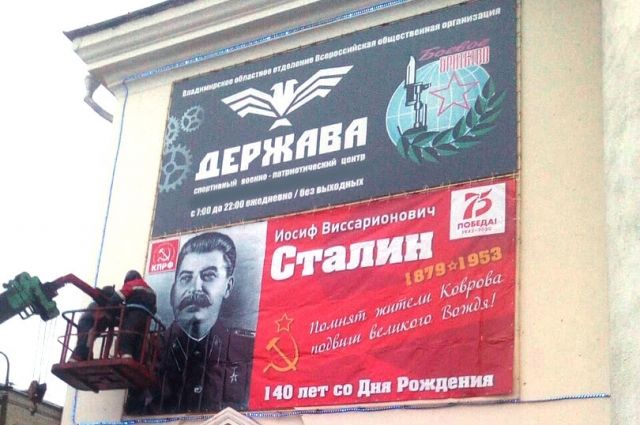
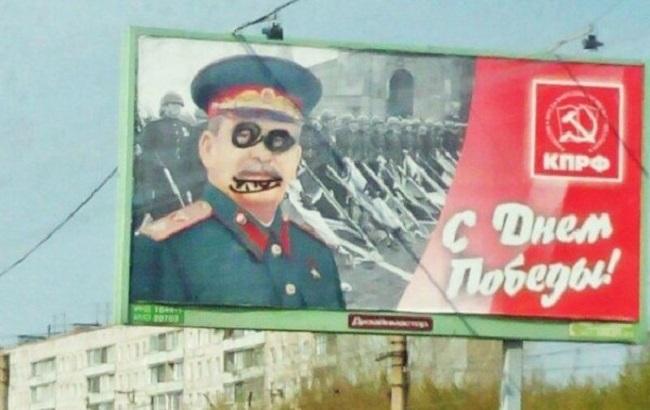
Posters, banners, and projections featuring the leader are very common. Communist Party leader Gennady Zyuganov claims that this “is an initiative of the people”13. Now try to recall how many ordinary workers or “people from the masses” you know who commission advertising banners and public projections.
The Communist Party of the Russian Federation promotes Stalin using fake Churchill quotes

Videos defending the leader are extremely common on YouTube, and are often produced with high professional quality14, which indicates a substantial budget behind their production. They are often quickly boosted into YouTube’s top search results for relevant keywords. Professional political strategists are involved, for example Konstantin Semin, a member of the Izborsk Club and former host of the TV channel Russia-2415.
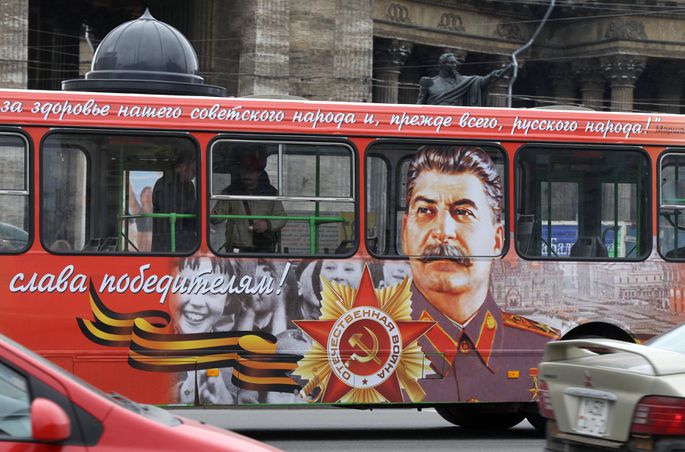
It is likely that a considerable amount of money was invested in the so-called “Stalin buses” program — buses with advertising images of Joseph Stalin. One of the organizers of the campaign, Dmitry Lyskov, openly admits that this campaign “is ordinary commercial advertising”, and that it “brings portraits of the Supreme Commander to the streets of cities by May 9 and is intended to remind people of the role of I.V. Stalin in the Great Victory”16. This is the same Dmitry Lyskov who is a propagandist for federal television and writes books such as “Stalinist Repressions: The Great Lie of the 20th Century”. It is no secret that images of the General Secretary are placed on public transport on a commercial basis17. Political campaigning and financing in itself is not a bad thing. However, a logical question arises: who exactly is paying for it? Which groups of citizens have the money for this? Is the financing of these campaigns transparent?

If we look at bookstore shelves, they are literally flooded with literature glorifying Stalin or attempting to whitewash the crimes of his era:
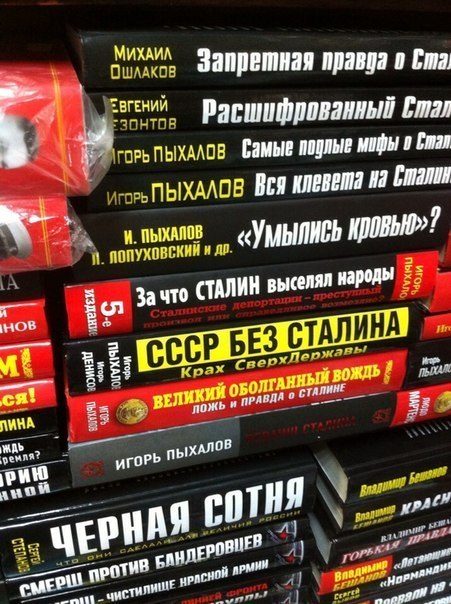
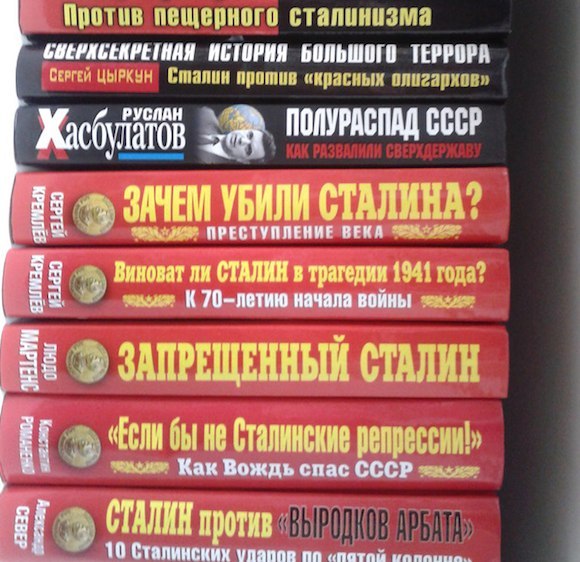
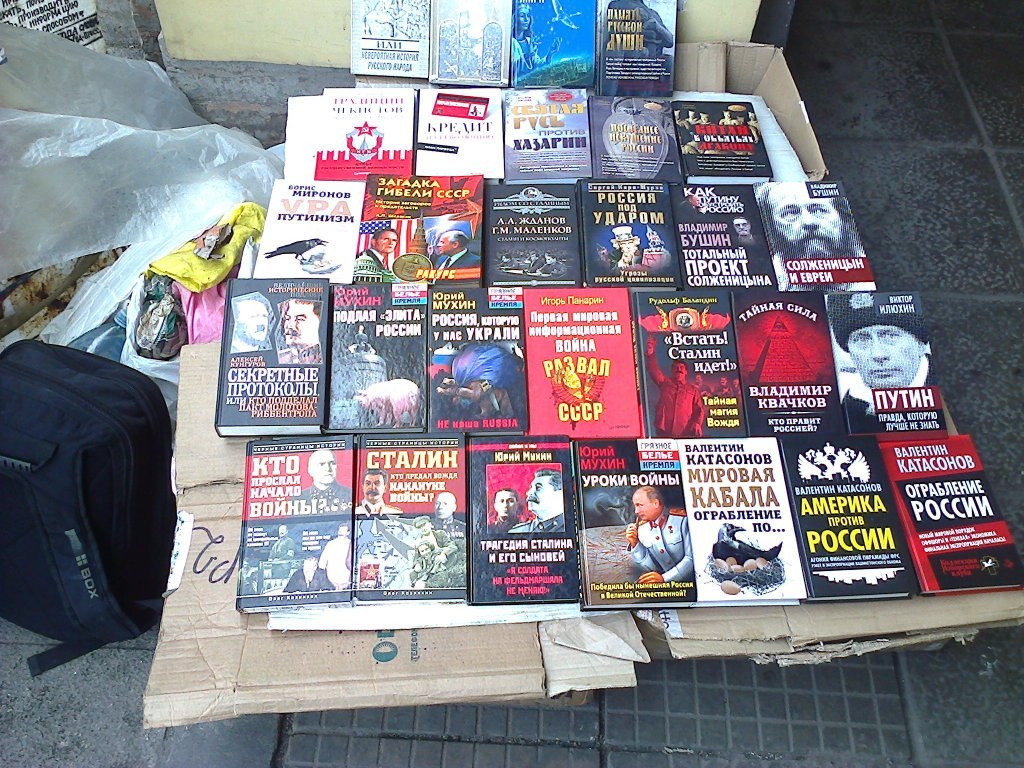
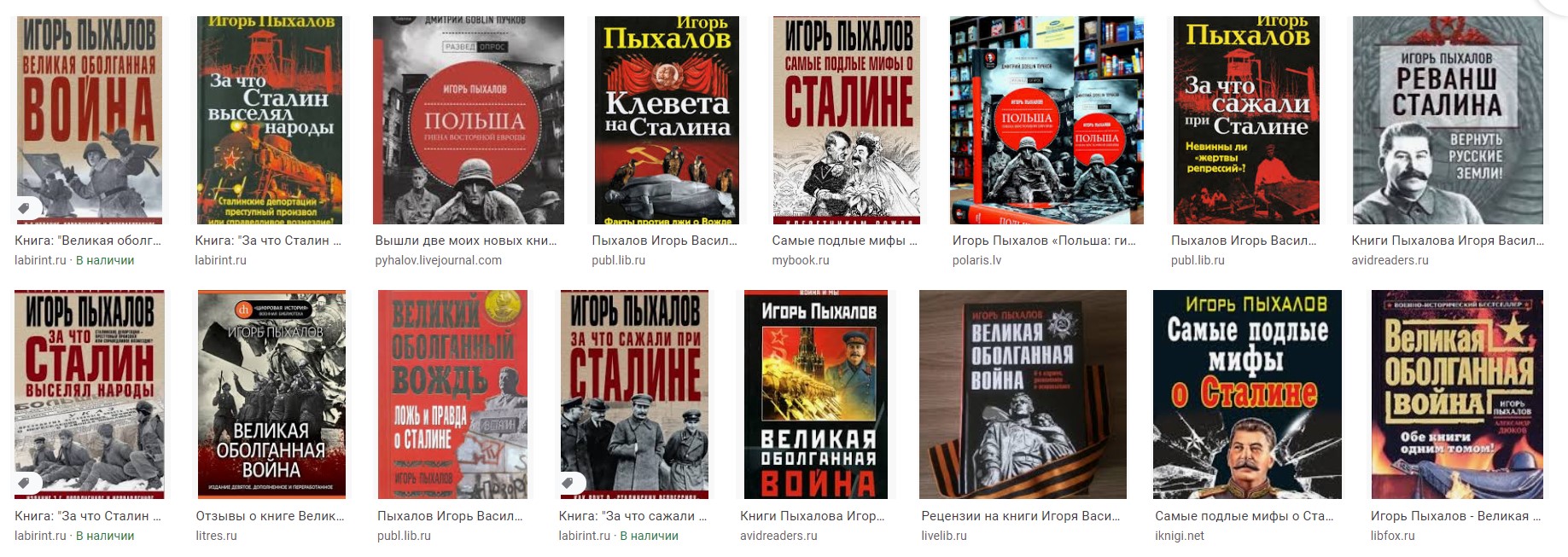
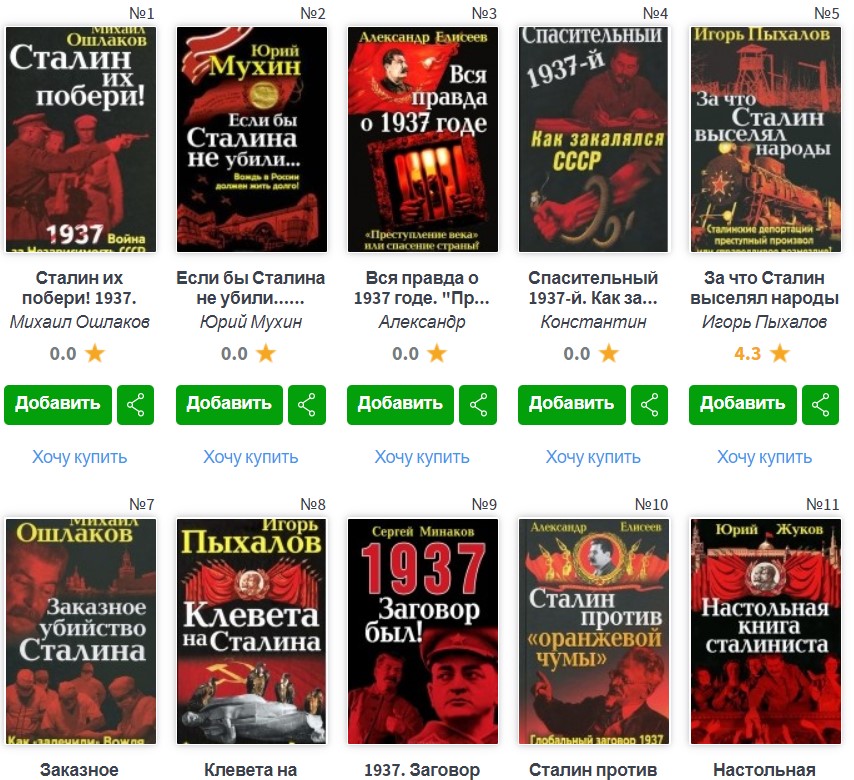
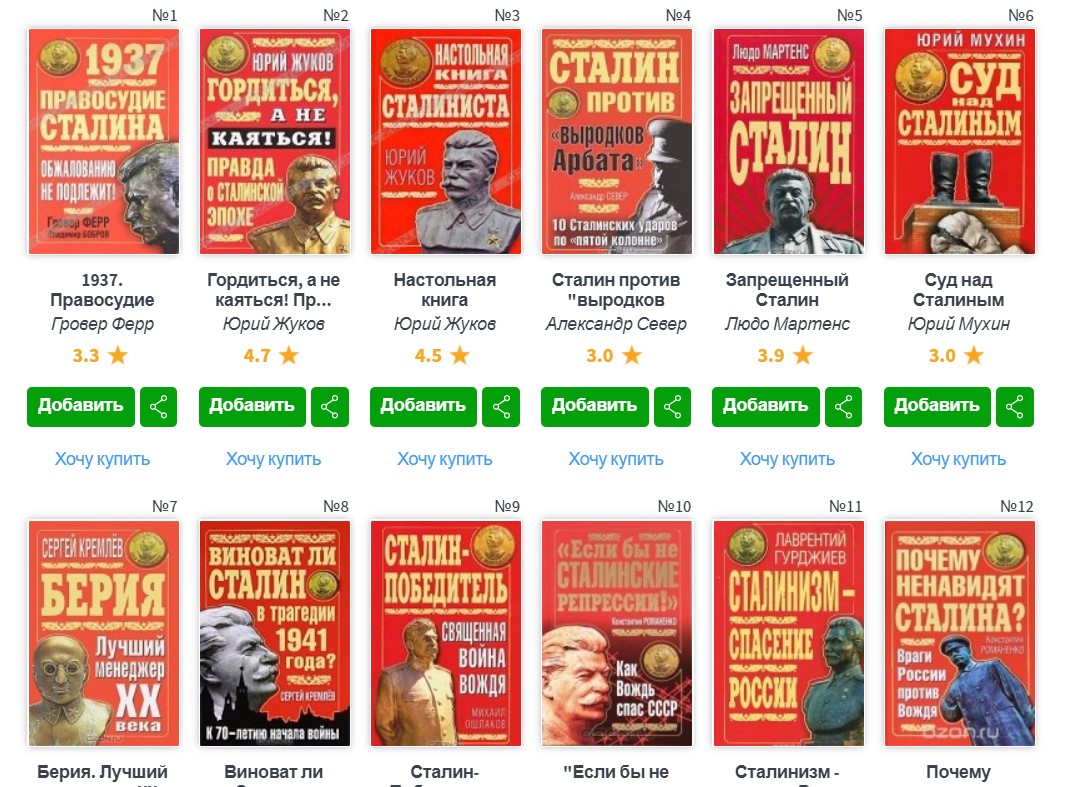
Again, the question arises — if Joseph Stalin is supposedly being slandered and there is allegedly an elite-driven trend to discredit him, then who is allowing the publication of all these tons of books? Even Dmitry Glukhovsky’s novel “Metro 2033”, which later became a cult work, was initially refused by publishers, and the author had to publish it online18. Stalinists, as can be seen, are published quite willingly. The issue of funding here is especially interesting. Where does the Communist Party receive its money from, and who allocated a complex of premises and public funds for its reconstruction to Sergey Kurginyan19? According to an RBC study, state support for the Communist Party reached 90% in 201820. The reader can draw their own conclusions about the direction of state policy — toward “whitewashing” or “blackening” Joseph Stalin.
Doctor of Historical Sciences, Chief Specialist at the State Archive of the Russian Federation Oleg Khlevnyuk has even identified a special genre of pseudo-scientific apologetics of Stalin21. He notes: “The authors of such publications are distinguished by ignorance. The lack of elementary knowledge is replaced by aggressive judgments, the use of fake ‘sources’ or the distortion of authentic documents. The impact of this ideological assault on readers’ minds is amplified by the hardships of everyday life, corruption, and outrageous social inequality in modern Russia. By failing to accept the present, people tend to idealize the past”. Indeed, most authors of pro-Stalin literature sometimes do not even have historical education (let alone an academic degree), because they are not historians but representatives of political propaganda.
A large number of films and mini-series about Stalin are being released: “Comrade Stalin”, “Stalin Is with Us”, “Stalin’s Wife”, “Stalin’s Son” (it is strange that a film titled “Stalin’s Dog” has not yet been made), and so on. One could say that the media space is saturated with the figure of the leader.
Not all archives related to the period of Stalin’s dictatorship have been opened to this day. Many inconvenient facts and documents for Stalinism remain classified, which does not fit with the legend of the “defamation of the General Secretary”. General of the Ministry of Internal Affairs Pavel Sudoplatov, mentioned above, recalled how state security officers concealed documents compromising the leader:
Aleksakhin took from the prosecutor’s office three sealed envelopes with unexamined operational materials seized from my office safe during a search in 1953. He handed the envelopes over to Serov’s secretariat, and they were never seen again. I cannot recall everything that was in my safe, but I know for certain that there were records of authorizations by the then top leadership — Stalin, Molotov, Malenkov, Khrushchev, and Bulganin — for the elimination of undesirable individuals…
<…>
Later, in 1988, when Aleksakhin and two intelligence veterans petitioned for a review of my case, they referred to this episode. And they advised me to remain silent and not further compromise the Party by bringing such unseemly matters into the light of day22.
The nomenklatura is also actively fighting organizations that conduct research exposing uncomfortable facts about the Stalinist period. For example, the authorities declared the organization “Memorial” a foreign agent23, and in 2014 the Ministry of Justice filed a lawsuit with the Supreme Court seeking the liquidation of “Memorial”24.
If there is anti-Stalin propaganda, then where is the translation of Victor Kravchenko’s book “I Chose Freedom”, where is the translation of the transcript of the Kravchenko trial, where is the translation of Valentin González’s book “Life and Death in the Soviet Union”? These key anti-Stalinist works have not even been translated into Russian.
Who benefits?
People believe that spreading criticism of Joseph Stalin benefits big capital and the nomenklatura. However, big capital is primarily interested in a free market and liberal policies. Since Stalin is a historical opponent of these phenomena, propagandists defending the interests of bankers may, as a side effect, also target him.
The nomenklatura, however, is indeed focused on the General Secretary, but not in the sense that it fears or dislikes him. Moreover, he is extremely beneficial to this stratum — since it was Stalin who created the mass nomenklatura in the country. What is beneficial for high-ranking officials? It is beneficial to prohibit media freedom (so that their corruption is not reported), it is beneficial to promote patriotism and racism (so that they can send people to die in war without too many questions, and so that they do not look at how people live abroad), and it is beneficial to have the ability to eliminate any opposition (in order to retain power and the privileges it provides). Stalin did all of this for the nomenklatura, which is why he is extremely beneficial to this class — if society justifies repression, it will also passively watch as the nomenklatura once again begins to destroy everyone who criticizes it. This is especially relevant since today’s ruling power is the same nomenklatura that originated in the CPSU. Stalinism is useful to the nomenklatura in order to, in the event of an economic downturn, rapidly expropriate small business (as “petty bourgeoisie”) and citizens with “excess assets”, such as an extra television or surplus living space (they are classified in a way similar to “kulaks”).
Stalinists will argue that it is not in the nomenklatura’s interest to “whitewash” Stalin, because he allegedly executed corrupt officials. In a separate article, we demonstrate that corruption flourished under Stalin, and we also published an article showing that the main target of repression was by no means corrupt officials.
Who fabricates it?
Are facts about Stalin being falsified in a negative light? The aforementioned right-liberal propagandists did not set themselves the task of defending historical truth; they were amateurs simply fulfilling a заказ (commission). Therefore, a small part of them did engage in falsification. For example, the fabricator Edward Radzinsky, who told stories about electricity being run through a Stalin monument so that birds sitting on it would be shocked and killed25 (whereas it is well known that birds sit calmly on high-voltage wires), or the propagandist Yulia Latynina, who claimed that fresh peaches were flown to Andrei Zhdanov by airplane into besieged Leningrad26. However, we are also dealing with falsifications on the part of Stalinists in favor of Joseph Stalin, and there are significantly more of these. The “Logic of Progress” website contains an entire section called “The Legendarium of Stalinists”, which includes such falsifications that have been documented and refuted. Be sure to review the key theses analyzed in that section.
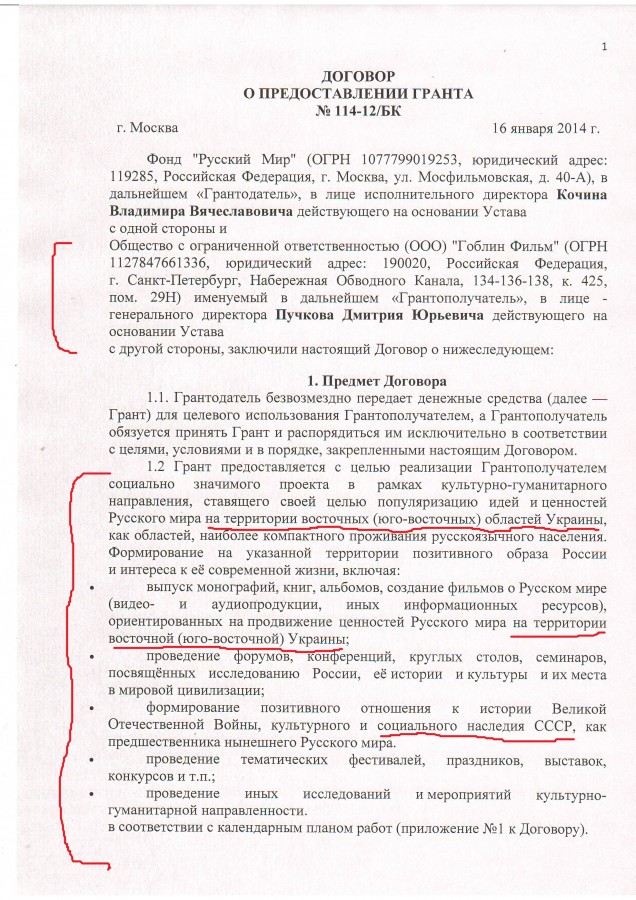

Who spreads these falsifications? Some of them originate from the “Short Course of the VKP(b)” and other propaganda materials published under Joseph Stalin’s direct instruction. Some were invented by marginal segments of the nomenklatura whose careers were disrupted by Nikita Khrushchev’s rise to power and Gorbachev’s perestroika — for example, Vyacheslav Molotov. Others come from professional propagandists such as Nikolai Starikov. These falsifications reflect the interests not of the majority of citizens, but of the nomenklatura. And the fact that the nomenklatura has taken a course toward “whitewashing” Stalin indicates that it is no longer satisfied with merely arresting thousands of innocent people and suppressing opposition. It needs even greater repression — if necessary, on the scale of the Stalin era. Thus, we can see that the alleged “defamation” of Stalin in a negative direction is vastly smaller than the equally systematic falsification in a positive direction, and the forces behind both directions of falsification do not represent the interests of the majority of citizens.
For example, former Marshal Dmitry Yazov, who in his interviews argues that Stalin was a “God-given leader”, a “greatest genius”, the “father of nations”, and so on27, himself lived very well under the system created by Stalin. As Doctor of Historical Sciences Mikhail Voslensky wrote, “the dacha of Politburo member and USSR Minister of Defense Marshal Yazov has a usable area of 1,380 square meters, and a ‘land plot’ of 16.7 hectares. This is not a dacha, but a latifundium with a rather large palace. According to housing norms, 100 people should have lived in it. But the minister does not pay for excess living space at fivefold or even triple rates”28. While 99 Stalinists defend the leader, their living space ends up belonging to the one “smarter” Stalinist — the one who understands why devotion to Stalin is useful.
One of the main publishing houses of Stalinists is “Algorithm”, whose editor-in-chief is Stalinist propagandist Alexander Kolpakidi. This is the same publishing house that released the book “No One but Putin” by British journalist Luke Harding, who later stated that he had nothing to do with the book, and also expressed doubts that the book “Understanding Putin”, published in the same series and attributed to Henry Kissinger, was actually written by him29. This was not an isolated case — in 2012, “Algorithm” published a book about the Pussy Riot group attributed to one of its members, who also did not write the book30.
Those who, according to Stalinists, try to “defame” the leader are often academic researchers and Doctors of Historical Sciences who have no political ambitions that would make it possible for them to falsify the views they present.
Conclusion
The alleged “defamation” of Stalin is a manipulative technique aimed at portraying the General Secretary as unjustly slandered, in order to evoke in the person subjected to this manipulation a sense of “righteous” anger toward the “offenders” and sympathy for the “victim”. Stalinists, as experienced manipulators equipped with an entire legendarium of manipulative short theses, use such techniques in propaganda practice on a regular basis.
What position, then, reflects the interests of the majority of citizens? It is most likely an entirely honest attitude toward historical sources and their unbiased interpretation. Because if historical experience is assessed on the basis of incorrect data, such an assessment can only be harmful. Whoever lies supposedly “for the greater good” is deceiving people right now, and will continue to deceive them in the name of their subjective idea of good (whatever that may turn out to be tomorrow) until their conscience awakens or someone from outside helps to awaken it. The policies of Stalin, the nomenklatura of the 1990s, Putin, and almost the entire era of nomenklatura dominance are anti-people in nature, and we should not support these eras, but instead build something new in accordance with the requirements of improving citizens’ living standards.
- Where are Russia’s current rulers leading the country? / A.P. Tarnayev — “ITRK”, 2015
- Alexander Petrovich Tarnayev // KPRF (kprf.ru). [Electronic resource]. URL: https://kprf.ru/personal/tarnaev-aleksandr-petrovich (accessed: 01.04.2020).
- Pavel Shchelin. Absurd historical forgeries // Lenta.ru (lenta.ru). August 29, 2015, 08:47. [Electronic resource]. URL: https://lenta.ru/articles/2015/08/29/bioleader/ (accessed: 01.04.2020).
- The Name of Russia: Stalin / S. Kremlyov — “Yauza”, 2008
- Ksenia Boletskaya. In Russia, a film distribution license has been withdrawn for the first time // Vedomosti (www.vedomosti.ru). January 23, 2018, 13:43. [Electronic resource]. URL: https://www.vedomosti.ru/technology/articles/2018/01/23/748704-minkulturi-otmenilo-pokaz-smerti-stalina (accessed: 01.04.2020).
- Dmitry Steshin. “The Death of Stalin” — a comedy that could have been made by Hitler // Ministry of Culture of the Russian Federation (www.mkrf.ru). January 24, 2018, 14:14. [Electronic resource]. URL: https://www.mkrf.ru/press/news/smert_stalina_komediya_kotoruyu_mog_by_snyat_gitler/ (accessed: 01.04.2020).
- Vladimir Medinsky. “We must stop blaming Stalin for all our problems” // Izvestia (iz.ru). July 3, 2015, 00:01. [Electronic resource]. URL: https://iz.ru/news/588424 (accessed: 01.04.2020).
- Putin believes that excessive demonization of Stalin is one of the ways to attack Russia // TASS (tass.ru). June 16, 2017, 04:51. [Electronic resource]. URL: https://tass.ru/politika/4341427 (accessed: 01.04.2020).
- K. Boletskaya, E. Bryzgalova. The film “Child 44” was withdrawn from Russian distribution due to distortion of historical facts // Vedomosti (www.vedomosti.ru). April 15, 2015, 11:14. [Electronic resource]. URL: https://www.vedomosti.ru/technology/articles/2015/04/15/film-nomer-44-otozvan-iz-rossiiskogo-prokata-iz-za-iskazheniya-istoricheskih-faktov (accessed: 14.06.2020).
- Russia banned comparisons between the actions of the USSR and Nazi Germany // Deutsche Welle (www.dw.com). July 1, 2021. [Electronic resource]. URL: https://www.dw.com/ru/putin-zapretil-sravnivat-rol-sssr-i-nacistskoj-germanii-v-razvjazyvanii-vojny/a-58121740 (accessed: 19.07.2023).
- Lavrov: attacks on Stalin as the main villain are part of an attack on our past // TASS (tass.ru). August 30, 2021, 12:20. [Electronic resource]. URL: https://tass.ru/obschestvo/12252695 (accessed: 19.07.2023).
- Channel One cut from an archival interview with Anatoly Lysenko the words about “glorification of Stalin’s cult” // Meduza (meduza.io). April 15, 2022, 12:30. [Electronic resource]. URL: https://meduza.io/news/2022/04/15/pervyy-kanal-vyrezal-iz-arhivnogo-intervyu-anatoliya-lysenko-slova-o-vospevanii-kulta-stalina (accessed: 19.07.2023).
- In Moscow, the appearance of Stalin on building facades was commented on // RIA Novosti (ria.ru). December 21, 2019, 15:41. [Electronic resource]. URL: https://ria.ru/20191221/1562678382.html (accessed: 01.04.2020).
- The Real Stalin // YouTube (www.youtube.com). February 20, 2020. [Electronic resource]. URL: https://www.youtube.com/watch?v=7GZBYgMlPcI (accessed: 01.04.2020).
- Konstantin Semin // Izborsk Club (izborsk-club.ru). August 4, 2017, 17:50. [Electronic resource]. URL: https://izborsk-club.ru/14112 (accessed: 02.04.2020).
- Battle for Stalin // Interfax (www.interfax.ru). April 28, 2011, 15:25. [Electronic resource]. URL: https://www.interfax.ru/russia/187830 (accessed: 02.04.2020).
- Larisa Khudikova. Stalin buses will travel through 40 cities on Victory Day, including Minsk and the Baltics // Vesti (www.vesti.ru). April 20, 2012, 13:54. [Electronic resource]. URL: https://www.vesti.ru/doc.html?id=775484 (accessed: 02.04.2020).
- Nikita Ostrovsky. How did Glukhovsky come up with “Metro”? // DTF (dtf.ru). February 14, 2019. [Electronic resource]. URL: https://dtf.ru/read/39676-kak-gluhovskiy-pridumal-metro (accessed: 02.04.2020).
- Sergey Taranov. Sergey Kurginyan’s share: what else can be earned from rallies? // Novye Izvestia (newizv.ru). March 13, 2017, 21:28. [Electronic resource]. URL: https://newizv.ru/news/politics/13-03-2017/dolya-sergeya-kurginyana-chto-esche-mozhno-zarabotat-na-mitingah (accessed: 02.04.2020).
- Evgenia Kuznetsova, Mikhail Nesterkin. Dependence of parliamentary opposition on the budget reached a maximum // RBC (www.rbc.ru). June 4, 2019, 14:09. [Electronic resource]. URL: https://www.rbc.ru/politics/04/06/2019/5cf54b259a79476bebab250b (accessed: 02.04.2020).
- O. Khlevnyuk. Stalin. The Life of a Leader: A Biography. – 464 p. – Moscow: AST-CORPUS, 2015. – p. 12.
- Pavel Sudoplatov. Intelligence and the Kremlin. Notes of an Unwanted Witness. – 507 p. – Moscow: TOO “Gea”, 1996. – pp. 453–454.
- “Memorial” received an order to register as a foreign agent // TV Rain (tvrain.ru). April 30, 2013.
- The Ministry of Justice filed a lawsuit to liquidate “Memorial” // Lenta.ru (lenta.ru). October 10, 2014, 19:54.
- E.S. Radzinsky. Stalin. Life and Death – 377 p. – AST, 2007. – p. 11.
- Yulia Latynina, program “Code Access”, Ekho Moskvy, broadcast 25.06.2011 // Echo of Moscow (echo.msk.ru). June 25, 2011, 19:07.
- Galina Kuskova, Dmitry Yazov. God-Given Leader. Conversation with the Last Minister of Defense of the USSR // Russian People’s Line (ruskline.ru). February 23, 2020.
- M. Voslensky. Nomenklatura. The Ruling Class of the Soviet Union (Second edition, revised and expanded), 671 p. – Overseas Publications Interchange Ltd, London, 1990. – p. 368.
- British journalist disowns his “book” about Putin // BBC News Russian Service. August 8, 2015.
- “Eksmo” suspends sales of a book about Pussy Riot // Vzglyad (vz.ru). November 26, 2012.