Standard of living in the USSR
The perception of the Soviet Union as a state with exemplary social welfare, an island of stability and high spirituality, is one of the pillars of statists and the primary foundation for red conservatives. Therefore, they support this belief in every possible way, but does it correspond to reality, or is it a result of conservative propaganda?
A kindergarten teacher tells the children:
– In the Soviet Union, everyone eats their fill and dresses beautifully. In the Soviet Union, people live in wonderful apartments. All children in the Soviet Union have many beautiful toys…
Little Vovochka bursts into tears:
– I want to… I want to… I want to go to the Soviet Union!..
If the USSR was such a good place to live (60% of Russians in 2016, according to polls, wanted the restoration of the Soviet system1), where, in that case, did the huge number of jokes and anecdotes about the USSR come from, where did the dissident movement and the famous “kitchen conversations” originate, and why was there so much hatred for the so-called “sovok”? Why, during the collapse of the Soviet Union, did no mass movement emerge in its defense, and why did Boris Yeltsin have such a large number of supporters? Why did 200,000 people turn out, according to official police data alone, for the rally on February 4, 1990, demanding the abolition of Article 6 of the Constitution, which affirmed the leading and guiding role of the CPSU2 (moreover, there were many other mass rallies3)? This article will help bring clarity.
Contents
Consumption
– No meat, no sausage, no milk. Everywhere you look — we just don’t have anything!
The standard of living in the late USSR was significantly higher than under Joseph Stalin (we described the Stalinist period here, and for a significant portion of citizens, living any worse was hardly possible), but it still lagged far behind developed countries. In the consumption of several food products (meat and seafood, vegetables, fruits, and berries), the USSR, even in 1980, maintained a substantial lag behind rational consumption norms4.
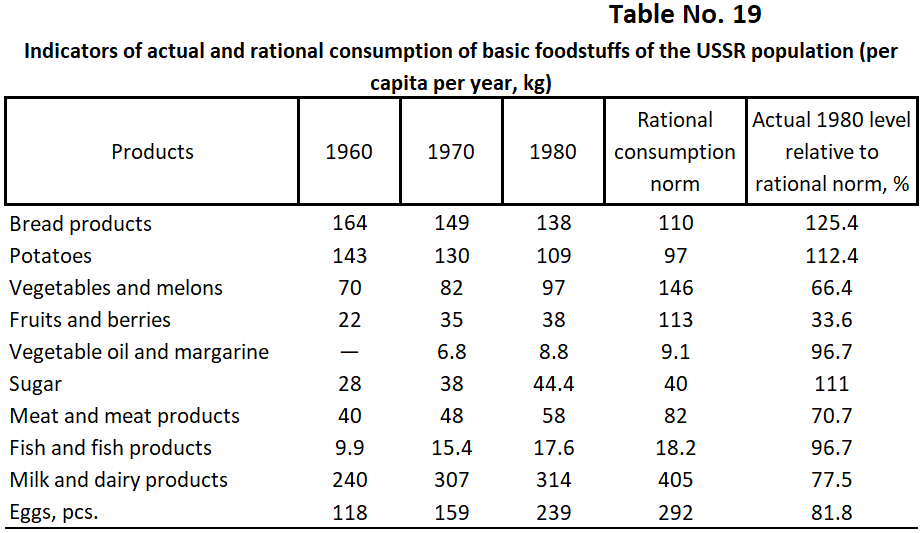
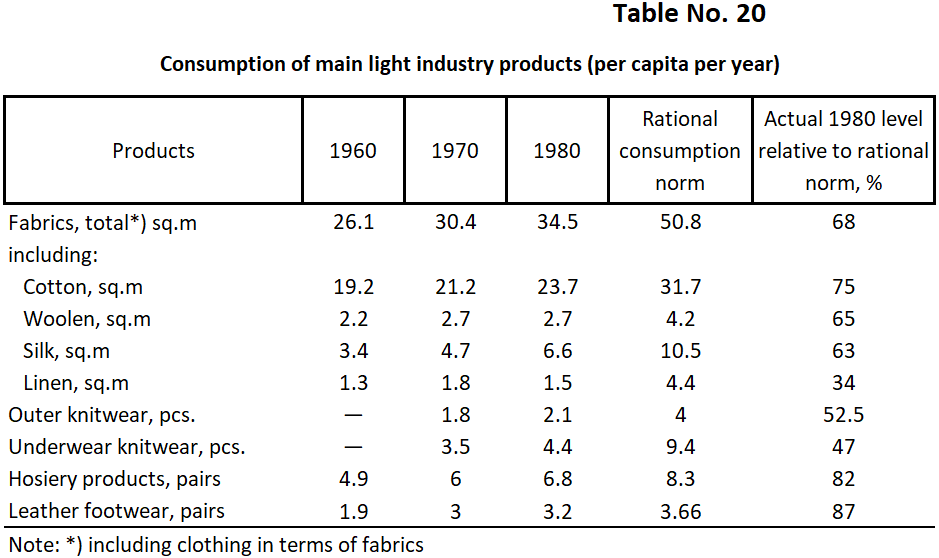
The supply of clothing and footwear was only 47–87% of the norm, to say nothing of the absence of any surplus5.
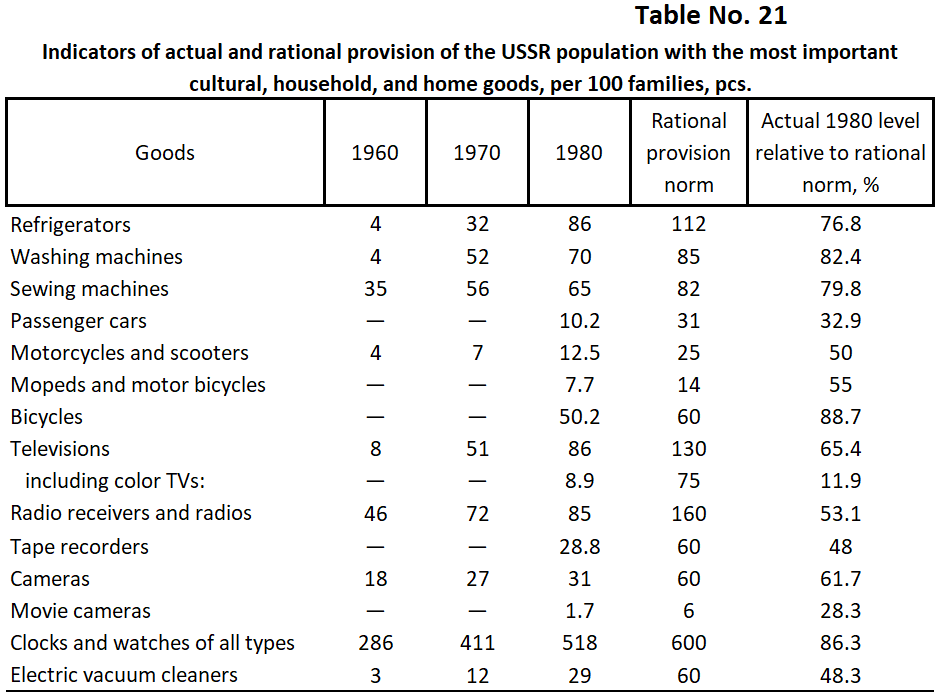
The consumption of most essential types of appliances and machinery stood at 12–89% of the established standards. In 1980, per 100 families, there were only about 10 cars, about 9 color televisions, and about 29 vacuum cleaners6.
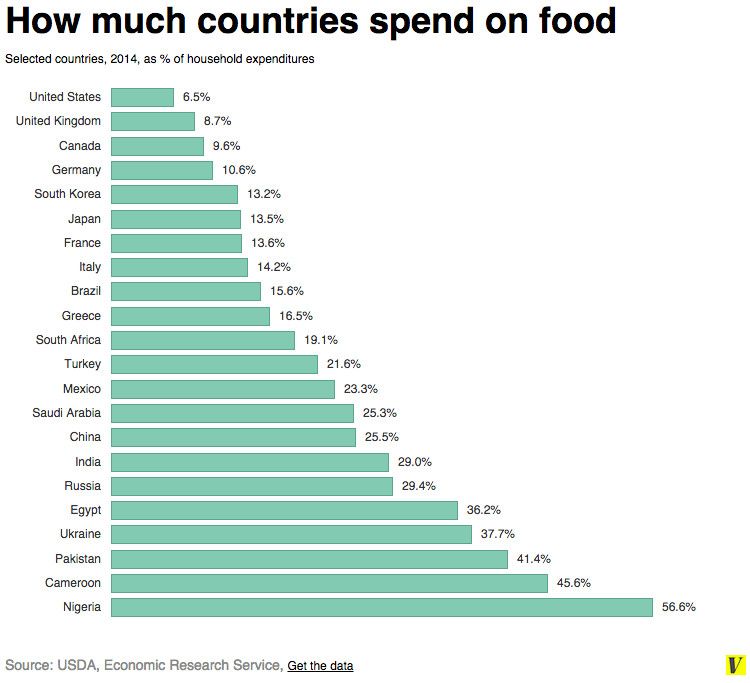
In the budget of a Soviet citizen, food expenditures accounted for 57.3% in 19807. This is an extremely high expense — for instance, in the US in 1984, citizens spent only 15% of their budget on food8, residents of Western Europe spent 21%9, while the average resident of Russia in 2011 spent 32.6% of their budget on food10.
The consumption of services in the USSR was about 25% of the rational level11. According to the Ministry of Trade, industry failed to meet between 15% and 60% of requests from retail chains for certain types of household goods — as a result, this gave rise to a shortage of some types of products and a growth in unsold inventories of products that were not in demand12 (the exact same crisis of overproduction, but only in relation to useless goods). While in developed countries there were already numerous supermarkets, pizzerias, and delivery services, in the USSR all of this was a curiosity. The assassin of American President John F. Kennedy, Lee Harvey Oswald, who moved to the USSR in 1959, wrote as early as January 1961, despite having very favorable financial conditions created for him:
I am starting to reconsider my desire about staying. The work is grey, the money I get has no place to be spent. There are no nightclubs or bowling alleys, no places of recreation accept the trade union dances. I have had enough13.
The quality of goods manufactured in the USSR was rather low. Thus, in 1980–1981, the trade inspectorate rejected ¼ of the televisions supplied to market stocks, 20–25% of refrigerators, 15% of furniture, 10% of washing machines, and so forth14.
In the mid-1980s, General Grigory Kazydub recalled:
By helicopters, we flew over Western and Eastern Siberia, visiting the most remote places… In Siberia, we encountered completely abandoned villages. The deserted, abandoned huts and human dwellings present an eerie, nightmarish picture. North of Omsk, above the regional center of Tara, we found dying, helpless elderly people in abandoned villages. Food had not been brought here for months; these people begged us for bread.
I know what hunger is; I saw hungry people during the war years. But that was war, the hunger had its reason, people believed in life and hoped. Looking into the eyes of the old people we saw forty-plus years after the war was terrifying. There was endless sorrow in their eyes; they were dry, without tears. How should one after this view our Leninist Central Committee, the founding fathers of the party and the country, and the local authorities?15
Prices
Recently, “Rossiyskaya Gazeta” calculated how much cars in the USSR would cost when converted to today’s prices16. The cost of a “Kopeyka” VAZ-2101 in 1975 amounted to almost one and a half million rubles (today, a Lada Granta costs from 435 thousand rubles17). A “big-eared” Zaporozhets ZAZ-966 cost 838 thousand rubles when converted into modern figures (for this money, one can buy, say, a Renault Sandero Stepway crossover). The cost of a UAZ-469 was almost 2 million rubles (in 2020, a UAZ Patriot costs from 894 thousand rubles at Major Auto18, and for 2 million, one can buy a BMW X119). Could it be that cars are sold on a much more massive scale today, which is why prices back then were so high? However, according to Statista.com, car sales in the US in 1978 were 15 million a year, and in 2019—17 million20, which means the figures are comparable. Thus, we see that the high prices are not due to a fundamental increase in car sales. Here is how Doctor of Historical Sciences Mikhail Voslensky describes the situation:
It is true that urban transport is cheap in the USSR. But on the other hand, cars have been declared a luxury item… The exact same “Zhiguli” car (in its export version – “Lada”) is sold in the USSR for 9,600 rubles, and in the West for 11,000 marks. Does this mean that to purchase this car, they must put away their entire salary: a Soviet worker for 37 months, and a West German for 3.5 months? A West German, yes. But a Soviet worker will need much more time: buying a “Zhiguli” by signing up for a waiting list is quite unrealistic. This means one must buy it on the market at a price of 40–50 thousand rubles. Accordingly, one will have to save up for 13–16 years21.
Blogger Maxim Katz also compared Soviet food prices from a “Beriozka” store catalog with food prices from modern Russian premium supermarkets, calculating their prices based on the average Soviet salary in 1980 and the average Russian salary in 2019. The comparison did not turn out in favor of the USSR — most goods proved to be cheaper in modern expensive Moscow stores.
Shortages and queues
An “Eros” store opened in Moscow — with naked shelves.
Regarding the previously mentioned cars — their maintenance was a very difficult matter, so Soviet car enthusiasts often repaired them themselves. Thus, in 1966, there were only 12 service stations within the city limits of Moscow22. The Moscow Compact Car Plant, for example, did not include the manufacturing of fenders, bumpers, and other parts in its production plans. After persistent requests, it began stamping fenders, but for some reason only the right ones23.
By the end of the 1970s, the amount of accumulated unfulfilled demand for material goods was estimated at approximately 45 billion rubles24 against a total gross social product (that is, the sum of all manufactured goods and services in the country, including heavy industry production) of 862 billion rubles for 197525 (and this is taking into account double counting, where the cost of the exact same components could be included in the GSP multiple times26). Note that this refers to the satisfaction of basic needs — for instance, the unfulfilled demand for food items amounted to 19 billion rubles. Candidate of Economic Sciences Andrey Illarionov believes that “serious problems with the food supply of cities in the USSR had always existed”27. In 1982, the Food Program of the USSR was even adopted, setting its task “to ensure a stable supply of all types of food to the population”28. Roman Kirsanov, a senior researcher at the Institute of Russian History of the Russian Academy of Sciences, also notes:
There were particularly many difficulties with food products. Up to 40% of agricultural products spoiled due to poor conditions of storage, transportation, and processing. And the lack of rhythm in sales, when products would appear and then disappear, was related to the fact that trade networks held them back to meet the inventory supply standard. Violating it threatened the loss of bonuses and a reduction in credits for new purchases. Therefore, the trade organizations “threw out” goods onto shelves only when their stocks were replenished and confidence appeared that the standard would be met.
<…>
Every region had its own set of shortage goods. In the Yaroslavl region at the turn of the 70s–80s, sugar, barley, fish, gingerbread, toothbrushes, and buckets would disappear. In the Penza region, there was a shortage of children’s clothing; in the Sakhalin region — of televisions and radios. Residents of different regions sent packages to one another and traveled to buy goods where the supply was better. The share of purchases that visitors made in the famous Moscow GUM department store amounted to 60%29.
Because of the shortage, a person often could not count on the fact that by earning money, they would be able to purchase anything with it. Nikolay Petrakov, an academician of the Russian Academy of Sciences, even compared Soviet rubles to lottery tickets for this reason30. Candidate of Sociological Sciences Vladimir Nikolaev states that “the Soviet person in their daily life was forced to participate in queues, did so routinely and regularly, and spent a significant part of their personal time, that is, of their personal biography, on this participation”31. In the first half of the 1980s, these time expenditures amounted to no less than 17.5–27.5% of non-working time for men, and no less than 13.4–23.5% for women32. A report by the Goskomstat of the USSR in 1988 stated:
The lack of resources of goods, the unsatisfactory operating hours of trade and consumer service enterprises lead to queues, unjustified spending of free, and sometimes even working time of working people on the acquisition of goods and services… Thus, in a number of places, buyers spend an average of approximately one hour to buy daily demand goods (sugar, meat, sausage and confectionery products, butter and vegetable oil, fruits and vegetables); to buy certain scarce non-food items (especially imported ones) — from 1 to 3 hours33.
Conflicts, aggression, and unfriendliness were born in queues. It was becoming obvious to people that the Soviet planned economy was unsustainable (for what exact reasons, we have already explained).
Lack of rights
– Why do Soviet laryngologists remove tonsils through the anus?
– Because no one dares to open their mouth.
In the Soviet Union, there was a privileged class — the nomenklatura, and much of what was allowed to its members was impossible to obtain for people from other classes. We have already described all these privileges in a separate article — special clinics, cars with personal drivers, special distributors, and so on. However, the propaganda of the nomenklatura worked intensively to present the working class as the masters of the country.
In the countries of real socialism, trade unions no longer protected the interests of working people from the employer — in this case, the state; instead, they monitored the fulfillment of the plan set by the employer and tightened labor discipline. Stalin accurately characterized Soviet trade unions as “transmission belts of the party”, that is, of the nomenklatura class. Trade unions became the drivers of the labor force.
The right of working people to strike was until recently not recognized — with reference to the claim that they allegedly had no reason to strike, since they worked for themselves. It would seem that in such a case, it is the business of the working people themselves as sovereign masters to decide whether to work or to strike. But the nomenklatura did not enter into a debate on this matter34.
And this was despite the fact that in 1981, almost 15 million people worked in unfavorable working conditions35. Also in 1986, according to calculations by Doctor of Economic Sciences Vasily Patrushev, the workweek, taking into account associated time expenditures, lasted 8.4 hours longer for men in the USSR than in the US, and 10.1 hours longer for women36.
And if you had allowed yourself to express dissatisfaction with anything described in this article, you could have faced big problems — like, for example, Andrei Amalrik, who wrote the book “Will the Soviet Union Survive Until 1984?”37 and was sentenced by a court to 3 years in camps under Article 190-1 of the Criminal Code of the RSFSR (“dissemination of knowingly false fabrications defaming the Soviet social and state system”)38. Or like Vladimir Bukovsky, who was sentenced to 7 years of imprisonment and 5 years of exile for “anti-Soviet agitation and propaganda”39. His only fault was that he brought information about punitive psychiatry in the USSR to the public’s attention (today, the fact of its existence is not questioned by scientific researchers). There were many such convicts. Those who still managed to organize themselves could end up even worse, such as the workers in Novocherkassk.
Doctors had no right to refuse to participate in punitive psychiatry. Thus, Kiev psychiatrist Semyon Gluzman, who conducted an independent in-absentia psychiatric evaluation of the dissident general Pyotr Grigorenko, concluded that he was completely sane and mentally healthy. On May 11, 1972, Gluzman was arrested and subsequently sentenced for anti-Soviet agitation and propaganda under Article 62 of the Criminal Code of the Ukrainian SSR (equivalent to Article 70 of the Criminal Code of the RSFSR) to seven years of imprisonment in a strict-regime camp and three years of exile40.
In the Soviet Union, you could not just travel to whatever country you wished, even if you had saved enough money for it. For many decades, initiative travel abroad by citizens was effectively banned. Any legislative regulation in this area was completely absent. Free exit was permitted only on May 20, 1991, with the adoption by the Supreme Soviet of the law “On the procedure for exit from the Union of Soviet Socialist Republics and entry into the Union of Soviet Socialist Republics of citizens of the USSR”41. Before that, who could travel and who could not (the so-called “refuseniks”) was decided by the party commission on foreign travel42. Those who were fortunate enough to travel and see the world were forbidden from going to cafes alone, using the services of guides individually, staying in private apartments, being left alone with a woman in a sleeping compartment, and much more (the entire list of prohibitions spanned nine pages). By 1991, the task of keeping citizens inside the country was carried out by 220,000 border guards43 (nearly a quarter of a million); the total personnel of the KGB was 480,000 people44 (nearly half a million). 180,000 people were KGB officers, and the informant network numbered about 260,000 undercover operatives — both Soviet citizens and foreigners45. People were ready to commit desperate acts to bypass this ban — for example, the Ovechkin family attempted to hijack a Tu-154 airliner, and oceanographer Stanislav Kurilov swam nearly a hundred kilometers through the open ocean after jumping from the steamship “Soviet Union”. Many defectors, such as Viktor Sheymov or Igor Gouzenko, handed over state secrets during their escape, completely nullifying a significant part of the “effect” of the state security organs’ work.
Sometimes one hears that even today few people can afford a trip abroad; however, for instance, in 2018, Russians made 44,551,092 trips outside of Russia46.
While today one can “dodge” the army by giving money to a capitalist in uniform, in the USSR every man had to lose between 1 and 3 years of his life in the Soviet army47, periods which were usually accompanied by hazing48 and meaningless rituals.
I am completing my conscript service in military unit 05299 in the city of Baku. Every day the “dedy” Baszhanov, Karpinsky, and Kirillov demand money from me. Several times I brought them money earned during unauthorized absences. When I explain that I have nowhere else to get money, they beat me; they demand that I commit a crime. If I report this to the unit commander, he will kill me. I have no parents. I wanted to kill myself, but I am only 19 years old, I want to live.
Please, transfer me to prison instead, otherwise a final dot will be placed on my life49.
If anyone thinks that the Soviet militsiya did not commit lawless atrocities, they are mistaken. For example, in 1980, four drunk militsiya officers brutally beat a man after noticing he had a bag with smoked sausage and a bottle of cognac — they combined their service with hunting for food packages containing delicacies issued to Muscovites before holidays50. In all likelihood, they would have gotten away with it this time as well; however, this man turned out to be a KGB major. Upon learning this, the militsiya officers were afraid to let him go and called in a militsiya major, who suggested finishing off the victim. The KGB major miraculously managed to survive the initial beating and was found by passersby, after which doctors fought for his life for five days but could not save him. During the investigation of the case, it was revealed that rampant alcoholism flourished in the 5th Line Department of Militsiya at “Zhdanovskaya”: every evening the staff drank together with the chief, often taking food away from people — thus, on the day of the murder, the militsiya officers present at the line department confiscated alcohol from a retired veteran who, to his misfortune, was returning home tipsy with a food order. The militsiya officers also confessed to killing another KGB officer — Viktor Sheymov — but that turned out to be false (Sheymov had escaped to the US). Apparently, the KGB investigators had decided to “fulfill the plan” for finding his killers and beat this confession out of them. The head of the KGB, Yuri Andropov, initiated an audit of the entire Moscow Directorate of the Ministry of Internal Affairs, resulting in the detection of multiple cases of abuse of power, robberies, inflictions of injuries, and murders committed by Moscow militsiya officers (it even reached the head of the Ministry of Internal Affairs, proving his embezzlement of huge sums) — at the disposal of the minister and his family were three official Mercedes cars, jewelry worth 250,000 rubles that served as physical evidence in a criminal case, as well as the painting “Wildflowers” by artist Martiros Saryan, purchased for ten thousand rubles from the Soviet militsiya budget.
The Welfare State
One of the strengths of the USSR was the presence of a welfare state in the country, including free medicine, education, and so forth. This sounds truly excellent in theory. In practice, however, all these free services in the Soviet Union came with the bitter taste of a “free lunch” — the quality was low, and access was often highly difficult.
Education
Communists often promote Soviet education as “the best in the world”. However, a question arises here — why did a country that received the best education in the world plunge into the chaos of the 1990s in that case? Why did millions of people with the best education support Yeltsin and Zyuganov, buy MMM tickets (there were more than 10 million investors in this pyramid scheme51), charge water near the TV (according to TVC, the audience of Anatoly Kashpirovsky and Allan Chumak was about 200 million people52), join criminal gangs, and so on? “The best in the world” education could not protect people from all this. Because it did not teach a person the most important thing — critical thinking and a scientific approach to sources (which is not surprising, since many sources were banned in the USSR).
In the Soviet Union, there was indeed free and universal education, and some of its fields were well-developed. But on the whole, the Soviet school involved rote-learning formulas and guidelines handed down from above. Any individuality was suppressed there — schoolchildren were not allowed to dress the way they wanted53, they were not allowed to get haircuts the way they wanted54, and all of this was monitored by bigoted teachers with an overseer mentality. The Soviet school demanded that everyone be like everyone else. Education is a key reason why the USSR/Russia has 26 Nobel laureates, the US has 271, Germany has 82, and even small Sweden (where social democrats have been in power for most of the last 100 years) has 2955.
Medicine
While rejoicing at free healthcare, Soviet citizens ceased to be so happy when they came to the clinic. After all, even access itself to this medicine was problematic due to massive queues, which gave rise to the movement of grandmothers saying phrases like “I’ve been standing here since morning, while all sorts of people are pushing in”. It became normal to bring champagne and chocolates to a doctor so that he would see you out of turn or simply provide good service. Anecdotes were popular like the one where a patient brought a doctor a bottle and a box of chocolates, and they turned out to be his test results. One of the issues of “Krokodil” magazine from 1979 described a real case that occurred in a dental clinic in Tbilisi, where a doctor demanded a bottle of “Bukhet Abkhazii” for removing an incisor, and cognac for removing a molar56. Therefore, in reality, medicine turned out to be far from free, considering what a scarcity the “gifts” required by doctors could be.
At the same time, about 30% of buildings occupied by health and preventive care institutions lacked central heating and sewage systems, and 27% lacked running water. Almost a quarter of the buildings required major repairs. The level of their equipment with medical supplies was 34.2%. The mortality rate of the population per 1000 people rose from 7.1 individuals in 1960 to 10.3 in 198057.
It is true that medical care is free in the USSR. However, polyclinics and hospitals for the ordinary population are overcrowded, and one has to wait for hours in lines to see a doctor. Doctors in polyclinics, on the other hand, are subject to a strict time allowance for examining a patient, and approximately half of this time is spent on filling out case histories58.
Housing
The provision of housing for the population in the USSR was 13.4 square meters per person in 198059, while about 40 million people had a living space allowance of no more than 5 square meters per capita60. In 19.3% of families, this figure fluctuated between 5.1 and 7 square meters61. In cities and urban-type settlements, 82% of the housing stock was equipped with sewage systems, 79% with central heating, and 75% with gas supply. In rural areas, however, these indicators stood at 18%, 21%, and 49%. Only 22% of the housing stock in rural areas was equipped with running water62. Mikhail Voslensky notes:
A Soviet worker has a living space norm of 9–12 sq. meters per person. As I have become convinced, in the West they either simply do not understand this, or perceive it as a guaranteed minimum for everyone. Meanwhile, 12 sq. meters is not a guaranteed minimum, but an allowed maximum. Living space exceeding the norm used to be simply confiscated, and now they force people to pay triple for it. An area of 5 sq. meters per person is viewed as a kind of minimum — though also not guaranteed by anyone: in such a case, a family is considered to be in need of housing and can be put on a waiting list, that is, entered into an extremely slowly advancing “list of waiting applicants” in the housing department of the regional executive committee. A family living in a single room in a communal apartment is still a common phenomenon in the Soviet Union. 20% of the urban population live in communal apartments63.
At the same time, the nomenklatura sometimes owned several apartments, or an apartment and a dacha. The “free housing”, which the propagandists of the nomenklatura now try to present as an almost universally accepted practice in the USSR, was primarily possessed by the nomenklatura members themselves.
At the Institute of World Economy and International Relations of the Academy of Sciences of the USSR, the allocation of long-promised living space for those on the waiting list was expected — not for everyone, of course, but for one or two people. This does not happen every year, so the local committee (I was the deputy chairman at the time) once again carefully verified the list of those in desperate need of living space. At the top of the list was a young researcher who had no housing at all and was renting a corner somewhere, and another whose family had only 3 sq. meters per person. And suddenly it turned out that the living space had already been assigned to the institute: instead of those on the waiting list, the new apartment was given to the first deputy director of the institute, who had previously been the secretary of the party committee. In connection with this, he turned down the cooperative apartment that was being offered to him (which had to be paid for) and took the free one. The apartment was large, so the limit of living space allocated to the institute was exhausted for a long time to come. Moreover, the deputy director did not even plan to use the apartment in the coming years, as he was leaving to work at the UN. Later, he became the USSR Ambassador to an African country. I will not mention his name: he is not a monster, but an ordinary, even likeable nomenklatura member. But such are the morals of this class64.
Foolish state campaigns
– To solve what complex problem is a group of the following specialists created: a mathematician, a physicist, a biologist, an engineer, a doctor, an architect, an economist, a lawyer, a philosopher?
– To harvest potatoes at a collective farm.
The Soviet state carried out many events and campaigns that struck citizens with their uselessness, meaninglessness, and ruthlessness. First of all, these were the so-called “subbotniks” — the voluntary and unpaid collective performance of socially useful labor assignments during overtime, which initially took place on Saturdays (hence the name)65. They were carried out until the 1990s. A subbotnik was held either at the workplace, during which people performed their regular, daily work, or to speed up the construction of economic facilities, community centers, schools, urban greening, and so on. Subbotniks were also conducted at the place of residence, on the initiative of local self-government bodies, and then people worked on beautifying their native area, performing various construction works: building and painting fences, planting lawns, creating and arranging flowerbeds, parks, and playgrounds. Initially, they were voluntary, and mostly communists, Komsomol members, and so-called “sympathizers” participated in them, but later they turned from voluntary into “voluntary-compulsory”. In fact, it was the use of citizens by the nomenklatura as free labor. And combined with compulsion, such public works simply become the introduction of elements of a slave system.
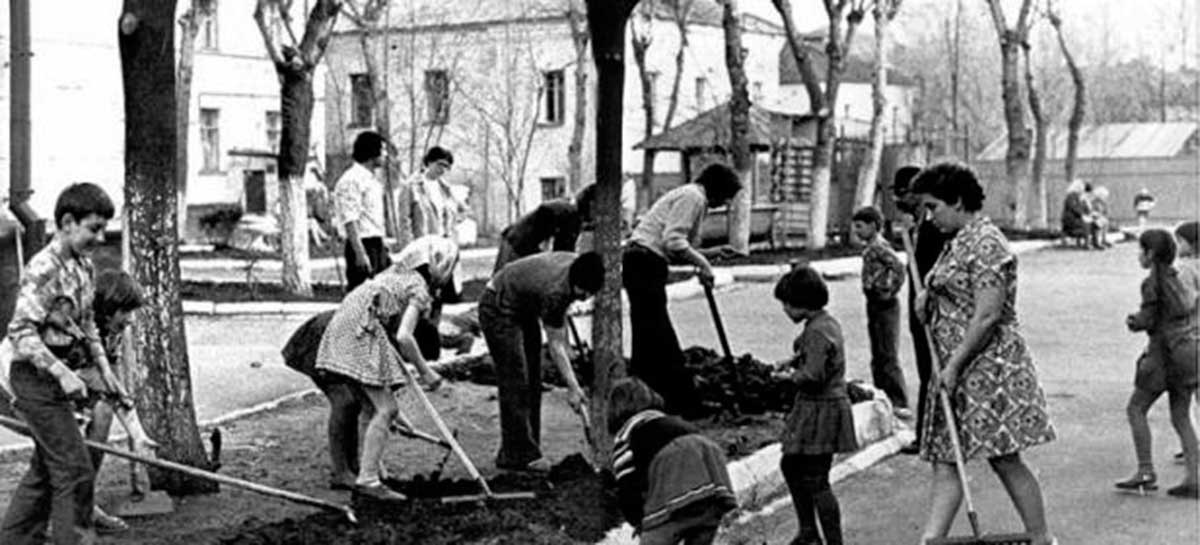
In the USSR, citizens employed in other sectors of the economy were actively recruited for agricultural work (in everyday speech, this was called “a trip for potatoes”). There was also a specific localized context everywhere — thus, in the republics of Central Asia, people were sent to harvest cotton. As a correspondent for “Komsomolskaya Pravda” recalls from personal experience, it was impossible to refuse (you would be expelled from the institute), they worked from dawn to dusk without even a proper toilet, and the management demanded that the quota be met66. In 1981, the number of workers diverted from their main production and used in agricultural work amounted to 17 million people67.
On the other hand, the nomenklatura fought now against jazz, then against alcohol, then against some other violations of its own code of spirituality, which it tried to impose on everyone else.

Total lies and hypocrisy
A track and field match between the USSR and the US. Two are running. The American won. Soviet newspapers reported: “In the 100-meter dash, the Soviet athlete finished one of the first. The American runner was next to last”.
The Soviet Union is not without reason called the “empire of lies” by some68. The media and official figures endlessly broadcasted that communism would arrive soon (until 1985, anyone joining the CPSU memorized the provisions of the program that promised communism by 1980, a comfortable apartment for every family, and much more69), that the Soviet system was the most advanced in the world, and that plans were being overfulfilled, and this clashed with what Soviet citizens saw in stores and on the streets.
Many important facts and documents were carefully hidden from the entire world and from their own people — for instance, the secret additional protocol to the Non-Aggression Pact between Germany and the USSR, the very existence of which Soviet historiography and high-ranking officials like Vyacheslav Molotov denied70, even though Western countries became aware of it back during the Nuremberg trials (this document was finally uncovered here only in 1992). The classification of secrecy has still not been lifted from many documents — on January 26, 2011, the Supreme Court of Russia recognized the classification of the “Katyn case” materials as lawful71. The FSB confirms that there are documents in their archives whose contents will never be declassified, and if necessary, the archives will be blown up72.
Anna Mirkina — the editor of all twelve editions of Marshal Georgy Zhukov’s book “Memoirs and Reflections” — tells how books were edited during the Soviet years:
In the military department of the CPSU Central Committee, the manuscript was initially rejected. The military reviewers demanded something completely different: for example, not to write so harshly about our lack of preparedness for the war, to speak more positively about Stalin…
<…>
Very many people wanted to “make it into history” themselves. I remember how Lieutenant General Bokov asked me to persuade Zhukov to include his last name in the book, stating that he held the position of Chief of the General Staff. Yet he held this position for only two days…
<…>
In the late 1980s, when Georgy Konstantinovich was no longer alive, his youngest daughter, Maria, fortunately tracked down the very first version of the manuscript. It turned out that a total of 300 pages of typewritten text had been blocked from publication!..
<…>
Leonid Ilyich Brezhnev also wanted to get into Zhukov’s memoirs, but the trouble was that Zhukov wrote only about those people whom he had met personally. He had never seen Brezhnev even once during the war.
One of the assistants suggested an original move to the General Secretary. Zhukov was “advised” to insert a text with roughly the following content: while discussing the possibility of expanding the Novorossiysk bridgehead, the Marshal stopped by to consult with the head of the political department of the 18th Army, Leonid Ilyich Brezhnev, but did not find him, since the latter “just then happened to be on Malaya Zemlya, where the heaviest fighting was taking place”73.
From the note of Yuri Andropov to the CPSU Central Committee on checking the procedure of work on the manuscript of Georgy Zhukov’s memoirs at the APN publishing house:
In connection with statements by the London press that the English publishing house “Flegon” possesses the memoirs of Marshal of the Soviet Union ZHUKOV G.K. and intends to publish them, the State Security Committee conducted a check on the procedure of work on the mentioned manuscript at the Novosti Press Agency publishing house and investigated the possibilities of its leak abroad.
In the course of the check, it was established that during the preparation of the text of ZHUKOV G.K.’s military memoirs manuscript for publication at the APN publishing house, elementary requirements for ensuring secrecy and storing this kind of document were ignored.
More than 40 people were involved in editing, retyping, and translating the text of the manuscript into foreign languages. At the same time, the procedure of work on the manuscript was the same as for ordinary materials, i.e., editors, translators, and typists took the text of the manuscript home, where no measures were taken to rule out the duplication of the manuscript as well as the familiarization of unauthorized persons with the text…74
The original information was carefully hidden under the control of the KGB, and the nomenklatura tried to change it to its own advantage.
Information about many disasters, for example, the accident at the Chernobyl nuclear power plant, was suppressed. In that instance, the Soviet media did not report the disaster immediately — the first information about the consequences of the explosion appeared in the Swedish media after a radioactive cloud appeared over their country. Prior to this, Swedish diplomats contacted Moscow, asking if a nuclear accident could have occurred there, to which they received the answer “no”. The Swedes threatened to appeal to the International Atomic Energy Agency, and only then was the USSR forced to acknowledge the fact of the disaster75. But the Soviet side sent a falsified report to the agency76, continuing to make a laughingstock of themselves and their citizens before the entire world. The nomenklatura members blamed the personnel for the accident rather than the design of the reactor. The idea is clear — to present the whole matter as if the people were to blame for everything, and not the Soviet economy. Therefore, Soviet citizens joked that they learned about events in the world from TASS denials.
The Soviet media also suppressed information about the crush in Sokolniki, when Canadian junior hockey players were distributing Wrigley chewing gum77, resulting in 21 deaths and 25 injuries. Only in 2013 did a memorial plaque appear at the stadium to honor the victims of the tragedy. The nomenklatura regularly disgraced itself before the entire world when USSR citizens, like some kind of Papuans, were forced to beg for chewing gum, jeans, or other imports instead of purchasing the goods like human beings.
On the other hand, propaganda books written on the orders and under the direction of the KGB78, such as “The CIA Against the USSR”, were published in huge editions. False posters were produced claiming that in the USSR national income goes to the working people (here we examined how it mostly went to the nomenklatura), and conclusions in history books were falsified (for example, in the “Brief History of the Great Patriotic War” it was written that allied Lend-Lease assistance “was not in any way significant and could not exert a decisive influence on the course of the Great Patriotic War”, even though the previous sentence stated that the US and Britain supplied 401,400 vehicles79). While the truth was often silenced, this seemed especially cynical and therefore could not but irritate a significant portion of the country’s citizens.
Dictatorship and “Big brother”
– When did the first Soviet elections take place?
– When God placed Eve before Adam and said: “Choose yourself a wife!”
In many countries, it seems natural for politicians to wage some kind of struggle or at least create the illusion of it, that one can cast a vote for someone, that an opposition rally can be held, that there are various parties and various political leaders, or simply people with different views. In the USSR, none of this existed for the most part — there was only one party, elections offered a single candidate for whom people voted unanimously (to avoid problems), rallies were dispersed, and the media was obligated to remain silent. People had no sense that they decided anything at all or were capable of influencing anything.
By the Party Rules, leading positions in party committees are elective. A way to bypass this clause of the rules was found without difficulty: leading party organs “recommend” to subordinate ones the individuals to be elected. For example, the candidacies of secretaries of volost party committees were recommended by the gubernia committee, and those of secretaries of the gubernia committee — by the Secretariat of the Central Committee. The Secretariat conducted intense work on the selection and relocation of these new governors: in 1922, 37 secretaries of gubernia committees were moved and 42 new ones were “recommended”80. Tellingly, the same Secretariat of the Central Committee recommended candidates not only to subordinate bodies but also to a superior organ — the Orgbyuro of the Central Committee, which made decisions on filling the highest posts in the party and the state. Thus, the Secretariat led by Stalin centralized in its hands the matter of appointments to the most responsible leading positions in the country81.
Proponents of authoritarianism and the USSR do not understand that once an authoritarian regime is established, it will be extremely difficult to dismantle it and start over. Only when such ideological supporters are thrown out of the state apparatus by careerists (as happened during Joseph Stalin’s coup d’état) will they realize what a solid cage they have ended up in. Phasing out an authoritarian regime can take decades, whereas in democratic countries, the government can be changed every few years.
Sometimes developed countries are criticized because exploitation exists there. How the Soviet nomenklatura exploited Soviet citizens and seized their capital was analyzed by us in detail in the previously mentioned article about the nomenklatura as an exploitative class.
The standard of living was also affected by the fact that the nomenklatura actively interfered in the personal lives of citizens and decided for them what they could read, what they could listen to, and what they could not. Many of today’s fans of Hollywood movies would have been deprived of the opportunity to watch them in the USSR, as was the case with film enthusiasts of the Soviet era. For example, the screening of the movies “The Godfather” and “Star Wars” was banned82 (did the nomenklatura fear that the “dark side of the force” would be interpreted as the Communist Party?). Despite the fact that the nomenklatura members had full access to “adult content” (for example, during a 1937 search of People’s Commissar of Internal Affairs Genrikh Yagoda, 3,904 pornographic photographs, 11 pornographic films, and 1 rubber artificial penis were found83), by virtue of Article 228 of the Criminal Code of the RSFSR, the “manufacturing, distribution, and advertising of pornographic writings, printed publications, images, or other objects of a pornographic nature, or trading in them or storing them for the purpose of sale or distribution” was recognized as criminal84. The result — “there is no sex in the USSR”. But how can sexual partners lead a fulfilling sexual life if they have a very limited understanding of it?
Many books were banned; they were transferred to the so-called “spetskhran” — the special storage department. When the Interdepartmental Commission, headed by the Glavlit of the USSR, began its work in 1987 to review publications and transfer them to “open” collections, the department’s collection in the Lenin Library numbered about 27,000 domestic books, 250,000 foreign books, 572,000 issues of foreign magazines, and about 8,500 annual sets of foreign newspapers85.
“Bourgeois” music was also banned. AC/DC and Julio Iglesias were accused of “neofascism”, while Pink Floyd was accused of “perverting the foreign policy of the USSR”.
Foreign radio stations were jammed; the Soviet radio-technical censorship network was the most powerful in the world86 (meaning that public funds were spent on enforcing foolish bans on society itself).
Marxists who today freely discuss the mistakes made in the USSR on YouTube would most likely be sitting in Lefortovo for such speeches in the Union itself, in a cell adjacent to Marxist Boris Kagarlitsky. Artists were not allowed to create the way they wanted (the most famous examples being the hounding of Boris Pasternak and the notorious “Bulldozer Exhibition”, which was destroyed by militsiya officers using water cannons and bulldozers87 due to deviations from the officially supported style of socialist realism). The famous writer Vladimir Sorokin described the situation as follows:
I grew up in a totalitarian state where everything was saturated with cruelty. It filled everything like air. My entire Soviet childhood and youth were a continuous clash with violence. Everywhere: in kindergarten, at school, on the street with hooligans, at home with Soviet parents, and so on. Soviet people could not choose. The state chose for them: starting from the cigarettes they had to smoke to everything else88.
Did life in the USSR have its pluses?
Finding itself unable to ensure the creation of social well-being due to an inefficient planned economy, the Soviet system proved partly capable of providing a sense of well-being. Several branches of state activity in the USSR operated at a fairly high level, in a certain sense — the military industry, intelligence, propaganda, and the promotion of sports. The Soviet nomenklatura dreamed of establishing world domination, and everything was subordinated to this goal — it is easy to imagine how citizens, athletic and pumped with short propaganda taglines, board high-class military vehicles and stand ready to execute any military tasks. This is why Afghanistan became a true disaster — bearing in mind the experience of the Winter War and the catastrophe of 1941 (which we have already discussed), the nomenklatura realized that this concept was effective only on paper, while reality was completely its opposite.
Nevertheless, Soviet propaganda indeed excelled greatly at instilling a sense of belonging to something great in its citizens. This is the only need that was effectively met in the USSR. The Soviet media did not show disasters, sex, violence, or provocative appearances, which created a feeling among citizens that they were somehow spiritually elevated (even if physiologically they remained ordinary people with ordinary needs). Sporting successes also contributed to the feeling that Soviet citizens were on some higher echelon (even if the vast majority of them had nothing to do with these successes). Propaganda worked intensively to identify anything that could be passed off as an achievement of the USSR (from the largest territory to “the trainiest trains” or “the most progressive paralysis in the world”, as citizens joked) and to convey this greatness to every citizen as much as possible. This is the very reason why many are still convinced of the greatness and high standard of living in the USSR — this propaganda settled in the minds of the majority of citizens, was passed on by word of mouth, and remained in the informational works of that period — films, books, posters, all carefully prepared by Soviet censorship. For the sake of this pleasant illusion, many citizens were ready to tolerate the unpleasant reality, just like drug addicts.
In the USSR, basic needs were relatively successfully covered and basic social security was provided. With a high degree of probability, one could secure a job in one’s field of study. However, all these achievements are impressive only against the backdrop of completely backward societies. Since the USSR was a partially European country, such accomplishments are extremely meager and speak more of the inefficiency of the government and its policies.
The verdict
The standard of living in the USSR was very low compared to the developed countries of the US and Europe. While other countries (Japan, South Korea, Sweden, Norway, Finland, Canada, Australia, New Zealand, and so on) made a significant leap forward in economic development and living standard growth, the USSR plunged into poverty under Stalin and grew at modest rates in later times, becoming a resource-dependent power (in 1985, the share of raw materials in exports amounted to more than 64%89). The economy of the USSR could not satisfy many basic needs of its citizens, let alone ensure prosperity. It proved its incapacity, which culminated in a predictable collapse. It is difficult for an objective researcher to claim that a high standard of living was provided in the USSR. Some proponents of the USSR argue that the Union collapsed not due to the aforementioned reasons, but due to someone’s betrayal or a conspiracy. This is not a scientific perspective on things, but conspiracy theory.
Communist propaganda holds one trump card — the fact that when the nomenklatura began to carry out right-liberal reforms in the 1990s, the standard of living in some places became even worse than in the pre-Perestroika era. However, this in no way proves the effectiveness of the Soviet system — it remains inefficient — this is merely proof of the inefficiency, firstly, of the right-liberal policy of “state non-intervention“, and secondly, of the communist nomenklatura, which became the new economic and political elite of society.
Therefore, social democrats can take the Soviet experience into account only as an example of a flawed system design. Social democrats previously had two paths — either to impose from above those forms of economic management that intuitively seemed more effective to them, or to improve and regulate those forms of economic management that actually work. The experience of the USSR and many other communist countries proved the hypothesis that the first path is disastrous for the country’s economy and leads either to a collapse or a return to previous forms of economic management. The second path is today the only intelligible option for progressive social democrats.
- The Collapse of the USSR // Levada Center (www.levada.ru). April 19, 2016. [Electronic resource]. URL: https://www.levada.ru/2016/04/19/raspad-sssr/ (accessed: 17.11.2020).
- Roldugin Oleg. Who organized the famous rally on February 4, 1990? // Sobesednik.ru (sobesednik.ru). January 31, 2012, 08:00. [Electronic resource]. URL: https://sobesednik.ru/obshchestvo/kto-organizoval-znamenityi-miting-4-fevralya-1990-goda (accessed: 17.11.2020).
- Anton Trofimov. 15 of the most famous mass actions in post-Soviet Russia // Forbes (www.forbes.ru). February 03, 2012, 14:21. [Electronic resource]. URL: https://www.forbes.ru/sobytiya-slideshow/lyudi/78962-15-samyh-znamenityh-massovyh-aktsii-postsovetskoi-rossii (accessed: 17.11.2020).
- KP NTP 3.1. – 591 p. – Moscow: Academy of Sciences of the USSR, 1983. – p. 243.
- Ibid., p. 246.
- Ibid., p. 247.
- Ibid., p. 242.
- Kathleen P. Utgoff, Commissioner. 100 Years of U.S. Consumer Spending. Data for the Nation, New York City, and Boston // U.S. Bureau of Labor Statistics (www.bls.gov). May 2006 (minor revisions were made to the online version of this report on June 2 and August 3, 2006). p. 47. [Electronic resource]. URL: https://www.bls.gov/opub/100-years-of-u-s-consumer-spending.pdf (accessed: 20.11.2020).
- Sergey Larionov. Soviet means excellent? Part 4 // Rabkor (rabkor.ru). July 26, 2017. [Electronic resource]. URL: http://rabkor.ru/columns/analysis/2017/07/26/soviet-the-best-4/ (accessed: 20.11.2020).
- L.N. Ovcharova, D.O. Popova. Incomes and expenditures of Russian households: what has changed in the mass standard of consumption. – 32 p. – Mir Rossii. 2013. No. 3. – p. 30.
- KP NTP 3.1. – 591 p. – Moscow: Academy of Sciences of the USSR, 1983. – p. 248.
- Ibid., p. 86.
- Warren Commission Hearings, vol. 16, p. 102, CE 24, Lee Harvey Oswald’s “Historic Diary”, entry of January 4-31, 1961.
- KP NTP 3.1. – 591 p. – Moscow: Academy of Sciences of the USSR, 1983. – p. 86.
- G.I. Kazydub. Seven Commanders-in-Chief. — 319 p. — Moscow: Nauka, 2004. – p. 169
- Boris Zakharov. How much the bestsellers of the Soviet auto industry would cost today // Rossiyskaya Gazeta (rg.ru). March 21, 2020, 10:09. [Electronic resource]. URL: https://rg.ru/2020/03/21/skolko-by-stoili-bestsellery-sovetskogo-avtoproma-segodnia.html (accessed: 17.11.2020).
- New LADA Granta Sedan – prices and configurations // LADA (www.lada.ru). [Electronic resource]. URL: https://www.lada.ru/cars/granta/sedan/prices.html (accessed: 21.10.2020).
- UAZ Patriot // Major Auto (www.major-auto.ru). [Electronic resource]. URL: https://www.major-auto.ru/models/uaz/patriot/ (accessed: 20.11.2020).
- BMW X1 // Major Auto (www.major-auto.ru). [Electronic resource]. URL: https://www.major-auto.ru/models/bmw/x1/ (accessed: 10.11.2020).
- I. Wagner. Light vehicle retail sales in the United States from 1978 to 2019 // Statista (www.statista.com). July 16, 2020. [Electronic resource]. URL: https://www.statista.com/statistics/199983/us-vehicle-sales-since-1951/ (accessed: 17.11.2020).
- M.S. Voslensky. Nomenklatura. The Ruling Class of the Soviet Union. – 294 p. – Moscow: MP “Oktyabr” — Sovetskaya Rossiya, 1991. – p. 146.
- E.D. Tverdyukova. The personal car as a consumer item in the USSR. 1930s – 1960s. – 281 p. — Modern History of Russia, 2012. No.1. – p. 175.
- V. Chernyavsky. An unpaired fender. – Izvestia newspaper, April 15, 1966.
- KP TNP 3.2. – 420 p. – Moscow: Academy of Sciences of the USSR, 1983. – p. 207.
- National Economy of the USSR. Summary Section. Central Statistical Administration of the USSR 1975, p. 57 // Historical Materials (istmat.info). [Electronic resource]. URL: http://istmat.info/files/uploads/20265/narhoz_1975_svodniy_1.pdf (accessed: 18.11.2020).
- Economic Theory. Edited by A.I. Dobrynin, L.S. Tarasevich: Textbook for universities. 4th ed. – 560 p. – St. Petersburg: Piter, 2009. – p. 268.
- Andrey Illarionov. The difficult path to freedom // Zhurnalny Zal (magazines.gorky.media). Kontinent magazine, issue 145, 2010. [Electronic resource]. URL: https://magazines.gorky.media/continent/2010/145/trudnyj-put-k-svobode.html (accessed: 18.11.2020).
- Food Program of the USSR. – 33 p. – Moscow: “Molodaya Gvardiya”, 1983. – p. 5.
- Alexey Makurin. In an orderly line. Why did the USSR produce everything, but there was still a shortage? // Argumenty i Fakty (aif.ru). January 09, 2020. [Electronic resource]. URL: https://aif.ru/money/economy/v_poryadke_ocheredi_pochemu_sssr_vypuskal_vsyo_no_pri_etom_byl_deficit (accessed: 18.11.2020).
- N.Ya. Petrakov. Russian Roulette: An Economic Experiment at the Cost of 150 Million Lives. – 286 p. – Moscow: “Ekonomika”, 1998. – pp. 120-121.
- V.G. Nikolaev. The Soviet Queue as a Habitat: A Sociological Analysis. – 188 p. – Moscow: INION RAN, 2000. – p. 38.
- V.D. Patrushev. Regional differences in the use of the time budget of the urban population of the USSR. – 158 p. – Moscow: “Sociological Research” journal, 1990, No. 2. – pp. 70-71.
- V.O. Rukavishnikov. The Queue // Sociological Research. 1989, No. 4, p. 6
- M.S. Voslensky. Nomenklatura. The Ruling Class of the Soviet Union. – 294 p. – Moscow: MP “Oktyabr” — Sovetskaya Rossiya, 1991. – p. 157.
- KP TNP 3.3. – 444 p. – Moscow: Academy of Sciences of the USSR, 1983. – p. 259.
- V.D. Patrushev. The time budget of the urban working population of the USA and Russia (1980s-1990s). – 146 p. – Moscow: “Sociological Research” journal, 2003, No. 12. – pp. 32-39.
- A.A. Amalrik. Will the Soviet Union Survive Until 1984? – 71 p. – Amsterdam: Herzen Foundation, 1970.
- Prophetic essay of 1969. “Will the Soviet Union Survive Until 1984?” // Dozhd (tvrain.ru). June 16, 2015. [Electronic resource]. URL: https://tvrain.ru/teleshow/slova_kotorye_izmenili_mir/prorocheskoe_esse_1969_goda_prosuschestvuet_li_sov-389287/ (accessed: 18.11.2020).
- Biography of Vladimir Bukovsky. Soviet dissident and writer died in the UK // TASS (tass.ru). October 28, 2019, 08:49. [Electronic resource]. URL: https://tass.ru/info/7051648 (accessed: 18.11.2020).
- Punitive Psychiatry in Russia. – 496 p. – Moscow: International Helsinki Federation, 2004. – p. 49.
- The law “On the procedure for exit from the USSR and entry into the USSR of citizens of the USSR”. Reference // RIA Novosti (ria.ru). May 20, 2011, 09:00. [Electronic resource]. URL: https://ria.ru/20110520/376704983.html (accessed: 18.11.2020).
- S.V. Saltanova. How trips abroad were controlled in the USSR // IQ Scientific and Educational Portal (iq.hse.ru). November 28, 2019. [Electronic resource]. URL: https://iq.hse.ru/news/320302001.html (accessed: 18.11.2020).
- Border Troops // History of Domestic Special Services and Law Enforcement Agencies (shieldandsword.mozohin.ru). [Electronic resource]. URL: http://shieldandsword.mozohin.ru/kgb5491/troops/border_guard.htm (accessed: 18.11.2020).
- Personnel Size of the KGB of the USSR // History of Domestic Special Services and Law Enforcement Agencies (shieldandsword.mozohin.ru). [Electronic resource]. URL: http://shieldandsword.mozohin.ru/kgb5491/personnel.htm (accessed: 18.11.2020).
- About KGB. KGB Museum, Museum In Prague // KGB Museum (kgbmuseum.com/en/). [Electronic resource]. URL: http://kgbmuseum.com/about/ (accessed: 18.11.2020).
- Ekaterina Yasakova. The number of trips of Russians abroad increased by 10 percent // Rossiyskaya Gazeta (rg.ru). February 21, 2019, 08:38. [Electronic resource]. URL: https://rg.ru/2019/02/21/kolichestvo-poezdok-rossiian-za-granicu-uvelichilos-na-10-procentov.html (accessed: 18.11.2020).
- Military Duty in the USSR and Russia // RIA Novosti (ria.ru). September 01, 2014, 10:21. [Electronic resource]. URL: https://ria.ru/20140901/1021958019.html (accessed: 18.11.2020).
- Hazing in the Army: (A Collection of Sociological Documents). Compiled by: Belanovsky S.A., Marzeeva S.N.; Managing Ed. Belanovsky S.A.; Academy of Sciences of the USSR. Institute of Economic Forecasting. Higher Sociological Courses – 214 p. – M.: Institute of Economic Forecasting, 1991.
- Ibid., p. 176
- Anna Komissarova. “I realized I was killing a man” // Lenta (lenta.ru). December 28, 2020, 00:01. [Electronic resource]. URL: https://lenta.ru/articles/2020/12/28/murder/ (accessed: 27.08.2023).
- A buyer was found for MMM shares. A collector paid 23 rubles for them // Kommersant (www.kommersant.ru). August 12, 2003. [Electronic resource]. URL: https://www.kommersant.ru/doc/403348 (accessed: 18.11.2020).
- “Chumak versus Kashpirovsky”: the story of two TV magicians of the Perestroika era // TVC (www.tvc.ru). July 15, 2018, 15:55. [Electronic resource]. URL: https://www.tvc.ru/channel/brand/id/2766/show/news/news_id/2206 (accessed: 18.11.2020).
- Yury Dmitriev. Six prohibitions in Soviet schools that seem ridiculous today // Infox (www.infox.ru). October 11, 2019, 07:38. [Electronic resource]. URL: https://www.infox.ru/usefull/288/225655-sest-zapretov-v-sovetskih-skolah-kotorye-segodna-kazutsa-smesnymi (accessed: 18.11.2020).
- Igor Maltsev. Where Hitlers come from in Russian schools // Vzglyad (vz.ru). September 13, 2019, 17:20. [Electronic resource]. URL: https://vz.ru/opinions/2019/9/13/997550.html (accessed: 18.11.2020).
- Nobel prize winners // The Economist – World in Figures (worldinfigures.com). [Electronic resource]. URL: https://worldinfigures.com/rankings/topic/48 (accessed: 18.11.2020).
- Mikhail Kartsov. “It’s scary to remember” Soviet medicine was considered the best in the world. But was it really so? // LENTA.RU (lenta.ru). June 7, 2020, 00:04. [Electronic resource]. URL: https://lenta.ru/articles/2020/06/07/soviet_medicine/ (accessed: 18.11.2020).
- KP NTP 3.1. – 591 p. – Moscow: Academy of Sciences of the USSR, 1983. – pp. 267-268.
- M.S. Voslensky. Nomenklatura. The Ruling Class of the Soviet Union. – 294 p. – Moscow: MP “Oktyabr” — Sovetskaya Rossiya, 1991. – p. 147.
- National Economy of the USSR in 1990. – 751 p. – Moscow: Finansy i statistika, 1991. – p. 194.
- KP NTP 3.1. – 591 p. – Moscow: Academy of Sciences of the USSR, 1983. – p. 264.
- KP TNP 3.2. – 420 p. – Moscow: Academy of Sciences of the USSR, 1983. – p. 216.
- KP NTP 3.1. – 591 p. – Moscow: Academy of Sciences of the USSR, 1983. – p. 263
- M.S. Voslensky. Nomenklatura. The Ruling Class of the Soviet Union. – 294 p. – Moscow: MP “Oktyabr” — Sovetskaya Rossiya, 1991. – p. 180.
- Ibid., p. 182.
- The history of holding subbotniks in Russia // RIA Novosti (ria.ru). April 17, 2010, 09:00. [Electronic resource]. URL: https://ria.ru/20100417/222951203.html (accessed: 19.11.2020).
- German Pyatov. Slave labor of students in the USSR // Komsomolskaya Pravda (www.kp.ru). February 15, 2019, 9:26. [Electronic resource]. URL: https://www.kp.ru/daily/26942/3993657/ (accessed: 19.11.2020).
- KP TNP 3.3. – 444 p. – Moscow: Academy of Sciences of the USSR, 1983. – pp. 135-136.
- German Pyatov. Why the Soviet Union was an empire of lies // Moskovskij Komsomolets (www.mk.ru). 16.02.2020 at 16:20. [Electronic resource]. URL: https://www.mk.ru/politics/2020/02/16/pochemu-sovetskiy-soyuz-byl-imperiey-lzhi.html (accessed: 19.11.2020).
- M.S. Voslensky. Nomenklatura. The Ruling Class of the Soviet Union. – 294 p. – Moscow: MP “Oktyabr” — Sovetskaya Rossiya, 1991. – p. 97.
- B.L. Havkin. On the history of publication of Soviet texts of Soviet-German secret documents of 1939-1941 // Forum for Contemporary Eastern European History and Culture — Russian Edition No. 1, 2007 .
- Russia will hand over the “Katyn case” to Poland after declassification // BBC News (www.bbc.com). January 27, 2011. [Electronic resource]. URL: https://www.bbc.com/russian/rolling_news/2011/01/110127_rn_russia_poland_katin (accessed: 19.11.2020).
- Natalia Nikulina. Special archive will not surrender secrets // FSB of the Russian Federation (www.fsb.ru). April 11, 1997. [Electronic resource]. URL: http://www.fsb.ru/fsb/smi/interview/single.htm%21id%3D10342762%40fsbSmi.html (accessed: 19.11.2020).
- Boris Stanishnev. On the fate of the disgraced commander’s memoirs. How Zhukov consulted with Brezhnev // Argumenty i Fakty (aif.ru). May 04, 1995, 00:00. [Electronic resource]. URL: https://aif.ru/archive/1643912 (accessed: 19.11.2020).
- Note of Yu.V. Andropov to the CPSU Central Committee on checking the procedure of work on the manuscript of G.K. Zhukov’s memoirs at the APN publishing house. – RGANI. F. 5. Op. 60. D. 31. Loll. 153-154. Original. Typewritten.
- 25 years after Chernobyl, how Sweden found out // Sveriges Radio (sverigesradio.se). April 22, 2011, 09:00. [Electronic resource]. URL: https://sverigesradio.se/sida/artikel.aspx?programid=2054&artikel=4468603 (accessed: 19.11.2020).
- Alexander Berezkin. The legend of the Chernobyl “experiment”: what actually happened at the NPP and why they lied in the USSR about the cause of the disaster predicted by the designers // Esquire (esquire.ru). June 15, 2020. [Electronic resource]. URL: https://esquire.ru/articles/98642-legenda-o-chernobylskom-eksperimente-chto-na-samom-dele-proizoshlo-na-aes-i-zachem-v-sssr-sovrali-o-prichine-katastrofy-predskazannoy-konstruktorami/ (accessed: 19.11.2020).
- Artem Mazilkin. 45 years ago, 21 people died at a match between the USSR and Canada. The crush started over free chewing gum // Eurosport (www.eurosport.ru). March 10, 2020, 11:46. [Electronic resource]. URL: https://www.eurosport.ru/ice-hockey/story_sto7699265.shtml (accessed: 19.11.2020).
- V.V. Polikarpov. From Tsushima to February. Tsarism and the military industry at the beginning of the twentieth century. – 552 p. – M.: “Indrik”, 2008. – pp. 513-516.
- The Great Patriotic War of the Soviet Union 1941-1945: A Brief History. – 560 p. – 3rd ed. Moscow: Voenizdat, 1984. – p. 508.
- M. Fainsod, How Russia is Ruled, pp. 158-159.
- M.S. Voslensky. Nomenklatura. The Ruling Class of the Soviet Union. – 294 p. – Moscow: MP “Oktyabr” — Sovetskaya Rossiya, 1991. – p. 54.
- Irina Rudevich. 6 films that Soviet citizens were banned from watching // RBC Style (style.rbc.ru). October 14, 2019. [Electronic resource]. URL: https://style.rbc.ru/impressions/5da38b3a9a794700c81e5c24 (accessed: 19.11.2020).
- Genrikh Yagoda. People’s Commissar of Internal Affairs of the USSR, General Commissar of State Security. Collection of documents. – 542 p. – Kazan, 1997. – pp. 89-93; TSAs FSB, f. N-13614, v. 2, loll. 15-20.
- V.O. Rukavishnikova. Liability for illegal traffic of pornographic products in the history of domestic criminal law. – 46 p. – Journal “Actual issues of combating crime”, No. 3, 2016. – p. 35.
- N.V. Ryzhak. Censorship in the USSR and the Russian State Library // Rumyantsev Readings. M., 2007. – pp. 284-291
- R. Pleikys. Radio censorship. – 71 p. – Vilnius, 2002.
- Viktor Agamov-Tupitsyn. The Bulldozer Exhibition. – 76 p. – Moscow: Ad Marginem Press, 2014. ArtGuide (artguide.com). January 16, 2015. [Electronic resource]. URL: https://artguide.com/posts/730 (accessed: 19.11.2020).
- Vladimir Sorokin: “In Russia, it is impossible to separate the executioner from the victim” // Novye Izvestia (newizv.ru). October 2, 2018, 11:59. [Electronic resource]. URL: https://newizv.ru/article/general/02-10-2018/vladimir-sorokin-v-rossii-nevozmozhno-otdelit-palacha-ot-zhertvy (accessed: 19.11.2020).
- National Economy of the USSR in 1985 (Statistical Yearbook). – 655 p. – Moscow: Finansy i statistika, 1986. – p. 575.