Freedom of the press and why it is needed
Many articles on "Logika progressa" mention the importance of freedom of the press, but so far there has been no article that explains what freedom of the press is, why it is needed, and how to implement it. We will attempt to fill this gap in the present material.
Freedom of the press is considered one of the essential attributes of democracy, as well as a tool that positively influences the standard of living and the economy. However, not many people understand what freedom of the press is and why this phenomenon has such a positive reputation. By the way, the media is one of the most important instruments of politics, and its influence is so great that journalism is even called the “fourth estate”1 (Alexander Dyck and Luigi Zingales, for example, described the extensive influence of the media even on the activities of corporations2). Therefore, freedom of the press becomes an exclusively important condition for democracy, and state control over the media today is often an important condition for the establishment of authoritarianism. Let us analyze what the concept we are examining entails.
Contents
What is freedom of the press
Merriam-Webster defines freedom of the press as “the right of newspapers, magazines, etc., to report news without being controlled by the government”3. Exactly the same definition is provided in the Macmillan Dictionary blog4. It emphasizes that freedom of the press means the distribution and publication of material in newspapers, magazines, and other media formats (such as social or electronic media) without restrictions imposed by governments. However, the press must still comply with legislation regarding libel, obscenity, and copyright. Encyclopedia Britannica also uses the term “media freedom”5. Other terms are also known that essentially mean the same thing — freedom of the press and freedom of mass media. The Finam dictionary adds that freedom of the press includes an individual’s personal right and the political right of citizens6:
- To freely establish print mass media;
- To freely publish and distribute any printed matter;
- The prohibition of censorship.
We can, therefore, conclude that freedom of the press is the right of mass media to report news without government censorship and the right to freely establish mass media outlets. It is extremely important to note, however, that every country has a different level of freedom of the press. Therefore, social democrats do not advocate for an abstract freedom of the press — in some, even minimal sense, it exists in many places, including modern Russia, but the problem is that in these cases its level is very low. Thus, progressive social democrats most often demand an increase in the level of freedom of the press — this is a more concrete demand.
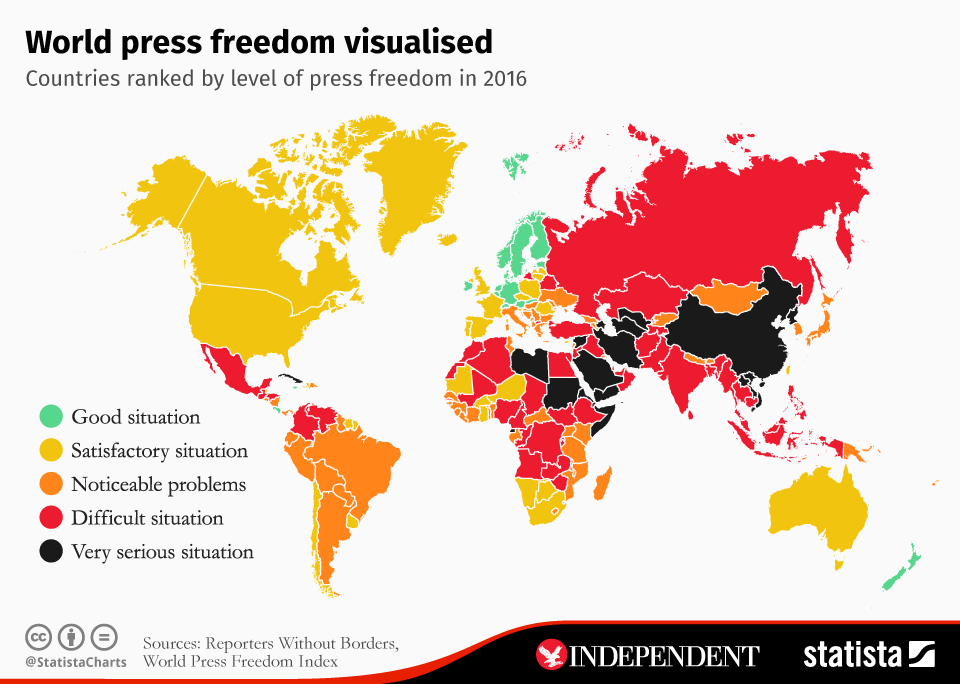
If the majority of media in a country is controlled by one organization, we can say with high probability that such a country has a very low level of freedom of the press. Below, we will list ways to improve the level of freedom of the press, and other institutions testifying to this level will be mentioned there.
What is freedom of speech
The concept of freedom of the press is linked to the concept of freedom of speech. A definition of the concept “freedom of speech” itself is not encountered in sources all that often. If we take the Merriam-Webster dictionary, freedom of speech is understood there as “the legal right to express one’s opinions freely”7. That is, one can say anything that is not prohibited by law. Britannica defines freedom of speech as the freedom to report information, ideas, and opinions without government restrictions. However, the encyclopedia also notes that the modern legal test for the legitimacy of proposed restrictions on freedom of speech was laid out in Oliver Wendell Holmes Jr.’s opinion in the case of Schenck v. United States (1919): restrictions are legitimate if the speech in question constitutes a “clear and present danger”, that is, a serious and imminent risk or threat to someone’s safety (or other public interests)8.
The Britannica definition is more specific because it speaks precisely about the absence of government restrictions on freedom of speech. The use of definitions such as the Merriam-Webster one led to a curious situation at the beginning of 2021, when the accounts of American President Donald Trump were blocked on Twitter and several other social networks for inciting insurrection910. Some considered this an infringement on freedom of speech, as Trump was deprived of the right to express his opinion on those social networks. However, this was not an infringement on freedom of speech, as he was not deprived of the right to express his opinion as such — he could freely express it where he had not been blocked. But many mistakenly decided that Twitter was obligated to give him the right to speak. At the same time, it is obvious that media editors are not required to publish articles from everyone who sends them these articles; furthermore, since a social network is a service, it has no obligation to cooperate with absolutely any user regardless of their behavior. If editors were to publish everything indiscriminately, they would not be able to monitor the quality of the media, and there would be no quality media left in society that could be trusted.
It is more reasonable to proceed from the consideration that freedom is not the absence of laws, but the existence of reasonable laws. Freedom is not the opportunity to do whatever one wants, but the opportunity to do everything that does not cause harm to another (we already mentioned this in the article on tolerance). Otherwise, we would arrive at the opinion that intimidation and threats against journalists (which lead to self-censorship, as we will discuss later) are normal, because one can say whatever one wants. We would arrive at the conclusion that it is impossible to legally prohibit incitement to suicide, incitement to commit a crime, calls for extremist activity, or threats of murder or causing grievous bodily harm, because this is an “infringement of freedom of speech”, yet this is an infringement only of freedom of speech in a perverted sense, and not of real freedom. For true press freedom and freedom of speech, the absence of restrictions represents only a threat. This is also expressed in the 1966 International Covenant on Civil and Political Rights, where Articles 19 and 20 state that the freedom of expression “carries with it special duties and responsibilities” and “may therefore be subject to certain restrictions”11. These restrictions presuppose respect for the rights of other people, and the prohibition of any advocacy of national, racial or religious hatred that constitutes incitement to discrimination, hostility or violence.
When the idea of freedom of speech arose, it did not arise as an idea of freedom of speech for everyone; rather, when discussing democracy, certain limiting conditions were always implied. First and foremost, it was intended to be a discussion among full-fledged, responsible, rational, and, in Kant’s expression, “mature” people. People who did not meet these criteria could be excluded from such a discussion12.
The handbook of the global organization for free speech again confirms this thesis:
However, the concept of seeking, receiving, and imparting information or ideas also includes actions toward which there will hardly be a tolerant attitude anywhere in the world. These are, for example, calls for murder, hooliganism involving spray-painting walls, or the distribution of pornographic products among minors. While the right to freedom of expression is recognized as being of primary importance, humanity has also recognized that this right is not absolute13.
Both freedom of speech and freedom of the press must proceed from the premise of not causing harm to others; that is, reasonable limiters must be present here. Public discussions should take place regarding what these limiters should be (they are usually reflected in legislation, and it is clear to everyone what these limiters are), rather than regarding their necessity.
Why freedom of the press is needed
Freedom of the press is one of the most significant tools for building a prosperous society. Typically, the level of freedom of the press is correlated with the standard of living and level of development in a country. If we take the 15 leading countries from the World Press Freedom Index by the organization Reporters Without Borders14 (Reporters sans frontières, hereinafter – RSF) and the 15 leading countries in the Human Development Index15, we will find that in both cases, Norway holds first place, and in both cases, Ireland, Switzerland, Iceland, Germany, Sweden, the Netherlands, Denmark, Finland, Belgium, and New Zealand are present. That is, 11 out of 15 countries overlap, which shows a clear correlation. Usually, countries with a high level of freedom of the press also have lower corruption, higher levels of the rule of law, and so on.
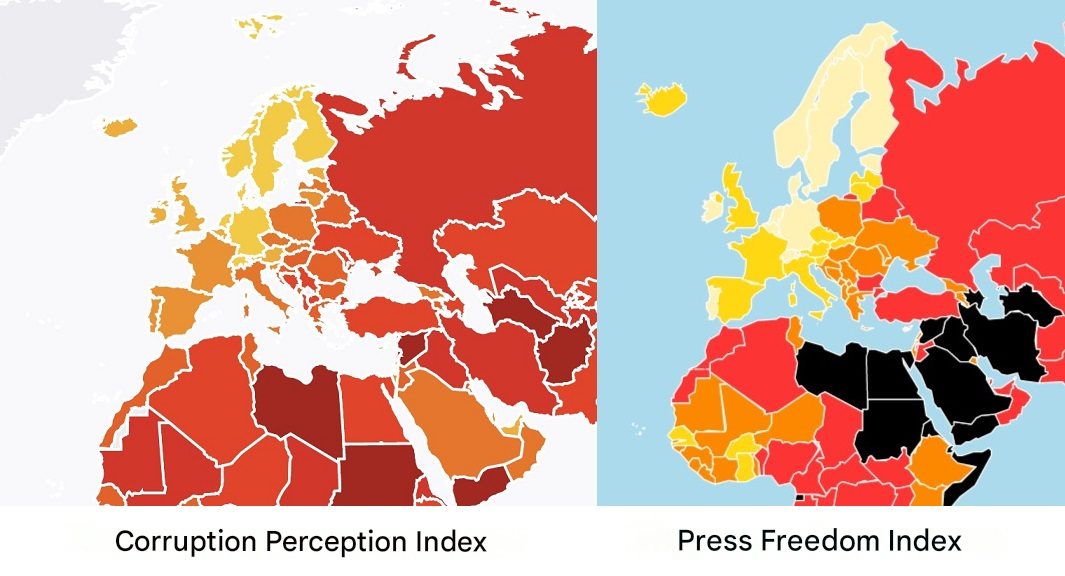
The level of freedom of the press is directly linked to the level of GDP per capita, according to a UNESCO study16. According to the organization, there are only a few countries where the press is not free and GDP per capita is high (more than $10,000): these are mainly oil-rich nations like Saudi Arabia, Bahrain, Oman, or the UAE. States where press freedom index scores are high and GDP per capita is low do not exist at all.
The correlation between these two indicators shows that the level of press freedom definitely influences the level of population income. But some exceptions remind us that high income does not guarantee people the freedom to think and express their opinion17.
Many other studies also prove that in countries with a free press, poverty is reduced and the level of development is increased much more effectively, along with other indicators of the standard of living18. Why does this happen?
Journalistic investigations. Often, journalists investigate various kinds of crimes, including major ones, on their own initiative. When journalists uncover a major crime, other criminals begin to reassess their risks, which influences decision-making regarding crime and, consequently, the general crime rate. Journalistic investigations also positively influence the crime detection rate, helping law enforcement agencies perform their work. With a free press, rule of law, political competition, and other mechanisms of civil society, officials fear journalistic investigations, which influences, for example, the level of corruption. The UN Doha Declaration reports19 that several studies have demonstrated a correlation between the level of freedom of the press and corruption — the higher the freedom of the press, the lower the corruption (in our article on methods of fighting corruption, we also noted that increasing the level of freedom of the press is one of the necessary tools).
One example of effective journalistic investigation is the work of The Boston Globe, when journalists exposed a whole series of cases of child abuse in the Catholic Church. This led to a whole barrage of investigations in other countries, as a result of which numerous crimes were revealed, which ultimately allowed for more effective combating of the problem of pedophilia. Without freedom of the press, numerous pedophile priests could have molested a huge number of other children. In the article on democracy, we also described many other examples of journalistic investigations.
The American experience of the first half of the twentieth century also demonstrates the crucial role of a free media in creating a virtuous circle. In 1906, President Theodore Roosevelt coined the term “muckraker”, hinting at a character from John Bunyan’s “The Pilgrim’s Progress”. Roosevelt used “muckraker” to refer to journalists who seemed too intrusive to him. The word stuck and came to signify journalists — intrusive, perhaps, but effective — who brought the dark deeds of the “robber barons” to light, including the bribery of local and federal politicians. Perhaps the most famous “muckraker” was Ida Tarbell, whose 1904 book “The History of the Standard Oil Company” played a key role in turning public opinion against Rockefeller and his business, eventually leading to the breakup of Standard Oil in 1911. Another well-known “muckraker” was the lawyer and writer Louis Brandeis, whom President Wilson subsequently appointed to the Supreme Court. In his book “Other People’s Money — and How the Bankers Use It”, Brandeis investigated a number of financial scandals, and these investigations had a major influence on the activities of the “Pujo Committee”. Newspaper magnate William Randolph Hearst also played a notable role in “muckraking”. In 1906, he published a series of articles in his magazine Cosmopolitan by David Graham Phillips under the general title “The Treason of the Senate”, which launched a campaign for the direct election of Senators — another key “progressive” reform that became a reality with the passage of the Seventeenth Amendment to the US Constitution (1913).
The “muckrakers” played an important role in inspiring politicians to take action against the trusts. The “robber barons” hated the journalists, but the political institutions of the United States left them no way to silence their enemies. Inclusive political institutions encouraged the flourishing of a free media, and a free media, in turn, reduced the likelihood that attempts to undermine inclusive economic and political institutions would go unnoticed, let alone prove successful. Conversely, such freedom is impossible under extractive political institutions, under absolutism or dictatorship, where the regime has the means to prevent the emergence of any serious opposition. The information provided by a free media became a critical factor in the political life of the United States in the first half of the twentieth century. Without such information, the citizens of the United States would not have known the true scale of the “robber barons'” abuses and would not have been able to finally curb the trusts20.
In 1970, physicist Andrei Sakharov, historian Roy Medvedev, and cyberneticist Valentin Turchin wrote a letter to the political leadership of the USSR, noting that without a free press, decision-makers would possess incomplete or even distorted information, which would affect the quality of management:
…Restrictions on the freedom of information lead not only to difficulties in supervising leaders and the undermining of popular initiative, but also to middle-level managers being deprived of both rights and information, turning them into passive executors and bureaucrats. The leaders of supreme bodies receive overly incomplete, sanitized information and are also deprived of the opportunity to effectively use the powers they possess21.
Defense of democracy. A free media provides information and mobilizes forces to counter any threat to inclusive institutions. If a certain group of people tries to take all power in a country into its own hands, a free press often begins to signal this, and if powerful opposition forces exist in the country, the group of people striving for power has a high chance of being defeated and held accountable.
Another actor (or more accurately, group of actors) can play a key role in the process of empowerment — the mass media. The process of empowering broad segments of society is difficult to coordinate and maintain without the dissemination of information about the economic or political abuses of those in power. In Chapter 11, we saw the role the media plays in informing the public and coordinating their demands when countering forces that undermine inclusive institutions in the United States. The media can also play a key role in encouraging broad segments of society toward political reform, as we showed in that same Chapter 11, particularly in the context of British democratization.
Pamphlets and books that inform and mobilize people played an important role in the Glorious Revolution in England, the French Revolution, and the movement toward democracy in 19th-century Britain. Similarly, mass communication media, especially new forms that arrived with new technologies, such as internet blogs, chat rooms, Facebook, and Twitter, were of decisive importance for the consolidation of the Iranian opposition during the protests against the falsification of the 2009 election results (and the ensuing repressions). These same information tools apparently played a central role in the “Arab Spring” protests, which were still ongoing at the time we completed this book.
<…>
However, of course, a free media and new communication technologies can only help partially, by providing information and coordinating the demands and actions of those who strive to build more inclusive institutions. This assistance will lead to significant change only when broad segments of society mobilize and organize to achieve political change, and they do so not out of narrow, selfish, or corporate interests, but for the sake of turning society toward greater inclusivity22.
As the OSCE notes, “no state can develop along democratic lines without freedom of speech, the press, and the dissemination of ideas and opinions. Democratic societies can function sustainably only on the condition that citizens are well-informed, have free access to information, and can freely exchange it, as well as discuss various views and judgments”23.
Media find systemic flaws and invent solutions. A free press is capable not only of fighting against isolated cases of threats to the public welfare but also of influencing the transformation of the system itself. In conditions of a free press, many researchers publish works that criticize the existing system and sometimes point out options for solving problems without the fear of being persecuted for their words and without the need to adjust to the desires of the elites. This enriches the minds of those who make political decisions, increasing their effectiveness and providing a well-rounded understanding of the situation. If there is no free press, few will dare to point out problems, and these problems will remain unresolved.
A free press, including blogs, is an important element of an efficient market, which allows the economy to develop and citizens to live richer and better lives… Why does the market need diverse information channels? Why the competition among media outlets, which in the last 10 years have additionally had to compete with blogs and microblogs? The less information there is, the more frequently two problems arise. Firstly, many investments turn out to be inefficient and useless. Secondly, there is too little investment because investors, in the absence of information, are afraid to waste their money. If information channels are weak, the financial system (banks, funds, other intermediaries, stock and bond markets) performs its function — transferring money from those who have it to those who could use it effectively to produce goods or services — poorly.
It is no coincidence that numerous studies show that the level of financial system development and a country’s economic growth are closely interconnected. There is an equally strong correlation between freedom of the press and the development of the financial system. Of course, there have been countries that managed to grow without developed financial markets and without a free press, but this was always growth that started from a low level of GDP per capita. The richer the economy became and the less it relied on “catch-up development”, the stronger the need for financial markets and, therefore, a free press. The Soviet economy is one of the cases where “catch-up” growth was fast but then steadily slowed down. The last decades before the collapse were characterized by the complete inability of the governing bodies to direct investments effectively in terms of economic development and public welfare24.
Sense of freedom. Freedom of the press is needed if only because people feel freer when the infringement of their rights can be written about in the media; people enjoy reading different points of view, not just the one preferred by the authorities. More than 50% of people surveyed in various countries consider freedom of speech, the media, and the internet to be a factor influencing their decision on whether or not to live in a country25. In Russia, under the rule of Vladimir Putin, the share of Russians who consider freedom of speech to be one of the important human rights grew by almost a quarter from 2017 to 2019 — from 34 to 58 percent26.
How to improve the level of press freedom
Some degree of press freedom exists almost everywhere — the difference lies only in its level. It can be very low, or it can be very high. The goal of social democrats is to achieve a very high level of press freedom. Even starting from an authoritarian state, we can adopt a set of measures that will move us to a high level of press freedom.
Independent media. By media independence, we mean, first and foremost, that they should have diverse owners. Social democrats must strive to ensure that state media and any press that is in one way or another controlled by or dependent on the state are minimized. Another important task is to avoid the concentration of media in the hands of one person or an affiliated group of persons, to avoid a situation where the political agenda in a country is formed by oligarchs and this agenda reflects their interests (as, for example, in 2019 in Estonia, when the owner of the country’s oldest newspaper, Postimees, interfered with the work of journalists and used the newspaper to promote his conservative theses27). Reporters Without Borders (hereinafter – RSF) notes that for press freedom, the trend of large media companies buying up smaller ones is alarming28. The concentration of media ownership rights in a few hands limits their pluralism29. The global campaign for free speech recognizes that “the concentration of economic power in the hands of a small handful of magnates always creates dangers for consumers, and in the case of media — also blatant threats to freedom of speech”, and provides a specific list of reasons30:
- When media belong to a small number of owners, the spectrum of permitted opinions narrows;
- If one structure acquires several media outlets, it may attempt to save money by distributing the same information across all its outlets; as a result, all news on television is presented exactly the same way as in newspapers and on the radio, and there is clearly a shortage of local or regional news;
- The scale of giant media conglomerates’ operations forces small media outlets to cut costs, as a result of which they are no longer able to conduct their own journalistic investigations or other analytical work;
- Advertisers prefer to work with large media conglomerates, which hits their less powerful competitors in the pocket;
- Weak competition can entail the cutting back of innovative measures, which over time will result in higher prices for consumers.
Therefore, antitrust authorities must have the right to block certain acquisitions and mergers, as, for example, in New Zealand, when the Commerce Commission blocked the proposed merger of Stuff and New Zealand Media and Entertainment (NZME), as well as the merger of NZME and Fairfax a year earlier31. Press freedom is also positively influenced by the absence of privileges for state media32. As Elena Vartanova, Dean of the Faculty of Journalism at Moscow State University, notes, in many European countries, editorial independence has been ensured by various mechanisms, including33:
- Provisions of media legislation that grant media and journalists freedom of speech, understood as professional activity autonomous from social institutions;
- The generally accepted approach provided for by legislation to journalism as a public service;
- Public consensus on the mission, role, and functions of journalism in a democratic society;
- The accountability of journalism to society, voluntarily accepted by the journalistic community, as formulated by the international and national media community in codes of conduct, codes of ethics, canons of journalism, declarations of principles, and similar self-regulatory documents;
- Adherence by journalism to a number of professional standards developed in the process of creating a collective agreement between society and media professionals;
- Observation by society of the activities of the media and their correction through informal mechanisms — media criticism, ombudsmen (media commissioners), “hotlines” at trade unions, public organizations, and media companies themselves.
Many of these mechanisms will also be discussed further on.
Creation of public media. To improve the level of media freedom, the concentration of ownership and management by the state or an oligarchy in the media should also be minimized. In the case of Russia, we propose leaving no more than one media outlet of each type — newspaper, television channel, radio station, and so on — in the ownership of the state and persons associated with high state positions. Those state media outlets that exceed these limits should be transferred to the status of public media or turned into joint-stock companies.
Public media are generally financed from taxpayers’ funds, yet they are not controlled or accountable to the state and operate independently of it. Such media include34, for example, the Swiss Broadcasting Corporation (SRG SSR). It is founded as a private law corporation, of which any resident of Switzerland, even one without citizenship, can become a “shareholder”. The activities of the broadcasting company are regulated by legislation and a special press council; the government and parliament do not have the right to interfere in its editorial activities. The main source of funding for SRG SSR is license fees from all Swiss households (70%), with the remaining income coming from advertising and sponsorship.
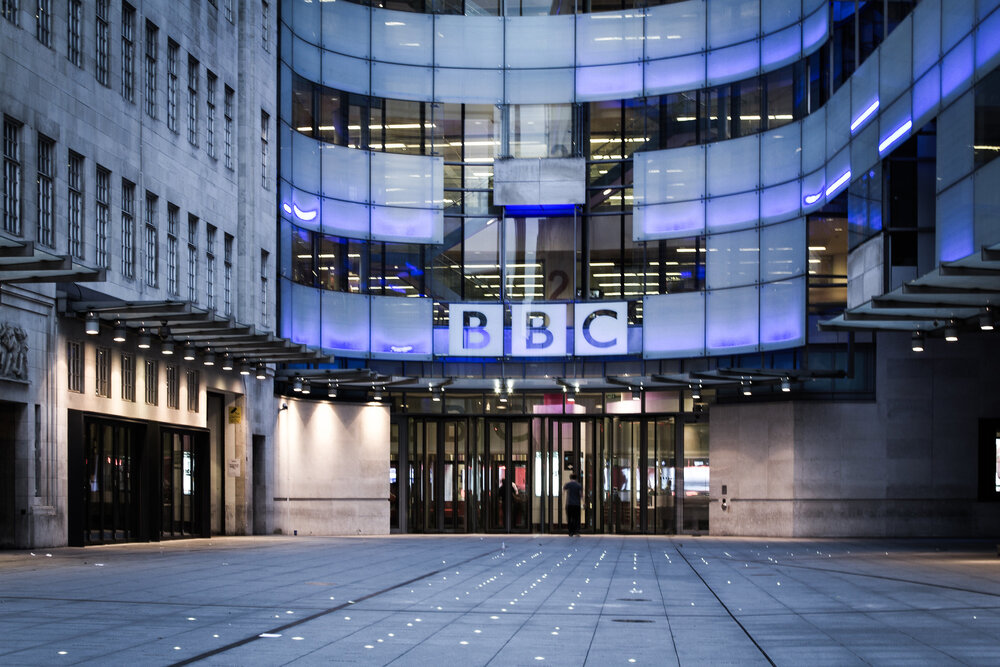
One of the world’s most well-known media outlets, the British BBC, also follows a similar format. The broadcasting company is headed by a Board of Directors, which includes 12 trustees; members of the Board are people appointed by the Queen and selected by the Cabinet of Ministers. Funding is provided as follows: every resident of the United Kingdom who owns a device capable of receiving video signals in real-time pays a special tax for the operation of the BBC. Thanks to this, the company’s annual budgets amount to several billion pounds sterling. Similar public media also exist, for example, in Germany and the USA (ARD, PBS, and so on).
However, the institution of public media itself can be improved. For example, the editorial board of such media outlets could be formed democratically rather than appointed by the authorities, as is the case with the BBC — by electing the editor-in-chief by employees and shareholders, while observing rules of rotation. The distribution of shares in major media outlets should be implemented without a primary holder (i.e., in this case, there is no owner of a controlling stake — more than 20%), with a separation of ownership and control rights; one person should not have the right to own shares in more than three media outlets. Such measures will maximally prevent the concentration of media resources in the hands of one person or an affiliated group of persons (in the article on social-democratic economics, we already wrote that something similar is implemented, for example, in enterprises in Germany or Finland). This will help avoid a situation where the political agenda in a country is formed by oligarchs and this agenda reflects their interests.
Rule of law and democracy. These components keep press freedom afloat, and it, in turn, supports them. Democracy (we wrote about its constituent parts in the material linked above) ensures political competition — accordingly, if the press publishes materials disadvantageous to one part of society, it will have the support and protection of another part of society. The rule of law, in conjunction with the legislative protection of journalists, allows them not to fear publishing even the most scandalous materials — for thanks to the protection of the legal system, there is little to threaten them. Such double protection allows for the most courageous and effective journalists and media workers.
Legislative protection of journalists. To ensure that journalists are not afraid to speak the truth, they must be protected not only by the rule of law but also by reasonable laws. For example, laws must effectively protect journalists from threats and attacks. These laws must be formulated as clearly as possible and exclude ambiguity, as in some countries, even those very advanced in terms of press freedom, due to the vagueness and weakness of existing legal norms, some law enforcement officials have been unwilling to conduct investigations, and some courts have been reluctant to take action even in the most high-profile cases35. Measures must also be taken to ensure the anonymity of journalists and witnesses (if they so desire), and if necessary, round-the-clock police protection must be provided to those journalists who require it (such a practice exists, for example, in Italy, where in 2019 about 20 journalists were protected from the mafia36). Coercing journalists to disclose confidential sources of information to law enforcement agencies must be punishable37. At the same time, there should be no legal norms like the Russian law on “foreign agents” or laws on insulting the feelings of believers, which undermine press freedom38, and freedom of the press itself should be enshrined in the Constitution.
Administrative barriers in media work (for example, requirements regarding registration, licensing, and accreditation) should be minimized. For example, the Inter-American Court of Human Rights ruled in 1985 that licensing that restricts access to the journalistic profession is harmful and serves not to benefit, but to prejudice public order39.
Lustration of propagandists. In cases where a portion of media management are pro-government propagandists who have betrayed all principles of honest journalism (as is the case in Russia), this part of the media management is subject to replacement, and the propagandists should be deprived of the right to work in the press for a certain period. The Dmitry Kiselyovs and Vladimir Solovyovs must be subjected to the same lustration as the nomenclature (the necessity of its lustration we described here). In this case, of course, every case requires an investigation and an assessment of the level of guilt, and the lustration procedure must be clearly regulated.
Ensuring transparency and ease of access to information. Journalists must have free access to most government documents, and hindering them must be punishable. For example, in Norway, the Association of Editors and the Union of Journalists sued the Attorney General for refusing access to documents in a case concerning police handling of weapons40. The refusal to provide access to information held by government agencies is, according to the OSCE, a threat to press freedom41. The handbook of the global campaign for free speech examines in detail both the principles of free access to information and a possible list of probable exceptions, such as the protection of personal data42.
Fighting fake news and hate speech. Freedom is not the absence of laws, but the existence of reasonable laws. And freedom of speech is not the opportunity to say anything one wants, but the existence of reasonable limits regarding what can and cannot be said. If society supports political forces that want to destroy press freedom, then this is a threat to press freedom and legitimizes pressure on “inconvenient” journalists, who then become afraid to write the truth. Also, the press cannot perform useful functions if it is not trusted. And it cannot be trusted if it publishes fake news. For these reasons, all leaders of the press freedom ranking are fighting fake news and hate speech — for example, the commission for analyzing the conditions of freedom of speech in Norway (the ranking leader) develops measures to counter the spread of fake news and hate speech, and investigates to what extent threats and incitement can lead to journalist self-censorship43. In the second country of the ranking — Finland — as RSF notes, “several positive initiatives have been prepared to curb abuse of freedom of speech on social media in the form of hate speech, harassment of journalists and many other professionals with the aim of silencing them”44. So, punishments should be provided for media outlets for publishing fake news and hate speech, which can be contested in an independent court, and the criteria for fake news and hate speech themselves should be formulated based on the consensus of the professional journalistic community.
Independent unions of journalists and editors. In the article on the rule of law, we mentioned the need to create an association of lawyers in the country that is independent and not accountable to the government. Exactly the same unions of journalists and editors, independent of the government and with democratically elected and replaceable leadership, will serve as additional counterweights to the authorities. Such organizations will help journalists defend themselves against arbitrariness and coordinate during an impending public danger.
Financial aid to media. The digital age poses a challenge to independent media — due to the growth of the online sector, small newspapers, publishing houses, and so on are going bankrupt. In some countries — for example, in Luxembourg45 — pluralism is guaranteed by a generous system of state subsidies. However, a great danger arises here that such media will become dependent on those who finance them. Therefore, the question of organizing the distribution of these funds remains open for now, but there is the successful experience of Sweden, which should be studied: when Swedish economists began talking about a period of “newspaper death” in the 1950s and early 1960s, the Swedish state created a system of financial support for newspapers in order to preserve the presence of competing media independent of political parties46. It emerged in 1965, a considerable amount of funds was spent on it, and — importantly — it provided a model for press subsidy systems in other Western European countries. Largely thanks to the systematic efforts of the state, the Swedish press managed to maintain its popularity. According to UNESCO, in the mid-2000s, the country was among the world leaders in newspaper readership: there were about 400 copies of newspapers per 1,000 Swedes.
Establishing the position of a media ombudsman. The institution of ombudsmen has long been operating successfully in many countries — for example, in Sweden, the press ombudsman was recently renamed the media ombudsman with expanded supervisory functions, allowing for the consideration of complaints not only regarding print media but also television, radio, and the Internet47. This ombudsman handles audience complaints about journalists and their compliance with the press code (the code will be discussed further on), arranging “courts of honor” for the offending journalists.
Support for international initiatives to expand press freedom. For example, support the RSF initiative to establish the position of a representative to the UN Secretary-General for the safety of journalists48, support independent journalists in other countries, and so on.
Development of political party press. Major political parties should have and develop their own media outlets — this is one of the tools for ensuring competition in the media and, as a consequence, their mutual regulation. It is important to social democrats that there is no unity of views and interests in major media, so that they cannot collude for the self-serving promotion of those interests.
Education. One of the most important components for creating press freedom is the presence of professional journalists with a high level of qualification. Journalists must know how to seek information, know their rights and defend them, work with sources, and conduct fact-checking. Of course, a comprehensive reform of the education system, not only journalism, will be required, but improving the quality of personnel is a necessary attribute for improving the level of implementation of press freedom.
Professional standards. Establishing ethical norms would be aided by the formation of a progressive journalistic code (a similar code exists, for example, in Germany49), the violation of which (for example, the dissemination of falsifications) would deprive the violator of the moral right to be called a journalist.
In Germany, compliance with the press code by journalists is monitored by the Press Council and the Broadcasting Council (a similar code and state body also exist in Sweden50). Citizens can file a complaint with the Press Council if they observe violations of the press code. This instance examines the complaint. In case of violations, the Council sends instructions to the relevant editorial offices regarding specific cases, expresses its disapproval, or issues public censure, which must be published by the editorial office. Of course, such a body must be independent of the state, its rights must be clearly spelled out, and the possibility of challenging its decision in court must be guaranteed. Ways to ensure the independence of such a body are described in the handbook of the global campaign for free speech51.
This body should not be part of any government department, nor should it be under its control. Its independence must be unequivocally guaranteed by law and, if possible, in the country’s constitution. The activities of the body should be overseen by a supervisory board appointed according to a procedure clearly established by law. No political party or commercial interest should predominate within it. Its regulations should provide for public participation and consultation, including the nomination of candidates for its members on behalf of civil society. Board members should not be appointed by a single person or a single party; in many countries, appointments are made by a multi-party parliamentary committee. Regardless of the mechanism, the state should not control the process of appointing members of the supervisory board. The law must establish the conditions under which a person cannot become a member of the supervisory board. In particular, the board should not include persons who 1) are in the civil service, work for a political party, or hold an elected office, or 2) hold a position in the broadcasting or telecommunications sector or have a significant business interest in them.
After appointment, board members must be protected from removal from office without specific grounds. The term of office on the board should be established by law, as should the grounds for the possible termination of powers. The dismissal of a member of the supervisory board should be the prerogative of the same body that appointed them and should be subject to judicial appeal. The regulatory body must be accountable to the public, represented by a multi-party body such as a parliament or a parliamentary committee. The board should publish an annual report on its activities, including financial information, with data on expenditures verified by auditors. Funding for the regulatory body must be adequate to prevent political interference in its activities, be provided according to the law, and be adjusted in accordance with clearly defined criteria. A reliable way to ensure the independence of the regulator is for it to autonomously use the funds received as license fees. If necessary, these funds can be supplemented by a grant from the state budget.
Conclusion
Freedom of the press (when all related terminology is correctly understood) plays a significant role in creating a prosperous society; it helps identify problems and solutions that escape the notice of politicians. It protects democratic institutions and serves as one of the most important tools for the implementation of democracy. The wealth of the leading countries in key indicators of the standard of living is linked, among other factors, to the level of implementation of press freedom.
For this reason, social democrats need to build effective institutions of a free press and adopt the successful experience of other countries in this matter. Above, we reviewed many measures that allow for raising the level of press freedom: ensuring media independence, creating public media, developing professional standards, monitoring their implementation, and so on. A significant part of these institutions, on which a free press is built, still remain underdeveloped or unimplemented in Russia. The level of the rule of law, which is the foundation not only for ensuring media independence but also for the development of many other essential democratic institutions, is also low. All these problems will have to be solved by Russian social democrats in the future.
- T.V. Naumenko. Sociology of Mass Communication: A Textbook. – 288 p. – SPb.: Piter, 2005. – p. 226.
- The Right to Free Speech. The Role of the Media in Economic Development / Abr. trans. from English; World Bank. – 350 p. – M.: Ves Mir Publishing House, 2005. – pp. 137-179.
- Freedom Of The Press // Merriam-Webster (www.merriam-webster.com). [Electronic resource]. URL: https://www.merriam-webster.com/dictionary/freedom%20of%20the%20press (Accessed: 31.01.2021).
- What is freedom of the press? // Macmillan Dictionary Blog (www.macmillandictionaryblog.com). [Electronic resource]. URL: https://www.macmillandictionaryblog.com/freedom-of-the-press (Accessed: 31.01.2021).
- Jennifer L. Eagan. Media freedom // Britannica (www.britannica.com). [Electronic resource]. URL: https://www.britannica.com/topic/media-freedom (Accessed: 31.01.2021).
- Freedom of the press: basic concepts and terms // Finam (www.finam.ru). [Electronic resource]. URL: https://www.finam.ru/dictionary/wordf028A700014 (Accessed: 31.01.2021).
- Freedom Of The Speech // Merriam-Webster (www.merriam-webster.com). [Electronic resource]. URL: https://www.merriam-webster.com/dictionary/freedom%20of%20speech (Accessed: 31.01.2021).
- Freedom of speech // Britannica (www.britannica.com). [Electronic resource]. URL: https://www.britannica.com/topic/freedom-of-speech (Accessed: 31.01.2021).
- Attack on the Capitol: did Trump incite his supporters to insurrection? // BBC News (www.bbc.com). January 14, 2021. [Electronic resource]. URL: https://www.bbc.com/russian/features-55655353 (Accessed: 31.01.2021).
- Mikhail Kotlyar. Trump has been blocked on social media. Is this legal? // RBC (www.rbc.ru). January 11, 2021, 14:55. [Electronic resource]. URL: https://www.rbc.ru/technology_and_media/11/01/2021/5ffc13cb9a794777cf0cbb13 (Accessed: 31.01.2021).
- International Covenant on Civil and Political Rights // United Nations (www.un.org). [Electronic resource]. URL: https://www.un.org/ru/documents/decl_conv/conventions/pactpol.shtml (Accessed: 31.01.2021).
- Dmitry Bulin. Can a society that is being gagged develop normally? // BBC News (www.bbc.com). June 8, 2016. [Electronic resource]. URL: https://www.bbc.com/russian/business/2016/06/160607_russia_freedom_of_speech_discussion (Accessed: 31.01.2021).
- Freedom of Speech Handbook for Central Asian Countries. – 240 p. – London, ARTICLE 19, 2005 – p. 44. // Article 19 (www.article19.org). [Electronic resource]. URL: https://www.article19.org/data/files/pdfs/tools/central-asian-pocketbook-ru.pdf (Accessed: 31.01.2021).
- 2020 World Press Freedom Index // Reporters without borders (rsf.org). [Electronic resource]. URL: https://rsf.org/en/ranking (Accessed: 31.01.2021).
- The next frontier Human development and the Anthropocene. – 412 p. – New York, United Nations Development Programme, 2020 // Human Development Report (hdr.undp.org). [Electronic resource]. URL: http://hdr.undp.org/sites/default/files/hdr2020.pdf (Accessed: 31.01.2021).
- Marina Guseva, Mounira Nakaa, Anne-Sophie Novel, Kirsi Pekkala, Bachir Souberou, Sami Stouli. Press freedom and development // United Nations Educational Scientific and Cultural Organization. Communication and Information Sector, Division for Freedom of Expression, Democracy and Peace. – 130 p. – Paris, 2008. [Electronic resource]. URL: https://unesdoc.unesco.org/ark:/48223/pf0000161825_eng (Accessed: 04.04.2021).
- Ibid., p. 45.
- Anne-Sophie Novel. Press Freedom and Poverty // UNESCO (https://en.unesco.org). [Electronic resource]. URL: http://www.unesco.org/new/fileadmin/MULTIMEDIA/HQ/CI/WPFD2009/pdf/wpfd2006_Article_Unesco_FOP_Pov_Novel_150606.pdf (Accessed: 31.01.2021).
- The role of the media in fighting corruption // Global Programme for the Implementation of the Doha Declaration (www.unodc.org). [Electronic resource]. URL: https://www.unodc.org/e4j/en/anti-corruption/module-10/key-issues/the-role-of-the-media-in-fighting-corruption.html (Accessed: 31.01.2021).
- Daron Acemoglu, James A. Robinson. Why Nations Fail: The Origins of Power, Prosperity, and Poverty / Daron Acemoglu, James A. Robinson. – 575 p. – Moscow: AST Publishing House, 2015. – pp. 359-360.
- Sonin, K.I. Lessons of Economics. United Press LLC; Moscow; 2011.
- Daron Acemoglu, James A. Robinson. Why Nations Fail: The Origins of Power, Prosperity, and Poverty / Daron Acemoglu, James A. Robinson. – 575 p. – Moscow: AST Publishing House, 2015. – pp. 501-503.
- Why free media matter // OSCE (www.osce.org). [Electronic resource]. URL: https://www.osce.org/files/f/documents/f/8/31231.pdf (Accessed: 31.01.2021).
- Konstantin Sonin. The Rules of the Game: The Economic Meaning of Freedom of the Press // Vedomosti (www.vedomosti.ru). March 17, 2014, 00:00. [Electronic resource]. URL: https://www.vedomosti.ru/newspaper/articles/2014/03/17/ekonomicheskij-smysl-svobody-pressy (Accessed: 31.01.2021).
- Richard Wike, Katie Simmons. Global Support for Principle of Free Expression, but Opposition to Some Forms of Speech // Pew Research Center (www.pewresearch.org). November 18, 2015. [Electronic resource]. URL: https://www.pewresearch.org/global/2015/11/18/global-support-for-principle-of-free-expression-but-opposition-to-some-forms-of-speech/ (Accessed: 31.01.2021).
- Human Rights // Levada-Center (www.levada.ru). November 20, 2019. [Electronic resource]. URL: https://www.levada.ru/2019/11/20/prava-cheloveka/ (Accessed: 31.01.2021).
- Estonia // Reporters without borders (rsf.org). [Electronic resource]. URL: https://rsf.org/en/estonia (Accessed: 31.01.2021).
- Sweden // Reporters without borders (rsf.org). [Electronic resource]. URL: https://rsf.org/en/sweden (Accessed: 31.01.2021).
- Costa Rica // Reporters without borders (rsf.org). [Electronic resource]. URL: https://rsf.org/en/costa-rica (Accessed: 31.01.2021).
- Freedom of Speech Handbook for Central Asian Countries. – 240 p. – London, ARTICLE 19, 2005 – p. 230. // Article 19 (www.article19.org). [Electronic resource]. URL: https://www.article19.org/data/files/pdfs/tools/central-asian-pocketbook-ru.pdf (Accessed: 31.01.2021).
- New Zealand // Reporters without borders (rsf.org). [Electronic resource]. URL: https://rsf.org/en/new-zealand (Accessed: 31.01.2021).
- Why free media matter // OSCE (www.osce.org). [Electronic resource]. URL: https://www.osce.org/files/f/documents/f/8/31231.pdf (Accessed: 31.01.2021).
- E.L. Vartanova. Editorial independence: foreign concepts and realities // Bulletin of Moscow University (vestnik.journ.msu.ru). [Electronic resource]. URL: https://vestnik.journ.msu.ru/books/2014/6/redaktsionnaya-nezavisimost-zarubezhnye-kontseptsii-i-realii/ (Accessed: 31.01.2021).
- Veronica De Vore, with contributions from Thomas Stephens, Shi Guo, and Igor Petrov. Public service broadcasting around the world // SWI swissinfo.ch. October 25, 2017, 21:15. [Electronic resource]. URL: https://www.swissinfo.ch/rus/глобальный-взгляд_общественное-теле- и-радиовещаение-в-мире/43049056 (Accessed: 22.04.2021).
- Finland // Reporters without borders (rsf.org). [Electronic resource]. URL: https://rsf.org/en/finland (Accessed: 31.01.2021).
- Italy // Reporters without borders (rsf.org). [Electronic resource]. URL: https://rsf.org/en/italy (Accessed: 31.01.2021).
- Why free media matter // OSCE (www.osce.org). [Electronic resource]. URL: https://www.osce.org/files/f/documents/f/8/31231.pdf (Accessed: 31.01.2021).
- Ireland // Reporters without borders (rsf.org). [Electronic resource]. URL: https://rsf.org/en/ireland (Accessed: 31.01.2021).
- “Compulsory Membership in an Association Prescribed by Law for the Practice of Journalism”, OC-5/85 of November 13, 1985, Series A. No. 5, for English version see: http://www.corteidh.or.cr/serieapdf_ing/seriea_05_ing.pdf.
- Norway // Reporters without borders (rsf.org). [Electronic resource]. URL: https://rsf.org/en/norway (Accessed: 31.01.2021).
- Why free media matter // OSCE (www.osce.org). [Electronic resource]. URL: https://www.osce.org/files/f/documents/f/8/31231.pdf (Accessed: 31.01.2021).
- Freedom of Speech Handbook for Central Asian Countries. – 240 p. – London, ARTICLE 19, 2005 – pp. 207-215. // Article 19 (www.article19.org). [Electronic resource]. URL: https://www.article19.org/data/files/pdfs/tools/central-asian-pocketbook-ru.pdf (Accessed: 31.01.2021).
- Norway // Reporters without borders (rsf.org). [Electronic resource]. URL: https://rsf.org/en/norway (Accessed: 31.01.2021).
- Finland // Reporters without borders (rsf.org). [Electronic resource]. URL: https://rsf.org/en/finland (Accessed: 31.01.2021).
- Luxembourg // Reporters without borders (rsf.org). [Electronic resource]. URL: https://rsf.org/en/luxembourg (Accessed: 31.01.2021).
- Elena Vartanova. Freedom of speech in Sweden: 9 things to know // Official website of Sweden in Russian (ru.sweden.se). December 4, 2019. [Electronic resource]. URL: https://ru.sweden.se/ljudi/svoboda-slova-v-shvecii-9-veshej-kotorye-nuzhno-znat/ (Accessed: 31.01.2021).
- Sweden // Reporters without borders (rsf.org). [Electronic resource]. URL: https://rsf.org/en/sweden (Accessed: 31.01.2021).
- For a protector of journalists // Reporters without borders (rsf.org). [Electronic resource]. URL: https://rsf.org/en/protector-journalists-1 (Accessed: 31.01.2021).
- Eva Steinlein. The basic structure of German media. Why is the media in Germany considered the “fourth estate”, what does the “press code” mean, and how is press freedom ensured? // deutschland.de (www.deutschland.de/ru). May 2, 2019. [Electronic resource]. URL: https://www.deutschland.de/ru/topic/kultura/obschaya-informaciya-o-svobode-pressy-i-smi-v-germanii (Accessed: 31.01.2021).
- Elena Vartanova. Freedom of speech in Sweden: 9 things to know // Official website of Sweden in Russian (ru.sweden.se). December 4, 2019. [Electronic resource]. URL: https://ru.sweden.se/ljudi/svoboda-slova-v-shvecii-9-veshej-kotorye-nuzhno-znat/ (Accessed: 31.01.2021).
- Freedom of Speech Handbook for Central Asian Countries. – 240 p. – London, ARTICLE 19, 2005 – pp. 120-129. // Article 19 (www.article19.org). [Electronic resource]. URL: https://www.article19.org/data/files/pdfs/tools/central-asian-pocketbook-ru.pdf (Accessed: 31.01.2021).