
What the rule of law is and why it is necessary
In this article, we will examine in detail one of the fundamental pillars of the social democratic system — the rule of law. Without a high degree of implementation of this principle, it is impossible to build a just society, therefore we need to know what must be done to achieve this.
When the president of the Kickboxing Federation beats up young women in Belgorod1, many understand that there is no point for these women to take him to court — in court everyone is “one of their own”, and the “brave guy” will get off with an administrative penalty at most, while the women themselves might face problems that our law enforcement system will not protect them from. When Sergei Magnitsky exposes a corruption scheme of top officials of the Ministry of Internal Affairs, everyone knows that it is not them who will be imprisoned, but him (later, Magnitsky was tortured to death2). On the other hand, in the US, the campaign of the incumbent president loses lawsuits in the courts of the states of Wisconsin and Michigan3. There are many reasons for the lawlessness taking place in Russia, and the most crucial of them is the weak level of the rule of law and of an effective judicial system in general. What is the rule of law and how can it be implemented?
Contents
What the rule of law is
According to the Venice Commission of the Council of Europe, “the concept of the rule of law implies a clear and predictable legal system, in which every citizen has the right to dignified, equal and reasonable treatment in accordance with the law from all persons in power, and also has the opportunity to challenge their decisions in independent and impartial courts in a fair trial”4. Britannica notes that the rule of law is “the mechanism, process, institution, practice, or norm that supports the equality of all citizens before the law, secures a nonarbitrary form of government, and more generally prevents the arbitrary use of power”5. According to the UN definition, it is “a principle of governance in which all persons, institutions and entities, public and private, including the State itself, are accountable to laws that are publicly promulgated, equally enforced and independently adjudicated, and which are consistent with international human rights standards”6. From the perspective of the international civil society organization World Justice Project, the rule of law presupposes the existence of a system in which four universal principles are respected7:
- The state apparatus, officials, and official representatives are subject to the law;
- Legal acts are clear and defined, they are officially published and meet the requirements of stability and justice aimed at ensuring the protection of fundamental rights, including the protection of person and property;
- The process of adoption, implementation, and enforcement of regulatory legal acts is open and rational;
- Justice is delivered by competent, independent adjudicators (a neutral party) who are present in the state in sufficient numbers, have adequate resources, and reflect the makeup of the society in which they serve.
Thus, we see from all the definitions that the rule of law is a legal doctrine according to which legality is the fundamental criterion of all legal relations, whereby everyone is equal before the law and no one can be above or below others from the perspective of this law. Also, according to this doctrine, no one can be held legally responsible except in accordance with the procedure established by law, and the sole basis for holding a person responsible is a violation of the established law. According to the principle of the rule of law, all regulatory legal acts (including the Constitution and legislation) and all activities of state power are subordinate to the protection of human dignity, freedom, and rights. The rule of law is also sometimes referred to as the supremacy of law, and a state where it is implemented to a high degree is often called a state governed by the rule of law.
A state governed by the rule of law is limited in its actions by the laws it has enacted. The rule of law in such a state excludes the arbitrariness of power and even broad discretionary powers of the government. The governance of people is carried out on the basis of law. Punishment is possible only for a violation of the law established by a court. The legal equality of citizens is recognized. Any person (including officials), whatever their title or position, is subject to the ordinary laws of the state and is subject to the jurisdiction of the ordinary courts. Everything that is not forbidden is allowed. Effective judicial protection of the rights of individuals is carried out8.
Why the rule of law is needed
With a weak implementation of the rule of law, compliance with laws becomes optional for a significant part of the population, and this leads to an increase in crime, corruption, tax evasion, as well as to the fact that laws passed to correct the country’s problems are not enforced, and the problems, as a consequence, are not resolved, but only grow. No matter what correct laws you pass, if there is a low degree of implementation of the rule of law in the country — they will not help, as they will not be executed. And it becomes irrelevant which party rules the country (whether social democratic or libertarian), because the laws and orders it adopts will be largely ignored. Therefore, the rule of law is necessary for government policy to work and be able to benefit society. As the authors of the collection “Standards of Fair Justice” note, the right to fair justice is viewed as an indispensable part of the catalog of universally recognized rights and freedoms — without a judicial mechanism, the protection of all other rights could not be realized9. We have already noted in a separate article that the rule of law is one of the factors necessary to defeat corruption.
Furthermore, the rule of law is needed to protect citizens from the arbitrariness of elites and from crime. When even the most humble citizen can win a lawsuit against a powerful politician — in that case, corrupt officials, election riggers, political assassins, and other criminals can be punished for their crimes. An employee can be unafraid of their boss, a journalist of an FSB officer, an oppositionist of a corrupt president. Without the rule of law, everyone lives in fear of the rich and powerful; the rule of law, however, restores dignity and freedom to a person, giving them the courage to fight arrogant elites. Without the rule of law and the rotation of power, there is no point for representatives of the legislative branch to pass laws in the interests of the entire society — what is the point for them if these laws will not apply to them anyway? When the judicial system is subordinate to the authorities, it contributes to the corruption of this system, and it ceases to perform its function. After all, if a judge is allowed to break the law based on state-political interests, should one be surprised when a judge breaks it based on personal ones10?
The more the law is unequal for everyone, the easier and more actively the decay of elites begins in a country. They will create corruption schemes, try to crush the press and political opponents, and establish a dictatorship. When the law is the same for everyone and is enforced in practice — such attempts will most often end in court and defeat for representatives of the elites. In this way, society heals itself. And so that officials do not pass laws aimed at breaking down the constitutional state, among other things, a Constitution is needed, which all adopted laws must not contradict — thus, it must exclude the possibility of their adoption.
From the UN’s perspective, “the rule of law and development are strongly interrelated and mutually reinforcing… the advancement of the rule of law at the national and international levels is essential for sustained and inclusive economic growth, sustainable development, the eradication of poverty and hunger and the full realization of all human rights and fundamental freedoms, including the right to development”11. The United Nations emphasizes “the importance of the rule of law as one of the key elements of conflict prevention, peacekeeping, conflict resolution and peacebuilding… justice, including transitional justice, is a fundamental building block of sustainable peace in countries in conflict and post-conflict situations”. Studies show that the higher the level of the rule of law, the higher the health outcomes of citizens in a country12, the higher the level of development, the lower the inequality metrics, and the better the education13.
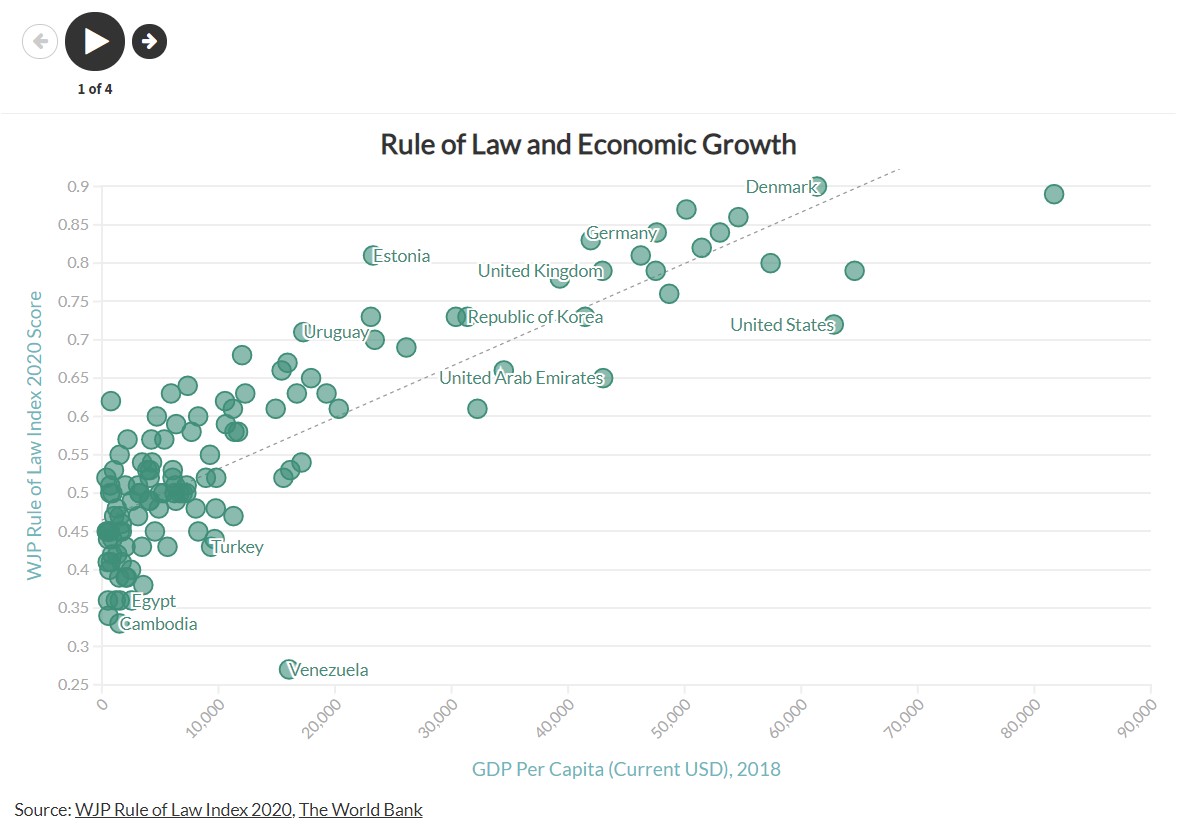
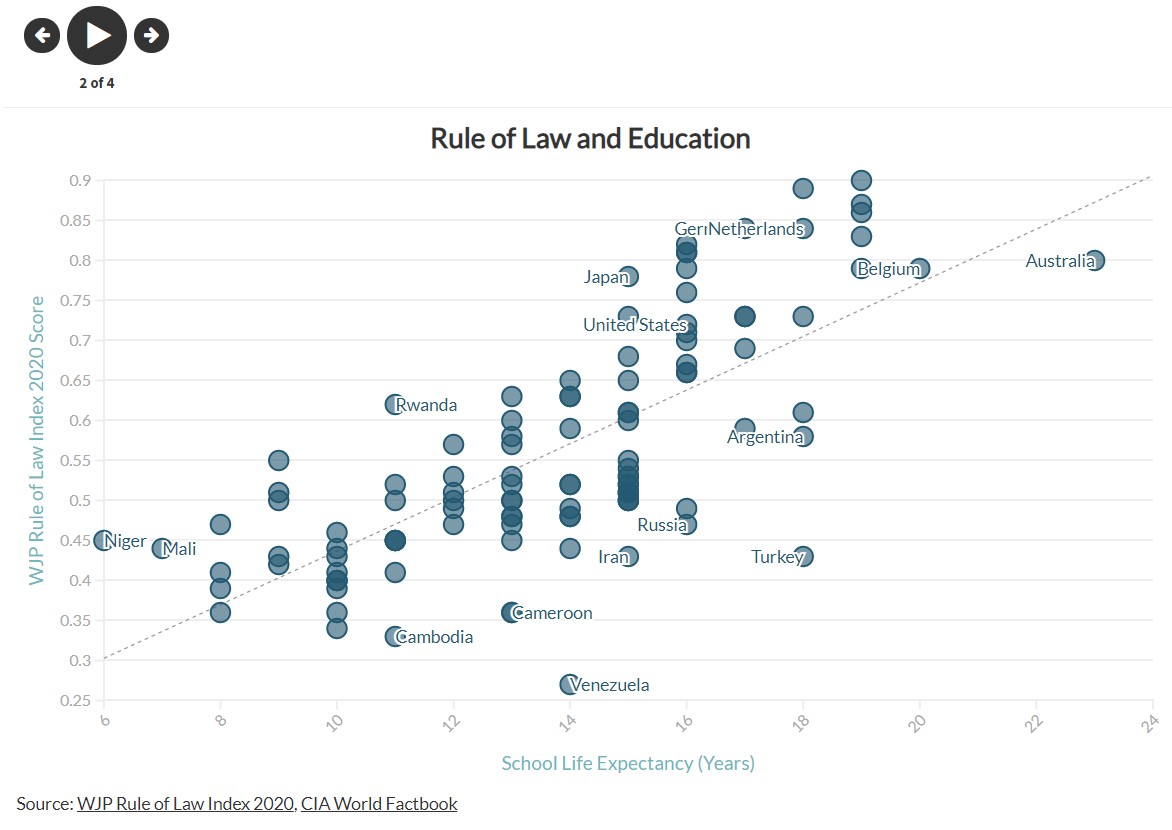

In a country with a high level of the rule of law, a journalist can write the truth in the media because they know: they will not be imprisoned for this, their rights are protected by law. In such a country, you can sue and strip of office an official who violates the Constitution. And so on. For all these reasons, one of the primary tasks of social democrats is to achieve a high level of implementation of the rule of law.
“There is no rule of law anywhere”
Sometimes it is beneficial for elites that the rule of law does not prevent them from robbing all other citizens. Especially if the elites are irreplaceable — after all, this way they will be confident that the lawlessness they have created will not later be turned against themselves. Therefore, the nomenklatura and its propagandists carry out a struggle to ensure that the rule of law is not implemented in the country. Directly proving that the rule of law is disadvantageous to most of society is a rather unpromising endeavor, because in such a debate, supporters of the rule of law would win against them. However, propagandists of authoritarian countries have found a solution — they need to prove not this, but the thesis that allegedly the rule of law is implemented nowhere, which means it makes no sense to strive for it, and the successes of developed societies are unrelated to it. As long as citizens think this way, elites can maintain the lawlessness that they will use for their own purposes.
This thesis is demagogic. Firstly, the rule of law cannot be fully implemented or not implemented simply due to the existence of the human factor. Substituting it with such a primitive division implies that there are only two options — that the rule of law is 100% implemented and that it is 0% implemented. But neither the first option nor the second exists in reality, and the existence of such options is highly improbable. Secondly, the rule of law can only be implemented to a greater or lesser degree. There is the World Justice Project rating14, where the degree of implementation of the rule of law is calculated based on a variety of different factors and data. In 2020, the leader of the index is Denmark, which scored 0.90 points in it, and the outsider is Venezuela, which scored 0.27 points. As we can see, no one scored a one or a zero.

The propaganda of authoritarian countries tries to convince citizens that even in countries with a high level of implementation of the rule of law, high inequality in rights persists, and representatives of the elites are immune to the law. However, there is a significant number of examples that refute this. For instance, in 1974 in the US, the incumbent president of the country, Richard Nixon, lost a court case concerning the Watergate scandal, which led to his resignation15; in 1999, the incumbent president Bill Clinton was ordered to pay a fine of more than 90 thousand dollars for giving false testimony16. In 2020 in Israel, the incumbent prime minister Benjamin Netanyahu found himself in the dock17; in Spain, the husband of Princess Cristina received 6 years and 3 months in prison for tax fraud. In South Korea, former presidents Park Geun-hye and Lee Myung-bak received 2518 and 15 years19 in prison respectively, and even in Romania, prosecutor Laura Codruța Kövesi managed to imprison the president’s brother for corruption20.
What is needed for progress
To raise the level of the rule of law in a country, immense and constant work is required. The UN stresses “the importance of a comprehensive approach to transitional justice incorporating the full range of judicial and non-judicial measures to ensure accountability, serve justice, provide remedies to victims, promote healing and reconciliation, establish independent oversight of the security system and restore confidence in the institutions of the State, and promote the rule of law”21. The rule of law cannot be implemented once and for all, and cannot be implemented fully due to the human factor. But it can be implemented to a very high degree, with further maintenance of this level. What is needed for this?
A well-crafted Constitution. The Constitution is the basic law of the state, having paramount importance in the life of the country22. One could say it is the founding document of the state, which defines the main goals of its creation. This document possesses supreme legal authority. Therefore, if the Constitution contradicts the laws of the state, it may lead to the non-fulfillment of its provisions and to the fact that such a Constitution will not be taken seriously, which undermines the very foundations of the state and the rule of law. The most important institution of a constitutional state is constitutional control, through which the compliance of decisions and actions of public authorities with the Constitution of the country is ensured, and primarily, control over the constitutionality of laws is exercised23 (including with the help of the Constitutional Court). The Constitution is the legal basis for the development of legislation and law enforcement practice; all legal acts, the practice of state bodies must comply with the Constitution, otherwise they are invalid (acts), unlawful (actions of organs) due to their anti-constitutionality. Violation of the Constitution must entail severe punishment — this is largely a matter of the political will of those at the top of power and the forces that oppose them. In authoritarian regimes, it is wise for the democratic opposition to have a drafted project of the Constitution even before the collapse of the regime.
Democracy. Establishing a democratic system, at least in the forms we described here, significantly increases the chances of implementing the rule of law. Democracy implies, among other things, the presence of elections, a strong opposition, and the rotation of power. This means that if judges ignore the law, and the government ignores such behavior of judges, then the opposition will use this as a tool of pressure, including in the next elections, and a criminally negligent government may lose its offices in the next elections. This forces the government not to remain negligent, and to exert pressure on judges who do not comply with the principle of the rule of law. Furthermore, since power is rotated, its representatives know that one day they will definitely not be at the levers of power, which means that if they do not do everything to create a constitutional state, cases may be fabricated later against themselves as well. It is beneficial for democratic officials to do everything to maintain the rule of law. While under authoritarianism, no one exerts significant pressure on the nomenklatura, and it benefits from exactly the opposite — having “pocket” judges who will make not the decisions that are fair, but the decisions that are beneficial to the nomenklatura. One of the first examples of introducing democratic institutions was the parliamentary democracy of England after the Glorious Revolution of 1688 (in 1689, the Bill of Rights was adopted, which had a significant impact on the development of the rule of law). As a result of the adoption of this document, parliament gained power over the army, navy, and state budget.
The rule of law is not imaginable under absolutist political institutions. It is a creation of pluralistic political institutions and of the broad coalitions that support them. It is only when many individuals and groups have a say in decisions and the political power to back it up that the idea that they should all be treated equally makes sense24.
An independent judiciary. The judiciary (including the bodies of constitutional control25) must not be controlled by the executive or legislative branches; it must be separated from them. The separation of powers is one of the most important features of a constitutional state26. As the UN declaration notes, “the independence of the judiciary, together with its impartiality and integrity, is an essential prerequisite for upholding the rule of law and ensuring that there is no discrimination in the administration of justice”27. The very principle of the independence of judges is based on the theory of separation of powers, according to which the executive, legislative, and judicial authorities represent three separate branches of power, which, in particular, form a system of mutual checks and balances aimed at preventing abuses of power to the detriment of a free society28.
In modern Russia, the judicial system is completely under the control of the authorities — thus, the Chairman of the Supreme Court of the Russian Federation is appointed to office by the Federation Council of the Federal Assembly of the Russian Federation for a term of six years upon the recommendation of the President of the Russian Federation and in the presence of a positive conclusion of the Higher Qualification Collegium of Judges of the Russian Federation29. Judges of the Supreme Court of the Russian Federation are appointed by the Federation Council of the Federal Assembly of the Russian Federation upon the recommendation of the President of the Russian Federation, which is submitted on the basis of a recommendation by the Chairman of the Supreme Court of the Russian Federation30. As a result of such appointment practice, the country’s judicial system is not professional — professionally it only executes the will of the highest officials of the nomenklatura, and 84% of judges are former employees of the executive branch: these are workers of the court apparatus, the prosecutor’s office, and the Ministry of Internal Affairs31. A case is known when telephone prankster Sergey Davydov called judges, introducing himself as the deputy chairman of the regional court, and asked to make a decision he needed — many fulfilled the request32.
At the moment, judges in Russia are highly dependent on leaders in the person of court chairmen and their deputies, due to the overly broad powers of this position — they select personnel, distribute workload, approve vacations and duty schedules, issue rewards, recommend for class assignments, initiate disciplinary action, and so on33. More than 90% of experts consider the dependence of judges on chairmen to be a serious problem34.
There are a number of proposals aimed at ensuring the independence of the judicial branch of power:
- Electability and rotation of judges;
- Decentralization. Each state (we discussed the state system here) must have its own Supreme Court, independent of the courts of other states;
- Introduction of the election of court chairmen at all levels by the judges of the respective court from among their number;
- Establishing the electability of court chairmen for a term of no more than 4 years (a maximum of 2 terms of 2 years or 1 term of 3 years);
- Minimizing the powers of the court chairman. They should concern the management of the apparatus and record-keeping rather than the management of judges. The chairman must not distribute cases among judges, influence salaries, or hire or fire judges;
- Abolition of the privileged position of the chairmen of higher courts, which allows them to remain in office as a judge after reaching the age limit35, and to utilize state security protection. The determination of the salaries of the chairmen of higher courts by presidential decree should also be abolished;
- Implementation and refinement of an automated and random system for distributing cases among judges;
- Enshrining in the Constitution and legislation of the country the principle of absolute financial independence of the entire judicial system and the right to form a budget estimate for the upcoming 4-year planning period. In this regard, the Constitutional Court and the Supreme Court should be granted the right, at least once every 4 years, to calculate the estimate and justify expenses for the planned 4-year period that are not covered by state fee collections for case hearings in court. The estimate should be submitted to parliament during the preparation of the country’s budget. In turn, an obligation for the parliament to accept the estimate (the judicial budget) for discussion should be introduced into legislative acts;
- Introduction of measures to combat telephone justice in judicial proceedings;
- Clear criteria for the delineation of competence between courts;
- Transfer of authority for conducting investigations regarding judges to the bodies of the judicial community;
- Consistently separating the institution of chairmen from the organs of the judicial community, in particular, from the council of judges36;
- Introducing a rule under which the state prosecution in court is presented by the same prosecutor who was involved in the oversight of operational-investigative activities and the investigation of that specific case. This would increase the prosecutor’s accountability for violations during the investigation, making them interested in the legality of investigative actions and the high quality of evidence, rather than in pressuring the judge;
- Expressly prohibiting employees of law enforcement and security agencies (especially the prosecutor’s office and investigative bodies) from taking any part in the appointment of judges (joining collegial bodies, participating in background checks, and so forth);
- Former employees of the prosecutor’s office and other law enforcement agencies may become judges only after a period of legal practice outside of law enforcement agencies lasting 3 years.
What do we mean by the electability of judges mentioned at the beginning of the list? Unfortunately, the system of electing judges by citizens has serious drawbacks — these include high expenditures on election campaigns, the costs of organizing elections, and the dependence of judges on public opinion on the eve of elections37. This would be justified if the effectiveness of such a system were obvious, but in the leading countries in terms of the rule of law, for example, in Denmark, direct election of judges by citizens is not practiced. By the electability of judges, we mean rather principles similar to the principles of the judicial statutes after the reform of 1864 in the Russian Empire. That is, in a classic three-tier system, we have the following instances: court, appeal, and cassation. Judges of the courts of first instance will have to be elected by municipal deputies (democratically elected and rotatable). Judges of the courts of second instance are chosen by regional parliaments. Judges of the courts of third instance are chosen by a scientific commission of the country’s leading lawyers. The election process must be transparent.
When we ensure the independence of the court, as well as its financial autonomy, then our chances of ensuring the rule of law increase significantly.
An independent bar association, unaccountable to the government, should also be created in the country (modeled after the American Bar Association). Often, without such associations, lawyers and judges do not have sufficient strength, moral and material, to insist on the implementation of the rule of law38.
Lustration of the nomenklatura and the dissolution of the FSB. We have already written about the necessity of the lustration of the nomenklatura, and mentioned that if most of the nomenklatura members remain in leadership positions, representatives of this class will, with a high degree of probability, reproduce authoritarian practices over time. There is a high probability that they will be able to dismantle an independent court as well. Therefore, without the lustration of the nomenklatura, most of the indicated measures may ultimately prove useless. The lustration of the nomenklatura also represents a measure designed to create social trust in the authorities and the court — we will show society that the authorities and the court no longer represent a corrupt organization engaged in robbing the population, and that they can and should be turned to for resolving one’s problems. Since the FSB currently has a very large influence on the formation and decisions of the judicial corps, one of the tasks for raising the level of the rule of law in Russia is the dissolution of this organization (there are very many reasons for such a decision besides the judicial issue, and they should be considered in a separate material). As for the lustration of the judges themselves, they do not possess the same political significance and influence as the nomenklatura and state security agencies, so here it might be possible to get by merely with investigations into specific criminal decisions (for instance, the passing of verdicts in the May 6 case).
In a constitutional state, the use of torture in the work of law enforcement agencies is unacceptable. In those countries where torture or political assassinations are used, it is necessary to conduct open, high-profile trials of those law enforcement officers who allowed themselves to use them. A person who gives orders for the use of forceful methods of interrogation must be severely punished, with the deprivation of the opportunity to hold office.
High salaries. To ensure that judges do not need additional “earnings” through corruption, employees of the judicial system should be provided with a truly high salary (however, in Russia this problem is more acute with employees of the judicial apparatus than with the judges themselves — for example, one could substantially increase the salaries of court secretaries and remove the requirement for a higher legal education). In the article on countering corruption, we noted that this measure is also necessary with respect to government officials: it has proven in many countries to be part of a complex of measures to fight corruption. Perhaps the salaries of leadership positions in the judicial system should be tied to the country’s position in international rule of law rankings, in the sense that as the country rises in the ranking, the salary will increase.
Jury trial. A jury trial in Russia is a form of judicial proceeding in criminal cases in the Russian Empire and the Russian Federation, in which questions of fact (that is, questions of whether the crime itself was or was not committed, whether the defendant committed this crime, including whether the defendant is guilty of committing it, and whether they deserve clemency) are decided not by professional judge-lawyers, but by a panel of non-lawyer citizens formed by random selection (the principle “de iure respondent iudices, de facto iuratores”). Jury trials first appeared in Russia after the judicial reform of 1864 as an integral part of the district court. As MGIMO Professor Maksim Isaev writes in his textbook: “…the jury panel was an additional guarantee of the impartiality of a judicial decision, for, as the principle we cited above states, ‘judges decide the legal question, and jurors — the factual one'”39. Examining the historical experience of using this institution, it can be said with confidence that it significantly accelerated the process of judicial proceedings, and most importantly — made it as open and fair as possible (let us turn, for example, to the famous “Vera Zasulich case”, when despite the strongest pressure from the state authorities, Vera Ivanovna Zasulich was acquitted by a jury trial after shooting the city governor Fyodor Trepov, who, bypassing the law, gave orders to flog prisoners with rods40). In 1917, the institution of jurors was liquidated and was restored again only in 1993. Unfortunately, with the strengthening of the authoritarianism of power, the competence of jurors also decreased, and in 2015 the Supreme Court virtually proposed to liquidate the jury trial in Russia, replacing it with a panel consisting of a judge and judicial assessors. We cannot possibly allow this and therefore must, firstly, increase the powers of the jury trial (including extending its scope to civil cases), and secondly, make the execution of the office of a juror an obligation of a citizen of the Russian Federation, since in this case a high legal culture and, accordingly, a sense of responsibility for one’s decisions will be nurtured among the population.
A capable state. To ensure tax collection, which guarantees the viability of this entire system, and the activity of law enforcement agencies that are capable of guaranteeing the execution of court decisions, a capable state is required, which engages in the creation and improvement of these components. It can be democratic (and the more democratic it is, the more it protects citizens from the interests of narrow elites), but at the same time it must be strong enough to be able to defeat criminal or terrorist groups that are a threat to the implementation of the rule of law. All groups that may disobey the law must immediately suffer severe punishment. Therefore, efficient tax and law enforcement systems are very useful components.
Raising the legal culture of citizens (legal literacy). The well-known tradition of “relying on chance” often plays a cruel joke on the population of Russia today. A 2018 study shows discouraging statistics: “40% of Russians believe that there are only individual cases when it is worth defending one’s rights, and 13% are sure that defending one’s rights is useless. More than a third (36%) of Russians, in the event of a violation of their rights, try to resolve the problem on the spot, on their own”41 – based on the results of this study, one can boldly speak of the phenomena of “legal negativism” (denial of the value of law as a universal regulator of social relations) and even “legal nihilism” (active rejection of legal prescriptions by the subject). In short, people would rather agree to any illegal exactions by officials, utility services, or law enforcement agencies than defend their rights, file lawsuits, or write complaints.
As history shows, many people can be driven to such a state where, except for force, there will be no other ways to solve urgent problems. Unquestionably, one can successfully fight corruption and lawlessness, but the legal mechanism of the state will still not work due to the fact that citizens will simply not be aware of their rights and duties. Therefore, today’s task of any democratic parties after coming to power consists, among other things, in raising the legal culture of citizens, namely:
- As many lawyers believe, the main element of purposeful influence on personality development is legal education; it must be structured as multi-level and continuous. It should begin from school (introduction of the school subject “Law” as a compulsory one, organization of lectures on legal topics, invitation of leading specialists in the field of law and law enforcement officers) and continue throughout life. Citizens of the Russian Federation from early childhood should be brought up with respect for law and order, so that in the future they can pass on their knowledge to the next generation. Admittedly, law is not always an interesting topic to study and discuss, however, as Egor Kovalenko believes, “To ‘lighten’ the topic, to make it more ‘digestible’ for children, gamification is here to help: online and offline games of various formats. Game scenarios for children of different ages can gradually involve them in the topic of protecting their rights, tell them about the basics of the state structure, teach them to apply the acquired knowledge in practice, express their thoughts, listen to the opinions of others, and look for solutions to problems”42;
- Thoughtful legal enlightenment in the mass media: not only familiarizing the population with their rights and methods of their protection, but also informing citizens of their duties to the state and society;
- Broad access to the regulatory and legal framework: citizens should have the opportunity at any moment to familiarize themselves with their rights and duties. Fortunately, such electronic database systems as “ConsultantPlus”, “Garant”, “Codex”, and so on are actively developing in Russia. With their help, one can quickly and conveniently find any legal information of interest;
- Development and implementation of effective forms of involving citizens in law-making and law-enforcement activities, for example, through participation in judicial activity as jurors;
- Raising the authority among citizens toward persons of legal professions (who now, unfortunately, are often associated with something frightening, expensive, and unnecessary) and law enforcement officers.
A major problem for the creation of a constitutional state is the citizens’ lack of understanding of how to use the rule of law and why it is needed. The task of democratic parties, the education system, and those mass media that are under state control (in one of our articles we emphasized that their number should be minimal) is to convey to society why it needs the rule of law and to explain how citizens can protect their rights: what is required to go to court; what is needed to win a lawsuit against a person who possesses great resources, and so on. Similar measures were proposed by us in the article on countering corruption. The goal is the same — to ensure that a large number of citizens, possessing this knowledge, have the tools to oppose the elites. The UN recognizes the importance of raising awareness of legal rights43.
Development of modern and democratic legislation. For laws to be respected, they must be reasonable, and reasonable punishments must be assigned for their violation. Thus, acts like “prohibition” will be constantly violated, which breeds disrespect for the law in society and conditions citizens to break it. Foolish laws like the ban on the adoption of Russian children in the USA44 also do not contribute to citizens viewing laws as a source of justice — on the contrary, it creates the impression that legislation is drafted by incompetent and unjust people, and the desire to obey such acts diminishes. Disrespect for the law is bred both by overly lenient punishments (for example, a few years in prison for a pedophile maniac can provoke people to vigilantism) and by overly harsh punishments (execution for minor theft can provoke law enforcement officers to release the criminal for a bribe or simply out of pity). For the most part, the establishment of democracy helps us here, because those politicians who pass foolish laws will face the danger of losing their seats in parliament. Social democrats must also develop a system for tracking the effectiveness of laws, their enforcement, and approval in society, subjecting them to analysis and the possibility of revision every year or two. Human rights must be fully, specifically, and consistently enshrined in legislation (and other sources of law)45.
Russian social democrats will have to ensure that inconsistencies in the system of law are eliminated, both between individual laws of the Republic, and between the laws of the Republic, on one hand, and state laws, on the other. All regulatory legal acts must be brought into compliance with the Constitution (including sub-legislative acts — into compliance with the laws of the state).
The World Justice Project also notes that one of the factors affecting the rule of law is the openness and public accessibility of laws46. This leads us to the conclusion that the country must have an official website listing all laws, featuring a news feed about changes in legislation, information about legal rights, and convenient navigation, and as many citizens as possible should be informed about the existence of such a site. It would also be useful to create a separate portal where all the laws of the Russian state in history will be placed in chronological order, as well as a similar chronology of laws for developed states — this will facilitate the study of one’s own and others’ legislative experience.
It is also extremely important to observe the basic principle of legal certainty: it requires clarity and consistency in the legal status of subjects and the content of legal norms.
Protection of property rights. We wrote about the need to protect private property rights in this article. If property rights are not protected, and the state or someone else can at any moment seize property from its citizens and face no punishment for doing so, it means that the state can seize property from opposition parties and the media, which will render the latter incapacitated and thereby deprive first democracy of protection (because democracy largely depends on the opposition and a free press), and then the rule of law (because it largely depends on democracy). Therefore, civil servants attempting to carry out corporate raids on businesses, or nationalizing enterprises without a voluntary agreement with their owners, must face punishment, and the very first incidents should be turned into arrests with high-profile trials.
Free legal aid. In many developed countries (for example, in the UK47), the state can provide citizens with money to pay for the services of a lawyer if they cannot afford it themselves and if the case is serious. Without this, low-income segments of the population often cannot afford to defend their rights in court (due to the high cost of lawyers’ services), as a result of which people who infringe upon these rights go unpunished and continue their activities of infringing upon the rights of citizens. Therefore, it is important for social democrats to provide legal aid to low-income citizens, and the more investment there is in this area, the easier citizens’ access to this aid will be — the higher the level of the rule of law will be observed in the country.
In Russia, there is also such a law, it is the Federal Law “On Free Legal Aid in the Russian Federation” dated 21.11.2011 N 324-FZ48.
The right of access to a court itself as an element of a fair trial was formulated by the European Commission of Human Rights in the case of “Golder v. the United Kingdom” (judgment of February 21, 1975)49. This right itself has a complex structure and encompasses both the right to apply to a court itself (that is, the initiation of judicial proceedings), and the right to have a case resolved on its merits (that is, obtaining a result of the judicial proceeding adequate to the factual circumstances), as well as the right to receive legal assistance and rights related to appealing judicial decisions.
Combating the overburdening of judges. As a report by the Institute for the Rule of Law noted, in 2012 in Russia, first-instance judges of courts of general jurisdiction were overburdened, which limited the possibility of meaningful consideration of cases and contributed to the spread of a formal (“assembly-line”) approach to justice50. The solution to this problem requires a separate analysis that will show which methods (expansion of the judicial corps, optimization of record-keeping, wider introduction of electronic document management, or others) will help reduce the load. The ILE itself proposed the following series of measures:
- Granting judicial assistants certain procedural powers;
- Increasing by 2-3 times the salaries of the technical staff of courts (primarily judicial assistants), which will attract more qualified specialists to this work, reduce staff turnover, and allow real responsibility to be placed on them;
- Conducting an audit and optimization of judicial document management in order to reduce the number of documents required to perform simple procedural actions;
- In civil proceedings, it is necessary to conduct a separate analysis of applications to court by state bodies and to isolate situations in which the latter shift the responsibility for minor and technical decisions onto the court (sending citizens there instead of resolving the issue independently). The identified problematic issues (specific government agencies and thematic areas) must be regulated at the level of administrative regulations.
Fighting corruption. The level of corruption strongly affects how the rule of law will be implemented — after all, if judges and prosecutors are corrupt, then criminals can avoid punishment. Above, we provided a link to our article on fighting corruption, where we examine the measures that must be taken to solve this problem.
What about case law?
Many developed countries use the Anglo-Saxon legal system, which is distinguished, among other things, by case law tools. These are quite flexible instruments that allow adaptation of rigid laws to constantly changing social relations. Relatively speaking, if there is a gap in the law due to which an unjust decision could be made during a trial in a specific case, then the experience of previous trials can be used to pass a verdict, where a similar problem has already been analyzed and arguments for and against have been presented. For example, one of the important statutes in the history of insurance law — the Marine Insurance Act of the British Parliament — was adopted in part thanks to the judicial inquiry by Lord Mansfield made in the case of Carter v. Boehm in the House Lords in 176651. Furthermore, while a Federal Law “On Amendments to Federal Law No. such-and-such” is being passed, relatively speaking, economic conditions and regulated relations will have time to change again. You cannot write everything into a statute; gaps (unregulated areas of relations) still remain anyway, and they require logical filling. A statutory norm carries an element of declarativeness and can be interpreted in different ways. In such cases, the law needs an official interpretation, rather than an arbitrary one (given, for instance, by the parties). Undoubtedly, the statute possesses supreme authority, not the precedent, but in cases where there are gaps in the law, the use of precedent is acceptable. It increases the predictability of the judicial system, which beneficially affects the level of the rule of law.
Previously, case law was quite difficult to use. Today, however, a huge number of judicial decisions, the content of which in former times would have been known only to the persons involved in the proceedings, has become available for quick and convenient searching52. Recording precedents allows for information that is useful when drafting new laws and prevents attempts by the court to present the case as if there were only one correct decision — its own.
However, many lawyers speak out against the introduction of case law in Russia, since the Russian legal system belongs to the continental legal family, and the transition to precedent may be accompanied by great difficulties. Therefore, the question of the advisability of transitioning to case law remains open and requires an independent scientific discussion.
Summary
The list is not exhausted by the measures we have listed, and the process of improving the rule of law is constant; there can be very many improvements here. For example, we can find ways to improve mechanisms for filing complaints and responding to them, satisfying requests for information, increasing the accessibility of the judicial system, speeding up record-keeping without losing quality, and so forth. The core mechanisms for conducting a fair trial must be ensured — proper and timely notification of the parties about the court hearing, the public nature of the trial, reasonable timeframes for judicial proceedings, and so on. Unfortunately, we cannot list all these mechanisms within a single article, as the judicial system is very complex, but many of them have already been analyzed in the work “Standards of Fair Justice: International and National Practices”, edited by Tamara Morshchakova.
In general, social democrats consider a high level of the rule of law to be an extremely important and fundamental part of a prosperous society. In the context of a transition from an authoritarian state or a third-world country to a social-democratic social order, social democrats can carry out reforms to ensure the rule of law in coalition with other democratic parties, or even simply support the implementation of such reforms by another democratic party if it includes most of the proposals of the social democrats.
The editorial board of “Logic of Progress” expresses its gratitude to Maksim Sikach and Nikolay Kavkazsky for their help in writing this article. You can also subscribe to Maksim’s Telegram channel, where he covers some aspects of the Russian system of law in more detail.
- Famous Belgorod kickboxer beat up young women for refusing to get acquainted: video // NTV (www.ntv.ru). May 26, 2017, 14:20. [Electronic resource]. URL: https://www.ntv.ru/novosti/1811267/ (Accessed: 26.01.2021).
- Alena Vershinina. Denied justice. 10 years since the death of Sergei Magnitsky // Radio Liberty (www.svoboda.org). November 16, 2019. [Electronic resource]. URL: https://www.svoboda.org/a/30273976.html (Accessed: 01.02.2021).
- Trump lost court cases in Wisconsin and Michigan // RBC (www.rbc.ru). December 12, 2020, 02:40. [Electronic resource]. URL: https://www.rbc.ru/rbcfreenews/5fd3fb849a794765f2be37d3 (Accessed: 26.01.2021).
- Rule of Law Checklist // Venice Commission. Council of Europe (www.venice.coe.int). [Electronic resource]. URL: https://www.venice.coe.int/images/SITE%20IMAGES/Publications/Rule%20of%20Law%20Check%20List%20-%20Russian.pdf (Accessed: 26.01.2021).
- Naomi Choi. Rule of law // Britannica (www.britannica.com). [Electronic resource]. URL: https://www.britannica.com/topic/rule-of-law/Challenges-to-the-rule-of-law (Accessed: 26.01.2021).
- What is the Rule of Law // United Nations (www.un.org). [Electronic resource]. URL: https://www.un.org/ruleoflaw/what-is-the-rule-of-law/ (Accessed: 26.01.2021).
- James R. Silkenat. On the rule of law and the constitutional state // Official website of the Moscow Branch of the Association of Lawyers of Russia (alrf.msk.ru). October 21, 2013. [Electronic resource]. URL: http://alrf.msk.ru/o_verhovenstve_prava_i_pravovom_gosudarstve (Accessed: 26.01.2021).
- N.V. Varlamova. Rule of law // Great Russian Encyclopedia. Volume 27. Moscow, 2015, pp. 347-348. [Electronic resource]. URL: https://bigenc.ru/law/text/3165163 (Accessed: 29.01.2021).
- Standards of Fair Justice (international and national practices) / coll. of authors; edited by Doctor of Law T.G. Morshchakova. – 584 p. – Moscow: Mysl, 2012. – p. 11.
- Evgeny Zhirnov. “Criminal activity of judicial workers”. Kommersant Vlast magazine No. 45 dated 16.11.2009, p. 62. [Electronic resource]. URL: https://www.kommersant.ru/doc/1269865 (Accessed: 29.01.2021).
- Declaration of the High-level Meeting of the General Assembly on the Rule of Law at the National and International Levels // United Nations (www.un.org). [Electronic resource]. URL: https://www.un.org/ru/documents/decl_conv/declarations/ruleoflaw2012.shtml (Accessed: 26.01.2021).
- Angela Maria Pinzon-Rondon, Amir Attaran, Juan Carlos Botero, Angela Maria Ruiz-Sternberg. Association of rule of law and health outcomes: an ecological study // BMJ Open (bmjopen.bmj.com). [Electronic resource]. URL: https://bmjopen.bmj.com/content/5/10/e007004 (Accessed: 26.01.2021).
- What is the Rule of Law? // World Justice Project (worldjusticeproject.org). [Electronic resource]. URL: https://worldjusticeproject.org/about-us/overview/what-rule-law (Accessed: 26.01.2021).
- WJP Rule of Law Index // World Justice Project (worldjusticeproject.org). [Electronic resource]. URL: https://worldjusticeproject.org/rule-of-law-index/ (Accessed: 26.01.2021).
- United States v. Nixon // Oyez (www.oyez.org). [Electronic resource]. URL: https://www.oyez.org/cases/1973/73-1766 (Accessed: 15.10.2020).
- Robert L. Jackson. Clinton Fined $90,686 for Lying in Paula Jones Case // Los Angeles Times (www.latimes.com). July 30, 1999, 12:00. [Electronic resource]. URL: https://www.latimes.com/archives/la-xpm-1999-jul-30-mn-61021-story.html (Accessed: 15.10.2020).
- Marianna Belenkaya. Israel is suing its own prime minister // Kommersant (www.kommersant.ru). May 25, 2020. [Electronic resource]. URL: https://www.kommersant.ru/doc/4355748 (Accessed: 15.10.2020).
- Ekaterina Venkina. Court extended prison term for South Korea’s ex-president to 25 years // Deutsche Welle (www.dw.com). August 24, 2018. [Electronic resource]. URL: https://www.dw.com/ru/суд-продлил-до-25-лет-заключение-экс-президенту-южной-кореи/a-45206430 (Accessed: 01.02.2021).
- Former South Korean President Lee Myung-bak sentenced to 15 years for corruption // Interfax (www.interfax.ru). October 5, 2018, 09:31. [Electronic resource]. URL: https://www.interfax.ru/world/631990 (Accessed: 01.02.2021).
- Luiza Ilie. Romanian court orders 30-day detention for president’s brother // Reuters (www.reuters.com). June 21, 2014, 12:58. [Electronic resource]. URL: https://www.reuters.com/article/uk-romania-politics-president-idUKKBN0EV2H320140620 (Accessed: 26.01.2021).
- Declaration of the High-level Meeting of the General Assembly on the Rule of Law at the National and International Levels // United Nations (www.un.org). [Electronic resource]. URL: https://www.un.org/ru/documents/decl_conv/declarations/ruleoflaw2012.shtml (Accessed: 26.01.2021).
- V.E. Chirkin, S.A. Baybakov. Constitution // Great Russian Encyclopedia. Electronic version (2020). URL: https://bigenc.ru/law/text/5732239 (Accessed: 29.01.2021).
- N.V. Varlamova. Constitutional State // Great Russian Encyclopedia. Volume 27. Moscow, 2015, pp. 347-348. [Electronic resource]. URL: https://bigenc.ru/law/text/3165163 (Accessed: 29.01.2021).
- Daron Acemoglu, James A. Robinson. Why Nations Fail: The Origins of Power, Prosperity, and Poverty. Crown Business, 2012. p. 306.
- V.E. Chirkin. Constitutional Control // Great Russian Encyclopedia. Volume 15. Moscow, 2010, p. 112. [Electronic resource]. URL: https://bigenc.ru/law/text/2092395 (Accessed: 29.01.2021).
- N.V. Varlamova. Constitutional State // Great Russian Encyclopedia. Volume 27. Moscow, 2015, pp. 347-348. [Electronic resource]. URL: https://bigenc.ru/law/text/3165163 (Accessed: 29.01.2021).
- Declaration of the High-level Meeting of the General Assembly on the Rule of Law at the National and International Levels // United Nations (www.un.org). [Electronic resource]. URL: https://www.un.org/ru/documents/decl_conv/declarations/ruleoflaw2012.shtml (Accessed: 26.01.2021).
- Human Rights in the Administration of Justice: A Manual on Human Rights for Judges, Prosecutors and Lawyers. UN Publications. Chapter 4. Independence and Impartiality of Judges, Prosecutors and Lawyers. [Electronic resource]. URL: https://www.ohchr.org/Documents/Publications/training9chapter4ru.pdf (Accessed: 29.01.2021).
- Federal Constitutional Law of 05.02.2014 N 3-FKZ (as amended on 02.08.2019) “On the Supreme Court of the Russian Federation”. Article 12.
- Law of the Russian Federation “On the Status of Judges in the Russian Federation” of 26.06.1992 No. 3132-1. Article 6.
- Aleksandr Sokolov. Study of Russian judges: who they are and how they work // Proekt Media (www.proekt.media). August 28, 2019. [Electronic resource]. URL: https://www.proekt.media/research/nezavisimost-sudey/ (Accessed: 26.01.2021).
- Oleg Sabitov. “Eminence grise” of the Perm judicial system // Zvezda (zvzda.ru). March 23, 2016. [Electronic resource]. URL: https://zvzda.ru/articles/dacc39040ca7 (Accessed: 26.01.2021).
- Aleksandr Sokolov. Study of Russian judges: who they are and how they work // Proekt Media (www.proekt.media). August 28, 2019. [Electronic resource]. URL: https://www.proekt.media/research/nezavisimost-sudey/ (Accessed: 26.01.2021).
- K. Titaev. Transformation of the judicial system: consensus of the legal community and business. Analytical note based on the results of an expert survey. – 36 p. – SPb: ILE EUSP, 2016. – p. 10.
- Vadim Insarov. Toward an Honest Court. Part 1. Equalizing Judges // Sanation of Law. Healing of Russian Legislation (sanatsia.com). [Electronic resource]. URL: http://sanatsia.com/articles/81/2110/ (Accessed: 26.01.2021).
- How to Ensure the Independence of Judges in Russia. (Series “Analytical Notes on Law Enforcement Problems”, July 2012) Authors: Volkov V.V., Paneyakh E.L., Pozdnyakov M.L., Titaev K.D. – 28 p. – SPb: ILE EUSP, 2012. – p. 3.
- Dmitry Skugarevsky. What are the pros and cons of appointing judges // Vedomosti (www.vedomosti.ru). January 23, 2020, 00:17. [Electronic resource]. URL: https://www.vedomosti.ru/opinion/articles/2020/01/22/821264-chem-plyusi (Accessed: 26.01.2021).
- James R. Silkenat. On the Rule of Law and the Constitutional State // Official website of the Moscow Branch of the Association of Lawyers of Russia (alrf.msk.ru). October 21, 2013. [Electronic resource]. URL: http://alrf.msk.ru/o_verhovenstve_prava_i_pravovom_gosudarstve (Accessed: 26.01.2021).
- M.A. Isaev. History of the Russian State and Law: Textbook/ MGIMO (University) MFA of Russia. – 840 p. – M.: Statut, 2012. – pp. 496-497.
- Vadim Erlikhman. Vera Zasulich and 12 Stubborn Men // “Rodina” (rg.ru). February 1, 2016, 16:25. [Electronic resource]. URL: https://rg.ru/2016/01/28/rodina-zasulich.html (Accessed: 01.02.2021).
- Study: 25% of Russians faced a violation of their rights over the past year // TASS (tass.ru). November 20, 2018, 10:07. [Electronic resource]. URL: https://tass.ru/obschestvo/5811886 (Accessed: 26.01.2021).
- Egor Kovalenko. How to raise the level of legal culture in Russia // Snob (snob.ru). June 21, 2019, 9:09. [Electronic resource]. URL: https://snob.ru/entry/178766/ (Accessed: 26.01.2021).
- Declaration of the High-level Meeting of the General Assembly on the Rule of Law at the National and International Levels // United Nations (www.un.org). [Electronic resource]. URL: https://www.un.org/ru/documents/decl_conv/declarations/ruleoflaw2012.shtml (Accessed: 26.01.2021).
- “Dima Yakovlev Law” // RIA Novosti (ria.ru). December 21, 2017, 04:58. [Electronic resource]. URL: https://ria.ru/20171221/1511287959.html (Accessed: 26.01.2021).
- N.V. Varlamova. Constitutional State // Great Russian Encyclopedia. Volume 27. Moscow, 2015, pp. 347-348. [Electronic resource]. URL: https://bigenc.ru/law/text/3165163 (Accessed: 29.01.2021).
- WJP Rule of Law Index // World Justice Project (worldjusticeproject.org). [Electronic resource]. URL: https://worldjusticeproject.org/rule-of-law-index/factors/2020/Open%20Government/ (Accessed: 26.01.2021).
- Legal aid // GOV.UK (www.gov.uk). [Electronic resource]. URL: https://www.gov.uk/legal-aid (Accessed: 26.01.2021).
- Federal Law “On Free Legal Aid in the Russian Federation” dated 21.11.2011 N 324-FZ (latest edition).
- Standards of Fair Justice (International and National Practices) / Coll. of authors; edited by Doctor of Law T.G. Morshchakova. – 584 p. – Moscow: Mysl, 2012. – p. 44.
- How to Ensure the Independence of Judges in Russia. (Series “Analytical Notes on Law Enforcement Problems”, July 2012) Authors: Volkov V.V., Paneyakh E.L., Pozdnyakov M.L., Titaev K.D. – 28 p. – SPb: ILE EUSP, 2012. – p. 3.
- Aybek Akhmedov. Case law: Pros and cons // Zakon.ru (zakon.ru). August 20, 2011, 15:41. [Electronic resource]. URL: https://zakon.ru/blog/2011/8/20/precedentnoe_pravo_plyusy_i_minusy (Accessed: 26.01.2021).
- Aleksandr Vereshchagin. Passions over case law // Republic (republic.ru). November 19, 2009. [Electronic resource]. URL: https://republic.ru/posts/l/192643 (Accessed: 26.01.2021).