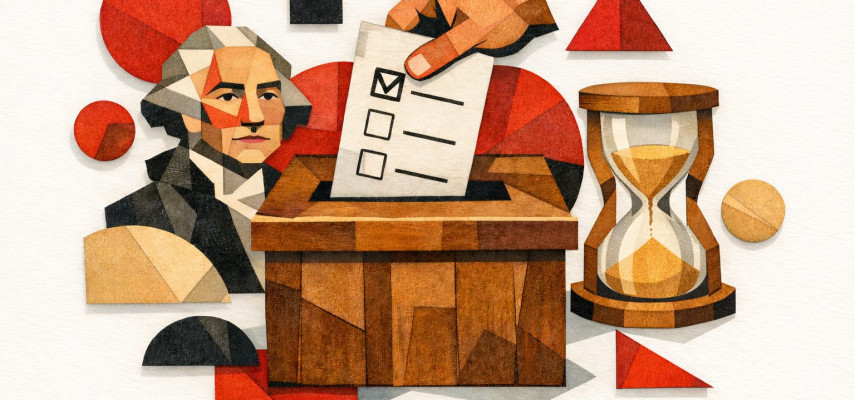
Why power turnover is needed
The collection of arguments in this article supporting the demand for power turnover shows why progressive social democrats consider this requirement one of the key priorities for the Russian political movement.
Politicians are like diapers: they should be changed regularly, and for the same reason.
The most important requirement for any democratic society is ensuring the regular turnover of political power. We can observe that in countries with a high standard of living, such turnover is generally present. Conversely, there are extremely few dictatorships and authoritarian regimes with a high standard of living among their populations. If we take the United States — a country that can be called a global leader of the last century — there is the Twenty-Second Amendment to the Constitution, which states that “No person shall be elected to the office of the President more than twice, and no person who has held the office of President, or acted as President, for more than two years of a term to which some other person was elected President shall be elected to the office of President more than once”1. The Constitution also pays special attention to the terms of office of senators: “The Senators shall be divided, as equally as may be, into three classes. The seats of the Senators of the first class shall be vacated at the expiration of the second year, of the second class at the expiration of the fourth year, and of the third class at the expiration of the sixth year, so that one third may be chosen every second year”2. One of the largest economies in Europe emerged in post-war West Germany, where one of the constitutional foundations was the turnover of government3.

Let us take the top three countries in the Human Development Index for 2019, namely Norway, Switzerland, and Ireland4. Since 2000, Norway has had three prime ministers — Erna Solberg (2013–2019), Jens Stoltenberg (2000–2001 and 2005–2013), and Kjell Magne Bondevik (1997–2000 and 2001–2005). Over the same period, Switzerland has had three Federal Chancellors — Walter Thurnherr (2016–2019), Corina Casanova (2008–2015), and Annemarie Huber-Hotz (2000–2007). In Ireland, there have been two presidents — Michael D. Higgins (2011–2019) and Mary McAleese (1997–2011) — and four prime ministers — Leo Varadkar (2017–2019), Enda Kenny (2011–2017), Brian Cowen (2008–2011), and Bertie Ahern (1997–2008). Of course, decentralization of power also plays an important role in these countries, but the trend is clear: in most developed states, there is a rotation of governments.
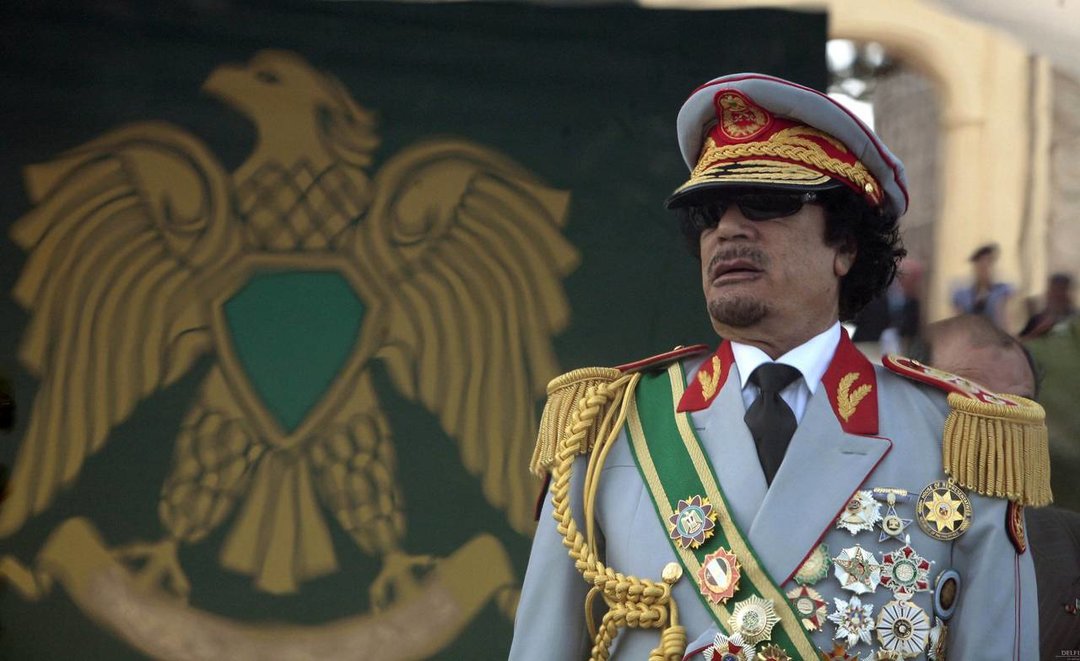
Now let us look at where heads of state and government remain in power for long periods without rotation5. This is Cameroon, where President Paul Biya has been in power for 42 years. This is Equatorial Guinea, where President Teodoro Obiang Nguema Mbasogo has ruled for 38 years. He appointed his son vice president, and according to the law, in the event of the father’s death, he will assume his position. In 2003, state radio announced that he was “like God in heaven” and in “constant contact with the Almighty”, possessing “all power over people and things”6. In Zimbabwe, power also changes very rarely — Robert Mugabe held the presidency for 37 years, and was eventually arrested by the military7. Continuing the list of countries with long-standing lack of political turnover, Uganda comes next, where Yoweri Museveni has ruled for 32 years. The reader can draw their own conclusions about the relationship between political turnover and a country’s level of development. If the data is still insufficient, one may consult Parade magazine’s ranking of the world’s worst dictators8 and examine the duration of their rule.
Doctor of Historical Sciences, Chief Research Fellow at the Institute of Europe of the Russian Academy of Sciences, Dmitry Furman, states that non-rotating regimes are almost always associated with corruption and mass impoverishment:
Regimes of non-alternative presidential power, which achieve this lack of alternatives through methods ranging from terror to the manipulation of ballot papers, emerged either from the very beginning or after a short period of “democratic chaos” across the entire territory of the former USSR, except for the Baltic states and Moldova. Their cultural and socio-psychological foundation everywhere is the unpreparedness of the majority of the peoples of the USSR for democracy and the rule of law, and the ease with which, under conditions of freedom, they move toward anarchy and then, in order to get rid of this anarchy, sacrifice freedom. Analogues outside the post-Soviet space are the numerous regimes of the countries of the former “Third World”, primarily the Arab world and African countries. These political systems are everywhere and always naturally associated with corruption and a social policy whose consequence is the enrichment of a small ruling elite and the impoverishment of the masses. Everywhere they become increasingly rigid, lose “feedback” with society, where forces gradually mature for whom the framework of these regimes becomes increasingly narrow9.
Doctor of Economic Sciences, Chief Economist of the European Bank for Reconstruction and Development from 3 November 2015 to 2019, and Professor of Economics at the Paris School of Political Studies, Sergei Guriev, argues that without the turnover of power a country cannot achieve high economic performance. In his assessment, there have so far been no non-democratic countries that have reached a high level of income, except for a few Middle Eastern monarchies with far more oil per capita, and Singapore, which actively fights against corruption and attracts investment10.
Even the left opposition within the RCP(b), in its platform for the 15th Party Congress, complained that “the upper leadership of provincial party committees, provincial executive committees, provincial trade union councils, and so on are in fact irremovable (for three, five years or more)”11. The platform put forward such demands as: “Struggle against the irremovability of secretaries. Establishing a maximum term for holding secretarial and other positions. Ruthless struggle against direct decay and degeneration of upper groups, nepotism, ‘mutual protection’ and the like (examples — Syzran, Kherson, Irkutsk, Chita, etc.)”12. The result was poor indicators of the standard of living under Joseph Stalin. Let us try to understand which factors ensure the effectiveness of the turnover of power.
Contents
Mutual control of rotating leaders
When a person knows that after a certain period they will definitely and inevitably leave office, they worry about the consequences of their actions; they fear that if they commit any violations or crimes, they will face severe punishment from the person who succeeds them. If, however, they know that there is an opportunity to extend their rule for a very long time, they may no longer fear committing almost any crime, relying on complete impunity due to the absence of a successor. They may also place their own people in lower-ranking positions, thereby protecting them as well from turnover. And then those people, too, will do whatever they want.
As researchers note, regular rotation of power between parties prevents the consolidation of authority and helps curb corruption and nepotism13.
Combating elite stagnation
Non-rotating power builds ties with business and helps it maintain its position, protecting it from competitors. Business helps the authorities, the authorities help business — and both suppress their competitors. As a result, the elite of society stagnates, social mobility disappears, and it becomes almost impossible for a talented and hardworking person to enter the elite. The main path to achieving this goal becomes kinship and personal connections rather than talent and effort (which leads to their devaluation and, consequently, to the degradation of the country and a mass outflow of capable personnel).
Winner of the “Golden Pen of Russia” award from the Union of Journalists, Andrei Kolesnikov, warns that “sooner or later everything comes to an end — either due to historical-political reasons (popular unrest) or physiological ones (the death of a leader who has turned into a gerontocrat). And then a whole host of social, economic, political, psychological, and everyday problems is revealed. And the new generation is left to clear away the ruins and start all over again, moreover under conditions of a deepening lag behind leading countries”. In his view, “the rotation of power is the greatest invention of all times and peoples. It cures corruption, madness, and apathy”14.
The turnover of power hinders large capital from establishing close ties with the authorities — it at least partially disrupts this system of relationships and increases its fragility, which is not beneficial for large capital but is beneficial for the majority of citizens. The fact that the turnover of power ensures its effectiveness is even reflected in certain laws of the Russian Federation — for example, in Federal Law No. 79-FZ of 27.07.2004 (as amended on 16.12.2019) “On the State Civil Service of the Russian Federation”, Article 60.1 states: “The rotation of civil servants is carried out in order to increase the efficiency of the civil service and to counteract corruption by appointing civil servants to other positions in the civil service within the same or another state body”15.
If there is no turnover of power, this also affects the economy. Suppose there are 3–4 milk producers in a country. They enter into a cartel agreement. First, they agree among themselves, and then with representatives of the antimonopoly authority. If there is no turnover, the antimonopoly officials make deals with their own superiors. Everyone is “in on it”, and no one fights the cartels. If there is turnover, one constantly has to negotiate with different antimonopoly officials and different leadership, and there is a much higher chance that the conspirators will run into an honest person who exposes the collusion.
Political competition
Turnover of power is necessary for political competition — without competition, politicians degenerate and fail to develop. If there is no competition, they lose the incentive to work better. If power changes regularly, then competition is maintained at least by former politicians who retain part of their influence. The threat from political competitors forces them to compete for voters’ favor. As Doctor of Sociological Sciences Alexander Makarin notes, “the political market and its analogue, the economic market, cannot function effectively without competition”. In his assessment, “the current model of power in Russia contains threats primarily related to a decline in its effectiveness due to a kind of blocking of mechanisms of political competition and active intervention of bureaucracy in socio-political processes, creating mechanisms for supporting inefficient institutions adapted to conditions of imperfect competition”16.
Balance of leadership qualities
Every leader has strengths and weaknesses: a person cannot be equally strong in all areas. Therefore, managerial personnel must be periodically replaced so that their shortcomings do not turn into significant failures. Russian journalist and five-time TEFI award winner Leonid Parfyonov also notes that turnover of power helps select politicians who better meet the demands of the era and better understand it:
“The issue of turnover and rotation of power is not about being tired of a particular face, and not even about a new political program. It is, above all, about the change of time and its challenges, which must be answered by new generations with different approaches, rather than people who have never really learned how to use the internet”17.
More experienced leaders
When power is subject to rotation, there are several people with experience in high-level leadership. When there is no turnover, there is only one such person for a given position. Suppose turnover and elections exist. Then there are 4–5, for example, ministers of agriculture (most of them former). In this case, the current minister can ask former or other ministers for experience and competent advice, thereby improving the effectiveness of their work. And we can judge, by comparing them with other ministers, whether they are doing well, and if not, replace them with another — possibly even a former one. If there is no turnover, first, there will be no one to compare with. Second, by probability alone, several ministerial positions will be occupied by ineffective specialists; taking into account all other disadvantages of non-turnover, they will perform even worse.
Higher level of democracy
The greater the turnover of power, the more people participate in governance; accordingly, the higher the level of democracy. We have already explained why democracy is needed and what it includes here, but most people can understand without this why it is better to control officials themselves rather than allow officials to control them. If there is no turnover of power, control over society is exercised only by the nomenklatura, which has spent most of its conscious life as a nomenklatura and knows only its own class interests. With sufficient turnover, representatives of different classes and professions enter government; they are able to express the interests of their colleagues and implement policies beneficial to different segments of society, rather than only one.
Even Vladimir Lenin considered the turnover of power an essential attribute of socialism: “Under socialism, everyone will govern in turn and will quickly become accustomed to the idea that no one governs”, “Full electability, the ability to recall and replace all officials at any time without exception, and reducing their salaries to the ordinary ‘wage of a worker’ — these simple and ‘self-evident’ democratic measures, fully combining the interests of workers and the majority of peasants, also serve as a bridge leading from capitalism to socialism”18. Moreover, he emphasized the importance of turnover not only in state administration but also in party affairs:
The Russian Social Democratic Labour Party is organized democratically. This means that all affairs of the Party are conducted, directly or through representatives, by all members of the Party, on equal rights and without any exception; moreover, all officials, all governing collegial bodies, and all institutions of the Party are elective, accountable, and replaceable19.
Helps avoid political violence
When there is turnover of power, in the event of a system crisis or the appointment of incompetent officials to the administrative apparatus, we can easily replace them. When power is not subject to turnover, replacing such officials through constitutional means becomes very difficult. This leads to a situation in which power does not change, while problems remain and accumulate. Ultimately, this may lead to a violent change of power and possibly even civil war (something that has already happened in Russian history). Dmitry Furman writes:
If a regime is such that rotation of power within it is impossible, this does not mean that rotation will not happen, but it does mean that it will occur through revolutionary means20.
Arguments of conservatives against turnover
The goal of forces opposing democratic movements is to provide their own arguments against the turnover of power in order to defend elite interests. Such arguments are usually not scientific but philosophical, and contain lengthy reasoning whose purpose is to divert attention from the essence of the issue and substitute the thesis. A long article defending non-rotating regimes is published on the Ruxpert website, created by blogger Oleg Makarenko, also known as FritzMorgen. The creator of this site (according to his own statement) voted for Vladimir Putin21, and according to some reports requested 20,000 rubles for a single political publication22 (as revealed after the hacking of the email account of Kristina Potupchik, press secretary of the “Nashi” movement23), writes articles such as “A Dying Europe Chooses Between Hunger, Cold, and Suicide”24, and, according to some journalists and bloggers, works to express the position of the country’s top leadership25. Let us examine his arguments.
“Historical experience in Russia shows that among the rulers under whom Russia achieved significant successes, there were rulers who governed for a long time (Ivan III, Peter I, Catherine II, Alexander II, Joseph Stalin)”26. We have already examined what the standard of living was under Joseph Stalin, and the crimes of his regime are discussed in the series of articles “Legendarium of Stalinists” and “Stalin”. That is, here Ruxpert provides incorrect information. Citing examples of Catherine II or Peter I in the 21st century is also meaningless, just as citing examples of Pharaoh Khufu or Rurik would be — first, their eras are insufficiently studied (there is no precise statistical data on the standard of living of the majority of the population, and so on), and second, modern political systems did not exist at that time, making comparative analysis impossible.
“If we look at the first 50 countries in the list of countries by GDP per capita at purchasing power parity, it turns out that the overwhelming majority of them are either monarchies or countries with limited turnover of power”. Ruxpert itself refutes this claim in the very next sentence: “At the same time, some monarchies are constitutional, that is, the monarch does not have real power”. The resource then claims that there is no turnover of power in the United States, using demagogic techniques No. 13 “Exception instead of the rule” and No. 4 “Is it any different in the USA?” (a full list of such techniques is discussed in this article). However, after Franklin Roosevelt, for example, there has not been a single U.S. president who has served more than two terms. Examples from most other countries are also presented through the use of these demagogic techniques.
These are two of the main arguments that remained in the Ruxpert article. Most of the others were removed by community members themselves during the discussion of the article, referring to the fact that even the Constitution of the Russian Federation provides for the turnover of power27. However, we will still examine some of these arguments preserved in the archived version of the article from July 22, 201928, simply to understand the directions in which the argumentation of conservatives may be constructed.
“When rulers change, they lack authority, since everyone understands that another ruler will soon come to power, and he will not be able to resist oligarchs who control their resources for decades”. This cannot be called a completely incorrect argument. However, in a social-democratic system, where large capital is subject to progressive taxation and many other taxes, along with the turnover of power there is also a turnover of financial elites, and this argument becomes completely invalid in debates with social democrats.
“Experience is important for a politician”. There is nothing incorrect in this statement in itself. Conservatives substitute the thesis elsewhere — the point is that no one proposes transferring power to politicians without experience; here conservatives use the demagogic technique No. 1 “Attribution”. When a politician comes to a high office under conditions of turnover of power, they already have experience in lower, but still managerial positions. If, however, a major politician remains in the same position for 20 years, they often accumulate experience only in the first few years, after which they delegate routine tasks to assistants and begin to focus primarily on how to buy a second apartment for their spouse’s nephew. Of course, politicians vary, but, for example, the Russian experience shows that over years without turnover most accumulate not experience but material resources.
“Caretakers steal the most”. First, this is refuted by data on corruption levels in democratic and authoritarian countries (we wrote about this here). Second, basic logic suggests that with turnover of power, a corrupt official will soon lose their position, and their successor can not only punish them but also make such punishment part of their election program. If there is no turnover of power, then such a threat for the corrupt official also does not exist.
Another argument that can be heard from conservatives is “if there is no turnover, then even if a person steals, they will eventually become satiated”. However, most people always lack money. We can see this from the example of the Russian nomenklatura. For instance, federal TV propagandist Vladimir Solovyov found one villa on Lake Como insufficient and acquired a second one29. Earlier, he also found a very good apartment in Moscow insufficient. On the contrary, the Russian nomenklatura demonstrates a high level of insatiability.
Conclusion
Turnover of power is an essential attribute of democracy, a tool for combating conservatism, and one of the most important demands of progressive social democrats. For Russia, where even after the overthrow of the monarchy Joseph Stalin ruled for almost 24 years, and Vladimir Putin is striving to match and surpass him, the requirement to ensure the turnover of power is indeed innovative. At the same time, according to a study by VTsIOM and the Institute for the Development of Parliamentarism, more than 50% of Russians support this requirement30.
- Twenty-Second Amendment / Constitution of the United States // Constitution Annotated (constitution.congress.gov). [Electronic resource]. URL: https://constitution.congress.gov/constitution/amendment-22/ (accessed: 22.03.2020).
- Чаннинг Э. История Соединенных Штатов Северной Америки (1765-1865 гг.)/Перевод с англ. А. Каменского. СПб , 1897. – 382 с. – с. 352
- Агузаров Т.К., Грачева Ю.В., Чучаев А.И. Уголовно-правовые проблемы охраны власти (история и современность). Monograph
- Human Development Report 2019. Beyond income, beyond averages, beyond today: Inequalities in human development in the 21st century // Human Development Reports. United Nations Development Programme (www.hdr.undp.org). [Electronic resource]. URL: http://www.hdr.undp.org/sites/default/files/hdr2019.pdf (accessed: 22.03.2020).
- Филипп Алексенко, Юлия Сапронова. Кому за 30: самые долго правящие избираемые главы государств // РБК (www.rbc.ru). 15 November 2017, 19:12. [Electronic resource]. URL: https://www.rbc.ru/photoreport/15/11/2017/5a0c0a189a7947dcbb75fa4b (accessed: 22.03.2020).
- Лидера Экваториальной Гвинеи назвали Богом // BBC (news.bbc.co.uk). 26 July 2003, 14:52. [Electronic resource]. URL: http://news.bbc.co.uk/hi/russian/life/newsid_3098000/3098929.stm (accessed: 22.03.2020).
- Юлия Сапронова. Колдовской переворот: как Зимбабве перешла под контроль военных // РБК (www.rbc.ru). 15 November 2017, 15:36. [Electronic resource]. URL: https://www.rbc.ru/photoreport/15/11/2017/5a0c063e9a7947d9fb244a94 (accessed: 22.03.2020).
- David Wallechinsky. The World’s 10 Worst Dictators // Parade (parade.com). 22 March 2009, 14:26. [Electronic resource]. URL: https://parade.com/110573/davidwallechinsky/the-worlds-10-worst-dictators/ (accessed: 22.03.2020).
- Фурман, Дмитрий. Первый шаг к реальной демократии / Д. Фурман // Дружба народов. – 03/2004. – N3. – с. 175-177
- Гуриев оценил слова Путина о приоритете стабильности власти // Ведомости (www.vedomosti.ru). 7 марта 2020 года, 07:41. [Электронный ресурс]. URL: https://www.vedomosti.ru/economics/news/2020/03/07/824703-o (дата обращения: 22.03.2020).
- Проект платформы большевиков-ленинцев (оппозиции) к XV съезду ВКП(б) (Кризис партии и пути его преодоления) // Коммунистическая оппозиция в СССР. 1923-1927 (из архива Льва Троцкого в четырех томах). Т. 4 (1927, июль-декабрь) / сост. Ю. Фельштинский. – 280 с. – Chalidze Publications, 1988. – с. 148.
- Там же, с. 153.
- The Multiparty System: Essential Principles // Democracy Web (democracyweb.org). [Electronic resource]. URL: https://democracyweb.org/multiparty-system-principles (accessed: 19.07.2023).
- Андрей Колесников. Второе крушение Союза // Газета.ru (www.gazeta.ru). 1 февраля 2011 года, 10:21. [Электронный ресурс]. URL: https://www.gazeta.ru/column/kolesnikov/3511334.shtml (дата обращения: 22.03.2020).
- Federal Law No. 79-FZ of 27.07.2004 (as amended on 16.12.2019) “On the State Civil Service of the Russian Federation”
- Макарин А.В. Political competition vs political stability in modern Russia // Vestnik SPbSU. Series 6: Political Science. International Relations. 2016. Issue 1
- Мария Плюснина. «Elderly rulers of the country are consuming someone else’s century» // Znak (www.znak.com). 24 February 2020, 6:00. [Electronic resource]. URL: https://www.znak.com/2020-02-24/leonid_parfenov_o_staline_repressiyah_i_o_trebovanii_smenyaemosti_vlasti (accessed: 22.03.2020).
- В.И. Ленин. Полное собрание сочинений. Издание пятое. Том 33. Государство и революция. – 433 с. – М.: Издательство политической литературы, 1969. – с. 116, с. 44.
- В.И. Ленин. Полное собрание сочинений. Издание пятое. Том 14. Сентябрь 1906 – февраль 1907. – 564 с. – М.: Издательство политической литературы, 1972. – с. 252.
- Фурман, Дмитрий. Первый шаг к реальной демократии / Д. Фурман // Дружба народов. – 03/2004. – N3. – с. 175-177
- Олег Макаренко. Почему я буду голосовать за Путина // Место для дискуссий (olegmakarenko.ru). 22 марта 2011 года, 11:46. [Электронный ресурс]. URL: https://olegmakarenko.ru/390461.html (дата обращения: 22.03.2020).
- Антон Носик. Кого и как покупают в сети // Новое время (newtimes.ru). 6 февраля 2012 года. [Электронный ресурс]. URL: https://newtimes.ru/articles/detail/49544/ (дата обращения: 22.03.2020).
- Топовых блоггеров обвинили в “политической проституции” и службе Кремлю // Newsru (www.newsru.com). 6 февраля 2012 года, 12:54. [Электронный ресурс]. URL: https://www.newsru.com/russia/06feb2012/potupchik.html (дата обращения: 22.03.2020).
- Олег Макаренко. Гибнущая Европа выбирает между голодом, холодом и самоубийствами // Место для дискуссий (olegmakarenko.ru). 18 ноября 2012 года, 00:50. [Электронный ресурс]. URL: https://olegmakarenko.ru/543110.html (дата обращения: 22.03.2020).
- Элизабет Пайпер. «Патриотический справочник» позволяет проникнуть в мысли Путина // Иносми.ру (inosmi.ru). 10 июня 2014 года. [Электронный ресурс]. URL: https://inosmi.ru/russia/20140610/220895178.html (дата обращения: 22.03.2020).
- Сменяемость власти // Русский эксперт (ruxpert.ru). [Электронный ресурс]. URL: https://ruxpert.ru/Сменяемость_власти (дата обращения: 22.03.2020).
- Обсуждение:Сменяемость власти // Русский эксперт (ruxpert.ru). [Электронный ресурс]. URL: https://ruxpert.ru/Обсуждение:Сменяемость_власти (дата обращения: 22.03.2020).
- Сменяемость власти // Русский эксперт (ruxpert.ru). [Электронный ресурс]. Archived: https://web.archive.org/web/20190622121852/http://ruxpert.ru/Сменяемость_власти.
- You will laugh: we found another villa in Italy belonging to him. And a Maybach // Alexei Navalny (navalny.com). 22 January 2019, 14:21. [Electronic resource]. URL: https://navalny.com/p/6058/ (accessed: 22.03.2020).
- More than 50% of Russians supported the turnover of the ruling party // Novye Izvestia (newizv.ru). 21 November 2019, 09:08. [Electronic resource]. URL: https://newizv.ru/news/society/21-11-2019/za-smenyaemost-partii-vlasti-vystupili-bolee-50-rossiyan (accessed: 22.03.2020).