“Capitalism” as a demagogic label
The main enemy of communists (and, for that matter, usually socialists as well) is traditionally "capitalism." Individual representatives of the communist movement blame it for all the vices and flaws of the modern world—even those that were far more acute in societies that communists themselves do not classify as capitalist. But what is "capitalism"?
According to the definition of the Great Russian Encyclopedia, capitalism is “a socio-economic system characterized by the dominance of private property, a free market, and competition as the main mechanisms for resource allocation and economic activity coordination, the hiring of labor based on its purchase and sale, and profit as the driving motive and goal of production. Capitalism is a self-developing system containing internal incentives and impulses for self-transformation and transformation”1. According to the definition in Britannica, it is “also called free market economy or free enterprise economy, economic system, dominant in the Western world since the breakup of feudalism, in which most means of production are privately owned and production is guided and income distributed largely through the operation of markets”2. According to the Merriam-Webster dictionary, it is “an economic system characterized by private or corporate ownership of capital goods, by investments that are determined by private decision, and by prices, production, and the distribution of goods that are determined mainly by competition in a free market”3. As we can see, all dictionaries equate capitalism with the free market. However, for some reason, the authors of Britannica believe that this system dominates the Western world, even though the economy of a significant number of Western countries is based not on a free market, but on the principles of a mixed economy (here we wrote about what a free market is). That is, we can see that today, according to generally accepted definitions of capitalism and the free market, many countries no longer live under capitalism.
Communists most often classify as “capitalist” even those states where the economy is subject to strong regulation — for example, the USA or even the countries of Northern Europe (“Socialist Alternative” equates a market economy with capitalism: “capitalism or, what is the same thing, a ‘market economy’, is an economic system built on social production and private appropriation”4). On the basis of which definitions this is done is not explained; however, communists have always had their own definitions, as we examined in the article on private property.
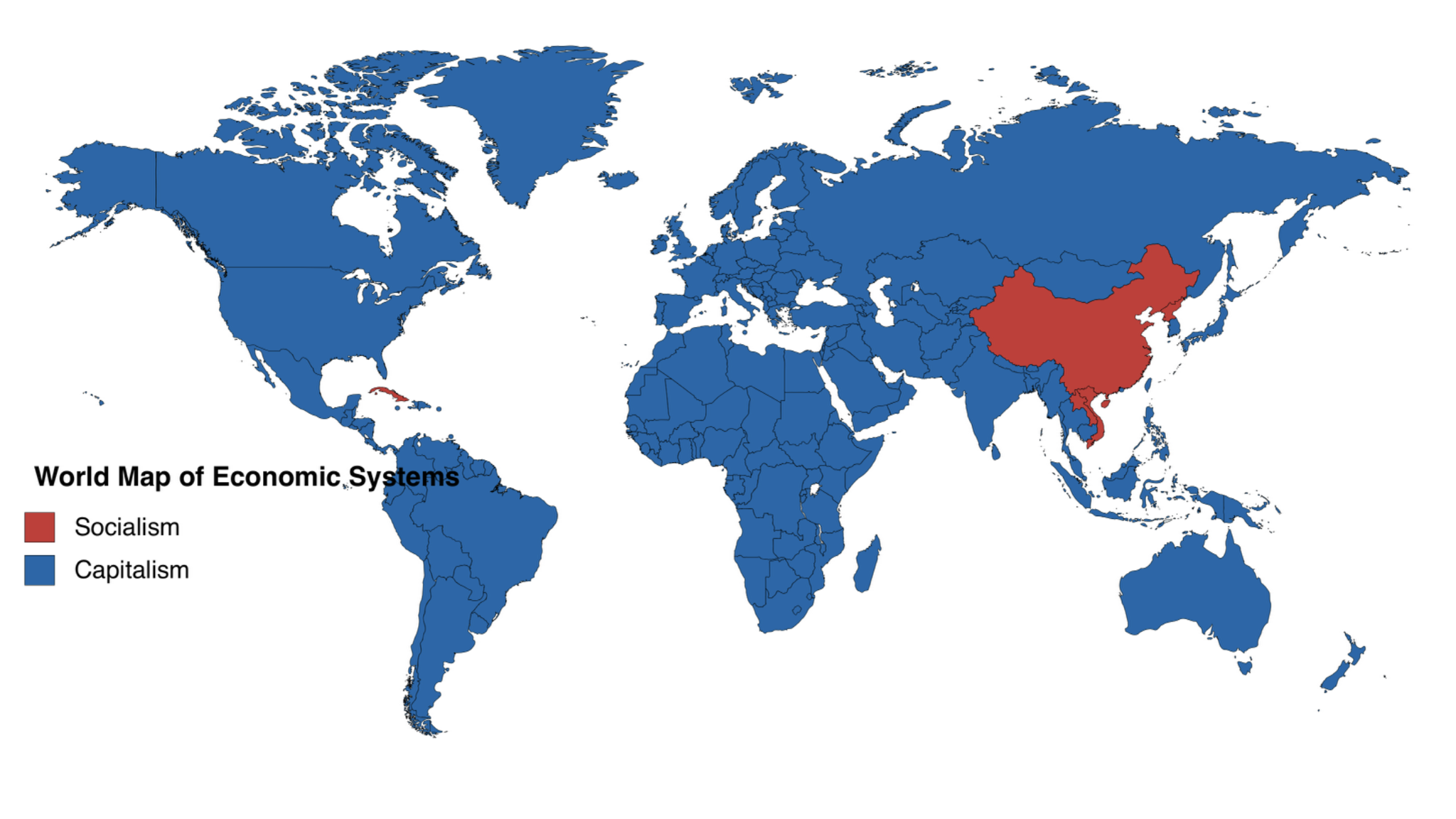
A clear and universally recognized list of capitalist and non-capitalist countries does not exist and cannot exist — for example, some communists classify China or the DPRK as capitalist countries, while some communists consider them socialist countries5. This happens because there are no criteria for an unambiguous assessment, as is the case in science (for example, in biology, there are traits of the classes of reptiles and mammals that allow an animal to be assigned to one class or another). And since criteria do not exist, proponents of communist theories simply assign here either all countries they dislike (sometimes countries with a high level of social democracy fall into the category of socialist during such a division, sometimes into the category of capitalist, sometimes depending on which definition is convenient for the communist at a given moment), or all countries where market mechanisms exist in the economy (and then, if desired, even the USSR could be included here, since commodity-money exchange can be classified as such a mechanism).
The communist understanding of the term “capitalism” is based on the theory of socio-economic formations, which, as we wrote in a separate article, is also questioned by mainstream science and lacks a sufficient evidentiary base. Some even claim that “capitalism” is a pseudoscientific fiction. There are not only no clear criteria for defining capitalist states, but there are also no clear historical frameworks for when it appeared — capital accumulation and market mechanisms of commodity exchange existed in one form or another throughout history; in the same way, resourceful people who wanted to earn something always existed. This is akin to considering the division of humans into races to be scientific, which, as we wrote in a separate article, has little in common with science.
Today, “capitalism” is a populist and demagogic amalgam — it is a label attached by communist organizations to everything that is disadvantageous to these organizations, used to manipulate their audience. An example of usage: defects are found in a state, it is declared capitalist, the cause of these defects is declared to be capitalism, which allows the audience to conclude that these defects will not exist under socialism, from which the communist organization receives a boost in reputation in the eyes of this audience. Another example: when a doubting reader objects that in the socialist USSR these same defects were not fixed, they are told that there was no socialism in the USSR, which is difficult to dispute given that clear criteria for socialism and capitalism do not exist. In the hands of a skilled political strategist, “capitalism” can be a powerful weapon of manipulation.
The term “capitalism” equates a welfare state with Somalia, a developed state with a backward one, a democracy with a dictatorship, and so on. From the point of view of an ordinary communist, both Somalia and Norway are capitalism, which means both are bad, even though there is a true gulf in the standard of living between these countries, and the term “capitalism” tells nothing about this gulf, rendering it useless. Such an amalgam is made so that the audience does not consider developed countries as a benchmark, preferring a communist project that in practice has never and nowhere achieved leadership in terms of living standards and development. Moreover, it is inconvenient for communists to criticize developed countries (lacking arguments) — it is much more convenient to attribute to them the shortcomings of countries with a low level of development, and this can only be done by combining them into a single entity, which the term “capitalism” allows. This was also described by one of the communist pages on the social network “VKontakte” — “Red Gamer” (author’s spelling and punctuation preserved):
So, we have dubbed capitalism an evil. This greatly simplifies things: now we can say that all troubles stem from it, and since communism is good, then under it all problems will be solved: there will be no wars, social inequality, crime will disappear, and maybe we won’t even need to die.
Yes, we understand that everything is somewhat more complex, that a long path of development is needed, that by no means all of society’s problems are caused specifically by capitalism, and communism is not a panacea for all societal ills, but… we are conducting propaganda for the broadest possible audience, which means we are allowed to lie, because the end, as is well known, justifies the means.
And since we are allowed to lie, everything becomes even simpler: we can declare that there is absolutely nothing good under capitalism, and all it does is solely and exclusively spoil everything. No “unity and struggle of opposites”, no elements of good in the bad or bad in the good, now, for propaganda purposes, we cancel to hell all this dialectics of yours, and discover the world’s first absolutely negative (at the present moment in time) phenomenon, capitalism6.
We attempted to give scientific definitions to the terms “capitalism” and “socialism” in our article on economic systems; however, such attempts encounter the fact that in this case, a colossal number of blank spots appear on the map — states that cannot be classified as either capitalist or socialist.
Today, the division into “capitalism” and “socialism” has been co-opted by the right. Since a significant portion of regimes that called themselves socialist collapsed in the 1980s and 1990s, this allowed the right to declare the victory of capitalism, by which they mean the “free market” or conservative states (which is the exact same attempt to create an amalgam by dumping these concepts into one heap with social democracies). The fact that social democratic countries occupy leading positions in terms of living standards is also declared by them as proof of the efficiency of capitalism. And since there are no clear definitions, they declare any state they dislike to be socialist, similar to how communists label an undesirable system as capitalist. So today, the term “capitalism” rather works for the right, allowing them to use demagogic amalgams to promote any right-wing policy.
Which division between states is actually relevant today?
At present, it is difficult to draw a clear line between states based on economic features. Pure planned economies (if such ever existed) are virtually non-existent anywhere anymore, just like pure market ones, which is why mixed economies are widespread everywhere. This mixed economy can be social or conservative, but drawing a simple and clear line here is also difficult because the institutions that define such a division can be vast in number. The same applies to the political regime — the division can be into democracy and authoritarianism, but the level of democracy, again, is determined by a large number of institutions, as we wrote in more detail in our article on political systems.
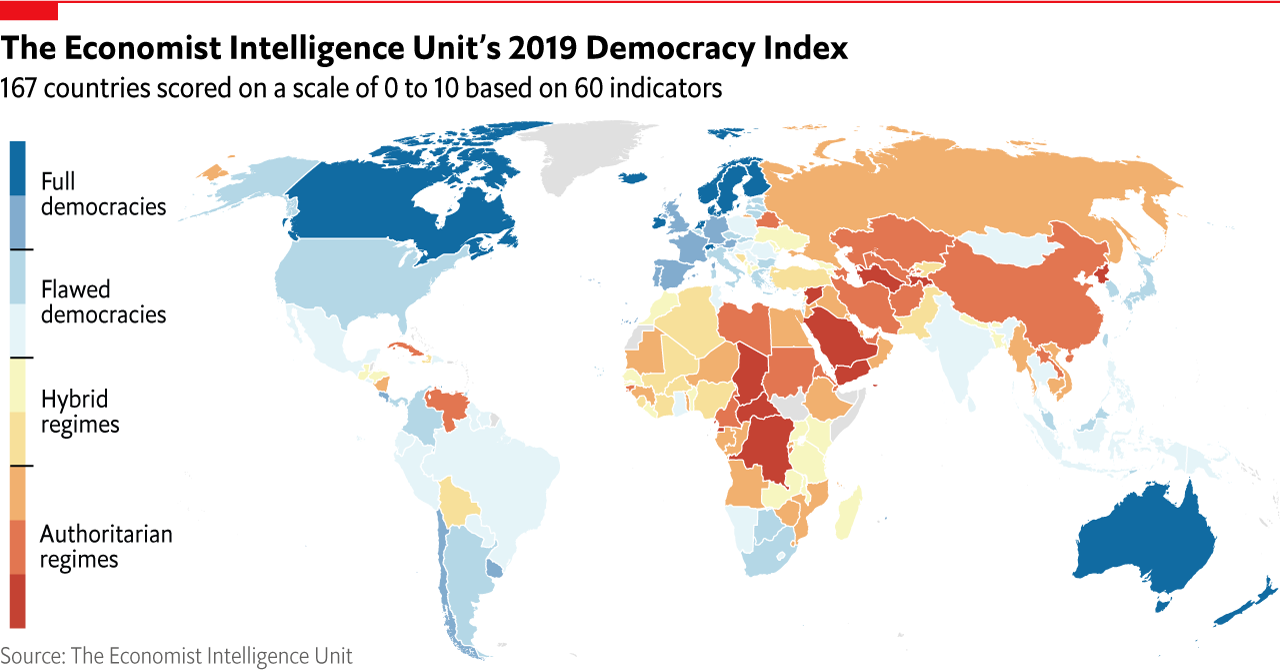
In that article, we also mentioned that in one of the most competent and high-quality gradations by the Economist Intelligence Unit7, there are 4 types of political regimes — full democracy, flawed democracy, hybrid regime, and authoritarian regime. To this, one can add that each of them can have different gradations of the level of the welfare state. Unfortunately, no one has yet created an index to measure it at this time, and although the textbook “Foundations of Social Democracy” provides a gradation into states with low, medium, and high levels of social democracy8, we do not currently have a detailed index (we hope to see one appear in the future). Thus, the division will be much more complex, and there will be far more gradations than the primitive binary division “capitalism/socialism”. As an example, consider the following breakdown:
- Full democracy with a high level of welfare state;
- Full democracy with a medium level of welfare state;
- Full democracy with a low level of welfare state;
- Flawed democracy with a high level of welfare state;
- Flawed democracy with a medium level of welfare state;
- Flawed democracy with a low level of welfare state;
- Hybrid regime with a high level of welfare state;
- Hybrid regime with a medium level of welfare state;
- Hybrid regime with a low level of welfare state;
- Authoritarian regime with a high level of welfare state;
- Authoritarian regime with a medium level of welfare state;
- Authoritarian regime with a low level of welfare state.
There turned out to be 12 of these conditional gradations, excluding an anarchic stateless system.
Conclusion
The term “capitalism” today represents a demagogic label that can say nothing about either the standard of living or the level of development of a country. It can be used perhaps only for the purposes of communist or right-wing propaganda. Its use by social democrats should ideally be kept to a minimum. Today, social democrats stand for full democracy with a high level of welfare state, opposing not vague “capitalism” specifically, but rather authoritarian and hybrid regimes, as well as any political structure with a low level of welfare state.
- S.A. Khavina. Capitalism // Great Russian Encyclopedia. Volume 13. Moscow, 2009, p. 21. [Online resource]. URL: https://bigenc.ru/economics/text/2043060 (accessed: 17.06.2020).
- G.D. Gloveli, A.B. Gofman. Marx // Great Russian Encyclopedia. Volume 19. Moscow, 2011, pp. 167-171. [Online resource]. URL: https://bigenc.ru/philosophy/text/2187272 (accessed: 17.06.2020).
- Capitalism // Dictionary by Merriam-Webster (www.merriam-webster.com). [Online resource]. URL: https://www.merriam-webster.com/dictionary/capitalism (accessed: 17.06.2020).
- Program of the CWI section in the CIS // Socialist News (socialist.news). [Online resource]. URL: https://socialist.news/isa/program-russia/ (Accessed: 21.07.2021).
- On capitalism with Chinese characteristics // Russian United Labor Front Party (www.rotfront.su). June 29, 2020. [Online resource]. URL: https://www.rotfront.su/o-kapitalizme-s-kitajskoj-spetsifikoj/ (Accessed: 21.07.2021).
- Red Gamer. The Crisis of Communism in Russia, Part 1: The Trap of Propaganda // VK (vk.com). January 23, 2023, 19:05. [Online resource]. URL: https://vk.com/@-208845174-krizis-kommunizma-v-rossii-chast-1-lovushka-propagandy (Accessed: 25.09.2023).
- Democracy Index 2020: In sickness and in health? // Economist Intelligence Unit (www.eiu.com). [Online resource]. URL: https://www.eiu.com/n/campaigns/democracy-index-2020/ (Accessed: 28.02.2021).
- Tobias Gombert, Julia Bläsius, Christian Krell, Martin Timpe. Foundations of Social Democracy – p. 107. // Friedrich-Ebert-Stiftung (www.fes.de). [Online resource]. URL: https://library.fes.de/pdf-files/akademie/07650.pdf (accessed: 21.07.2021).