Dictatorship of the proletariat and its essence today
In the 21st century, it is high time for the left to finally exclude the dictatorship of the proletariat from their demands, replacing it in their rhetoric with parliamentary democracy and its expansion. However, many leftists continue to believe in the appeal of the concept of the dictatorship of the proletariat or its feasibility in practice, despite the fact that practice is exactly what rules out its appeal (as does, for that matter, more modern theory). In this article, we will try to encroach on the "sacred" for orthodox Marxists and explain why this concept is flawed.
The concept of the “dictatorship of the proletariat” is one of the key elements in Marxist theory, and Marxist movements traditionally advocate for the establishment of the dictatorship of the proletariat. However, just as traditionally, they tend to avoid giving a clear definition of this term and briefly — sometimes in a populist manner and adapting to the listener’s views — offer some explanations. What exactly is the dictatorship of the proletariat, and how should a social democrat view such demands?
Contents
What is the dictatorship of the proletariat
As the Great Russian Encyclopedia notes, the term “Dictatorship of the Proletariat” was used in Marxist-Leninist ideology to designate the form of state power in socialist states during the transitional phase from capitalism to socialism1. According to the Encyclopædia Britannica, it is the rule by the proletariat — the economic and social class of industrial workers who derive their income solely from their labour — during the transitional period between the abolition of capitalism and the establishment of communism. During this transition, the proletariat must suppress resistance to the socialist revolution by the bourgeoisie, destroy the social relations of production underlying the class system, and create a new, classless society2. The Political Dictionary of 1940 notes that the dictatorship of the proletariat is “the state power of the victorious working class in the transitional period from capitalism to communism… In the system of the dictatorship of the proletariat, the Communist Party is the main guiding force”3.
The concept of the “dictatorship of the proletariat” itself appeared in Karl Marx’s work “The Class Struggles in France, 1848-1850”, in which the author himself defines it as follows:
…the necessary transit point to the abolition of class distinctions generally, to the abolition of all the relations of production on which they rest, to the abolition of all the social relations that correspond to these relations of production, to the revolutionizing of all the ideas that result from these social relations4.
The second variant, which was used in the USSR:
…the political power of the working class established by it as a result of the overthrow of the bourgeoisie, as a result of the victory of the socialist revolution; it is necessary for the working class for the entire period of the revolutionary transformation of capitalism into socialism5.
To summarize the available definitions, the dictatorship of the proletariat is a transitional period from capitalism to socialism, which is characterized by the power of the broad masses of workers (under the guidance of the party). The classics did not leave us a specific definition or structural system for the dictatorship of the proletariat, thereby creating opportunities for loose interpretations. For instance, Joseph Stalin gave it the following definition: “1) the restriction of the capitalists and landlords, unrestricted by law, 2) the leadership of the proletariat with regard to the peasantry, 3) the building of socialism with regard to the whole of society. Not one of these three aspects of the dictatorship can be excluded without running the risk of distorting the concept of the dictatorship of the proletariat. Only all these three aspects taken together give us a complete and finished concept of the dictatorship of the proletariat”6. Since the classics (considered the primary sources of the term) did not provide a precise definition, refuting such a definition is quite problematic.
The practice of the dictatorship of the proletariat
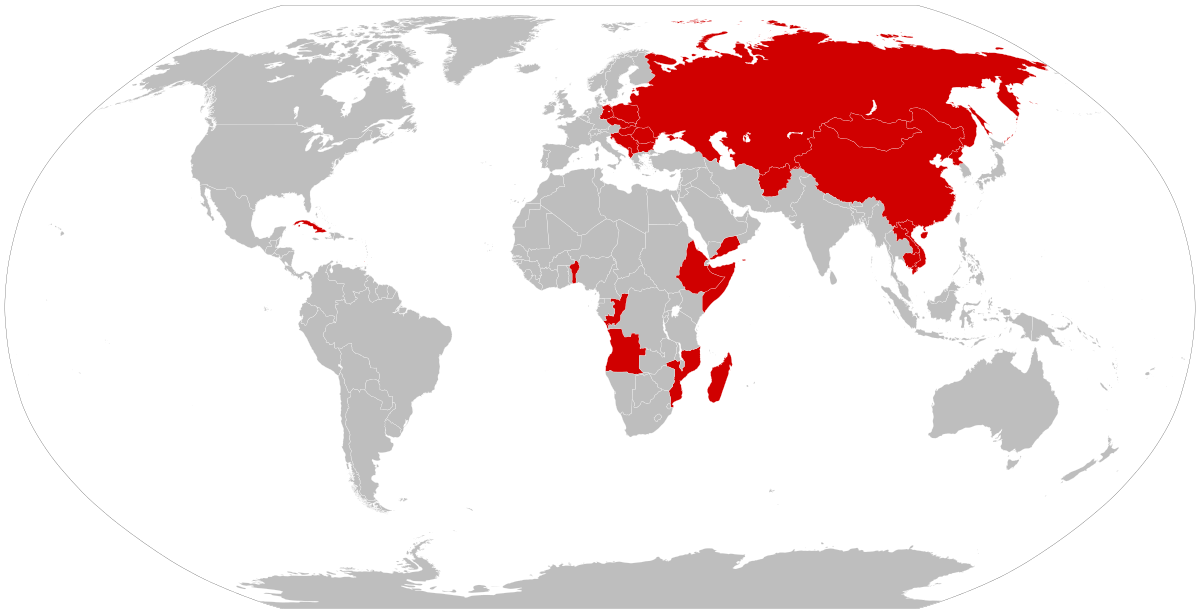
The first significant experience of putting Marx’s hypothesis into practice (excluding the Paris Commune, which existed briefly on a limited territory) took place in the USSR. Later, other states where the communist party came to power — such as China, Cuba, Vietnam, the DPRK, Laos, Ethiopia, Cambodia, Mozambique, Angola, and several others — also attempted to build a dictatorship of the proletariat or something resembling it. In the countries of Eastern Europe after the Second World War, the so-called “people’s democracies” emerged, which were also a transitional stage from capitalism to socialism. Let us examine the first and most illustrative example of the theory’s realization — the Soviet Union.
One-Party Rule
The idea of the power of a single party as the spokesperson for the interests of the workers has deep roots. In “The Communist Manifesto”, surprisingly enough, it is the Communist Party that is considered the most advanced section of the working-class parties:
The Communists are distinguished from the other working-class parties by this only: 1. In the national struggles of the proletarians of the different countries, they point out and bring to the front the common interests of the entire proletariat, independently of all nationality. 2. In the various stages of development which the struggle of the working class against the bourgeoisie has to pass through, they always and everywhere represent the interests of the movement as a whole.
The Communists, therefore, are on the one hand, practically, the most advanced and resolute section of the working-class parties of every country, that section which pushes forward all others; on the other hand, theoretically, they have over the great mass of the proletariat the advantage of clearly understanding the line of march, the conditions, and the ultimate general results of the proletarian movement7.
The authors of the “Manifesto” also mentioned the “organisation of the proletarians into a class, and, consequently, into a political party”, from which follows the concept of the “vanguard”, which will be discussed further below. If one combines this with the thoughts expressed in the Manifesto regarding the “conquest of political power by the proletariat”, the logical conclusion is that the communist party conquers power and establishes its dictatorship. The idea of the leading role of the communist party as the spokesperson for the interests of the proletariat was developed by Vladimir Lenin: in particular, he believed that Marx’s ideas were the knowledge necessary for workers, from which an ideologically sound force would grow:
The teaching on the class struggle, when applied by Marx to the question of the state and of the socialist revolution, leads of necessity to the recognition of the political rule of the proletariat, of its dictatorship, i.e., of power shared with none and relying directly upon the armed force of the masses… The proletariat needs state power, a centralized organization of force, an organization of violence, both to crush the resistance of the exploiters and to lead the enormous mass of the population — the peasants, the petty bourgeoisie, and semi-proletarians — in the work of “organizing” a socialist economy…
…By educating the workers’ party, Marxism educates the vanguard of the proletariat, capable of assuming power and leading the whole people to socialism, of directing and organizing the new system, of being the teacher, the guide, the leader of all the working and exploited people in organizing their social life without the bourgeoisie and against the bourgeoisie8.
Thus, from the aforementioned ideas, it followed that the dictatorship of the proletariat is realized through the “vanguard” — the party whose power is “shared with none”, because only it possesses the advantage of understanding the development of the proletarian movement. Other parties, obviously, did not possess this advantage and were therefore considered by Marxists to be either bourgeois or opportunistic.
On the whole, the dictatorship of the proletariat is a philosophical rather than a scientific concept — it lacks a clear definition (the importance of which we described here), so one could certainly fit democracy under it when proving their point, but with equal success one could fit the harshest forms of dictatorship. And since this can be done, there is a high probability that it will be done, which is precisely what the practice of Marxist movements shows.
The Soviets and the Dictatorship
Organs such as the Soviets appeared as early as the Russian Revolution of 1905-1907 as self-organized bodies of workers’ power. The first of them appeared on March 8, 1905, in the town of Alapayevsk, but more famous is the Soviet of Delegates, organized on May 15, 1905, by striking workers of textile and weaving enterprises in Ivanovo-Voznesensk (now Ivanovo), which operated on the scale of an entire city9.
After 1907 they ceased to exist, but they gained a second wind during the February Revolution of 1917, which resulted in the formation of the Petrograd Soviet of Workers’ and Soldiers’ Deputies, and the Bolsheviks began to advocate for the power of the Soviets.
The Soviets themselves somewhat resembled a parliament in structure, but unlike it, they possessed the following features:
- The negation of the idea of the separation of powers, meaning that the Soviets possessed both executive and legislative authority: “The Commune was to be a working, not a parliamentary, body, executive and legislative at the same time”10;
- They were part of a centralized system of governance (so-called democratic centralism);
- An imperative mandate (according to which a deputy was required to report to the voters, and the voters themselves could in theory replace the deputy if he did not fulfill their will)11;
- Serving as a deputy was not considered a job as such (since deputies were directly employed in production, meaning they performed public and state duties alongside their industrial production activities).
These organs were also characterized by a lack of a clear distribution of powers, and under the “dictatorship of the proletariat” they did not play any significant role.
The centers of decision-making are not the Soviets, so generously listed in the Constitution of the USSR, but the organs that are not named in it. These are the party committees of various levels: from the Central Committee to the district committee of the CPSU. They and only they made every single political decision of any scale in the USSR12.
In terms of party composition, the Soviets were fairly heterogeneous and included Mensheviks, Socialist-Revolutionaries, as well as Bolsheviks, but due to the Kornilov affair, from August to October 1917, the latter began to gain popularity — thanks to their ideas expressed in the resolution “On Power”13. More specifically — the demand for an immediate proposal to all peoples of the warring states to conclude a democratic peace, the cessation of all reprisals against workers and their organizations, the immediate abolition of the death penalty at the front, the restoration of full freedom of agitation in the army, the confiscation of bourgeois newspapers, the election of commissars, the exercise of the right to self-determination for nations living in Russia, and the dissolution of the State Council and the State Duma.
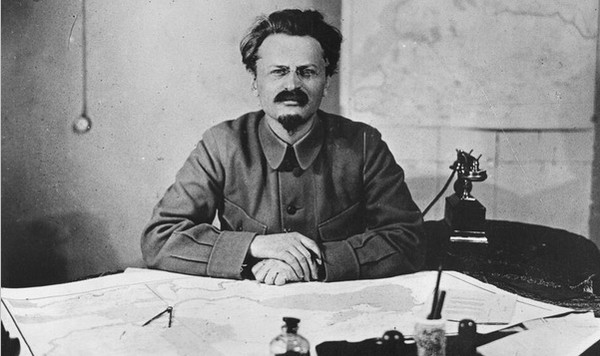
For the first time in the entire history of the Petrograd Soviet, during a vote on a crucial issue, the Bolshevik party won a majority of the deputies’ votes. In an attempt to prevent the Bolshevization of the Petrograd Soviet, its Socialist-Revolutionary-Menshevik Presidium — N. S. Chkheidze, A. R. Gotz, F. I. Dan, I. G. Tsereteli, V. M. Chernov — resigned, which led on September 9 (22), 1917, to the election of Leon Trotsky as head of the Petrograd Soviet, who had shortly before been released from the “Kresty” prison.
On September 25 (October 8), 1917, re-elections to the Executive Committee of the Petrograd Soviet took place. In the workers’ section, 230 deputies voted for the Bolsheviks, while 156 voted for the Socialist-Revolutionaries and Mensheviks. By early November, the Bolsheviks held up to 90 % of the votes in the Petrograd Soviet. In the Executive Committee of the workers’ section of the Moscow Soviet of Workers’ and Soldiers’ Deputies, during the elections of September 18-19, 1917, the Bolsheviks won 32 seats, the Mensheviks – 16, and the Socialist-Revolutionaries – 9; the Bolsheviks won the elections in 11 out of 17 district dumas. Also, by November, the Bolsheviks held a majority of seats in 80 local Soviets of large industrial cities. The soldiers’ committees, primarily on the Northern and Western fronts, the Petrograd garrison, and Centrobalt, went over to the side of the Bolsheviks.
All of this allowed the Bolsheviks to strengthen their positions, which frightened the “All-Russian Central Executive Committee of Soviets of Workers’ and Soldiers’ Deputies” (which had been elected by the First All-Russian Congress of Soviets of Workers’ and Soldiers’ Deputies and was predominantly Socialist-Revolutionary and Menshevik), causing the Second All-Russian Congress, which was planned to take place in September, to be postponed. This made it possible to seize power within the Soviets themselves, which manifested itself in holding the pro-Bolshevik First Congress of Soviets of the Northern Region (which was conducted with gross violations — for example, there were representatives from the Moscow Governorate, which was not part of the Northern Region) and the formation of the Northern Regional Committee there, which began work on convening the Second Congress of Soviets, contrary to the rules:
No other committee [except the VTsIK] is authorized or has the right to take the initiative in calling a congress. Still less has the Northern Regional Congress the right to do so, called as it was in violation of all the rules established for regional congresses and representing accidentally and arbitrarily selected Soviets14.
Nevertheless, they eventually agreed to hold it, but later the VTsIK stated the following:
The Central Executive Committee considers the Second Congress a failure and regards it as a private meeting of Bolshevik delegates. The decisions of this congress, as illegal, the Central Executive Committee declares non-binding for local Soviets and all army committees. The Central Executive Committee calls upon the Soviets and army organizations to rally around it for the defense of the revolution. The Central Executive Committee will convene a new congress of Soviets as soon as conditions are created for its proper convocation15.
The Bolsheviks seized power in the country as well, organizing the October coup, as a result of which all power ended up in their hands; the old composition of the VTsIK was dissolved, and a temporary worker-peasant government was created — the Council of People’s Commissars.
Practice showed that under the conditions of a one-party dictatorship, even such organs of self-government as the Soviets gradually pass under the control of the ruling party. According to the calculations of the classics of Marxism, it was the state that was supposed to wither away, but in practice, only the organs of real popular power withered away, not the state, and what was established was not a “dictatorship of the proletariat”, but an ordinary dictatorship. However, Marx and Lenin hinted that it would be a dictatorship of the party.
“There Was a Dictatorship of the Proletariat in the USSR”
Some communists claim that power in the USSR (at least during certain periods) belonged not to the communist party, but to the entire proletariat. However, this is contradicted by the frequent protests of the workers themselves against the Bolshevik dictatorship, the most famous of which is the Izhevsk-Votkinsk uprising16, the main striking force of which consisted of workers17 dissatisfied with the policy of “War Communism”, rising unemployment (by early May 1918, there were more than 7 thousand unemployed in Izhevsk), and falling wages (down to 40 % of the 1913 level).
Citizens were also dissatisfied with the behavior of the Bolsheviks, who twice (at the end of May and at the end of June) suffered defeat in the elections to the Izhevsk Soviet, and subsequently, with the help of reinforcements from Kazan, along with the Socialist-Revolutionaries-Maximalists, dispersed it. Power in the city passed first to a new executive committee, in which the majority was held by the Bolsheviks and Maximalists, and then to the Izhevsk Military-Revolutionary Headquarters, headed by the Bolshevik Stepan Kholmogorov. The dispersion of the Soviet and the subsequent arrests of the leaders of opposition parties led to discontent among both the workers and the opposition in the form of Socialist-Revolutionaries and Mensheviks, as well as the Union of Front-line Soldiers, which became the future striking force of the uprising, since it consisted of 4,000 people, many of whom had weapons18. The last straw was a workers’ rally on August 7, 1918, which was assembled due to the defeat of Soviet forces in Kazan for the purpose of drafting workers into the army; the opposition decided to take advantage of this, since the main forces of the Bolsheviks and Maximalists had left for the front, and only a few dozen Red Army soldiers and policemen remained in the city19. At this rally, the “Union of Front-line Soldiers” put forward 10 demands supported by the workers, of which the Bolsheviks refused to fulfill one: to arm and equip all those mobilized at the factory and send them all together20. In the end, the Bolsheviks said that the weapons would be issued at the Agryz station, which led to an ultimatum from the “Union of Front-line Soldiers”, as well as to a rally, a procession, arrests, and the uprising itself, which was suppressed.
Another well-known incident was the Kronstadt Uprising — an armed demonstration in March 1921 by the garrison of the Kronstadt fortress, the crews of the Baltic Fleet ships, and the inhabitants of the city against the Bolsheviks and their policy of War Communism, which led to terrible consequences, as Lenin himself noted:
A peculiar “War Communism” consisted in the fact that we actually took from the peasants all surpluses, and sometimes even not surpluses, but a part of the grain necessary for the peasant’s food, took it to cover the expenses for the army and for the maintenance of workers21.
Workers in Petrograd were outraged by the living conditions: thus, at the beginning of 1921, Petrograd workers engaged in steelmaking received 800 grams of black bread daily; shock workers received 600, and other categories received 400 or even 200 grams. According to official data, transport workers received between 700 and 1,000 kilocalories a day. But even these meager rations were issued irregularly and were far below the norm required for a full day of physical labor.
By the end of 1920, this led to a situation where, despite the presence of armed roadblock detachments that blocked roads and confiscated products from speculators, illegal trade flourished. Moreover, it largely displaced official sources of food supply. At the same time, the urban population declined sharply: in particular, of the 2.5 million people living in Petrograd in October 1917, only about 750 thousand remained by August 192022.
Fuel was also supplied to the city intermittently: in early February 1920, more than 60% of Petrograd’s factories and plants were forced to close because there was nothing to heat them with. The Kronstadt sailors were dissatisfied not only with the situation in the country, but also with the fact that in March 1918 the Central Committee of the Baltic Fleet (Centrobalt — a collective organ of the sailor masses created to coordinate the activities of fleet committees) was dissolved, and its powers were transferred to the Board of Commissars of the Baltic Fleet — essentially, this was the liquidation of the committees, their organs of power, and the appointment of commissars to command posts, which caused a “storm of protest”23.
By the end of 1920, an epidemic of scurvy broke out in the Baltic Fleet, and cases of desertion increased sharply24. In January 1921, about five thousand Baltic sailors left the ranks of the RCP(b), and the unfolding political struggle for the administration of the fleet between Trotsky and Zinoviev25 further undermined the party’s authority.
On February 28, 1921, the crew of the battleship “Petropavlovsk” passed a resolution calling for a “third revolution” that would drive out the usurpers and end the regime of the commissars. A revolutionary committee headed by S.M. Petrichenko (a clerk from the “Petropavlovsk”) was elected. On March 1, 1921, an all-city rally was called on Anchor Square, where resolutions were adopted with the demands: “For Soviets without Communists!”, “Power to the Soviets, not the Parties!”, “Down with Prodrazvyorstka!”, “Give us Freedom of Trade!”.
This uprising, like many others, was suppressed by the Bolsheviks, who labeled it the “Kronstadt Mutiny”.
One of the largest uprisings against the Bolsheviks was the Tambov Uprising (1920–1921)26, which was caused by the prodrazvyorstka, manifested in the expropriation of grain from peasants. The fact is that in 1920 there was a drought that caused serious damage to the harvest, while the Bolsheviks demanded impossible prodrazvyorstka quotas (11.5 million poods out of 12 collected in the governorate). As a result, on August 19, 1920, in several villages (Kamenka of the Tambov Uyezd, Tugolukovo of the Borisoglebsk Uyezd), the peasants refused to hand over grain and, with the support of partisans, destroyed the food detachments, local communists, and Cheka agents. On the same day, in the village of Afanasyevka of the Tambov Uyezd, several small rebel groups merged into a partisan army, and the uprising began to spread rapidly.
Soon the uprising covered the territories of the Tambov, Kirsanov, Borisoglebsk, Morshansk, and Kozlov uyezds of the Tambov Governorate, as well as the neighboring uyezds of the Saratov and Voronezh Governorates. The rebels liquidated the organs of Soviet power, destroyed its representatives, military garrisons, and took power into their own hands in some villages. The uprising was effectively led by the chief of staff of the 2nd Rebel Army, a member of the Socialist-Revolutionary Party, Aleksandr Antonov, after whom the uprising was later named the “Antonovshchina” and the “Antonov Mutiny”. This uprising lasted quite a long time and, along with Kronstadt, became the reason for the transition from War Communism to the NEP.
The Bolsheviks also dispersed demonstrations with broad participation of workers in support of the Constituent Assembly. From the testimony of a worker at the Obukhov Factory, D.N. Bogdanov, dated January 29, 1918, a participant in the demonstration in support of the Constituent Assembly:
I, as a participant in the procession back on January 9, 1905, must state as a fact that I did not see such brutal violence there as was perpetrated by our “comrades”, who still dare to call themselves such, and in conclusion, I must say that after that shooting and that savagery which the Red Guards and sailors carried out against our comrades, and even more so after they began tearing away the banners and breaking the poles, and then burning them on a bonfire, I could not understand what country I was in: either in a socialist country or in a country of savages who are capable of doing everything that Nicholas’s satraps could not do, now done by Lenin’s fine fellows27.
All of the above is rather strange given the declared dictatorship of those who were being shot, dispersed, and suppressed. We are not even speaking of the Stalinist period, the uprisings during which would be more properly set apart in a separate article, and of the subsequent years with incidents like the Novocherkassk massacre. It would be more correct to call such a system not the “dictatorship of the proletariat”, but at least the “dictatorship of the communist proletariat”, but still, most correctly — the dictatorship of the communist party, which in practice decided which proletariat was communist and which was not. Vladimir Lenin himself asked a rhetorical question:
Does the class struggle in the epoch of the transition from capitalism to socialism not consist in protecting the interests of the working class from those handfuls, groups, and strata of workers who stubbornly cling to the traditions (habits) of capitalism and continue to look at the Soviet state as before: to give “it” less work and of worse quality, and to extract more money from “it”28.
Lenin stated that after the October Revolution, the workers knew “no yoke and no authority over them except the authority of their own unity, of their own, more conscious, bold, cohesive, revolutionary, steadfast vanguard”29. The abundance of laudatory adjectives does not alter the fact that a yoke and authority over the workers do, it turns out, exist after all, and they are exercised by the “vanguard”, that is, according to the designation that had already become standard by that time, an organization of professional revolutionaries. The reality is accurately reflected.
At the same time, property did not belong to the proletariat either. This was best uncovered by Doctor of Historical Sciences Michael Voslensky in his work “Nomenklatura”:
The right of property is the unrestricted right of the owner to dispose of the object of property at his own discretion, including transferring it to another owner or destroying it…
<…>
…the relationship of precisely the nomenklatura to the means of production fully corresponds to the concept of ownership. Only the nomenklatura can destroy the means of production of its own free will. It was by its decisions during the war that the dam of the Dnieper Hydroelectric Station — the legendary Dnieprostroi of the 1930s — was blown up, and industrial enterprises were blown up during the retreat of Soviet troops — in a number of cases despite the desperate protests of the workers, the nominal masters of socialist production, who were thus doomed to unemployment and starvation.
<…>
Can collective farmers, even by a unanimous decision, liquidate their collective farm, sell or destroy collective farm property, the means of production, and the products they created?
No, they cannot. Even a proposal of this kind would be a punishable act in the USSR. Collective farmers are strictly regulated in the right to use what is supposedly their property. Even if they are starving, they cannot slaughter collective farm cattle. All land was transferred to the collective farm by the state for free and permanent use, but the collective farm meeting cannot make an assignment of land within this tract in favor of private household plots. So what kind of property is this?
However, even without indulging in theoretical research, the Soviet citizen in practice proceeds from the assumption that the collective farm, of course, does not belong to the collective farmers. The city dwellers who are regularly sent in the autumn to save the perishing collective farm harvest are perfectly aware that they are going to work not for the members of this collective farm, but along with them — for the real master.
For it is clear to everyone that collective farm property is not ownerless; it belongs to someone. But neither the state nor “public organizations” recognize it as theirs. Who is the owner?
The representative of this owner will be pointed out by anyone who has been to a Soviet village: the district party committee. The authorized representative of the district committee in the collective farm is the chairman. The general meeting of collective farmers “elects” the chairman, but the district committee sends him to the collective farm. Collective farm chairmen are the nomenklatura of the district party committees.
It is the district committee that can really dispose of collective farm-cooperative property, in contrast to the cooperative collective farmers themselves. During the war, by decisions of the district committees, collective farm cattle were destroyed or driven away, and collective farm barns were burned before the advancing Germans. By decisions of the district committees, collective farms were reshaped, amalgamated, and broken up. However, the district committee is also not the owner, but merely an authorized representative of the owner of collective farm-cooperative property, and it acts under the control of the regional party committee30.
In the articles about the privileges of the nomenklatura and about the real standard of living of the majority of citizens under Stalin and during the late USSR, we showed the difference in the standard of living, which allows one to judge who held the real power. In the article about how the nomenklatura, from a Marxist perspective itself, constitutes an exploitative class, we also revealed that replacing businessmen with nomenklatura bureaucrats yields nothing good for society.
Thus, we can see that power was held not by the proletariat, but by those who led the communist party. Not even by the communist party as a whole, because many communists began to be physically destroyed under Stalin, which we examined in a separate piece. A completely logical outcome — after all, the other parties had been suppressed, so there was no one left to stand up for them. This genesis was described as follows by the former communist nomenklatura member Milovan Djilas in his work “The New Class” (published in Russian as “The Face of Totalitarianism”):
The party makes the class. Then the class grows by its own power, using the party as a basis. The class grows stronger, while the party grows weaker — this is the inescapable fate of every ruling communist party31.

Indeed, during communist “proletarian” revolutions, it is most often a “proletarian” party that comes to power, establishing its dictatorship, after which the cadres of this party form the nomenklatura. The proletariat here possesses no power from the first minute to the last. Power is held only by that part of it which influences decision-making within the communist party (if it survives the intra-party struggle for the only correct interpretation of the only correct teaching), but even that part eventually transforms into the nomenklatura.
A Proletarian Party?
Many researchers have also noted that the Bolshevik Party, like its leadership, was not proletarian in its composition. In the words of Vladimir Lenin, “the founders of modern scientific socialism, Marx and Engels, themselves belonged, by their social status, to the bourgeois intelligentsia”32. Lenin himself was a hereditary nobleman33, Grigory Zinoviev came from the family of a dairy farm owner34, Leon Trotsky’s father was the owner and lessee of 300 dessiatines of land35, and so on. Before the 11th Congress, Lenin wrote about the social composition of the entire party as a whole: “There is no doubt that our party now is not proletarian enough in the majority of its composition. I think no one can dispute this, and a simple glance at the statistics will confirm this statement”36. The situation did not change much by the 13th Party Congress either. Joseph Stalin’s report included the following data:
Social composition of the Party. Last year workers constituted 44.9 per cent, this year, without the Lenin Enrollment, they constitute 45.75 per cent — an increase of 0.8 per cent.
<…>
As regards social composition, this year, in forty-five organizations, workers constituted 48 per cent in the gubernia and regional committees. In the presidiums of gubernia and regional committees, in fifty-two organizations, workers constituted 41 per cent. At the time of the Twelfth Congress, workers constituted 44.6 per cent of the secretaries of gubernia and regional committees; at the time of the Thirteenth Congress they constitute 48.6 per cent.
<…>
Composition of the Central Committee and Central Control Commission. If we take the candidate members and full members of the Central Committee, fifty-six persons in all, 44.6 per cent are workers and 55.3 per cent are peasants and intellectuals. The Central Committee must, therefore, be expanded by increasing the number of workers on it. In the Central Control Commission, 48 per cent of the members and candidate members are workers and 52 per cent are peasants and intellectuals37.
Attempts to expand worker participation in the party led to a decline in the quality of the leadership cadres. Doctor of Historical Sciences Viktor Nikulin notes that the political and cultural level of the workers who joined during the “Lenin Enrollment” was low; 80-90% of them were poorly developed and were primarily interested in everyday domestic matters. They were inclined toward egalitarianism and had an extremely negative attitude toward specialists and the intelligentsia38. As a result, the party turned out to be “less politically educated”, which from a socio-psychological point of view meant nothing less than an inability to make independent decisions, influence the situation in the party, or develop its own political line. This barrier of mass psychology became virtually insurmountable in the 1920s. This barrier can be defined as the capacity and willingness of the party recruits to perform only one function: for the leaders — to command, and for the rank-and-file — to obey. It was a mass that was obedient and trusting of any suggestion from above.
Was that party of which Lenin spoke — the RSDLP, founded in 1898 — a working-class party?
Here is what the official multi-volume Soviet “History of the CPSU” reports on this subject. At the First Congress of the party, which founded it, “some of the delegates spoke against naming the party a workers’ party. This was motivated by the fact that actually few workers had joined the Social Democratic organizations so far. Opinions were divided. By a majority of five votes ‘against’, the Fourth Congress approved the name ‘Russian Social Democratic Party’. The word ‘Workers” was included in it only after the congress, during the drafting of the Manifesto, with the consent of two members of the Central Committee”39.
And was this consent valid? No. The decision adopted by the First Congress of the party, which replaced the party rules, established in its paragraph 4: “In particularly important cases, the Central Committee shall be guided by the following principles:
a) In matters allowing for delay, the Central Committee is obliged to apply to the party congress for instructions;
b) In matters not allowing for delay, the Central Committee acts independently by a unanimous decision…”40.
It is a fact that the little word “Workers'” appeared in the name of the party contrary even to its own decision and rules. Needless to say, it had absolutely nothing to do with the actual composition of the party. It was a group of intellectuals, many of whom were indeed inspired by the noble goals of fighting against despotism — but by no means for the creation of a new despotism.
<…>
We have said: there are no workers in the Sovnarkom. But perhaps the ruling Communist Party consists of workers? No, under Lenin, workers make up significantly less than 50% of the party41. Perhaps they make up the majority in the Central Committee of the party? No, under Lenin, the composition of the Central Committee is small and there, as in the government, are professional revolutionaries. So workers were never included in the Central Committee? Why, it happened sometimes. There is still a practice to this day of including a few workers for show in the Central Committee.
I had to deal with some of them, for example, with Valentina Gaganova. They are typical representatives of the labor aristocracy, who are elected to presidiums and sent as part of delegations, but these professional figureheads have no influence in the Central Committee, understand this perfectly well, and know their place.
<…>
There was no dictatorship of the proletariat in Soviet Russia. Nor was there one in any other socialist country. In general, it did not exist42.
This practical experience shows us that the very idea of a class party and the power of a class has nothing in common with reality. Different representatives of the same social class can have different interests. At the same time, workers may be too busy with exhausting labor to formulate a political agenda, and they do not have enough money to create their own political organization. It is completely normal when the formulation of the agenda is handled by a part of the intelligentsia, while financing is provided by a part of the business world — this intelligentsia and business may well sympathize with left-wing ideas, which is demonstrated by the actual history of the Bolshevik Party itself (there will be a separate material on the party’s sources of funding). It is just that if the party is declared to be “proletarian” and to advocate for the “dictatorship of the proletariat” at the same time — it is hypocrisy and deception. But if the party is democratic, the contradiction disappears.
Obsolescence of the Term and People’s Democracies
The concept of the dictatorship of the proletariat was already criticized by Marxists themselves from among the supporters of the evolutionary development of socialism — for example, Karl Kautsky. He believed that the proletariat could win without a revolution, and noted the democratization of society as capitalism developed43, in connection with which it is necessary to fight for democracy and the realization of socialism through reforms. The system that arose in the USSR he described as follows:
…if we speak of dictatorship as a form of government, we cannot speak of the dictatorship of a class, for […] a class can rule, but not govern. Consequently, if by dictatorship we mean […] a form of government, then we can only speak of the dictatorship of a single person or an organization. Consequently — not of the dictatorship of the proletariat, but of the dictatorship of the proletarian party. But then […] the proletariat splits into different parties. The dictatorship of one of them will by no means be the dictatorship of the proletariat, but the dictatorship of one part of the proletariat over another44.
At the same time, parliamentary democracy, upon which Karl Marx slapped the demagogic label of “bourgeois democracy” (apparently considering his arguments unconvincing without the use of this trick), and Vladimir Lenin following him declared that “in reality the democratic republic, the constituent assembly, general elections, etc., are the dictatorship of the bourgeoisie”45, increasingly began to bring social democratic parties to power and to carry out social and democratic reforms in the interests of the majority of citizens (as we described in our article on social democratic parties), which do not “express the interests of the bourgeoisie”, a point we analyzed in the article on myths about social democrats. In many developed countries, the role of independent trade unions grew, various left-wing parties began to come to power, and workers actually participated in the management of society both through trade unions and through elections, and thanks to the rotation of power, their chances of participating in politics themselves increased. That is, no “dictatorship of the bourgeoisie” was observed. Meanwhile, under the so-called “dictatorship of the proletariat”, independent trade unions were suppressed and turned into “transmission belts”46 of the party, all parties (except the communist one) were suppressed, and workers began to participate less and less in politics, as belonging to the nomenklatura became practically hereditary, and nomenklatura bureaucrats had to secure this belonging primarily for their own children.
Closer to the second half of the 20th century, the concept of dictatorship had discredited itself to such an extent that communist parties were forced to shift from the dictatorship of the proletariat to a new concept — the so-called “people’s democracies”, which were created in the Soviet sphere of influence47, meaning multi-party systems under the leading role of the communist party and the presence of some democratic institutions — such as a parliament. At the same time, these countries called themselves socialist.
The dictatorship of the proletariat legally disappeared in the USSR as early as Joseph Stalin, since Article 1 of the 1936 Constitution stated that “The Union of Soviet Socialist Republics is a socialist state of workers and peasants”.48. This implied that the transitional stage of the dictatorship of the proletariat had been passed. This thought was repeated at the 22nd Congress of the CPSU in 196149. Here, instead of the dictatorship of the proletariat, the State of the Whole People was proclaimed, that is, a new stage in the development of the socialist state, a major milestone on the road to the transformation of socialist statehood into communist public self-government50. This was also reflected in the 1977 Constitution, which stated that a “state of the whole people” had been built in the Soviet Union:
Having fulfilled the tasks of the dictatorship of the proletariat, the Soviet state has become a state of the whole people.
Article 1. The Union of Soviet Socialist Republics is a socialist state of the whole people, expressing the will and interests of the workers, peasants, and intelligentsia, the working people of all nations and nationalities of the country51.
Dictatorship or Democracy
What should be the attitude toward the dictatorship of the proletariat among progressive social democrats? First of all, one must recognize that this slogan is obsolete, as it failed experimental verification. In Marxist theory, the implementation of the “dictatorship of the proletariat” was supposed to lead to the power of the workers, but in reality, it led to the power of the nomenklatura, which suppressed any other political forces, including the workers themselves. In the USSR, it also led to the actual mass destruction of communists. Today, the slogans of the dictatorship of the proletariat and democracy are mutually exclusive. This is proven both by the opposite (and therefore logically incompatible) meanings of the terms “dictatorship” and “democracy”, and by the logic of the development of the term “dictatorship of the proletariat” and the practice of embodying the dictatorship of the proletariat and democracy.
The idea of the dictatorship of the proletariat is a demagogic construct like the idea of the “power of the Russian people”. Neither the power of the proletariat nor the power of the Russian people will exist when these constructs are implemented; rather, there will be the power of their representatives (the inevitability of representative democracy was substantiated by us here). And the dictatorship of these very representatives in practice will mean the suppression of all others, including those whom they “represent”.
The relevant slogan today is increasing the level of social democracy. In a separate article, we described the reasons why democracy is much more effective than dictatorships, and this is true from the standpoint of economic growth, improving the standard of living, and society’s access to political management. Today, social democrats understand that democracy implies not just a multi-party system, but a host of other institutions — the rotation of power, the presence of a strong opposition, political pluralism, freedom of the press, and so on. We can add new components here if they have proven to contribute to the realization of progressive values, or test new hypotheses experimentally. But the baseline consists of the principles of democracy, on the foundation of which the refinement and supplementation of these principles take place.
- K.S. Gadzhiev. Dictatorship // Great Russian Encyclopedia. Volume 8. Moscow, 2007, p. 747. [Electronic resource]. URL: https://bigenc.ru/world_history/text/1955756 (Accessed: 15.01.2021).
- Dictatorship of the proletariat // Encyclopaedia Britannica (www.britannica.com). [Electronic resource]. URL: https://www.britannica.com/topic/dictatorship-of-the-proletariat (Accessed: 15.01.2021).
- Political Dictionary / edited by G. Aleksandrov, V. Galyanov, and N. Rubinshtein. – 671 p. – M.: State Publishing House of Political Literature, 1940. – p. 175.
- K. Marx and F. Engels. Works. Second Edition. Volume 7. – 669 p. – M.: State Publishing House of Political Literature, 1956. – p. 91.
- Soviet Historical Encyclopedia. Editor-in-chief E.M. Zhukov. Vol. 5. Dvinsk-Indonesia. – 960 p. – M.: “Sov. Entsiklopediya”, 1964. – p. 201.
- J.V. Stalin. Works. Volume 7. 1925. – 423 p. – M.: State Publishing House of Political Literature, 1947. – p. 186-187.
- K. Marx, F. Engels. Manifesto of the Communist Party – 71 p. – M.: State Publishing House of Political Literature, 1950. – p. 47.
- V.I. Lenin. Collected Works. Fifth Edition. Volume 33. The State and Revolution. – 433 p. – M.: Publishing House of Political Literature, 1969. – p. 43.
- K.E. Baldin, A.M. Semenenko. Ivanovo-Voznesensk. From the Past into the Future. – 248 p. — Ivanovo: Episheva O.V., 2011. – p. 57-62.
- V.I. Lenin. Collected Works. Fifth Edition. Volume 33. The State and Revolution. – 433 p. – M.: Publishing House of Political Literature, 1969. – p. 46.
- Collection of Statutes and Decrees of the Government for 1917-1918. – 1483 p. – Moscow, 1942. – p. 681.
- M. Voslensky. Nomenklatura. The Ruling Class of the Soviet Union (Second Edition, corrected and supplemented), 671 p. — Overseas Publications Interchange Ltd London, 1990. — p. 127-128.
- The Petrograd Soviet of Workers’ and Peasants’ Deputies in 1917: Protocols, transcripts and reports, resolutions and decisions of general meetings, section meetings, meetings of the Executive Committee, the Bureau of the Executive Committee and factions (February 25 – October 25, 1917) / Vol. 4. (July 3 – October 25, 1917). – 615 p. – M.: “Russian Political Encyclopedia” (ROSSPEN), 2003. – p. 245-247.
- R. Pipes. The Russian Revolution: In 3 books. Book 2. The Bolsheviks in the struggle for power. 1917—1918. – M., Zakharov, 2005. – 720 p.
- Ibid.
- M.A. Feldman. The Izhevsk-Votkinsk workers’ uprising through the prism of Russia’s social history // Rossiyskaya Istoriya. — M.: Academic Scientific-Publishing, Production-Political and Book-Distribution Center of the Russian Academy of Sciences “Nauka Publishing House”, 2012. — No. 3. — p. 12—20.
- A.Y. Ermolov. Izhevsk-Votkinsk uprising 1918 // Great Russian Encyclopedia. Volume 10. Moscow, 2008, p. 729-730. [Electronic resource]. URL: https://bigenc.ru/military_science/text/2001093 (Accessed: 15.01.2021).
- (D.O. Churakov. Rebellious Proletarians: Worker Protest in Soviet Russia (1917-1930s). – 352 p. – M: Veche, 2009. – p. 197.)
- (D.O. Churakov. Right Socialists and the White Terror: Izhevsk, 1918 // Alternativy. – 2004. – No. 2.)
- A.G. Efimov. The Izhevsk and Votkinsk Forces. The Struggle against the Bolsheviks 1918-1920 / compiled by L.Y. Tremsina, foreword by A.A. Petrov. – 416 p. – M.: Ayris-press, 2008. – p. 51.
- V.I. Lenin. Collected Works. Fifth Edition. – 561 p. – M.: Publishing House of Political Literature, 1970. – p. 219.
- P. Avrich. Kronstadt 1921. – 240 p. – M.: Tsentrpoligraf, 2007. – p. 16-19
- P.E. Dybenko. From the Depths of the Tsarist Fleet to Great October. From Memoirs of the Revolution. 1917—7.XI—1927. – 237 p. — M: Voenny Vestnik, 1928. – p. 199.
- P. Avrich. Kronstadt 1921. – 240 p. – M.: Tsentrpoligraf, 2007. – p. 48
- R.B. Day. Leon Trotsky and the Politics of Economic Isolation. – 469 p. – M.: Delo, 2013. – p. 143
- V.V. Kanishchev. Tambov Uprising 1920–21 // Great Russian Encyclopedia. Volume 31. Moscow, 2016, p. 627-628. [Electronic resource]. URL: https://bigenc.ru/military_science/text/4181089 (Accessed: 15.01.2021).
- GA RF. F.1810. Op.1. D.514. L.79-80
- V.I. Lenin. Collected Works. Fifth Edition. Volume 37. July 1918 – March 1919. – 747 p. – M.: Publishing House of Political Literature, 1969. – p. 90.
- V.I. Lenin. Collected Works. Fifth Edition. Volume 39. June – December 1919. – 623 p. – M.: Publishing House of Political Literature, 1970. – p. 17.
- M.S. Voslensky. Nomenklatura. The Ruling Class of the Soviet Union. – 624 p. — M: “Sovetskaya Rossiya” jointly with MP “Oktyabr”, 1991. – p. 174-181.
- Milovan Djilas. The Face of Totalitarianism. – 544 p. — M: “Novosti”. 1992. – p. 200.
- V.I. Lenin. Collected Works. Fifth Edition. Volume 6. January-August 1902. – 619 p. – M.: State Publishing House of Political Literature, 1963. – p. 30-31.
- I.S. Rozental. Lenin // Great Russian Encyclopedia. Electronic version (2016). [Electronic resource]. URL: https://bigenc.ru/domestic_history/text/3793734 (Accessed: 16.01.2021).
- Yu.V. Aksyutin. Zinoviev // Great Russian Encyclopedia. Volume 10. Moscow, 2008, p. 495-496. [Electronic resource]. URL: https://bigenc.ru/domestic_history/text/2879281 (Accessed: 16.01.2021).
- G.I. Chernyavsky. Leon Trotsky. – 665 p. – M.: Molodaya Gvardiya, 2010. – p. 22.
- V.I. Lenin. Collected Works. Fifth Edition. Volume 45. March 1922 – March 1923. – 729 p. – M.: Publishing House of Political Literature, 1970. – p. 19.
- Organizational Report of the Central Committee to the Thirteenth Congress of the R.C.P.(B.), May 24, 1924. Stalin J.V. Works. – Vol. 6. – M.: OGIZ; State Publishing House of Political Literature, 1947. pp. 191–219.
- V.V. Nikulin. The Political Doctrine and Composition of the Ruling Party. (Regulation of the Social Composition of the RCP(b) – VKP(b) in the 1920s: Goals, Specifics, Results). // Genesis: Historical Research. – 2017. – No. 1. – p. 78 – 97.
- History of the CPSU, vol. 1. M., 1964, p. 262.
- “The CPSU in Resolutions…”. 7th ed. M., 1953, part I, p. 14.
- See “History of the USSR”, 1972, No. 3, pp. 162-163.
- M.S. Voslensky. Nomenklatura. The Ruling Class of the Soviet Union. – 624 p. – M: “Sovetskaya Rossiya” jointly with MP “Oktyabr”, 1991. – p. 44, 73, 75.
- Karl Kautsky. From Democracy to State Slavery (A Response to Trotsky). – 166 p. — Berlin: “Socialist Courier”, 1922. – pp. 23-25.
- Karl Kautsky. Bolshevism at a Deadlock. – 320 p. — M: Antidor. 2002. – p. 56.
- V.I. Lenin. Collected Works. Fifth Edition. Volume 37. July 1918 – March 1919. – 747 p. – M.: Publishing House of Political Literature, 1969. – p. 390.
- J.V. Stalin. Works. Volume 5. 1921-1923. – 446 p. – M.: State Publishing House of Political Literature, 1952. – p. 199.
- A.V. Shubin. People’s Democracy // Encyclopedia of World History (w.histrf.ru). [Electronic resource]. URL: https://w.histrf.ru/articles/article/show/narodnaia_diemokratiia (Accessed: 15.01.2021).
- Izvestia. Newspaper. No. 283, December 6, 1936. M. TsIK USSR 1936 – 4 p.
- Materials of the XXII Congress of the CPSU. – 464 p. – M.. Goslitizdat, 1962 – p. 185.
- Ibid., p. 183.
- Constitution (Fundamental Law) of the Union of Soviet Socialist Republics (adopted at the extraordinary seventh session of the Supreme Soviet of the USSR of the ninth convocation on October 7, 1977) // Vedomosti Verkhovnogo Soveta SSSR. – 1977. – No. 41. Art. 617