
Revolutionary conservationism
Among the Russian left, it is customary to deify revolution while simultaneously doing nothing for it. Is this position useful for changes in the country, or does it, on the contrary, express the interests of the ruling elites? Let us figure it out.
The essence of revolutionary conservationism is to declare one or several types of struggle against the government (usually all types of struggle except for revolution) as “incorrect” and to fight against them while hiding behind one’s own “revolutionary nature”, without performing any revolutionary actions whatsoever. As a result, it turns out that revolutionary conservationists fight exclusively against the opposition. For example, a group on the social network VKontakte called “Union of Red Groups and all those loyal to the USSR!” labeled Russian protests as “liberal rallies” and actively campaigned against the participation of the left in protests and elections:
People without class consciousness will not be able to understand that, in fact, they are chaotically going to rallies to support one group of capitalists against another1.
The message is clear: do not go out into the streets, stay home, study the class struggle, and write comments against the protesters and in favor of the communists. Here, revolutionary conservationists are trying to convince the reader that the protesters and Putin are one and the same. Such a position is aimed at protecting the regime. Another resource of revolutionary conservationists, “Politsturm”, writes an article aimed at ensuring that everyone stays home during elections:
Conscious ignoring of elections by the majority of the working class is one of the greatest fears of the capitalists, for without the attraction of “elections”, the bourgeois government will not receive legitimacy, which will significantly complicate their position and make them vulnerable2.
Of course, no examples are given of which governments “failed to receive legitimacy” as a result of an election boycott in the absence of a turnout threshold (there is no turnout threshold in Russia3). Nor is a strategy provided that would allow defeating the regime. It is not needed, because “Politsturm” is fighting against the opposition, not against the regime.
Now, when the citizens of Belarus have risen up against the dictatorship of Alexander Lukashenko in conditions where any rotation of power (we described in detail why it is needed) would be a step forward, and where non-rotation means a guarantee of the absence of improvements, revolutionary conservationists rushed to defend the Lukashenko regime, declaring hundreds of thousands of people4, including striking workers at large enterprises5, as the bourgeoisie. For instance, “Politsturm” writes:
We are witnessing another bourgeois coup d’état, and in the absence of a Marxist-Leninist Communist Party in Belarus, communists are unable to seriously influence the outcome of these events.
First and foremost, Marxists and conscious workers must maintain common sense, remain cool-headed, and not rush into adventures to support one side or the other out of a desire to “just participate in the action”6.
Communist blogger and member of the Izborsky Club7 Konstantin Semin invented an even more cunning legend to defend a regime similar to Putin’s — that the fight against the “Belarusian Maidan” is a fight against Russian capital.
It is not difficult to imagine a situation in which workers start striking in Russia, and revolutionary conservationists declare them, too, servants of the bourgeoisie (just because they do not set the goal of giving everything to the communists) and of Western capital, and invent yet another “dialectical” mental gymnastics about how, in reality, freedom is slavery. In the opinion of “Politsturm”, the problem is that there is no “Marxist-Leninist Communist Party”, however, if one appears, they can always say that these are, in fact, opportunists, traitors, and agents of the bourgeoisie, thereby continuing to fulfill their conservationist tasks.
Stalinists are the most striking example of revolutionary conservationists. They speak aggressively against oppositionists who go to rallies, create political parties, serve as election observers, and so on. Stalinists lecture them, saying that these are all petty-bourgeois methods and that one must only make a revolution. Yet, they themselves do nothing for the revolution; they do less than nothing. Stalinists have no organization of professional revolutionaries, no combat groups, they do not stage uprisings, they do not seize buildings — all their revolutionary spirit is limited to a verbal struggle on the internet against the opposition. That is, Stalinists are revolutionary conservationists. Many Marxists and anarchists are guilty of the same thing — the infection of revolutionary conservationism spreads through the Stalinists with whom they interact.
In the end, instead of hitting the government on all fronts by all possible means, revolutionary conservationists strive to redirect the entire struggle into one direction, which they then proceed to sabotage, and instead, they fight against the opposition. This plays perfectly into the hands of the nomenklatura.
Political practice shows that different people prefer different methods of struggle — some prefer single-person pickets, others prefer participating in elections, and so on. If someone likes conducting single-person pickets, there is no point in stubbornly forcing them to write articles. If you do that, it is quite possible that they will not do anything at all. It is impossible to force those who want only revolution to do what, from the point of view of revolutionary conservationists, they “need” to do. The best way to win people over to your side is to set an exemplary example. But revolutionary conservationists do not want to set an example of revolution; they want people to make the revolution for them and lead them to power literally by the hand. People (unless you count the most gullible among them) instantly see this self-serving hypocrisy and ignore such figures.
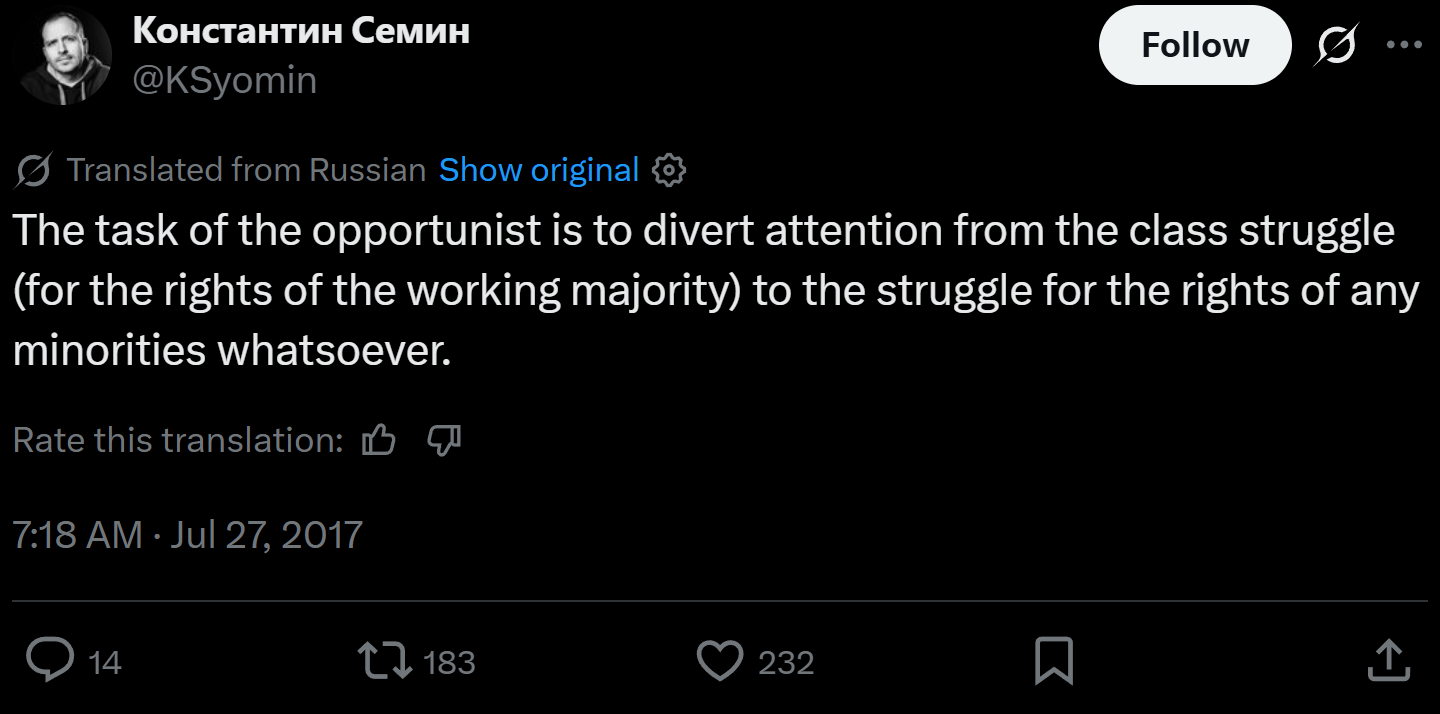
One of the favorite techniques of revolutionary conservationists for fighting the opposition is to declare something a “distraction from the class struggle”. Anything can be declared as such — from the demand for the rotation of power to the fight for women’s rights. The goal of revolutionary conservationists is to ensure that all opposition-minded citizens do nothing, but rather sit at home and engage in “class struggle”, that is, political masturbation. For example, Konstantin Semin uses this technique8:
Another example — an article by revolutionary conservationist and CPRF member German Sadulaev in “Svobodnaya Pressa” reports:
Back at the beginning of the last century, European “socialists” tried to lead the working class away from the struggle for its interests, to direct its power toward defending “feminists” and minorities9.
Further, the author declares Donald Trump to be the most “leftist” of all US presidential candidates, and anarchism to be “petty-bourgeois”. The author also laments that “gays united with Negroes” do not look much like the iron battalions of the proletariat that Lenin spoke of, leading the reader to the conclusion that demonstrations for LGBT rights and the rights of Black people are “incorrect” protests. How many workers has the author brought to the streets, given that “gays and Negroes” are a “wrong” protest? That’s right — none at all. He is only engaged in fighting against feminists and minorities, “gays and Negroes”, that is, fighting against a part of the opposition.
Even some people on the right laugh at revolutionary conservationists. For example, here is the opinion that the page Right Wing expresses about such individuals, noting beforehand that there are quite a lot of conservationists among the right-wingers as well:
On the other side, “leftists” are stomping their feet. These leftists also agree that the authorities are generally acting correctly by smashing the heads of a crowd of onlookers shouting “we are the power here” with clubs. The reason for their agreement is that, in their opinion, this protest is a bourgeois protest of one group of bourgeois against another, where the interests of the workers are not being defended. It does not even occur to a serf, regardless of their political preferences, that a protest, although it arises around something and for a specific purpose, around a specific circle of people, flows into a mass protest with the right infusion of resources, the agenda of which is either intercepted or expanded. Therefore, the serf wants a protest with slogans that would coincide with their serf-like perception of the world. The serf wants changes but does not want to sacrifice anything for these changes, so the serf wants a painless protest. That is precisely why the serf is indignant that someone dared to participate in something unsanctioned10.
Revolutionary conservationism is extremely convenient for the authorities. It works to present any criticism of the authorities (like Navalny’s investigations) as “bourgeois”, and therefore unworthy of trust or reading. It turns out that one should only read revolutionary conservationists, who practically do not engage in criticizing the Russian nomenklatura. And if you add to this the assurances from pseudo-leftist agents of the Russian nomenklatura that participation in elections is “bourgeois”, participation in rallies is “bourgeois”, and so on, we end up with a very sad picture. It turns out that revolutionary conservationists are the watchdogs of the Russian authorities in their fight against the opposition and the “rotting West” (some of them specialize, for example, in fighting “American imperialism”11, and not against the Russian nomenklatura), and this is practically a new form of the Black Hundreds.
Those democratic socialists who fight primarily against the Russian government and the elite as a whole (a significant part of which consists of nomenklatura members) — these are allies of the social democrats. The position of social democrats in relation to revolutionary conservationists can only be one — these are people who conduct political activity in the interests of the authorities, whether consciously or unconsciously. Therefore, there is no place for revolutionary conservationists in a social-democratic organization. Social democrats approve of a wide spectrum of struggle against conservative and authoritarian governments. This, by the way, also means that social democrats advocate for revolution as well — all the more so, the wider the control of the ruling elites over state institutions and the political field (and the less so, the higher the real possibility of coming to power through democratic means). For example, if elections are falsified, and a social-democratic party cannot register properly and participate in elections, the constitutional path to participating in government is closed, and a course toward revolution, as an additional path, is perfectly acceptable. However, this does not mean abandoning other forms of struggle. We described the highest priority form of these in an article about how to change power in an authoritarian state.
- ABOUT THE RALLIES OF THE LIBERAL OPPOSITION IN MOSCOW! // Union of Red Groups and all those loyal to the USSR! VKontakte (vk.com). August 6, 2019. [Electronic resource]. URL: https://vk.com/wall-15175514_933925 (accessed: 21.08.2020).
- Bourgeois elections: results // Politsturm (politsturm.com). March 21, 2018. [Electronic resource]. URL: https://politsturm.com/burzhuaznye-vybory-itogi/ (accessed: 21.08.2020).
- Putin signed a law on the abolition of the minimum voter turnout threshold // RIA Novosti (ria.ru). December 6, 2006, 18:15. [Electronic resource]. URL: https://ria.ru/20061206/56559199.html (accessed: 21.08.2020).
- For Lukashenko – one, against – all the rest. How people across the country went to rallies on Sunday. Online // TUT.BY (news.tut.by). August 16, 2020, 10:12. [Electronic resource]. URL: https://news.tut.by/society/696866.html (accessed: 21.08.2020).
- Tatyana Nevedomskaya. Strikes in Belarus: which enterprises are against Lukashenko // Deutsche Welle (www.dw.com). August 17, 2020. [Electronic resource]. URL: https://www.dw.com/ru/zabastovki-v-belarusi-kakie-predprijatija-protiv-lukashenko/a-54599090 (accessed: 21.08.2020).
- Protests in Belarus: What to do? // Politsturm (politsturm.com). August 13, 2020. [Electronic resource]. URL: https://politsturm.com/protesty-v-belarussii-chto-delat-2020/ (accessed: 21.08.2020).
- Konstantin Semin // Izborsky Club (izborsk-club.ru). [Electronic resource]. URL: https://izborsk-club.ru/author/semin (accessed: 21.08.2020).
- Konstantin Semin on Twitter // Twitter (twitter.com). July 27, 2017, 7:18. [Electronic resource]. URL: https://twitter.com/KSyomin/status/890426056477421568 (accessed: 21.08.2020).
- German Sadulaev. Leftist protest and the petty-bourgeois element // Svobodnaya Pressa (svpressa.ru). June 21, 2020, 13:26. [Electronic resource]. URL: https://svpressa.ru/world/article/268813/ (accessed: 21.08.2020).
- Serfs are a national treasure // RIGHT WING. VKontakte (vk.com). July 28, 2019. [Electronic resource]. URL: https://vk.com/wall-118843334_72443 (accessed: 21.08.2020).
- P.S. Dorokhin: American imperialism is running its steamroller over countries and continents // CPRF (kprf.ru). November 20, 2012, 17:38. [Electronic resource]. URL: https://kprf.ru/international/new-world/112675.html (accessed: 21.08.2020).