What democracy is and why it is necessary
The concept of democracy, meaning "rule of the people", is very vague. It is used to describe a great number of political systems — from direct democracy to the attempt to present the establishment of a dictatorship as an expression of the people's will. Therefore, we need to clearly define what social democrats mean by democracy.
Social democrats, as is clear from the name of the ideology, advocate for democracy, but it is important to clarify here which democracy we are talking about and what is included in this concept. After all, if one wishes, one can invent any kind of demagoguery — for example, that a dictator expresses the will of the people, and therefore the people rule through him, meaning a dictatorship is a democracy. In order not to fall for such a clever verbal masquerade, we need to know what democracy is. As we have already noted, even modern democratic systems, which will be discussed here, sometimes prove incapable of effectively expressing the interests of the majority of citizens. This does not mean that democratic institutions do not work — it means they are insufficient and need to be supplemented, but it is also impossible to do without them.
Contents
What democracy is
Dictionaries usually provide definitions according to which democracy is the rule of the people. For example, the Ozhegov dictionary says that it is a “political system based on the recognition of the principles of popular sovereignty, freedom, and the equality of citizens”1. However, such definitions are too vague, as an overly broad range of concepts fits them. A dictionary of political science notes:
In real life, democracy is not rule by the people, since the entire population cannot perform the functions of political governance. Democracy is understood as a form of state government characterized by the recognition of the people as the source of power, the equality of citizens, the subordination of the minority to the majority when making decisions and the recognition of the value of the opinions and interests of the minority, the election of the main state bodies, and other characteristic features, the main one of which is the observance of human rights and freedoms.
<…>
Democracy means respect for the rights and interests of the minority. It also requires a certain set of institutions: an independent judicial system, civilian control over the army, a free press, etc. Without this, a person will remain in strong dependence on the state2.
We have already explained in the article on direct democracy why the entire population is not capable of exercising political governance, which means it will always be exercised by a certain part of it. However, under these conditions, democracy means not the rule of the people, but the opportunity for any representative or any group of representatives of the masses to take part in political life (if this participation does not contradict democratic rules, which we noted here). The definition of democracy is basically correctly formulated in the New Philosophical Encyclopedia: “a form of state organization in which popular rule of the majority of the population is exercised in the interests of the majority and with the help of the majority”3. However, one error is made here (a form of state organization can be a monarchy or a republic, while democracy is a political regime; we wrote about this in the article on political systems), so, summarizing the data from all sources, the correct definition will sound like this: democracy is a political regime in which popular rule of the majority of the population is exercised in the interests of the majority and with the help of the majority.
Democratic “rules of the game”
As correctly noted in the dictionary of political science, democracy implies the presence of a certain set of institutions. Without the attributes of this set, it cannot be a democracy. The more broadly this set is represented, the more one can speak about the existence of democracy. They are partially listed in the UN policy document “Democracy and Human Rights”:
In 2002, the UN Commission on Human Rights made efforts to promote a common understanding of democracy by adopting a historic resolution defining its essential elements, which include respect for human rights and fundamental freedoms, freedom of association, the right to freedom of opinion and expression, access to power and its exercise in accordance with the rule of law, the holding of periodic free and fair elections on the basis of universal and secret suffrage as the expression of the will of the people, a pluralistic system of political parties and organizations, the separation of powers, the independence of the judiciary, transparency and accountability in public administration, and free, independent and pluralistic media4.
The rule of law
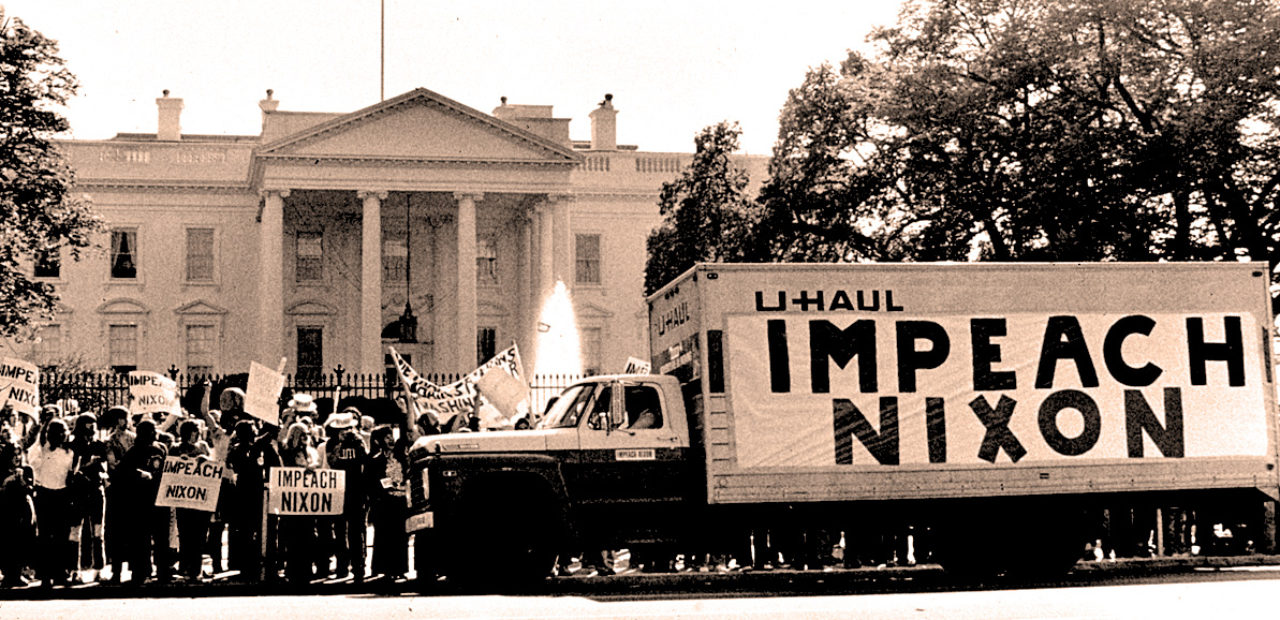
Where the law is not the same for everyone, and where one cannot punish, say, a president or another important political figure for breaking the law, there cannot be a truly high level of democracy. Because in such a case, on paper, the state may be democratic, but in practice, democratic procedures will be violated without any consequences for the violator. No one will be punished for falsifying elections, for persecuting political competitors, and so on. Where the rule of law is realized to a high degree, and where the judicial system is independent from the state, such violations are followed by punishment. For example, in the US, President Richard Nixon of the conservative Republican Party had tapes of illegally recorded conversations of members of the opposition Democratic Party, which was an attempt at unfair political struggle, that is, a violation of the rules of democracy. The result was a big scandal and Nixon’s resignation. In the absence of the rule of law and other democratic “rules of the game”, the Republicans would have had the opportunity not only to wiretap political rivals but also to engage in any other activity aimed at undermining democracy. They could have suppressed their political opponents, who would have been defenseless before the authorities; however, those opponents were protected by law. As the UN Office of the High Commissioner for Human Rights reports, “the Rule of Law and Democracy Section is the focal point of OHCHR’s work on democracy”5.
A basic element in the development of democracy is the rule of law, if we consider it not only as an instrument of the executive branch, but also as a legal norm that binds the entire society, including the government6.
Democratic laws
To exercise democracy, one also needs a set of reasonable laws that protect it. Because if the rule of law is implemented, but there is no, say, law establishing punishment for election fraud, then this means that they can be falsified, even despite the implementation of the rule of law, which also leads to the absence of democracy.
As noted in the collection of scientific papers “Law and Democracy”, “the emergence, development of the content, and forms of manifestation of democracy are based on legal norms. Democracy and legality are concepts that mutually presuppose each other. Democracy is the foundation of legality, since legality can only be really realized under the conditions of democracy. In turn, democratism relies on a clear order regulated by legislation”7.
Multiparty system
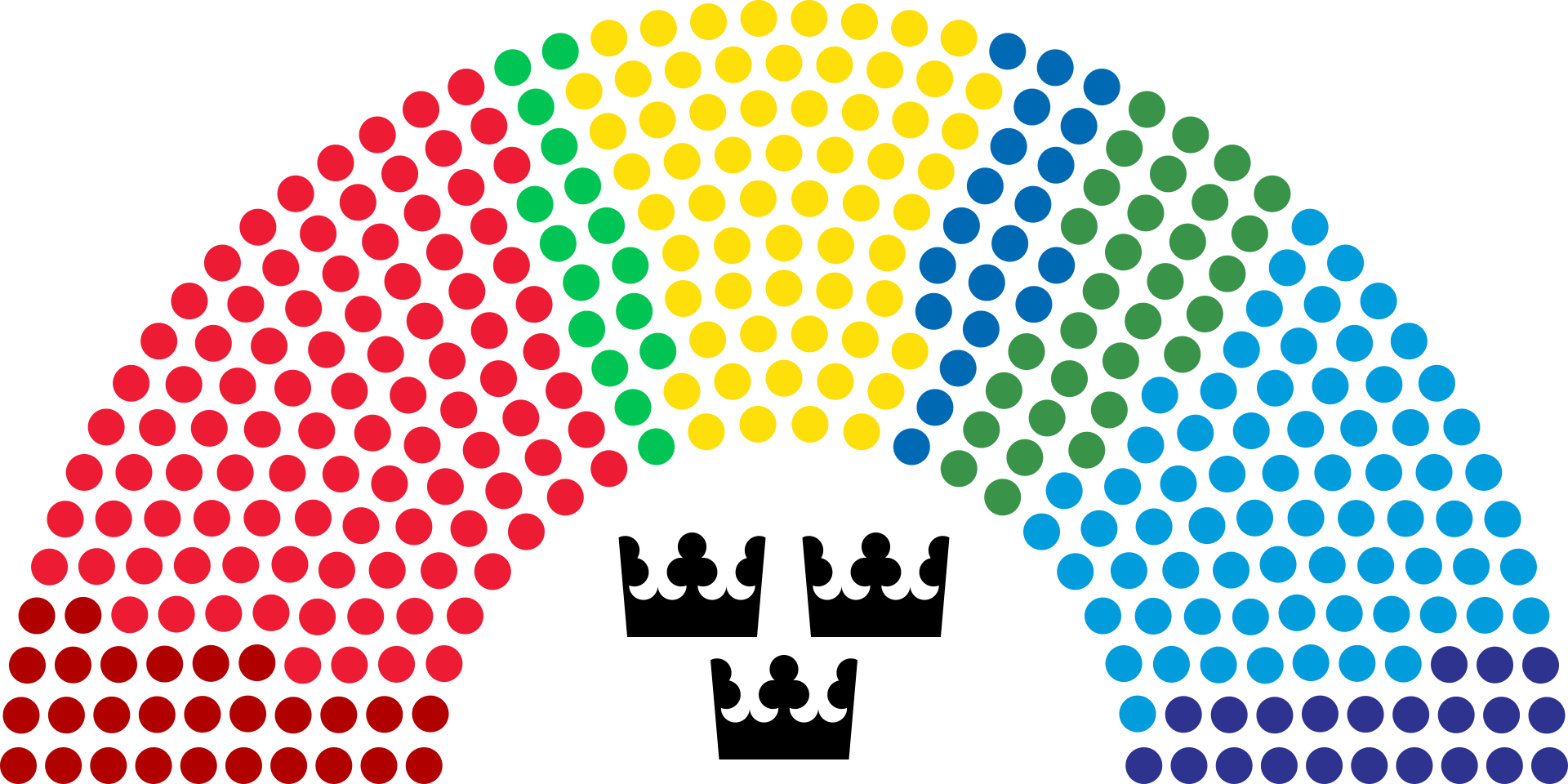
Citizens must have the opportunity to create their own parties, and without significant bureaucratic barriers — in case the existing parties do not express their will. Practically everything reflected in the legislation on political parties matters here — from the required number of signatures for registration to the conditions for liquidation. The best legislation in this regard would be that under which a more or less significant group of like-minded people (in the case of modern Russia, this would be, let’s say, a thousand people from a certain number of different regions) has the opportunity to register a party in a short time (2–3 months) that has the ability to participate in parliamentary elections.
The UN views a pluralistic system of political parties and organizations as a necessary attribute of democracy8. Democracy Web notes that more than two centuries of political history have shown that no democracy can survive without a multiparty system in which people can freely join competing political organizations or competing factions within political organizations. A multiparty system is a fundamental and necessary component of democracy. In the absence of conditions for creating free and independent political parties, power is typically used by narrow cliques pursuing their own interests, or it is monopolized by a single party that suppresses dissent9.
Indeed, if society does not have the right to freely create its own political parties to participate in elections, then upon the degeneration of existing parties, it is effectively deprived of power and the ability to influence policy (the system can easily “crush” an individual, but it is much harder to fight people organized into a party). There is no democracy to speak of in this case.
Strong opposition
If there are many opposition parties, but they either mostly copy the values and program of the ruling one or are small and insignificant organizations, one can hardly speak of the presence of democracy. We have already analyzed in the article on why some countries are rich and others are poor why a strong opposition is one of the most important inclusive institutions. Candidate of Political Sciences Kirill Ponomarev notes:
Political opposition or the real possibility of its existence is an attributive characteristic of a democratic regime.
<…>
In general, the political opposition plays an objectively positive role in the full life of society. This role is manifested in its functions. These include objective and reasoned criticism (conceptual or regarding specific issues) of power structures and power-holders, as well as other political actors; monitoring the actions of the authorities and their representatives with the aim of identifying shortcomings in their activities and informing the general public about them; putting forward alternative ideas, proposals, and policies; and training potential political figures, leaders, and top management personnel10.
The editor-in-chief of the journal “Russia in Global Affairs”, Fyodor Lukyanov, acknowledges that the opposition is the main mechanism of democracy11, and Candidate of Political Sciences Ivan Nazarov believes that “the presence of an opposition limits the abuse of power and violations of the civil and political freedoms of the population”12. Indeed, if there is no opposition to the ruling party or government, or if this opposition is weak and incapable of influencing anything (and can be easily crushed), or if this opposition mostly shares the fundamental foundations of the government’s policy, then there is no counterweight to power, no mechanism that will curb the processes of the formation of authoritarianism. As a consequence, in such a case, one cannot speak of democracy either.
Rotation of power
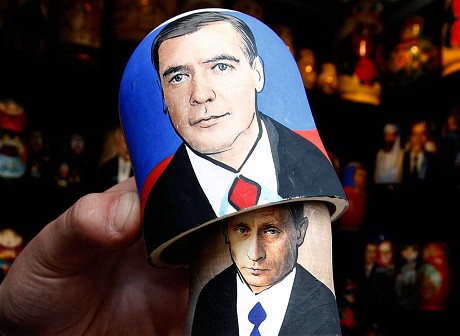
We described in detail why democracy cannot be realized without the rotation of power in this article. The lack of rotation of power is a step toward dictatorship. Russian society understood this back during the Medvedev-Putin “castling”, which was expressed in mass protests. Where there is no rotation of power, there can be no democracy.
Universal suffrage
Every citizen over the age of 18 must have the opportunity to vote in elections regardless of their gender or beliefs. As the UN Office of the High Commissioner for Human Rights reports, “respect for human rights and fundamental freedoms and the principle of periodic and genuine elections by universal suffrage are essential elements of democracy”13. Doctor of Sociology Maxim Zheltov notes that “one of the most important political and constitutional foundations of a modern democratic society is universal suffrage”14. The requirement for universal and equal suffrage is enshrined in the Universal Declaration of Human Rights15.
Universal suffrage to a certain extent restrains the most radical projects for dismantling the social security system. The very idea of a welfare state is not called into question. Modern society will not approvingly perceive ideas about eliminating the system of pensions and social benefits. No matter how popular the ultra-liberal ideas of L. von Mises and F. von Hayek may be in some intellectual circles, thanks to the existence of universal suffrage, they will remain speculative constructs similar to the ideal Platonic state16.
If we do not have universal suffrage, it means that someone determines who to give the right to vote to and who not to. Thus, this can easily become not the rule of the people, but the rule of the one who determines who to give the right to vote to. Consequently, we slide back into an authoritarian regime. Furthermore, if part of the citizens has the right to vote and part does not, it means that the first part turns out to be privileged, and this is one of the attributes of inequality. Electoral qualifications create inequality and are one of the tools for creating new elites.
Freedom of the media
One of the pillars on which democracy rests is freedom of the media. Without the rule of law, it is unrealizable, and without it, democracy is unrealizable. In the opinion of the Council of Europe, free media is the core of any democracy17.
The Watergate scandal already mentioned by us was largely uncovered thanks to the press — as the textbook “Journalistic Investigation: History of the Method and Modern Practice” notes, it was only thanks to Washington Post correspondents that the public learned the details of the case, which the government had attempted to hush up18. Correspondents Bob Woodward and Carl Bernstein became national heroes. Thanks to the courage of journalist Edward Murrow, it was possible to take down the influential Senator Joseph McCarthy19, whose continuation of policies could well have pushed the US in the direction of authoritarianism. The press helped defeat the Standard Oil monopoly and played a significant role in the victory over the “robber barons”.
The American experience in the first half of the twentieth century also illustrates the vital role of a free press in creating virtuous feedback loops. In 1906, President Theodore Roosevelt coined the term “muckraker”, a reference to a character in John Bunyan’s Pilgrim’s Progress. Roosevelt used it to describe investigative journalists who he felt were too intrusive. The term stuck and came to signify journalists — intrusive, perhaps, but effective — who exposed the dark dealings of robber barons, including the bribery of local and federal politicians. Perhaps the most famous muckraker was Ida Tarbell, whose 1904 book, The History of the Standard Oil Company, was instrumental in turning public opinion against Rockefeller and his business, ultimately leading to the breakup of Standard Oil in 1911. Another prominent muckraker was the lawyer and writer Louis Brandeis, whom President Wilson later appointed to the Supreme Court. In his book, Other People’s Money and How the Bankers Use It, Brandeis investigated several financial scandals, and these investigations had a major impact on the work of the Pujo Committee. Newspaper magnate William Randolph Hearst also played a prominent role in muckraking. In 1906, he placed a series of articles by David Graham Phillips in his magazine, Cosmopolitan, under the general title “The Treason of the Senate”, which launched the campaign for direct election of the Senate — another key Progressive reform that became reality with the passage of the Seventeenth Amendment to the US Constitution (1913).
The muckrakers played an important role in inspiring politicians to take action against the trusts. The robber barons hated the journalists, but the political institutions of the United States gave them no way to silence their enemies. Inclusive political institutions encouraged the thriving of a free press, and a free press, in turn, reduced the likelihood that attempts to undermine inclusive economic and political institutions would go unnoticed or, even more so, succeed. Conversely, such freedom is impossible under extractive political institutions, under absolutism or dictatorship, when the regime has the means to prevent the emergence of any serious opposition. The information provided by a free press became a critical factor in US political life in the first half of the twentieth century. Without such information, the citizens of the United States would not have learned of the true scale of the abuses of the robber barons and would not have been able, in the end, to curb the trusts20.
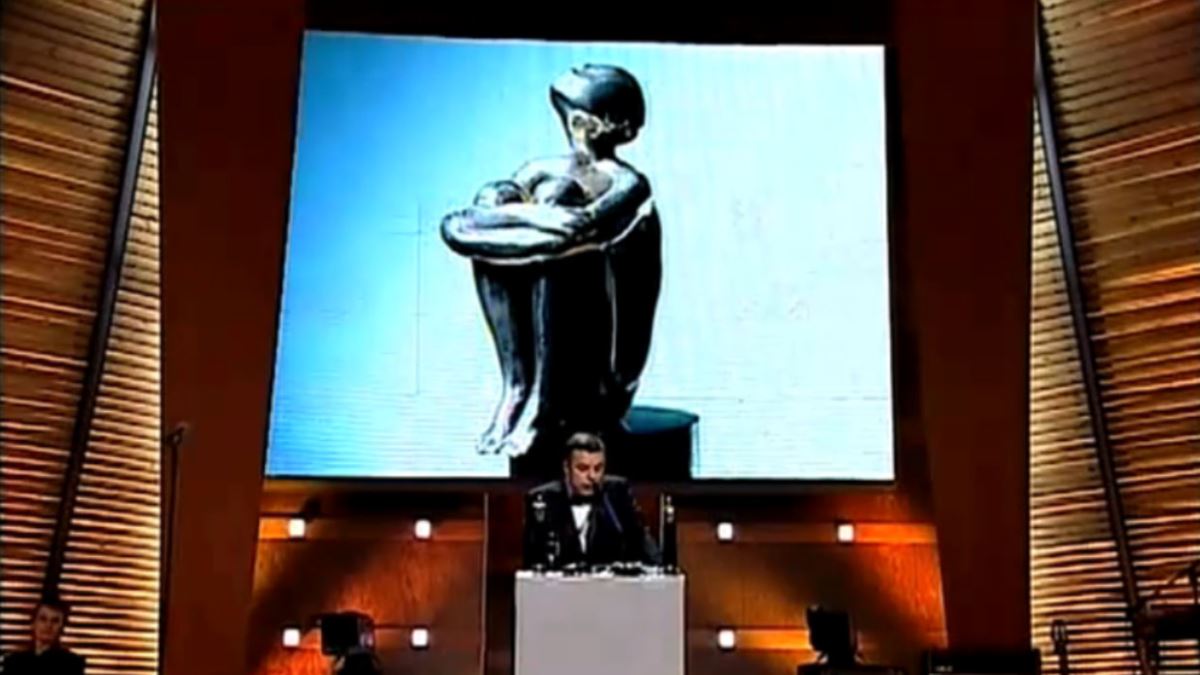
A free press is the main enemy of those who want to destroy democracy. It is capable of exposing these people, criticizing them, and mobilizing citizens against them. A free press conveys information to citizens about the opposition and its proposals.
Private property
We have already described in a separate article why guarantees of private property rights are necessary; they also mean a great deal for ensuring democracy. The fact is that any political force needs funding, and if there are no owners behind the opposition, then this opposition will be destitute, and consequently, weak in relation to the authorities, and therefore incapable of resisting the establishment of a dictatorship. Conversely, if all or most property belongs to the state, then the nomenklatura has all the necessary leverage to establish a dictatorship. A country must have capital that is independent of the state.
Minimal inequality
If capital in a country is concentrated in the hands of a small layer of the super-rich, they obtain all the opportunities and resources for establishing ideological dominance and seizing power, which poses a threat to democracy. As the New Philosophical Encyclopedia notes, “the real embodiment of popular rule is substantially hindered by the concentration of economic power progressing in modern society in the hands of the ‘ruling elite,’ which creates an oligarchic model of power and politics, often turning from a democracy into a kleptocracy”21. Therefore, capital in a country should be distributed evenly so that there are as many different centers of political funding as possible. The fewer such centers there are, the lower the real level of democracy. We mentioned this also in our article on equality and social justice.
Freedom of assembly and protest
The United Nations recognizes the importance of the rights to freedom of peaceful assembly and association for the full realization of civil and political rights, as well as economic, social, and cultural rights22. Therefore, the Russian nomenklatura strives to restrict freedom of assembly in every way — organizers must coordinate the holding of an event with the authorities, unauthorized actions are dispersed by police, and their participants are charged under Article 20.2 of the Code of Administrative Offenses (violation of the procedure for holding a public event)23. Such restrictions should be lifted in a democratic society.
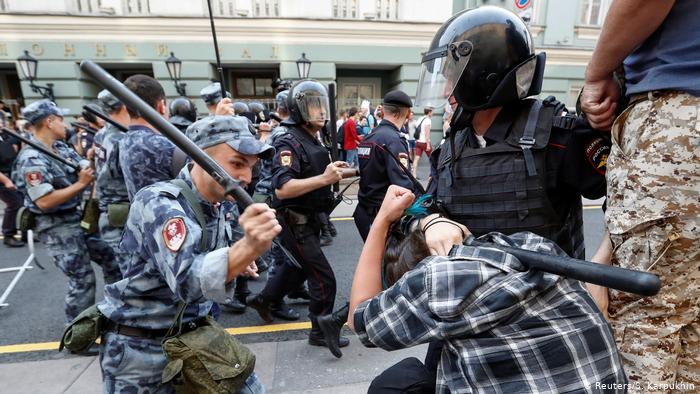
If such restrictions are not lifted, the authorities may deny permission to hold an event, may grant permission to hold them only in an inconvenient location, and by various other means sabotage the holding of events that express the will of society.
Decentralization of power
The separation of powers is recognized by the UN as one of the necessary attributes of democracy: “the principle of the separation of powers into legislative, executive, and judicial branches must be enshrined in the constitution and effectively observed”24. If in a country the legislative and judicial branches are subordinate to the executive branch (say, the presidential administration), then there is no democracy in such a country.
Such a separation is needed so that a person or group of people intending to establish their dictatorship can be pushed back (by groups not under their control that possess power). In a democratic system, such an authoritarian group in power may, for instance, try to pass a law restricting freedom of assembly, but will meet resistance from a strong opposition, a free press, and the masses who have taken to the streets. This resistance will provoke debates in parliament — the opposition parties represented in it will use the support of the press and the masses to strengthen themselves, up to and including the removal of the authoritarian group from executive power. In the event that this group resorts to illegal methods of struggle, the judicial power will come into play, and this group may be arrested.
In the Russia of the 90s, there was no strong democratic opposition, there was no minimal inequality, and the separation of powers was not ensured, which is why it was unable to move away from authoritarianism.
Democracy responds much faster to the need for change. If something in the politics and economy of a state is not working well, a free press identifies it, covers it, and, together with the opposition, develops options for solutions. These solutions can be used by both the authorities and the opposition to win elections. A government that is unable to respond effectively to urgent changes is replaced in elections.
Under authoritarianism, there are no such effective mechanisms. If the government is incompetent in a democracy, it is realistic to change it in elections. If it is incompetent without democracy, it is almost impossible to change it. Thus, society’s problems will accumulate, and the country will lag in development behind those whose governments respond faster to the need for change. Moreover, if opposition forces are not allowed to come to power legally, they will come to it illegally; that is, the absence of democracy can lead to a revolution or to a “palace coup” of sorts, where power is seized not by someone who has managed to convince the masses, but by someone most adept at backroom intrigues. Therefore, it is not surprising that Stalin managed to seize power — after all, the Bolsheviks had not created modern democratic institutions of checks and balances.
Democracy is beneficial for all political forces in a country that are confident in their rightness and their ability to win honestly. It gives every movement the opportunity to win honestly in elections and form a government in the event of another movement’s crisis.
Therefore, countries that lead democracy rankings — for example, the Democracy Index from The Economist Intelligence Unit25 — are also leaders in the most important indicators of the standard of living in the country (we will write about these indicators in a separate article, for now it is sufficient to point to the HDI26 and other indicators that we mentioned in the article on myths about social democrats).
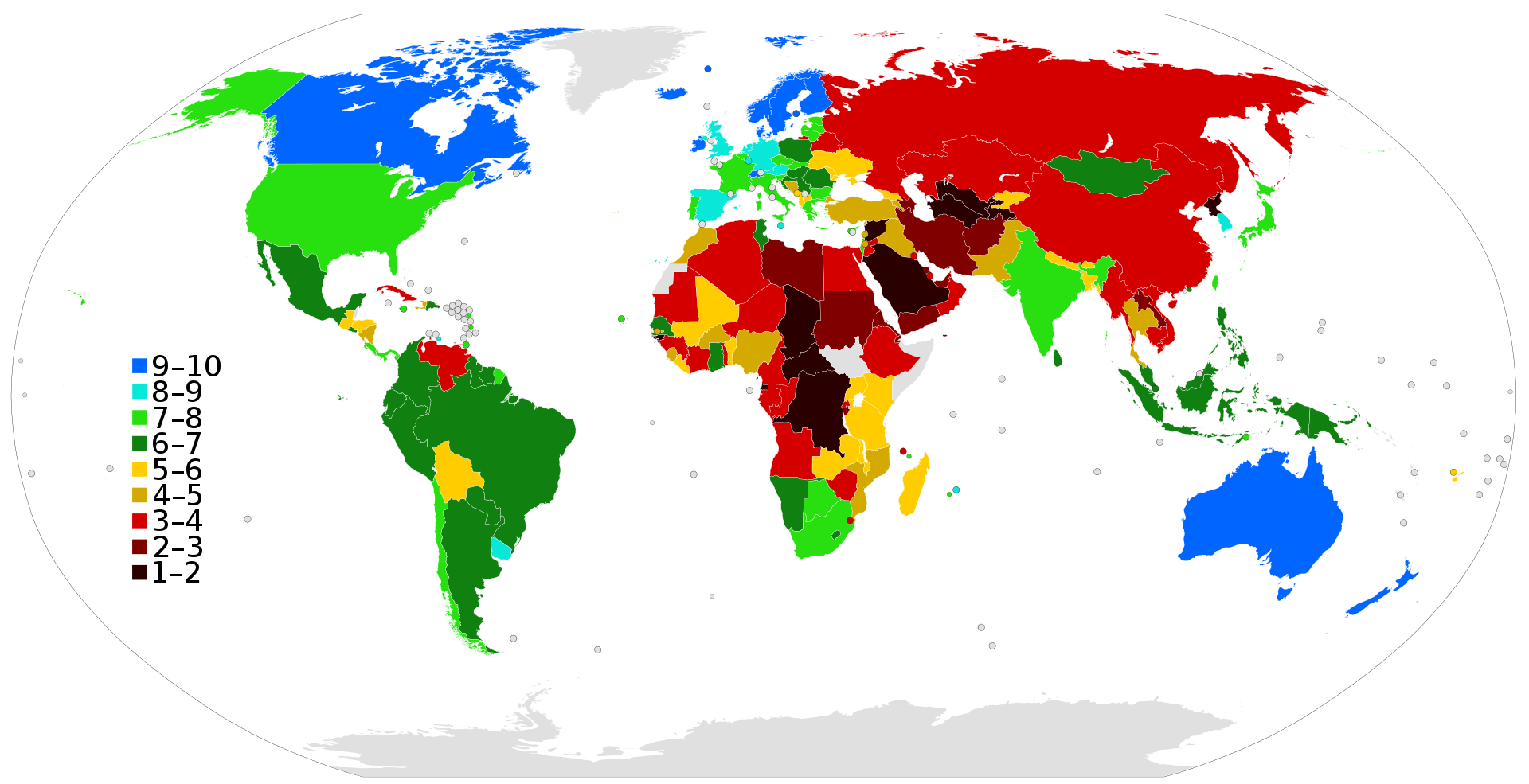
Democratic regimes are gradually replacing authoritarian ones because they cope better with political tasks. Here, for example, is a visualization of research by the portal Our World in Data27:
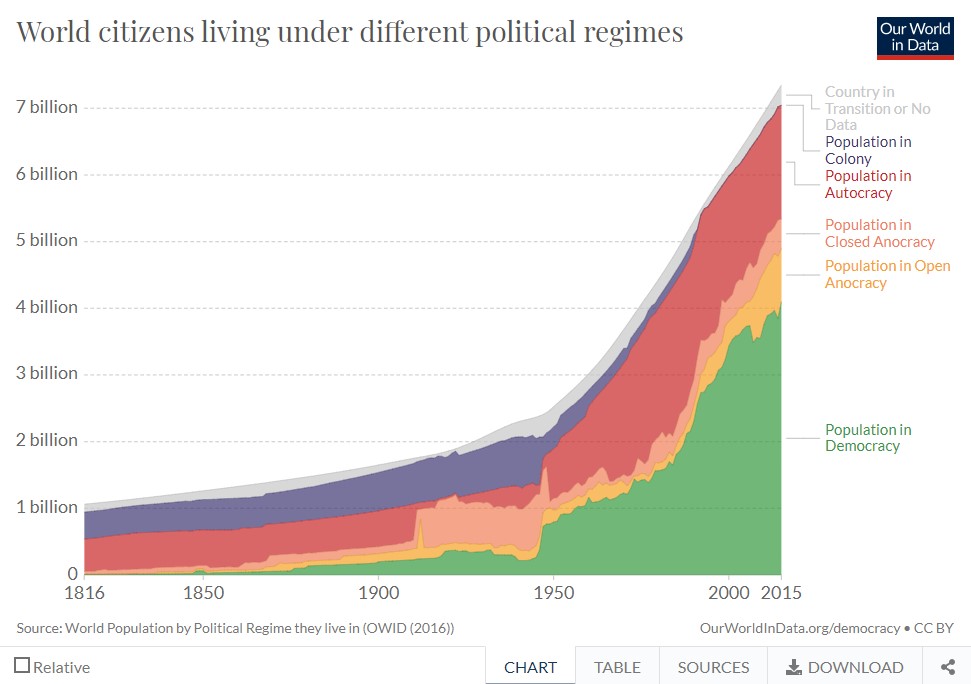
The Our World in Data study concludes that democratic countries are richer, people in them are healthier, and human rights are better protected in them.
Probably the oldest major military clash between democracy and authoritarianism is the Battle of Marathon, when an army consisting mostly of citizens of democratic Athens routed the numerically superior Persian army. This was followed later by the Peloponnesian War, in which Athens devastated authoritarian Sparta in the initial period, but in the end was defeated itself. One can also recall the so-called “Cold War”, in which democratic states proved their superiority over the authoritarian socialist bloc, one can recall the confrontation between Israel and authoritarian Arab regimes, the confrontation between tiny democratic Finland and the huge authoritarian USSR, and so on. The reason for the superiority of democracy over authoritarianism is that democracy expresses the interests of the majority of citizens (while authoritarianism expresses the interests of a narrow layer), as a result of which they show more diligence and will in the struggle, and also have more room for creativity.
Dmitry Travin, Candidate of Economic Sciences and academic director of the Center for Modernization Studies, notes:
Democracy, when solving economic problems, is undoubtedly more effective than authoritarianism in a stable society with established legal norms. In particular, a parliamentary republic turns out to be a good anti-corruption tool, because the opposition, possessing significant rights, is interested in controlling the actions of officials appointed by its political opponents.
The struggle of various interest groups (linked to the government and the opposition) minimizes abuses and prevents the adoption of completely brazen decisions on “budget embezzlement”.28
We provided even more evidence of the effectiveness of democracy compared to authoritarianism in this material. Democracy itself is not capable of making the standard of living high, but it is one of the important components of success. If all other components are at a high level, then achieving a high standard of living is possible without democracy, but this happens extremely rarely, and such results are not long-lasting.
Conclusion
Democracy realizes progressive values more effectively than authoritarianism, and it is one of them itself; it is, on the whole, a more effective system for a country’s development. In democratic countries, the level of life and freedoms is higher. Finally, democracy is needed primarily, if for nothing else, so that you have the opportunity to decide your own fate yourself, rather than helplessly watching as a group of oligarchs does it for you. That is to say, it is a protection against slavery. This alone is worth a lot. Therefore, one of the primary tasks of the social-democratic movement is the struggle for democracy, including for raising its level.
- S.I. Ozhegov, N.Yu. Shvedova. Explanatory Dictionary of the Russian Language: 80,000 words and phraseological expressions / Russian Academy of Sciences. Vinogradov Russian Language Institute. – 4th ed., supplemented. – 944 p. – M.: OOO “A TEMP”, 2006. – p. 160.
- Dictionary of Political Science / ed. V.N. Konovalov // Free electronic library online “Unified Window to Educational Resources” (window.edu.ru). [Electronic resource]. URL: http://window.edu.ru/resource/681/37681/files/polit_dict.pdf (accessed: 17.09.2020).
- New Philosophical Encyclopedia: In 4 vols. / Institute of Philosophy RAS, National Social-Scientific Foundation; Scientific-editorial council: chair V.S. Styopin, deputy chairs: A.A. Guseinov, G.Yu. Semigin, academic secretary A.P. Ogurtsov. – 744 p. – M.: Mysl, 2010. – p. 619.
- Democracy and Human Rights: The Role of the United Nations. Policy Document / ed. Massimo Tommasoli. September 2013. [Electronic resource]. URL: https://www.idea.int/sites/default/files/publications/democracy-and-human-rights-RU.pdf (accessed: 17.09.2020).
- Rule of Law – Democracy and Human Rights // Office of the High Commissioner for Human Rights (ohchr.org). [Electronic resource]. URL: https://www.ohchr.org/RU/Issues/RuleOfLaw/Pages/Democracy.aspx (accessed: 17.09.2020).
- Democracy and Human Rights: The Role of the United Nations. Policy Document / ed. Massimo Tommasoli. September 2013. [Electronic resource]. URL: https://www.idea.int/sites/default/files/publications/democracy-and-human-rights-RU.pdf (accessed: 17.09.2020).
- Law and Democracy: Collection of scientific papers. Iss. 13 / Ed. V. N. Bibilo. – 291 pp. – Mn.: BSU, 2002. – p. 6.
- Democratic Governance // United Nations (www.un.org). [Electronic resource]. URL: https://www.un.org/sections/issues-depth/democracy/index.html (accessed: 17.09.2020).
- The Multiparty System: Essential Principles // Democracy Web (democracyweb.org). [Electronic resource]. URL: https://democracyweb.org/multiparty-system-principles (accessed: 17.09.2020).
- K.N. Ponomarev. Political Opposition as an Attribute of Democracy. Abstract of the dissertation for the degree of Candidate of Political Sciences. Kazan, 2001. – pp. 17-21.
- Fyodor Lukyanov. A world without opposition: what will replace the main mechanism of democracy? // Forbes (www.forbes.ru). April 4, 2013, 8:47. [Electronic resource]. URL: https://www.forbes.ru/mneniya-column/mir/236782-mir-bez-oppozitsii-chto-pridet-na-smenu-glavnomu-mehanizmu-demokratii (accessed: 17.09.2020).
- I.I. Nazarov. Political opposition as a catalyst for the political process of modern states / Vestnik TSU, 2015. Issue 4. – p. 26.
- Rule of Law – Democracy and Human Rights // Office of the High Commissioner for Human Rights (ohchr.org). [Electronic resource]. URL: https://www.ohchr.org/RU/Issues/RuleOfLaw/Pages/Democracy.aspx (accessed: 17.09.2020).
- M.V. Zheltov. Suffrage and elections in the modern context of life // Bulletin of Tomsk Polytechnic University. 2005. Vol. 308. No. 3. – p. 178.
- Universal Declaration of Human Rights, G.A. res. 217A (III), U.N. Doc A/810 at 71 (1948) // Human Rights Library – University of Minnesota (hrlibrary.umn.edu). [Electronic resource]. URL: http://hrlibrary.umn.edu/instree/b1udhr.htm (accessed: 17.09.2020).
- M.V. Zheltov. Suffrage and elections in the modern context of life // Bulletin of Tomsk Polytechnic University. 2005. Vol. 308. No. 3. – p. 180.
- Free media – a core element of any democracy // Council of Europe (www.coe.int). May 3, 2011, 9:15. [Electronic resource]. URL: https://www.coe.int/en/web/commissioner/-/free-media-a-core-element-of-any-democracy (accessed: 18.09.2020).
- Journalistic Investigation: History of the Method and Modern Practice / Ed. A.D. Konstantinov. – 480 p. – SPb.: “Izdatelsky Dom Neva”; M.: “OLMA-PRESS”, 2003. – p. 34.
- Jack Mirkinson. 60 Years Ago, Edward R. Murrow Took Down Joseph McCarthy // HuffPost (www.huffpost.com). October 3, 2014, 15:15. [Electronic resource]. URL: https://www.huffpost.com/entry/edward-murrow-joseph-mccarthy-60-years-later_n_4936308 (accessed: 18.09.2020).
- Daron Acemoglu, James A. Robinson. Why Nations Fail: The Origins of Power, Prosperity, and Poverty. – New York: Crown Business, 2012. – pp. 433-435.
- New Philosophical Encyclopedia: In 4 vols. / Institute of Philosophy RAS, National Social-Scientific Foundation; Scientific-editorial council: chair V.S. Styopin, deputy chairs: A.A. Guseinov, G.Yu. Semigin, academic secretary A.P. Ogurtsov. – 744 p. – M.: Mysl, 2010. – p. 620.
- Special Rapporteur on the rights to freedom of peaceful assembly and of association // Office of the High Commissioner for Human Rights (www.ohchr.org). [Electronic resource]. URL: https://www.ohchr.org/RU/Issues/AssemblyAssociation/Pages/SRFreedomAssemblyAssociationIndex.aspx (accessed: 18.09.2020).
- Anastasia Kurilova. UN checks freedom of assembly // Kommersant (www.kommersant.ru). Kommersant newspaper No. 40 of 06.03.2019, p. 5. [Electronic resource]. URL: https://www.kommersant.ru/doc/3903920 (accessed: 18.09.2020).
- Study on the common challenges faced by States in their efforts to secure democracy and the rule of law from a human rights perspective / Report of the United Nations High Commissioner for Human Rights // Office of the High Commissioner for Human Rights (ohchr.org). [Electronic resource]. URL: https://www.ohchr.org/Documents/HRBodies/HRCouncil/RegularSession/Session22/A-HRC-22-29_russian.pdf (accessed: 18.09.2020).
- Laza Kekic. The Economist Intelligence Unit’s index of democracy // The Economist (www.economist.com). [Electronic resource]. URL: https://www.economist.com/media/pdf/democracy_index_2007_v3.pdf (accessed: 18.09.2020).
- Human Development Report 2019. Beyond income, beyond averages, beyond today: Inequalities in human development in the 21st century // United Nations Development Programme (hdr.undp.org). [Electronic resource]. URL: http://hdr.undp.org/sites/default/files/hdr2019.pdf (accessed: 26.06.2020).
- Max Roser. Democracy // Our World in Data (ourworldindata.org). [Electronic resource]. URL: https://ourworldindata.org/democracy#world-maps-of-political-regimes-over-200-years (accessed: 18.09.2020).
- Dmitry Travin. Is democracy always good? // Open University (openuni.io). [Electronic resource]. URL: https://openuni.io/course/8-course-7-1/lesson/3/material/759/ (accessed: 18.09.2020).