
Nationalism and social democracy
Due to numerous requests, this article will examine why nationalism is unacceptable for social democrats, even when presented under a noble guise. At the same time, this does not mean that social democrats advocate, for example, for banning national-democratic parties — on the contrary, such parties are currently needed to support democratic institutions.
In our article on constructed identities, we analyzed what nationalism is, and we will duplicate that here. Why is nationalism incompatible with social democracy? And what does it offer in its place? Before addressing these questions, let us first reiterate what nationalism is.
Contents
What is nationalism
The Great Russian Encyclopedia states that nationalism is a political ideology and practice based on the idea of the nation and its interests as the highest values1. Depending on the understanding of what a nation is, nationalism has two main forms — civic (or state) and ethnic. The compilers of the encyclopedia note that civic nationalism is the same thing as patriotism; it often contains provisions for the discrimination and assimilation of minorities, as well as for state expansion (messianism) or, conversely, for isolationism.
Ethnic nationalism is based on biological and racial arguments and took shape during the era of the dominance of evolutionism and ethno-racial theories (see Racism) in the second half of the 19th century… It is based on simplified interpretations of history, the usurpation of cultural heritage in favor of one group, and on conflicting territorial interpretations (“ethnic territory”, “ancestral lands”, “historical homeland”, and the like). It contains negative stereotypes regarding other peoples and anti-statist attitudes. Political ethnonationalism from dominant groups is discriminatory toward minorities and migrants. Radical ethnonationalism of minorities can take on a separatist character with demands for changing internal borders or creating a separate “nation-state”. It becomes the cause of protracted and destructive ethnic conflicts (Northern Ireland, Biafra, Katanga, Karabakh, Eritrea, Sri Lanka, Chechnya, and others)2.
According to the Ozhegov dictionary, nationalism is an ideology and policy stemming from ideas of national superiority and the contrasting of one’s own nation with others, or the manifestation of the psychology of national superiority, national antagonism, and the idea of national exclusiveness3. Encyclopaedia Britannica reports that it is an ideology based on the premise that the individual’s loyalty and devotion to the nation-state surpass other individual or group interests4. The Merriam-Webster dictionary provides two definitions of nationalism: 1) loyalty and devotion to a nation; 2) a nationalist movement or government5. In general, we see that the definitions of nationalism most often do not contradict the definition from the Great Russian Encyclopedia.
Blurred terminology
As we examined above, nationalism includes both “civic” and “ethnic” nationalism. At the same time, the boundaries of belonging to an ethnos are quite blurred and vague, and can include elements of racial theory. That is, there is a danger that nationalists will switch from civic to ethnic nationalism and racism, and that there will always be ethnic nationalists in nationalist organizations (we have already mentioned that the extreme form of ethnic nationalism is Nazism). Moreover, with the rise in popularity of nationalism, even if clearly declared as civic, ethnic nationalism will also grow — if only due to the duality of the term. Using an ideology that is such a bizarre and dangerous amalgam seems meaningless in a situation where one can perfectly well do without it, as we will show next.
Some nationalists insist that we need at least civic nationalism specifically. But civic nationalism is not needed where there is democracy — it already executes the will of the citizens. Their interests, in turn, are reflected to a much greater extent by progressive values, which we will discuss next.
If we prioritize the interests of the nation, we thereby push the interests of social groups into the background, replacing them with a struggle for common interests. Nationalism implies that elites and the rest of society have the same interests (national), but they have substantially fewer common interests than they have divergences. From the point of view of social democrats, for example, workers should prioritize their interests specifically as professionals. Because, if they are guided primarily by national interests, this may incline them more toward abandoning, for example, trade union struggles, which are an important source of social democratic policy.
Transition into radical forms
Since nationalism is the upholding of the interests of the nation rather than classes, it most often leads to patriotism, the harm of which we explained in a separate article. At the same time, the transition into patriotism is only a mild form — as Hannah Arendt believed, chauvinism is a natural product of the national concept, growing directly out of the old idea of a “national mission”6. The element of ethnicity in nationalism leads to the formation of chauvinism and racism in society, and possibly fascism/Nazism, and we explained the harm of racism separately. The less strong nationalism is in a society, the lower the risk of such a transition. According to writer Boris Strugatsky, fascism arises from the combination of just two components — nationalism and dictatorship: “there is nothing else at the core of fascism. Dictatorship plus nationalism. Totalitarian rule by one nation. And everything else — secret police, camps, book burnings, war — grows out of this poisonous seed like death from a cancer cell”7.
“Nationalism” is a pathology of modern development, as inescapable as “neurosis” in the individual, with much the same essential ambiguity attaching to it, a similar built-in capacity for descent into psychosis, rooted in the dilemmas of helplessness which have become part of the world order (the social equivalent of infantilism), and mostly incurable8.
“Interests of the nation” or progressive values?
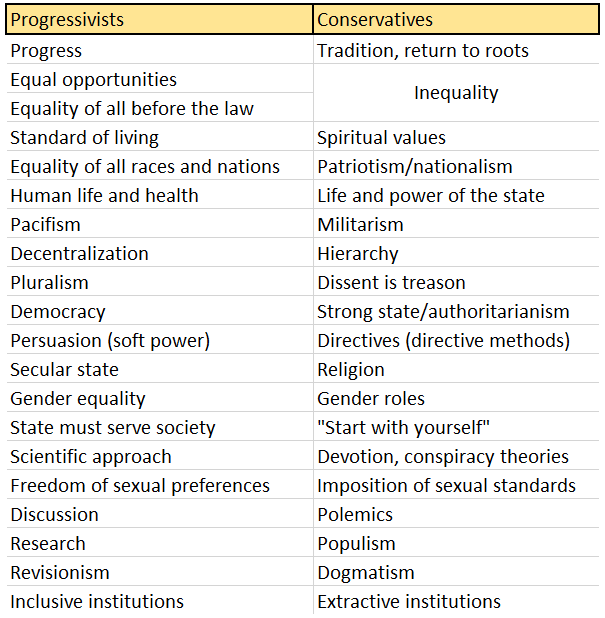
Social democrats do not deny that, for example, Russian society and a future social democratic Russia have their own interests — these manifest, for instance, in foreign policy. However, nationalism is not needed to defend these interests. A state can conduct a foreign policy in the interests of Russian society without nationalism — this requires a full-fledged democracy so that citizens can choose for themselves who will represent their interests. Furthermore, foreign policy considerations are not a priority for social democrats. Priority is given to domestic policy and improving the living standards of citizens. When national interests become the priority, the emphasis shifts to foreign policy to the detriment of domestic policy. For social democrats, the highest values are progressive values, not vague and imprecise “interests of the nation”, under which one can imply anything at all. It is progressive values that social democrats are guided by in foreign policy. This does not mean that the interests of the residents of a social democratic country will be infringed upon — on the contrary, the realization of progressive values is what best reflects their interests, far better than nationalism.
The nationalism of the oppressed
A classic argument among leftists who have not yet abandoned nationalism (in the form of internationalism) is the justification for the nationalism of oppressed nations. Indeed, if a state pursues a policy of protecting the interests of the titular nation (essentially nationalism), and as a result, the interests of other nations are infringed upon, would it not be progressive for them to secede from the titular nation? In some cases, this may indeed be progressive, but it is often hindered by a multitude of reasons. Firstly, often with such nationalism of the oppressed, oppression by the elites of the titular nation is replaced by oppression by the elites of the formerly oppressed nation (for example, after the collapse of the USSR, many authoritarian regimes emerged in the new nation-states), and in this case, there is nothing progressive about it. Secondly, such secession is sometimes associated with violent conflicts — we provided examples in the article on internationalism. Thirdly, even in the event of success, there is a high probability of nationalists gaining strength in the newly formed nation-state, which gives rise to associated problems (for example, members of the former titular nation may subsequently begin to be subjected to the same persecution that members of the formerly oppressed nation were previously subjected to). Fourthly, residents of territories that failed to win the struggle for their own nation-state remain oppressed and are deprived of support in the struggle for democratization from those who left these territories. Fifthly, without dismantling the nationalist regime in the former metropolitan state, it may become hostile to the newly formed nation-state and pose a danger to it in other ways (an example is the complex relations between Russia and Ukraine).
Furthermore, nationalism here represents discrimination. Why do groups united by ethnicity have the right to secede, while regions that do not possess these characteristics do not have such a right? Only because of ethnicity? This results in racism and discrimination based on ethnic grounds. Residents of any region can be oppressed no less than representatives of a separate nation within a state, but “left-wing nationalists” fight only for the rights of the latter, ignoring the rights of the former and thereby contributing to their oppression. Why, say, do citizens with social democratic views not have the right to secede and create their own state, even though they have more valid reasons for this than ethnic origin?
Summarizing the above, nationalism in this case is far from the best solution. What, then, is the best solution in this case? For progressive social democrats, such a solution is regionalism — that is, a movement for the expansion of regional powers, for increasing their independence from the center, and for the expansion of local democratic institutions. It is also the political result or effect of regionalization, that is, the process of redistributing power competencies, transferring functions from the national to the regional level, and the emergence and development of new institutional forms that respond to the new role of regions in the decision-making process at the national and supranational levels9. As one of the supporters of regionalism and editor-in-chief of the journal Region.Expert, Vadim Shtepa, notes, “gradually, this phenomenon that appeared after the Great French Revolution — the nation-state — is receding into the background. It is not disappearing entirely yet, but regions are already becoming major subjects, more active than nation-states”10.
One example of the successful implementation of regionalism is multinational Switzerland, where there is no division based on nationality, but there is a division into cantons, many of which even have their own Constitution and possess broad autonomy rights (we described this structure in a separate article). Regionalism is not based on nationalist unity, so it does not generate ethnic strife, which leads to most of the dangers of “nationalism of the oppressed nation” that we have described. It does not contain discrimination, as we recognize the rights of all regions to expand their autonomy. It does not imply mandatory secession (although it implies its possibility), which allows for the preservation of the advantages of unity while combining them with the advantages of independence. Therefore, progressive social democrats can advocate for the rights of regions rather than for the rights of nations (we also mentioned this in the article on the national policy of social democrats).
For example, in 2020 in Russia, residents of Khabarovsk and many other cities in the Far East went out to mass protests11. The reason was Vladimir Putin’s removal of Governor Sergey Furgal. It is obvious that residents of the region also have every right to express their will and to expand the powers of their region. But developing the demands of regionalism would be more useful here than nationalism.
Of course, the nationalism of oppressed nations, demanding secession from an empire, also has its advantages — for example, the weakening of the empire. In the event that some part of it secedes, the empire becomes weaker. Moreover, a situation where the seceded territory becomes a democracy while the rest of the empire remains authoritarian is better than if the entire territory of the empire were under the rule of authoritarian forces. In this case, at least some people get a chance to improve their living standards. Therefore, in certain situations, supporting the nationalism of oppressed nations, provided that it is democratic, may not be critical for social democrats.
The link between nationalism and corruption
How many times has it been told to the world
That flattery is vile and harmful; but it is of no avail,
And the flatterer will always find a corner in the heart.
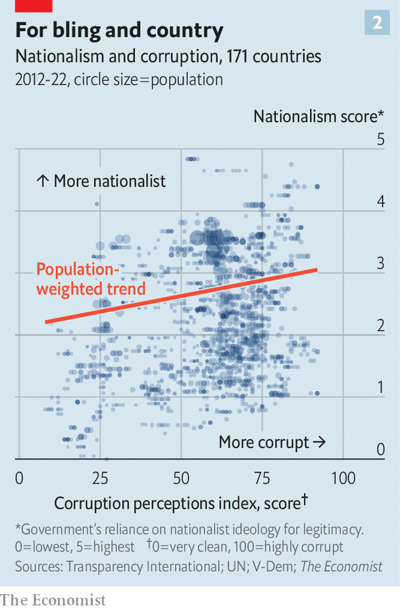
Nationalism is often a way for incompetent politicians to compensate for their incompetence in the eyes of the public, thereby holding onto power. This is confirmed by a study from the renowned magazine The Economist12. In one of its articles, it analyzed data from the V-Dem Institute and found that the more nationalism there is, the more corruption there tends to be: in the period from 2012 to 2021, governments began to rely more on nationalism to justify themselves to voters or citizens. It was also found that where governments rely on nationalist rhetoric to stay in power, the public sector is much more corrupt. The magazine also provided concrete examples. “Vote for me, and I will gradually improve schools” is a wonderful platform but a boring slogan. “The tribe next door will attack us!” is electrifying, says The Economist. Let us add that banal flattery also allows for “buying” the votes of some uninformed voters, and this must be fought, as such cases allow ineffective politicians to remain in power, which negatively affects the standard of living.
Conclusion
Of course, social democrats do not have the right to ban nationalist ideology. Moreover, national democrats are allies of social democrats in a broad democratic coalition, the goal of which is to overthrow an authoritarian regime. However, social democrats should not share nationalist theories, nor should they forget that after the establishment of parliamentary democracy, national democrats become political opponents against whom a decisive struggle is waged within the framework of democratic methods.
- V.A. Tishkov. Nationalism // Great Russian Encyclopedia. Electronic version (bigenc.ru). [Electronic resource]. URL: https://bigenc.ru/ethnology/text/2252782 (Accessed: 10.03.2021).
- Ibid.
- S.I. Ozhegov, N.Y. Shvedova. Explanatory Dictionary of the Russian Language: 80,000 words and phraseological expressions / Russian Academy of Sciences. V.V. Vinogradov Russian Language Institute. – 4th ed., supplemented. – 944 p. – M.: OOO “A TEMP”, 2006. – p. 398.
- Hans Kohn. Nationalism // Encyclopaedia Britannica (www.britannica.com). [Electronic resource]. URL: https://www.britannica.com/topic/nationalism (Accessed: 10.03.2021).
- Nationalism // Merriam-Webster (www.merriam-webster.com). [Electronic resource]. URL: https://www.merriam-webster.com/dictionary/nationalism (Accessed: 10.03.2021).
- A.E. Yashlavsky. Chauvinism // Great Russian Encyclopedia. Volume 35. Moscow, 2017, p. 74. [Electronic resource]. URL: https://bigenc.ru/world_history/text/4944821 (Accessed: 15.03.2021).
- “A very important sign of fascism is lies”. Boris Strugatsky on how easy it is to become infected with what seemed long defeated // Gazeta.ru (www.gazeta.ru). April 18, 2015, 15:00. [Electronic resource]. URL: https://www.gazeta.ru/comments/2015/04/17_a_6643957.shtml (Accessed: 15.03.2021).
- Tom Nairn. The Break-up of Britain, p. 359.
- Nikolai Baranov. Lecture 3. Regionalism and comparative analysis of regionalization models // Personal website of Nikolai Baranov (nicbar.ru). June 19, 2016. [Electronic resource]. URL: https://nicbar.ru/politology/study/kurs-politicheskaya-regionalistika/182-lektsiya-3-regionalizm-i-sravnitelnyj-analiz-modelej-regionalizatsii (Accessed: 15.03.2021).
- Viktor Rezunkov. What is regionalism, and how does it differ from separatism // Radio Liberty (www.svoboda.org). July 13, 2012. [Electronic resource]. URL: https://www.svoboda.org/a/24641766.html (Accessed: 15.03.2021).
- Protests in Khabarovsk in 2020 // DW (www.dw.com). February 13, 2021. [Electronic resource]. URL: https://www.dw.com/ru/habarovsk-protesty-furgal/t-54397099 (Accessed: 15.03.2021).
- How cynical leaders are whipping up nationalism to win and abuse power // The Economist (www.economist.com). August 31, 2023. [Electronic resource]. URL: https://www.economist.com/briefing/2023/08/31/how-cynical-leaders-are-whipping-up-nationalism-to-win-and-abuse-power (Accessed: 12.09.2023).