
Inequality in the USSR and Piketty’s graph
In this short note, we will analyze the graph on inequality in the USSR, widely disseminated by communists, which, according to their plan, is supposed to prove the absence of high inequality in the Soviet Union.
Communists and other citizens sympathizing with the USSR sometimes claim that inequality in the Soviet Union was low, citing as proof, as a rule, Thomas Piketty’s graph showing the income share of the country’s richest households relative to the income of all the country’s households:
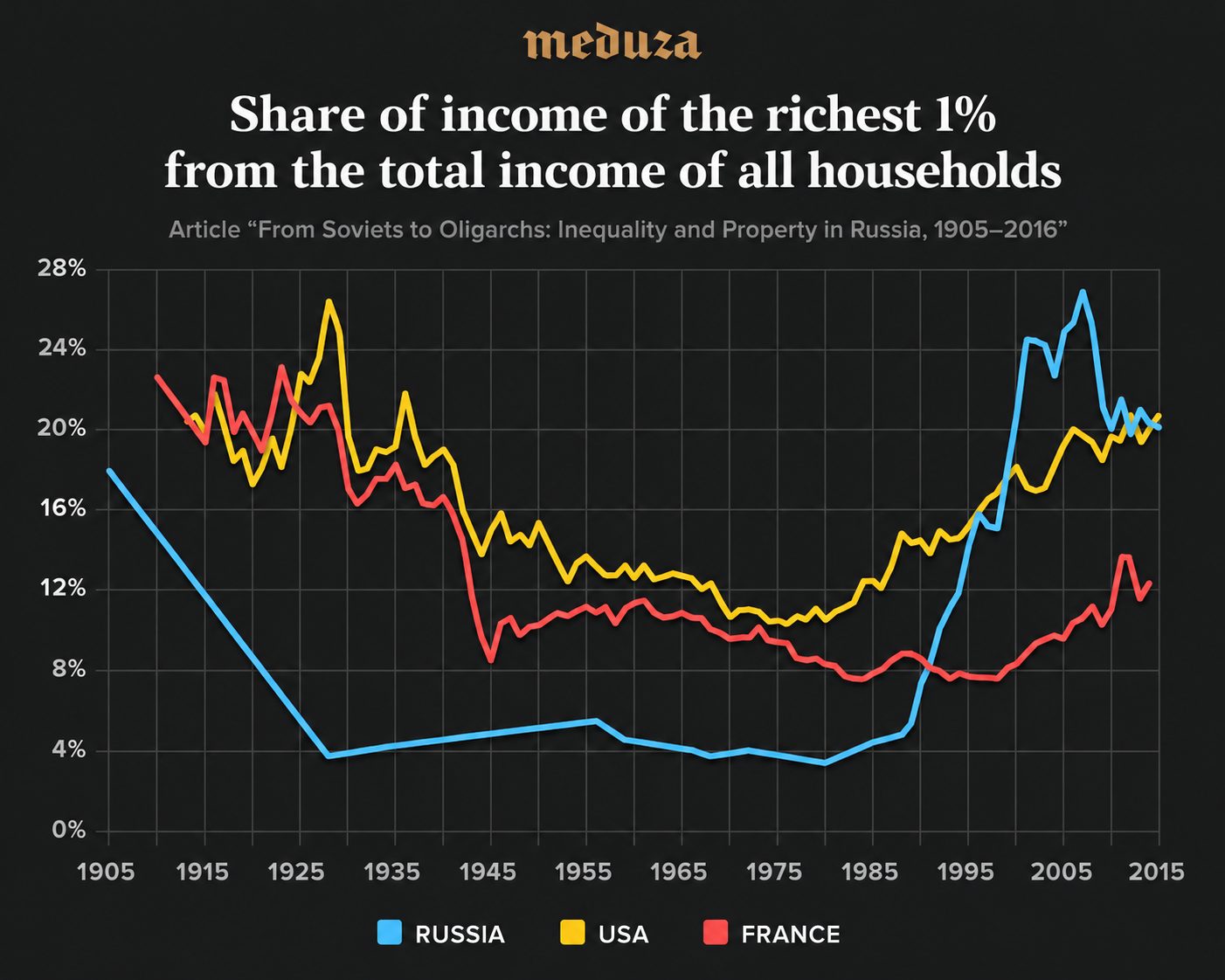
First of all, let us note that in the report by Piketty and his co-authors (from where, in fact, this graph is taken), it is explicitly written:
However, this obviously does not mean that the Soviet elite did not have access to top-quality goods, services, and opportunities. This could take different forms — access to special shops, vacations, etc. —, which effectively allowed the top 1% of Soviet society to enjoy living standards that in some cases may have been significantly higher than their incomes 4 to 5 times higher than average (likely a bit lower than in Tsarist or post-Soviet Russia). Unfortunately, we do not have any way to quantify this1.
Indeed, the concept of “income” does not include already existing capital, state dachas, servants at state expense, undeclared income (corruption), and so on. A Soviet apparatchik had no need for large monetary incomes, since he received a significant portion of benefits for free at state expense. In the exact same way, modern Russian apparatchiks can officially own only a “Skif” trailer and a small apartment, but make use of benefits registered to the Presidential Administration or another state organization. In slave-owning societies, property stratification or income differences could also be significantly lower than in modern developed democracies, yet it can hardly be argued that inequality between a slave and his master was smaller than between a worker and an entrepreneur, for example, in Sweden. Therefore, in societies where top officials have a large number of privileges, one must look not only at their income or property, but also at the presence of privileges. Taking only income out of all this and presenting it as proof of low inequality (while the main part of inequality can manifest in other forms) is manipulation.
Suppose there are two citizens with salaries of 20,000 rubles per month each. One is a worker, the other an official. One has no other inflows of resources, while the second has access to state supply, that is, an apartment given to him by the state, a car with a driver given to him by the state, access to special cafeterias for officials with extremely low prices for expensive food, and all kinds of other privileges. Is it possible to conclude on the basis of the above that there is no inequality between them? That would be an extremely biased conclusion.
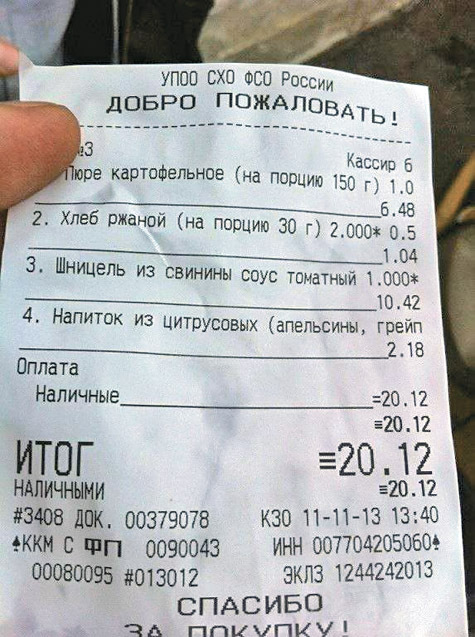
At the same time, we wrote in the article on the privileges of the nomenklatura that the volume of these privileges not included in income was huge, but it is indeed impossible to calculate them for many reasons — for example, archival information on dachas and facilities is under the jurisdiction of the FSO and the Directorate of Affairs of the President of the Russian Federation2, and is accordingly classified. Finally, the very fact of having privileges unavailable to an ordinary citizen for any money is a far more serious indicator of inequality than mere income inequality, because otherwise medieval or slave-owning societies could be more egalitarian than those market and mixed economies in which an ordinary citizen possesses quite a good amount of rights, freedoms, and property. For example, according to economist Guido Alfani3, the level of social inequality in the mid-15th century was lower than today:
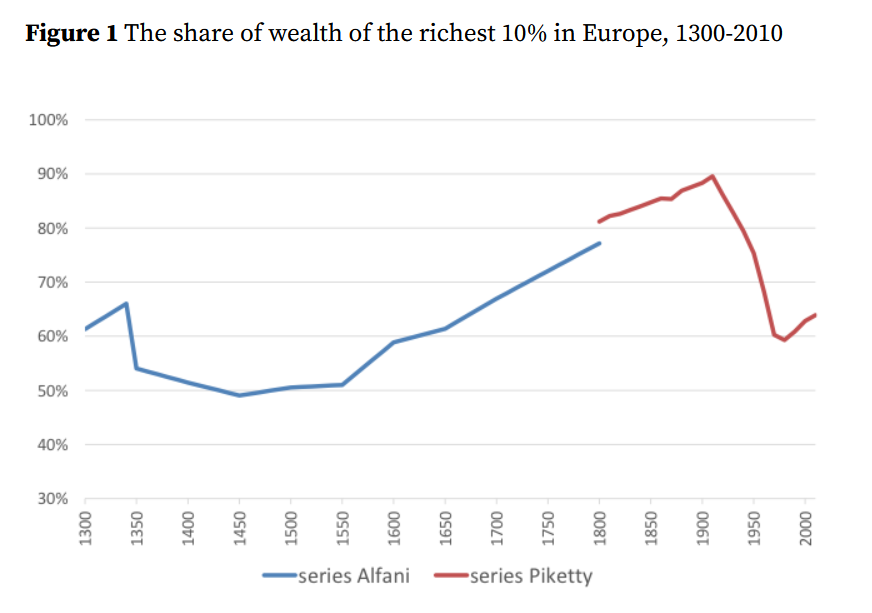
However, this does not indicate that the level of inequality as a whole was lower (and one cannot say that the standard of living was higher), since in addition to inequality in income and property, there is also inequality in rights (including access to various kinds of goods) and the overall level of economic development. If one proves the progressiveness of the Soviet system using graphs on income or property inequality, then in this manner one could prove the progressiveness of feudal Europe. All of the above shows that the income distribution graph in the USSR takes into account only part of all existing aspects of inequality and therefore cannot be cited as proof of a low level of inequality in the country.
- Filip Novokmet, Thomas Piketty, Gabriel Zucman. From Soviets to Oligarchs: Inequality and Property in Russia 1905-2016 // Thomas Piketty (piketty.pse.ens.fr). July 2017. [Electronic resource]. URL: http://piketty.pse.ens.fr/files/NPZ2017WIDworld.pdf (accessed: 30.12.2022).
- Andrey Artamonov. Stalin’s special facilities. An excursion under the “secret” classification – 256 p. – M.: Algoritm, 2013
- Guido Alfani. The top rich in Europe in the long run of history (1300 to present day) // Centre for Economic Policy Research (cepr.org). January 15, 2017. [Electronic resource]. URL: https://cepr.org/voxeu/columns/top-rich-europe-long-run-history-1300-present-day (accessed: 30.12.2022).