“Under Stalin, people were repressed for a reason”
In this article, Logic of Progress analyzes the popular belief in the fairness of Stalin's repressions, which stems from the masses' desire to find solid ground and a successful historical model for justice. Is it worth seeking such an experience specifically in the Stalinist past, and should we even look for it in the past at all?
Russian society has grown so desperate from witnessing rampant corruption that it instinctively, subconsciously desires one fate for most corrupt officials and oligarchs: execution by firing squad. And at the mention of this word, of course, one historical figure comes to mind: Joseph Stalin. This proved to be very fertile ground for Stalinists to create a myth about a Soviet Robin Hood who executes thieving deputies and provides benefits to the poor. For instance, the notorious fraudulent publicist Ustin Chashchikhin, who argued that before the Great Flood people lived an average of about 900 years1, writes in his latest book aimed at gullible readers:
Under Stalin, corrupt officials were shot roughly like this: during the day, an official stole money from the budget, and at night, the NKVD came for him and shot him — he didn’t even have time to build himself a palace. Stalinism is the best and proven way to eradicate corruption. Furthermore, under Stalin, they also shot drunk drivers, for example. Whereas today in the Russian Federation, drunk drivers run people over and, as a rule, go unpunished2.
Stalinist propagandist Igor Pykhalov (who has neither an academic degree nor a background in history), with barely concealed hatred for the deceased, demagogically labeling them all as terrorists and Nazis, writes in his book “What People Were Jailed for Under Stalin: Are the ‘Victims of Repressions’ Innocent?”:
And were these “victims of repressions” really so innocent? Can terrorists and conspirators who plotted the violent overthrow of the existing regime (which fully falls under today’s article on “extremism”) be considered “innocently convicted”? Were Ukrainian and Baltic Nazis, Caucasian bandits, and traitors to the Motherland innocent? And what about the executioners of Yagoda and Yezhov, the bloody “Leninist Guard”, and the “Children of the Arbat” who brought down the country after Stalin’s death — didn’t they deserve the “extreme penalty”? Debunking the most mendacious and slanderous myths, and answering the main question of Soviet history — what were people jailed for under Stalin? — this book irrefutably proves: FOR A GOOD REASON!3
The belief of simple-minded people in this myth is all the more amusing considering that practically nothing about the “Robin Hood” image corresponds to reality — we wrote about the rampant corruption under Stalin in this article, and about the low standard of living for most citizens during his dictatorship here. Finally, let us analyze the brief thesis: “Stalin punished mostly thieves and criminals”.
Contents
Absolute figures
According to Viktor Zemskov, Doctor of Historical Sciences, as early as 2000, 63.3% of those repressed had been rehabilitated4 (nearly 2.5 million innocent people who were subjected to repressions), and this process is ongoing. While by 1961 only 737,182 people had been rehabilitated following the review and examination of cases, by 2000 many more cases had been processed. Thus, 63.3% of innocents is a minimum figure that will continue to grow, and at the same time, this percentage already allows us to say that the majority of those repressed were indeed innocent.
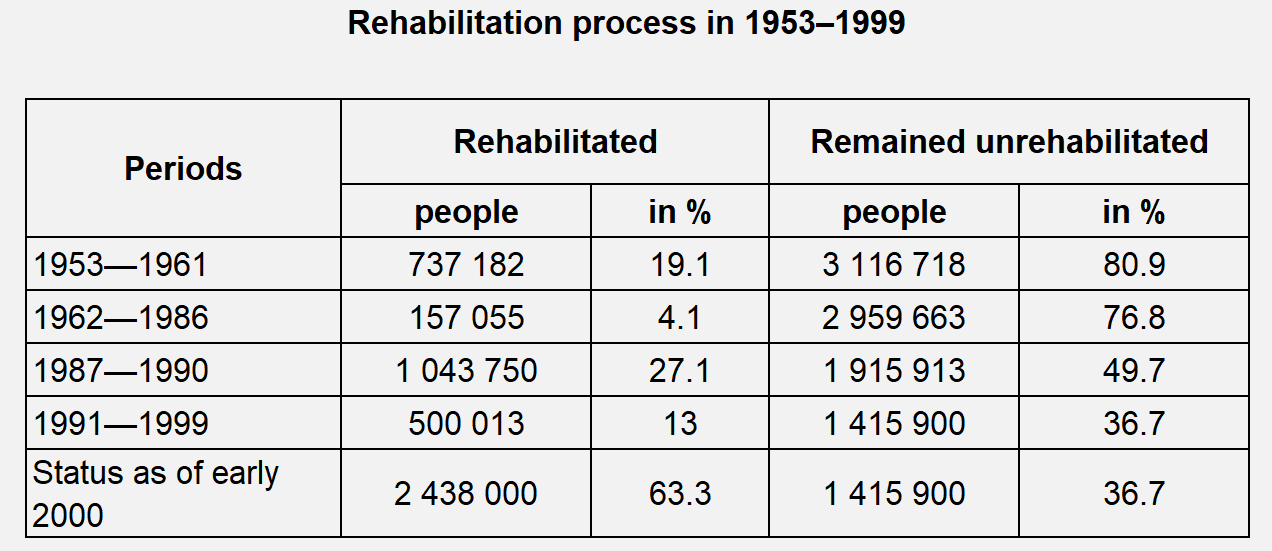
A five-volume course on criminal law confirms Zemskov’s figures:
According to updated data established by the board of the KGB of the USSR on March 13, 1990, from 1921 to 1953, 3.7 million people were convicted of counter-revolutionary crimes by judicial and extrajudicial bodies, of whom 790 thousand were shot.
Even before the Party Congress following the death of J.V. Stalin, the Supreme Court of the USSR began reviewing cases of convictions for counter-revolutionary crimes and rehabilitating those innocently convicted — many, unfortunately, posthumously. Thus, from 1954 to 1956, the country’s Supreme Court rehabilitated 7,679 groundlessly convicted citizens. According to data from the Prosecutor General’s Office of the Russian Federation and the Ministry of Internal Affairs of Russia, as of January 1, 2000, a total of 2,438,000 persons convicted under judicial and extrajudicial procedures to criminal punishment had been rehabilitated5.
Where, then, does the Stalinist propagandists’ figure of “95% deservedly punished” come from? As a rule, they do not cite sources (let alone scientific sources); therefore, we have every reason to believe that this figure is entirely made up by the propagandists themselves to politically manipulate the masses.
Who was eliminated under Stalin?
The Great Terror was a purge of dissidents (for example, we wrote about the mass elimination of communists and socialists here) designed to consolidate Stalin’s personal power, make the entire country forget the criminal way he came to power, and cover his tracks (this is discussed here). In addition to the statistics provided above, it is sufficient to present a brief list of specific examples of people — and their achievements — who were eliminated or simply ended up in Stalin’s prison system. This list is only a tiny fraction of the innocent people who were destroyed; however, this fraction is quite enough to refute the thesis that “mostly criminals were shot” (if so many famous people were eliminated, how many innocent ordinary citizens must have been killed?). Here are the people who, according to the Stalinist government, deserved death:
Ivan Kleymyonov (1899-1938) – one of the organizers and leaders of rocket technology development in the USSR6, Hero of Socialist Labor. Head of the Leningrad Gas Dynamics Laboratory and the Reaction Scientific Research Institute (NII No. 3). Shot on January 10, 1938, after being arrested on false charges of “sabotage” and participation in an “anti-Soviet terrorist organization”7.
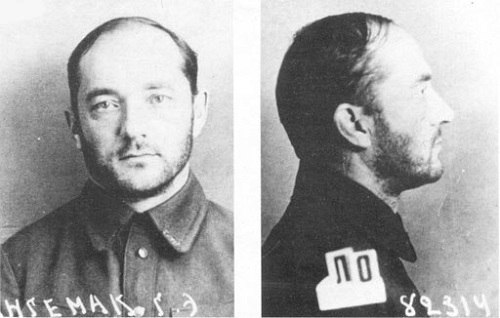
Georgy Langemak (1898-1938) – Soviet scientist, one of the pioneers of rocket technology8 and one of the creators of the “Katyusha” multiple rocket launcher, Hero of Socialist Labor. Pioneer of research into the design of rockets using smokeless powder, he discovered the so-called law of similarity, the knowledge of which allowed for determining the optimal geometry of a rocket engine nozzle through analytical calculation without long, expensive experiments9. He introduced the term “cosmonautics” into the Russian language10. Shot on January 11, 1938, after being arrested on false charges of “sabotage” and participation in an “anti-Soviet terrorist organization”11.
Nikolai Kondratiev (1892-1938) – world-renowned economist, founder of the theory of economic cycles known as “Kondratiev Cycles”12. Arrested by the OGPU in 1930 on charges of “smuggling in bourgeois planning methods”13. Joseph Stalin gave instructions to Vyacheslav Molotov on this matter: “Kondratiev, Groman, and a couple of other scoundrels must definitely be shot”14. On September 17, 1938, Nikolai Kondratiev was sentenced to the highest penalty by the Military Collegium of the Supreme Court of the USSR and shot on the same day.
Vsevolod Meyerhold (1874-1940) – theater director, actor, and educator. Theorist and practitioner of theatrical grotesque, creator of the acting system known as “biomechanics”15. Shot in 194016.
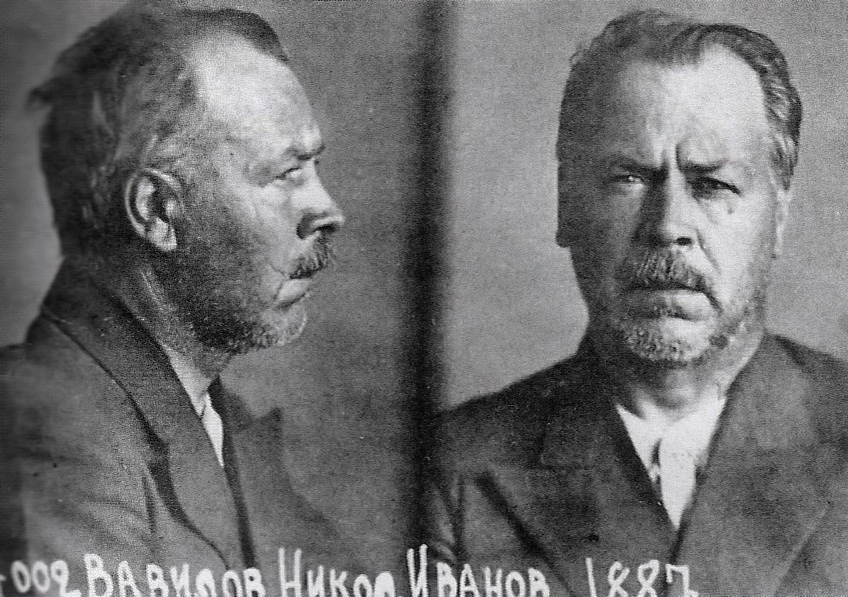
Nikolai Vavilov (1887-1943) – world-renowned geneticist, botanist, and plant breeder. He formulated the theory on the world centers of origin of cultivated plants17. He established the theory of plant immunity and discovered the law of homologous series in heritable variation of organisms. He made a significant contribution to the development of the concept of biological species. Under Vavilov’s leadership, the world’s largest collection of plant seeds was created. He laid the foundations for the state system of crop variety testing. He formulated the operating principles of the country’s primary scientific center for agricultural sciences and established a network of research institutions in this field. On the basis of fabricated charges, he was arrested in 1940 as a “spy for foreign intelligence agencies”18; in 1941, he was convicted and sentenced to death, which was later commuted to a 20-year prison sentence. He died in prison.
Lev Shubnikov (1901-1937) — Soviet experimental physicist, specialist in the field of low-temperature physics, professor, co-discoverer of the “Shubnikov – de Haas effect”19. Shot on November 10, 1937; he was blamed for inviting German émigré scientists to the institute, allegedly for espionage, who had been deported to Germany shortly before his arrest20.
Georgii Karpechenko (1899-1941) – geneticist who, through artificially induced polyploidy, was the first in the world to obtain fertile hybrids of plants belonging to different genera21. Sentenced to the highest penalty by the Military Collegium of the Supreme Court of the USSR on July 9, 1941, on a fabricated charge of participating in an “anti-Soviet sabotage organization”. Shot on July 28, 194122.
Boris Gerasimovich (1889-1937) – astronomer, author of more than 170 articles and the monograph “Physics of the Sun”; in 1927, together with W. Luyten, he determined the distance of the Sun from the galactic plane. In 1928, together with Donald Menzel, he performed pioneering work examining the processes of stellar energy release from the perspective of statistical mechanics. He was the first astronomer to seriously consider the astronomical aspects of cosmic rays23. On a fabricated charge of organizing a counter-revolutionary group of Pulkovo astronomers (“the Pulkovo Affair”), he was arrested on June 28, 1937, and shot on November 30, 193724.
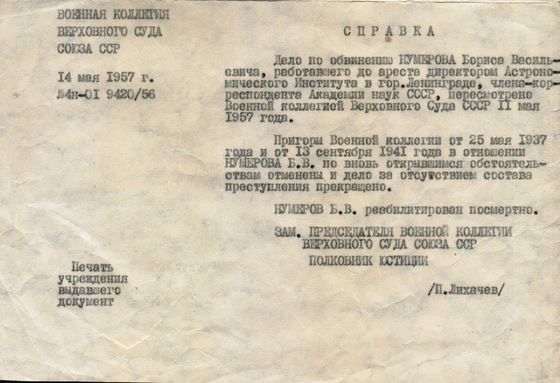
Boris Numerov (1891-1941) – astronomer, developed the theory of the universal instrument and the theory of the photographic transit instrument, and conducted research into the theory of refraction. In connection with the problem of creating a catalogue of faint stars, he proposed in 1932 a plan of observations of 10 selected minor planets to determine the vernal equinox point and the position of the equator for this catalogue. Under this plan, over 22,000 precise planet positions were obtained across 19 observatories in different countries from 1956 to 197525. He proposed a method for the numerical solution of differential equations (Numerov’s method), which is still used today. Arrested on the night of October 21–22, 1936, in connection with the “Pulkovo Affair”, and shot after the start of the Great Patriotic War on September 13, 1941, in the Orel Prison before the city was surrendered to the Nazis26.
Yakov Taubin (1900-1941) – artillery weapons designer, creator of the world’s first automatic grenade launcher27. On May 20, 1940, “for the successful development of new models of armaments”, he was awarded the Order of Lenin. On May 16, 1941, Taubin and several colleagues were arrested on charges of “preserving unfinished weapon designs and putting into mass production technically raw systems: the 23-mm aircraft cannon, the 12.7-mm machine gun, and others”28. Shot without trial on October 28, 1941.
Georgii Meister (1873-1938) – scientist in the field of breeding and seed production of cereal and leguminous crops. He published about 100 works on the critical issues of genetics, breeding, seed production, and biology. One of the creators of new high-yielding, shattering-resistant, awnless hybrid varieties of wheat (Saratovskaya 210, Albidum 43, etc.)29. He conducted experiments in wide hybridization. Initiator of work on breeding rye-wheat hybrids, creating a number of their winter-hardy forms. Arrested on August 11, 1937. On January 21, 1938, he was sentenced to the highest penalty by the Military Collegium of the Supreme Court of the USSR and shot on the same day30.
In 1937, Georgii Karlovich Meister was slandered and arrested, and on January 21, 1938, he was shot. He was a man of principle and a true scientist who entered the fight against emerging Lysenkoism and paid for it with his life, just like the great N.I. Vavilov, N.M. Tulaikov, and many others. He was rehabilitated in 1957. Even in the 21st century, modern agriculture feels the need for leaders of this level, who understand the necessity of new knowledge and technologies, who create and develop scientific institutions, and who actively implement developments into production31.
If we look at public figures, even the purest communists, the closest associates of Vladimir Lenin (and the most active among them), were mostly purged. While Stalin was a minor bureaucrat of the party machine, who settled nothing and possessed no outstanding talents, these people were creating the best of the NEP era (which was not without its flaws), accomplishments that Stalinists would later credit to the General Secretary.
Grigory Sokolnikov (1888-1939) — People’s Commissar of Finance of the RSFSR. He directed the nationalization of the country’s banking system and the implementation of the monetary reform (which resolved the financial crisis during which the ruble had depreciated 50,000 times compared to pre-war times32). He introduced a stable currency, the “chervonets” (as a result of Sokolnikov’s efforts, in April 1924 the dollar exchange rate was 1 ruble 94.5 kopecks33), and was the creator of the Soviet financial system and the network of banking institutions headed by the State Bank. On July 26, 1936, he was arrested in the case of the “Parallel Anti-Soviet Trotskyite Center”, and on May 21, 1939, he was murdered by inmates in prison. The murder was carried out under the direction of Senior NKVD Operative Kubatkin, who acted on direct orders from L.P. Beria and B.Z. Kobulov; the order for the assassination came personally from Stalin34. Grigory Sokolnikov’s wife, Galina Serebryakova, was arrested and spent eighteen years in labor camps and exile.
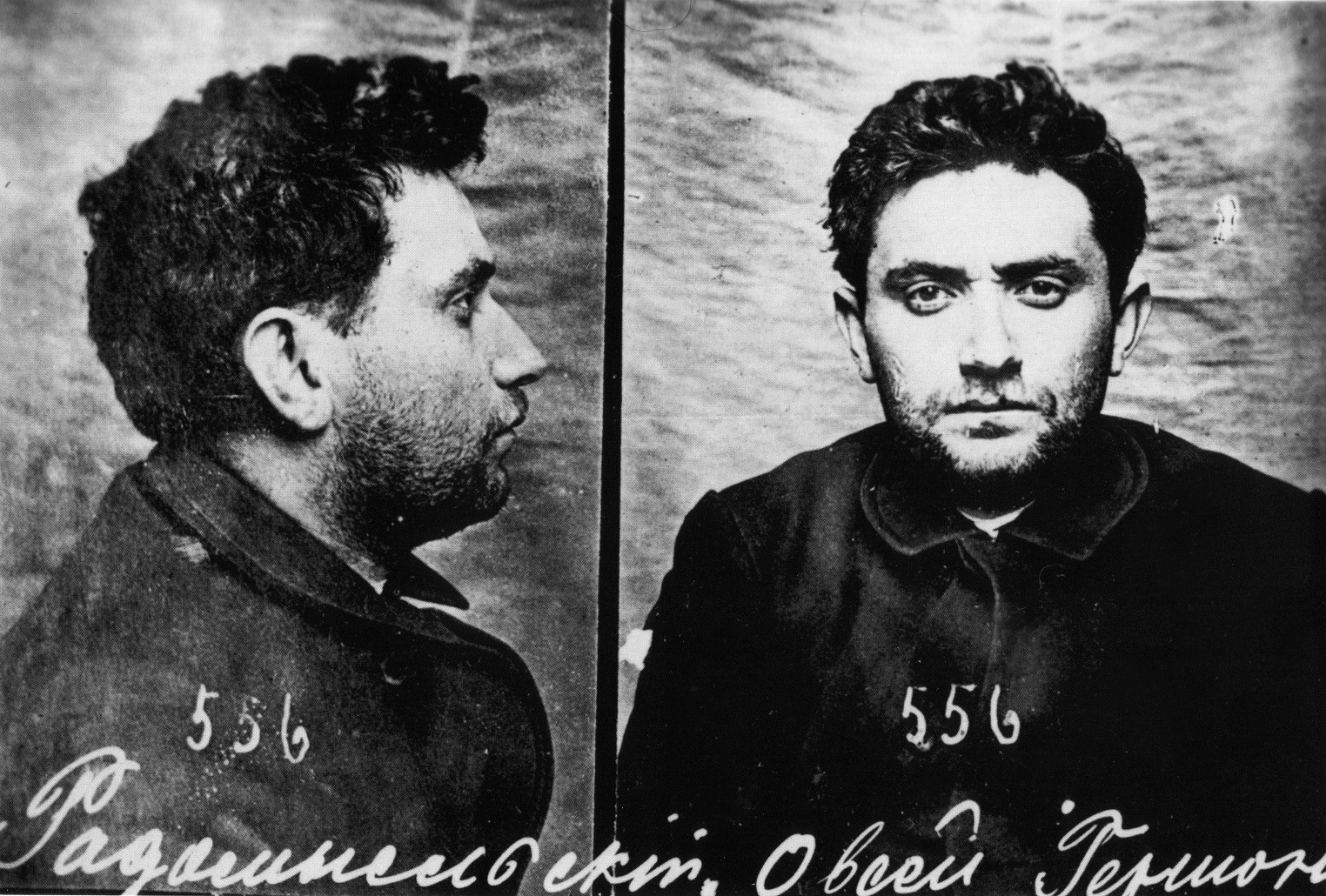
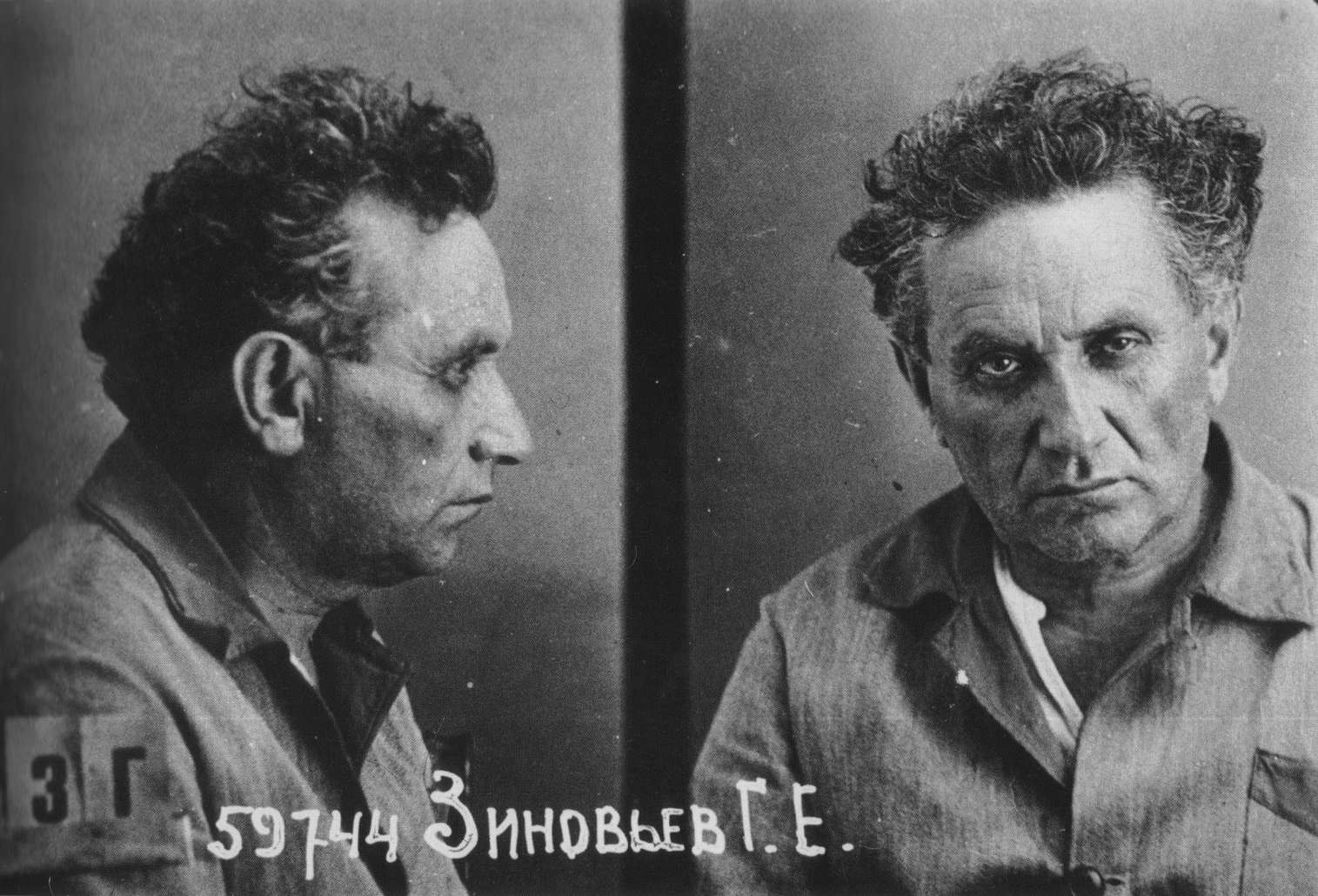
Leon Trotsky (1879-1940) — founder of the Red Army, organizer of the victory over the White Movement, and one of the primary organizers of the October Revolution (Stalin himself wrote: “All practical work in connection with the organization of the uprising was carried out under the immediate direction of the Chairman of the Petrograd Soviet, Comrade Trotsky”35). Assassinated on August 20, 1940, by Stalin’s agent Ramon Mercader.
Nikolai Bukharin (1888-1938) — the “favorite of the party” of the Bolsheviks, as Lenin put it36, one of the leading economists of his time, a theorist of the NEP, and co-author of one of the most popular political works in the USSR, “The ABC of Communism”. Arrested on charges of “treason to the country, espionage, diversion, terror, wrecking, undermining the military power of the USSR”37 and other fabricated accusations, he was executed by firing squad on March 15, 1938.
The scale of the purges among the party leadership is truly colossal (we have already examined them in our article on Stalin’s mass destruction of communists), but we are only selecting a few individuals from a few fields, otherwise reading this article would take several days.
Who was imprisoned?
Let us now turn to those who were not executed but were arrested by the NKVD and sent to the camps:
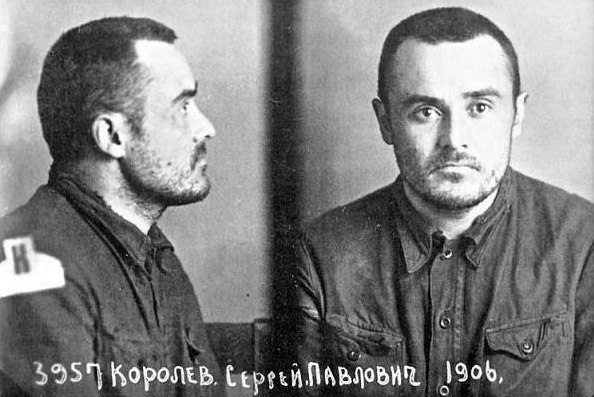
Serei Korolev (1907-1966) — scientist, rocket and space systems designer, one of the primary creators of Soviet rocket and space technology, a key figure in human space exploration, and one of the founders of practical astronautics. Under his leadership, the launch of the world’s first artificial satellite and the first human in space, Yuri Gagarin, was organized and carried out. He was arrested on June 27, 1938, and accused of undermining state industry for counter-revolutionary purposes and organizing crimes38. From 1938 to 1944, he was held in a labor camp.
Andrei Tupolev (1888-1972) — scientist and aircraft designer who developed over a hundred types of aircraft, which set 78 world records39. On October 21, 1937, he was arrested on charges of wrecking and belonging to a counter-revolutionary organization. On May 28, 1940, he was sentenced by the Military Collegium of the Supreme Court of the USSR to 15 years in corrective labor camps40. He remained in the camp until July 1941.
Vasily Luzhin (1906-1955) — one of the developers of the “Katyusha” multiple rocket launchers41. Chief Engineer of the Jet Propulsion Research Institute. In 1940, the development was completed, and a banquet was held to celebrate; an informant submitted a denunciation to the NKVD claiming that Luzhin had smashed a portrait of Stalin at the restaurant during the banquet42. On April 2, 1940, he was convicted and sent to work on the construction of the Pechora Railway. From 1940 to 1948, he was held in a labor camp.
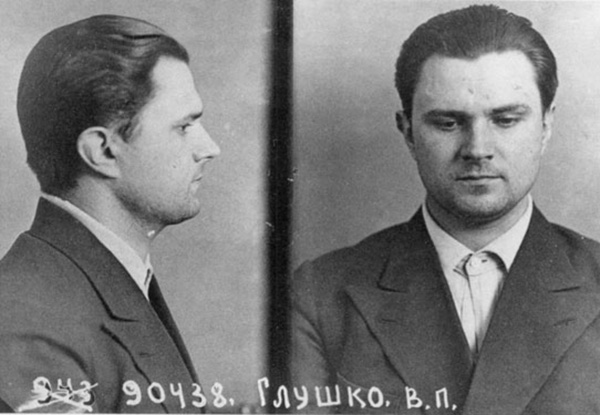
Valentin Glushko (1908-1989) — engineer and scientist in the field of rocket and space technology, the founder of Soviet liquid-propellant rocket engine design43, and general designer of the reusable space transportation system “Energia-Buran”. On March 23, 1938, Glushko was arrested and, based on a case fabricated by the NKVD, sentenced to 8 years in a corrective labor camp44; he was released in August 1944.
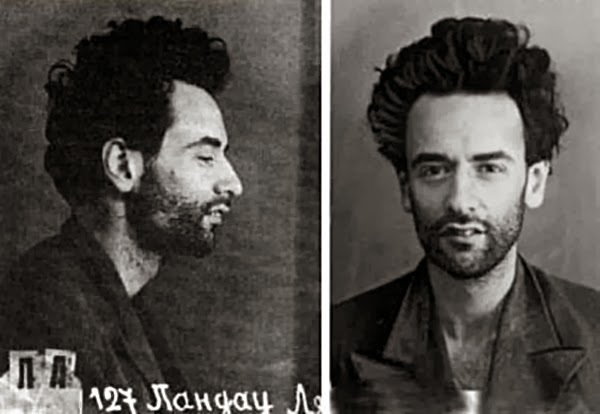
Lev Landau (1908-1968) — theoretical physicist, founder of a scientific school, laureate of the 1962 Nobel Prize in Physics, initiator and co-author (with E.M. Lifshitz) of the fundamental, classic Course of Theoretical Physics, which went through multiple editions and was published in 20 languages. He was arrested on April 28, 1938, for editing a leaflet that stated: “Comrades! The great cause of the October Revolution has been basely betrayed. The country is flooded with torrents of blood and filth. Millions of innocent people have been thrown into prisons, and no one can know when his turn will come. The economy is collapsing. Famine is approaching. Do you not see, comrades, that the Stalinist clique has carried out a fascist coup? Socialism has remained only on the pages of thoroughly mendacious newspapers. In his frantic hatred of real socialism, Stalin has matched Hitler and Mussolini. In destroying the country for the sake of preserving his own power, Stalin is turning it into easy prey for brutal German fascism. The only way out for the working class and all working people of our country is a decisive struggle against Stalinist and Hitlerite fascism, a struggle for socialism”45. He spent a year in prison46 and was released thanks to a letter in his defense from Niels Bohr and the intervention of Pyotr Kapitsa, who secured his release by providing a personal guarantee (“taking him on bail”).
Leon Theremin (1896-1993) — Soviet inventor, creator of a family of musical instruments, the most famous of which is the theremin. He invented many different automated systems (automatic doors, automated lighting, etc.) and security alarm systems47. In 1925–1926, he invented one of the earliest television systems, “Dalnovidenie” (Long-Distance Vision). In March 1939, he was arrested; initially, he served his sentence in Magadan, working as a construction crew foreman, and was later transferred to the so-called “Tupolev sharaga”, where he worked for about eight years. In March 1991, at the age of 95, he joined the CPSU (he could not do this earlier due to the sensitive nature of his work). When asked why he was joining a collapsing party, Theremin replied: “I promised Lenin”48.
Yuri Kondratyuk (1897-1942) — scientist, one of the pioneers of astronautics. In the early 20th century, he calculated the optimal flight trajectory to the Moon. These calculations were used by NASA in the Apollo lunar program49. He built the famous “Mastodon” grain elevator in Kamen-na-Obi — a 13,000-ton granary constructed without a single nail; under conditions of severe shortages, this was an incredible feat. On July 30, 1930, Kondratyuk, along with several other employees of “Khleboprodukt”, was arrested on charges of wrecking (sabotage). One of the counts of the indictment was that he had built the “Mastodon” not only without blueprints, but also without nails50. The local nomenklatura concluded that the structure would not withstand such a vast amount of grain and would collapse, thereby destroying 10,000 tons of the people’s grain. On May 10, 1931, he was sentenced to three years in labor camps (this term was later replaced by work in a sharashka). In reality, the “Mastodon” stood for more than 60 years and burned down in the mid-1990s51.
Vladimir Myasishchev (1902-1978) — Soviet aircraft designer, one of the developers of the TB-1, TB-3, and Li-2 aircraft52 (about 14,000 units were produced in various modifications, serving in aviation for nearly 40 years53), among others. He was arrested in 1937 and released in 1940.
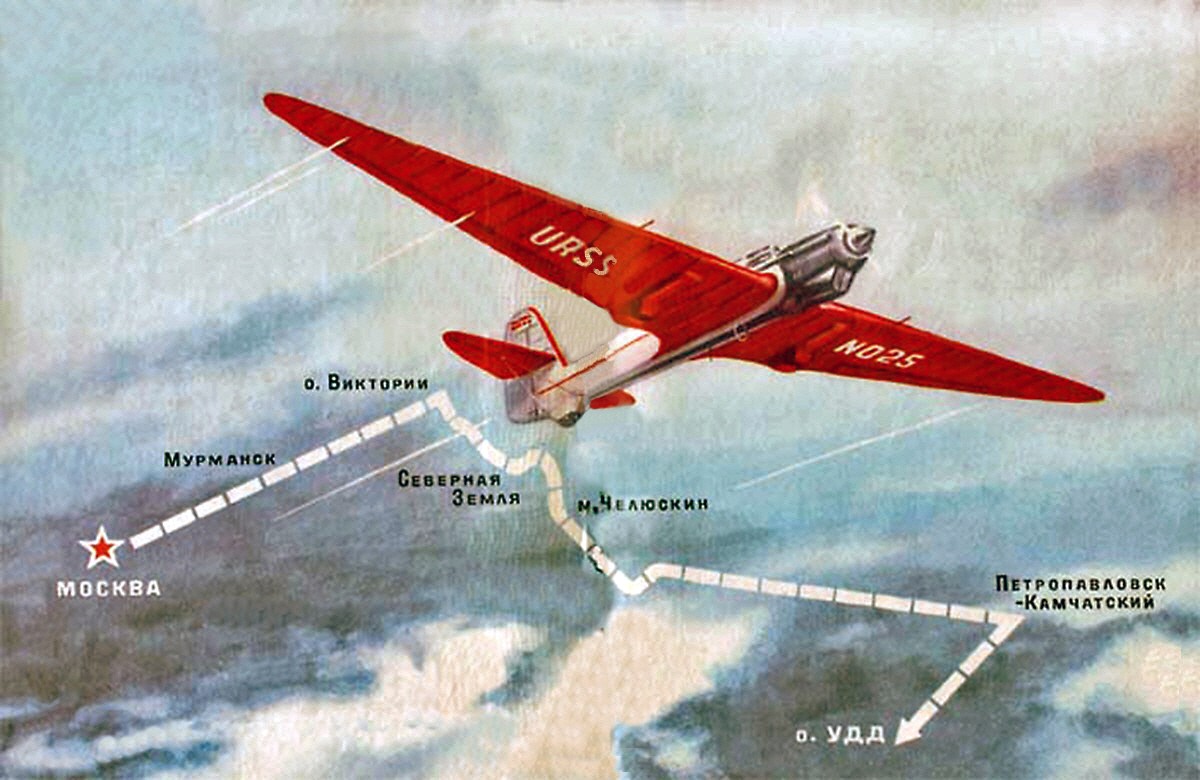
Vladimir Petlyakov (1891-1942) — aircraft designer, one of the developers of the ANT-25 “RD” (Range Record) airplane. This aircraft set several flight range records (for instance, on September 12, 1934, M. Gromov’s crew set a world record on the ANT-25 for flight distance over a broken route, covering a distance of 12,411 kilometers in 75 hours); it was also used for Chkalov’s famous flight across the Arctic and several other long-distance flights widely covered in the Soviet and international press54. Developer of the TB-7, Pe-255 (the most mass-produced Soviet-built bomber56), and other famous aircraft of World War II. He was arrested in November 1937 on a fabricated charge of leading a “wrecker-fascist party in the aviation industry”57 and was released from custody on July 27, 1940.
Boris Stechkin (1891-1969) — scientist and designer in the field of heat and aircraft engines. In 1929, in the journal “Tekhnika Vozdushnogo Flota” (Aviation Engineering), he published the article “Theory of the Air Jet Engine”, where he first formulated the principles that became foundational to this field of engineering58. He authored numerous theoretical works and practical methodologies for thermal and gas-dynamic calculations of heat engines and bladed machinery. He was first arrested on October 20, 1930, in connection with the Industrial Party trial and sentenced to 3 years in prison, but thanks to the intervention of Academician S.A. Chaplygin, he was released early in late 1931. He was arrested for a second time in December 193759 (this prevented his son, S.B. Stechkin — who later became a professor at Moscow University and the founder of a scientific school in the theory of functions — from entering Moscow University60). He remained in custody until 1943.
Lev Zilber (1894-1966) — immunologist and virologist, founder of the domestic scientific schools of medical virology, oncovirology, and oncoimmunology61. He directed the suppression of a plague outbreak in Nagorno-Karabakh in 1930. Upon his return to Baku, he was recommended for the Order of the Red Banner and shortly thereafter arrested on charges of sabotage intended to infect the population of Azerbaijan with the plague. He was released after 4 months. In 1937, he led the Far Eastern Expedition of the USSR People’s Commissariat of Health to study an unknown infectious disease of the central nervous system. During the expedition’s work, the nature of the disease — tick-borne encephalitis — was discovered, and methods to combat it were proposed. Immediately upon his return, he was arrested following a denunciation accusing him of attempting to infect Moscow with encephalitis through the city’s water supply network and intentionally delaying the development of a cure62. While imprisoned, Zilber served part of his term in the Pechora labor camps, where under tundra conditions he developed a yeast preparation from reindeer lichen to treat pellagra, saving the lives of hundreds of prisoners dying from severe vitamin deficiency. An author’s certificate of invention was granted for this breakthrough. The certificate was registered under the name of the “NKVD”. In 1939, he was released, but in 1940 he was arrested for a third time. He repeatedly refused offers to work on bacteriological weapons. He was released in March 1944.
Criminals or not?
Were all these people thieves and criminals? No evidence exists of their involvement in corruption or real crimes; even the NKVD operatives themselves and Joseph Stalin considered them politically repressed — the charges under which they were arrested mostly read as “counter-revolutionary activity”. One could go on for a long time — the number of even well-known people is simply immense, and the number of unknown ones is entirely staggering. This alone is fully sufficient to understand that Stalinists engage in falsifications. They did not arrest and destroy thieves and criminals, but rather those who were undesirable to Stalin and the NKVD. All these people could have done so much more useful work for the country and humanity.
Fabricated cases against valuable scientific personnel entangled most industries. Let us take the automotive industry as an example and open the automotive celebrity encyclopedia of the “Za Rulem” (Behind the Wheel) magazine, where the figures of domestic automotive engineering are, in principle, not that numerous. Out of these few, the following were destroyed during the period of Stalinist repressions63:
- Evgeny Vazhinsky, an automotive designer who played a leading role in the creation of the AMO-F15, AMO-2, AMO-3, ZIS-5, and ZIS-6 vehicles, the ZIS-101 limousine for the nomenklatura, and so on;
- Aleksey Litvinov, chief designer of the Yaroslavl Automobile Plant, who directed the development of the USSR’s first 4-axle all-wheel-drive truck, the YaG-12, with a payload capacity of 12 tons. He took an active part in the development of the first Soviet dump trucks, the YaS-1 and YaS-3, the first Soviet trolleybuses, the YaTB-1, YaTB-2, YaTB-4A, and other models;
- Vladimir Tsipulin, an automotive designer, one of the developers of the first Soviet automobile, the AMO-F15, and the first head of technical services at the Moscow (AMO) and Gorky automobile plants. He was the head of the production department of the “Prombron” association during the period when the first Soviet armored car, the “Prombron”, was assembled;
- Sergey Dyakonov, the first director of the Gorky Automobile Plant, who in March 1934 was awarded the Order of Lenin for the successful mastery of mass production of several automobile models;
- Nikolai Osinsky, a member of the RSDLP since 1907, founder and editor-in-chief of the “Za Rulem” magazine, and a popularizer of motorization in the USSR;
- Dmitry Bondarev, head of the design bureau at the ZIS plant, who coordinated work on the reconstruction of the plant and increasing automobile production to 180,000–200,000 per year.
Here we are not counting the automotive figures who were arrested and sent to labor camps.
Here is what Doctor of Historical Sciences and Chief Specialist of the State Archive of the Russian Federation, Oleg Khlevniuk, says:
Contrary to the myth carefully cultivated by Stalin’s admirers, the victims of the mass repressions were not so much bureaucrats allegedly punished by the leader for their arbitrariness, but rather many millions of ordinary people64.
Why did Stalin need to destroy innocent people? In 1922–1929, he established his dictatorship through illegal means. A link describing his rise to power has already been provided above. He needed to eliminate all party members who knew how he had obtained his power, because Stalin wanted to preserve his dictatorship and prevent any uprising that would restore the era of collective leadership, or even lead to democratization, after which the Stalinist group would lose its power, wealth, and privileges. And subsequently, it was necessary to destroy the majority of those who expressed dissatisfaction.
Wives and children
The so-called “members of the family of a traitor to the Motherland” (ChSIR) were not “thieves” either, and many of them were destroyed. Fourteen-year-old Rauf Lakoba — son of Bolshevik Nestor Lakoba — was arrested65, sent to the NKVD dungeons, and shot at the age of 1866, as were several of his friends and relatives — for instance, high school student Nikolai Lakoba-Grigolia, who was accused of “participation in a counter-revolutionary organization”67. Musto Dzhikhashvili, a relative of Nestor Lakoba, recalls:
“Uncle Lavrentiy”, Rauf said, choking with tears, “maybe… my father, Nestor Lakoba, really is guilty of something… after all, he was a professional politician. But mother — you know perfectly well that she never was involved in politics. Free her… give me back my mother, Uncle Lavrentiy!”
Suddenly Beria said very loudly, so loudly that everyone in the crowd of onlookers, typical for the province, could hear: “Alright, Raufchik, we will sort everything out soon, and your mother will return home”.
But that very night, several Chekists woke the frightened, exhausted, frail boy from his bed. After a repeated confiscation of property — the little that had been “mercifully” left behind during his mother’s arrest — he was taken to the NKVD, only to be shot four years later in the basement of the Butyrka prison, after being put through everything meant for an “enemy of the people”68.
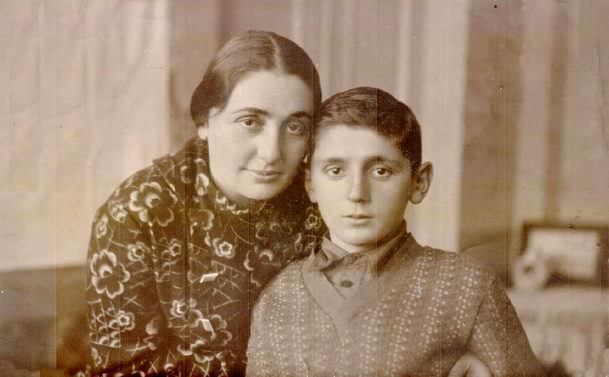
Rachel Messerer-Plisetskaya — following the arrest of her husband Mikhail Plisetsky on a false denunciation, she was imprisoned in the Butyrka prison along with her nursing infant. After being sentenced as the wife of an enemy of the people, she was transferred to the “Akmola Camp for Wives of Traitors to the Motherland”, also known as ALZHIR69. Azari Plisetsky recalls ALZHIR:
We were among the first residents of this camp. It is not far from Astana, about 50 kilometers of dirt road. I happened to visit there more than half a century later when they opened a memorial. So I saw firsthand the place where the camp used to be, that exact spot. And I learned to walk there. When people asked me, “Did you serve time there?”, I would say, “I didn’t sit there, I lay there”. But I learned to walk in that camp70.
Pyotr Yakir was the son of Army Commander Iona Yakir, who was shot in 1937. He was exiled to Astrakhan along with his mother. After his mother’s arrest, 14-year-old Petya was accused of creating an “anarchist cavalry gang” (the fact that he liked to ride horses was presented as evidence)71 and sentenced to five years of imprisonment as a “socially dangerous element”. The Bolshevik Civil War hero Marshal Blücher saw not only his first wife (Galina Pokrovskaya) and second wife (Galina Kolchugina) shot, but also his brother’s wife, Lidiya Bogutskaya72. The marshal’s eldest daughter, Zoya Belova, was sentenced to 5 years of exile in April 1951. The fate of his youngest son, Vasilin (who was only 8 months old at the time of Blücher’s arrest), according to his mother Glafira Lukinichna — who served her sentence and was fully rehabilitated (along with all other family members) in 1956 — remained unknown73. All of them, according to the likes of Igor Pykhalov and other propagandists of Stalinism, were thieves whom Stalin rightfully repressed.
In December 1935, at a meeting of foremost combine operators in Moscow with the party leadership, one of them, a Bashkir collective farmer named Gilba, said: “Even though I am the son of a kulak, I will fight honestly for the cause of the workers and peasants and for the building of socialism”. Stalin replied to him: “A son does not answer for his father”74. However, just a year and a half later, the Decree of the Politburo of the Central Committee of the All-Union Communist Party (Bolsheviks) No. P51/144 of July 5, 1937, was adopted:
144. — NKVD Question.
1. To accept the proposal of the Narkomvnutredel [People’s Commissariat of Internal Affairs] to confine in camps for 5–8 years all wives of convicted traitors to the motherland, members of the right-Trotskyite spy-diversionist organization, according to the presented list.
2. To suggest to the Narkomvnutredel to organize special camps for this purpose in the Narym Krai and the Turgay District of Kazakhstan.
3. To establish henceforth a procedure according to which all wives of exposed traitors to the motherland, right-Trotskyite spies, are subject to confinement in camps for no less than 5–8 years.
4. To place all orphaned children under 15 years of age remaining after conviction under state care; as for children over 15 years of age, their case shall be decided individually.
5. To suggest to the Narkomvnutredel to place the children in the existing network of orphanages and closed boarding schools of the People’s Commissariats for Education (Narkompros) of the republics.
All children are subject to placement in cities outside of Moscow, Leningrad, Kiev, Tiflis, Minsk, maritime cities, and border cities75.
In total, about 18,000 women were arrested during this operation (NKVD Order No. 00386)76 and 25,342 children were seized by January 193977.
Next, we read USSR NKVD Order No. 00309 “On the elimination of distortions in the maintenance of children of repressed parents in orphanages”. There we see: “In the dining room of an orphanage for 212 children, there are only 12 spoons and 20 plates. In the bedroom, there is one mattress for every three people. The children sleep in their clothes and shoes. In the Borkovsky orphanage of the Kalinin Oblast, wards of the older group raped two 8-year-old female wards of the orphanage. As a form of punishment, the educators of this home force the wards to beat each other”78.
Let us turn to the Stalinists — could they say to these children’s faces: “I support the one who destroyed your life”? Would they have the audacity to call these children thieves and corrupt officials? If you are not a Stalinist but have such acquaintances, think carefully about the kind of people you associate with.
The real thieves prospered
But the most important point is this. Corrupt officials under Stalin were mostly not shot; on the contrary, they prospered. Beria had his own mansion on Malaya Nikitskaya79, rode in a limousine, and before the 1947 monetary reform, instructed Boris Lyudvigov to secretly deposit a significant sum of money (more than 40,000 rubles) into various savings banks to avoid the revaluation of money80. Stalin himself had, by the most modest estimates, about a dozen and a half palaces, modestly referred to as “dachas” (we examined them here). We quote a study by Doctor of Historical Sciences Igor Govorov:
In the Leningrad trust of canteens in 1945–1946, a pyramid of widespread extortion flourished, at the top of which stood the trust’s director, Legovoy. In all the canteens, stalls, and tea rooms of the trust, the practice of short-weighting and overcharging consumers prevailed. In February 1946 alone, food worth 18,000 rubles was embezzled in the trust, and in June — worth 50,000 rubles. Legovoy directly protected his thieving subordinates. Canteen directors caught in abuses by the trade inspection and dismissed at its direction were immediately given new positions. Workers who spoke out against the embezzlement were expelled from the trust, while protection for Legovoy from the excessive activity of law enforcement agencies was ensured by the patronage of “friends” from the regional party committee.
<…>
In May 1947, E. Fedorova, a worker at the “Piskaryovka” state farm, sent a statement to the state control commission about abuses by the farm’s administration. She accused the state farm’s director, A. Komanov, the chief agronomist, and other responsible farm workers of keeping personal livestock in the collective cow shed, using materials intended for the repair of farm premises to build their own houses, theft of feed and milk, concealing and misappropriating part of the harvest, illegally obtaining food ration cards, etc. The statement was forwarded to the prosecutor’s office for verification, which confirmed the accuracy of the accusations and returned the documents to state control for a comprehensive audit of the farm. However, instead of this, the materials began circulating from one oversight institution to another until they ended up in the archive. Not a single farm manager was punished. The only victim in this situation was Fedorova herself. With the help of “friends” from the regional executive committee, the farm director evicted her from her room (the decision of the people’s court on the illegality of such actions was simply ignored). However, Fedorova did not back down. In December 1947, when Komanov was nominated as a candidate for deputy of the Kalinin Regional Council, she sent a statement about new abuses by the director to the regional party committee. The result was not long in coming. The complainant was summoned to the regional department of the MVD and warned that if she continued to slander honest communists, she would be arrested for anti-Soviet agitation81.
Were these real thieves and corrupt officials shot? Of course not. We examine the rampant corruption during Joseph Stalin’s dictatorship and its impunity in more detail here — as we can see, real corrupt individuals, on the contrary, enjoyed immunity provided they were completely loyal to higher-ranking officials. And this is where we understand the true goal of Stalinist agitators — to bring back those times when they can steal completely unchecked again, and those who open their mouths can be sent to the wall or to a labor camp for “Trotskyite activity” or “treason to the Motherland”. One of the most important tasks of social democrats is to fight Stalinism in Russia in every possible way.
- Vladimir Chuprin. Revolution in Evolution // Moskovskij Komsomolets (www.mk.ru). March 28, 2008, 14:30. [Online resource]. URL: https://www.mk.ru/editions/daily/article/2008/03/28/47991-revolyutsiya-v-evolyutsii.html (accessed: 21.04.2020).
- U.V. Chashchikhin. Debunking Slander Against Stalin and the USSR. An Independent Investigation – “Izdatelskie Resheniya”, 2017
- I.V. Pykhalov. What People Were Jailed for Under Stalin: How They Lie About “Stalin’s Repressions” – Moscow: “Yauza”, 2015
- V.N. Zemskov. On the Scale of Political Repressions in the USSR // Mir i Politika No. 6 (33), June 2009. – pp. 89-105
- A Course on Criminal Law. Vol. 1. Ch. 8. Criminal Legislation of the Period of Liberalization of Public Relations (1953-1960) / Edited by N. F. Kuznetsova. – Moscow: Zertsalo, 1999
- V. Klimentov, O. Nizovtseva. The Space Age: Histories of Space Conquest – 192 p. – Moscow: AST Publishing House, 2019. – p. 172
- Alexander Glushko. The Unknown Langemak: Designer of the “Katyushas” – 512 p. – Moscow: Eksmo, 2012
- A.M. Vaylov. Russian Aviation Geniuses of the First Half of the 20th Century – 256 p. – Moscow: Algoritm; 2017. – p. 176
- V.S. Sokolov. Fire Worshippers – 62 p. – St. Petersburg: “Politekhnika” Publishing House, 1996. – p. 40
- S.I. Averkov. The Origins of Russian Rocketry – “1000 Bestsellers”, 2017
- V.E. Zvyagintsev. A Tribunal for Academicians – 462 p. – Moscow: TERRA-Knizhny klub, 2009. – p. 202
- Economic Sociology: From Classics to Modernity: An Anthology / Comp., author of introduction, bio-bibliographical information and commentary G.N. Sokolova. – 441 p. – Minsk: Belaruskaya Navuka, 2016
- S. Morozova. Financiers Who Changed the World. – 284 p. – Moscow: Mann, Ivanov and Ferber Publishing, 2014. – p. 120.
- E.M. Shchagin, D.O. Churakov, V.Zh. Tsvetkov. The Formation of the Soviet Political System: 1917–1941 / Edited by Honored Scientist of the Russian Federation, Honorary Prof. of MSPU and Ryazan State University named after S. A. Yesenin E. M. Shchagin. – 192 p. – Moscow: MSPU, 2011. – p. 137.
- P.A. Markov. The Directing of Vl.I. Nemirovich-Danchenko in Musical Theater – 408 p. – All-Russian Theatrical Society, 1960. – p. 353
- Isaac Glikman. Meyerhold and Musical Theater – 349 p. – Sov. Kompozitor, 1989. – p. 348
- Culture and Time. No. 2 (48). 2013: Socio-Scientific and Art Journal – pp. 98-99
- Great Minds of Russia. Volume 21. Sergei Vavilov. Nikolai Vavilov – 96 p. – Komsomolskaya Pravda Publishing House, 2017. – p. 63
- A.A. Abrikosov. Fundamentals of the Theory of Metals: A Textbook. – 520 p. – Moscow: Nauka. Main Editorial Office for Physics and Mathematics Literature, 1987. – p. 175.
- “The Case” of UPTI 1935-1938. Phoenix, 1998 – Total pages: 324
- N.N. Vorontsov. The Development of Evolutionary Ideas in Biology. – 640 p. – Moscow: Publishing Department of the Educational and Scientific Center of Moscow State University, Progress-Traditsiya, ABF, 1999. – pp. 478-480.
- Execution Lists: Moscow, 1937-1941, “Kommunarka”, Butovo. – 504 p. – Moscow: Zvenya, 2000. – p. 188
- V.M. Lopatkin. From the History of Astronomy and the Lives of Its Creators: A Brief Biographical Handbook: A Textbook / V.M. Lopatkin, A.V. Volf, A.D. Nasonov. – 264 p. – Barnaul: IP Kolmogorov I.A., 2019. – p. 62.
- Artem Krechetnikov. “The Great Soviet Eclipse”: Why Did the NKVD Turn Against Astronomers? // BBC News Russian Service (www.bbc.com). May 26, 2017. [Online resource]. URL: https://www.bbc.com/russian/features-40015205 (accessed: 21.04.2020).
- V.M. Lopatkin. From the History of Astronomy and the Lives of Its Creators: A Brief Biographical Handbook: A Textbook / V.M. Lopatkin, A.V. Volf, A.D. Nasonov. – 264 p. – Barnaul: IP Kolmogorov I.A., 2019. – p. 142.
- V.A. Kumanev. Tragic Fates: Repressed Scientists of the Academy of Sciences of the USSR. – 253 p. – Moscow: Nauka, 1995. – p. 246.
- V.N. Shunkov. Weapons and Military Equipment That Changed the Course of History: The History of Armaments from Deep Antiquity to the Present Day – 320 p. – Moscow: AST, 2013. – p. 102.
- Alexander Osokin. Shot Under Number Fourteen. Part 2 // Moskovskij Komsomolets (www.mk.ru). October 28, 2010, 18:34. [Online resource]. URL: https://www.mk.ru/politics/russia/2010/10/28/540271-rasstrelyannyiy-pod-nomerom-chetyirnadtsat-chast-2.html (accessed: 21.04.2020).
- MEISTER Georgii Karlovich / Biographical Encyclopedia of RASHN, VASKHNIL, RAS // Electronic Agricultural Library of Knowledge (www.cnshb.ru). [Online resource]. URL: http://www.cnshb.ru/AKDiL/akad/base/RM/000744.shtm (accessed: 21.04.2020).
- R.G. Sayfullin, A.I. Pryanishnikov, Yu.S. Svistunov. Georgii Karlovich Meister (1873–1938) // Federal Research Center Institute of Cytology and Genetics of the Siberian Branch of the RAS (www.bionet.nsc.ru). [Online resource]. URL: http://www.bionet.nsc.ru/vogis/?wpfb_dl=37 (accessed: 21.04.2020).
- Georgii Karlovich Meister // FSBSI “Research Institute of Agriculture of the South-East” (www.arisersar.ru). [Online resource]. URL: https://www.arisersar.ru/meister.html (accessed: 21.04.2020).
- Yury Gruzitsky. Denominations of the Soviet Ruble // Finance, Accounting, Audit, 2015. No. 12. – p. 48
- M.E. Burov. Sokolnikov. The First People’s Commissar of Finance of the USSR // Bulletin of the Saratov State Socio-Economic University. – 2009. – No. 5. – p. 169.
- A.G. Teplyakov. The Procedure: Execution of Death Sentences in the 1920s-1930s – 108 p. – Moscow: Vozvrashchenie, 2007. – pp. 82-83.
- I.V. Stalin. The October Coup // Pravda No. 241, November 6, 1918
- V.I. Lenin. Complete Collected Works. Fifth Edition. Vol. 45. March 1922 – March 1923 – 729 p. – Moscow: Publishing House of Political Literature, 1970. – p. 345.
- Report of Court Proceedings in the Case of the Anti-Soviet Bloc of Rights and Trotskyites, Heard Before the Military Collegium of the Supreme Court of the U.S.S.R., March 2-13, 1938. Full Verbatim Report. – 708 p. – Moscow: 1938, People’s Commissariat of Justice of the USSR, Legal Publishing House. – p. 7.
- N. S. Koroleva. Arrestee No. 1442: From the Book About My Father. // Nashe Nasledie. 2000. No. 54.
- Brief Russian Encyclopedia. Vol. 3: R-Ya. – 1134 p. – Moscow: Onyx 21 Vek, 2003. – p. 483
- Biography of Andrei Tupolev // RIA Novosti (ria.ru). November 10, 2013, 10:00. [Online resource]. URL: https://ria.ru/20131110/975497582.html (accessed: 21.04.2020).
- Hero of Socialist Labor Luzhin Vasily Nikolaevich // Heroes of the Country (www.warheroes.ru). [Online resource]. URL: http://www.warheroes.ru/hero/hero.asp?Hero_id=13729 (accessed: 21.04.2020).
- V.E. Zvyagintsev. Tribunal for Academicians – 462 p. – Moscow: TERRA-Knizhny Klub, 2009. – p. 205
- A.V. Suldin. History of the USSR: Chronicle of a Great Country. 1917-1991. – 651 p. – Moscow: AST, 1991. – p. 222
- Academician Valentin Petrovich Glushko // Department of Moon and Planets Research (selena.sai.msu.ru). [Online resource]. URL: http://selena.sai.msu.ru/Home/Resear/Glushko/glushko.htm (accessed: 21.04.2020).
- Izvestiya TsK KPSS. 1991. No. 3. pp. 146-147
- Landau Lev Davidovich // Great Russian Encyclopedia. Volume 16. Moscow, 2010, p. 654 (bigenc.ru). [Online resource]. URL: https://bigenc.ru/physics/text/2642592 (accessed: 21.04.2020).
- Termen Lev Sergeevich // Sakharov Center (www.sakharov-center.ru). [Online resource]. URL: https://www.sakharov-center.ru/asfcd/auth/?t=author&i=2484 (accessed: 21.04.2020).
- From Oblivion to Being: Creativity as a Purposeful Activity. Eduard Anatolyevich Sosnin, Boris Nikolaevich Poyzner – pp. 374-375
- Touches to the Portrait of Domestic Cosmonautics: Collection of Documents / Comp. T.A. Golovkina. – 527 p. – Moscow: RGGU, 2018. – p. 478.
- History. The Enigma Man Yuri Kondratyuk // Roscosmos State Corporation for Space Activities (www.roscosmos.ru). March 13, 2011, 00:11. [Online resource]. URL: https://www.roscosmos.ru/15272/ (accessed: 21.04.2020).
- Akulova E. A Place under the Sun // Altaiskaya Pravda Newspaper, February 8, 2007.
- Myasishchev Vladimir Mikhailovich // Bauman Moscow State Technical University (bmstu.ru). [Online resource]. URL: https://bmstu.ru/scholars/myasichev_v_m (accessed: 21.04.2020).
- L.L. Selyakov. A Thorny Path to Nowhere: Notes of an Aircraft Designer. – Moscow: 4th Branch of Voenizdat, 1997 – 256 p., illus.
- Winged Machines of Vladimir Petlyakov // Scientific and Educational Complex “Power Engineering”. Bauman Moscow State Technical University. [Online resource]. URL: http://energo.bmstu.ru/sites/default/files/MVTU2018_21.pdf (accessed: 21.04.2020).
- Petlyakov Vladimir Mikhailovich // Great Russian Encyclopedia. Volume 26. Moscow, 2014, p. 70 (bigenc.ru). [Online resource]. URL: https://bigenc.ru/technology_and_technique/text/2777557 (accessed: 21.04.2020).
- Airplanes of the World / Editorial group: O. Mironenko, L. Kovalchuk, E. Suchkova et al. – 180 p. – Moscow: Mir Entsiklopediy Avanta+, Astrel, 2011. – p. 77.
- A.V. Suldin. History of the USSR: Chronicle of a Great Country. 1917–1991. – 651 p. – Moscow: AST, 2016 – p. 216
- RGANTD. F.133. Op.1. D.100. L.1. / The first graduation of engineers with a rocket specialty at the Zhukovsky Air Force Academy. Among the graduates’ instructors: B.S. Stechkin, M.K. Tikhonravov, L.S. Dushkin, et al. 1945 // “Archives of Russia” Portal (projects.rusarchives.ru). [Online resource]. URL: http://projects.rusarchives.ru/victory65/pages/14_27.htm (accessed: 21.04.2020).
- Stechkin Boris Sergeevich // Great Russian Encyclopedia. Volume 31. Moscow, 2016, p. 246 (bigenc.ru). [Online resource]. URL: https://bigenc.ru/technology_and_technique/text/4166385 (accessed: 21.04.2020).
- V.V. Arestov, V.I. Berdyshev, Yu.N. Subbotin, N.I. Chernykh. S.B. Stechkin and Approximation Theory // Ural Branch of the RAS (tex.imm.uran.ru). [Online resource]. URL: http://tex.imm.uran.ru/tom4/ste/ste.html (accessed: 21.04.2020).
- Zilber Lev Aleksandrovich // Great Russian Encyclopedia. Volume 10. Moscow, 2008, pp. 475-476 (bigenc.ru). [Online resource]. URL: https://bigenc.ru/biology/text/2878699 (accessed: 21.04.2020).
- Zilber Lev Aleksandrovich // Russian Congress of Laboratory Medicine (congress.fedlab.ru). [Online resource]. URL: https://congress.fedlab.ru/city-streets/3173/ (accessed: 21.04.2020).
- Encyclopedia of Automotive Celebrities. Designers. Engineers. Entrepreneurs – 224 p. – Moscow: “Za Rulem” Publishing House, 2000.
- O. Khlevniuk. Stalin. Life of a Leader: A Biography. – 464 p. – Moscow: AST-CORPUS, 2015. – p. 448.
- Around Stalin: Historical and Biographical Reference Book / Compiled by Torchinov V.A., Leontyuk A.M. – 608 p. – St. Petersburg: “Philological Faculty of St. Petersburg State University”, 2000. – p. 292.
- The burial place of Efrem Eshba and Rauf Lakoba became known // N.A. Lakoba Historical and Memorial Museum (lakobamuseum.org). November 10, 2018. [Electronic resource]. URL: http://lakobamuseum.org/10-11-2018 (accessed: 21.04.2020).
- Lakoba-Grigolia Nikolai Mikhailovich // Sakharov Center (www.sakharov-center.ru). [Electronic resource]. URL: https://www.sakharov-center.ru/asfcd/martirolog/?t=page&id=9881 (accessed: 21.04.2020).
- Musto Dzhikhashvili. Stalin’s Caucasian Safari. Batumi – Moscow. KHRONOS. 2003
- M. Baganova, A. Shlyakhov. Maya Plisetskaya. Hellish Spark. Musical Love – 256 p. – Moscow: AST, 2015
- Maya Peshkova. Unpast Time – 288 p. – Moscow: AST Publishing House, 2018
- Applebaum, Anne. GULAG / Anne Applebaum; trans. from English by L. Motylev. – 688 p. – Moscow: ACT Publishing House: CORPUS, 2017. – p. 338.
- V.D. Ignatov. Executioners and Executions in the History of Russia and the USSR – 416 p. – Moscow: Veche, 2013. – pp. 141-142.
- A.N. Sorochan. Their Names on the City Map. – 436 p. – Mykolaiv: “RAL-Poligrafiya”, 2015. – p. 15.
- “Pravda”, 1935. December 2
- AP RF. F. 3. Op. 58. D. 174. L. 107. Original. TypeScript. // Lubyanka. Stalin and the Main Directorate of State Security of the NKVD. Stalin’s Archive. Documents of the Highest Organs of Party and State Power. 1937–1938. — Moscow: MFD, 2004, pp. 238-239.
- AP RF. F. 3. Op. 24. D. 366. L. 78–79. Original. TypeScript / Special report of N.I. Yezhov and L.P. Beria to I.V. Stalin on the arrests of wives of traitors to the motherland. October 15, 1938 // Lubyanka. Stalin and the Main Directorate of State Security of the NKVD. Stalin’s Archive. Documents of the Highest Organs of Party and State Power. 1937–1938. — Moscow: MFD, 2004, p. 563
- Report of Yu.D. Sumbatov, Head of the Administrative and Economic Department of the NKVD, to Narkom of the NKVD L.P. Beria, dated January 29, 1939 (TsA FSB. F. 3. Op. 6. D. 839. L. 35)
- GARF. F. 9401. Op. 1a. D. 20. L. 199–199ob.
- Beria’s Mansion // History of Russia – federal portal Istoriya.RF (histrf.ru). [Electronic resource]. URL: https://histrf.ru/lichnosti/pamyatnie-mesta/place/item-228 (accessed: 21.04.2020).
- RGASPI. F. 17. Op. 171. D. 475. L. 1-35. Copy. TypeScript.
- I.V. Govorov. Corruption under Post-War Stalinism (Based on Materials from Leningrad and Leningrad Oblast) // Modern History of Russia. 2011. No. 1.