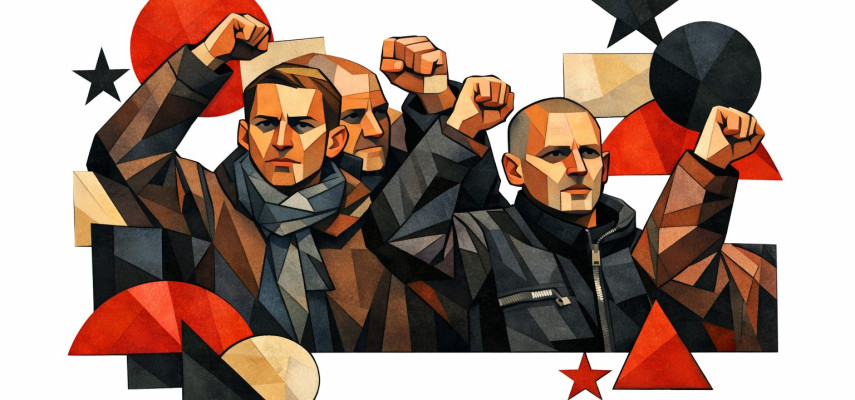
Broad coalition and social democrats
It is time to draw conclusions from the political practice that democratic leftists in Russia have encountered in recent years. Perhaps we too often make the same mistakes, either by forming blocs with forces we should not have, or by striving to maintain the "purity of ideas" and not forming blocs with anyone at all, remaining marginal groups and shielding ourselves from growing in popularity. In this article, we will talk about why a coalition is necessary after all, and with whom exactly.
Left-wing movements always face the question: which opposition movements should they form a bloc with? Usually, intolerance toward other concepts and the rejection of democratic principles lead to formations like the so-called “broad left” — an association that includes a “broad spectrum of left-wing, anti-capitalist traditions”1, as it was described in a 2010 article, “Toward building an organization of the anti-capitalist left”, by activists of the Russian Socialist Movement. This concept was attempted to be developed not only by the RSM, but also by the Left Front, ROT Front, organizers of the Left Forces Forum, and later the United Communist Party2. As RSM activists note, “almost all the ‘broad left’ entities that existed at that time went through painful splits and periods of decline. Unification sentiments were replaced by the struggle between left-wing conservatives and democrats”. A contradiction was embedded in the very concept of the “broad left”. It tried to unite in a democratic coalition left-wing traditions, some of which shared the values and basic principles of democracy, while others branded them “bourgeois democracy”. Splits became a logical development of the situation.
Today, we can state that for the democratic left (social democrats, democratic socialists, social liberals), a broad coalition with red conservatives (Stalinists, Maoists, Soviet patriots, supporters of the dictatorship of the proletariat) is a completely dead-end path of development. Even in an incredible scenario leading to the political victory of the “broad left”, it harbors the danger of red conservatives cracking down on other leftists, as already happened in the 1930s (and not only then — opponents of democratic methods are generally prone to crackdowns). Moreover, in the article about the right and the left, we explained why Stalinists are not left-wing, so this is not a “broad left” coalition at all; it is effectively a coalition with the right.
Another left-wing resource — “Levoradikal” — responded to this concept in 2015 with the concept of the “narrow left”, which consisted of rallying revolutionary Marxists while discarding all “opportunists”, “revisionists”, “doctrinaires”, “vulgar Marxists”, “centrist-pacifists”, “social-chauvinists”, “new leftists”, and so on3 (although since then, “Levoradikal” has shifted in a more democratic direction and shown its ability to move forward with the launch of the AltLeft project). In practice, this meant that almost everyone would have to be discarded. The concept of the “broad left” meant servitude to Stalinists; the concept of the “narrow left” meant sectarianism. Both paths so far have not contributed to the growth of the democratic left-wing movement, and there is little reason to believe they ever will.
Contents
Why a broad coalition is necessary
Modern social democrats rely on current scientific works when developing political strategy. We have already written an article about the book by Daron Acemoglu and James Robinson, in which the authors — authoritative economists — emphasize that inclusive institutions, which are the cause of countries’ prosperity, were formed only after a broad coalition of democratic forces came to power.
England was able to make its political institutions inclusive by relying on two factors… The second factor proved more important. On the eve of the Glorious Revolution, a broad and powerful coalition formed in the country, capable of imposing durable and lasting constraints on the power of the monarch and his ministers. The latter, in turn, were forced to yield to the demands of this coalition. This created the basis for pluralistic political institutions, which laid the foundation for inclusive economic institutions and, ultimately, for the first industrial revolution in history4.
<…>
Perhaps most important here was that the emergence and expansion of different interests — from the gentry, the commercial farmers who had emerged under the Tudors, to various groups of manufacturers and Atlantic merchants — meant that the coalition against Stuart absolutism was becoming not just stronger but also broader. This coalition strengthened even further with the formation in the 1670s of the Whig party, which became the organizational basis for the further defense of the interests of the “new men”.
This expansion of political participation was the soil from which pluralism grew after the Glorious Revolution. If all those who fought against the Stuarts had had similar interests, the overthrow of the Stuarts would have resembled the victory of the Lancastrians over the Yorkists: the interests of one narrow group would have prevailed over the interests of another. Ultimately, this overthrow would have led to the recreation, in one form or another, of the same extractive institutions. A broad coalition, however, meant that the demand for the creation of pluralistic political institutions would be higher. Without a certain degree of pluralism, there was a danger that someone’s interests would prevail to the detriment of others’. The fact that Parliament after 1688 represented such a broad coalition is a crucial reason why Parliament was forced to accept petitions, even if they came from representatives of strata not represented in it, including those who had no right to vote at all. This was a key factor in countering attempts by any single group to establish a monopoly at the expense of others, as wool producers had tried to do before the Manchester Act.
The Glorious Revolution was a historical event precisely because it was carried out by a broad coalition and subsequently led to the strengthening and expansion of that coalition’s influence, and this, in turn, led to the establishment of a constitutional regime in which both executive power as a whole and, no less importantly, the power of any particular individual in government were limited. It was precisely these limitations, for example, that prevented wool fabric manufacturers from destroying potential competitors — cotton and flannel manufacturers. Finally, this broad coalition was not only a vital factor in strengthening Parliament after 1688, but it also meant that within Parliament itself there existed a mechanism that would prevent any faction from becoming too powerful and beginning to abuse its power.
This was the decisive step in the formation of political pluralism and in the strengthening of inclusive economic and political institutions5.
The principle of a broad coalition, as Acemoglu and Robinson note, held true regarding the French Revolution, the Meiji Restoration in Japan, and most other economically successful countries. Revolutions in countries like Sierra Leone or Ethiopia, by contrast, were the result of the actions of specific individuals and narrow groups seeking power to use it to extract benefits from others. In other words, democracy, according to these researchers, emerges where a broad coalition comes to power in which, first, several strong and different ideologies are represented, and second, all these ideologies share democratic principles of governance. Where a monolithic force or a coalition with a clearly dominant power (even if it is a very democratic force) comes to power, it begins to suppress all others and creates a dictatorship, as well as the conditions for building extractive institutions. We saw this in Russia with the example of the Bolsheviks coming to power. The collection of the International Institute for Democracy and Electoral Assistance, “From Authoritarian Rule to Democratic Governance: Lessons Learned from the Experiences of Political Leaders”, confirms that in conditions of authoritarianism, the creation of a broad coalition is of high importance:[/html]
Encouraging the convergence of positions, achieving broad consensus, and creating coalitions of opposition forces were of vital importance both for implementing transition reforms and for beginning to build a democratic governance system.
<…>
Building a broad coalition, firmly committed to democratic values and capable of overthrowing an authoritarian regime, often requires persistent work to overcome divisions within the opposition, but it is also necessary not to forget the need to exploit the open or hidden divisions within the regime6.
Returning to Acemoglu and Robinson, we note that they believe the creation of a broad coalition can become the very point that will lead in the future not only to a change in power, but also to the formation of inclusive institutions and the future prosperity of the country7. Therefore, for the Kremlin’s nomenklatura today, it is vitally important to support primarily those agents in the opposition movement who work to divide the opposition, search for enemies, and prevent the formation of a broad democratic coalition — for example, revolutionary guardians.
What is a broad coalition?
By a broad coalition, we mean a strategic alliance of democratic opposition forces in politics. That is, each of these forces must support the requirements of parliamentary democracy, the rotation of power, a multiparty system, political freedoms, and other principles of democracy. These forces must have respect for other coalition participants and strive for political pluralism. Establishing such interaction within a coalition and creating several strong movements within it is the key to building a democratic society and a system of fair elections.
This coalition is needed to coordinate joint protest actions, as well as to form a future democratic parliament. Participants in a broad coalition can hold their own separate events and actions, however, they must respond to significant political events and anti-popular government actions with joint actions. Therefore, established contact and links between movements in the coalition are very important. Furthermore, using the experience of the “broad left” as an example, we see how important it is not to allow the participation in a coalition of forces that do not share the principles of democracy, be they Stalinists, fascists, supporters of absolute monarchy, or other fans of the so-called “strong hand”.
We wrote an article on tolerance where we substantiated why freedom allows one to do anything that does not cause harm to others (that is, freedom is only for those who respect the freedom and rights of others). From this concept, the concept of a broad coalition logically follows — democracy and participation in democratic processes are only for those who share democratic principles.
However, after the fall of authoritarianism, the “broad coalition” disintegrates into political competitors who will continue their rivalry within the framework of a democratic system. That is, until the fall of authoritarianism, social democrats (in alliance with democratic socialists and social liberals) can form blocs with right-wing liberals, Christian democrats, and national democrats, but after that, blocs between these forces become rather unlikely, and in any case, not strategic.
Social democrats
Modern social democrats are ready to participate in a broad coalition. This means that until the overthrow of the authoritarian regime, they are ready to form blocs with a broad spectrum of forces that advocate for democracy and to form a government based on the results of fair elections. We explained why it is preferable to wind down cooperation with part of the broad coalition after the fall of the authoritarian regime, including in the article about allies of social democrats.
Until social democrats and the democratic left in Russia as a whole gain strength, Stalinists and other revolutionary guardians will accuse them of having entered the orbit of liberals. However, at the moment, Russia’s social democrats represent a fairly narrow movement, and until the situation changes, they are doomed to temporarily enter someone’s orbit. Only in the case of liberals will they get the opportunity to create a party and enter parliament with the prospect of further struggle for political leadership, whereas in the case of Stalinists, they will get executions and camps. Furthermore, a broad coalition allows social democrats to broadcast their position to citizens involved in all the coalition’s movements, thereby expanding their influence and promoting their ideas.
Liberals
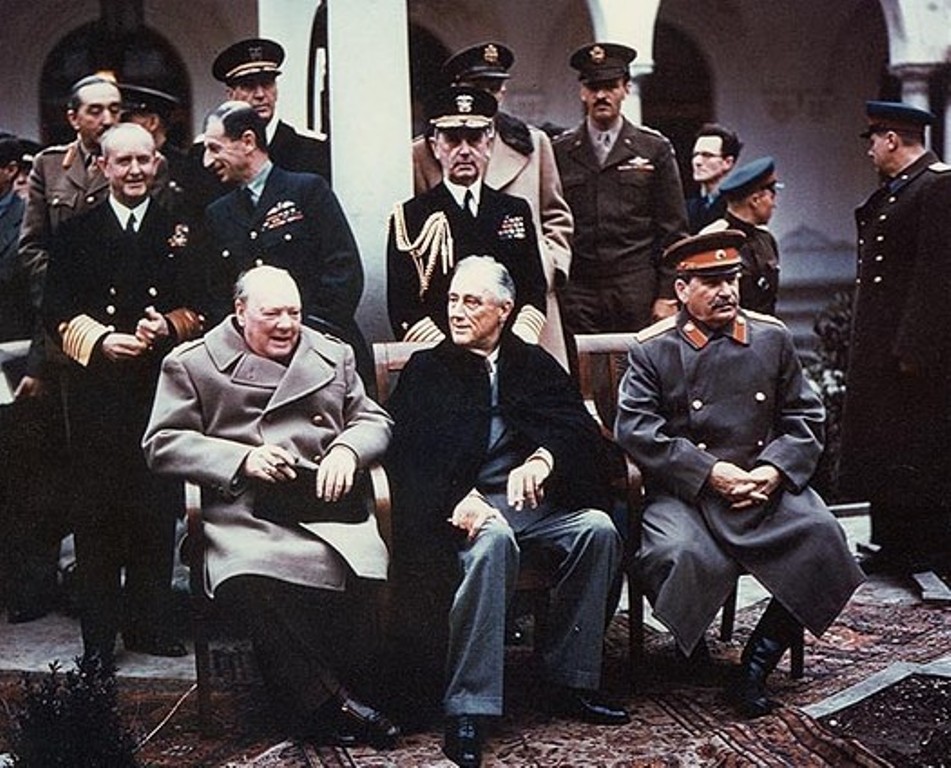
Right-wing liberals and social liberals must understand that without a broad coalition and a strong social-democratic wing within it, their protest will in all likelihood be marginal. Simply because broad sections of society have advocated and will continue to advocate for social policy and social justice. Liberals have financing; the left has mass support, and of all the leftists, social democrats are likely the most preferable allies for liberals. In politics, financing is nothing without mass support, and mass support is nothing without financing. Therefore, and also for the reason that only a broad coalition is capable of leading to the formation of inclusive institutions and the prosperity of the country, in conditions of authoritarianism, liberals need social democrats, and social democrats need liberals. Until liberals understand this and begin to provide all possible support to social democrats, including information support, they will not be able to create a real broad coalition and, as a consequence, the possibility of building a full-fledged democracy in Russia.
Conclusion
As researchers note and as historical practice shows, the probability of establishing democracy, as well as ensuring the country’s prosperity, is significantly higher when a broad coalition of opposition democratic forces comes to power. The logic itself says this — if authoritarianism is defeated, for example, by liberals alone, and only liberals are in power, then what kind of strong opposition (which, incidentally, is a necessary attribute of democracy) can one talk about? No real political competition will be created, which will lead to the degeneration of democracy. In turn, social democrats also understand that without real political competitors, they will not be able to build a democratic society. Furthermore, in a coalition, winning is simply easier than alone.
Social democrats differ from liberals on economic issues. They also differ in how they believe democratic institutions should be expanded. However, they share the same foundation of political demands in the form of realizing the basic principles of democracy. It is for these reasons that social democrats need a coalition with those movements that share these principles. Those movements, however, that advocate for establishing their own dictatorship and suppressing the opposition (such movements are not difficult to recognize by their attitude toward democratic principles) are opponents of social democrats, and strategic cooperation with them is impossible. We do not need the suppression of the opposition, but the establishment of “rules of the game” for fair political competition. We shared our assumptions about how to create a broad coalition in a separate article.
- Toward building an organization of the anti-capitalist left // Russian Socialist Movement (anticapitalist.ru). December 2010. [Electronic resource]. URL: http://anticapitalist.ru/archive/documents/rezolyuczii/k_postroeniyu_organizaczii_antikapitalisticheskix_levyix.html (accessed: 02.10.2020).
- Ivan Ovsyannikov. Broad left: myth and reality // Russian Socialist Movement (anticapitalist.ru). January 11, 2019. [Electronic resource]. URL: http://anticapitalist.ru/2019/01/11/широкая-левая-миф-и-реальность/ (accessed: 02.10.2020).
- Ivan Markov. For the narrow left! // Levoradikal (levoradikal.ru). October 22, 2015. [Electronic resource]. URL: https://levoradikal.ru/archives/15048 (accessed: 02.10.2020).
- Daron Acemoglu, James A. Robinson. Why Nations Fail: The Origins of Power, Prosperity, and Poverty. – New York: Crown Business, 2012. – pp. 238-239.
- Ibid., pp. 238-239.
- Abraham F. Lowenthal, Sergio Bitar. From Authoritarian Rule Toward Democratic Governance: Lessons Learned from the Experiences of Political Leaders // International IDEA (www.idea.int). [Electronic resource]. URL: https://www.idea.int/sites/default/files/publications/from-authoritarian-rule-toward-democratic-governance-RU.pdf (accessed: 02.10.2020).
- Daron Acemoglu, James A. Robinson. Why Nations Fail: The Origins of Power, Prosperity, and Poverty. – New York: Crown Business, 2012. – pp. 441-442.