“Decolonization”: dangers and pros
In 2022, after the start of the full-scale invasion of Ukraine by Putin's RF, conversations resumed in the Russian info space on a topic that, it seemed, had not been widely discussed for more than 20 years. This topic is decolonization and the collapse of the country. Not long ago, to most Russians it seemed absurd and unambiguous. However, as the regime grows more ferocious, the Russian opposition is beginning to think about rethinking this topic. How should social democrats approach this issue?
One of the main historical “anchors” of Russia’s imperial forces is the amount of territory controlled by their government. The ruling party in the country is even called “United Russia”. Even discussing this topic is a strict taboo in Russian society. There is a special article of the Criminal Code of the Russian Federation, 280.1, “Public calls to commit actions aimed at violating the territorial integrity of the Russian Federation”. Therefore, only one point of view on this issue is permitted in society, and under these conditions, it is not surprising why a different point of view is perceived as almost heresy, sacrilege, as something fundamentally contrary to common sense by default. However, we are well aware of how the authorities disinform society by establishing these laws and shaping these perceptions. So let’s pretend that we are taking a fresh look at this issue, with a “clear” head, and consider all the pros and cons of a theoretical division of the country into different states.
First of all, it should be said that at the time of writing this article, there are no significant prerequisites for decolonization. Moreover, representatives of the authorities of the countries of the democratic bloc, who, according to the assurances of Russian propaganda, intend to divide Russia, are actually rather trying to avoid its collapse, which further reduces this probability. Therefore, it is practically zero, and today’s decolonizers are working in a direction with very slim prospects.
Contents
Definition
What is “decolonization”? According to the Britannica encyclopedia, it is process by which colonies become independent of the colonizing country1. Similar definitions are given by other sources23, so we will use this exact understanding. We will not dwell in detail here on whether the territories seized by Russia in various historical periods are colonies — their seceding is already referred to as decolonization in the information space and at the level of state institutions4, including Russian ones5. Therefore, it is obvious that the decolonization of Russia also implies the process in which territories with cultural or national characteristics subordinated to the central government become independent.
Russian conservatives also use the terms “collapse of the country” and “disintegration of the country” to define this phenomenon, and these terms have become commonly used in Russia, so progressive forces are forced to use them for better understanding as well. However, these terms are used by Russian conservatives only in relation to their own country — they will not use this term in relation to the decolonization of France or Great Britain, even though these countries went through the process of decolonization, and relatively successfully for themselves.
Examples of decolonization in history
We will not take cases like those where metropoles lost colonies under pressure from a third force (besides the metropole and the colony) as a result of the terms of a peace treaty. We will take those cases where the main factor was the struggle for independence in the colonies themselves, and the government turned out not to be too bloodthirsty to stand on principle and drown this struggle in blood. Most cases of decolonization are associated with the period after World War II, when European governments lacked the resources (including manpower) and support necessary to suppress distant rebellions6. From this, it is logical to conclude that after an exhausting war, a window opens for decolonization.
Great Britain7. The largest and most powerful empire that ever existed, today Great Britain is not so huge (and does not particularly grieve about this, nor does it dream of unhealthy fantasies of restoring the empire). Back in 1776, the US declared independence from Great Britain. This was a painful process — the British tried to hold onto their colony and sent troops to bloodily suppress the rebellion, but to no avail.

At various times, India, Pakistan, Myanmar, Sri Lanka, Malaysia, a number of African states, and other countries became independent to varying degrees. Canada, Australia, and New Zealand have the British monarch as head of state8; nevertheless, the king does not play any tangible role there. Moreover, such countries can reject the British monarch: for example, in 2021, Barbados officially removed Queen Elizabeth II from the post of head of state and became the youngest republic in the world9. Some former British colonies became developed democratic states, some have so far achieved less success (India, Malaysia), and some became authoritarian and poor.
France10. French colonial possessions included Indochina, Madagascar, Algeria, Senegal, Cameroon, and a number of other countries. By 1960, most of them had gained independence. It should be noted that France was far less willing to grant independence to colonies compared to Great Britain. In Indochina and Algeria, two terrible wars occurred with huge casualties. At the same time, Algeria was not considered a colony at all, but was a part of the French Republic, its province (so this situation may be especially interesting for Russians). Its loss was perceived extremely painfully in French society, up to large-scale terror by revanchists from the OAS (these events even became the basis for the plot of the famous political novel “The Day of the Jackal”), and today only a few remember that Algeria was a full-fledged part of France. Most former French colonies did not become developed and democratic states. Only a few countries formed hybrid regimes, so overall the results of France’s decolonization turned out to be a failure.
Portugal11. The main part of their colonies in South America, including Brazil, the Portuguese lost in the 1820s, during the period after the Napoleonic Wars. In 1975, after a democratic revolution in Portugal, independence was also granted to Angola and Mozambique, which was preceded by large-scale military actions in that region. Brazil overall is a relatively democratic state today, but Angola and Mozambique became authoritarian.
US. The Americans participated in granting independence to Cuba in 1902 (they defeated the Spanish, thanks to which Cuban rebels were able to declare the country’s independence) and granted independence to the Philippines in 194612 (largely thanks to not wanting to invest in their post-war reconstruction). And while an imperfect democracy formed in the Philippines today, Cuba, in whose affairs the US continued to actively interfere, was lost and fell into the hands of dictators — first right-wing (Gerardo Machado13, Fulgencio Batista14), and then left-wing (Fidel Castro15).
Netherlands. In the 20th century, Dutch colonies actively fought for their independence, and in the end, it was won by Suriname and Indonesia16. The Netherlands tried to suppress uprisings in Indonesia using cruel and dirty methods, but these attempts were not successful. Today, both Suriname and Indonesia are imperfect democracies.
The key factor in the decolonization of Asia was World War II. During the Japanese occupation, many national forces were formed in the colonies of this region, and European colonial empires failed to defend their possessions, so the locals no longer saw much sense in preserving them.
Belgium17. One of the most sinister colonial empires is the Belgian one. Despite the fact that Belgium today is a peaceful, developed, and democratic country, the situation in its former colonies is simply terrible. These are three countries — Congo, Rwanda, and Burundi. Each of them is an authoritarian regime, and the world shuddered in its time from the genocide in Rwanda. The Belgians themselves carried out a genocide in the Congo18, but even after their departure, as we can see, the problem in their former territories has persisted.
Decolonization of the USSR itself. As a result of this process, 15 new states were formed: the Russian Federation, Ukraine, the Republic of Belarus, Latvia, Lithuania, Estonia, Moldavia, Georgia, Armenia, Azerbaijan, Kazakhstan, Uzbekistan, Turkmenistan, Kirghizia, and Tajikistan. As we know, four of them (Estonia, Latvia, Lithuania, and Moldavia) became imperfect democracies, three more (Ukraine, Georgia, and Armenia) — hybrid regimes (for some time such a regime persisted in Kirghizia, but in the end a rollback occurred). The remaining eight became authoritarian regimes. At the same time, the former metropole has not accepted the results and is fueling wars in the region.

As we can see, as a result of decolonization, some territories become democratic, and this is a relative success, but it is observed far from always. Thus, the results of the decolonization of France and Belgium turned out to be a failure. However, in our case, what is encouraging is that the results of the decolonization of the USSR turned out to be not as bad as they could have been.
Pros
First of all, the biggest plus of decolonization is the appearance of options. Today, if a Russian becomes undesirable to the government, he can migrate only to a foreign country, with a foreign language and unfamiliar institutions, where it will be difficult for him to obtain documents, and where Russians are perceived as migrants. In the event of dividing the country into several parts, establishing a dictatorship in one of them does not become a catastrophe — moving to another country will be significantly easier than to countries with a different language and culture. Russians will get the opportunity to live in Russia, but a different one. But here we are talking not only about pros in case of repression — several different countries on the territory of the modern RF will mean several different economic, political, and legal systems with different vectors, and, firstly, people will be able to choose one more suitable for them, and secondly, this will help test several different policies in different post-imperial states at once, as a result of which the most developed republic will stand out, whose path to development others can copy. In theory, this could improve the well-being of all residents of the former RF.
This plus will be all the more significant if some of these new republics are democratic, which we will mention in the third plus. Those persecuted in authoritarian republics will be able to move to democratic ones.
Second. We must realize that we, the democrats of Russia, are opposed by the regime of the Russian nomenklatura. It is extremely strong and possesses colossal resources. It can mobilize budgets from across the whole country or security forces from across the whole country to fight against rebels or protesters. Defeating it by the forces of the opposition would require exceptional heroism, which at the moment is not observed. Thus, the decolonization of Russia will mean the weakening of one of the most terrible authoritarian regimes in history, the weakening of the main enemy of the residents of Russia. In this case, the nomenklatura will be able to send far fewer resources to suppress protesters or rebels. For example, if 50 thousand people come out to protest in the Far East, right now they will most likely be suppressed. But if the Far East is independent, they can sweep away the government in the capital.

In a small country, it is easier for progressive forces to take power. One needs to agitate only in one’s own region and a few nearby ones. Now, however, parties need to agitate and have branches in many dozens of regions. This is immeasurably more difficult and requires far more resources. This severely complicates the possibility of a change of power. Every seceding region means that the central government (the Kremlin) will be able to send fewer subordinates to wars of conquest or to suppress rebellions. This will make the Kremlin think twice before starting another war or suppressing the opposition — the reduced capabilities will have to be taken into account. That is, this will also reduce the likelihood of Russians being sent to war. Moreover, a new disintegration of the country could forever put an end to dreams of building an empire, of subjugating the entire world (which will allow Russians to finally live normally, rather than work toward conquering the world). Small republics will not have the resources for large and successful wars of conquest, and creating a huge empire becomes much more difficult. And the KGB clan, which has taken deep root in Moscow, will find it just as hard to establish itself as firmly in the regions.
So far, it turns out that the Russian opposition complains: the regime is too strong, so fighting it is difficult. And what conclusion do they draw from this? The regime is strong and great — let’s fight to ensure it retains control over all the territories on which this strength rests!
Third. At the moment, the entire territory of Russia is under the rule of an authoritarian regime. The probability is extremely high that this will continue in the future. But there is a chance that in the event of the country’s collapse, at least some of the newly formed countries will become democratic. Even if these are just 2 out of 50 regions — that is already better than if all 50 out of 50 are under the iron heel of imperial power. But it could also be 10 regions, or 15. If at least a portion of the people gain the right to choose — that will already be progress.
The fourth plus — the above-mentioned democratic republics formed as a result of decolonization could serve as a “bridgehead” for the further promotion of democracy in the region, for the speediest democratization of the remaining republics. In this case, the liberation of Russians from the authoritarian yoke would gradually continue. Right now, Ukraine, the Baltic states, and a few other countries are interested in the democratization of Russia, but they are still not interested in it in the way culturally closer people would be. Furthermore, at the moment, Russia is a bridgehead for spreading authoritarianism, a powerful center that tries to promote authoritarianism in regions such as the Caucasus and Central Asia. If there is no such bridgehead, but a democratic one instead — this is a colossal plus in the cause of promoting democracy worldwide.
Fifth point. The collapse of Russia would strike a very heavy blow to the established perception of Russians as an imperial nation constantly threatening the free world. It would prove that Russians are capable of living without a tsar, without an empire, without conquering ambitions. After all, it would then turn out that Russians are different and reside in different states with different policies. This would positively reflect on the reputation of the nationality.
As an example, one can recall the Federal Republic of Germany, which showed the world that Germans can build a free democratic country, unlike its neighbor, the German Democratic Republic, an authoritarian regime and de facto satellite of the USSR. In the end, it was democratic Germany that became the unifier in 1990.
Sixth. Right now, in the event of democratic protests and clashes, it may well be that the nomenklatura, sensing pressure from democrats and impending economic catastrophe, will once again pull off the same thing as during the Thaw and Perestroika — temporarily permit certain freedoms while leaving all economic and command heights in its hands. Most of the Russian opposition will “calm down” and abandon further struggle. Meanwhile, in the resulting difficult situation, the nomenklatura will blame the democrats (who never received real power) and over time will begin purging them again. The regime can pull this off indefinitely. Thus, Russia will remain authoritarian and imperial. One can already predict how many of the Russian right-wing liberals, during another “thaw”, will stop fighting to complete democratization and conduct lustration because everything has become more or less tolerable (when in reality statists are simply licking their wounds and gathering strength for a new strike), and Russia will lose yet another chance. In this case, the only way to establish real democracy in at least part of the territories, the only way to move forward, is the secession of part of the territories.
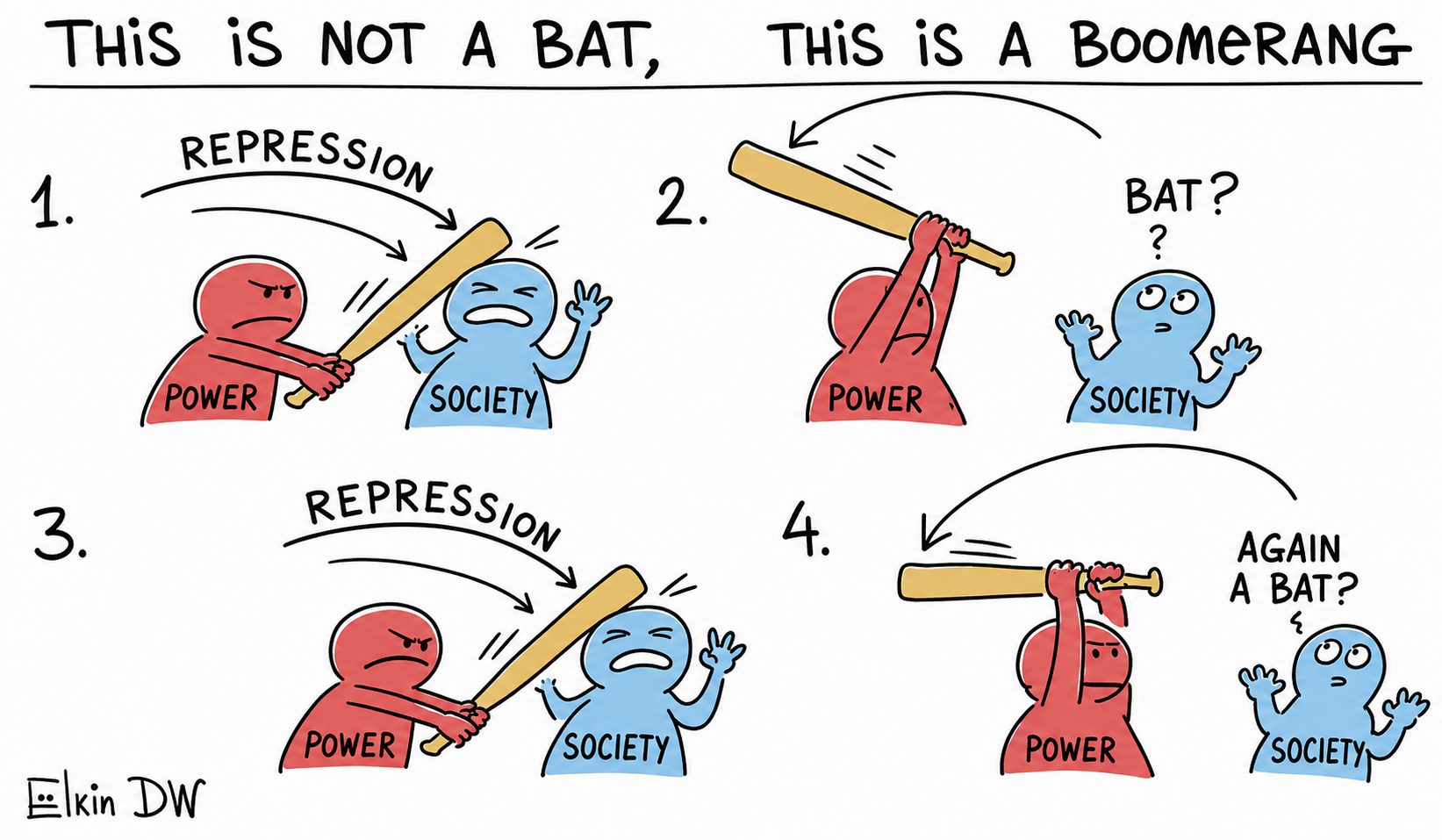
During the failure of the putsch, 33 years ago, I believed in the beautiful Russia of the future (BRF). Now I don’t. To paraphrase Disraeli’s famous expression: back then, not to believe in the BRF was to have no heart; now, to believe in it is to have no head.
The Russian liberal is eternally and unrequitedly in love, like with Blok’s Beautiful Lady, with the beautiful Russia of the future. But the BRF is only a mirage, a hallucination that taunts and inflames the imagination, but vanishes when attempting to approach it.
Periodically, it seems to Russian liberals that the BRF is very close, but time and again they find themselves deceived in their hopes. Liberals in Russia are being beaten once more. However, they are incorrigible and do not learn from their mistakes. If, by analogy with the famous biblical image, an eternal Russian liberal existed, he would have managed to joyfully welcome the reforms of Alexander II, only to go into internal emigration during the counter-reforms of Alexander III, taken heart at the October Manifesto of 1905 and fallen into despondency during the years of subsequent reaction, experienced euphoria during the February Revolution of 1917, and then ended up in a Bolshevik concentration camp, hopefully welcomed the Khrushchev Thaw, and emigrated under Brezhnev. The eternal Russian liberal became filled with hope during Gorbachev’s Perestroika and Gaidar’s reforms. However, soon the old oppression returned again with tripled force. And even after this, the liberal continues to wait for a free, beautiful Russia of the future.
The Russian Empire (whatever it may be called) cannot, a priori, become a free country. Its entire history convincingly demonstrates this. The peoples inhabiting the empire (including the Russian people) can become free only after its final collapse. Yeltsin was very proud of having preserved the RF. He said that of all the politicians from the time of his presidency, he was most grateful to Shaimiev, who stopped the process of Tatarstan’s exit from the RF that had begun, thereby preventing its collapse as a result of a chain reaction. Now it is clear that Shaimiev, by betraying the movement for Tatarstan’s independence, helped Yeltsin preserve the empire, infected with the ancient bacilli of external expansion and internal slavery, which actively manifested themselves under Putin.
Russian liberals have always spoken of freedom and at the same time wanted to preserve the empire. Pavel Milyukov, the patriarch of Russian liberalism, wrote after the start of Soviet aggression against Finland: “I feel sorry for the Finns, but I am for Vyborg Province”. If you want Vyborg Province — then learn to love Stalin’s boot.
Many liberals still do not understand that the Russian Empire (falsely named the Russian Federation) and freedom are incompatible. Freedom can come to current Russian territory only as it did to post-war Germany or Japan — after defeat in the war and the collapse of the colonial empire. If you want freedom for the residents of modern Russia, do not deceive people with the mirage of the BRF; help the empire lose the war and die19.
Cons
However, the collapse of Russia has a number of cons that do not allow calling this option a priority.
The first con is the controversial experience of 20th-century decolonization. Its problem was that a large number of the formed states did not become democracies, and the UN now has a huge number of authoritarian countries voting for reactionary initiatives. If, in the event of Russia’s collapse, a large number of states are formed, they will most likely become authoritarian (given the cultural level of modern Russia, these will most likely be many entities similar to the DPR and LPR). This means that in the UN (where they will most likely soon be admitted), reaction will gain significantly more votes. And this is a big problem.
The second con is that upon the country’s collapse, many Russians will end up in non-Russian republics, and citizens of non-Russian ethnicity will end up in Russian ones. This is the “bomb” that statists deliberately plant under the country in order to make the potential exit of republics fraught with great problems and force those who initiated and supported these processes to “regret” it. They work to ensure that, in the event of their defeat, the peoples of Russia pay with great blood for this. This con could lead to an increase in clashes on ethnic grounds and the infringement of the rights of representatives of the ethnicity that loses in the struggle for power in the newly formed republic. Something similar happened in Algeria: a quarter of Algeria’s population were pieds-noirs, European settlers. And Algeria’s secession turned into great blood and a forced population exchange.
The third con is that the democratic world in this case will lose the chance to gain a tangible force in the confrontation for control over Asia and the Middle East. A democratic Russia could become a strong player capable, in alliance with Japan and South Korea, of confronting China and the DPRK in the region on equal terms. And in alliance with Israel, with moderate support from Turkey and Saudi Arabia, the Iranian regime could be relatively easily defeated and at least relative democratization of the Middle East carried out. A democratic Russia would almost immediately strongly influence the situation in Central Asia, the South Caucasus, and the Republic of Belarus. Republics formed as a result of decolonization, on the other hand, might themselves fall under the influence of the region’s authoritarian regimes — economic, informational, political.
Different views on this point exist in the editorial office of “Logika Progressa”. Thus, some of the authors believe that “Russia will definitely not become a democracy, at most a hybrid regime. And such a regime will not be a full-fledged ally of the West, at most a situational one. This would suit Western countries, but it does not suit consistent democrats”.
The fourth con is more pronounced resistance to globalization processes. New republics could spread their languages, their measurement systems, their currencies, introduce new borders, and so on — this dismantles many achievements in standardization and overcoming barriers between people. This could also stimulate nationalism. Of course, if the republics are democratic, the borders between them will be like those inside the European Union, that is, not even as harsh as inside modern “united” Russia, and if they are progressive, then one should not fear a threat to standardization. However, both of these are unlikely in most cases at the present moment.
The fifth con is that in the event of aggression by, for example, China or the DPRK, individual republics will be more vulnerable and less capable of defense than Russia as a whole.
Finally, the sixth con (though it is not certain to be permanent) is that as of today, there are almost no prerequisites for the secession of the republics. A democratic coup in the center of the country is even more likely than a real secession of territories. Accordingly, it is more reasonable to support a course toward changing the central government while preserving the unity of territories. However, the situation can change rapidly. Empires collapse suddenly, and often people do not even particularly notice the processes that lead to their destruction. Only years and decades later does everything become obvious. The USSR collapsed in a relatively short time. Before that, only a few saw the prerequisites for its collapse.
Debatable statements
Some other considerations are also voiced against the decolonization of Russia, which, however, cannot be considered well-founded.
The first of them is that wars could start between the republics, the so-called “Yugoslav scenario”. Yes, this could happen. However, what will change in this case? Russia is already constantly waging wars to restore the USSR, and people from different regions of the country are sent to them. Wars are already underway, and we already have the “Yugoslav scenario” implemented. Russia is already attacking Georgia, Ukraine, and sending troops into Kazakhstan. It is constantly waging wars of conquest. So regardless of whether decolonization happens or not, its population could constantly be sent to war. The only difference is that regions could appear on the territory of Russia that are not involved in wars at all.
The second consideration is that very many people, including in democratic countries, fear that nuclear weapons “could end up in unreliable hands”. Again — what will change? They are already in the hands of absolutely unreliable, criminal people, that is, in the hands of “thugs” who threaten the world with nuclear weapons and blackmail the entire world with them20. Putin’s regime is capable of starting a nuclear war if it senses a severe threat to itself. So regardless of whether decolonization happens, nuclear weapons will be in unreliable hands. The only difference is that in the event of its collapse, fewer nuclear weapons might end up in unreliable hands.
As we can see, the issue under consideration is very multifaceted, and therefore it is difficult to give a universal answer to it. It would be most reasonable to say here that under different circumstances, the correct answers will also differ. The maximum plan is the establishment of democratic power in Moscow and the subsequent democratization and real federalization of all of Russia. This plan has the fewest cons and it is the priority. This is what we must strive for. At the same time, part of the editorial staff of “Logika Progressa” considers it as unrealistic as possible.

So we must proceed from realities. This option is the most difficult. The opportunity for its realization may not present itself. At the same time, the most diverse situations can actually arise. Let us consider for example two situations — the secession of one of the territories under democratic slogans and a rebellion of local petty dictators.
In the first case, let’s assume that the hypothetical Kaliningrad Region, Saint Petersburg, Dagestan, or the Black Earth Region proclaim secession from the Russian Federation and there is at least a remote chance that a democratic system will be built there. Should social democrats support this secession? Undoubtedly. The very idea that it is better that none of the Russians live under democracy than at least 5% is Russophobic, misanthropic, and reflects a slave mindset. Naturally, a person with a slave mindset will manage to come up with hundreds of excuses for this — “what if it doesn’t work out” (then let them sit under the rule of Putin’s regime, in case it’s not possible to overthrow it), “it’s better to democratize all of Russia” (who’s arguing, but in a specific situation such an opportunity is completely illusory, while another is real), “I don’t trust the forces conducting this secession” (then let them sit under the rule of Putin’s regime and wait for Prince Charming like an infantile lady), and so on. But the main essence is one — it is better that at least 5% of Russians live in a democracy than 0%. Therefore, social democrats are obliged to support such a secession or even come to the defense of such an entity.
At the moment, there is a very low probability of such a secession. However, Russian formations within the Armed Forces of Ukraine, such as the Freedom of Russia Legion, Sibir Battalion, and the Russian Volunteer Corps (RVC), acting together, are capable of organizing it under certain conditions. We cannot fail to support such activity on their part; moreover — we must stimulate it.

Another case — the republics begin to secede from the RF, but this secession is initiated by local petty dictators. What should be done here? We should neither support this secession nor resist it. We need to work on changing the power in Moscow and use this secession as further proof of the incompetence of the government, which incites interethnic strife. Naturally, one should not try to return these republics to Russia by force. This is irrational even when the use of military force is morally justified. For example, if a dictatorial regime was established in one of the seceded republics, citizens came out to protest with democratic demands, the dictator went to suppress the protest, our citizens for the most part approve of intervention, and we have the military force that would allow removing the dictator with minimal losses — even in this case, after the successful completion of the operation, there is no point in returning the territory to Russia.
Under all favorable accompanying circumstances, the maximum intervention that is permissible is sending in troops to overthrow the authoritarian regime and assist local democrats in establishing democratic rule (along the lines of US military operations). Then, with this new democratic regime, it will be possible to agree on open borders and a single economic space while maintaining political independence. The annexation of these territories to Russia, on the other hand, is a clear signal to the entire international community and to imperial forces that the new Russia has taken an imperial course. This will be the beginning of the complete collapse of the new democracy in the country.
Conclusion
Summing up, we can conclude that social democrats do not want the collapse of Russia into different states, but are not so foolish as to sacrifice civil liberties or standards of living for the sake of “unity of the state”. A democratic Russia is the priority goal, but democracy in part of it is much better than an authoritarian and unified Russia. Therefore, the question of decolonization does not have an unambiguous answer — the answer to it very much depends on the input data. It is one thing if we are talking about the secession of a colony from an authoritarian metropole with a high chance of democratization. Another — if about the secession of an authoritarian colony from an equally authoritarian metropole. A third — if we are talking about the secession of a colony from a democratic metropole. Here, too, much depends on how high the level of democracy and life in the colonies is, as well as on how the secession occurs. It is one thing if a referendum was held, as was the case in Scotland, people voted against secession, and local separatists accepted this. Another thing — if a military clash is inevitable. As we can see, there are a huge number of nuances in the issue of decolonization. But in any case, the main thing for us in each specific situation is the maximum possible implementation of our values, regardless of whether it takes place in a unified or separate country.
- Decolonization // Encyclopaedia Britannica (www.britannica.com). [Electronic resource]. URL: https://www.britannica.com/topic/decolonization (Accessed: 05.10.2024).
- Decolonization // Cambridge Dictionary (dictionary.cambridge.org). [Electronic resource]. URL: https://dictionary.cambridge.org/dictionary/english/decolonization (Accessed: 05.10.2024).
- Decolonize // Merriam-Webster (www.merriam-webster.com). [Electronic resource]. URL: https://www.merriam-webster.com/dictionary/decolonize (Accessed: 05.10.2024).
- Decolonization of Russia to Be Discussed at Upcoming Helsinki Commission Briefing // Commission on security and cooperation in Europe (www.csce.gov). June 21, 2022, 15:58. [Electronic resource]. URL: https://www.csce.gov/press-releases/decolonization-of-russia-to-be-discussed-at-upcoming-helsinki-commission-briefing/ (Accessed: 05.10.2024).
- K.I. Kosachev. Non-legal council // Federation Council of the Federal Assembly of the Russian Federation (council.gov.ru). April 22, 2024. [Electronic resource]. URL: http://council.gov.ru/services/discussions/blogs/155842/ (Accessed: 05.10.2024).
- Decolonization // Encyclopaedia Britannica (www.britannica.com). [Electronic resource]. URL: https://www.britannica.com/topic/decolonization (Accessed: 05.10.2024).
- British Empire // Encyclopaedia Britannica (www.britannica.com). [Electronic resource]. URL: https://www.britannica.com/place/British-Empire (Accessed: 05.10.2024).
- The Commonwealth // The official website of the Royal Family (www.royal.uk). [Electronic resource]. URL: https://www.royal.uk/the-commonwealth (Accessed: 05.10.2024).
- Barbados becomes a republic and parts ways with the Queen // BBC (www.bbc.com). November 30, 2021. [Electronic resource]. URL: https://www.bbc.co.uk/news/world-latin-america-59470843 (Accessed: 05.10.2024).
- French empire // Oxford Reference (www.oxfordreference.com). [Electronic resource]. URL: https://www.oxfordreference.com/display/10.1093/oi/authority.20110803095835170 (Accessed: 05.10.2024).
- M. Cartwright. Portuguese Empire // World History Encyclopedia (www.worldhistory.org). July 19, 2021. [Electronic resource]. URL: https://www.worldhistory.org/Portuguese_Empire/ (Accessed: 05.10.2024).
- Decolonization // Encyclopaedia Britannica (www.britannica.com). [Electronic resource]. URL: https://www.britannica.com/topic/decolonization (Accessed: 05.10.2024).
- Gerardo Machado y Morales // Encyclopaedia Britannica (www.britannica.com). [Electronic resource]. URL: https://www.britannica.com/biography/Gerardo-Machado-y-Morales (Accessed: 05.10.2024).
- Fulgencio Batista // Encyclopaedia Britannica (www.britannica.com). [Electronic resource]. URL: https://www.britannica.com/biography/Fulgencio-Batista (Accessed: 05.10.2024).
- Fidel Castro // Encyclopaedia Britannica (www.britannica.com). [Electronic resource]. URL: https://www.britannica.com/biography/Fidel-Castro (Accessed: 05.10.2024).
- V.A. Tyurin, G.A. Shatokhina-Mordvintseva. Dutch colonial empire // Great Russian Encyclopedia. Volume 22. Moscow, 2013, pp. 605-606
- Matthew G. Stanard. Belgian Colonial Rule // Oxford Bibliographies (www.oxfordbibliographies.com). [Electronic resource]. URL: https://www.oxfordbibliographies.com/display/document/obo-9780199846733/obo-9780199846733-0107.xml (Accessed: 05.10.2024).
- The Free State of the Congo, a hidden history of genocide // Barcelona City Council (www.barcelona.cat). [Electronic resource]. URL: https://ajuntament.barcelona.cat/gabinetpostal/lestat-lliure-del-congo-un-genocidi-a-lombra/?lang=en (Accessed: 05.10.2024).
- I. Eidman. The Empire Must Die // Telegram (t.me). August 20, 2024, 12:59. [Electronic resource]. URL: https://t.me/igoreidman/1680 (Accessed: 05.10.2024).
- M. Starchak. Blackmail on the Brink of the Possible. Where Russia’s Nuclear Threats Lead // Carnegie Berlin Center (carnegieendowment.org). June 11, 2024. [Electronic resource]. URL: https://carnegieendowment.org/russia-eurasia/politika/2024/06/russia-nuclear-war-threats?lang=ru (Accessed: 05.10.2024).