
Political structure of Germany
Germany is one of the most developed and democratic countries in Europe, which, like Russia, has gone through difficult times, and yet has managed to achieve great success, including in matters of organizing its political structure. And despite many differences, Russia as a federation can draw on Germany's experience to build a new, more effective model of political structure.
We continue to examine the political structure of countries that are successful in terms of implementing progressive values, and following the article on the structure of Switzerland, we will analyze the Federal Republic of Germany (FRG). Germany ranks 6th in the world in the Human Development Index1 and 17th in GNI per capita at PPP2 (Russia ranks 52nd and 55th, respectively). Germany is also particularly interesting because it ranks 4th in the world by nominal GDP3. This means that the organization of production in this country is at a very high level. In many ways, all these achievements are the result of well-established institutions, including political ones. How are they structured?
First, let’s outline the system briefly so that it is easier for the reader to understand later. The supreme power in Germany is held by the legislative body (parliament). De facto, it consists of two parts — the Bundestag (elected directly, partly through a majority and partly through a proportional electoral system) and the Bundesrat (formed by the governments of the States — as the regions are called — of which there are 16 in Germany). The legislative body forms the executive branch, i.e., the government, including the Federal Chancellor, who is considered by many to be the de facto main figure of the country, and the President.
Each of the 16 States has a local parliament — a district assembly (elected by citizens), and a local executive authority — a district administration (elected by the local parliament). There is also a local executive authority, appointed by the local parliament, for units slightly smaller than the States — the Government Districts. An even smaller unit is the counties (which can also include independent cities due to similar functions). There is a Kreistag (county council), which is elected by citizens, and an administration, which is formed differently in various counties. Following the counties comes the minimum unit — the communes (or municipalities, as well as their unions — associations of communities). They are elected by citizens.
Contents
Legislative body (Parliament)
Germany has a de facto bicameral parliament, the chambers of which are the Bundesrat and the Bundestag.
I. The Bundesrat (literally, the “Federal Council”4) is a body that participates in the legislative and administrative power of the Federation, according to Article 505 of the Basic Law of the FRG (in Germany, the Basic Law is roughly the same as a constitution in other countries). This body is not directly elected by citizens, as it consists of members of the State governments, who appoint them from among their number and recall them (these government members are mostly deputies appointed to the government by the parliaments of the States, which in turn are elected by the citizens of the States).
The number of these members from the States varies depending on the population size of the region, according to Article 51.2 of the Constitution of the FRG:
- Up to two million people (Bremen, Hamburg, Saarland, Mecklenburg-Western Pomerania) – 3 deputies;
- From two to six million (Berlin, Brandenburg, Rhineland-Palatinate, Saxony, Saxony-Anhalt, Schleswig-Holstein, Thuringia) – 4 deputies;
- From six to seven million (Hesse) – 5 deputies;
- Over seven million (Bavaria, Baden-Württemberg, Lower Saxony, North Rhine-Westphalia) – 6 deputies.
The remaining members of the State governments are usually designated as alternates for the members of the Bundesrat, so that virtually all members of the governments are included in the composition of the Bundesrat6, which amounts to 170 people. The members of the Bundesrat themselves cannot vote independently, meaning that the members of each group of representatives from a State must vote together — otherwise their vote is not counted (Article 51.3). To pass a necessary decision, an absolute majority is required, which constitutes 35 votes, while a qualified majority (of two-thirds of the votes), required at times, constitutes 46 votes. No remuneration is paid for work in the Bundesrat. As compensation for official expenses, members of the Bundesrat are paid per diem allowances and reimbursed for travel expenses (and they are also entitled to free tickets for rail transport).
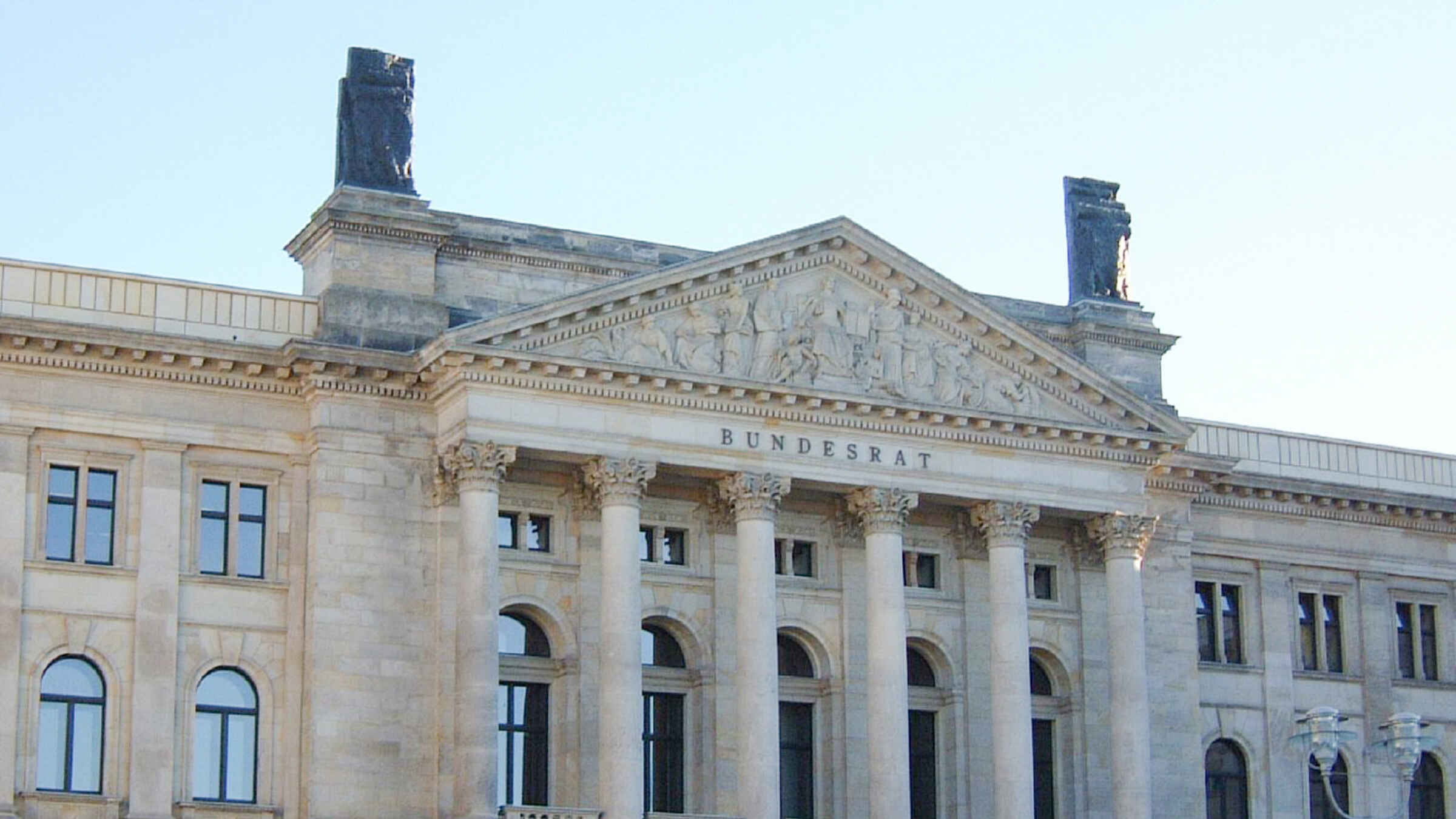
In accordance with Article 53 of the Basic Law, members of the Bundesrat enjoy a special privilege: they are granted the right to participate in all meetings of the Bundestag and its committees, where they are entitled to take the floor at any moment. Furthermore, this right extends to the “commissioners” whom they send there as their deputies. Deputies of the Bundestag do not have such opportunities for obtaining and providing information in the Bundesrat. The Bundesrat has several functions, here are the main ones:
1) Oversight of bills. All bills pass through the Bundesrat, and they can be divided into three parts:
- Laws amending the constitution. These require the consent of the Bundesrat by a two-thirds majority;
- Laws affecting the budgets of the States. Regarding the revenue part, this includes all tax laws under which the States and communes receive revenue into their budgets — for example, income tax, value-added tax, trade tax, and motor vehicle tax. Regarding the expenditure part — all federal laws concerning the obligations of the States to provide monetary payments, benefits in kind, or other similar services to third parties;
- Laws affecting the sovereignty of the States in the area of the organization of structures and activities of the executive branch.
The Bundesrat is assisted in this task by 16 permanent committees, including the Committee on Education and Science, the Committee on Internal Affairs, and the Committee on European Union Affairs. The response of the Bundesrat often reads: “no objections”, its members may also propose to amend or supplement a bill, and only occasionally is a bill rejected completely, which, nevertheless, can be later introduced by the Federal Government for consideration in the Bundestag.
If a conflict arises between the Bundesrat and the Bundestag, a Mediation Committee is convened, which consists of 32 members, 16 from each chamber, and which is authorized to formulate proposals for amending the bill — in this case, the amended bill is introduced to the Bundestag. If the mediation committee does not formulate any amendments, the bill is sent again in its original form (as a rule, with explanations from the mediation committee) to the Bundesrat, which makes the corresponding decision — to agree to or reject the bill.
2) Right to propose bills. The Bundesrat has the right to introduce bills to the Bundestag. The corresponding drafts are sent to the Federal Government to provide it with an opportunity to formulate an opinion. Within six weeks, or in special cases within three or nine weeks, the Federal Government must then forward them to the Bundestag. There, these bills go through the same procedure as bills of the Federal Government or bills initiated within the Bundestag itself.
3) Oversight of the executive branch. For most ordinances of the Federal Government and federal ministries individually, the consent of the Bundesrat is strictly required. The government is also obliged to keep the Bundesrat “informed of current affairs”. Not only government ordinances but also a multitude of General Administrative Regulations intended for executive branch structures depend on the consent of the Bundesrat if they affect the prerogatives of the States.
4) Oversight concerning the EU. The Bundesrat, and through it the States, participates in formulating the federation’s positions on matters concerning the European Union. Therefore, the Federal Government is called upon to notify the Bundestag and the Bundesrat in a timely and comprehensive manner of all steps planned by the European Union. The Bundesrat, and in urgent cases its Chamber for European Affairs, conduct detailed discussions of draft regulations and directives of the European Union in committees, after which they send their opinion to the EU.
If EU regulatory acts affect the federation, the Federal Government should take the position of the Bundesrat into account in its “Brussels” decisions. If the core provisions of a bill affect the legislative powers, structure, or activity of the authorities of the States, then, since the “authoritative opinion” of the Bundesrat must be reckoned with, it retains the final say in determining Germany’s position in the EU Council of Ministers. If the Bundesrat and the Federal Government cannot agree, the position of the Bundesrat prevails, provided that it is based on a decision that received a two-thirds majority. However, the Bundesrat cannot make a final decision to increase expenditure or reduce the revenue of the federation. In such cases, the German position determined by the Bundesrat requires the consent of the Federal Government.
If the main sections of an EU regulation affect the exclusive legislative powers of the States in the fields of school education, culture, or broadcasting, the Federal Government must transfer the conduct of negotiations at the EU level and the right to vote to one of the state ministers designated by the Bundesrat.
5) Oversight of international treaties. The law ratifying a treaty between states requires the Consent of the Bundesrat if, in accordance with the provisions of the Basic Law, the consent of the Bundesrat would be required for the adoption of a domestic legal act of the same content. By imposing a veto, that is, by withholding its approval, the Bundesrat can prevent an international agreement from entering into force for Germany.
6) Elects half of the composition of the Federal Constitutional Court.
7) Entitled to nominate and approve candidates for a whole range of posts. For example, only with the approval of the Bundesrat can candidates be proposed to the Federal President of Germany for appointment to the posts of the Attorney General of Germany, federal prosecutors, and members of the Executive Board of the German Federal Bank “Deutsche Bundesbank”.
8) Special powers. If the Federal Chancellor has lost the confidence of the Bundestag, but dissolution of the Bundestag has not occurred, the Federal Government is entitled, within a complex procedure, to enact laws with the consent of the Bundesrat, meaning it becomes a “legislative reserve” in case of the incapacity of the Bundestag.
Let us now talk about the body as a whole. Although it resembles an upper chamber of parliament, it actually differs significantly from its counterparts — the upper chambers of parliaments in other countries, including those with a federal structure. As the Constitutional Court of Germany pointed out back in 1974: “In accordance with the norms of the Basic Law, the Bundesrat is not a second chamber of a single legislative body that participates in the legislative process fully and on an equal footing with the ‘first chamber’ — the Bundestag”7. On the whole, it contains elements of an upper chamber, but on the other hand, the Bundesrat is not an equal participant in the legislative process, and it also possesses competence not only in the legislative sphere but also in the executive sphere8; furthermore, no exclusive sphere of competence belonging to it alone and to no one else is assigned to this body.
It can be said that this is a special administrative body, which is not only an organ of control over the branches of power but also a link between the authorities of the States and the Federation.
II. The Bundestag (Federal Assembly) is the lower and de jure sole chamber of Germany. In theory, there are 598 seats in the Bundestag, and accordingly 299 people are elected under a majority system (that is, candidates are chosen directly), and 299 under a proportional system (that is, a list of candidates is chosen). Therefore, every resident of Germany has 2 votes:
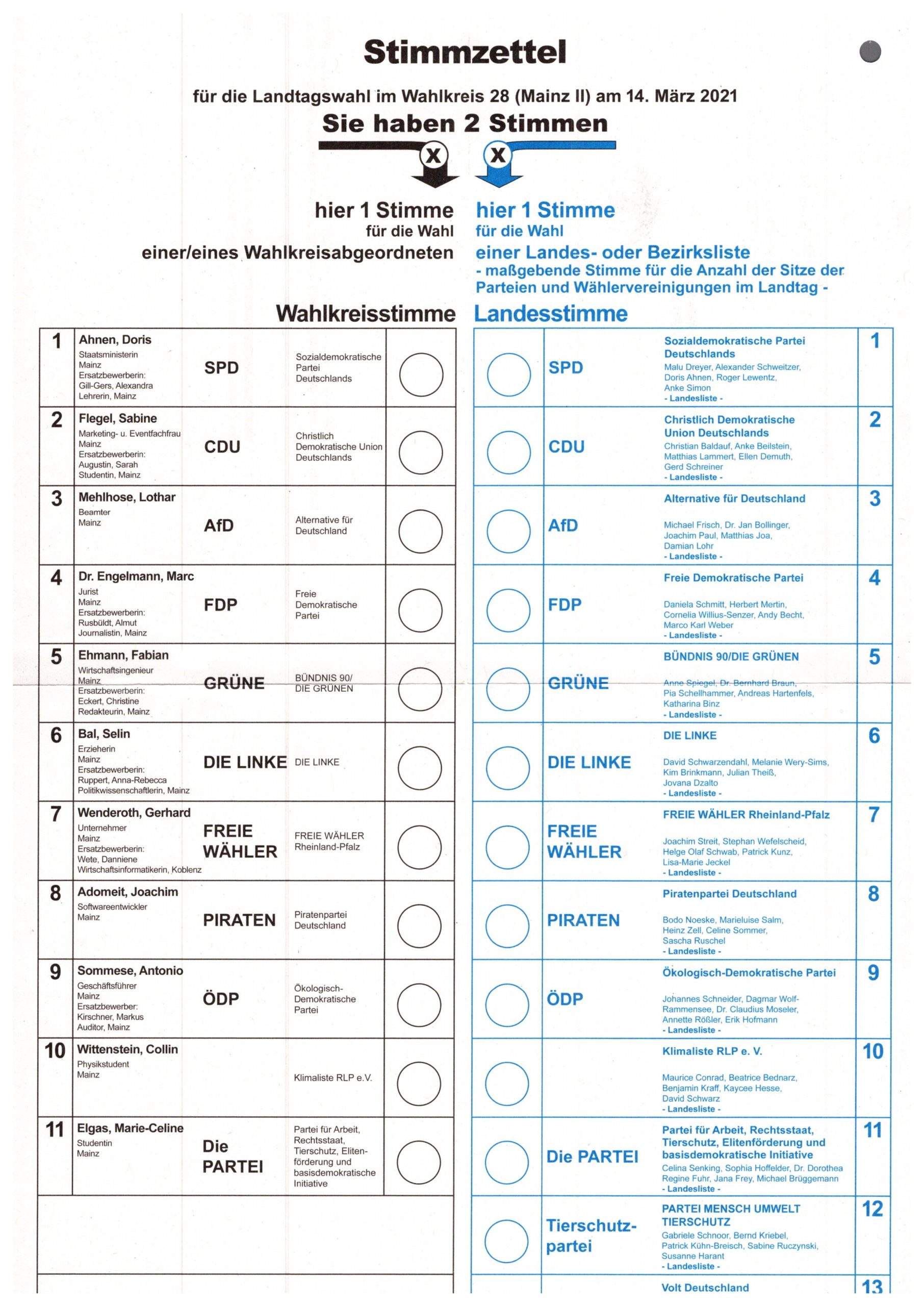
- The first — when they vote for candidates;
- The second — when they vote for a list of candidates.
But if you look at the number of seats as of March 27, 2021, there are as many as 709 seats.

Why, exactly, is this so? It is all due to the German system, in which the second vote, namely the vote for a list, is of greater importance because it determines the balance of power in the country. On this basis, in addition to the regular seats for deputies, two more types are distinguished:
1) Overhang seats. These seats appear if a party in one of the States has obtained more seats in the Bundestag for its candidates via the first votes than it was entitled to have in that State based on the results of the second-vote count. What if there are fewer first votes and more second votes? If, for example, a party in a federal State received ten mandates according to its share of second votes and achieved four direct mandates in the same State, then only six seats remain, which go to the candidates of this party from the State party list.
Why were such seats introduced? In a mixed electoral system, it is not uncommon for one of the parties — due to the success of its candidates in single-member constituencies — to receive more mandates in individual federal States than it would be entitled to by the number of second votes. A candidate who has directly won the election in their constituency cannot be deprived of a seat in parliament. This is how overhang mandates arise. In principle, this can help small parties occupy a certain number of seats (if they have passed the thresholds in terms of the number of seats and the percentage of support). As a result, a party receives a disproportionately large number of seats in the Bundestag, which led to disputes within the FRG itself and the emergence of the second type of mandates.
2) Compensatory or leveling seats. These seats were introduced in 2013 because the Federal Constitutional Court of Germany deemed that the presence of “overhang seats” violated the constitutional guarantee that the electoral system be equal and direct. The old system was opposed by members of the SPD and Alliance 90/The Greens, as well as more than 3,000 citizens of the FRG. The purpose of these seats is that overhang seats will be compensated for by providing compensatory seats (leveling mandates) to the extent that will ultimately ensure a distribution of seats proportional to the results of the second-vote count.
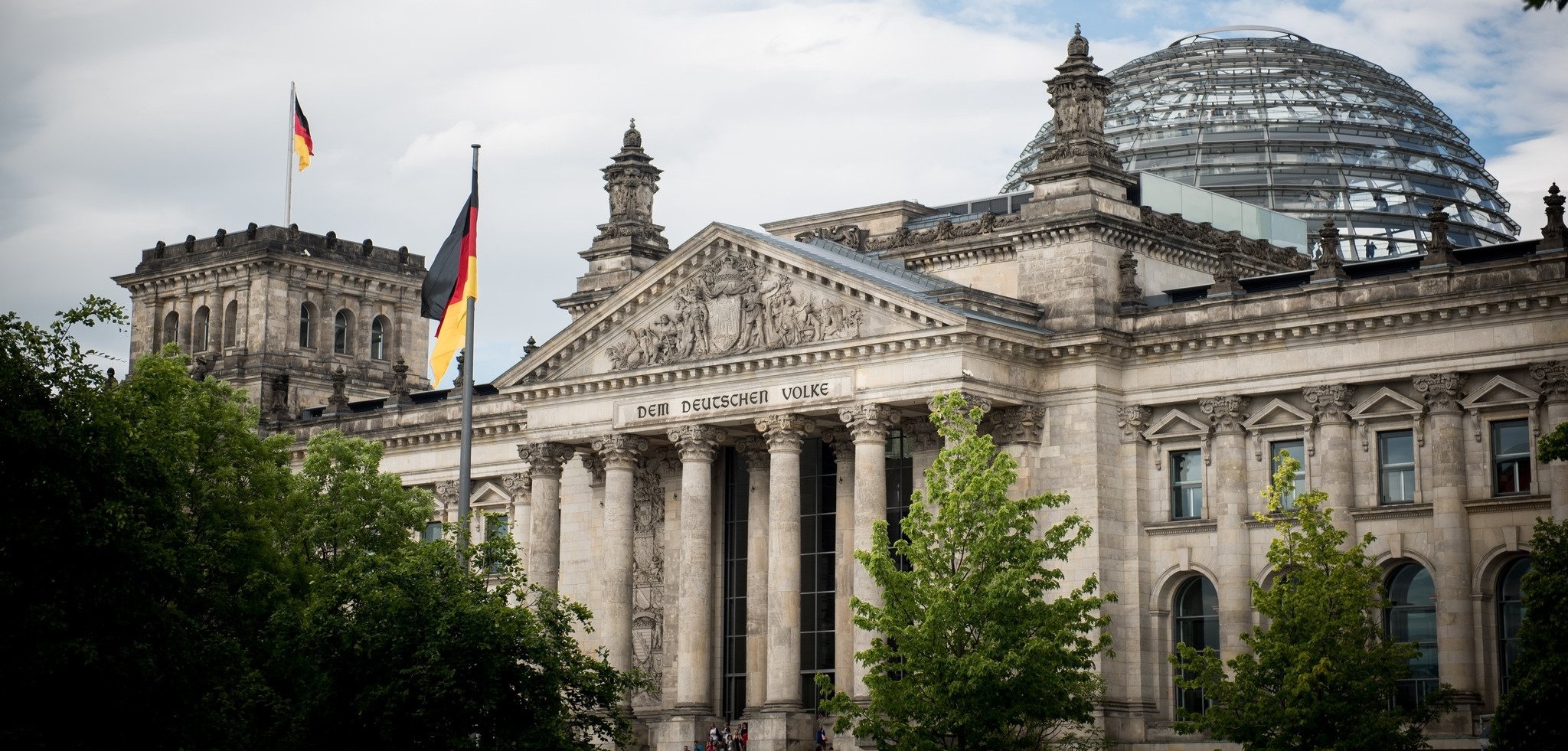
Every party that wants to enter the Bundestag must win at least five percent of the second votes nationwide (this is a percentage barrier that prevents minor parties from entering parliament, in order to avoid fragmentation of the party system, which could weaken parliament). The only exception: if a party wins at least three direct mandates, it enters the Bundestag regardless of the five percent barrier, with its share of second votes received.
As a result, due to 111 overhang seats as of March 27, 2021, everything looks as follows: 299 elected under the majority system, and 410 under the proportional system.
One can vote from the age of 18, provided that they have lived directly in Germany for the last three months; one can also be elected to the Bundestag from the age of 18.
Powers of the Bundestag9:
1) Legislative function. The federal parliament has exclusive legislative power over the following matters (Article 73):
- Foreign affairs and defense, including protection of the civilian population;
- Citizenship in the Federation;
- Freedom of movement, passports, immigration, emigration, and extradition;
- Currency, money, and coinage, weights and measures, and the determination of standard time;
- The unity of the customs and trading area, treaties on commerce and navigation, the free movement of goods, and international trade and payments, including customs and border security;
- Air transport, as well as rail transport owned wholly or predominantly by the Federation (federal railways), the construction, maintenance, and operation of track installations of federal railways, and the levying of charges for the use of such installations;
- Postal and telecommunications services;
- The legal relations of persons employed by the Federation and by federal corporations under public law;
- Industrial property rights, copyrights, and publishing law;
- Cooperation between the Federation and the States concerning criminal police work, protection of the free democratic basic order, or of the existence and security of the Federation or of a State (protection of the Constitution), and protection against activities within the federal territory which, by the use of force or actions preparatory to the use of force, endanger the external interests of the Federal Republic of Germany, as well as the establishment of a Federal Criminal Police Office and international crime control;
- Statistics for federal purposes.
At the same time, the States (regions of Germany) may possess these powers when authorized by federal law (Article 71).
2) Elects public officials10:
- The Chancellor, that is, the head of government (but does not appoint them; this is done by the President, according to Article 63 (2)). In Russia, this figure is the Chairman of the Government, and in many other countries, the prime minister;
- Half of the judges of the Federal Constitutional Court;
- The President and Vice-President of the Federal Court of Audit;
- The Federal Commissioner for Data Protection and Freedom of Information.
3) Oversight functions. This is expressed in the fact that the Bundestag exercises control through responses to deputies’ questions from inquiries addressed to the government, from the “Question Time”, via committees of inquiry, and the institution of the Parliamentary Commissioner for the Armed Forces, whom the Bundestag instructs to exercise parliamentary oversight over the armed forces, which are called the “Bundeswehr”.
If the deputies do not like the work of the government, they can bring a motion of no confidence in the government. With the resignation of the Chancellor, the government also resigns. The question of a vote of no confidence in the Chancellor is voted on together with a proposal for a candidate for their successor. In turn, the Chancellor is entitled to put forward the question of a vote of confidence in the government. In the event of a negative response, it is expected, upon proposal of the Federal President, that either another person will be elected as Chancellor, or the Bundestag will be dissolved; at the same time, the dissolution of parliament is provided for in the event that a new Chancellor is not elected within 21 days.
4) Adopts the federal budget.
The Bundestag is elected for 4 years. It is also worth singling out conditionally two more bodies associated with the parliament:
1. The Federal Convention (Chapter V of the Basic Law for the FRG). A constitutional body that is needed for the election of the Federal President of the FRG. The Federal Convention consists of the members of the Bundestag and an equal number of members elected by the popular representations of the States on the principles of proportional representation, that is, the number of representatives is calculated and determined proportionally to the population of the State. It is elected under a system of an absolute majority, that is, to win, a candidate needs to gain 50%+1 vote. Such a system takes place in two rounds, but at the same time, in the second round, which is unique, this system also operates (usually in a second round a relative majority system is used, that is, a candidate is chosen by a simple majority). But if in the first two rounds of voting such a majority is not obtained by any applicant, the person who gathers the largest number of votes in the next round of voting is considered elected.
2. The Joint Committee (Chapter IV-a). It is formed in the event of a state of defense, which is declared by the Federal President of the FRG with the consent of the Chancellor, according to Article 115-a (4) (if the bodies are working normally, then according to Article 115-a (1) the Bundestag, with the approval of the Bundesrat, determines this upon the proposal of the government, but it requires a majority of 2/3 of the votes cast, at the same time not less than a majority of the votes of the members of the Bundestag), and this body replaces the Parliament of Germany. It consists of 2/3 of members of the Bundestag (they are appointed by the Bundestag on the basis of the representation of parliamentary groups, and they also cannot be members of the Federal Government) and 1/3 of members of the Bundesrat (each State must be represented by one member of the Bundesrat appointed by it, and these members are not bound by instructions). As a result, there are 48 people in the Joint Committee: 32 (2/3) from the Bundestag and 16 (1/3) from the Bundesrat.
Head of state
This is the Federal President of the FRG. As mentioned above, he is elected by the Federal Convention, and his term of office is 5 years. There is a maximum of two presidential terms. To become President, a person must be 40 years of age and hold the right to vote. According to Article 55, he may not belong to either the Government or the legislative body of the Federation or of a State; nor may he hold any other salaried office, engage in any commercial or professional activity, or belong to the management or supervisory board of any enterprise conducted for profit. Powers11:
- Article 82 (1). Signing laws, but at the same time he is the penultimate person to sign them (the law must also be signed by the chancellor, and after signing, laws are countersigned by the Federal President and published in the federal law gazette “Bundesgesetzblatt” (translated into Russian as “Федеральный вестник законов”)). In theory, the President has a right of veto; in practice, it is rarely applied and is most often connected with the president’s opinion that the law contradicts the Constitution12 (in total, this has happened 9 times, the last time — in 2020, when Frank-Walter Steinmeier refused to sign the “Hate Speech Act” due to concerns over its constitutionality13));
- Article 59. The Federal President represents the Federation in terms of international law. He concludes treaties with foreign states on behalf of the Federation. He accredits and receives envoys. Treaties which regulate the political relations of the Federation or relate to subjects of federal legislation require the consent or participation of the bodies competent in terms of federal legislation in the form of a federal law. For administrative agreements, the provisions relating to the federal administration apply mutatis mutandis;
- Article 60 (1). The Federal President appoints and dismisses federal judges, federal civil servants, officers and non-commissioned officers, except as otherwise provided by law;
- Article 60 (2). He exercises the power to pardon on behalf of the Federation in individual cases;
- Article 63 (1). Proposes a candidate for Chancellor to the Bundestag, and, if they are agreed upon, he appoints them. But there is a specific feature to this, which will be discussed in the “Government” section;
- Article 64 (1). Upon the proposal of the Chancellor, appoints and dismisses members of the government;
- Awarding certificates of honor on behalf of the Federation.
The President of the FRG is not the commander-in-chief; his role in peacetime is performed by the Federal Minister of Defence (Article 65-a), and in the event of a state of defense — by the Federal Chancellor (Article 115-b).
The President, however, does not possess great freedom, because according to Article 58, for the validity of orders and instructions of the Federal President, as well as according to Article 82 (1), for the validity of a law, their countersignature by the Federal Chancellor or by the competent federal minister is required.
What is a countersignature? A countersignature (from Latin contra — against and signo or assigno — to sign) — in a number of countries, the signing by a prime minister or authorized minister of a regulatory act of a head of state, giving this act legal force14. This allows control over the head of state, so that in theory they cannot seize power. This rule does not apply to the appointment and dismissal of the Federal Chancellor and the dissolution of the Bundestag, which will be discussed in the “Government” section.
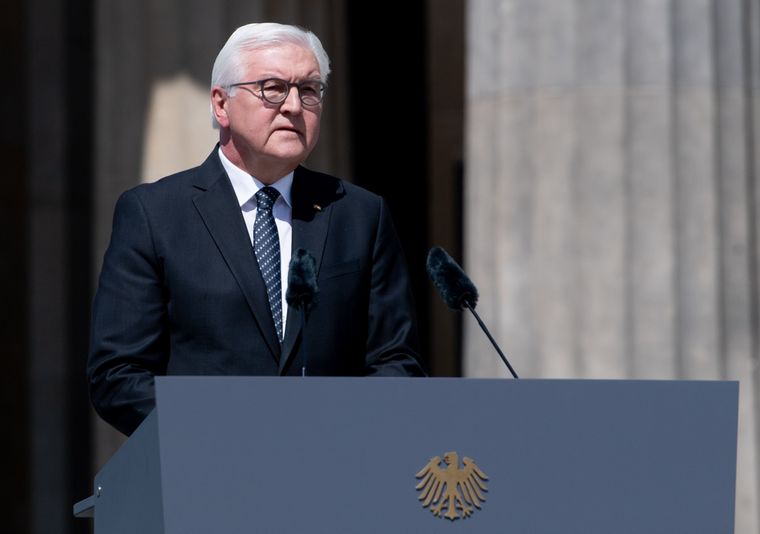
The Bundestag and the Bundesrat can dismiss the head of state, because according to Article 61, they may impeach the Federal President before the Federal Constitutional Court for willful violation of the Basic Law or of any other federal law. The motion to bring charges must be brought on behalf of at least 1/4 of the members of the Bundestag or at least one-fourth of the votes of the Bundesrat. The decision to impeach requires a majority — 2/3 of the members of the Bundestag or 2/3 of the votes of the Bundesrat. The case for impeachment is presented by a person authorized by the body that brought the charges. After impeachment, the Federal Constitutional Court may rule by an interim order that the Federal President is prevented from performing the duties of his office.
The Federal President himself can resign of his own free will. The powers of the Federal President in the event of any impediment or early vacancy of office are exercised by the President of the Bundesrat (Article 57).
Government (executive branch)
It consists of the Federal Chancellor and the federal ministers (Article 62). The Chancellor is the head of government of the FRG. He is elected by the Bundestag upon the proposal of the President by a majority of the votes of the deputies, and is subsequently appointed by the President, according to Article 63 (1) and (2). If the person proposed is not elected, the Bundestag may, within 14 days after the ballot, elect a Federal Chancellor by an absolute majority of the votes of its members (that is, 50%+1 vote), according to Article 63 (3). Under Article 63 (4), if no election has taken place within this period, a new round of voting shall be held without delay, in which the person who receives the largest number of votes shall be considered elected.
If the person elected gathers the votes of a majority of the members of the Bundestag, the Federal President must appoint him within seven days after the election. If the person elected does not receive such a majority, the Federal President has two options to solve the problem:
- Appoint him within seven days;
- Dissolve the Bundestag.
The Chancellor determines the general guidelines of policy and is responsible for them.
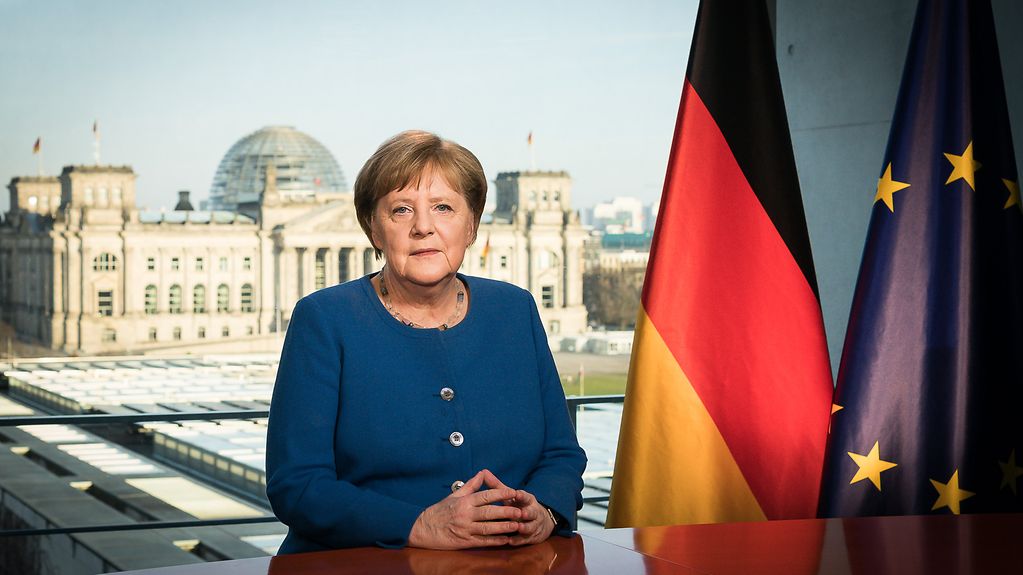
Federal ministers are the members of the government of the FRG. There are 15 of them in total:
- Federal Foreign Office;
- Federal Ministry of the Interior;
- Federal Ministry of Defence;
- Federal Ministry of Labour and Social Affairs;
- Federal Ministry of Education and Research;
- Federal Ministry of Food and Agriculture;
- Federal Ministry for Family Affairs, Senior Citizens, Women and Youth;
- Federal Ministry of Finance;
- Federal Ministry of Health;
- Federal Ministry of Justice and Consumer Protection;
- Federal Ministry for the Environment, Nature Conservation, Building and Nuclear Safety;
- Federal Ministry of Transport and Digital Infrastructure;
- Federal Ministry for Economic Affairs and Energy;
- Federal Ministry for Economic Cooperation and Development;
- Head of the Federal Chancellery (an agency within the structure of the executive bodies of the FRG whose task is to support the activities of the Federal Chancellor of Germany) — Minister for Special Tasks.
They are appointed and dismissed by the Federal President upon the proposal of the Federal Chancellor (Article 64 (1)). The Federal Chancellor also appoints one of the federal ministers as his deputy (Article 69 (1)).
Within these general guidelines, each federal minister conducts the affairs of his department independently and on his own responsibility. In the event of a difference of opinion between federal ministers, the Federal Government shall decide.
The government is accountable to parliament, and in the case of dissatisfaction with it, the members of the Bundestag may express their lack of confidence in the Federal Chancellor by electing a successor by a majority of its members and by requesting the Federal President to dismiss the Federal Chancellor, and the President must comply with this request and appoint the person elected. If a motion of the Federal Chancellor for a vote of confidence is not supported by the majority of the members of the Bundestag, the Federal President may, upon the proposal of the Federal Chancellor, dissolve the Bundestag within twenty-one days. The right to dissolve lapses as soon as the Bundestag elects another Federal Chancellor by a majority of its members.
The term of office of the ministers is tied to the work of the Bundestag itself, meaning that a new government is chosen after new elections.
States (regions)
Germany consists of 16 constituent entities, which are called States (Länder), but many have their own designations (Free State (Bavaria and Thuringia), Free Hanseatic City of Bremen, Free and Hanseatic City of Hamburg), yet they have more serious differences. The States are large entities of the Federation, which make up the majority (13 out of 16), as well as cities that hold the status of a State (Berlin, Hamburg, Bremen).
Unlike ordinary constituent entities, cities holding the status of a State do not have counties as an administrative-territorial unit (except for Bremen, which de facto consists of 2 cities (Bremen and Bremerhaven) or urban districts). Unlike regular cities, their city districts (or boroughs) possess government authorities.
The following can be cited as an example. Berlin, the capital of Germany, is divided into 12 administrative boroughs, and each of the boroughs has the following government authorities:
- Borough assembly of district councillors (Bezirksverordnetenversammlung). It is an organ of borough self-government; it exercises oversight over the borough administration, makes decisions on the borough budget, and decides on matters assigned to it (Chapter VI, Article 72 of the Constitution of Berlin15). It is elected by the residents of the borough (Chapter VI, Article 69 of the Constitution of Berlin). One can vote from the age of 16, for which it is necessary to reside in the borough, hold the right to vote, and have lived in Berlin for at least three months. EU citizens can also stand for election and be elected. The borough assembly consists of 55 members. Borough candidate lists for which less than three out of one hundred votes are cast do not receive seats (Chapter VI, Article 70 (2)). Their term of office is the same as that of the Berlin House of Representatives, which is 5 years;
- Borough office (Bezirksamt). The administration of the borough (Chapter VI, Article 74 (2)). It consists of the borough mayor and borough city councillors, one of whom is also elected as deputy mayor. The borough office must be formed in the borough assembly based on the nominations of the political groups in accordance with their proportional strength calculated by a special formula (Chapter VI, Article 74 (1)). The head of the office — the Borough Mayor — exercises supervision over the members of the borough office. Each borough city councillor bears personal responsibility for their work. The Borough Mayor is subordinate to the head of the city, i.e., the Governing Mayor (Chapter VI, Article 75 (2)). In case of disagreement among the members of the borough office, the borough office itself makes the decision. Borough assemblies can dismiss a member of the borough office before the expiration of their term of office by a two-thirds majority of the assembly representatives. Joint meetings of the Governing Mayor and the 12 borough mayors or their deputies as representatives are also held regularly, at least once a month, according to Chapter VI, Article 68 (2) (Council of Mayors).
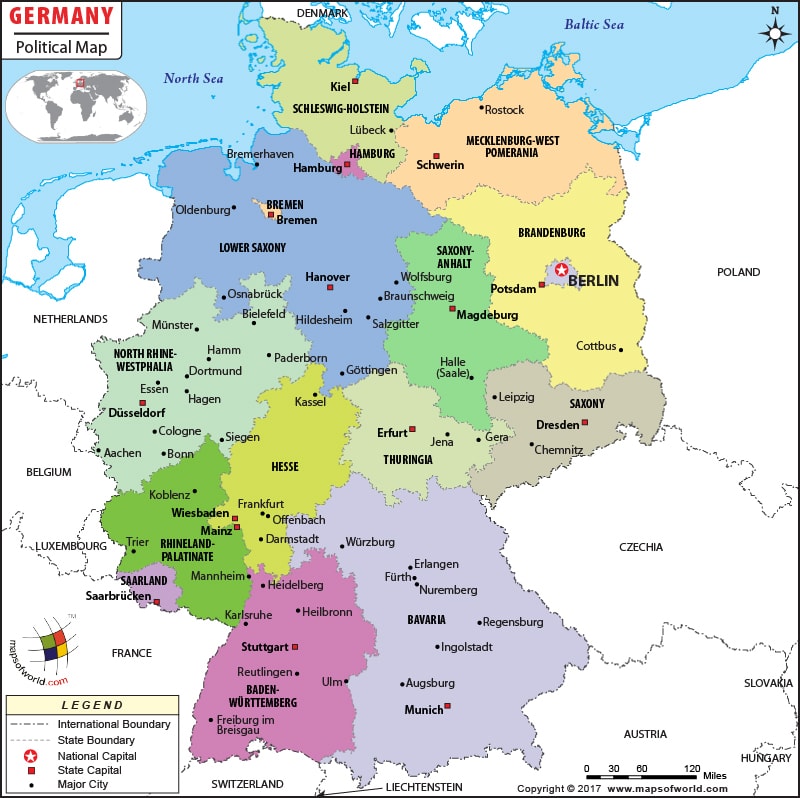
According to the powers that the States possess, 4 types can be distinguished (these are the powers of the regions that are prescribed in the Basic Law, which are handled by the authorities of the States).
1. Concurrent powers, or, as they are also called, competing powers (Article 74):
- Civil law, criminal law and execution of sentences, the court system, judicial procedure, the bar, the notary public and legal advice;
- Registration of births, deaths and marriages;
- The law of association and assembly;
- The law relating to the residence and establishment of aliens;
- The law relating to weapons and explosives;
- Matters concerning refugees and displaced persons;
- Public assistance;
- War damage and restitution;
- Benefits for war-disabled persons and surviving dependents and care of former prisoners of war;
- Graves of victims of war and graves of other victims of war and victims of totalitarian regimes;
- The law relating to economic affairs (mining, industry, energy, crafts, trades, commerce, banking, stock exchanges and private insurance);
- The production and utilization of nuclear energy for peaceful purposes, the construction and operation of facilities serving such purposes, protection against hazards arising from the release of nuclear energy or from ionizing radiation, and the disposal of radioactive substances;
- Labour law, including the legal organization of enterprises, occupational safety and health and employment agencies, as well as social security, including unemployment insurance;
- The regulation of educational and training grants and the promotion of scientific research;
- The law of expropriation, insofar as it concerns matters mentioned in Articles 73 and 74;
- The transfer of land, natural resources and means of production to public ownership or other forms of public enterprise;
- Prevention of the abuse of economic power;
- The promotion of agricultural production and forestry, ensuring the security of the food supply, the importation and exportation of agricultural and forestry products, deep-sea and coastal fishing and coastal preservation;
- Real estate transactions, land law (except the right to participate in land development) and agricultural leases, housing, settlements and homesteads;
- Measures against communicable diseases and diseases that constitute a public hazard affecting humans and animals, admission to the medical and other health professions and to the practice of the healing arts, as well as trade in medicines, drugs, narcotics and poisons;
- Economic security of hospitals and the regulation of hospital hospitalization fees;
- Protection of the food supply and food industry, consumer goods, fodder, agricultural and forestry seeds and seedlings, protection of plants against diseases and pests, and animal protection;
- Maritime and coastal shipping, as well as navigational aids, inland navigation, meteorological services, sea routes and inland waterways used for general traffic;
- Road traffic, motor transport, the construction and maintenance of long-distance highways, as well as the levying and allocation of fees for the use of public highways by vehicles;
- Railways that are not federal railways, with the exception of funiculars;
- Waste disposal, air pollution control and noise abatement;
- State liability (the Constitution does not specify exactly what this is; it presumably refers to liability regarding certain issues);
- Human artificial insemination, analysis and artificial alteration of genetic information, as well as the regulation of organ and tissue transplantation.
- Remuneration and pensions of persons in the public service who are subject to a public-law relationship of service and loyalty (Article 74-a). This refers to the civil service.
The Federation may pass laws itself for the purpose of ensuring uniform living conditions throughout the federal territory or preserving legal or economic unity in the interests of Germany (Article 72.2). If the Federation does not regulate it, then the regions can make their own decisions.
The state civil service is a type of public service; professional service activities of citizens to ensure the execution of the powers of the highest officials of the state and the bodies of legislative, executive, and judicial power16.
2. Deviating powers. According to Article 72 (1), in the area of concurrent legislative competence, the States shall have power to legislate only so long as and to the extent that the Federation has not exercised its legislative power. In the fields of nature conservation, university degrees and university admissions, among other things, state legislation may deviate from (i.e., modify or replace) federal legislation17. However, if necessary, federal bodies may take measures on specific matters.
3. Framework powers. These appear in exceptional cases, in the form of the Federation enacting framework provisions for the States in the following areas:
- The legal status of persons in the public service of the States, municipalities, and other corporations under public law, insofar as Article 74-a does not provide otherwise;
- The general principles governing higher education;
- The general legal status of the press and motion pictures;
- Hunting, nature conservation, and landscape management;
- Land distribution, regional planning, and water management;
- Registration of the population and identity cards;
- Protection of German cultural heritage against removal abroad.
If the provisions have been enacted, the States are obliged to pass their own laws within the period prescribed by law.
4. Exclusive powers. If matters are prescribed neither as powers of the Federation nor as concurrent powers, the States have the power to make decisions themselves (Article 70 (1)). They deal, for instance, with matters of internal security, school and higher education, culture, and municipal administration18. On the whole, Germany is not as “soft” as Switzerland, since there are very many concurrent powers here, but nevertheless, the States have certain distinct features; in particular, under Article 32 (3), they may, with the consent of the Federal Government, conclude treaties with foreign states (insofar as they have power to legislate).
Nationwide referendums on general political issues are not provided for by the Basic Law of the FRG19. This is connected both with the fear that the people will yield to political temptation, and with the disastrous experience of the Weimar Republic (as Germany was called from 1919 to 1933)20.
A referendum is mandatory if it concerns the adoption of a new Constitution for the whole country or a change in the administrative division of the federal structure. In such a case, it is held in the relevant constituent entities of the federation. For the most part, referendums are held in municipalities and on a State-wide scale (according to data from 2010, 3,280 referendums took place in the FRG, and only 18 times at the State level). Public polls are also used and popular initiatives exist, but in many States — for example, in Bremen (Article 71 of the Constitution of Bremen21), people have the opportunity to propose initiatives which, if the conditions are met, will become a referendum).
Regarding their political structure, they all have their own Constitutions, which must conform to the principles of a republican, democratic, and social state under the rule of law in the spirit of this “Basic Law”. Based on the Basic Law, the States have similar regional government authorities, though with their own minor differences from one another. Legislative power is represented by local parliaments:
- Landtags;
- House of Representatives (Berlin);
- Bürgerschaft (Bremen and Hamburg).
They are elected by citizens in the different States for 4 or 5 years22. They are elected either under the federal system (that is, roughly the same way as to the Bundestag), or under a purely proportional system. Executive power is represented in the form of a government:
- State Government;
- Senate (Berlin, Bremen, Hamburg);
- State Government (Bavaria, Saxony, Thuringia).
All States are structured as parliamentary republics, meaning the parliament has more power, and it is the parliament that elects the government. The government is also responsible to the State parliament. The head of government is the Prime Minister or Minister-President (in most States), the First Mayor of Hamburg, and the Governing Mayor of Berlin.
At the same time, they are all different — for instance, some have the power to pardon while others do not, and there are also different age requirements, different rules regarding whether the head of government can be a member of parliament, differences in powers, and so on. The government serves for the same duration as the parliament, which is from 4 to 5 years.
The Free Hanseatic City of Bremen deserves a separate mention, as it is unique in its own right. Its parliament — the Bürgerschaft — is elected here for a term of 4 years by representatives of two cities, Bremen and Bremerhaven, according to Article 75 of the Constitution of Bremen (despite its full name — the Free Hanseatic City of Bremen — it de facto consists of two cities). At the same time, these deputies from the city of Bremen form the municipal assembly, which handles matters concerning the city of Bremen (Article 148 of the Constitution of Bremen). The executive branch — the Senate of Bremen — serves as the administration for the city as well as the executive authority for the State. In the Free Hanseatic City of Bremen, there are de facto 2 burgomasters (or mayors): the President of the Senate and Burgomaster of the Free Hanseatic City of Bremen, and the Senator-Burgomaster (Article 114 of the Constitution of Bremen), who acts as the deputy head of Bremen. They serve as both the head of the city and the head of the State. Meanwhile, Bremerhaven has the same government authorities as most German cities, meaning a local elected council, an administration, and a head of the city.
The States represent the highest tier of regional division, below which lie the intermediate and local levels.
Intermediate level – Government Districts (Baden-Württemberg, Bavaria, Hesse, and North Rhine-Westphalia). They consist of several counties and independent cities. A government district contains the following bodies:
- The district government, headed by a district president (Regierungspräsident);
- The governing praesidium, which is a collegial body, chaired by the district president (Regierungspräsident).
The head is appointed by the State authorities, as is their deputy. The body itself consists of various kinds of specialists, including those in press and public relations, coordination and administrative orders of government decisions, and project management within the district territory. The body itself plays the role of a link between the State government and lower administrative levels23. They handle the allocation of state funds for both standard tasks and support measures. Furthermore, district presidents have oversight, control, and licensing functions in the areas of roads and transport, agriculture, schools, and so on. Many States have abolished this tier and transferred some of its powers to the administrative levels below.
Counties
Local level – Counties. This is a smaller association of various small towns and villages (large cities are not included in them). In accordance with federal as well as State legislation, counties have the following tasks24:
- Construction and maintenance of “county roads”;
- Building plans that cover more than one local government area;
- Care of national parks;
- Social welfare;
- Construction and maintenance of hospitals and public secondary schools;
- Collection and disposal of household waste;
- Vehicle registration;
- Accommodation of foreign refugees;
- Election of the Landrat (more on him later).
Counties can perform additional functions based on various local laws in each region:
- Financial support for culture;
- Construction of pedestrian zones and bicycle paths;
- Financial support for school exchanges;
- Construction and maintenance of public libraries;
- Economic revitalization;
- Promotion of tourism;
- Management of community colleges.
A county includes the following government authorities:
1) County council (Kreistag): responsible for regional self-government. The highest organ of each county. It makes all important decisions and oversees the entire administration. Important decisions that can only be made by the county council include25:
- Altering county boundaries;
- Adopting, amending, and repealing the Articles of Association;
- Discussing and adopting the budget statute and the investment program;
- Establishing public fees and private legal charges that affect a significant portion of the county population;
- Determining school districts for primary and vocational schools;
- Assuming new tasks for which there are no legal obligations.
The council is elected directly by the population every 5 years (in Bavaria, 6 years). Usually, the administrative seat of a rural county is located in one of its largest towns. However, the county council and the administrative seat of some rural counties are not located within the county itself, but in a neighboring independent city.
2) Administration, which is represented in two forms:
- A regular administration, headed by a Landrat (county councillor), who is elected either by the population or by the Kreistag. He serves for a term ranging from 5 to 10 years;
- The county committee — a collegial body of local self-government. Its composition, tasks, and selection differ significantly among the German States. Typically, the county committee consists of the county council, a full-time first county deputy, a full-time second county deputy, and 13 other honorary county councillors. The head of the county committee is the Landrat, but here he is a first among equals, since decisions here are made collegially.
What the administration can deal with, using the example of the County Committee26:
- Execution of laws, regulations, and instructions of the supervisory authority issued within the framework of the laws;
- Preparation and implementation of decisions of the county council;
- Deciding on county matters assigned to it by the county council as a whole or on a case-by-case basis;
- Management of public institutions, economic enterprises of the county, and other county assets;
- Allocation of county levies among the obligated entities in accordance with the laws and decisions of the County Council, as well as ensuring their recovery and the collection of county revenues;
- Drafting the budget and the investment program, monitoring funds and accounting;
- Representing the county, exchanging correspondence, and executing county affairs.
Independent cities
These are usually large cities, typically with a population of over 100,000 people (although there are exceptions, for instance, in the smallest of them — Zweibrücken — 34,193 people lived as of September 30, 201927), which are not part of any county, meaning that they themselves possess the rights of a county (a city equivalent to a county). In terms of structure, they are similar to cities, but at the same time, in terms of powers, they are similar to counties.
Municipalities
The lowest level is municipalities or communes. This is usually a small town (though there may be exceptions), a rural settlement, or a combination of several settlements. In municipalities, the population elects a municipal council. It or the citizens directly elect a burgomaster (a chief burgomaster in municipalities with a population of more than 50,000 people). The burgomaster is frequently elected (sometimes hired under contract) for a long term — 8-12 years. The burgomaster, like a French mayor, is simultaneously appointed as a representative of the state. Usually, four models of organizing local self-government and administration in municipalities are distinguished28:
- The South German model (for example, in Bavaria). The representative body — the municipal council — and the executive body — the burgomaster — form to a certain extent a single college. They are elected by the population separately, but the burgomaster becomes ex officio the chairman of the municipal council; the leading role belongs to the council;
- The North German model (for example, in the State of Lower Saxony). The representative body (council, etc.) elected by the population elects a municipal director and an executive committee. The committee deals with the preparation of council decisions, and the director manages the municipal administration and conducts day-to-day affairs. The decisive role also belongs to the council;
- The Council-Burgomaster model (the States of Palatinate, Saarland). The representative body is elected by the population, the burgomaster is elected by the representative body and is ex officio its chairman. However, unlike the South German model, the burgomaster possesses significant powers, single-handedly deciding important issues;
- The Council-Magistracy model (the State of Hesse, the city-State of Hamburg). The representative body is elected by the population, while the executive body is a collective magistracy elected by the council. The magistracy consists of a salaried burgomaster (frequently, this is essentially a management specialist hired for a certain term, who is merely appointed to office through an election procedure) and unsalaried members of the magistracy — a kind of council under the burgomaster. Important issues are resolved collegially, while the burgomaster mainly conducts day-to-day administrative work.
The powers of municipalities can be divided into two types29:
- Mandatory (fire protection, construction and operation of school buildings, urban planning, drinking water supply);
- Voluntary (construction of socio-cultural facilities — sports halls, museums, theaters, and so on).
There are also Delegated (assigned) powers, which are granted by the authorities of the State or the state (matters of disaster protection, maintenance of public order, and so on). They are temporary, their execution is monitored by the authorities, and they are also funded by them.
Association of communities
This is an association of two or more neighboring, usually small, municipalities within the same county. The management of the association of municipalities is carried out by a mayor (burgomaster), who is often the mayor of one of the municipalities included in the association, as well as by the council of the association and the executive committee. The typical powers of associations of municipalities usually include:
- Land use planning;
- Wastewater management issues;
- Construction and maintenance of roads of local importance;
- Organization of primary education;
- Ensuring the activity of public libraries and sports grounds;
- Ensuring the functioning of cemeteries;
- Fire protection.
These powers themselves are very diverse, and their specific features depend on the State.
Conclusion
What conclusions can be drawn from studying the political structure of Germany? The first conclusion is that one should not be afraid of complex systems. Complex systems can be well-thought-out and functioning if they are designed correctly. The political structure of Germany is quite complex but effective. The second conclusion is that the combination of majority and proportional electoral systems works, and quite well. The third conclusion is that in Germany, regions play a rather important role (they form the Bundesrat), and this also works, which is extremely important for such a large country as Russia — we can use this experience at home.
- Pedro Conceição. Human Development Report 2020 // Human Development Reports (hdr.undp.org). [Electronic resource]. URL: http://hdr.undp.org/sites/default/files/hdr2020.pdf (Accessed: 06.02.2021).
- International Comparison Program, World Bank. GNI per capita, PPP (current international $) // World Bank Group (www.worldbank.org). [Electronic resource]. URL: https://data.worldbank.org/indicator/NY.GNP.PCAP.PP.CD?most_recent_value_desc=true&year_high_desc=true (Accessed: 21.04.2021).
- GDP (current US$) // World Bank Group (www.worldbank.org). [Electronic resource]. URL: https://data.worldbank.org/indicator/NY.GDP.MKTP.CD (Accessed: 21.04.2021).
- V.V. Lopatin, I.V. Nechaeva, L.K. Cheltsova. Capital or lowercase? Orthographic dictionary. – 512 p. – M.: Eksmo, 2009. — p. 91.
- Basic Law for the Federal Republic of Germany, May 23, 1949 // 100(0) key documents on German history in the 20th century (www.1000dokumente.de). [Electronic resource]. URL: https://www.1000dokumente.de/?c=dokument_de&dokument=0014_gru&object=translation&l=ru (Accessed: 21.04.2021).
- The Bundesrat and the federal state // Bundesrat (www.bundesrat.de). [Electronic resource]. URL: https://www.bundesrat.de/SharedDocs/downloads/DE/publikationen/Bundesrat-und-Bundesstaat-RU.pdf?__blob=publicationFile&v=1 (Accessed: 21.04.2021).
- E. Markvart. The role of the German Bundesrat as an institutional mechanism for taking territorial interests into account // Contours of Global Transformations: Politics, Economics, Law, 2014, 7(5) – p. 70-77.
- V.I. Vasiliev. Some aspects of the contemporary discussion on German federalism // Polis. 2000. – № 1.
- E.N. Primova. Features of the judicial system of the Federal Republic of Germany // Issues of Russian and International Law. 2019. Volume 9. № 10A – p. 411-419.
- Facts. The Bundestag at a glance // Deutscher Bundestag (www.btg-bestellservice.de). [Electronic resource]. URL: https://www.btg-bestellservice.de/pdf/80140400.pdf (Accessed: 21.04.2021).
- Interaction between constitutional organs // Der Bundespräsident (www.bundespraesident.de). [Electronic resource]. URL: https://www.bundespraesident.de/EN/Role-and-Functions/ConstitutionalBasis/InteractionBetweenConstitutionalOrgans/interactionbetweenconstitutionalorgans-node.html (Accessed: 21.04.2021).
- Irina Filatova. What powers does the president of the FRG possess // DW (www.dw.com). February 12, 2017. [Electronic resource]. URL: https://www.dw.com/ru/какими-полномочиями-обладает-президент-фрг/a-37445444 (Accessed: 21.04.2021).
- Wolfgang Janisch. Das könnt ihr besser // Sueddeutsche Zeitung (www.sueddeutsche.de). October 8, 2020, 18:50. [Electronic resource]. URL: https://www.sueddeutsche.de/politik/hate-speech-gesetz-das-koennt-ihr-besser-1.5059141 (Accessed: 21.04.2021).
- V.E. Chirkin. Countersignature // Great Russian Encyclopedia. Volume 15. Moscow, 2010, p. 146. [Electronic resource]. URL: https://bigenc.ru/law/text/2093440 (Accessed: 21.04.2021).
- Verfassung von Berlin – Abschnitt VI: Die Verwaltung // Berlin.de (www.berlin.de). [Electronic resource]. URL: https://www.berlin.de/rbmskzl/regierender-buergermeister/verfassung/artikel.41514.php (Accessed: 21.04.2021).
- A.V. Kudashkin. State Civil Service // Great Russian Encyclopedia. Volume 7. Moscow, 2007, pp. 515-516. [Electronic resource]. URL: https://bigenc.ru/law/text/2372870 (Accessed: 21.04.2021).
- Wolf Dittmayer. Wer regelt was bei Bund und Land? // Bundeszentrale für politische Bildung (https://www.bpb.de). May 01, 2014. [Electronic resource]. URL: https://www.bpb.de/lernen/projekte/wahl-o-mat-im-unterricht/188466/wer-regelt-was?p=all (Accessed: 21.04.2021).
- Federal Republic // Facts about Germany (www.tatsachen-ueber-deutschland.de). [Electronic resource]. URL: https://www.tatsachen-ueber-deutschland.de/ru/politika-germaniya/federativnaya-respublika (Accessed: 21.04.2021).
- M.S. Velibekov. Legal and organizational forms of implementing popular sovereignty through referendum in the federal states of Western Europe / M.S. Velibekov // Eurasian Advocacy. – 2016. – № 2 (21). – pp. 93-97.
- Nikita Jolkver. Important topics in Germany are not put to referendum // DW (www.dw.com). July 20, 2010. [Electronic resource]. URL: https://www.dw.com/ru/важные-темы-в-германии-на-референдумы-не-выносят/a-5819768 (Accessed: 21.04.2021).
- Landesverfassung der Freien Hansestadt Bremen // Transparenzportal Bremen (www.transparenz.bremen.de). [Electronic resource]. URL: https://www.transparenz.bremen.de/sixcms/detail.php?gsid=bremen2014_tp.c.75088.de&asl=bremen203_tpgesetz.c.55340.de&template=20_gp_ifg_meta_detail_d#jlr-VerfBRpG11 (Accessed: 21.04.2021).
- A.Y. Salomatin, Z.A. Savchenko. Characteristic features of German federalism // Science. Society. State. – 2015. – №2. – pp. 45-53.
- Bezirksregierung // Regierung von Oberbayern (https://www.regierung.oberbayern.bayern.de). [Electronic resource]. URL: https://www.regierung.oberbayern.bayern.de/ueber_uns/bezirksregierung/index.html (Accessed: 21.04.2021).
- Der Landkreis // Deine Demokratie (www.deinedemokratie.de). [Electronic resource]. URL: https://www.deinedemokratie.de/der-landkreis.html (Accessed: 21.04.2021).
- Der Kreistag // Lahn-Dill-Kreis (www.lahn-dill-kreis.de). January 28, 2020. [Electronic resource]. URL: https://www.lahn-dill-kreis.de/politik/kreistag/ (Accessed: 21.04.2021).
- § 41 – Aufgaben des Kreisausschusses // Bürgerservice Hessenrecht (www.rv.hessenrecht.hessen.de). April 01, 2005. [Electronic resource]. URL: https://www.rv.hessenrecht.hessen.de/bshe/document/jlr-LKreisOHE2005pP41 (Accessed: 21.04.2021).
- Mein Kreis, meine kreisfreie Stadt // Statistische Landesamt (www.statistik.rlp.de). [Electronic resource]. URL: https://infothek.statistik.rlp.de/MeineHeimat/content.aspx?id=101&l=1&g=07320&tp=536870912 (Accessed: 21.04.2021).
- P.A. Matveev. Constitutional Law of Foreign Countries: Course of Lectures: Textbook – 640 p. – Berlin.: Direct-Media, 2016. – pp. 537-538.
- N.V. Mikhaleva. Local Self-Government in Germany // Leningrad Legal Journal. – 2013. – № 4. – pp. 177-184.